
Structural Isomerism in Organic Compounds for HSC Chemistry
Learn how to draw and distinguish chain, position, and functional-group isomers in saturated and unsaturated organic compounds.
A molecular formula can hide a lot. Suppose two compounds are both \(\ce{C4H10}\). Would you expect them to have exactly the same structure?
They don’t. One can be a straight chain, \(\ce{CH3CH2CH2CH3}\), while the other can be branched, \(\ce{CH3CH(CH3)CH3}\). Same atoms. Same number of each atom. Different connections.
That is the problem structural isomerism solves: a molecular formula tells you what atoms are present, but not how those atoms are connected.
Before going further, make a prediction. If two compounds have the same molecular formula but different names, must they be structural isomers?
No. Different names aren’t enough. You need to check the actual connectivity of the atoms. The same molecule can sometimes be drawn in several orientations, and stereoisomers can have different names while keeping the same connectivity.
01What makes two compounds structural isomers?
Two compounds are structural isomers, also called constitutional isomers, when they have:
- the same molecular formula, but
- different connectivity between their atoms.
The second condition is the important one.
Think of the molecular formula as the guest list for a slightly awkward dinner. The same five people can attend both dinners, but who sits beside whom can change. Structural isomers have the same “guest list” of atoms but a different bonding arrangement.
The analogy breaks because atoms aren’t free to connect however they like. Carbon normally forms four bonds, oxygen two, hydrogen one, and the other bonding rules still apply.
For HSC Chemistry, three particularly useful types of structural isomerism are chain, position, and functional-group isomerism.
| Type | What stays the same? | What changes? | Simple example |
|---|---|---|---|
| Chain isomerism | Molecular formula and functional group | Carbon skeleton | butane and 2-methylpropane |
| Position isomerism | Molecular formula, carbon skeleton, and functional-group type | Position of a functional group, substituent, or multiple bond | but-1-ene and but-2-ene |
| Functional-group isomerism | Molecular formula | Functional-group identity | propanal and propanone |
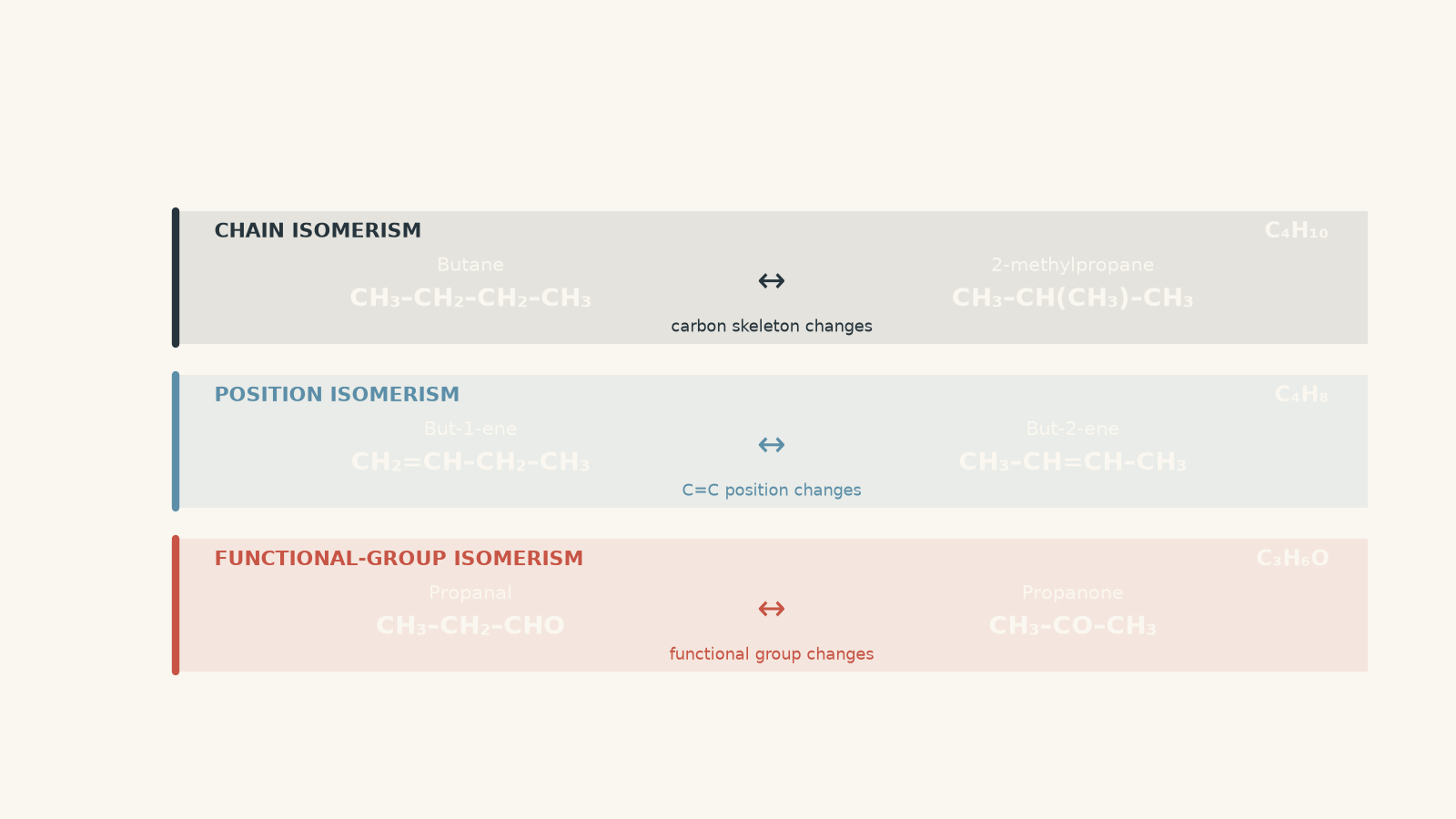
One warning before using the table: these labels describe a relationship between two compounds. A molecule is not simply “a chain isomer” by itself. It is a chain isomer of some particular molecule.
02Chain isomerism: change the carbon skeleton
Start with \(\ce{C4H10}\).
The obvious structure is:
\[
\ce{CH3CH2CH2CH3}
\]
This is butane.
Can you rearrange the four carbon atoms while keeping every carbon at four bonds and keeping the molecular formula \(\ce{C4H10}\)?
Yes:
\[
\ce{CH3CH(CH3)CH3}
\]
This is 2-methylpropane.
The two compounds have the same formula and are both alkanes. What changed is the carbon skeleton: one is unbranched, and one is branched. They are chain isomers.
This can also happen in unsaturated compounds. For example:
- \(\ce{CH2=CHCH2CH2CH3}\), pent-1-ene
- \(\ce{CH2=CHCH(CH3)CH3}\), 3-methylbut-1-ene
Both have molecular formula \(\ce{C5H10}\), and both contain a carbon-carbon double bond. The carbon skeleton is different, so they are chain isomers.
Worked example: Draw every chain isomer of \(\ce{C5H12}\)
Draw and name all structural isomers of \(\ce{C5H12}\).
Step 1
Five carbons in a row gives:
\[
\ce{CH3CH2CH2CH2CH3}
\]
This is pentane.
Step 2
Placing the methyl group at carbon 2 gives:
\[
\ce{CH3CH(CH3)CH2CH3}
\]
This is 2-methylbutane.
Putting the branch at carbon 3 does not create another compound. Numbering from the other end turns “3-methylbutane” into 2-methylbutane.
Step 3
The only genuinely new carbon skeleton is:
\[
\ce{CH3C(CH3)2CH3}
\]
This is 2,2-dimethylpropane.
Step 4
The three distinct structures are therefore:
- pentane
- 2-methylbutane
- 2,2-dimethylpropane
All have molecular formula \(\ce{C5H12}\). They differ only in carbon skeleton, so they are chain isomers.
The key idea is not “move a methyl group around until the page looks busy”. It is to generate genuinely different carbon skeletons.
03Position isomerism: keep the skeleton, move the important part
Now compare:
\[
\ce{CH2=CHCH2CH3}
\]
and
\[
\ce{CH3CH=CHCH3}
\]
These are but-1-ene and but-2-ene.
Both compounds:
- have molecular formula \(\ce{C4H8}\),
- have the same unbranched four-carbon skeleton, and
- contain the same functional group, a carbon-carbon double bond.
Only the position of the double bond changes.
They are position isomers.
Position isomerism also occurs when a functional group or substituent moves. For example:
\[
\ce{CH3CH2CH2OH}
\]
propan-1-ol, and
\[
\ce{CH3CH(OH)CH3}
\]
propan-2-ol are position isomers. The three-carbon skeleton is unchanged, and both are alcohols. Only the position of the \(\ce{-OH}\) group changes.
The same logic applies to haloalkanes such as 1-chloropropane and 2-chloropropane.
If naming these structures is the part that slows you down, revise IUPAC naming of organic compounds to C8 alongside the isomer work. Correct naming is useful here because it helps expose duplicates.
Worked example: Find the acyclic alkene isomers of \(\ce{C4H8}\)
Draw all acyclic structural isomers of \(\ce{C4H8}\) that contain one carbon-carbon double bond.
Step 1
\[
\ce{CH2=CHCH2CH3}
\]
This is but-1-ene.
Step 2
\[
\ce{CH3CH=CHCH3}
\]
This is but-2-ene.
Moving the double bond another carbon gives the same structure viewed from the opposite end, not “but-3-ene”.
Step 3
Use a three-carbon main chain with a methyl branch:
\[
\ce{CH2=C(CH3)2}
\]
This is 2-methylpropene.
Step 4
But-1-ene and but-2-ene are position isomers because the skeleton stays the same while the double bond moves.
But-1-ene and 2-methylpropene are chain isomers because their carbon skeletons differ.
There are therefore three acyclic alkene structural isomers of \(\ce{C4H8}\).
A useful trap appears here. But-2-ene can also exist as different geometric arrangements around its double bond. Those forms have the same atom-to-atom connectivity, so they are stereoisomers, not additional structural isomers.
04Functional-group isomerism: the bonding change becomes more important
Consider these two compounds:
\[
\ce{CH3CH2CHO}
\]
propanal, and
\[
\ce{CH3COCH3}
\]
propanone.
Count the atoms. Both have molecular formula \(\ce{C3H6O}\).
At first glance, you might say, “The \(\ce{C=O}\) bond just moved.”
That prediction is tempting, but it misses something important.
In propanal, the carbonyl carbon is at the end of the chain and is bonded to a hydrogen. The functional group is an aldehyde.
In propanone, the carbonyl carbon is bonded to two carbon groups. The functional group is a ketone.
The functional-group identity has changed. These compounds are functional-group isomers, not merely position isomers.
This distinction matters because functional groups control characteristic reactions. Moving atoms in a way that turns an aldehyde into a ketone is not just changing a number in the name.
Another HSC-relevant example is a carboxylic acid and an ester. Ethanoic acid, \(\ce{CH3COOH}\), and methyl methanoate, \(\ce{HCOOCH3}\), both have molecular formula \(\ce{C2H4O2}\), but they contain different functional groups.
For more practice with recognising these groups from names and structures, see IUPAC naming of acids, amines, amides, and halo compounds.
05Saturated and unsaturated compounds can both show structural isomerism
A saturated hydrocarbon contains only carbon-carbon single bonds. An unsaturated hydrocarbon contains at least one carbon-carbon double or triple bond.
Structural isomerism occurs in both.
For saturated hydrocarbons, branching creates chain isomers:
\[
\ce{C4H10}
\]
can be butane or 2-methylpropane.
For unsaturated hydrocarbons, there are more possibilities because you can change both the carbon skeleton and the location of the multiple bond:
\[
\ce{CH2=CHCH2CH3}
\]
and
\[
\ce{CH3CH=CHCH3}
\]
are position isomers, while
\[
\ce{CH2=CHCH2CH3}
\]
and
\[
\ce{CH2=C(CH3)2}
\]
are chain isomers.
Be careful with molecular formula shortcuts. An acyclic alkene containing one double bond has the general formula \(\ce{C_nH_{2n}}\), but the formula alone does not tell you exactly where the double bond is, or even uniquely determine the structural class in every possible organic molecule.
Structure has to be established from connectivity, not guessed from one formula pattern.
06How to draw structural isomers without missing or repeating them
Randomly moving branches is an unreliable method. A systematic method is much safer.
1. Check the molecular formula first
Structural isomers must have identical molecular formulae.
If one structure is \(\ce{C5H12}\) and another is \(\ce{C5H10}\), stop. They aren’t isomers.
2. Decide what restrictions the question gives you
A question might ask for:
- all structural isomers,
- only alkenes,
- only alcohols,
- only aldehydes and ketones, or
- only compounds with a particular carbon skeleton.
These restrictions matter. “All alkenes with formula \(\ce{C5H10}\)” is a different task from “all structural isomers with formula \(\ce{C5H10}\)”.
3. Generate carbon skeletons systematically
Start with the longest unbranched skeleton. Then introduce branching.
For five carbon atoms, for example, the three alkane skeletons are based on:
- pentane,
- 2-methylbutane, and
- 2,2-dimethylpropane.
4. Put the functional group or multiple bond into genuinely different positions
Once the skeleton is fixed, ask which carbon positions are chemically distinct.
Symmetry matters. Two positions that look different on your page may become identical when the molecule is rotated or numbered from the other end.
5. Check normal valencies
For the structures used here:
- carbon needs four bonds,
- oxygen normally needs two,
- hydrogen needs one, and
- a halogen such as chlorine normally needs one.
This quickly kills some attractive but impossible drawings.
6. Name each structure
Naming is not just the final cosmetic step. It is a duplicate detector.
If two drawings both receive the same correct IUPAC name, you have almost certainly drawn the same connectivity twice.
07The most common mistake: counting drawings instead of structures
Suppose a student draws pentane horizontally and then draws the same five-carbon chain bent into a zigzag.
Those are not two structural isomers.
Atoms can be drawn in different places on the page without changing which atoms are bonded to which.
The same problem appears with numbering. “3-methylbutane” is not a new isomer of 2-methylbutane. Once the chain is numbered from the correct end, both drawings describe 2-methylbutane.
A useful question is:
Did an atom gain a different neighbour?
If the answer is no, the connectivity has not changed.
08Chain, position, or functional group? Use this decision
When you are comparing a pair of compounds, work in this order.
First, confirm the molecular formulae are identical. If they are not, the compounds are not isomers.
Then ask what actually changed:
- If the functional-group type has changed, functional-group isomerism is usually the important classification.
- If the functional group stays the same but the carbon skeleton changes, you have chain isomerism.
- If the skeleton and functional-group type stay the same but its position changes, you have position isomerism.
- If the connectivity has not changed at all, don’t call them structural isomers.
That final check prevents a lot of mistakes with geometric isomers and with the same structure drawn backwards.
09Questions and solutions
Question 1
1-chloropropane has the condensed structural formula \(\ce{CH3CH2CH2Cl}\). Another compound has the formula \(\ce{CH3CHClCH3}\).
Show that the two compounds are structural isomers, name the second compound, and identify the type of structural isomerism.
Solution 1
The compounds are position isomers, and the second compound is 2-chloropropane.
Both compounds contain three carbon atoms, seven hydrogen atoms, and one chlorine atom, so both have molecular formula \(\ce{C3H7Cl}\).
Their carbon skeleton is also the same: an unbranched three-carbon chain. The chlorine atom is attached to carbon 1 in 1-chloropropane and carbon 2 in 2-chloropropane.
The functional-group type has not changed, and the skeleton has not changed. Only the position of the chlorine substituent changes, so this is position isomerism.
The tempting mistake is to call them chain isomers simply because their drawings look different. A chain isomer would require a different carbon skeleton.
Question 2
Consider only open-chain alkenes with molecular formula \(\ce{C5H10}\), and ignore stereoisomerism.
Draw and name every structural isomer in this set. Then identify:
- one pair of position isomers, and
- one pair of chain isomers.
Explain why geometric forms of one of your structures would not add another structural isomer.
Solution 2
There are five open-chain alkene structural isomers of \(\ce{C5H10}\):
\[
\begin{aligned}
&\ce{CH2=CHCH2CH2CH3} &&\text{pent-1-ene}\\
&\ce{CH3CH=CHCH2CH3} &&\text{pent-2-ene}\\
&\ce{CH2=C(CH3)CH2CH3} &&\text{2-methylbut-1-ene}\\
&\ce{CH2=CHCH(CH3)CH3} &&\text{3-methylbut-1-ene}\\
&\ce{CH3C(CH3)=CHCH3} &&\text{2-methylbut-2-ene}
\end{aligned}
\]
A clear position-isomer pair is pent-1-ene and pent-2-ene. Their five-carbon skeleton is unchanged, and both are alkenes. Only the position of the \(\ce{C=C}\) bond changes.
A clear chain-isomer pair is pent-1-ene and 3-methylbut-1-ene. Both contain one carbon-carbon double bond, but one carbon skeleton is unbranched and the other is branched.
The systematic method is what prevents missing structures. First use the five-carbon straight skeleton and place the double bond in its distinct positions. Then use the branched 2-methylbutane carbon skeleton and place the double bond on each chemically distinct bond where a valid alkene can form.
Pent-2-ene can have different geometric arrangements around its double bond. These do not add new structural isomers because the same carbon atoms are bonded to the same neighbours. Geometric isomerism changes spatial arrangement, not connectivity.
The tempting route is to count every visibly different drawing. The constraint that matters is different connectivity.
Question 3
Three compounds \(X\), \(Y\), and \(Z\) all have molecular formula \(\ce{C4H8O2}\).
- \(X\) is an unbranched carboxylic acid.
- \(Y\) is a branched carboxylic acid.
- \(Z\) is an ester. Its \(\ce{-O-}\) alkyl group contains one carbon atom, while the acid-derived part contains three carbon atoms in total.
Draw and name \(X\), \(Y\), and \(Z\). Classify the relationship between \(X\) and \(Y\), and between \(X\) and \(Z\).
Finally, explain whether moving the \(\ce{-COOH}\) group from the end of the carbon chain to an internal carbon could produce a position isomer that is still a carboxylic acid.
Solution 3
\(X\) is butanoic acid, \(Y\) is 2-methylpropanoic acid, and \(Z\) is methyl propanoate. \(X\) and \(Y\) are chain isomers, while \(X\) and \(Z\) are functional-group isomers.
The structures are:
\[
\ce{CH3CH2CH2COOH}
\]
for butanoic acid,
\[
\ce{(CH3)2CHCOOH}
\]
for 2-methylpropanoic acid, and
\[
\ce{CH3CH2COOCH3}
\]
for methyl propanoate.
All three contain four carbon atoms, eight hydrogen atoms, and two oxygen atoms.
For \(X\) and \(Y\), the \(\ce{-COOH}\) functional group remains a carboxylic acid group. What changes is the carbon skeleton: \(X\) is unbranched and \(Y\) is branched. They are chain isomers.
For \(X\) and \(Z\), the functional group changes from carboxylic acid to ester, so they are functional-group isomers.
A carboxylic acid cannot have a simple position isomer formed by moving an intact \(\ce{-COOH}\) group to an internal carbon while keeping the same carbon skeleton in the way that an \(\ce{-OH}\) group can move in an alcohol. The carboxyl carbon is itself part of the parent carbon chain and is necessarily terminal because it has the bonding pattern \(\ce{-C(=O)OH}\).
The tempting idea is to treat every functional group like a detachable sticker that can be moved from carbon 1 to carbon 2. The exact bonding requirements of the functional group stop that from working here.
Question 4
Determine every alcohol structural isomer with molecular formula \(\ce{C5H12O}\).
Organise your reasoning by carbon skeleton rather than by guessing names. For each carbon skeleton, explain how many chemically distinct positions can hold the \(\ce{-OH}\) group.
Then:
- identify one pair of chain isomers,
- identify one pair of position isomers, and
- explain why the proposed structure “2,2-dimethylpropan-2-ol” is impossible.
Solution 4
There are eight alcohol structural isomers of \(\ce{C5H12O}\).
The safest route is to begin with the three possible five-carbon alkane skeletons and then place the \(\ce{-OH}\) group only at chemically distinct carbon positions.
For the pentane skeleton, there are three distinct positions:
\[
\ce{CH3CH2CH2CH2CH2OH}
\]
pentan-1-ol,
\[
\ce{CH3CH(OH)CH2CH2CH3}
\]
pentan-2-ol, and
\[
\ce{CH3CH2CH(OH)CH2CH3}
\]
pentan-3-ol.
Positions 4 and 5 do not create new compounds because numbering from the opposite end gives positions 2 and 1.
For the 2-methylbutane skeleton, there are four distinct carbon environments that can carry the \(\ce{-OH}\) group:
\[
\ce{HOCH2CH(CH3)CH2CH3}
\]
2-methylbutan-1-ol,
\[
\ce{HOCH2CH2CH(CH3)CH3}
\]
3-methylbutan-1-ol,
\[
\ce{CH3CH(OH)CH(CH3)CH3}
\]
3-methylbutan-2-ol, and
\[
\ce{CH3C(OH)(CH3)CH2CH3}
\]
2-methylbutan-2-ol.
The first instinct might be that every terminal carbon is equivalent. It isn’t. On this asymmetric skeleton, the terminal carbon beside the branched carbon and the terminal carbon at the other end have different bonding environments. Putting \(\ce{-OH}\) on them gives different connectivity.
For the 2,2-dimethylpropane skeleton, all four outer carbon atoms are equivalent by symmetry. Only one alcohol is possible:
\[
\ce{(CH3)3CCH2OH}
\]
2,2-dimethylpropan-1-ol.
So the total number is:
\[
3+4+1=8
\]
A chain-isomer pair is pentan-1-ol and 2-methylbutan-1-ol. Both are alcohols with formula \(\ce{C5H12O}\), but their carbon skeletons differ.
A position-isomer pair is pentan-1-ol and pentan-2-ol. Their carbon skeleton and functional-group type remain the same, but the \(\ce{-OH}\) group changes position.
“2,2-dimethylpropan-2-ol” is impossible because carbon 2 of the 2,2-dimethylpropane skeleton is already bonded to four carbon atoms. Carbon has no fifth bonding capacity available for an \(\ce{-OH}\) group.
That last constraint is easy to miss if you treat isomer drawing as moving labels around. Valency decides which positions actually exist.
Question 5
A question asks for every open-chain compound with molecular formula \(\ce{C5H10O}\) that contains exactly one carbonyl group, \(\ce{C=O}\), and no other multiple bond. Only aldehydes and ketones are allowed.
A student proposes eight structures:
- pentanal
- 2-methylbutanal
- 3-methylbutanal
- 2,2-dimethylpropanal
- pentan-2-one
- pentan-3-one
- 3-methylbutan-2-one
- 2-methylbutan-2-one
Another student notices a problem and replaces the final name with “4-methylbutanal”, claiming this gives the missing eighth isomer.
Determine the complete set of valid structural isomers. Explain why each student’s eighth structure fails, and justify why no eighth structure can exist under the stated conditions.
Finally, identify a pair showing each of chain, position, and functional-group isomerism within the valid set.
Solution 5
There are exactly seven valid structural isomers under the stated restrictions: four aldehydes and three ketones. Neither proposed eighth structure is new or valid.
The four aldehydes are:
\[
\ce{CH3CH2CH2CH2CHO}
\]
pentanal,
\[
\ce{CH3CH2CH(CH3)CHO}
\]
2-methylbutanal,
\[
\ce{CH3CH(CH3)CH2CHO}
\]
3-methylbutanal, and
\[
\ce{(CH3)3CCHO}
\]
2,2-dimethylpropanal.
Why exactly four?
An aldehyde has the terminal group \(\ce{-CHO}\). Once that carbon is fixed at the end, the remaining four carbon atoms form an alkyl arrangement attached to it. Systematically generating the possible carbon skeletons produces the four structures above.
The three ketones are:
\[
\ce{CH3COCH2CH2CH3}
\]
pentan-2-one,
\[
\ce{CH3CH2COCH2CH3}
\]
pentan-3-one, and
\[
\ce{CH3COCH(CH3)CH3}
\]
3-methylbutan-2-one.
A ketone carbonyl carbon must be bonded to two carbon groups. That means the carbonyl cannot be terminal.
The first student’s extra compound, “2-methylbutan-2-one”, fails because that name would require the carbonyl carbon to carry too many carbon-carbon bonds.
At carbon 2, a supposed 2-methylbutan-2-one would try to make the carbonyl carbon simultaneously:
- double-bonded to oxygen,
- bonded along the chain in one direction,
- bonded along the chain in the other direction, and
- bonded to an additional methyl substituent.
Counting bond order, that would exceed carbon’s valency of four. The structure is chemically impossible.
The second student’s replacement, “4-methylbutanal”, also fails, but for a different reason.
For an aldehyde, the aldehyde carbon is carbon 1. A structure casually labelled “4-methylbutanal” can be traced through a longer continuous carbon chain. Once the correct longest chain containing the aldehyde carbon is chosen, it is not a distinct structure with that name. The proposed drawing collapses into one of the structures already counted rather than producing a new connectivity.
So neither error can be repaired simply by inventing another name.
The completeness argument is the important part. For aldehydes, systematically generating all carbon skeletons compatible with a terminal \(\ce{-CHO}\) group gives four structures. For ketones, placing an internal carbonyl into every valid, non-equivalent carbon environment gives three structures. Symmetry removes duplicates, and valency removes impossible candidates.
Therefore:
\[
4+3=7
\]
A chain-isomer pair is pentanal and 2-methylbutanal. They are both aldehydes, but their carbon skeletons differ.
A position-isomer pair is pentan-2-one and pentan-3-one. They have the same unbranched five-carbon skeleton and are both ketones, but the carbonyl group occupies a different position.
A functional-group-isomer pair is pentanal and pentan-2-one. Both have molecular formula \(\ce{C5H10O}\), but pentanal is an aldehyde and pentan-2-one is a ketone.
The tempting shortcut throughout this problem is to assume that any plausible-looking change of locant creates another isomer. It does not. A valid structural isomer has to survive three separate checks: identical molecular formula, genuinely different connectivity, and chemically valid bonding.
Once you can generate isomers systematically rather than by visual guessing, IUPAC nomenclature becomes much more useful. The name stops being something you attach after the chemistry; it becomes a way to test whether two drawings are genuinely different and whether the structure you drew is possible at all.