
Periodic Patterns in Metal Activity: HSC Chemistry Explained
Learn how periodic-table position helps predict metal activity by linking atomic structure, shielding, and electron loss. Includes worked examples and challenging HSC-style questions.
If lithium and potassium both have one electron in their outer shell, why does potassium give that electron up much more readily? Then a second puzzle appears: across Period 3, sodium, magnesium, and aluminium are all metals, yet their tendency to lose electrons generally falls as you move from left to right.
Before reading on, predict which atom holds its outer electron more tightly: lithium or potassium. It is lithium. Potassium has more protons, but its outer electron is much farther from the nucleus and is screened by several inner electron shells. That combination matters more.
This is the useful idea behind periodic patterns in metal activity: the periodic table gives clues about how difficult it is for a metal atom to lose electrons.
01Metal activity starts with electron loss
When a metal reacts, its atoms are usually oxidised. They lose electrons and form positive ions.
For a metal \(M\) that forms an ion with charge \(n+\):
\[
\ce{M -> M^{n+} + n e^-}
\]
Here:
- \(M\) is the metal atom,
- \(M^{n+}\) is the positive metal ion,
- \(n\) is the number of electrons lost, and
- \(e^-\) represents an electron.
A more active metal has a greater tendency to undergo this electron-loss process in a suitable reaction.
That wording matters. “Reactive” does not simply mean “makes the biggest fizz”. The visible rate of a reaction can also depend on temperature, concentration, surface area, and protective coatings on the metal.
The periodic table helps us predict the underlying tendency to lose electrons. Experiments and the metal activity series then show how that tendency plays out in real reactions.
02Why metals become more reactive down a group
Consider lithium, sodium, and potassium. Each is a Group 1 metal and has one outer-shell electron.
You might first think potassium should hold that electron most strongly because potassium has the most protons. More positive charge in the nucleus sounds like stronger attraction.
But the outer electron is not sitting the same distance away in each atom.
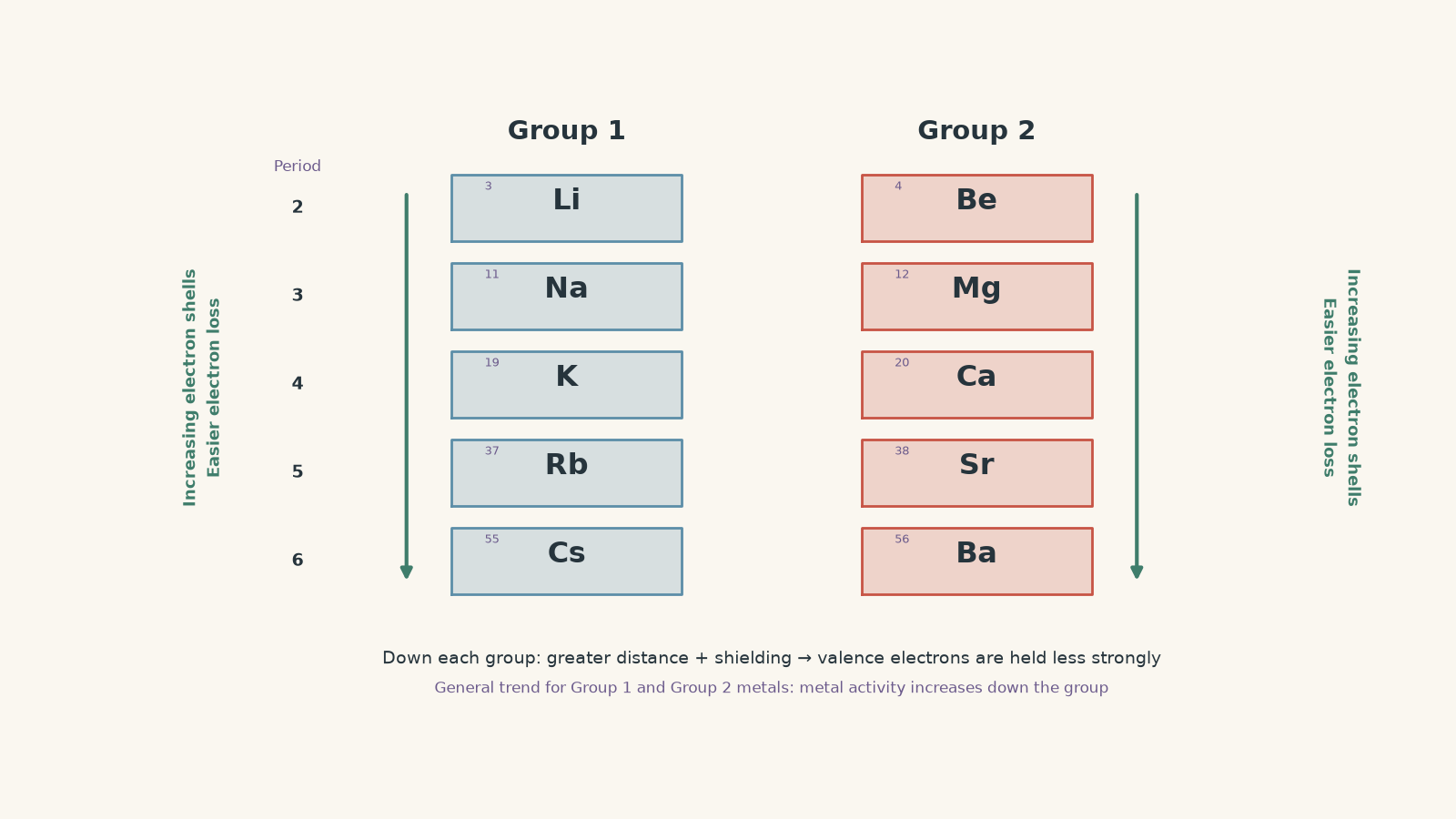
Moving down the group adds electron shells:
- lithium has 2 occupied shells,
- sodium has 3,
- potassium has 4.
The outer electron therefore gets farther from the nucleus. Inner electrons also shield it from some of the nucleus’s attraction.
Think of the nucleus and outer electron as being in a slightly doomed long-distance relationship. Moving down the group puts more distance between them, while extra electron shells act like increasingly unhelpful friends standing in between. The nucleus is still attractive, but the outer electron is easier to lose.
The analogy stops there. Electrons are not little objects orbiting at fixed distances, and shielding is a result of electron distributions and electrostatic interactions. The picture is useful because it captures the two important changes: greater distance and greater shielding.
The down-group trend
For Group 1 and Group 2 metals, moving down the group generally causes:
| Change down the group | Effect |
|---|---|
| More occupied electron shells | Outer electrons are farther from the nucleus |
| More inner-electron shielding | Nuclear attraction on outer electrons is reduced |
| Larger atomic radius | Valence electrons are less strongly held |
| Lower ionisation energy overall | Electrons are easier to remove |
| Easier oxidation | Metal activity generally increases |
Ionisation energy is the energy required to remove electrons from gaseous atoms or ions. A lower ionisation energy means electron removal is energetically easier.
The increasing nuclear charge down the group does partly oppose this trend. However, the increased distance and shielding usually have the greater effect for Group 1 and Group 2 metals.
So, broadly:
\[
\ce{Li < Na < K}
\]
in metal activity, and:
\[
\ce{Mg < Ca < Sr < Ba}
\]
for the Group 2 metals.
These are trends in chemical activity, not promises that every possible reaction will occur at exactly that rate.
Worked example: Magnesium or calcium in acid?
Equal clean pieces of magnesium and calcium, with the same surface area, are placed separately into identical dilute acid solutions. Which metal should have the greater tendency to react, and why?
Step 1
Magnesium and calcium are both in Group 2. Calcium is below magnesium.
Step 2
Calcium has an extra occupied electron shell. Its outer electrons are, on average, farther from the nucleus and more strongly shielded.
Calcium should therefore lose its two valence electrons more readily.
Step 3
Both metals form \(2+\) ions:
\[
\ce{Mg -> Mg^2+ + 2e^-}
\]
\[
\ce{Ca -> Ca^2+ + 2e^-}
\]
The calcium oxidation is expected to occur more readily.
Step 4
The general ionic equation is:
\[
\ce{M(s) + 2H+(aq) -> M^2+(aq) + H2(g)}
\]
So, under comparable conditions, calcium should show the greater metal activity and produce hydrogen more rapidly.
The important result is not merely “calcium reacts faster”. Calcium is easier to oxidise because its valence electrons are less strongly attracted to the nucleus.
03Why metal activity generally falls across a period
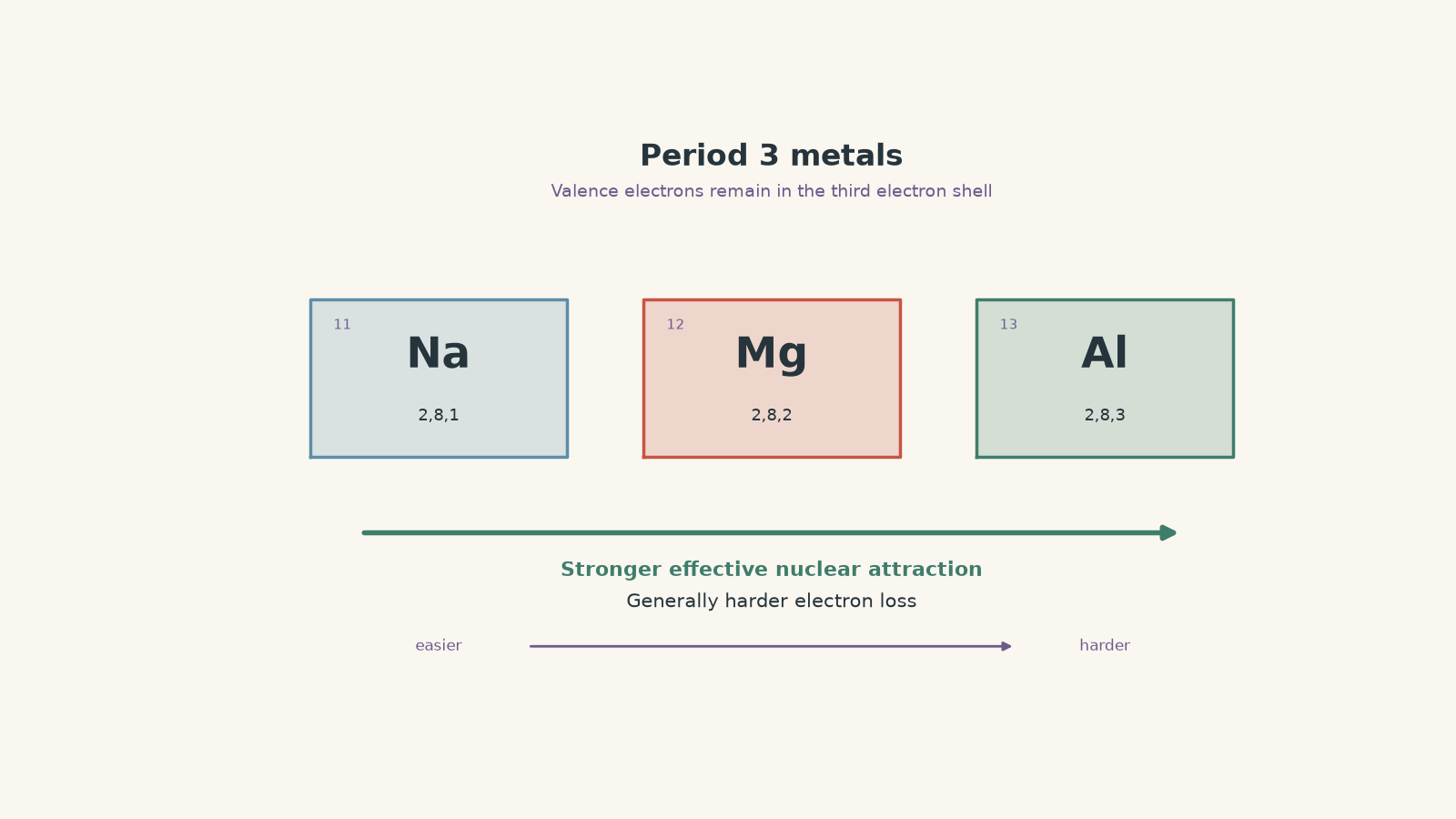
Now compare sodium, magnesium, and aluminium. All three are in Period 3:
- sodium has the shell arrangement \(2,8,1\),
- magnesium has \(2,8,2\),
- aluminium has \(2,8,3\).
They all place their valence electrons in the third electron shell.
What changes as you move from sodium to aluminium?
The number of protons increases. Electrons are also added, but they are being added mainly to the same outer shell rather than creating whole new inner shells.
As a result, the shielding does not increase enough to cancel the increasing nuclear charge. The valence electrons generally experience a stronger effective attraction towards the nucleus.
Atomic radius also generally decreases across the period.
So, across the main-group metallic part of Period 3, electron loss becomes less favourable overall:
\[
\ce{Na > Mg > Al}
\]
as a broad metal-activity pattern.
Do not turn this into “more valence electrons means less reactive”
That shortcut gets the pattern but misses the chemistry.
Sodium does not beat aluminium simply because \(1<3\). What matters is how strongly the relevant electrons are held and the total energetics of forming the ions involved.
Their common oxidation half-equations are:
\[
\ce{Na -> Na+ + e^-}
\]
\[
\ce{Mg -> Mg^2+ + 2e^-}
\]
\[
\ce{Al -> Al^3+ + 3e^-}
\]
One mole of aluminium atoms can release three moles of electrons if fully oxidised to \(\mathrm{Al}^{3+}\). That tells you the amount of electron transfer, not how easy it is to start that oxidation.
A metal can transfer more electrons per atom and still be harder to oxidise.
Worked example: Rank sodium, magnesium, and aluminium
Rank sodium, magnesium, and aluminium in their expected tendency to lose electrons, and explain the order from periodic position.
Step 1
Because they are in Period 3, their valence electrons occupy the same principal electron shell.
Step 2
Moving from sodium to magnesium to aluminium adds protons to the nucleus without adding a new inner electron shell.
The effective attraction on the valence electrons therefore generally increases.
Step 3
More strongly held electrons are harder to remove. The overall tendency of the atoms to form their positive ions therefore decreases across these metals.
The expected activity order is:
\[
\ce{Na > Mg > Al}
\]
Step 4
This means sodium has the greatest tendency of the three to be oxidised, followed by magnesium, then aluminium.
It does not mean that every visible experiment will show sodium reacting fastest, magnesium second, and aluminium third under every set of conditions. Sodium, for example, reacts strongly with water, while aluminium can be protected by an oxide coating.
04First ionisation energy is useful, but it is not the whole answer
A tempting rule is:
Lower first ionisation energy = more reactive metal.
That can be useful as a first clue. It is not an exact definition of metal activity.
There are two reasons.
First, many metals lose more than one electron. Magnesium commonly forms \(\mathrm{Mg}^{2+}\), while aluminium commonly forms \(\mathrm{Al}^{3+}\). The first ionisation energy describes only the removal of the first electron.
Second, a real chemical reaction does not begin with isolated gaseous atoms and end with isolated gaseous ions. Metals begin in a solid metallic structure, and their ions may become surrounded by water molecules or incorporated into compounds. Those processes also affect the energy change.
There is even a useful warning sign in Period 3: aluminium’s first ionisation energy is lower than magnesium’s. Aluminium’s first electron is removed from a \(3p\) orbital, while magnesium’s is removed from its filled \(3s\) subshell.
That small exception does not mean aluminium suddenly becomes more active than magnesium.
The lesson is more useful than memorising the exception: do not use one ionisation-energy value as a universal reactivity meter.
05Why aluminium can look less reactive than it really is
Suppose you place a piece of aluminium into a solution and initially see very little happen. It is tempting to conclude that aluminium simply does not want to lose electrons.
The surface is the problem.
Aluminium reacts with oxygen to form a thin, adherent layer of aluminium oxide, \(\ce{Al2O3}\). This layer separates the aluminium underneath from surrounding reactants.
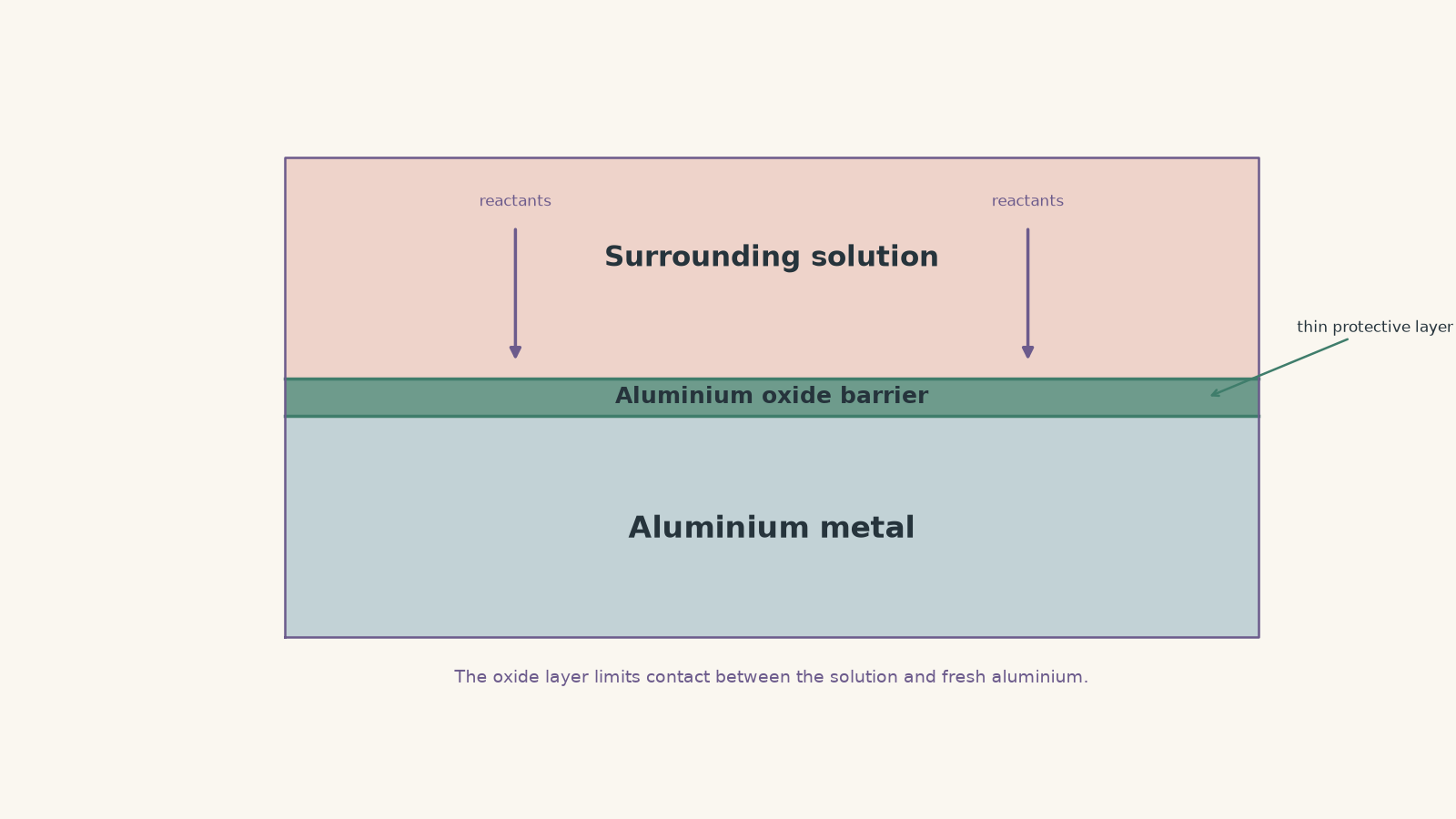
This process is called passivation.
The aluminium atoms beneath the coating may have a substantial tendency to be oxidised, but the coating slows the reaction by making it difficult for reactants to reach the metal surface.
This gives us two different ideas:
- thermodynamic tendency asks whether oxidation is favourable,
- reaction rate asks how quickly the reaction actually proceeds under the stated conditions.
The two are connected, but they are not identical.
This is why surface preparation matters when comparing metal reactions with dilute acids. A dirty, oxidised, or coated surface can make a reasonably active metal appear surprisingly quiet.
06A reliable decision rule for periodic-table questions
When an HSC question asks you to predict metal activity from periodic position, work in this order.
| Situation | Useful prediction |
|---|---|
| Two Group 1 metals | The lower metal is generally more active |
| Two Group 2 metals | The lower metal is generally more active |
| Main-group metals in the same period | Activity generally decreases from left to right |
| Metals in different periods and different groups | Simple trends may compete; periodic position alone may not give a secure ranking |
| Transition metals | Do not expect a simple left-to-right rule to work reliably |
| Experimental result seems to contradict the trend | Check oxide layers, surface condition, concentration, temperature, and reaction mechanism |
The important distinction is between a trend and a complete prediction.
Periodic position explains why certain patterns occur. The activity series is based on chemical behaviour and gives a more direct empirical ordering of metals for many redox comparisons.
07The most tempting misconceptions
“The metal with more outer electrons is more reactive”
Not necessarily.
Aluminium can lose three electrons per atom when forming \(\mathrm{Al}^{3+}\), while sodium loses only one when forming \(\mathrm{Na}^{+}\). Sodium is nevertheless the more active metal in the broad Period 3 comparison.
Number of electrons transferred and ease of electron transfer are different quantities.
“More protons always means the electrons are held more strongly”
Only if you ignore distance and shielding.
Potassium has more protons than lithium, yet its outer electron is farther from the nucleus and much more shielded. Potassium therefore loses that electron more readily.
“If I cannot see a reaction, the metal must be unreactive”
Not necessarily.
A protective oxide layer can prevent reactants from reaching the metal. Aluminium is the classic example.
“The periodic table gives one diagonal arrow for metal reactivity”
Be careful.
Down a group, activity generally increases for Group 1 and Group 2 metals. Across a period, metallic activity generally falls from left to right. If one metal is both lower and farther right than another, those two trends oppose one another.
At that point, you need more information rather than inventing a diagonal rule.
08Questions and solutions
Question 1
Magnesium and strontium are both Group 2 metals.
Which metal is expected to react more readily with dilute hydrochloric acid? Explain your prediction in terms of atomic structure and electron loss, and write the general ionic equation for the reaction.
Solution 1
Strontium is expected to react more readily with dilute hydrochloric acid.
Strontium is below magnesium in Group 2. It therefore has more occupied electron shells, a larger atomic radius, and greater shielding of its valence electrons.
Although strontium also has a greater nuclear charge, the increased distance and shielding reduce the effective attraction holding its two outer electrons.
Both metals undergo oxidation of the form:
\[
\ce{M -> M^2+ + 2e^-}
\]
The reaction with acid is:
\[
\ce{M(s) + 2H+(aq) -> M^2+(aq) + H2(g)}
\]
The tempting mistake is to argue that both metals have two valence electrons, so they should be equally reactive. Their valence-electron count is the same, but the strength with which those electrons are held is not.
Question 2
A student places clean magnesium into dilute hydrochloric acid and immediately observes hydrogen bubbles. An aluminium strip placed into identical acid produces almost no bubbles at first.
After the aluminium surface is thoroughly abraded, it begins reacting much more rapidly.
The student says, “The first observation proves aluminium has almost no tendency to lose electrons.”
Evaluate this conclusion. Your answer should distinguish periodic activity from observed reaction rate.
Solution 2
The student’s conclusion is not justified because the slow initial reaction can be caused by aluminium’s protective oxide layer rather than a lack of tendency to lose electrons.
Aluminium is commonly covered by a thin layer of \(\ce{Al2O3}\). The acid must penetrate or remove this layer before it can react readily with the aluminium underneath.
The oxidation half-equation for the exposed metal is:
\[
\ce{Al -> Al^3+ + 3e^-}
\]
Abrading the surface removes much of the barrier, so the increase in reaction rate is evidence that surface condition was affecting the original observation.
Periodic reasoning still predicts that magnesium is generally more active than aluminium across the metallic part of Period 3:
\[
\ce{Mg > Al}
\]
However, the first experiment by itself does not establish the size of that difference because it compares a readily accessible magnesium surface with a passivated aluminium surface.
The tempting route is to treat “more bubbles” as identical to “greater intrinsic tendency to oxidise”. Bubble rate measures the rate of that particular reaction under those particular conditions. It can be changed by kinetic barriers such as an oxide coating.
Question 3
Three hypothetical metals \(A\), \(B\), and \(C\) are consecutive main-group metals in the same period.
They form the ions \(\mathrm{A}^{+}\), \(\mathrm{B}^{2+}\), and \(\mathrm{C}^{3+}\), respectively.
A student argues that \(C\) must be the most reactive because each mole of \(C\) can release three moles of electrons, while each mole of \(A\) releases only one mole.
Assuming the three metals follow the usual main-group periodic trend, rank their metal activity. Then explain how \(C\) can release the most electrons per mole but still be the least active of the three.
Solution 3
The expected metal-activity order is \(A>B>C\), even though \(C\) releases the greatest number of electrons per mole when completely oxidised.
Their oxidation half-equations are:
\[
\ce{A -> A+ + e^-}
\]
\[
\ce{B -> B^2+ + 2e^-}
\]
\[
\ce{C -> C^3+ + 3e^-}
\]
Moving from \(A\) to \(B\) to \(C\) across the same period generally increases the effective nuclear attraction on the valence electrons. The electrons become harder to remove overall, so the tendency towards oxidation decreases.
If one mole of each metal is completely oxidised:
- \(1\) mol of \(A\) releases \(1\) mol of electrons,
- \(1\) mol of \(B\) releases \(2\) mol of electrons,
- \(1\) mol of \(C\) releases \(3\) mol of electrons.
That tells us the electron-transfer capacity per mole after oxidation occurs. It does not tell us how easily the oxidation begins.
The tempting argument confuses amount with tendency. A large water tank can contain more water than a small bottle without being easier to empty. Likewise, \(C\) can transfer more electrons per mole while holding those electrons strongly enough that its oxidation is less favourable.
The bottle analogy is limited because atoms do not physically store electrons like liquid. Its only purpose is to separate two ideas: how much can be transferred and how easily transfer occurs.
Question 4
Consider three metals:
- \(X\) is a Group 1 metal in Period 3,
- \(Y\) is a Group 2 metal in Period 3,
- \(Z\) is a Group 2 metal in Period 4.
Using only the simple periodic trends developed in this guide:
- Compare the expected activity of \(X\) and \(Y\).
- Compare the expected activity of \(Y\) and \(Z\).
- Decide whether those same trends alone are sufficient to rank \(X\) and \(Z\).
A student claims, “Any metal lower on the periodic table must be more reactive, so \(Z\) must be more reactive than \(X\).” Assess this reasoning.
Solution 4
The periodic trends predict \(X>Y\) and \(Z>Y\), but they do not by themselves give a secure ranking of \(X\) against \(Z\).
For \(X\) and \(Y\), both metals are in Period 3. \(X\) is farther left. Across the metallic region of a period, the tendency to lose electrons generally decreases from left to right.
Therefore:
\[
X>Y
\]
For \(Y\) and \(Z\), both are in Group 2, and \(Z\) is below \(Y\). Moving down Group 2 increases shielding and atomic radius, making valence-electron loss easier.
Therefore:
\[
Z>Y
\]
The \(X\)-versus-\(Z\) comparison is different. Going from \(X\) to \(Z\) involves moving both down and to the right.
Moving down tends to increase metal activity.
Moving right tends to decrease it.
The two simple trends therefore compete. They do not tell us which effect is larger.
The student’s claim fails because “lower on the table” is not a universal rule. It works well for comparisons within a suitable group, such as Group 1 or Group 2, but not automatically for metals in different groups.
To rank \(X\) and \(Z\) confidently, we would need additional evidence such as an activity series, suitable experimental data, or more detailed energetic information.
The tempting move is to imagine one universal diagonal arrow of increasing reactivity. The periodic table does not give us one. Trends are most reliable when we compare elements while changing one major structural feature at a time.
Question 5
The following first and successive ionisation energies are supplied. All values are in \(\mathrm{kJ\,mol^{-1}}\).
| Metal | First ionisation energy | Second ionisation energy | Third ionisation energy | Common ion |
|---|---|---|---|---|
| Sodium | 496 | – | – | \(\mathrm{Na}^{+}\) |
| Magnesium | 738 | 1451 | – | \(\mathrm{Mg}^{2+}\) |
| Aluminium | 578 | 1817 | 2745 | \(\mathrm{Al}^{3+}\) |
A student looks only at the first ionisation energies and argues:
\[
\ce{Na > Al > Mg}
\]
for metal activity because aluminium’s first electron requires less energy to remove than magnesium’s.
Another student argues that the broad Period 3 metal-activity trend is:
\[
\ce{Na > Mg > Al}
\]
Explain which model gives the more useful prediction for these three metals. Your explanation must account for aluminium’s unusually low first ionisation energy, the formation of the common ions, and why even the successive ionisation energies are not a complete description of real metal reactivity.
Solution 5
The broader prediction \(\ce{Na > Mg > Al}\) is the more useful metal-activity trend; ranking the metals from first ionisation energy alone gives a misleading magnesium-aluminium comparison.
The first student’s reasoning initially looks convincing because the supplied values give:
\[
496 < 578 < 738
\]
so sodium’s first electron is easiest to remove, followed by aluminium’s, then magnesium’s.
The hinge is that first ionisation energy describes only one electron.
Aluminium’s first electron is removed from its \(3p\) subshell. That electron is somewhat easier to remove than the first \(3s\) electron from magnesium, so aluminium breaks the simple expectation of a perfectly smooth increase in first ionisation energy.
But magnesium and aluminium do not usually stop after losing one electron.
Magnesium commonly forms \(\mathrm{Mg}^{2+}\), requiring its first two ionisations:
\[
738+1451=2189\ \mathrm{kJ\,mol^{-1}}
\]
for the gas-phase ionisation steps.
Aluminium commonly forms \(\mathrm{Al}^{3+}\), requiring three:
\[
578+1817+2745=5140\ \mathrm{kJ\,mol^{-1}}
\]
for the corresponding gas-phase steps.
Those totals show why focusing only on aluminium’s first, relatively easy \(3p\) electron gives a distorted picture.
However, it would also be a mistake to declare the summed ionisation energies to be an exact reactivity calculation. Ionisation-energy data refer to gaseous atoms and ions. A real metal reaction may involve breaking interactions in a solid metal, forming bonds, solvating ions, transferring electrons to another species, and overcoming surface barriers.
Aluminium adds another complication because its oxide coating can make its observed reaction rate much slower than its underlying redox behaviour would suggest.
The exact constraint that defeats the first student’s argument is therefore this: metal activity concerns the energetics and mechanism of the complete oxidation process, while first ionisation energy describes just one isolated step.
The Period 3 trend remains useful, but it must be treated as a chemical model rather than as a rule generated from one number.
09What this pattern lets you predict next
Periodic position is most useful when it tells you why a metal sits where it does in a reactivity pattern.
Down Group 1 or Group 2, greater distance and shielding generally make electron loss easier. Across the main-group metallic part of a period, stronger effective nuclear attraction generally makes electron loss harder. Once those trends compete, or once surface coatings and particular reaction conditions matter, periodic position alone is no longer enough.
That is the point where the next tool becomes useful: the metal activity series. Instead of only asking, “Where is this metal on the periodic table?”, you can ask the more powerful question, “Given its tendency to lose electrons, will this metal displace another species under these particular conditions?”