
Metal Reactivity with Water: HSC Chemistry Guide
Learn how metal reactions with cold water and steam reveal relative reactivity, and how to interpret hydrogen production, reaction conditions, and passivation.
Drop a piece of copper into water and almost nothing happens. Do the same with calcium and you get bubbles of hydrogen and a new alkaline product. Sodium reacts much more dramatically again. So what exactly are those observations telling you about the metals?
Before reading on, predict this: if metal A reacts slowly with cold water, while metal B reacts only when exposed to steam, which metal is more reactive with water?
Metal A. It can react under the less demanding conditions. That idea, how easily a reaction begins and how vigorously it proceeds under comparable conditions, is the key to using water reactions to compare metal reactivity.
There is one important complication, though. A quiet-looking metal is not always an unreactive metal. Surface coatings, especially oxide layers, can hide what the metal underneath would otherwise do.
01What happens when a metal reacts with water?
Picture a metal atom at the surface of a solid. If it reacts, that atom loses electrons. In chemistry language, the metal is oxidised.
For a metal \(M\):
\[
\ce{M -> M^{n+} + ne^-}
\]
Here:
- \(M\) is the metal atom
- \(M^{n+}\) is the metal ion formed
- \(n\) is the number of electrons lost
- \(e^-\) represents an electron
Those electrons don’t disappear. Something else must accept them. In a reaction with liquid water, water molecules can gain electrons and form hydrogen gas:
\[
\ce{2H2O + 2e^- -> H2 + 2OH^-}
\]
So when a sufficiently reactive metal meets water, two things are happening together:
- the metal loses electrons
- water gains electrons, producing hydrogen gas
This is a redox reaction.
The bubbles you see are usually hydrogen gas, \(\ce{H2}\). The exact metal-containing product depends on the metal and the reaction conditions.
02Cold water, hot water, and steam are different tests
A common mistake is to treat “reacts with water” as a simple yes-or-no property. It isn’t.
Some metals react with cold liquid water. Others need hotter water. Some show little reaction with liquid water but react with steam. Others do not react with water even under those conditions.
A useful broad pattern is:
| Metal behaviour | What you might observe | What it suggests |
|---|---|---|
| Very vigorous reaction with cold water | rapid bubbling, fast movement or heating | very high reactivity with water |
| Steady reaction with cold water | obvious hydrogen production | high reactivity |
| Slow reaction with cold or hot water | gradual bubbling or surface change | moderate reactivity |
| No obvious reaction with liquid water, but reaction with steam | hydrogen produced only at high temperature | lower reactivity with water |
| No reaction with water or steam | no hydrogen under these conditions | comparatively low reactivity with water |
The table is a guide, not a universal ranking machine. Observations are useful only when the experimental conditions are properly compared.
03Why cold water gives a metal hydroxide
For metals such as sodium, reaction with cold water produces a metal hydroxide and hydrogen.
For sodium:
\[
\ce{2Na(s) + 2H2O(l) -> 2NaOH(aq) + H2(g)}
\]
The sodium is oxidised from oxidation state \(0\) to \(+1\).
Water is reduced, producing hydrogen gas.
Calcium behaves similarly:
\[
\ce{Ca(s) + 2H2O(l) -> Ca(OH)2(aq/s) + H2(g)}
\]
Calcium hydroxide is only moderately soluble, so the water can become cloudy as the reaction proceeds.
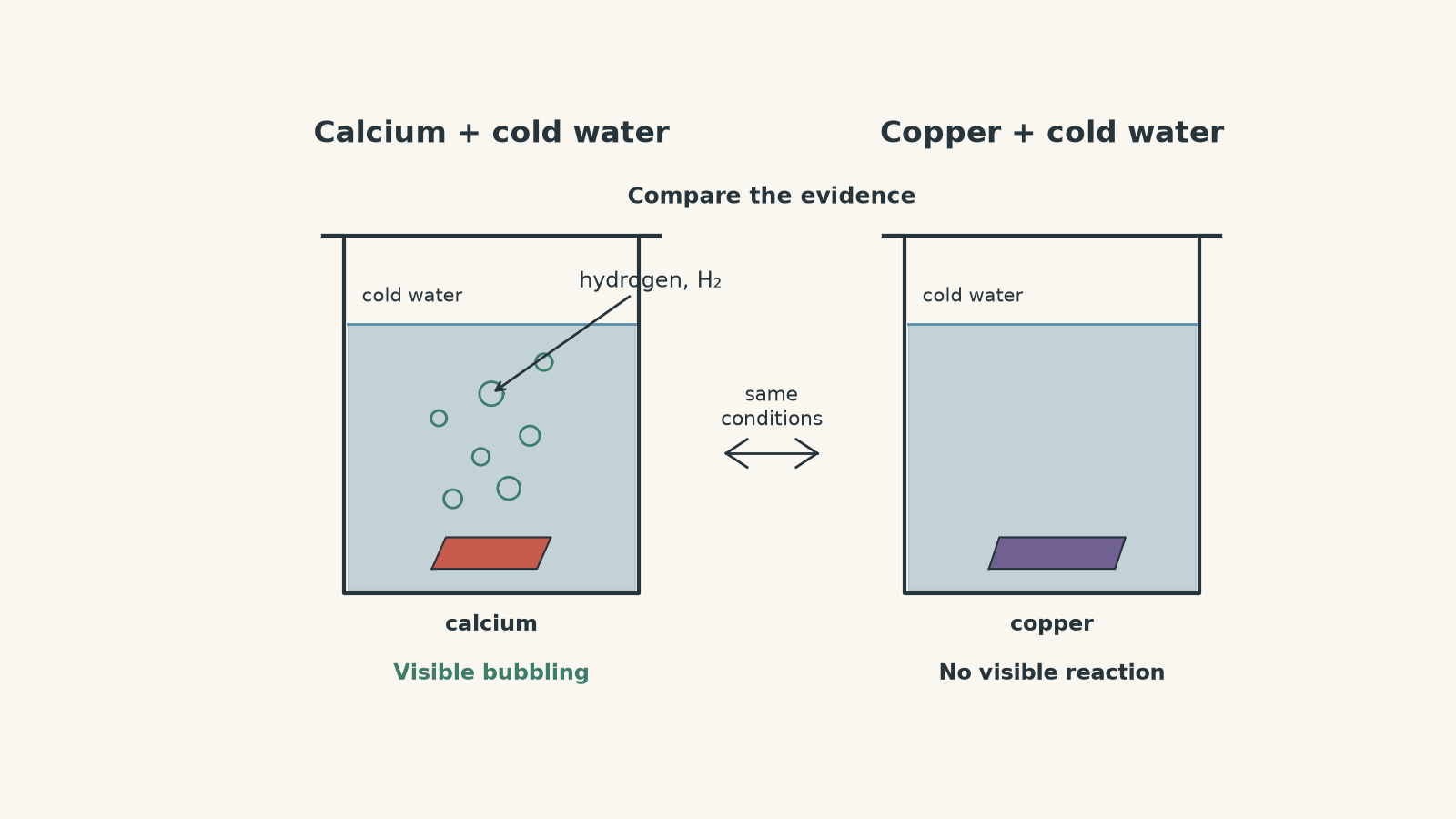
The key observation isn’t simply “bubbles happened”. Ask three questions:
- Did the reaction occur at room temperature?
- How quickly was hydrogen produced?
- Was heating needed before anything happened?
Those details help distinguish metals that might otherwise all be described as “reacting with water”.
Worked example: Ranking three metals from cold-water observations
Three freshly cleaned metals are placed separately into equal volumes of water at the same temperature.
- Metal P produces hydrogen rapidly.
- Metal Q produces hydrogen slowly.
- Metal R shows no visible change.
Rank the metals from most to least reactive with cold water.
Step 1
All three were tested using the same amount of water at the same temperature, so the observations can be compared directly.
Step 2
P reacts most rapidly, so it is the most reactive with cold water.
Q reacts, but more slowly, so it is less reactive than P.
R shows no observable reaction, so it is the least reactive with cold water in this test.
Step 3
\[
\ce{P > Q > R}
\]
The result means P reacts with cold water more readily than Q, while R shows the least reactivity under these particular conditions.
Notice the wording. We haven’t proved that R is chemically incapable of reacting with water under any conditions. It may react when heated or exposed to steam.
04Why steam can react when liquid water does not
Suppose a metal sits unchanged in room-temperature water but reacts when steam is passed over it at high temperature.
Has heating somehow made the metal itself more reactive?
Not in the sense of changing its position in the reactivity series. Heating gives particles more energy and increases the rate at which successful reactions can occur. A reaction that is far too slow to notice at room temperature may become obvious at a higher temperature.
For several metals, reaction with steam produces a metal oxide rather than a metal hydroxide.
For magnesium:
\[
\ce{Mg(s) + H2O(g) -> MgO(s) + H2(g)}
\]
Magnesium is oxidised:
\[
\ce{Mg -> Mg^2+ + 2e^-}
\]
Hydrogen in water is reduced to hydrogen gas.
Zinc can also react with steam:
\[
\ce{Zn(s) + H2O(g) -> ZnO(s) + H2(g)}
\]
Iron can react with steam too. A commonly observed product under suitable conditions is magnetite, \(\ce{Fe3O4}\):
\[
\ce{3Fe(s) + 4H2O(g) -> Fe3O4(s) + 4H2(g)}
\]
A student might look at magnesium and sodium and say, “They both react with water, so they’re roughly equally reactive.” But that ignores the conditions. Sodium reacts readily with cold water. Magnesium’s reaction with cold water is much slower, while steam produces a much clearer reaction.
The need for harsher conditions is evidence that magnesium reacts less readily with water.
05A useful ranking rule
When you’re comparing metals from observations, use this order of evidence.
First, compare the minimum conditions needed for reaction:
\[
\text{cold water reaction} > \text{hot water reaction} > \text{steam-only reaction} > \text{no water reaction}
\]
Here, \(>\) means “reacts more readily with water”, not necessarily that every pair of metals in each category can be perfectly ranked.
Then, if two metals react under the same conditions, compare the rate or vigour of their reactions.
For example:
- A reacts rapidly with cold water.
- B reacts slowly with cold water.
- C does not react with cold water but reacts with steam.
- D does not react with water or steam.
The evidence supports:
\[
\ce{A > B > C > D}
\]
for relative ease of reaction with water.
Worked example: When different conditions matter
Four metals give these observations:
| Metal | Cold water | Steam |
|---|---|---|
| J | rapid hydrogen production | not tested |
| K | slow hydrogen production | not tested |
| L | no visible reaction | hydrogen produced |
| M | no visible reaction | no visible reaction |
Rank J, K, L, and M by their observed reactivity with water.
Step 1
J and K both react with cold water. That places them above L, which requires steam, and M, which shows no reaction in either test.
Step 2
J produces hydrogen faster than K in cold water, so J is more reactive than K under those conditions.
Step 3
L reacts with steam, while M does not. L therefore reacts with water more readily than M.
Step 4
\[
\ce{J > K > L > M}
\]
This ranking uses two kinds of evidence: the conditions required for reaction and, where those conditions are the same, the observed reaction rate.
06The major trap: aluminium does not behave as simply as it looks
Imagine testing aluminium and magnesium in cold water. Neither appears spectacular.
Would it be safe to conclude that aluminium must be less reactive because you don’t see much happening?
No.
Aluminium develops a thin, strongly attached layer of aluminium oxide, \(\ce{Al2O3}\), at its surface. This layer separates the underlying aluminium metal from the surrounding water.
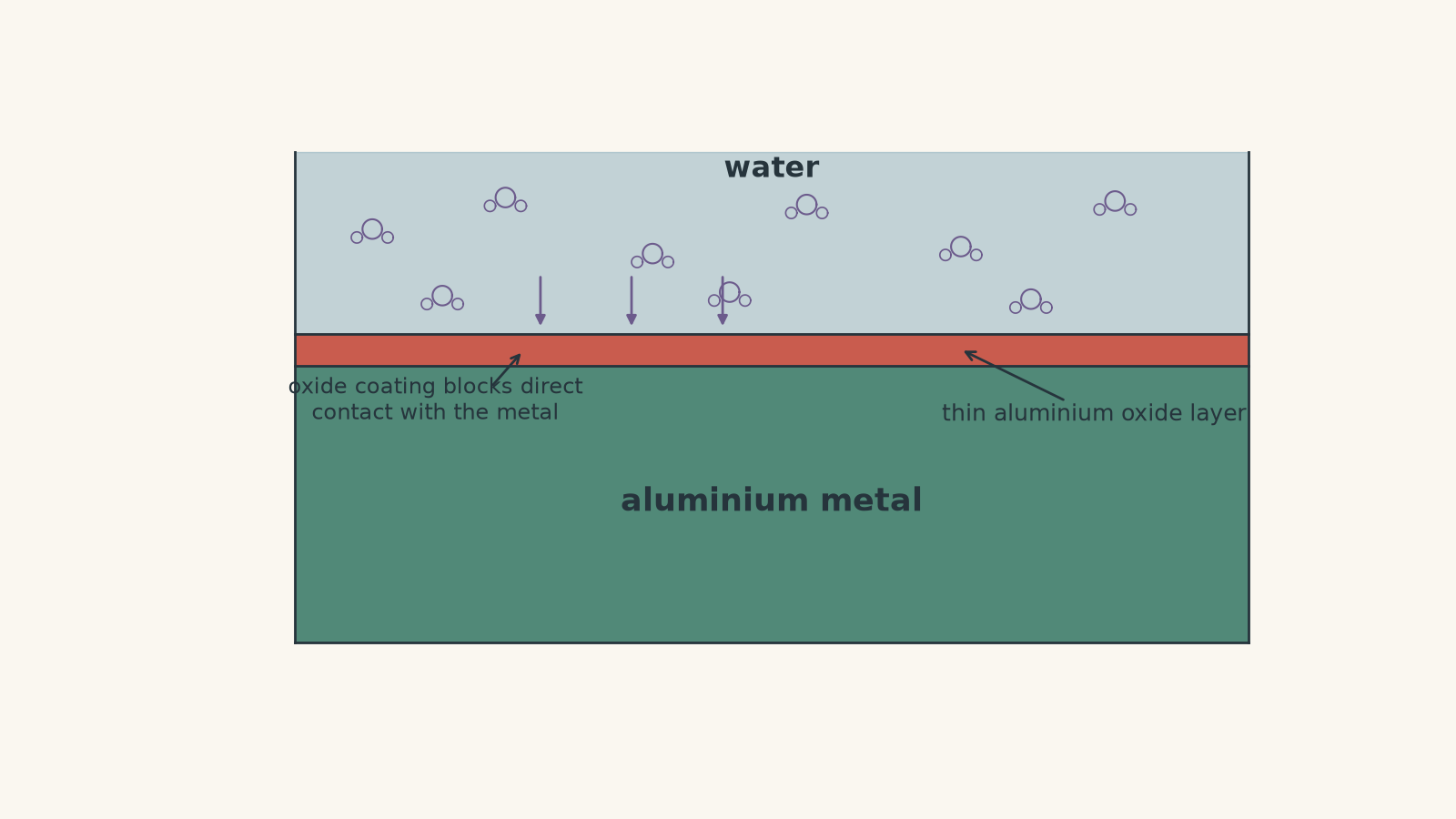
Think of the oxide layer as someone standing outside a house because their date has left them on “seen”. The person may be very keen to react, chemically speaking, but the barrier between them is stopping contact.
That’s only an analogy. Aluminium atoms aren’t waiting emotionally for water molecules, and the oxide layer isn’t perfectly permanent. The useful part of the analogy is simply that a barrier can make an inherently reactive material appear unreactive.
This introduces an important distinction.
Reactivity is not identical to visible reaction rate
The thermodynamic tendency of a reaction tells us whether a process is energetically favourable.
The reaction rate tells us how quickly it happens.
A protective surface layer can make the rate extremely slow even when the underlying metal has a strong tendency to be oxidised.
This behaviour is called passivation.
Aluminium is therefore a warning against ranking metals from appearance alone without considering surface conditions.
07What observations are actually reliable?
Suppose you want to compare two unknown metals using water.
A fair comparison should control variables that affect reaction rate, including:
- water temperature
- exposed surface area
- mass or amount of metal
- surface cleanliness
- concentration of dissolved substances
- length of observation time
Why does surface area matter?
A powdered metal exposes far more atoms to water than the same mass in one large lump. It may therefore produce hydrogen much faster even though its underlying chemical identity is unchanged.
So this comparison would be poor evidence:
Metal X powder bubbles faster than a large block of metal Y, therefore X is more reactive.
Maybe X really is more reactive. But the experiment hasn’t isolated reactivity from surface area.
A better comparison uses similar amounts and exposed areas under the same conditions.
08Using hydrogen production as evidence
Because hydrogen gas is a product of many metal-water reactions, its production can give more useful evidence than a vague description such as “it bubbled a bit”.
Suppose equal amounts of two metals react separately with excess cold water.
Metal A releases hydrogen much faster than metal B.
If other relevant variables have been controlled, this supports the conclusion that A reacts more readily with cold water.
Be careful with the final volume of gas, though.
Reaction rate and total gas yield answer different questions.
A metal might react slowly but eventually produce a large amount of hydrogen. Another might react quickly but be present in a smaller amount and therefore stop after producing less gas.
So:
- hydrogen produced per unit time gives evidence about reaction rate
- total hydrogen produced depends on the amount of reactant and reaction stoichiometry
Don’t use one as if it automatically tells you the other.
09Reading the equations rather than memorising them
You do not need a separate memorised story for every metal.
For many reactive metals in liquid water, the pattern is:
\[
\text{metal} + \text{water} \rightarrow \text{metal hydroxide} + \text{hydrogen}
\]
For a Group 1 metal \(M\):
\[
\ce{2M + 2H2O -> 2MOH + H2}
\]
For a metal such as calcium that forms \(M^{2+}\):
\[
\ce{M + 2H2O -> M(OH)2 + H2}
\]
With steam, a common pattern is:
\[
\text{metal} + \text{steam} \rightarrow \text{metal oxide} + \text{hydrogen}
\]
For a metal forming a simple \(2+\) oxide:
\[
\ce{M + H2O(g) -> MO + H2}
\]
The equations also explain why hydrogen bubbles are useful evidence. They are not an unrelated side effect. They are produced because water is being reduced as the metal is oxidised.
10A practical comparison of familiar metals
A simplified HSC-level comparison looks like this:
| Metal | Typical behaviour with water | Useful interpretation |
|---|---|---|
| Potassium | extremely vigorous with cold water | among the metals that react very readily with water |
| Sodium | vigorous with cold water | reacts very readily |
| Calcium | clear reaction with cold water | readily oxidised by water |
| Magnesium | very slow with cold water, clearer reaction with hot water or steam | less reactive with water than the metals above |
| Aluminium | normally little visible reaction because of its oxide coating | appearance is affected by passivation |
| Zinc | little reaction with cold water, reacts with steam | requires more energetic conditions |
| Iron | little reaction with cold water, reacts with steam under suitable conditions | reacts less readily with water than metals that react cold |
| Copper | no significant reaction with water or steam under ordinary school-level comparison conditions | relatively unreactive towards water |
This table should not be used as “bigger bubbles equals exact reactivity series position”. Its job is to connect observations to chemical reasoning.
11Questions and solutions
Question 1
Three metals are placed separately in cold water under identical conditions.
- Metal A shows no visible change.
- Metal B produces a steady stream of hydrogen bubbles.
- Metal C produces hydrogen much more rapidly than B.
Rank the metals by their observed reactivity with cold water and explain your reasoning.
Solution 1
The ranking is:
\[
\ce{C > B > A}
\]
C is the most reactive with cold water because it produces hydrogen at the greatest observed rate. B also reacts with cold water, but more slowly, so it is ranked below C.
A shows no visible reaction under the same conditions, so it is ranked below both B and C for reactivity with cold water.
The important point is that the conditions were identical. Without that control, differences in temperature or surface area could also explain differences in rate.
Question 2
Metal P shows no visible reaction in cold water but produces hydrogen when exposed to steam. Metal Q reacts slowly with cold water.
Which metal reacts more readily with water? Explain why simply saying “both produce hydrogen” is not enough.
Solution 2
Metal Q reacts more readily with water.
Q can react under the milder condition of cold liquid water, whereas P requires high-temperature steam before an observable reaction occurs.
Hydrogen production tells us that both metals can reduce water while being oxidised, but it does not by itself show that their reactivities are equal. The conditions required for the reaction are also evidence.
The useful comparison is therefore:
\[
\ce{Q > P}
\]
for ease of reaction with water.
Question 3
A student compares two metals.
Metal X is used as a fine powder and produces hydrogen rapidly in warm water. Metal Y is used as one large strip and produces hydrogen slowly in cold water.
The student concludes that X is more reactive than Y.
Explain why this conclusion is not justified by the evidence and describe what would need to change for a stronger comparison.
Solution 3
The conclusion is not justified because more than one relevant variable has changed.
X has a much larger surface area because it is powdered, and it is tested at a higher temperature. Both changes can increase reaction rate independently of the metal’s underlying reactivity.
The student’s observed rate therefore depends on at least three things:
- metal identity
- surface area
- temperature
A stronger experiment would compare similar amounts of X and Y with similar exposed surface areas, using water at the same temperature and observing them for the same period.
Only then would a faster reaction provide stronger evidence that one metal reacts more readily with water.
The trap is assuming that reaction rate depends only on position in the reactivity series. Experimental conditions also affect rate.
Question 4
Two equal-sized samples of freshly prepared metals R and S are tested.
- R produces no visible reaction in cold water. When heated in steam, it forms an oxide and hydrogen.
- S normally shows almost no reaction in cold water because it rapidly develops a thin, protective oxide coating.
- Independent electrochemical evidence shows that S has a stronger tendency than R to lose electrons.
A student argues, “R must be the more reactive metal because R visibly reacts with steam and S doesn’t react with cold water.”
Evaluate the student’s argument.
Solution 4
The student’s conclusion does not follow from the observations because S may be passivated.
R’s steam reaction shows that R can be oxidised by water under sufficiently energetic conditions:
\[
\text{metal} + \text{steam} \rightarrow \text{metal oxide} + \text{hydrogen}
\]
S, however, is protected by an oxide layer that prevents water from reaching the underlying metal effectively. Its lack of visible reaction therefore reflects a kinetic barrier at the surface, not necessarily a weak tendency to lose electrons.
The independent electrochemical evidence states that S has the stronger tendency to undergo oxidation. That evidence is consistent with S being intrinsically more easily oxidised while still appearing unreactive because of passivation.
The misconception is treating visible reaction rate and underlying tendency to be oxidised as exactly the same property. They are connected, but a protective surface layer can separate them.
Question 5
Metal T reacts slowly with cold water. Metal U does not visibly react with cold water but reacts rapidly with steam.
A student claims that U might actually be more reactive than T because its steam reaction is faster than T’s cold-water reaction.
Can the rate observations alone establish that claim? Explain what comparison should take priority.
Solution 5
No. The observed rates alone cannot establish that U is more reactive than T because the reactions were measured under different conditions.
Steam is at a much higher temperature than cold water. Increasing temperature can greatly increase reaction rate, so U’s rapid reaction with steam cannot be directly compared with T’s slow reaction in cold water as though temperature were unchanged.
The stronger evidence is the minimum condition required for an observable reaction. T reacts in cold water, while U requires steam. On that evidence, T reacts more readily with water under milder conditions.
To compare intrinsic reaction rates fairly, T and U would need to be tested under appropriately controlled, comparable conditions.
This is why a good reactivity ranking starts with the conditions needed for reaction, then uses reaction rate only when the conditions are genuinely comparable.
12What this lets you understand next
Water reactions are one way of seeing a larger redox pattern: reactive metals are readily oxidised, meaning they lose electrons.
Once you can turn observations such as hydrogen bubbling, required temperature, and passivation into evidence about reactivity, the next step is to compare metals using other electron-transfer reactions. Reactions with acids, displacement reactions between metals and metal ions, and electrochemical cells all test the same underlying question from different angles:
How readily does this metal give up electrons?