
Periodic Properties and Metal Reactivity for HSC Chemistry
Learn how atomic radius, shielding, ionisation energy, and electronegativity explain periodic trends in metal reactivity, including important exceptions and surface effects.
A strip of magnesium reacts with dilute acid. Sodium reacts far more violently. Aluminium, despite sitting to the right of magnesium in Period 3, can sometimes appear strangely unreactive because of its oxide coating.
So what are you actually meant to predict from the periodic table?
Before reading on, make a prediction: if a metal atom holds its outer electrons less strongly, should the metal become more reactive or less reactive?
More reactive. Most metal reactions involve the metal losing electrons. The easier those electrons are to remove, the easier it is for oxidation to occur.
The useful idea is:
\[
\ce{M -> M^{n+} + ne^-}
\]
Here, \(\ce{M}\) is a metal atom, \(n\) is the positive charge on the ion formed, and \(e^-\) represents electrons lost.
Ionisation energy, atomic radius, shielding, and electronegativity all help explain how tightly those outer electrons are held. They therefore help explain periodic patterns in metal reactivity.
01Start with the electron the metal has to lose
Imagine two metal atoms, A and B.
In atom A, the outer electron is close to the nucleus and feels a strong attraction towards it. In atom B, the outer electron is further away and is partly shielded from the nucleus by several inner electron shells.
Which electron should be easier to remove?
The electron in B.
That gives us our first model:
- greater distance from the nucleus usually makes an outer electron easier to remove
- greater shielding weakens the attraction experienced by the outer electron
- weaker attraction usually means lower ionisation energy
- lower ionisation energy generally makes electron loss easier
- because metals react by losing electrons, easier electron loss generally means greater metal reactivity
That model is useful, but it needs some precision. The periodic properties are related, not separate rules that compete independently.
02Atomic radius: how far are the outer electrons from the nucleus?
Atomic radius is a measure of the size of an atom.
For our purposes, the important question is how far the valence electrons are from the positively charged nucleus.
The electrostatic attraction between a positive nucleus and a negative electron becomes weaker as their separation increases. So, when a metal has a larger atomic radius, its outer electrons are generally held less strongly.
This often makes them easier to remove.
Down a group
Atomic radius increases down a group.
For example:
\[
\ce{Li < Na < K}
\]
in atomic radius.
Each step down the group adds another occupied electron shell. Potassium’s outer electron is therefore much further from the nucleus than lithium’s.
This is one reason Group 1 metals become more reactive down the group:
\[
\ce{Li < Na < K}
\]
in metal reactivity.
If you want to connect this trend to actual reactions, compare the behaviour described in Metal Reactivity with Water: HSC Chemistry Guide.
Across a period
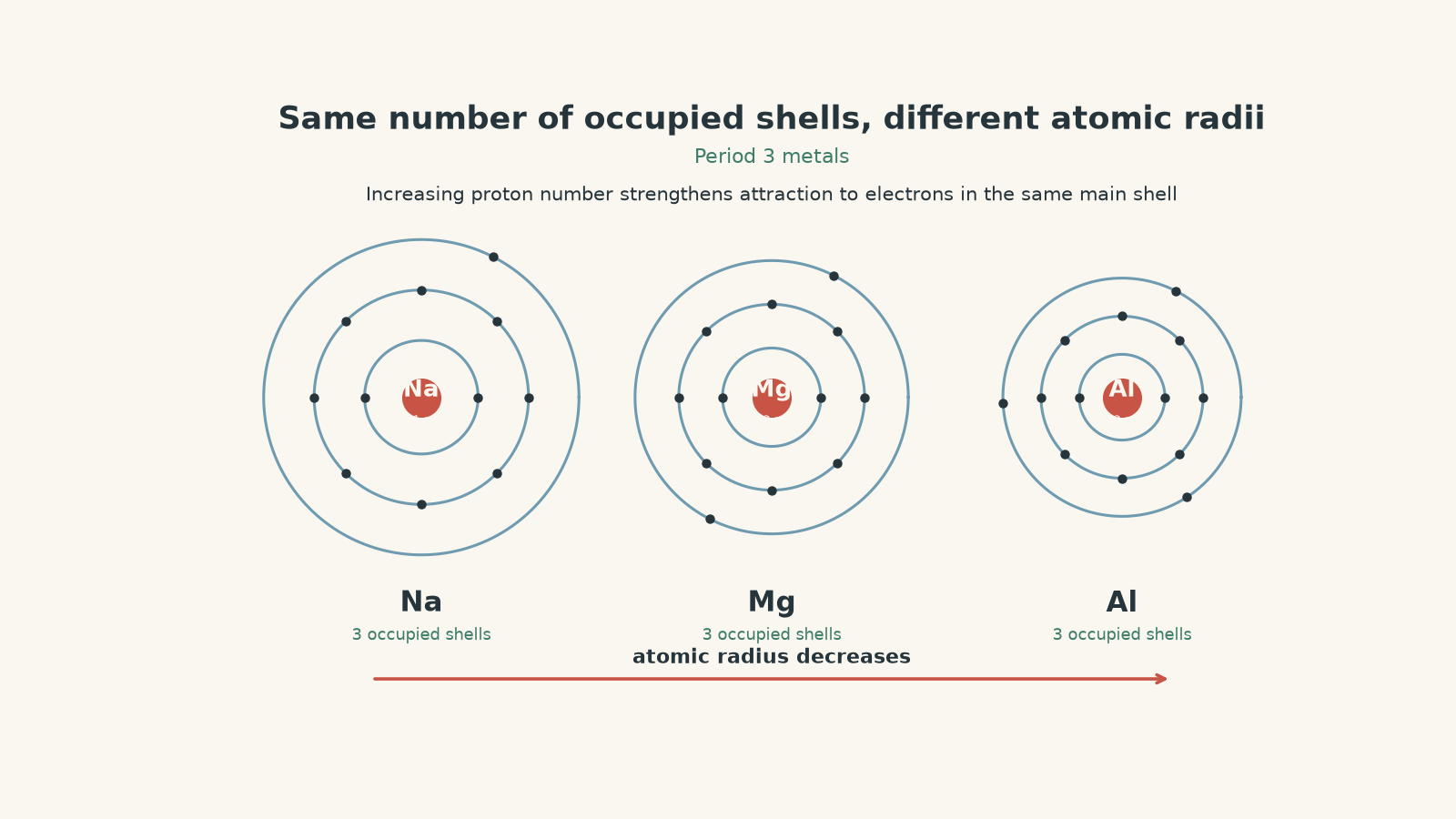
Atomic radius generally decreases from left to right across a period.
That can seem odd at first because electrons are being added. Shouldn’t adding more electrons make the atom larger?
Not necessarily. The new electrons are added to the same main electron shell, while the number of protons in the nucleus increases.
The stronger nuclear attraction pulls that shell closer.
So across Period 3, for example, sodium has a larger atomic radius than magnesium, and magnesium has a larger radius than aluminium.
03Shielding: the inner electrons get in the way
The nucleus does not attract a valence electron as though all the other electrons were absent.
Inner-shell electrons repel outer electrons and partly reduce the nuclear attraction they experience. This is called shielding.
Picture the nucleus as someone trying to get the attention of a person across a crowded room. The valence electron is the person at the other side, while the inner-shell electrons are everyone standing between them. More people in the way makes the interaction less direct.
The analogy has limits. Electrons aren’t tiny people standing still in layers, and shielding is an electrostatic effect arising from electron distributions. But the picture correctly captures the important point: inner electrons reduce the attraction experienced by outer electrons.
Down a group, shielding increases
Going down a group adds extra occupied electron shells.
Compare lithium and potassium:
- lithium has fewer inner electron shells
- potassium has more inner electron shells
- potassium’s outer electron experiences greater shielding
The larger distance and greater shielding both make potassium’s valence electron easier to remove.
Across a period, shielding changes much less
Across one period, added electrons mainly enter the same outer shell.
The number of inner occupied shells stays the same.
So although electron-electron repulsion does change, the major shielding from inner shells remains fairly similar. Meanwhile, proton number increases.
The result is a stronger attraction between the nucleus and the valence electrons as you move across a period.
This idea is often described using effective nuclear charge: the net positive attraction experienced by an electron after shielding is considered.
You do not need to imagine shielding as perfectly cancelling some exact number of protons. The important trend is that across a period, nuclear charge rises while inner-shell shielding changes relatively little.
04Ionisation energy brings those ideas together
The first ionisation energy is the energy required to remove one electron from each atom in one mole of gaseous atoms.
For a metal \(\ce{M}\):
\[
\ce{M(g) -> M+(g) + e^-}
\]
A low first ionisation energy means relatively little energy is needed to remove the first electron.
A high first ionisation energy means the electron is more strongly held.
So predict this before continuing: what should happen to first ionisation energy down Group 1?
It should decrease.
Down the group:
- atomic radius increases
- shielding increases
- the outer electron feels weaker attraction to the nucleus
- less energy is required to remove it
Therefore first ionisation energy decreases, while metal reactivity increases.
Worked example: Which Group 1 metal should react more readily?
Lithium and potassium are both Group 1 metals. Predict which metal should lose its valence electron more readily and therefore show greater metal reactivity.
Step 1
Both metals form \(+1\) ions by losing one electron:
\[
\ce{Li -> Li+ + e^-}
\]
\[
\ce{K -> K+ + e^-}
\]
Step 2
Potassium is below lithium in Group 1. It has more occupied electron shells, so its atomic radius is larger and its valence electron experiences greater shielding.
Step 3
The potassium valence electron experiences weaker attraction to the nucleus. Potassium therefore has a lower first ionisation energy than lithium.
Step 4
Potassium loses its valence electron more readily, so it is generally more reactive as a metal than lithium.
The periodic trend is therefore:
\[
\ce{Li < Na < K}
\]
for metal reactivity.
This doesn’t tell you the exact rate of every possible reaction under every condition. It predicts the underlying trend in how readily these metals undergo oxidation.
05Why metals generally become less reactive across a period
Now compare sodium and magnesium.
Both are metals in Period 3, but sodium is further left.
Sodium forms \(\mathrm{Na}^{+}\):
\[
\ce{Na -> Na+ + e^-}
\]
Magnesium usually forms \(\mathrm{Mg}^{2+}\):
\[
\ce{Mg -> Mg^2+ + 2e^-}
\]
As you move from sodium towards magnesium:
- proton number increases
- the valence electrons remain in the same main shell
- inner-shell shielding changes relatively little
- atomic radius decreases
- attraction to the valence electrons becomes stronger
- ionisation energy generally rises
It therefore becomes harder to remove electrons.
This contributes to a general decrease in metallic reactivity from left to right across the metallic portion of a period.
That is the broad pattern, not a promise that every observed reaction rate follows a perfectly smooth sequence.
06Electronegativity tells the same story from another angle
Electronegativity describes how strongly an atom attracts shared electrons towards itself in a chemical bond.
For metals, low electronegativity usually goes with a tendency to lose electrons rather than strongly attract them.
So reactive metals tend to have:
| Property | More reactive metals tend to have |
|---|---|
| Atomic radius | larger |
| Shielding | greater, especially down a group |
| Ionisation energy | lower |
| Electronegativity | lower |
| Tendency to lose electrons | greater |
These are not five independent causes.
Atomic radius and shielding affect how strongly valence electrons are held. Ionisation energy measures the energy needed to remove an electron. Electronegativity reflects an atom’s attraction for electrons in bonding.
They are different ways of describing related consequences of atomic structure.
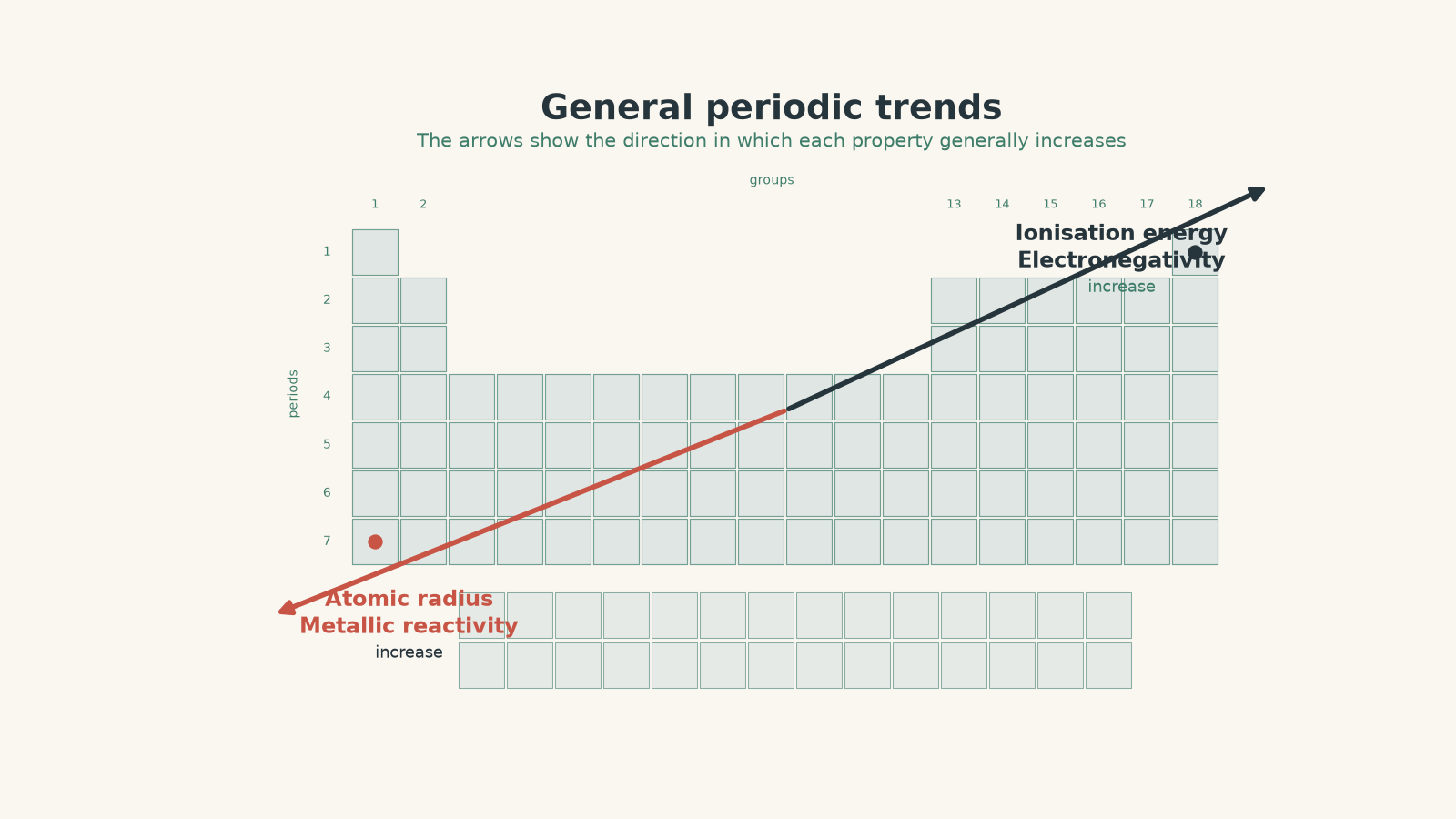
07Down a group versus across a period
The two directions are worth separating.
Moving down a metallic group
Generally:
\[
\text{radius} \uparrow
\]
\[
\text{shielding} \uparrow
\]
\[
\text{ionisation energy} \downarrow
\]
\[
\text{electronegativity} \downarrow
\]
so the tendency to lose electrons increases.
Metal reactivity therefore generally increases down groups such as Group 1 and Group 2.
Moving left to right across the metallic part of a period
Generally:
\[
\text{effective nuclear attraction} \uparrow
\]
\[
\text{radius} \downarrow
\]
\[
\text{ionisation energy} \uparrow
\]
\[
\text{electronegativity} \uparrow
\]
so electron loss becomes less favourable.
Metal reactivity therefore generally decreases.
08The tempting mistake: treating one periodic property as the whole explanation
Suppose a student says:
Aluminium has a lower first ionisation energy than magnesium, so aluminium must always be more reactive than magnesium.
There are two problems here.
First, metal reactions do not necessarily involve removing only one electron.
Magnesium commonly forms \(\mathrm{Mg}^{2+}\), while aluminium commonly forms \(\mathrm{Al}^{3+}\). The overall energetics involve more than the first ionisation step.
Second, observed reactivity is not determined only by how favourable electron loss is.
Aluminium rapidly forms a thin, strongly adherent aluminium oxide layer at its surface. This layer can stop reactants from reaching the aluminium metal underneath. Aluminium can therefore appear much less reactive than its underlying chemical tendency might suggest.
This is called passivation.
So you must distinguish:
- the atomic factors affecting a metal’s tendency to lose electrons
- the actual observed rate of a particular reaction
The second can also depend on surface coatings, concentration, temperature, physical form, and the other reactant involved.
That is why the periodic table gives powerful trends, not a complete replacement for experimental evidence.
Worked example: Magnesium or aluminium?
A student is given the following simplified first-ionisation-energy data:
| Metal | First ionisation energy |
|---|---|
| \(\ce{Mg}\) | \(738\ \text{kJ mol}^{-1}\) |
| \(\ce{Al}\) | \(578\ \text{kJ mol}^{-1}\) |
The student concludes that aluminium must react faster than magnesium in dilute acid because aluminium has the lower first ionisation energy. Explain why that conclusion is not justified.
Step 1
The lower first ionisation energy of aluminium means less energy is required for the process
\[
\ce{Al(g) -> Al+(g) + e^-}
\]
than for
\[
\ce{Mg(g) -> Mg+(g) + e^-}
\]
The units \( \text{kJ mol}^{-1} \) mean kilojoules of energy per mole of gaseous atoms.
Step 2
Magnesium usually forms \(\mathrm{Mg}^{2+}\), while aluminium usually forms \(\mathrm{Al}^{3+}\).
So a real comparison cannot be made from the first ionisation energy alone. Further electron removals and the rest of the reaction energetics also matter.
Step 3
Aluminium normally has an oxide coating on its surface. This passivating layer can prevent acid from immediately reaching the metal beneath it.
Magnesium can therefore appear to react more readily under some experimental conditions even though a single first-ionisation-energy value might suggest otherwise.
Step 4
The first ionisation energy is useful evidence about electron loss, but it does not by itself determine the observed reaction rate of magnesium and aluminium in acid.
When the oxide layer and experimental conditions matter, they must also be considered.
For a closer look at what you actually observe in this type of experiment, see Metal Reactivity with Dilute Acids: HSC Chemistry Guide.
09A decision rule that works better than memorising arrows
When asked to explain a periodic trend in metal reactivity, work through the cause rather than dumping four trend words into the answer.
Ask:
- Are the metals being compared down a group or across a period?
- How does the number of occupied electron shells change?
- What happens to shielding?
- What happens to the distance between the nucleus and valence electrons?
- Does the attraction for the valence electrons become stronger or weaker?
- What happens to ionisation energy and the ease of oxidation?
- Is there a surface effect or reaction condition that could change what is observed experimentally?
That produces explanations such as:
Calcium is more reactive than magnesium because calcium has an additional occupied electron shell. Its valence electrons are further from the nucleus and experience greater shielding, so they are less strongly attracted to the nucleus. Calcium therefore has a lower first ionisation energy and loses electrons more readily.
That is much stronger than saying only, “reactivity increases down the group”.
10Questions and solutions
Question 1
Magnesium and calcium are both Group 2 metals.
Predict which is more reactive and explain your answer using atomic radius, shielding, and ionisation energy.
Solution 1
Calcium is more reactive than magnesium.
Calcium is below magnesium in Group 2 and has one additional occupied electron shell. Its valence electrons are therefore further from the nucleus and experience greater shielding from inner electrons.
The nuclear attraction acting on calcium’s outer electrons is consequently weaker. Calcium has a lower first ionisation energy and can lose its valence electrons more readily:
\[
\ce{Ca -> Ca^2+ + 2e^-}
\]
The tempting shortcut is to say only that calcium is “lower in the group”. That identifies the trend but does not explain it. The causal link is larger radius and greater shielding \(\rightarrow\) weaker attraction \(\rightarrow\) easier electron loss \(\rightarrow\) greater metal reactivity.
Question 2
Two hypothetical Group 1 metals, X and Y, have the following properties:
| Property | X | Y |
|---|---|---|
| Atomic radius | \(190\ \text{pm}\) | \(240\ \text{pm}\) |
| First ionisation energy | \(500\ \text{kJ mol}^{-1}\) | \(420\ \text{kJ mol}^{-1}\) |
Here, \(\text{pm}\) means picometres.
A student argues that there is not enough information to predict which metal is more reactive because no electronegativity values are given.
Evaluate the student’s reasoning and predict which metal should be more reactive.
Solution 2
Y should be more reactive, and the missing electronegativity data is not needed to make that prediction.
Y has the larger atomic radius, \(240\ \text{pm}\), compared with \(190\ \text{pm}\) for X. Its first ionisation energy is also lower:
\[
420\ \text{kJ mol}^{-1} < 500\ \text{kJ mol}^{-1}
\]
That means the outer electron of Y requires less energy to remove. Both pieces of evidence point towards easier oxidation:
\[
\ce{Y -> Y+ + e^-}
\]
The tempting argument is that all four periodic properties must be supplied before any conclusion can be made. They do not. These properties are related pieces of evidence, not boxes that all need to be ticked separately.
The given radius and ionisation-energy data are already sufficient to predict that Y loses its outer electron more readily and should therefore be the more reactive Group 1 metal.
Question 3
Three Period 3 metals, \(\ce{Na}\), \(\ce{Mg}\), and \(\ce{Al}\), are compared.
A student proposes the following explanation:
“Each element has more electrons than the one before it, so shielding continually increases from sodium to aluminium. The increasing shielding should make aluminium the most reactive.”
Identify the flaw in the reasoning and give the expected broad periodic trend in metallic reactivity.
Solution 3
The broad trend is decreasing metallic reactivity from sodium towards magnesium and aluminium, and the student’s main mistake is treating every added electron as though it produced a new inner-shell shielding layer.
Sodium, magnesium, and aluminium all have their valence electrons in the third main electron shell. Moving from \(\ce{Na}\) to \(\ce{Mg}\) to \(\ce{Al}\) does add electrons, but it also adds a proton to the nucleus each time.
The major shielding from the inner \(n=1\) and \(n=2\) shells remains broadly similar because no new inner electron shell is added across Period 3.
The increasing nuclear charge therefore has a substantial effect. Valence electrons are attracted more strongly overall, and atomic radius generally decreases across the period.
This makes electron removal generally harder and contributes to rising ionisation energy across the metallic part of the period.
The expected broad trend is therefore:
\[
\ce{Na -> Mg -> Al}
\]
with metallic character and the ease of electron loss generally decreasing from left to right.
There is an important complication. The first ionisation energy does not rise perfectly at every single step: aluminium’s first ionisation energy is lower than magnesium’s because aluminium’s first electron is removed from a higher-energy \(3p\) subshell. That exception does not reverse the entire broader explanation of periodic metallic behaviour, nor does a first-ionisation-energy value alone determine observed reaction rates.
The tempting route was to equate “more electrons” with “much more shielding”. The exact constraint is where those electrons are being added.
Question 4
Metals A and B are in the same group, with B below A.
Metal B has a lower first ionisation energy and a larger atomic radius than A. In an experiment, however, equal-sized samples of B and A are placed in the same dilute acid and A initially produces hydrogen gas faster.
Assume the measurements are reliable.
A student concludes that the periodic trend must therefore be wrong.
Is that conclusion valid? Give a chemical explanation consistent with all the observations.
Solution 4
No. The result does not disprove the periodic trend; it shows that observed reaction rate depends on more than the ease of removing electrons from isolated gaseous atoms.
The periodic evidence still indicates that B should have a greater underlying tendency to lose electrons:
- B has the larger atomic radius
- its valence electrons are further from the nucleus
- it is expected to experience greater shielding
- its first ionisation energy is lower
Those factors favour oxidation of B.
However, the experiment measures the rate at which the solid metal reacts with acid. For electron transfer to occur, the acid must reach the metal surface.
A consistent explanation is that B has a protective surface coating, such as an oxide layer, which initially reduces contact between the acid and the underlying metal. A could therefore produce hydrogen faster at first even though B’s atoms, once exposed and participating in the reaction, have a greater tendency to lose electrons.
For example, the general acid reaction can be represented as oxidation of a metal coupled to reduction of hydrogen ions. For a \(2+\) metal:
\[
\ce{M -> M^2+ + 2e^-}
\]
and
\[
\ce{2H+ + 2e^- -> H2}
\]
The tempting conclusion is to treat “more reactive metal” as identical to “faster initial bubbling in every experiment”. That ignores kinetics and surface access.
The key constraint is that periodic properties describe atomic tendencies, while an experimentally observed rate also depends on physical and chemical conditions at the reacting surface.
Question 5
Two unknown metals, P and Q, lie in the same period.
P is to the left of Q.
The following observations are made:
- P has a larger atomic radius than Q.
- P has a lower electronegativity than Q.
- P reacts rapidly with water.
- A clean sample of Q also has a strong tendency to oxidise, but an untreated piece of Q appears almost unchanged in water because it carries a stable oxide coating.
- Q has a slightly lower first ionisation energy than the element immediately to its left in the periodic table.
A student says the last observation proves the usual across-period reasoning has failed and that Q should therefore be more metallic and more reactive than every metal immediately to its left.
Assess that claim. Your answer must explain how all five observations can be consistent with periodic structure.
Solution 5
The claim is not justified. A local decrease in first ionisation energy does not erase the broader across-period trends, and an observed reaction can also be altered by passivation.
P being to the left of Q is consistent with P having the larger atomic radius and lower electronegativity. Across a period, proton number rises while the main inner-shell shielding changes relatively little. The stronger effective nuclear attraction generally pulls valence electrons closer and increases the atom’s attraction for electrons.
So the observations
\[
r_{\mathrm{P}} > r_{\mathrm{Q}}
\]
and
\[
\text{electronegativity of P} < \text{electronegativity of Q}
\]
fit the normal periodic pattern, where \(r\) represents atomic radius.
P’s rapid reaction with water is also consistent with strong metallic behaviour and ready electron loss.
The apparently troublesome observation is that Q has a slightly lower first ionisation energy than the element immediately to its left. But across-period ionisation energies contain small irregularities because electron configuration matters.
For example, beginning to fill a higher-energy subshell can make one particular electron easier to remove even though the broader movement across the period is towards smaller radius, higher electronegativity, and reduced metallic character.
This is exactly why first ionisation energy should not be treated as a one-number reactivity ranking.
There is a second issue. The untreated Q sample is protected by an oxide coating. Its weak visible reaction with water therefore gives information about its surface as well as its atomic properties. The fact that a clean sample oxidises readily shows why the surface condition matters.
The tempting route is:
\[
\text{lower first ionisation energy} \Rightarrow \text{more reactive in every sense}
\]
But two constraints break that argument.
First, metal oxidation may require loss of more than one electron, so the first ionisation energy describes only one stage of the process. Second, observed reaction rate can be controlled by access to the metal surface.
All five observations can therefore coexist. Periodic structure still explains the broad changes in radius, electronegativity, and ease of electron loss, while electron configuration can create local ionisation-energy exceptions and passivation can change what is seen experimentally.
That is the useful endpoint of periodic trends: not memorising that reactivity points towards the bottom-left of the periodic table, but being able to explain why that trend exists, recognise where a single property is insufficient, and then connect atomic structure to actual observations such as reactions with oxygen and other oxidising agents.