
Metal Reactivity with Oxygen: HSC Chemistry Guide
Learn how to compare metal reactivity with oxygen using experimental observations, and recognise when surface area or oxide layers affect what you see.
A piece of iron wool can shower sparks in oxygen, while an iron nail may only glow weakly. Same element, completely different show. So does the wool contain “more reactive iron”?
No. The iron atoms have not changed. The wool simply exposes much more metal surface to oxygen.
That is the main problem when using oxygen reactions to compare metal reactivity: the observations are useful only when you know what else could be causing them. A brighter flame or faster reaction can be evidence of greater reactivity, but surface area, temperature, oxygen concentration, and protective oxide layers can all change what you see.
01What happens when a metal reacts with oxygen?
Picture the surface of a metal. Oxygen molecules from the gas are constantly colliding with it. If a collision has enough energy and the reaction is favourable, metal atoms at the surface can transfer electrons to oxygen.
For example, magnesium burns in oxygen to form magnesium oxide:
\[
\ce{2Mg(s) + O2(g) -> 2MgO(s)}
\]
Magnesium is oxidised because magnesium atoms lose electrons:
\[
\ce{Mg -> Mg^2+ + 2e^-}
\]
Oxygen is reduced because oxygen gains those electrons. The overall process is a redox reaction.
You do not need to see a flame for oxidation to be happening. Copper, for example, can react with oxygen when strongly heated without producing the spectacular white light associated with burning magnesium:
\[
\ce{2Cu(s) + O2(g) -> 2CuO(s)}
\]
The black copper(II) oxide coating is evidence that a chemical reaction has occurred.
This gives us an important distinction. Oxidation describes the electron-transfer process. Combustion is rapid, exothermic oxidation. A combusting metal may glow, spark, or produce intense light, but slow oxidation is still oxidation.
02Predict what a more reactive metal should do
Suppose you have two freshly cleaned metal samples with the same exposed surface area. You place each in the same concentration of oxygen and heat them in the same way.
Which metal would you expect to react more readily?
A reasonable prediction is that the more reactive metal should require less encouragement to react. It may ignite after less heating, react more rapidly once started, or release energy quickly enough to produce stronger glowing, sparks, or light.
Those observations can all support a comparison of reactivity.
The phrase under the same conditions is doing a lot of work, though. If one sample is powder and the other is a thick strip, you are no longer testing only the identity of the metal.
A useful way to read the evidence is:
| Observation | What it can suggest | What could mislead you |
|---|---|---|
| Metal ignites after relatively little heating | Reaction with oxygen begins readily | Samples may start at different temperatures or have different oxide coatings |
| Rapid, sustained burning | High reaction rate once ignition occurs | Surface area and oxygen concentration strongly affect rate |
| Strong glowing, sparks, or intense light | Energy is being released rapidly | Brightness alone is not a direct measurement of reactivity |
| Slow formation of an oxide coating | Oxidation is occurring, but relatively slowly under those conditions | A protective coating may be slowing further reaction |
| No visible change | Reaction is very slow or has not begun during the observation time | “No visible change” does not prove that reaction is impossible |
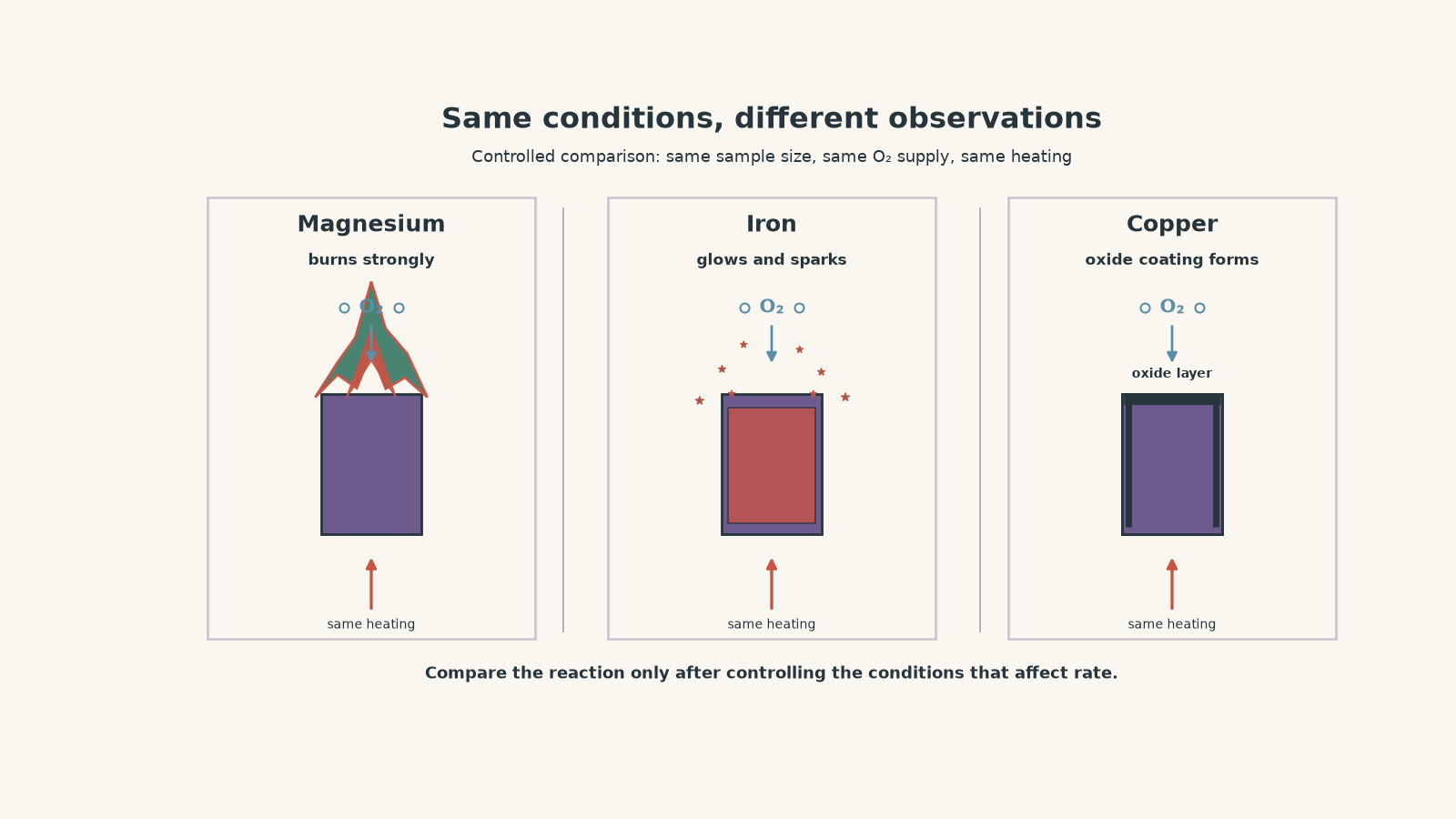
Worked example: Comparing magnesium, iron, and copper
Equal exposed areas of freshly cleaned magnesium, iron, and copper are heated separately in identical containers of oxygen.
Magnesium ignites after brief heating and burns with an intense white light. Iron requires stronger heating, then glows and produces some sparks. Copper does not sustain combustion but develops a dark oxide coating after continued heating.
What conclusion is supported by these observations?
Step 1
Magnesium begins reacting vigorously after the least heating. Iron needs greater heating before rapid oxidation is obvious. Copper reacts much less vigorously under the same conditions.
Step 2
Magnesium reacts rapidly enough for sustained combustion. Iron also reacts visibly but less readily. Copper forms an oxide without sustained burning.
Step 3
Under these controlled conditions, the observations support the order:
\[
\ce{Mg > Fe > Cu}
\]
for reactivity with oxygen.
This does not mean brightness itself defines reactivity. The useful evidence is the combination of ease of reaction, reaction rate, and the fact that the conditions were kept comparable.
03Why surface area can completely distort the comparison
Now return to the iron wool and iron nail.
Imagine oxygen molecules as people trying to enter a concert through doors around the outside of a building. More doors means more people can enter at once. In the same way, more exposed metal surface gives oxygen access to more metal atoms at the same time.
Iron wool contains many thin strands, so a large area of iron is exposed. A solid nail of the same mass has much less exposed surface.
The analogy breaks because oxygen molecules do not queue politely at microscopic doors. The real process involves collisions, electron transfer, heat transfer, and reaction kinetics. The useful part of the analogy is simply that more exposed surface creates more places where reaction can occur simultaneously.
This is why powders, filings, wool, ribbons, and solid blocks should not be casually compared as though their different behaviour comes only from chemical reactivity.
Worked example: A spectacular but unfair experiment
A student places fine iron powder and a thick magnesium strip in separate containers of oxygen. The iron powder produces a dramatic shower of sparks, while the magnesium strip takes several seconds to ignite.
The student concludes that iron is more reactive with oxygen than magnesium.
Is that conclusion justified?
Step 1
The iron is a fine powder. The magnesium is a thick strip. Their surface-area-to-volume ratios are very different.
Step 2
A much larger fraction of the iron atoms are exposed at the surface, so oxygen can react with many sites at once. The powder can therefore react very rapidly even though iron is not intrinsically more reactive with oxygen than magnesium.
Step 3
The valid observation is that the iron powder reacted more rapidly in this particular setup.
The conclusion that iron is therefore the more reactive metal is not valid. The experiment does not isolate metal identity as the only important variable.
A better comparison would use samples with similar exposed surface area, similar mass, similar cleanliness, the same oxygen concentration, and the same heating conditions.
04Protective oxide layers can hide reactivity
Aluminium creates another trap.
You might predict that a visibly unreactive aluminium object must be chemically reluctant to react with oxygen. It certainly looks that way. Aluminium window frames do not normally burst into flames when exposed to air.
But aluminium reacts with oxygen to form aluminium oxide:
\[
\ce{4Al(s) + 3O2(g) -> 2Al2O3(s)}
\]
The important part is what happens next.
A thin layer of aluminium oxide forms tightly on the surface. This layer is strongly attached and limits the movement of oxygen towards fresh aluminium underneath. Further oxidation becomes much slower.
This process is called passivation.
Think of the oxide layer as a slightly overprotective bouncer standing between oxygen and the aluminium underneath. Oxygen can arrive, but reaching fresh metal becomes difficult.
The analogy has limits. The coating is not deliberately “blocking” anything, and atoms can still move through real solids under some conditions. The important idea is that a dense, adherent oxide layer creates a physical barrier to continued reaction.
So if bulk aluminium appears less reactive than expected, you must ask whether you are observing the behaviour of fresh aluminium or the behaviour of aluminium protected by its oxide layer.
Not every oxide layer protects equally well. Some oxide coatings are porous, cracked, or easily disrupted, allowing oxidation to continue.
05Reactivity is not the same thing as “biggest flame”
A tempting rule is:
Bigger reaction = more reactive metal.
That is too crude.
A vigorous reaction is useful evidence when the test conditions are comparable, but several separate factors affect what you see.
The reaction must first overcome an activation energy, which is the energy barrier that must be crossed before reaction can proceed rapidly. Heating helps particles overcome this barrier.
After reaction begins, its rate depends on factors including temperature, exposed surface area, oxygen availability, and whether the products block further contact.
This creates situations where two observations seem to disagree. One metal might begin oxidising at a relatively low temperature but quickly form a protective coating. Another might need stronger heating initially, then burn rapidly once it has ignited.
There is no need to force those observations into a simplistic conclusion. They are telling you about different parts of the reaction process.
For HSC questions, the safest decision rule is this: compare reactivity using observations made under controlled conditions, then check whether surface area, heating, oxygen supply, or passivation could explain the difference instead.
06What counts as good evidence?
Imagine metals X and Y have equal exposed areas and have both been freshly cleaned. They are placed in identical containers of oxygen.
Metal X begins glowing after gentle heating and continues reacting without extra heating. Metal Y requires prolonged strong heating and then develops only a thin oxide coating.
The evidence supports X reacting more readily with oxygen under those conditions. The difference cannot easily be blamed on surface area, oxygen supply, or an obvious initial oxide coating because those factors were controlled.
Now change one detail. Metal Y is a powder while X remains a solid strip.
The comparison becomes much weaker. Even if Y reacts more dramatically, the result now combines two effects: the identity of the metal and the much larger surface area of the powder.
This distinction between observation and inference is one of the most useful habits in experimental chemistry. “Y produced more sparks” is an observation. “Y is more reactive” is an inference that needs the experimental design to support it.
07Questions and solutions
Question 1
Three freshly cleaned metal strips, A, B, and C, have similar exposed areas and are heated separately in identical containers of oxygen.
A ignites after mild heating and continues burning. B glows only after stronger heating. C develops a thin oxide coating but does not glow.
What order of reactivity with oxygen is supported by these observations?
Solution 1
The evidence supports the order A > B > C for reactivity with oxygen under these conditions.
A reacts most readily because it begins rapid oxidation after the least heating and sustains the reaction. B requires more heating before rapid oxidation becomes visible. C still reacts, as shown by the oxide coating, but its oxidation is slower.
The conclusion is limited to the controlled conditions of the experiment. The observations support a comparison because exposed area, oxygen conditions, and sample preparation were stated to be similar.
Question 2
A student burns 0.50 g of iron wool and 0.50 g of iron wire in oxygen. The wool burns much faster and produces more sparks.
The student says, “The iron in the wool must be more reactive.”
Evaluate this statement.
Solution 2
The statement is incorrect because both samples contain the same metal, and the different reaction rates are explained mainly by surface area.
Iron wool consists of many thin strands, giving it a much larger surface-area-to-volume ratio than the wire. More iron atoms are therefore exposed to oxygen at any instant, so oxidation can occur at more sites simultaneously.
The experiment demonstrates that increasing surface area can increase reaction rate. It does not show that the iron atoms in the wool have a different chemical reactivity from those in the wire.
The trap is treating reaction rate as though it depends only on chemical identity.
Question 3
Aluminium sheet is strongly heated in oxygen but shows little visible change. Copper powder heated under similar oxygen conditions quickly develops a black coating.
A student concludes that copper is more reactive with oxygen than aluminium.
Explain why the observation does not justify that conclusion.
Solution 3
The conclusion is not justified because both surface area and aluminium passivation can distort the comparison.
Copper powder has a large exposed surface area, which can make oxidation occur rapidly. Aluminium sheet has a much smaller surface-area-to-volume ratio.
More importantly, aluminium normally has a thin, adherent layer of aluminium oxide on its surface. This layer reduces contact between oxygen and fresh aluminium, slowing further oxidation.
The black coating on copper is evidence that copper has reacted with oxygen:
\[
\ce{2Cu(s) + O2(g) -> 2CuO(s)}
\]
However, the experiment does not isolate the metals’ inherent tendency to react. A fairer comparison would require comparable physical forms and careful consideration of surface oxide layers.
The tempting misconception is to interpret “less visible reaction” as automatically meaning “less reactive metal”.
Question 4
Two identical magnesium strips are placed in oxygen. Strip P has been freshly cleaned immediately before the experiment. Strip Q has been stored for a long time and has a thicker surface coating.
P ignites sooner than Q.
Can you conclude that P contains more reactive magnesium than Q? Explain.
Solution 4
No. The magnesium itself has the same chemical identity in both strips, so the difference does not show that P contains intrinsically more reactive magnesium.
The likely difference is access to the magnesium surface. Strip Q’s surface coating provides an additional barrier between oxygen and fresh magnesium. Strip P has been cleaned, so oxygen can contact fresh magnesium more readily.
For magnesium combustion:
\[
\ce{2Mg(s) + O2(g) -> 2MgO(s)}
\]
The experiment therefore shows that surface condition can affect the observed ease of reaction.
The important trap is assuming that every difference in reaction behaviour must come from a difference in the metal’s intrinsic reactivity. Here, an uncontrolled surface condition provides a better explanation.
Question 5
Metals R and S are tested using samples with equal exposed surface area in identical oxygen conditions.
R begins oxidising after relatively little heating, but the reaction quickly slows as a dense oxide layer forms.
S requires a higher temperature before reaction begins. Once ignited, however, S burns rapidly and continues until most of the exposed metal has reacted.
A student insists that the experiment must identify one of the two metals as “the more reactive metal”.
Is that conclusion possible from the evidence given?
Solution 5
No single ranking is fully justified from the evidence given because R and S outperform each other according to different observations.
R begins oxidation more readily, which is evidence that rapid reaction can start at a lower temperature. However, its oxide layer then restricts further reaction.
S has a larger initial barrier to rapid reaction because stronger heating is required. Once that barrier is overcome, its oxidation proceeds much faster and is not stopped by an equally effective protective layer.
The observations therefore involve at least two effects: the conditions needed to initiate rapid oxidation and the rate at which oxidation continues after it begins.
Simply declaring that S is more reactive because its later combustion is more dramatic would ignore R’s easier initial oxidation. Declaring R more reactive solely because it reacts first would ignore the strong effect of passivation on what happens next.
A stronger investigation would define the comparison more precisely and control or measure the relevant variables. For example, it could compare initial oxidation rates at the same temperature using similarly prepared surfaces.
The deeper lesson is that “reactivity” is inferred from evidence. When several kinetic factors affect that evidence, you should explain them rather than forcing an unsupported ranking.
08Using oxygen reactions as part of a bigger reactivity picture
Reaction with oxygen gives useful evidence about how readily a metal can be oxidised, but it is only one chemical test. Surface coatings and activation energy can sometimes make the visible behaviour misleading.
A stronger picture appears when you compare how the same metals behave with several reactants. The next useful step is to examine metal reactivity with water and metal reactivity with dilute acids.
Across those reactions, the same habit matters: separate what you observe from what you infer, control the conditions that affect rate, and look for chemical explanations when a metal behaves differently from the simple pattern you expected.