
The Metal Activity Series: Practical HSC Chemistry Guide
Learn how to construct a metal activity series from displacement reactions, interpret practical evidence, and compare your results with a reliable secondary source.
Put a zinc strip into a solution containing copper(II) ions and copper can form on the strip. Swap the materials – put copper metal into a solution containing zinc ions – and you usually see nothing.
Why does the swap only work one way? Before reading on, predict this: if zinc can displace iron from a solution of iron ions, and iron can displace copper from a solution of copper ions, where must the three metals sit relative to one another?
Zinc must be above iron, and iron must be above copper. Written as an activity series:
\[
\ce{Zn} > \ce{Fe} > \ce{Cu}
\]
That is the useful idea behind the metal activity series. You do not have to begin by memorising a long list. You can build part of the list from practical evidence, one comparison at a time.
01A displacement reaction is a head-to-head comparison
Imagine the activity series as a ladder. When two different metals are compared through a displacement reaction, the metal higher on the ladder can displace ions of the metal below it.
For example:
\[
\ce{Zn(s) + Cu^2+(aq) -> Zn^2+(aq) + Cu(s)}
\]
The zinc metal becomes zinc ions. The copper ions become copper metal.
That tells us:
\[
\ce{Zn} > \ce{Cu}
\]
The important point is not that zinc somehow “pushes” copper out of the solution. The actual process is electron transfer.
Zinc atoms lose electrons:
\[
\ce{Zn(s) -> Zn^2+(aq) + 2e^-}
\]
Copper ions gain those electrons:
\[
\ce{Cu^2+(aq) + 2e^- -> Cu(s)}
\]
So zinc is oxidised and copper ions are reduced.
A more active metal has a greater tendency to be oxidised in this kind of comparison. It gives up electrons while the ions of the less active metal accept them.
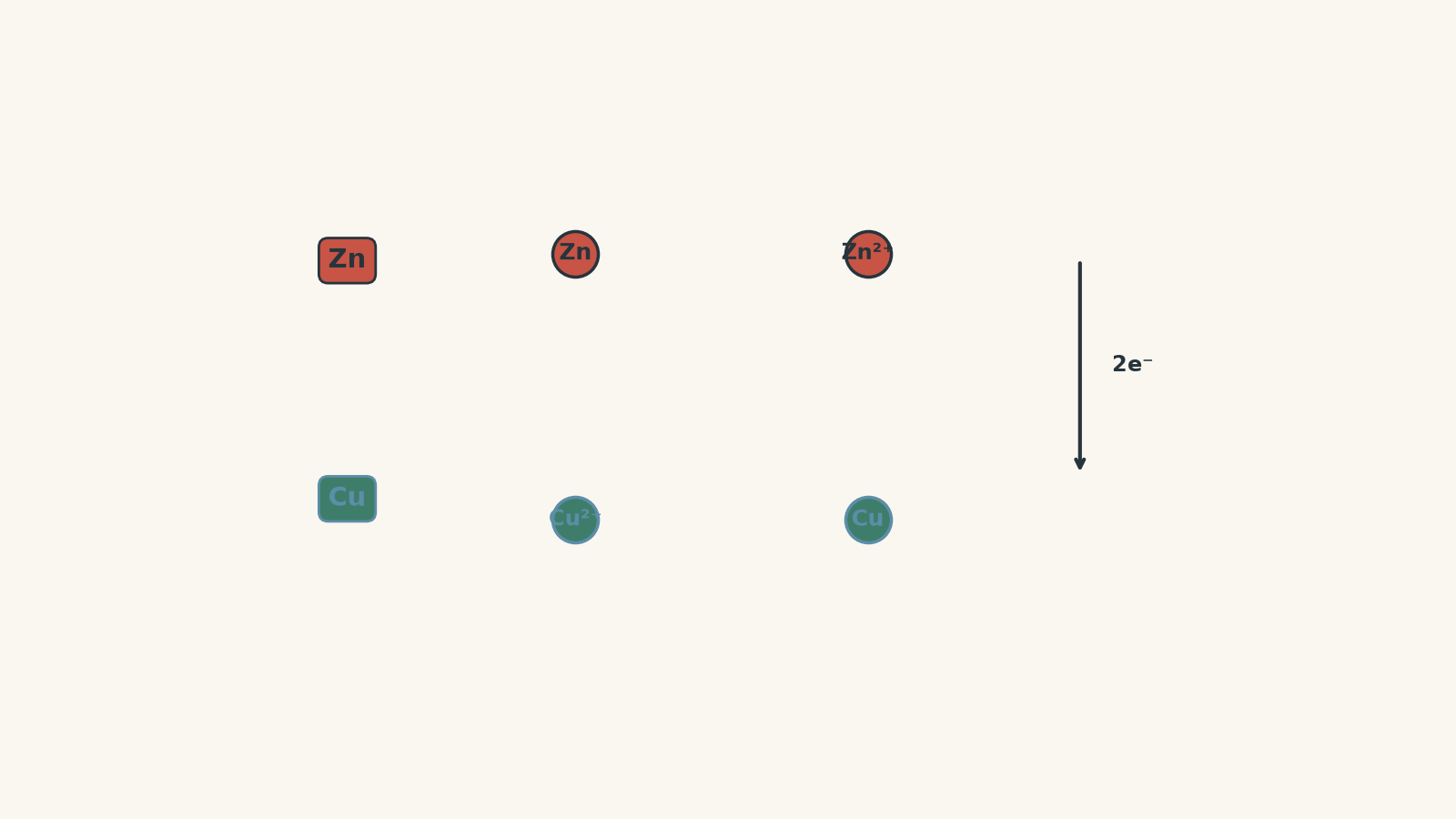
The ladder picture is useful, but it has a limit. Real reactions also depend on surface condition, concentration, temperature, oxide coatings, and reaction rate. A metal’s position in the series does not tell you exactly how fast every reaction involving that metal will occur.
02How to construct an activity series from practical results
Suppose you are given four metals:
- magnesium, \(\ce{Mg}\)
- zinc, \(\ce{Zn}\)
- iron, \(\ce{Fe}\)
- copper, \(\ce{Cu}\)
You test each solid metal in solutions containing ions of the other metals.
A representative set of results might look like this:
| Solid metal | \(\mathrm{Mg}^{2+}\) solution | \(\mathrm{Zn}^{2+}\) solution | \(\mathrm{Fe}^{2+}\) solution | \(\mathrm{Cu}^{2+}\) solution |
|---|---|---|---|---|
| \(\ce{Mg}\) | – | reaction | reaction | reaction |
| \(\ce{Zn}\) | no visible reaction | – | reaction | reaction |
| \(\ce{Fe}\) | no visible reaction | no visible reaction | – | reaction |
| \(\ce{Cu}\) | no visible reaction | no visible reaction | no visible reaction | – |
Actual school practicals are rarely this tidy. A newly deposited grey metal can be difficult to see on another grey metal, and some reactions are much slower than others. Treat the table as the evidence after the observations have been interpreted carefully.
Each positive displacement gives a direct comparison.
Magnesium displaces zinc ions:
\[
\ce{Mg(s) + Zn^2+(aq) -> Mg^2+(aq) + Zn(s)}
\]
Therefore:
\[
\ce{Mg} > \ce{Zn}
\]
Zinc displaces iron ions:
\[
\ce{Zn(s) + Fe^2+(aq) -> Zn^2+(aq) + Fe(s)}
\]
Therefore:
\[
\ce{Zn} > \ce{Fe}
\]
Iron displaces copper ions:
\[
\ce{Fe(s) + Cu^2+(aq) -> Fe^2+(aq) + Cu(s)}
\]
Therefore:
\[
\ce{Fe} > \ce{Cu}
\]
Now connect those comparisons:
\[
\ce{Mg} > \ce{Zn} > \ce{Fe} > \ce{Cu}
\]
This use of transitivity is important. If magnesium is above zinc, and zinc is above iron, you do not need another experiment to know that magnesium should also be above iron.
What should you actually look for?
Do not reduce every observation to “bubbles or no bubbles”. Metal-ion displacement often produces no gas at all.
Evidence can include:
- a new solid coating forming on the original metal
- the original metal dissolving or changing texture
- a coloured solution becoming paler or changing colour
- a measurable temperature change
- a change in mass, if the procedure is designed for it
You need evidence that distinguishes a chemical reaction from scratches, oxide, salt crystals, or contamination.
03The practical has to be a fair comparison
Suppose one zinc strip has been freshly polished and another has a thick oxide or grease layer. If the polished strip reacts and the dirty strip does not, you have learnt something about the surfaces, not necessarily something new about zinc’s position in the activity series.
For meaningful comparisons, keep important conditions as consistent as possible:
- use similarly sized, freshly prepared metal surfaces
- use the same concentration and volume of each metal-ion solution where appropriate
- keep temperature and reaction time consistent
- avoid contaminating solutions with droppers or metal fragments from another test
- rinse equipment between trials
- repeat doubtful observations
Follow your school’s risk assessment, teacher instructions, and the relevant safety information for the chemicals being used.
There is also a chemical limit to the method. You would not try to rank every metal by putting highly reactive Group 1 metals into aqueous salt solutions. Water itself reacts strongly with those metals. Different forms of evidence are needed for different parts of a full activity series.
That is one reason the final practical series should be compared with a reliable secondary source rather than treated as the complete truth by itself.
Worked example: rank four unknown metals
Four metals, \(P\), \(Q\), \(R\), and \(S\), form \(2+\) ions. The following observations are made under identical conditions:
- \(P\) displaces \(\mathrm{Q}^{2+}\)
- \(R\) displaces \(\mathrm{P}^{2+}\)
- \(Q\) displaces \(\mathrm{S}^{2+}\)
- \(S\) does not displace \(\mathrm{R}^{2+}\)
Construct the activity series and predict whether \(Q\) will displace \(\mathrm{R}^{2+}\).
Step 1
\(P\) displaces \(Q\), so:
\[
P > Q
\]
\(R\) displaces \(P\), so:
\[
R > P
\]
\(Q\) displaces \(S\), so:
\[
Q > S
\]
Step 2
\[
R > P > Q > S
\]
The final no-reaction observation is consistent with this order. \(S\) is below \(R\), so \(S\) should not displace \(\mathrm{R}^{2+}\).
Step 3
\(Q\) lies below \(R\). It therefore should not displace \(\mathrm{R}^{2+}\).
The important method is to translate each experiment into an inequality before trying to remember the whole order.
04Do not confuse reaction speed with position in the series
Here is a tempting argument:
Metal A produced a coating in ten seconds, while metal B took two minutes. Therefore A must be higher in the activity series.
That conclusion does not follow.
The activity series is primarily about the direction of a redox reaction: which metal is more readily oxidised relative to another. The speed at which you see the reaction is a kinetics question.
A reaction can be thermodynamically favourable but slow.
Aluminium is the classic warning. Aluminium is relatively active, but its surface rapidly develops a thin, strongly adherent oxide layer. That layer can separate the aluminium underneath from the solution.
A student might therefore put aluminium into a metal-ion solution, see little happening, and conclude that aluminium must be unreactive.
The observation is real. The conclusion may not be.
The missing idea is passivation: a protective surface layer can slow or prevent an otherwise favourable reaction from being visible on the timescale of the experiment.
Worked example: a result that disagrees with the source
A student tests aluminium, zinc, and copper.
Fresh zinc displaces copper from a solution containing \(\mathrm{Cu}^{2+}\). Copper does not displace \(\mathrm{Zn}^{2+}\). An aluminium strip that has not been freshly cleaned shows no visible reaction with either solution after one minute.
The student writes:
\[
\ce{Zn} > \ce{Cu} > \ce{Al}
\]
A reliable secondary source instead places aluminium above zinc. Explain how the results should be interpreted.
Step 1
Zinc displaces copper ions, so the practical supports:
\[
\ce{Zn} > \ce{Cu}
\]
Step 2
“No visible reaction after one minute” is not as strong as observing a definite displacement. The aluminium surface may be passivated by aluminium oxide.
The result therefore does not securely prove that aluminium is below copper.
Step 3
If the published series gives:
\[
\ce{Al} > \ce{Zn} > \ce{Cu}
\]
then the aluminium trial is the result requiring investigation. The sensible response is not to throw away the practical result or blindly copy the source. It is to ask why the methods produced different evidence.
Step 4
The aluminium surface could be freshly prepared immediately before testing, while keeping the other variables controlled. Repeated observations would then give stronger evidence about whether the original “no reaction” resulted from the surface layer.
The broader lesson is useful well beyond aluminium: an absence of visible change is evidence, but it is not automatically proof that no favourable redox process exists.
05Comparing your practical series with a secondary-sourced series
From the representative practical above, we obtained:
\[
\ce{Mg} > \ce{Zn} > \ce{Fe} > \ce{Cu}
\]
For comparison, a Royal Society of Chemistry educational resource gives the decreasing reactivity order \(\ce{K}\), \(\ce{Na}\), \(\ce{Li}\), \(\ce{Ca}\), \(\ce{Mg}\), \(\ce{Al}\), \(\ce{Zn}\), \(\ce{Fe}\), \(\ce{Cu}\), \(\ce{Ag}\), and \(\ce{Au}\).
Our four tested metals appear in exactly the same relative order:
| Metal | Practical position among tested metals | Relative position in the secondary series |
|---|---|---|
| \(\ce{Mg}\) | 1 | above \(\ce{Zn}\), \(\ce{Fe}\), and \(\ce{Cu}\) |
| \(\ce{Zn}\) | 2 | below \(\ce{Mg}\), above \(\ce{Fe}\) and \(\ce{Cu}\) |
| \(\ce{Fe}\) | 3 | below \(\ce{Mg}\) and \(\ce{Zn}\), above \(\ce{Cu}\) |
| \(\ce{Cu}\) | 4 | below the other three |
That agreement matters, but be precise about what it means. Your practical did not experimentally establish the positions of potassium, sodium, lithium, calcium, aluminium, silver, or gold. It only ranked the metals that were actually compared.
A strong conclusion would therefore sound like this:
The experimentally determined order \(\ce{Mg} > \ce{Zn} > \ce{Fe} > \ce{Cu}\) agrees with the relative positions of these metals in the secondary-sourced activity series.
A weaker conclusion would be:
The experiment proved the entire published activity series.
It did not.
Published series can also contain reference substances such as hydrogen, and some versions include carbon because both are useful for predicting reactions and extraction processes even though they are not metals.
06Hydrogen gives the series another useful reference point
Metal-ion displacement is not the only evidence you can use.
If a metal reacts with a suitable dilute, non-oxidising acid to release hydrogen gas, the metal can reduce \(\mathrm{H}^{+}\) ions:
\[
\ce{M(s) + 2H+(aq) -> M^2+(aq) + H2(g)}
\]
For a metal forming \(2+\) ions, that tells you the metal lies above hydrogen in the usual activity series.
Zinc, for example:
\[
\ce{Zn(s) + 2H+(aq) -> Zn^2+(aq) + H2(g)}
\]
Copper does not normally liberate hydrogen from a dilute, non-oxidising acid, so it lies below hydrogen.
You can explore this evidence more closely in Metal Reactivity with Dilute Acids: HSC Chemistry Guide.
Water reactions provide another set of observations, although the conditions matter greatly. Some metals react readily with cold water, while others require steam or show little observable reaction. The distinction is developed in Metal Reactivity with Water: HSC Chemistry Guide.
Do not mash these observations into one ranking based simply on which test looked most dramatic. A violent reaction with water, a slow acid reaction, and a metal-ion displacement involve different reactants and different kinetic barriers.
07A compact decision rule
For a test involving solid metal \(A\) and ions of metal \(B\):
\[
\ce{A(s) + B^{n+}(aq) -> A^{m+}(aq) + B(s)}
\]
If a genuine displacement occurs, then \(A\) is more active than \(B\):
\[
A > B
\]
The charges \(m+\) and \(n+\) do not have to be the same. You simply have to balance the electron transfer correctly.
For example, aluminium and copper involve different numbers of electrons:
\[
\ce{Al(s) -> Al^3+(aq) + 3e^-}
\]
\[
\ce{Cu^2+(aq) + 2e^- -> Cu(s)}
\]
The least common multiple of 3 and 2 is 6, giving:
\[
\ce{2Al(s) + 3Cu^2+(aq) -> 2Al^3+(aq) + 3Cu(s)}
\]
The stoichiometric coefficients come from electron balance. They do not mean copper is somehow “more reactive” because there are three copper ions for every two aluminium atoms.
08What to do when the practical and source disagree
A mismatch is not a cue to change the numbers until they agree.
Work through the evidence.
| Possible issue | Why it matters |
|---|---|
| Oxide or other surface coating | May prevent solution from reaching the metal |
| Unequal reaction times | A slow reaction may be recorded as “no reaction” too early |
| Different concentrations | Can change how easily a reaction is observed and, in more advanced treatment, affect cell potential |
| Contaminated metal or solution | May create a coating or colour change unrelated to the intended comparison |
| Poorly cleaned metal | Grease, oxide, or residue can reduce contact |
| Misidentified deposit | A stain or crystal is not automatically newly displaced metal |
| Different surface areas | Can make one reaction look much faster than another |
| Too few comparisons | The data may establish only a partial order |
| Comparing reaction rates instead of reaction direction | Fast does not automatically mean “higher in the activity series” |
The strongest practical argument usually combines several consistent pairwise comparisons.
If \(A>B\), \(B>C\), and an independent test also gives \(A>C\), the evidence fits together. If one isolated observation contradicts all three, investigate that observation before rebuilding the entire series around it.
09Construct the series before explaining it
In an exam response, keep observation and interpretation separate.
Suppose the results show:
- magnesium displaces zinc ions
- zinc displaces iron ions
- iron displaces copper ions
A clean reasoning chain is:
- \(\ce{Mg}\) displaces \(\mathrm{Zn}^{2+}\), so \(\ce{Mg}\) is more readily oxidised than \(\ce{Zn}\).
- \(\ce{Zn}\) displaces \(\mathrm{Fe}^{2+}\), so \(\ce{Zn}\) is more active than \(\ce{Fe}\).
- \(\ce{Fe}\) displaces \(\mathrm{Cu}^{2+}\), so \(\ce{Fe}\) is more active than \(\ce{Cu}\).
- Therefore:
\[
\ce{Mg} > \ce{Zn} > \ce{Fe} > \ce{Cu}
\]
- This order can then be compared with the selected secondary source.
Notice the logic. You are not saying, “magnesium is high in the memorised series, so the experiment must show a reaction.” You are using the experiment to construct a series, then checking that construction against independent information.
That distinction is exactly what makes the practical scientifically useful.
10Questions and solutions
Question 1
A magnesium strip is placed in a solution containing \(\mathrm{Cu}^{2+}\) ions. A reddish-brown solid forms on the strip and the magnesium slowly dissolves.
State which metal is higher in the activity series and write the net ionic equation.
Solution 1
Magnesium is higher than copper in the activity series, and the net ionic equation is:
\[
\ce{Mg(s) + Cu^2+(aq) -> Mg^2+(aq) + Cu(s)}
\]
Magnesium atoms lose two electrons:
\[
\ce{Mg(s) -> Mg^2+(aq) + 2e^-}
\]
The copper ions gain those electrons:
\[
\ce{Cu^2+(aq) + 2e^- -> Cu(s)}
\]
Therefore magnesium is oxidised and copper ions are reduced. The solid copper deposit is direct evidence that magnesium can displace copper ions.
A common mistake is to say copper is “more reactive” because copper appears on the strip. The opposite is true: copper appears because the more active magnesium supplies electrons to \(\mathrm{Cu}^{2+}\).
Question 2
Three unknown metals \(X\), \(Y\), and \(Z\) each form \(2+\) ions.
The following reliable observations are made:
- \(X\) displaces \(\mathrm{Y}^{2+}\)
- \(Y\) reacts with dilute hydrochloric acid and releases hydrogen
- \(Z\) does not react with dilute hydrochloric acid
- \(Z\) displaces \(\mathrm{Cu}^{2+}\)
Assume the surfaces are clean and there are no significant kinetic barriers.
Place \(X\), \(Y\), \(Z\), hydrogen, and copper in decreasing activity. Then predict whether \(Y\) will displace \(\mathrm{Cu}^{2+}\).
Solution 2
The order is:
\[
X > Y > \ce{H} > Z > \ce{Cu}
\]
and \(Y\) will displace \(\mathrm{Cu}^{2+}\).
Start with the metal displacement. \(X\) displaces \(\mathrm{Y}^{2+}\), so:
\[
X > Y
\]
Next, \(Y\) reacts with dilute acid:
\[
\ce{Y(s) + 2H+(aq) -> Y^2+(aq) + H2(g)}
\]
Therefore:
\[
Y > \ce{H}
\]
Metal \(Z\) does not displace hydrogen from the acid. Under the stated assumption that the no-reaction result is reliable:
\[
\ce{H} > Z
\]
However, \(Z\) does displace copper ions:
\[
\ce{Z(s) + Cu^2+(aq) -> Z^2+(aq) + Cu(s)}
\]
so:
\[
Z > \ce{Cu}
\]
Combining every constraint gives:
\[
X > Y > \ce{H} > Z > \ce{Cu}
\]
Since \(Y\) is above hydrogen, hydrogen is above \(Z\), and \(Z\) is above copper, \(Y\) must also be above copper. It should therefore displace \(\mathrm{Cu}^{2+}\).
The tempting route is to treat the acid tests and metal-ion tests as unrelated observations. They can be combined because hydrogen acts as a reference position in the activity series.
Question 3
A student tests magnesium, aluminium, zinc, and copper.
The results are:
- magnesium displaces \(\mathrm{Zn}^{2+}\) and \(\mathrm{Cu}^{2+}\)
- zinc displaces \(\mathrm{Cu}^{2+}\)
- copper does not displace \(\mathrm{Zn}^{2+}\)
- an aluminium strip with its normal surface oxide intact shows no visible reaction with any of the three ion solutions during a 60-second test
The student concludes:
\[
\ce{Mg} > \ce{Zn} > \ce{Cu} > \ce{Al}
\]
A reliable secondary source instead gives the relative order:
\[
\ce{Mg} > \ce{Al} > \ce{Zn} > \ce{Cu}
\]
Evaluate the student’s conclusion and describe how you would investigate the discrepancy.
Solution 3
The student’s placement of aluminium below copper is not justified by this experiment; the secure practical result is \(\ce{Mg} > \ce{Zn} > \ce{Cu}\), while aluminium requires further investigation.
The positive displacement results provide strong evidence:
\[
\ce{Mg} > \ce{Zn}
\]
and:
\[
\ce{Zn} > \ce{Cu}
\]
so:
\[
\ce{Mg} > \ce{Zn} > \ce{Cu}
\]
The aluminium evidence is different. The aluminium was tested with its oxide layer intact. Aluminium oxide can passivate the surface and limit contact between the metal underneath and the solution.
Therefore, “no visible reaction in 60 seconds” does not securely establish:
\[
\ce{Cu} > \ce{Al}
\]
The test should be repeated with a freshly prepared aluminium surface, while keeping solution concentration, volume, temperature, exposed metal area, and observation time controlled. Repeated trials would strengthen the comparison.
The tempting conclusion is that every no-reaction observation has the same evidential strength as a positive displacement. It does not. A positive deposit can directly demonstrate electron transfer, whereas a no-reaction observation can also result from a kinetic or surface barrier.
The disagreement with the secondary source is therefore useful. It identifies which part of the practical method needs checking rather than telling us to ignore either source of evidence.
Question 4
A clean zinc strip has an initial mass of \(2.5000\ \mathrm{g}\). It is placed in excess copper(II) sulfate solution. After reaction, all deposited copper remains attached. The strip is rinsed, dried thoroughly, and has a final mass of \(2.4944\ \mathrm{g}\).
Assume the only reaction is:
\[
\ce{Zn(s) + Cu^2+(aq) -> Zn^2+(aq) + Cu(s)}
\]
Use \(M(\ce{Zn}) = 65.38\ \mathrm{g\,mol^{-1}}\) and \(M(\ce{Cu}) = 63.55\ \mathrm{g\,mol^{-1}}\).
Calculate:
- the amount of zinc that reacted
- the mass of zinc lost
- the mass of copper deposited
Then explain why the very small net mass change does not mean that very little reaction occurred.
Solution 4
About \(0.00306\ \mathrm{mol}\) of zinc reacted, corresponding to \(0.200\ \mathrm{g}\) of zinc lost and \(0.194\ \mathrm{g}\) of copper deposited. A substantial displacement reaction can therefore produce a tiny net mass change because zinc lost and copper gained have similar molar masses.
The measured change in mass is:
\[
\Delta m = 2.4944 – 2.5000 = -0.0056\ \mathrm{g}
\]
For every one mole of zinc that reacts, one mole of copper is deposited.
One mole of reaction therefore changes the mass of the strip by:
\[
63.55 – 65.38 = -1.83\ \mathrm{g\,mol^{-1}}
\]
Let \(n\) be the number of moles of zinc that reacted. Then:
\[
n=\frac{0.0056\ \mathrm{g}}{1.83\ \mathrm{g\,mol^{-1}}}
=0.00306\ \mathrm{mol}
\]
The mass of zinc oxidised is:
\[
m(\ce{Zn})
=nM
=(0.00306\ \mathrm{mol})(65.38\ \mathrm{g\,mol^{-1}})
\approx 0.200\ \mathrm{g}
\]
The mass of copper deposited is:
\[
m(\ce{Cu})
=(0.00306\ \mathrm{mol})(63.55\ \mathrm{g\,mol^{-1}})
\approx 0.194\ \mathrm{g}
\]
The net change is therefore approximately:
\[
0.194 – 0.200=-0.006\ \mathrm{g}
\]
which agrees with the measured decrease after rounding.
The trap is to use the final mass change as though it were the amount of material that reacted. Two mass changes are occurring at once: zinc is leaving the strip while copper is being added to it. They nearly cancel.
Despite the tiny change in total mass, about \(0.200\ \mathrm{g}\) of zinc has been oxidised. The direction of the displacement still gives the important activity-series conclusion:
\[
\ce{Zn} > \ce{Cu}
\]
Question 5
An iron strip is first placed in a solution containing \(\mathrm{Cu}^{2+}\). Copper deposits on the iron, showing that:
\[
\ce{Fe} > \ce{Cu}
\]
The copper-coated iron strip is thoroughly rinsed and then transferred, without removing the copper coating, into a fresh solution containing \(\mathrm{Ag}^{+}\).
Silver crystals form. At the end of this second stage, analysis of the solution detects \(\mathrm{Fe}^{2+}\) but no detectable \(\mathrm{Cu}^{2+}\).
A student argues:
Because there is no \(\mathrm{Cu}^{2+}\) in the final solution, the copper coating cannot have reacted with the silver ions. Therefore this experiment proves nothing about the position of copper relative to silver.
Determine what the experiment does prove about iron and silver, whether it proves anything about copper and silver, and explain why the final absence of \(\mathrm{Cu}^{2+}\) does not identify a unique reaction pathway. State one additional experiment that would settle the copper-silver comparison.
Solution 5
The second stage supports \(\ce{Fe} > \ce{Ag}\), but it does not by itself establish the relative positions of copper and silver. The absence of \(\mathrm{Cu}^{2+}\) at the end cannot prove that copper never reacted, because any \(\mathrm{Cu}^{2+}\) formed earlier could subsequently have been reduced back to copper by iron.
One possible pathway is direct reduction of silver ions by iron:
\[
\ce{Fe(s) + 2Ag+(aq) -> Fe^2+(aq) + 2Ag(s)}
\]
This produces exactly the important final observations: silver metal and \(\mathrm{Fe}^{2+}\). It supports:
\[
\ce{Fe} > \ce{Ag}
\]
The copper coating could simply remain present while electron transfer involving iron occurs at exposed regions of the strip.
But there is another possible sequence.
Copper could first reduce silver ions:
\[
\ce{Cu(s) + 2Ag+(aq) -> Cu^2+(aq) + 2Ag(s)}
\]
If that occurred, copper would temporarily enter the solution as \(\mathrm{Cu}^{2+}\).
However, we already know from the first experiment that iron is above copper. Exposed iron could therefore reduce those copper ions back to copper:
\[
\ce{Fe(s) + Cu^2+(aq) -> Fe^2+(aq) + Cu(s)}
\]
Add those two equations and the copper cancels:
\[
\ce{Cu(s) + 2Ag+(aq) -> Cu^2+(aq) + 2Ag(s)}
\]
\[
\ce{Fe(s) + Cu^2+(aq) -> Fe^2+(aq) + Cu(s)}
\]
Overall:
\[
\ce{Fe(s) + 2Ag+(aq) -> Fe^2+(aq) + 2Ag(s)}
\]
That is the same net reaction as the direct iron-silver pathway.
So the final mixture could contain silver and \(\mathrm{Fe}^{2+}\), with no detectable \(\mathrm{Cu}^{2+}\), in either case.
This is the hinge: final products can establish the net chemical change without revealing every intermediate electron-transfer step.
The additional experiment should isolate the comparison that is still uncertain. Put a clean copper sample directly into a fresh solution containing \(\mathrm{Ag}^{+}\) under suitable controlled conditions.
If copper displaces silver ions, that directly supports:
\[
\ce{Cu} > \ce{Ag}
\]
If a reliable direct test shows no displacement, the opposite ordering is supported under those conditions.
The tempting route was to treat “not present at the end” as meaning “never existed”. Chemical species can form and then be consumed in a later reaction, so that inference is not valid.
11What the activity series prepares you for next
The activity series turns practical observations into predictions about electron transfer. Once you can read a displacement reaction as “this metal is oxidised while those ions are reduced”, several later ideas become much easier.
The next step is to replace the qualitative ladder with quantitative electrochemistry. Standard electrode potentials let you compare redox tendencies numerically, predict cell reactions, and explain why concentration and conditions can matter.
So the activity series is not just a list of metals. It is your first compact model for deciding which species will give up electrons, which will take them, and what evidence is strong enough to justify that decision.