
Addition polymers explained: PE, PVC, PS and PTFE for HSC Chemistry
Learn how addition polymerisation creates PE, PVC, PS and PTFE, and how polymer structures determine their properties and uses in HSC Chemistry.
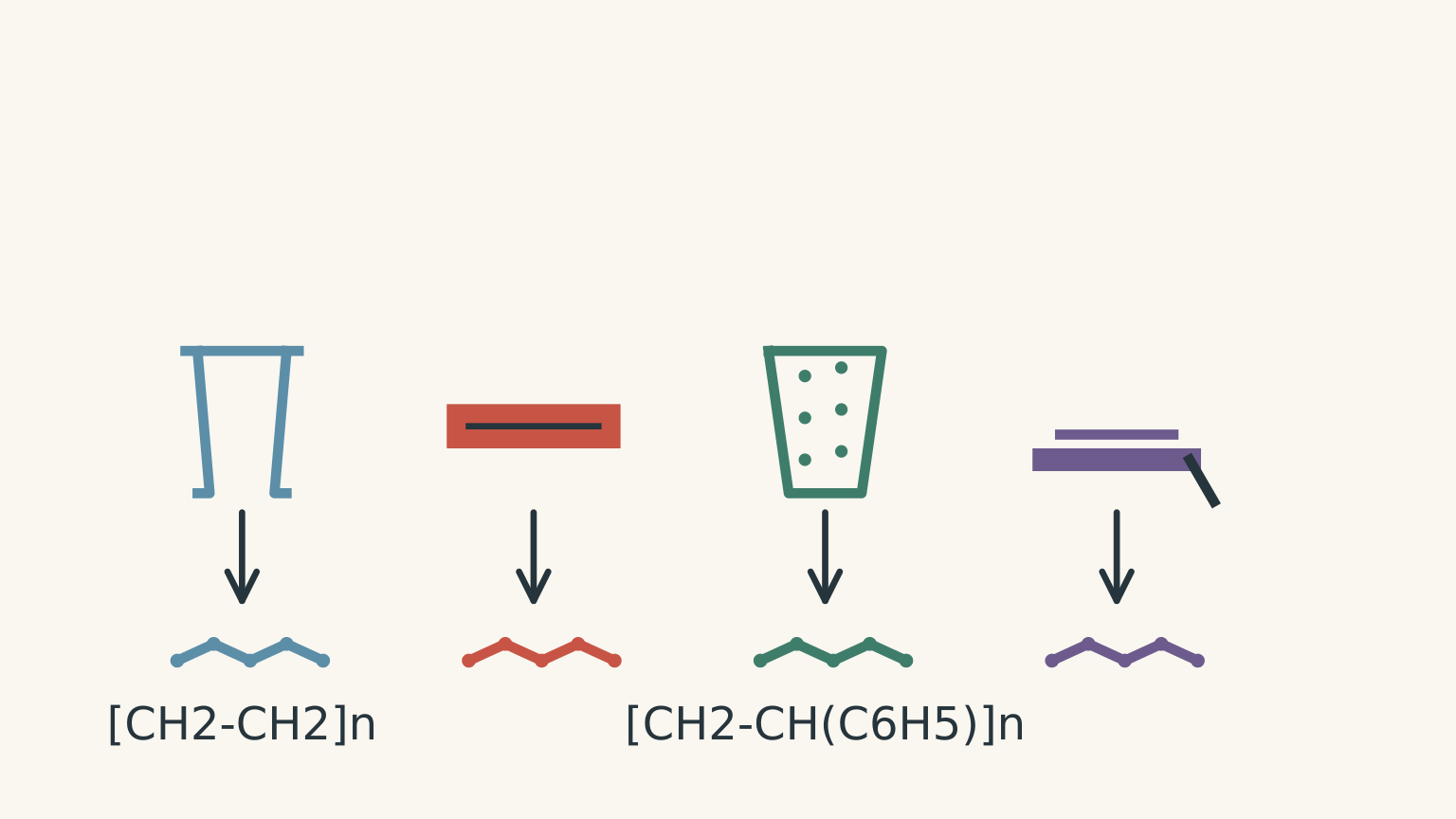
A student looks at a plastic shopping bag, a PVC pipe, a foam coffee cup, and a non-stick frying pan and sees four completely different materials. The surprising part is that they all begin with a similar chemical idea: small molecules joining together to form very long chains.
But if the starting idea is just “monomers join to make polymers”, it creates a problem. Why is a soft plastic bag flexible, while PTFE in a frying pan can survive high temperatures and resist almost everything?
Predict this: if two polymers are made by joining lots of carbon-based monomers into chains, should they have similar properties?
Not necessarily. The chain length, the atoms attached to the chain, and how the chains interact with each other can completely change the material.
01From small molecules to giant chains
A polymer is a very large molecule made from many repeating smaller molecules called monomers.
Think of a polymer like a long train. The monomers are the carriages, and polymerisation is the process of coupling the carriages together. A train made from identical carriages can still behave differently depending on the carriage design and how the trains pack together.
This analogy is useful because it shows why the repeating unit matters. However, polymers are not actual trains. Real polymer chains are flexible molecules that twist, bend, and interact through forces between atoms.
An addition polymer forms when unsaturated monomers containing a carbon-carbon double bond react together. The double bond opens, allowing the molecules to link into a long chain.
The general pattern is:
\[ \ce{n CH2=CHR -> [-CH2-CHR-]_{n}} \]
where:
- \(n\) is the number of monomer molecules joining together,
- \(R\) represents an atom or group of atoms attached to the carbon chain,
- the repeating unit inside the brackets is repeated many times.
The important idea is that the atoms in the original monomer do not disappear. They are rearranged into the polymer chain.
02Why does the double bond disappear?
A common first prediction is: “The carbon-carbon double bond must still be somewhere because it was in the monomer.”
That seems reasonable. The monomer starts with a \(C=C\) bond, so it feels like the polymer should contain lots of \(C=C\) bonds.
The opposite happens.
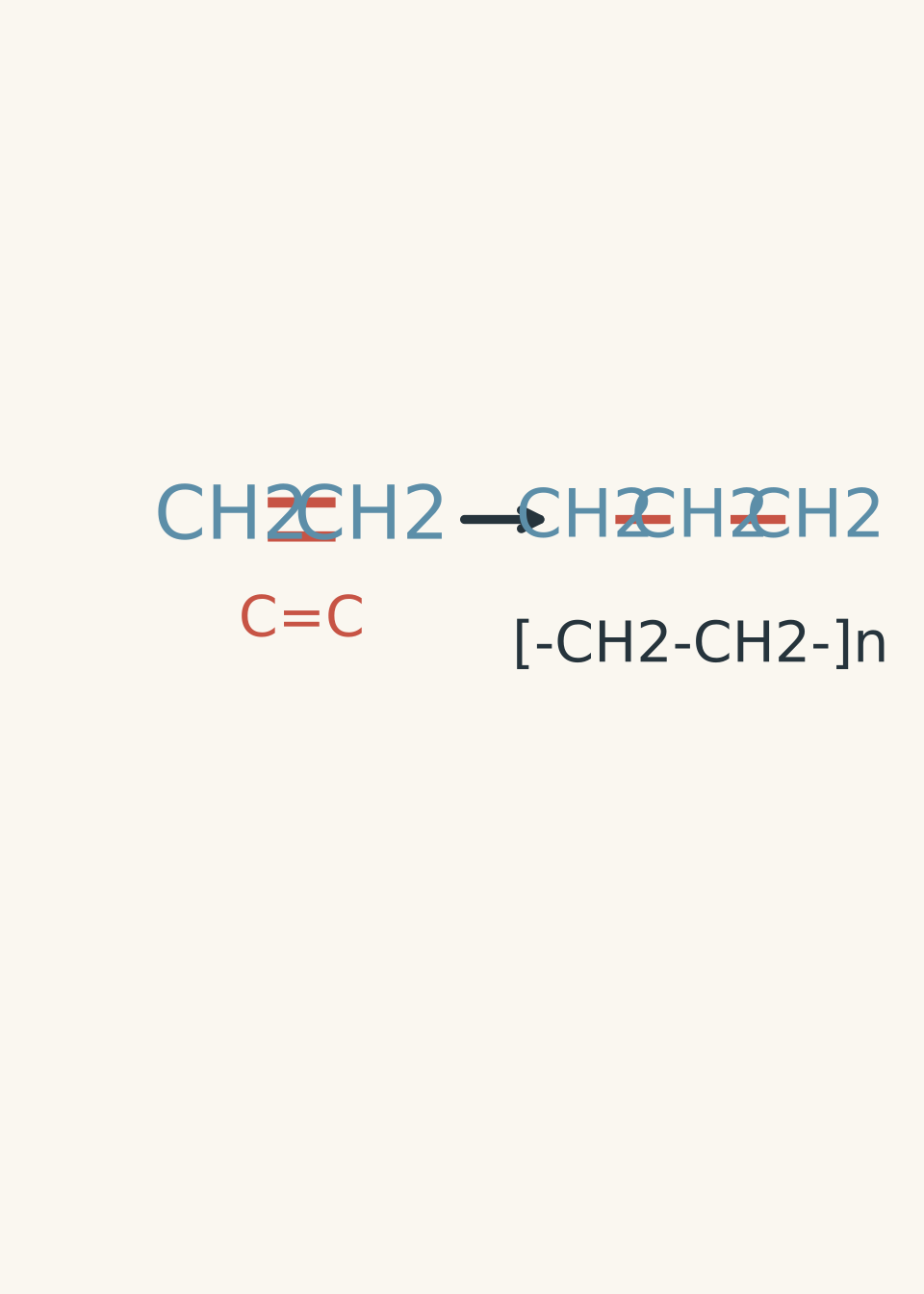
During addition polymerisation, the double bond breaks open. Each carbon uses its new bonding capacity to connect with neighbouring monomer molecules.
For example, ethene becomes polyethylene:
\[ \ce{n CH2=CH2 -> [-CH2-CH2-]_{n}} \]
The double bond in ethene becomes single bonds in the polymer backbone.
The simplified picture is:
- Ethene molecules contain \(C=C\).
- The double bonds open.
- Carbon atoms form new carbon-carbon single bonds.
- A long chain of repeating \(-CH_2-CH_2-\) units forms.
This is called addition polymerisation because the monomers add together without producing a small molecule by-product such as water.
03The first model is useful, but incomplete
At this stage, it is tempting to imagine a polymer as just a very long carbon chain. That model helps, but it misses the reason different plastics behave differently.
A more complete model asks three questions:
- What groups are attached to the chain?
- How closely can the chains pack together?
- How strongly do neighbouring chains attract each other?
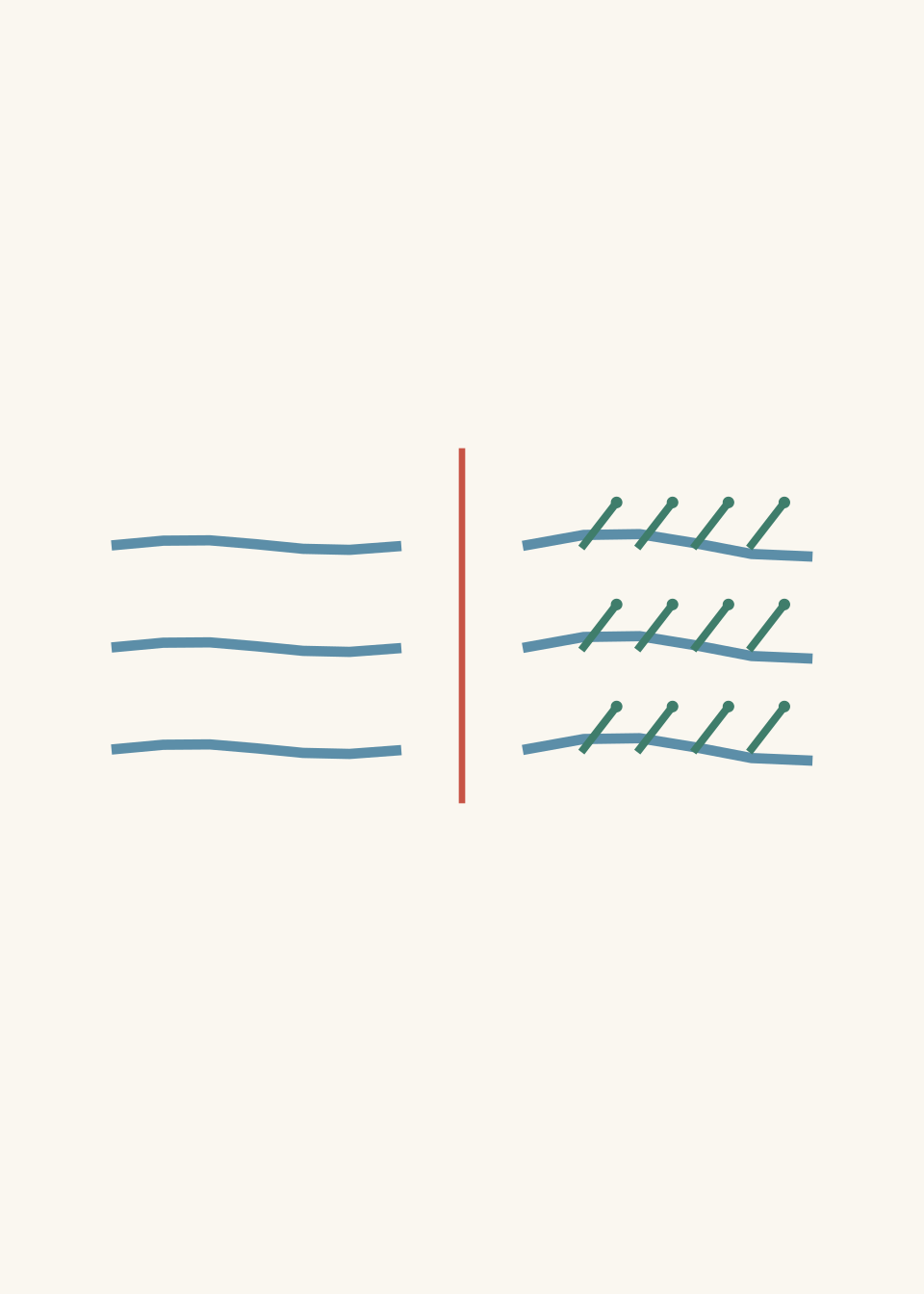
A polymer with straight chains that pack neatly often has stronger attractions between chains and may be more rigid.
A polymer with bulky side groups may stop chains from packing closely, making the material softer or less dense.
04Polyethylene (PE)
Polyethylene is made from ethene monomers.
\[ \ce{n CH2=CH2 -> [-CH2-CH2-]_{n}} \]
Its repeating unit contains only carbon and hydrogen atoms.
There are two common forms:
| Type | Structure | Properties | Uses |
|---|---|---|---|
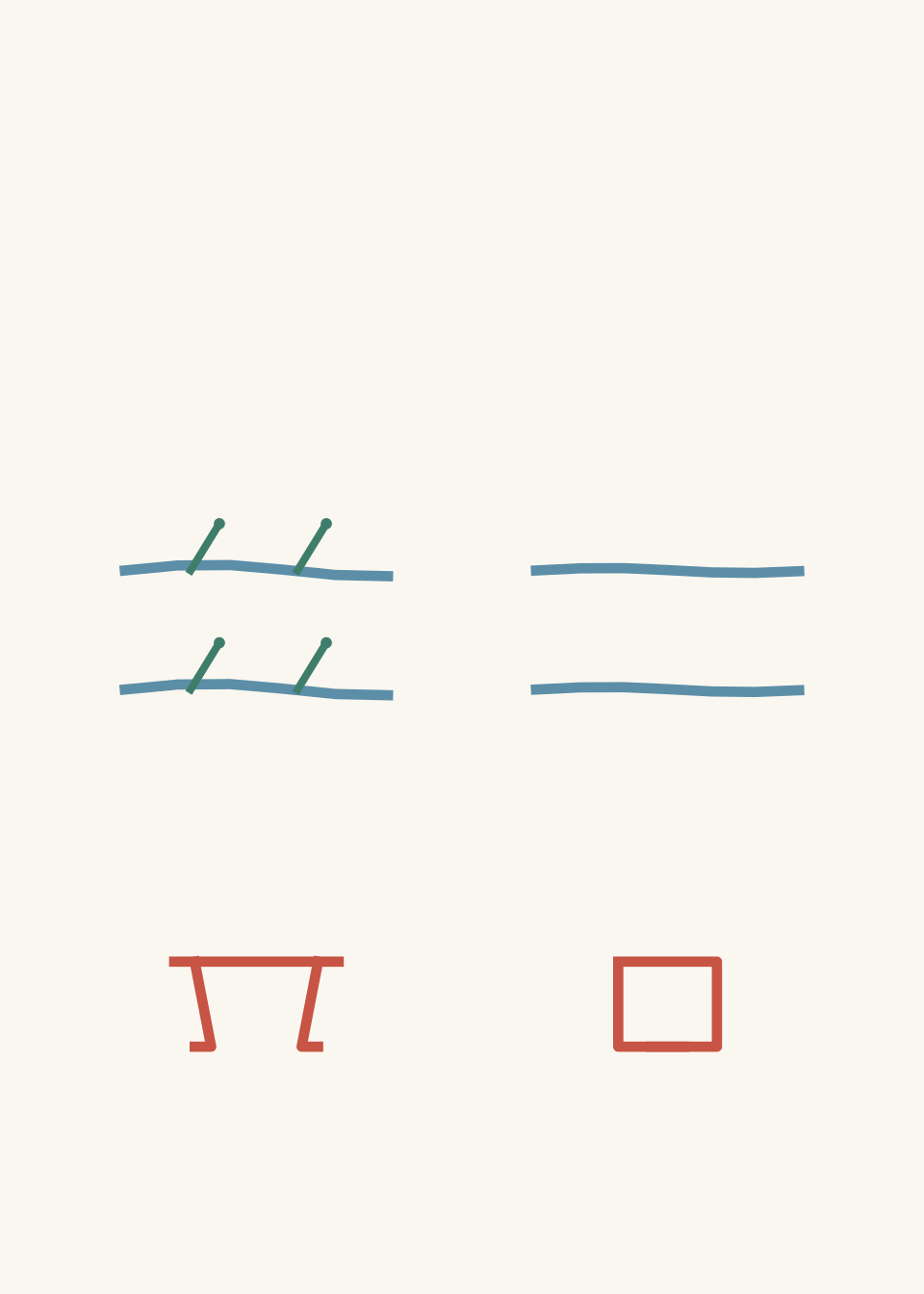
| Low-density polyethylene (LDPE) | More branching between chains | Flexible, lower density | Plastic bags, squeeze bottles |
| High-density polyethylene (HDPE) | More linear chains | Stronger, higher density | Milk bottles, pipes |
Why does branching matter?
Imagine trying to stack two piles of rope. Straight ropes can lie close together. Curly, tangled ropes leave more empty space. Polymer chains behave similarly.
More branching usually prevents close packing, reducing the strength of attractions between chains.
05Polyvinyl chloride (PVC)
PVC is made from chloroethene (also called vinyl chloride).
\[ \ce{n CH2=CHCl -> [-CH2-CHCl-]_{n}} \]
The repeating unit contains chlorine atoms attached to the carbon chain.
The chlorine atoms increase the mass of the polymer and affect how chains interact.
PVC is naturally rigid, but additives called plasticisers can make it flexible.
Rigid PVC is used for:
- pipes,
- window frames,
- construction materials.
Flexible PVC is used for:
- cable insulation,
- tubing,
- flooring.
A useful prediction: if chlorine atoms are larger than hydrogen atoms, will they make the polymer chain pack exactly like polyethylene?
No. The chlorine atoms change the spacing and interactions between chains, which changes the physical properties.

06Polystyrene (PS)
Polystyrene is made from styrene monomers.
\[ \ce{n C6H5CH=CH2 -> [-CH2-CH(C6H5)-]_{n}} \]
The key feature is the phenyl group (\(\ce{C6H5}\)) attached to the chain.
This large side group makes the polymer more rigid because the bulky groups restrict movement of the chain.
Polystyrene is used as:
- rigid packaging,
- disposable containers,
- expanded polystyrene foam.
Expanded polystyrene foam contains many trapped air spaces. The polymer itself is not simply “foam”; the structure contains gas pockets that reduce density and improve insulation.
07Polytetrafluoroethylene (PTFE)
PTFE is made from tetrafluoroethene (tetrafluoroethylene).
\[ \ce{n CF2=CF2 -> [-CF2-CF2-]_{n}} \]
PTFE is often known by the trade name Teflon.
The repeating unit has fluorine atoms surrounding the carbon backbone.
Fluorine atoms create very strong carbon-fluorine bonds. They also shield the carbon chain from chemical attack, which helps explain why PTFE is:
- chemically resistant,
- stable at high temperatures,
- very low friction.
This is why PTFE is used for non-stick coatings and specialised equipment.
08Comparing PE, PVC, PS and PTFE
The monomer structure gives a useful shortcut for predicting properties.
| Polymer | Important structural feature | Effect on properties | Common uses |
|---|---|---|---|
| PE | Only C and H atoms | Flexible, chemically resistant | Bags, bottles, pipes |
| PVC | Chlorine side groups | More rigid, stronger interactions | Pipes, insulation |
| PS | Large phenyl side groups | Rigid, less flexible | Packaging, foam |
| PTFE | Fluorine atoms around chain | Very stable, low friction | Non-stick coatings |
The trap is thinking that a stronger bond in one part of the molecule automatically means the whole material is stronger.
A material’s properties depend on the entire polymer structure, including chain packing and intermolecular forces.
09Worked example: identifying an addition polymer
Worked example: Determine the repeating unit formed from propene
Question: Propene, \(\ce{CH2=CHCH3}\), undergoes addition polymerisation. Draw the repeating unit of the polymer.
Step 1
The carbon-carbon double bond in propene is the reactive part of the monomer.
Step 2
The methyl group remains attached to the second carbon.
Step 3
\[ \ce{[-CH2-CH(CH3)-]_{n}} \]
The polymer is polypropylene. The methyl side group affects how the chains pack and therefore changes the properties compared with polyethylene.
10Worked example: comparing polymer structures
Worked example: Explain why PVC is generally more rigid than polyethylene.
Question: Polyethylene and PVC are both addition polymers. Explain why PVC is generally more rigid than polyethylene.
Step 1
Polyethylene contains:
\[ \ce{[-CH2-CH2-]_{n}} \]
PVC contains:
\[ \ce{[-CH2-CHCl-]_{n}} \]
PVC has chlorine atoms attached to the carbon chain.
Step 2
The chlorine atoms are larger than hydrogen atoms and increase interactions between neighbouring chains.
Step 3
The stronger interactions and altered chain packing make PVC less flexible and more rigid than polyethylene.
This does not mean PVC chains are “stronger” than polyethylene chains in every way. It means the arrangement of molecules creates different bulk properties.
11Worked example: predicting a polymer property
Worked example: Predict whether a polymer with bulky side groups is likely to be flexible or rigid.
Question: A new addition polymer has large side groups attached regularly along its carbon chain. Predict whether it is likely to be more flexible or more rigid than polyethylene.
Step 1
Large side groups take up space and can prevent chains from moving freely.
Step 2
Polyethylene has small hydrogen atoms, allowing the chains to rotate more easily.
Step 3
The new polymer is likely to be more rigid than polyethylene because bulky side groups restrict movement and change chain packing.
The exact result depends on the side group and the interactions it creates, so the structure must always be considered carefully.
12A quick method for HSC questions
When you are given a polymer structure, do not jump straight to memorised uses.
Use this order:
- Identify the atoms or groups attached to the carbon chain.
- Decide whether those groups increase or decrease chain movement.
- Consider whether chains can pack closely.
- Link structure to intermolecular forces.
- Predict the physical property.
- Connect the property to a use.
This approach works better than memorising “PVC = pipes” or “PTFE = frying pans” because exam questions often ask you to explain a new situation.
13Questions and solutions
Question 1
Ethene undergoes addition polymerisation to form polyethylene.
Write the repeating unit of polyethylene and explain what happens to the double bond during the reaction.
Solution 1
The repeating unit of polyethylene is \(\ce{[-CH2-CH2-]_{n}}\), and the double bond in ethene opens to allow carbon-carbon single bonds to form between monomer molecules.
The tempting mistake is to keep the \(C=C\) bond in the polymer. However, addition polymerisation uses the double bond as the reaction site. The carbon atoms use the available bonding positions to connect into a long chain, leaving single bonds in the polymer backbone.
Question 2
A student says:
“Polystyrene must be flexible because it is made by addition polymerisation in the same way as polyethylene.”
Evaluate this statement.
Solution 2
The statement is incorrect because polystyrene is generally more rigid than polyethylene due to its bulky phenyl side groups.
Both polymers form by addition polymerisation, but the polymerisation method does not determine all properties. Polystyrene contains large \(\ce{C6H5}\) groups attached to the chain. These groups restrict movement and affect chain packing, reducing flexibility.
The trap is assuming the same reaction type means the same material properties. The monomer structure is what controls the polymer structure.
Question 3
A manufacturer wants a polymer for electrical cable insulation. The material needs to be flexible and resistant to chemical attack.
Explain why PVC may be suitable for this purpose, and describe one change that could make PVC more flexible.
Solution 3
PVC is suitable because it is chemically resistant and can be made flexible by adding plasticisers.
The chlorine atoms in PVC contribute to its different interactions compared with polyethylene, and the polymer can resist many chemicals. However, pure PVC is relatively rigid because the chains interact strongly and do not move as easily.
Plasticisers are added between polymer chains to reduce the strength of interactions and allow the chains to move more freely. This increases flexibility.
The trap is thinking flexibility comes only from changing the monomer. Sometimes additives change the behaviour of an existing polymer.
Question 4
Two addition polymers are made from these monomers:
Polymer A: \(\ce{CH2=CH2}\)
Polymer B: \(\ce{CH2=CHCl}\)
A student predicts that Polymer B will have a lower melting point because chlorine makes the chain “less pure carbon”.
Explain why this prediction may be wrong.
Solution 4
Polymer B may have a higher melting point than Polymer A because chlorine changes intermolecular forces and chain packing.
The student’s prediction focuses only on the idea of “pure carbon” rather than the interactions between polymer chains. PVC contains polar carbon-chlorine bonds and larger side groups, which affect how chains attract and arrange themselves.
The exact melting behaviour depends on the polymer structure, but the key idea is that additional atoms can increase, not decrease, the strength of interactions between chains.
Question 5
A chemist designs a new addition polymer. It has the same carbon backbone pattern as polyethylene, but every hydrogen atom is replaced with fluorine atoms.
The chemist claims:
“Because it has the same carbon chain as polyethylene, it should behave like polyethylene.”
Assess this claim and predict the likely properties of the new polymer.
Solution 5
The claim is incorrect because replacing hydrogen with fluorine completely changes the polymer’s structure and interactions, producing properties more similar to PTFE than polyethylene.
The tempting route is to focus on the carbon backbone and ignore the surrounding atoms. The important constraint is that the atoms attached to the chain control how the polymer interacts with its environment.
Replacing hydrogen with fluorine creates strong carbon-fluorine bonds and a fluorine-rich outer surface. This can make the polymer highly chemically resistant, thermally stable, and low friction.
The deeper lesson is that a polymer is not defined only by its backbone. The side atoms create the final material behaviour. This is why polyethylene and PTFE can share a carbon-chain idea but have dramatically different uses.
14Where this idea leads next
Once you can connect monomer structure to polymer properties, the next step is understanding why some plastics can be reshaped when heated while others cannot. That difference comes from the way polymer chains are connected, leading into the distinction between thermoplastics and thermosetting polymers.