
Precipitation Titrations: Calculate an Unknown Concentration
Use silver nitrate titration data and mole ratios to calculate an unknown chloride concentration. Follow worked examples, then tackle five questions with complete solutions that explore dilution, endpoint errors, and the method’s limits.
A few drops of silver nitrate turn a clear chloride solution cloudy. Would stopping at the first white precipitate tell you its chloride concentration? No. The cloudiness shows that a reaction has started, not that enough silver ions have been added to account for the chloride in the sample. University of Canterbury
A precipitation titration turns that reaction into a measurement. You add a solution of known concentration, measure how much is needed, and use the reaction’s mole ratio to work backwards to the unknown concentration.
01Turn a reaction into an ion count
Imagine counting a heap of socks by attaching exactly one peg to each sock. Once every sock has a peg, the number of pegs used tells you the number of socks.
For chloride analysis, silver ions play the role of the pegs. Each chloride ion incorporated into silver chloride requires one silver ion:
\[ \ce{Ag+(aq) + Cl-(aq) -> AgCl(s)} \]
The state symbol \(\ce{(aq)}\) means dissolved in water, and \(\ce{(s)}\) means solid. Silver nitrate supplies the silver ions; its nitrate ions do not appear in this net ionic equation because they remain dissolved without participating in the precipitation reaction. University of Canterbury
The equation gives the counting rule: one mole of silver ions reacts with one mole of chloride ions. A mole is a counting unit for particles, so the same ratio applies whether you count individual ions or moles.
The peg model is only a counting analogy. Silver chloride forms an extended ionic solid, not isolated peg-and-sock pairs. Also, “insoluble” does not mean that absolutely no ions remain dissolved. Ordinary titration calculations treat precipitation as essentially complete under suitable conditions; we’ll examine that assumption later. OpenStax
02Find the finishing point-not the first solid
Start by using a pipette to transfer an accurately measured portion of the sample into a conical flask. This portion is called an aliquot.
Above the flask sits a burette containing the silver nitrate solution. The solution added from the burette is the titrant. Its concentration must be accurately known; such a solution is called a standard solution. Chloride is the analyte-the substance being measured. OpenStax
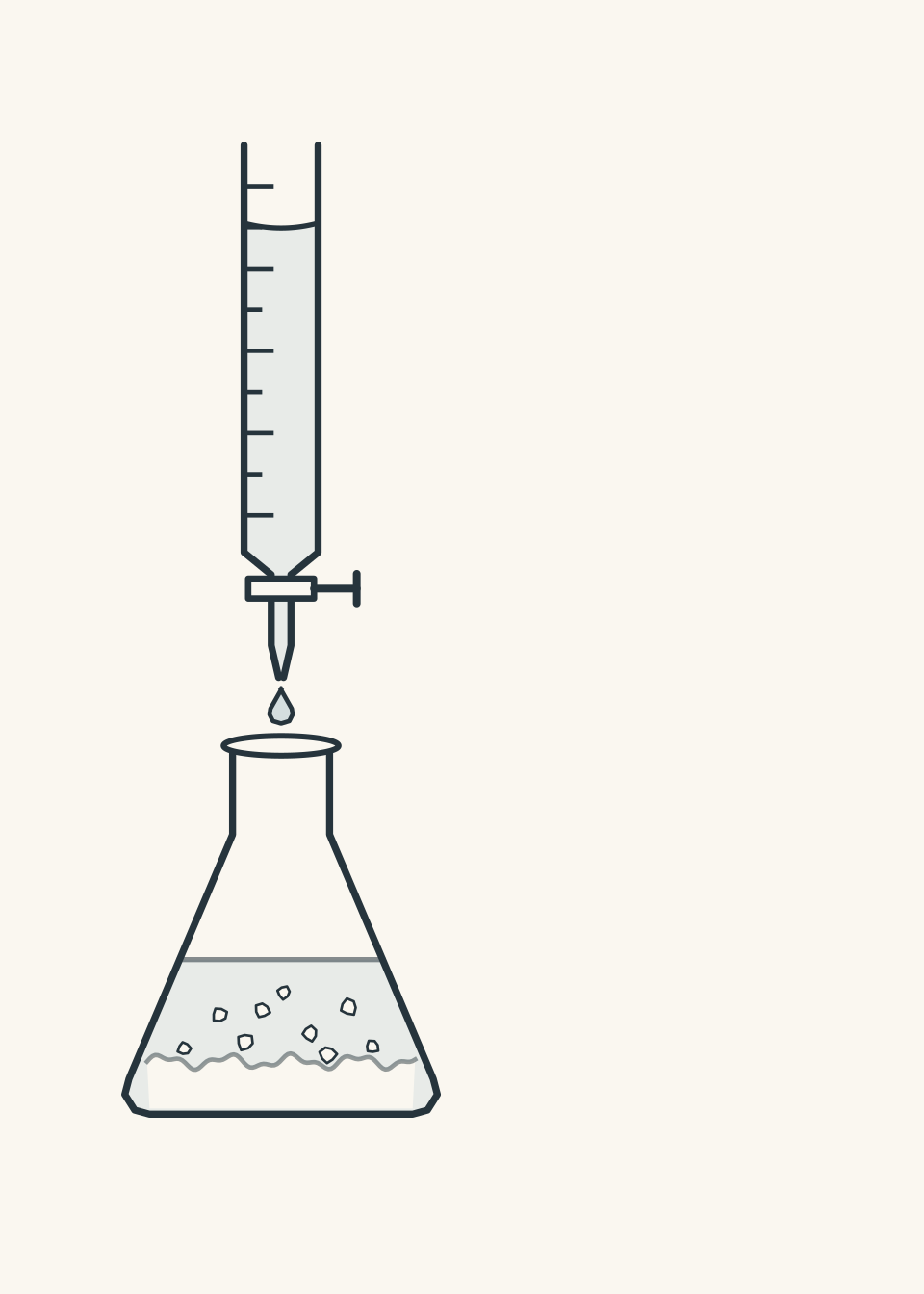
As you add titrant and swirl the flask, silver chloride forms. The important finishing point is not the first appearance of this solid.
The equivalence point is reached when the amounts of titrant added and analyte originally present match the balanced reaction’s mole ratio. The endpoint is the observable signal used to decide when to stop. A suitable method makes these points close enough for the required measurement. OpenStax
How the Mohr method signals the endpoint
In the Mohr method, a small amount of potassium chromate indicator is added to the sample. Near the equivalence point, a slight excess of silver ions produces a red-brown silver chromate precipitate:
\[ \ce{2Ag+(aq) + CrO4^2-(aq) -> Ag2CrO4(s)} \]
The endpoint is the first persistent red-brown appearance after mixing-not a temporary patch where a drop lands. The white silver chloride does not disappear. National Environmental Methods Index
Notice the two different ratios. The indicator reaction uses two silver ions per chromate ion, but the chloride calculation still uses one silver ion per chloride ion. Use the reaction involving the analyte, not whichever equation happens to show the colour change.
The method requires controlled conditions, including a suitable near-neutral to mildly alkaline pH. Chromate is carcinogenic, so this is a supervised laboratory method requiring appropriate protective equipment and waste handling, not a home experiment. University of Canterbury
03Calculate concentration from the titre
The titre is the volume delivered from the burette:
\[ V_{\mathrm{titre}}=V_{\mathrm{final\ reading}}-V_{\mathrm{initial\ reading}} \]
The burette does not have to start at zero.
To turn a delivered volume into an amount of substance, use \(n=cV\). Here, \(n\) is the amount in moles, \(\mathrm{mol}\); \(c\) is concentration in moles per litre, \(\mathrm{mol\,L^{-1}}\); and \(V\) is volume in litres, \(\mathrm{L}\). Convert millilitres to litres by dividing by \(1000\). Concentration is then found using \(c=n/V\). OpenStax
Keep the calculation in three connected moves:
Titrant volume → titrant moles → analyte moles → analyte concentration.
The balanced equation controls the middle step. The volume of sample represented by those analyte moles controls the last step.
Worked example: Find the chloride concentration
A \(25.00\ \mathrm{mL}\) chloride sample is titrated with \(0.0800\ \mathrm{mol\,L^{-1}}\) silver nitrate. The initial and final burette readings are \(1.35\ \mathrm{mL}\) and \(19.95\ \mathrm{mL}\). Determine the chloride concentration.
Assume chloride is the only reacting sample ion, precipitation is essentially complete, and endpoint error is negligible.
Step 1
\[ V_{\mathrm{titre}} =19.95-1.35 =18.60\ \mathrm{mL} =0.01860\ \mathrm{L} \]
Step 2
Each mole of dissolved silver nitrate supplies one mole of silver ions.
\[ n(\mathrm{Ag}^{+}) =cV =(0.0800\ \mathrm{mol\,L^{-1}})(0.01860\ \mathrm{L}) =1.488\times10^{-3}\ \mathrm{mol} \]
Keep these extra digits during working, then round the final result.
Step 3
From \(\ce{Ag+ + Cl- -> AgCl}\), the ratio is \(1:1\). Therefore, the original aliquot contained \(1.488\times10^{-3}\ \mathrm{mol}\) of chloride.
Step 4
\[ c(\mathrm{Cl}^{-}) =\frac{n(\mathrm{Cl}^{-})}{V_{\mathrm{aliquot}}} =\frac{1.488\times10^{-3}\ \mathrm{mol}}{0.02500\ \mathrm{L}} =0.05952\ \mathrm{mol\,L^{-1}} \]
The chloride concentration is \(0.0595\ \mathrm{mol\,L^{-1}}\), to three significant figures.
This describes the sample before titration. It is not the concentration of chloride left dissolved in the flask at the endpoint.
04Dilution changes concentration, not the ions already collected
Suppose you pipette a chloride aliquot into a flask, then add some pure water. Predict what happens to the amount of silver nitrate required: does it increase, decrease, or stay the same?
The stoichiometric requirement stays the same. The water spreads out the chloride ions but does not add or remove any. This predicts the same titre provided precipitation remains essentially complete and the endpoint remains reliable.
That qualification matters. Keeping the same number of ions does not guarantee that a method will work at every possible dilution.
There are two different operations to keep separate:
| Operation | Effect on the calculation |
|---|---|
| Dilute a sample, then take an aliquot | The aliquot contains fewer analyte moles than the same volume of the original sample. Account for the dilution. |
| Take an aliquot, then add pure water to its flask | The aliquot’s analyte moles are unchanged. Do not replace its measured volume with the total flask volume when calculating its original concentration. |
Dilution calculations follow conservation of solute amount: increasing the solution volume decreases its concentration by the same factor. OpenStax
Worked example: Undo a dilution and account for two chlorides
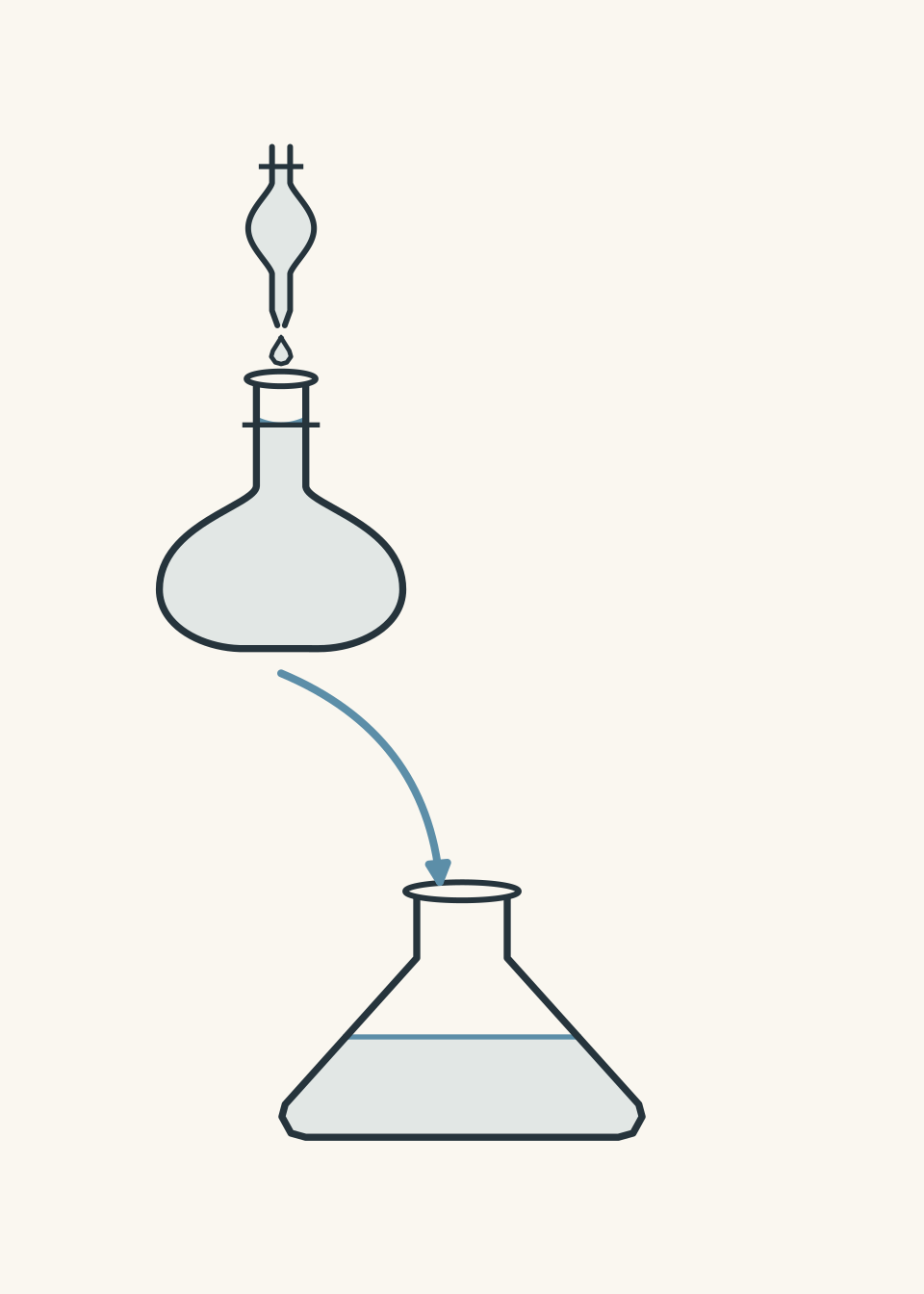
A \(20.00\ \mathrm{mL}\) sample of calcium chloride solution is diluted to \(250.0\ \mathrm{mL}\) in a volumetric flask and mixed thoroughly.
A \(25.00\ \mathrm{mL}\) aliquot of the diluted solution is transferred to a conical flask. After adding \(40\ \mathrm{mL}\) of pure water, it requires \(16.40\ \mathrm{mL}\) of \(0.05000\ \mathrm{mol\,L^{-1}}\) silver nitrate.
Determine the calcium chloride concentration in the original sample. Assume calcium chloride is the only source of chloride, and the endpoint accurately represents the stoichiometric requirement.
Step 1
The silver-to-chloride ratio is \(1:1\).
\[ \begin{aligned} n(\mathrm{Ag}^{+}) &=(0.05000\ \mathrm{mol\,L^{-1}})(0.01640\ \mathrm{L})\\ &=8.200\times10^{-4}\ \mathrm{mol}\\ n(\mathrm{Cl}^{-}) &=8.200\times10^{-4}\ \mathrm{mol} \end{aligned} \]
Step 2
Each formula unit of \(\ce{CaCl2}\) supplies two chloride ions. The amount of calcium chloride represented by the aliquot is therefore half its chloride amount:
\[ n(\ce{CaCl2}) =\frac{8.200\times10^{-4}}{2} =4.100\times10^{-4}\ \mathrm{mol} \]
The silver-to-chloride ratio is still \(1:1\). The factor of two comes from the salt’s formula.
Step 3
\[ c_{\mathrm{diluted}} =\frac{4.100\times10^{-4}\ \mathrm{mol}}{0.02500\ \mathrm{L}} =0.01640\ \mathrm{mol\,L^{-1}} \]
Use \(25.00\ \mathrm{mL}\), not \(65\ \mathrm{mL}\). The added water did not change the amount originally present in that aliquot.
Step 4
The original \(20.00\ \mathrm{mL}\) was spread through \(250.0\ \mathrm{mL}\), a volume increase by a factor of \(12.50\).
\[ \begin{aligned} c_{\mathrm{original}} &=c_{\mathrm{diluted}} \frac{V_{\mathrm{final\ dilution}}}{V_{\mathrm{original\ portion}}}\\ &=(0.01640\ \mathrm{mol\,L^{-1}}) \frac{250.0\ \mathrm{mL}}{20.00\ \mathrm{mL}}\\ &=0.2050\ \mathrm{mol\,L^{-1}} \end{aligned} \]
The original calcium chloride concentration is \(0.2050\ \mathrm{mol\,L^{-1}}\). Its chloride concentration is twice this: \(0.4100\ \mathrm{mol\,L^{-1}}\).
05Know what your titre is actually counting
Correct for reagent demand when required
A blank contains the relevant reagents but no sample analyte. It can measure titrant demand that should not be attributed to the sample.
When the method specifies a valid, matched blank correction, use \(V_{\mathrm{corrected}}=V_{\mathrm{sample}}-V_{\mathrm{blank}}\). The two volumes must use the same units. A blank is method-dependent; subtracting one cannot repair every possible problem with a titration. National Environmental Methods Index
Repeat titrations should give closely agreeing, or concordant, titres. Follow the specified agreement criterion and average the accepted titres rather than automatically including a rough trial. Agreement supports repeatability, but the same systematic error can occur in every trial. University of Canterbury
Another ion can use up your silver
Silver ions also precipitate bromide:
\[ \ce{Ag+(aq) + Br-(aq) -> AgBr(s)} \]
A titration that precipitates both chloride and bromide measures their combined silver demand. Treating all that demand as chloride overestimates chloride. A clear endpoint does not, by itself, establish which ions consumed the titrant. National Environmental Methods Index
“Insoluble” still allows dissolved ions
For a dilute solution in equilibrium with solid silver chloride, the concentration-based solubility relation is:
\[ K_{\mathrm{sp}}=[\mathrm{Ag}^{+}][\mathrm{Cl}^{-}] \]
Here, \(K_{\mathrm{sp}}\) is the solubility product at the stated temperature. Square brackets mean dissolved-ion concentration in \(\mathrm{mol\,L^{-1}}\). This is the usual dilute-solution approximation.
When solid is absent, the solution can be unsaturated: the product of the dissolved-ion concentrations is below \(K_{\mathrm{sp}}\), rather than equal to it. Do not impose the equality without establishing that the relevant solid is present at equilibrium. OpenStax
06Questions and solutions
Question 1
A \(50.00\ \mathrm{mL}\) chloride sample requires \(14.75\ \mathrm{mL}\) of \(0.02000\ \mathrm{mol\,L^{-1}}\) silver nitrate.
Write the net ionic equation and calculate the chloride concentration. Assume complete precipitation for calculation purposes and negligible endpoint error.
Solution 1
The chloride concentration is \(5.900\times10^{-3}\ \mathrm{mol\,L^{-1}}\).
The reaction is \(\ce{Ag+(aq) + Cl-(aq) -> AgCl(s)}\), so equal amounts of silver and chloride react.
\[ \begin{aligned} n(\mathrm{Ag}^{+}) &=cV\\ &=(0.02000\ \mathrm{mol\,L^{-1}})(0.01475\ \mathrm{L})\\ &=2.950\times10^{-4}\ \mathrm{mol}\\ n(\mathrm{Cl}^{-}) &=2.950\times10^{-4}\ \mathrm{mol}\\ c(\mathrm{Cl}^{-}) &=\frac{2.950\times10^{-4}\ \mathrm{mol}}{0.05000\ \mathrm{L}}\\ &=5.900\times10^{-3}\ \mathrm{mol\,L^{-1}} \end{aligned} \]
The titre tells you how much chloride was present; the aliquot volume turns that amount into a concentration. Dividing by the titre instead would use the wrong solution’s volume.
Question 2
An analyst first determines the concentration of a silver nitrate solution using \(20.00\ \mathrm{mL}\) of \(0.04000\ \mathrm{mol\,L^{-1}}\) sodium chloride. The observed titre is \(20.20\ \mathrm{mL}\).
The same silver nitrate then gives an observed titre of \(12.70\ \mathrm{mL}\) for a \(25.00\ \mathrm{mL}\) unknown chloride sample.
A valid blank correction is \(0.20\ \mathrm{mL}\) in each titration.
Determine the unknown chloride concentration. Another analyst ignores the blank in both calculations, claiming that the errors cancel. Evaluate that claim quantitatively.
Solution 2
The unknown chloride concentration is \(0.02000\ \mathrm{mol\,L^{-1}}\). Ignoring both blanks gives approximately \(0.02012\ \mathrm{mol\,L^{-1}}\), which is \(0.594\%\) too high. The errors oppose each other but do not cancel.
Step 1: Determine the corrected silver nitrate concentration.
The standard chloride amount is known:
\[ \begin{aligned} n(\mathrm{Cl}^{-}) &=(0.04000\ \mathrm{mol\,L^{-1}})(0.02000\ \mathrm{L})\\ &=8.000\times10^{-4}\ \mathrm{mol}\\ V_{\mathrm{corrected}} &=20.20-0.20=20.00\ \mathrm{mL}\\ c(\ce{AgNO3}) &=\frac{8.000\times10^{-4}\ \mathrm{mol}}{0.02000\ \mathrm{L}}\\ &=0.04000\ \mathrm{mol\,L^{-1}} \end{aligned} \]
Step 2: Use the corrected unknown titre.
\[ \begin{aligned} V_{\mathrm{corrected}} &=12.70-0.20=12.50\ \mathrm{mL}\\ n(\mathrm{Cl}^{-}) &=(0.04000\ \mathrm{mol\,L^{-1}})(0.01250\ \mathrm{L})\\ &=5.000\times10^{-4}\ \mathrm{mol}\\ c(\mathrm{Cl}^{-}) &=\frac{5.000\times10^{-4}\ \mathrm{mol}}{0.02500\ \mathrm{L}}\\ &=0.02000\ \mathrm{mol\,L^{-1}} \end{aligned} \]
Step 3: Follow the uncorrected calculation rather than guessing its direction.
Ignoring the standard’s blank makes the calculated titrant concentration too low. Using the unknown’s full titre then makes the inferred analyte amount too high.
Together, these produce:
\[ \begin{aligned} c_{\mathrm{uncorrected}} &=\frac{(8.000\times10^{-4}\ \mathrm{mol})/(0.02020\ \mathrm{L}) \times0.01270\ \mathrm{L}}{0.02500\ \mathrm{L}}\\ &=0.0201188\ldots\ \mathrm{mol\,L^{-1}}\\ \text{Percentage overestimate} &=\frac{0.0201188\ldots-0.02000}{0.02000}\times100\\ &=0.594\% \end{aligned} \]
The same extra volume is a different fraction of the two corrected titres. Equal absolute errors are not automatically equal relative errors.
Question 3
A sample may contain both chloride and bromide. Under the specified conditions, silver nitrate precipitates both ions quantitatively, each in a \(1:1\) ratio.
Repeated titrations of \(25.00\ \mathrm{mL}\) aliquots with \(0.05000\ \mathrm{mol\,L^{-1}}\) silver nitrate give closely agreeing titres averaging \(20.00\ \mathrm{mL}\). The blank is negligible.
A fresh \(25.00\ \mathrm{mL}\) aliquot is then spiked with \(2.500\times10^{-4}\ \mathrm{mol}\) of known chloride. Its titre is \(25.00\ \mathrm{mL}\).
An analyst claims that the repeatability and correct response to added chloride prove that the original chloride concentration was \(0.04000\ \mathrm{mol\,L^{-1}}\).
Evaluate the claim using two different original compositions consistent with all the results. Explain what further measurement is needed.
Solution 3
The results establish a combined chloride-plus-bromide concentration of \(0.04000\ \mathrm{mol\,L^{-1}}\), not a uniquely determined chloride concentration.
The unspiked aliquot consumes:
\[ n(\mathrm{Ag}^{+}) =(0.05000\ \mathrm{mol\,L^{-1}})(0.02000\ \mathrm{L}) =1.000\times10^{-3}\ \mathrm{mol} \]
Therefore,
\[ c(\mathrm{Cl}^{-})+c(\mathrm{Br}^{-}) =\frac{1.000\times10^{-3}\ \mathrm{mol}}{0.02500\ \mathrm{L}} =0.04000\ \mathrm{mol\,L^{-1}} \]
Two possible original compositions are:
| Chloride concentration | Bromide concentration |
|---|---|
| \(0.04000\ \mathrm{mol\,L^{-1}}\) | \(0\ \mathrm{mol\,L^{-1}}\) |
| \(0.03000\ \mathrm{mol\,L^{-1}}\) | \(0.01000\ \mathrm{mol\,L^{-1}}\) |
Both produce the same unspiked titre. Both also produce the observed extra titre after adding chloride:
\[ \Delta V =\frac{n_{\mathrm{added\ chloride}}}{c(\ce{AgNO3})} =\frac{2.500\times10^{-4}\ \mathrm{mol}} {0.05000\ \mathrm{mol\,L^{-1}}} =0.005000\ \mathrm{L} =5.000\ \mathrm{mL} \]
The spike tests the response to additional chloride. It does not identify what consumed the original silver nitrate.
The tempting route is to treat several successful checks as proof of selectivity. But none of these checks separates the original chloride contribution from the original bromide contribution.
An independent bromide-selective measurement would allow its concentration to be subtracted from the combined result. Alternatively, a validated separation must remove bromide without losing chloride or introducing extra chloride. Simply repeating or diluting the sample supplies no new information about that split.
Question 4
Continue with the sample in Question 3, which contains \(1.000\times10^{-3}\ \mathrm{mol}\) of combined chloride and bromide per \(25.00\ \mathrm{mL}\).
To remove bromide, an analyst stirs a fresh aliquot with \(0.07166\ \mathrm{g}\) of solid silver chloride until equilibrium is reached. The recovered dry solid weighs \(0.08944\ \mathrm{g}\). The combined filtrate and washings still require \(20.00\ \mathrm{mL}\) of \(0.05000\ \mathrm{mol\,L^{-1}}\) silver nitrate.
Only \(\ce{AgCl}\) and \(\ce{AgBr}\) can be present in the recovered solid. No solid is lost, and separation and washing cause negligible further reaction. Neglect dissolved silver in mole balances.
Use molar masses \(M(\ce{AgCl})=143.32\ \mathrm{g\,mol^{-1}}\) and \(M(\ce{AgBr})=187.77\ \mathrm{g\,mol^{-1}}\). At the experimental temperature,
\[ \frac{K_{\mathrm{sp}}(\ce{AgCl})}{K_{\mathrm{sp}}(\ce{AgBr})} =3.60\times10^2 \]
Determine the original chloride and bromide concentrations. Explain whether bromide removal was complete and why the unchanged titre does not mean the treatment did nothing.
Solution 4
The original concentrations were approximately \(0.0239\ \mathrm{mol\,L^{-1}}\) chloride and \(0.0161\ \mathrm{mol\,L^{-1}}\) bromide. Bromide removal was incomplete. The titre stayed the same because bromide removed from solution was replaced by chloride released from the solid.
Step 1: Identify what the mass gain measures.
The relevant exchange is:
\[ \ce{AgCl(s) + Br-(aq) <=> AgBr(s) + Cl-(aq)} \]
Replacing chloride with heavier bromide increases the solid’s mass without changing the number of silver ions in it.
Initially,
\[ n(\ce{AgCl}) =\frac{m}{M} =\frac{0.07166\ \mathrm{g}}{143.32\ \mathrm{g\,mol^{-1}}} =5.000\times10^{-4}\ \mathrm{mol} \]
Here, \(m\) is mass and \(M\) is molar mass. The amount converted is:
\[ \begin{aligned} n_{\mathrm{converted}} &=\frac{\text{mass increase}} {M(\ce{AgBr})-M(\ce{AgCl})}\\ &=\frac{0.08944-0.07166\ \mathrm{g}} {187.77-143.32\ \mathrm{g\,mol^{-1}}}\\ &=4.000\times10^{-4}\ \mathrm{mol} \end{aligned} \]
Thus, \(1.000\times10^{-4}\ \mathrm{mol}\) of silver chloride remains alongside the silver bromide.
Dividing the entire recovered mass by \(M(\ce{AgBr})\) would incorrectly assume that every part of the solid had been converted.
Step 2: Use the fact that both solids remain.
Both solids are in equilibrium with the same solution and therefore the same dissolved silver concentration:
\[ \begin{aligned} \frac{K_{\mathrm{sp}}(\ce{AgCl})}{K_{\mathrm{sp}}(\ce{AgBr})} &=\frac{[\mathrm{Ag}^{+}][\mathrm{Cl}^{-}]} {[\mathrm{Ag}^{+}][\mathrm{Br}^{-}]}\\ &=\frac{[\mathrm{Cl}^{-}]}{[\mathrm{Br}^{-}]}\\ &=360 \end{aligned} \]
The equilibrium solution contains 360 chloride ions for every bromide ion. The ratio is large, but it is not infinite.
Step 3: Track the total dissolved halide amount.
Each bromide ion entering the solid releases one chloride ion. The combined dissolved amount therefore remains \(1.000\times10^{-3}\ \mathrm{mol}\).
Consequently,
\[ n_{\mathrm{Br,\ final}} =\frac{1.000\times10^{-3}\ \mathrm{mol}}{361} =2.770\times10^{-6}\ \mathrm{mol} \]
This non-zero amount establishes that bromide removal was incomplete.
Step 4: Reconstruct the original sample.
Original bromide equals bromide transferred into the solid plus bromide still dissolved:
\[ \begin{aligned} n_{\mathrm{Br,\ original}} &=4.000\times10^{-4}+2.770\times10^{-6}\\ &=4.02770\times10^{-4}\ \mathrm{mol}\\ c_{\mathrm{Br,\ original}} &=\frac{4.02770\times10^{-4}\ \mathrm{mol}}{0.02500\ \mathrm{L}}\\ &\approx0.0161\ \mathrm{mol\,L^{-1}}\\ c_{\mathrm{Cl,\ original}} &=\frac{1.000\times10^{-3}-4.02770\times10^{-4}\ \mathrm{mol}} {0.02500\ \mathrm{L}}\\ &\approx0.0239\ \mathrm{mol\,L^{-1}} \end{aligned} \]
The treatment substantially changed the dissolved composition. However, it conserved the total number of chloride-plus-bromide ions, so it conserved their total silver demand.
The new information came from the solid’s mass change and the equilibrium constraint. The unchanged titre alone could not reveal the original composition.
Question 5
An idealised method uses a silver-ion detector rather than chromate. It signals whenever the dissolved silver concentration reaches \(3.00\times10^{-5}\ \mathrm{mol\,L^{-1}}\).
The titrant is \(3.00\times10^{-4}\ \mathrm{mol\,L^{-1}}\) silver nitrate. Two identical \(10.00\ \mathrm{mL}\) aliquots of an unknown chloride solution give these results:
| Run | Liquid present before titration | Titre |
|---|---|---|
| A | \(10.00\ \mathrm{mL}\) sample | \(2.00\ \mathrm{mL}\) |
| B | \(10.00\ \mathrm{mL}\) sample diluted to \(90.00\ \mathrm{mL}\) | \(10.00\ \mathrm{mL}\) |
| Blank | \(90.00\ \mathrm{mL}\) pure water | \(10.00\ \mathrm{mL}\) |
Use \(K_{\mathrm{sp}}(\ce{AgCl})=1.80\times10^{-10}\), with concentrations entered in \(\mathrm{mol\,L^{-1}}\). Volumes add, equilibrium is reached after each addition, and silver chloride is the only possible solid.
Determine the original chloride concentration and establish whether solid is present at each sample’s endpoint. Explain the different titres despite identical initial chloride amounts.
Finally, find the range of chloride concentrations consistent with Run B and the blank alone, and evaluate whether subtracting the blank gives a valid chloride result here.
Solution 5
The original chloride concentration is \(3.12\times10^{-5}\ \mathrm{mol\,L^{-1}}\). Solid silver chloride is present at A’s endpoint but absent at B’s endpoint.
Run B and the blank alone permit any original chloride concentration from zero to \(6.00\times10^{-5}\ \mathrm{mol\,L^{-1}}\). Their equal titres do not prove that chloride is absent, and subtracting the blank does not give a valid chloride determination here.
Step 1: Establish whether A contains solid before using \(K_{\mathrm{sp}}\).
Run A receives:
\[ n_{\mathrm{Ag,\ added}} =(3.00\times10^{-4}\ \mathrm{mol\,L^{-1}})(0.00200\ \mathrm{L}) =6.00\times10^{-7}\ \mathrm{mol} \]
Its final volume is \(0.01200\ \mathrm{L}\). The detector tells us the dissolved silver concentration, so:
\[ n_{\mathrm{Ag,\ dissolved}} =(3.00\times10^{-5}\ \mathrm{mol\,L^{-1}})(0.01200\ \mathrm{L}) =3.60\times10^{-7}\ \mathrm{mol} \]
The remaining silver must be in solid silver chloride:
\[ n(\ce{AgCl}) =6.00\times10^{-7}-3.60\times10^{-7} =2.40\times10^{-7}\ \mathrm{mol} \]
This positive amount establishes that solid is present.
Step 2: Count chloride in both the solid and the solution.
Because solid is present at equilibrium,
\[ [\mathrm{Cl}^{-}] =\frac{K_{\mathrm{sp}}}{[\mathrm{Ag}^{+}]} =\frac{1.80\times10^{-10}}{3.00\times10^{-5}} =6.00\times10^{-6}\ \mathrm{mol\,L^{-1}} \]
The original chloride amount includes the chloride that never left solution:
\[ \begin{aligned} n_{\mathrm{Cl,\ dissolved}} &=(6.00\times10^{-6}\ \mathrm{mol\,L^{-1}})(0.01200\ \mathrm{L})\\ &=7.20\times10^{-8}\ \mathrm{mol}\\ n_{\mathrm{Cl,\ original}} &=2.40\times10^{-7}+7.20\times10^{-8}\\ &=3.12\times10^{-7}\ \mathrm{mol}\\ c_{\mathrm{Cl,\ original}} &=\frac{3.12\times10^{-7}\ \mathrm{mol}}{0.01000\ \mathrm{L}}\\ &=3.12\times10^{-5}\ \mathrm{mol\,L^{-1}} \end{aligned} \]
The tempting shortcut \(n(\mathrm{Cl}^{-})=n(\mathrm{Ag}^{+})_{\mathrm{added}}\) fails. Some added silver is still dissolved, and some original chloride is also still dissolved.
Step 3: Account for B without assuming that it contains precipitate.
Run B receives:
\[ n_{\mathrm{Ag,\ added}} =(3.00\times10^{-4}\ \mathrm{mol\,L^{-1}})(0.01000\ \mathrm{L}) =3.00\times10^{-6}\ \mathrm{mol} \]
Its final volume is \(0.10000\ \mathrm{L}\). At the detector signal, its dissolved silver amount is:
\[ n_{\mathrm{Ag,\ dissolved}} =(3.00\times10^{-5}\ \mathrm{mol\,L^{-1}})(0.10000\ \mathrm{L}) =3.00\times10^{-6}\ \mathrm{mol} \]
All the added silver is accounted for in solution. None is in solid.
All chloride therefore remains dissolved, at:
\[ [\mathrm{Cl}^{-}] =\frac{3.12\times10^{-7}\ \mathrm{mol}}{0.10000\ \mathrm{L}} =3.12\times10^{-6}\ \mathrm{mol\,L^{-1}} \]
Using the stated concentration convention, the ion product is:
\[ [\mathrm{Ag}^{+}][\mathrm{Cl}^{-}] =(3.00\times10^{-5})(3.12\times10^{-6}) =9.36\times10^{-11} <K_{\mathrm{sp}} \]
The absence of solid is consistent with equilibrium. In fact, B remains too dilute to precipitate silver chloride before the detector signals.
Its larger titre mainly reflects the silver required to reach the detector’s concentration threshold in a larger liquid volume. The signal is no longer measuring essentially complete chloride precipitation.
Step 4: Find what B alone can establish.
At B’s endpoint, dissolved chloride can be no greater than the saturation value:
\[ [\mathrm{Cl}^{-}]_{\mathrm{maximum}} =\frac{1.80\times10^{-10}}{3.00\times10^{-5}} =6.00\times10^{-6}\ \mathrm{mol\,L^{-1}} \]
Across the final \(0.10000\ \mathrm{L}\), this permits up to \(6.00\times10^{-7}\ \mathrm{mol}\) of chloride. That amount originally came from \(0.01000\ \mathrm{L}\):
\[ 0\leq c_{\mathrm{original}} \leq\frac{6.00\times10^{-7}\ \mathrm{mol}}{0.01000\ \mathrm{L}} =6.00\times10^{-5}\ \mathrm{mol\,L^{-1}} \]
At the upper boundary, the solution is just saturated. Below it, chloride can be present while producing exactly the blank’s titre.
Subtracting \(10.00-10.00\ \mathrm{mL}\) gives zero because the detector response is insensitive to chloride across this range-not because every sample in the range contains zero chloride.
07From a concentration to a defensible result
A precipitation titration determines concentration only when its measured silver demand can be connected to the original analyte amount. The balanced equation supplies the ratio; sample preparation, competing ions, and endpoint chemistry determine whether that ratio has been applied to the right measurement.
Before using a chloride result to judge a water sample, establish what the method actually counted. The next step is connecting that defensible concentration to sampling conditions, comparison values, and an appropriate response, as developed in tutorgum’s Environmental Chemical Monitoring: From Results to Decisions.