
How to Derive Ksp Expressions for HSC Chemistry
Learn how to derive solubility-product expressions from balanced dissolution equations, use stoichiometry correctly, and avoid common Ksp mistakes.
Imagine a beaker containing a little solid \(\ce{AgCl}\) at the bottom and a clear solution above it. The solution is already saturated. If you add another spoonful of solid \(\ce{AgCl}\), will the concentration of \(\mathrm{Ag}^{+}\) in the water increase?
It feels like it should. More solid seems as though it should mean more dissolved ions. But at the same temperature, once equilibrium has been reached, adding more pure solid does not change the equilibrium ion concentrations. It just gives the system a bigger reservoir of solid.
That is the problem the solubility product, \(K_{sp}\), helps us describe: what combination of dissolved ion concentrations can coexist with a sparingly soluble ionic solid at equilibrium?
01Saturation is not the same as “nothing else can dissolve”
Consider silver chloride:
\[ \ce{AgCl(s) <=> Ag+(aq) + Cl-(aq)} \]
At first, ions leave the crystal and become surrounded by water molecules. As more ions accumulate in solution, some collide with the crystal and join it again.
Eventually, the forward and reverse processes occur at the same rate:
- dissolution: solid ions enter the solution
- precipitation: dissolved ions return to the solid
The concentrations stop changing, even though ions are still moving in both directions. This is dynamic equilibrium.
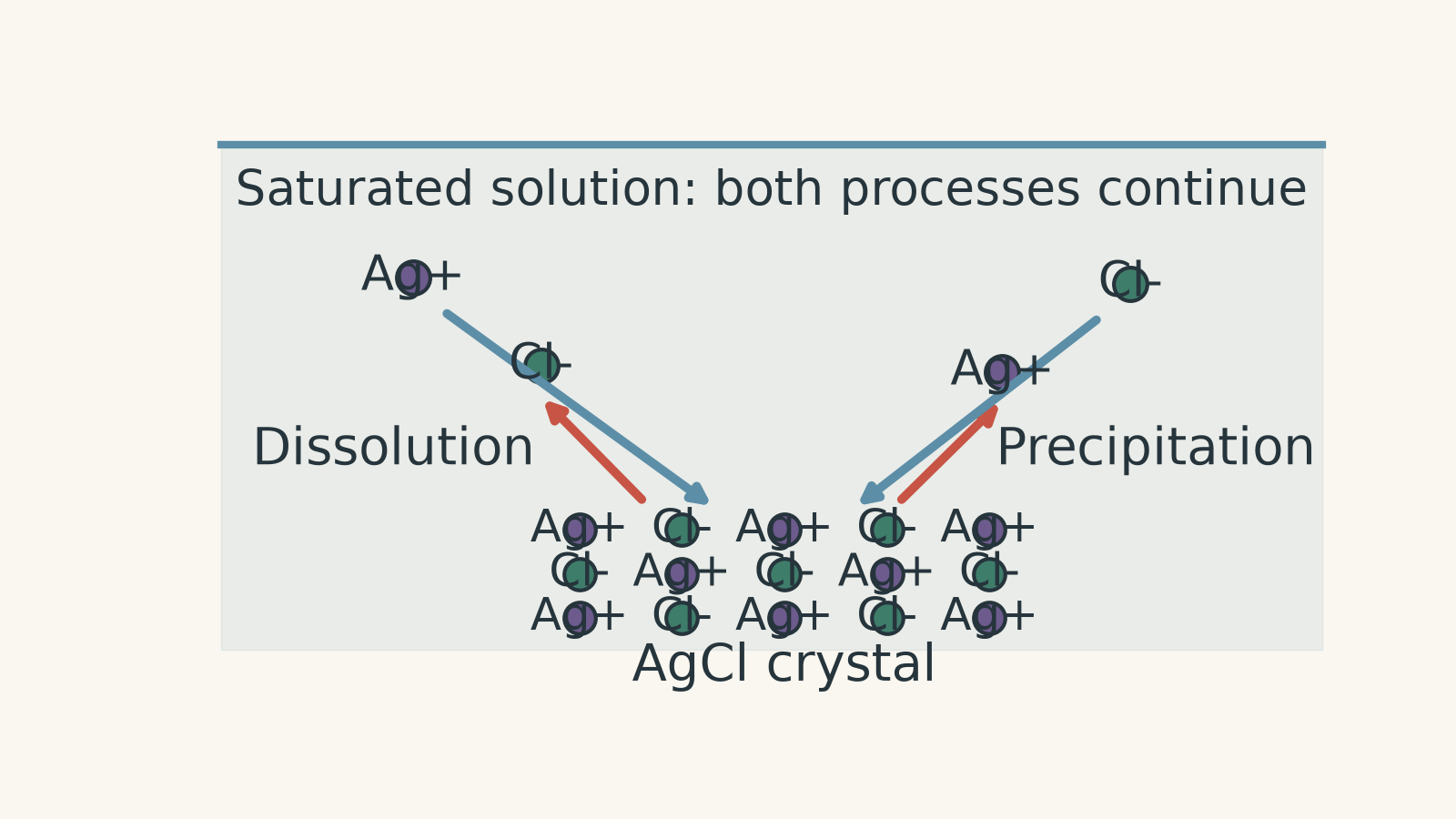
A useful mental model is a busy train platform. People leave one train while other people board it. If ten people leave each minute and ten board each minute, the number of people on the platform stays constant. That does not mean nobody is moving.
The analogy breaks because ions do not make decisions about trains. Their behaviour comes from particle motion, electrostatic interactions, hydration, and collisions. But the idea of equal opposing rates is useful.
If the solution is saturated and undissolved solid is present, the system can maintain this equilibrium.
If you need a refresher on what happens when an ionic solid enters water, see Dissolution of Ionic Compounds in Water for HSC Chemistry.
02Deriving the \(K_{sp}\) expression
Start with the balanced dissolution equation. That equation tells you everything you need for the equilibrium expression.
For a general ionic solid,
\[ \ce{A_mB_n(s) <=> mA^{z+}(aq) + nB^{y-}(aq)} \]
where \(m\) and \(n\) are the stoichiometric coefficients. The charges must balance so the original solid is electrically neutral.
At a more exact level, an equilibrium constant is written using activities. Activity is an effective concentration that accounts for interactions between particles.
For the dissolution above,
\[ K=\frac{a(\ce{A^{z+}})^m a(\ce{B^{y-}})^n}{a(\ce{A_mB_n})} \]
For a pure solid, its activity is constant and is taken as 1. That means the solid does not appear in the final expression.
At HSC level, we normally approximate the activities of dissolved ions using their molar concentrations:
\[ K_{sp}=[\ce{A^{z+}}]^m[\ce{B^{y-}}]^n \]
The subscript “sp” means solubility product.
There are three important moves here.
- Write the balanced dissolution equation.
- Leave the pure solid out of the \(K_{sp}\) expression.
- Turn each aqueous ion’s coefficient into an exponent.
For example:
| Solid | Dissolution equation | \(K_{sp}\) expression |
|---|---|---|
| \(\ce{AgCl}\) | \(\ce{AgCl(s) <=> Ag+(aq) + Cl-(aq)}\) | \(K_{sp}=[\mathrm{Ag}^{+}][\mathrm{Cl}^{-}]\) |
| \(\ce{CaF2}\) | \(\ce{CaF2(s) <=> Ca^2+(aq) + 2F-(aq)}\) | \(K_{sp}=[\mathrm{Ca}^{2+}][\mathrm{F}^{-}]^2\) |
| \(\ce{Ag2CrO4}\) | \(\ce{Ag2CrO4(s) <=> 2Ag+(aq) + CrO4^2-(aq)}\) | \(K_{sp}=[\mathrm{Ag}^{+}]^2[\ce{CrO4^2-}]\) |
| \(\ce{Al(OH)3}\) | \(\ce{Al(OH)3(s) <=> Al^3+(aq) + 3OH-(aq)}\) | \(K_{sp}=[\mathrm{Al}^{3+}][\ce{OH-}]^3\) |
The coefficients do not get written in front of the concentrations. They become powers.
For \(\ce{CaF2}\), for example, the expression is
\[ K_{sp}=[\mathrm{Ca}^{2+}][\mathrm{F}^{-}]^2 \]
not
\[ K_{sp}=[\mathrm{Ca}^{2+}](2[\mathrm{F}^{-}]) \]
That second expression confuses stoichiometric amounts with the equilibrium law.
03The two different jobs done by stoichiometry
This is where students often mix two ideas together.
Take calcium fluoride:
\[ \ce{CaF2(s) <=> Ca^2+(aq) + 2F-(aq)} \]
The coefficient 2 has two consequences.
First, it becomes an exponent in the \(K_{sp}\) expression:
\[ K_{sp}=[\mathrm{Ca}^{2+}][\mathrm{F}^{-}]^2 \]
Second, if \(\ce{CaF2}\) is dissolving in pure water and no other source of either ion is present, every mole of \(\ce{CaF2}\) produces one mole of \(\mathrm{Ca}^{2+}\) and two moles of \(\mathrm{F}^{-}\).
If the molar solubility is \(s\), measured in \(\mathrm{mol\,L^{-1}}\), then
\[ [\mathrm{Ca}^{2+}]=s \]
and
\[ [\mathrm{F}^{-}]=2s \]
Substituting those concentrations into the equilibrium expression gives
\[ K_{sp}=s(2s)^2=4s^3 \]
The square in \([\mathrm{F}^{-}]^2\) comes from the equilibrium expression. The \(2s\) comes from the amount of fluoride produced by dissolution. They are related, but they are not the same mathematical step.
And there is an important limit to the \(2s\) model: it works only when dissolution is the only significant source of fluoride.
If fluoride was already present before the solid was added, then \([\mathrm{F}^{-}]\neq2s\).
Worked example: Find \(K_{sp}\) from molar solubility
A saturated solution of \(\ce{Ag2CrO4}\) has a molar solubility of \(1.30\times10^{-4}\ \mathrm{mol\,L^{-1}}\) at a particular temperature. Assume there are no other sources of \(\mathrm{Ag}^{+}\) or \(\ce{CrO4^2-}\). Derive the \(K_{sp}\) expression and calculate \(K_{sp}\).
Step 1
\[ \ce{Ag2CrO4(s) <=> 2Ag+(aq) + CrO4^2-(aq)} \]
Step 2
The solid is omitted, and the coefficients of the aqueous ions become exponents:
\[ K_{sp}=[\mathrm{Ag}^{+}]^2[\ce{CrO4^2-}] \]
Step 3
Let
\[ s=1.30\times10^{-4}\ \mathrm{mol\,L^{-1}} \]
Each mole of \(\ce{Ag2CrO4}\) gives two moles of \(\mathrm{Ag}^{+}\), so
\[ [\mathrm{Ag}^{+}]=2s=2.60\times10^{-4}\ \mathrm{mol\,L^{-1}} \]
Each mole gives one mole of chromate:
\[ [\ce{CrO4^2-}]=s=1.30\times10^{-4}\ \mathrm{mol\,L^{-1}} \]
Step 4
\[ \begin{aligned} K_{sp} &=(2.60\times10^{-4})^2(1.30\times10^{-4})\\ &=8.79\times10^{-12} \end{aligned} \]
Step 5
At this temperature, equilibrium is reached when the product \([\mathrm{Ag}^{+}]^2[\ce{CrO4^2-}]\) has the numerical value \(8.79\times10^{-12}\).
Strictly, equilibrium constants are dimensionless because they are defined using activities. At HSC level, concentrations are used to calculate their numerical values.
Worked example: Do not ignore ions that were already present
A solution initially contains \(5.00\times10^{-3}\ \mathrm{mol\,L^{-1}}\) iodide ions from a soluble iodide salt. Excess \(\ce{PbI2(s)}\) is added. At equilibrium, the concentration of \(\mathrm{Pb}^{2+}\) is \(2.00\times10^{-4}\ \mathrm{mol\,L^{-1}}\). Calculate \(K_{sp}\).
Step 1
\[ \ce{PbI2(s) <=> Pb^2+(aq) + 2I-(aq)} \]
Step 2
\[ K_{sp}=[\mathrm{Pb}^{2+}][\mathrm{I}^{-}]^2 \]
Step 3
The equilibrium lead concentration is
\[ [\mathrm{Pb}^{2+}]=2.00\times10^{-4}\ \mathrm{mol\,L^{-1}} \]
Because each mole of dissolved \(\ce{PbI2}\) produces two moles of iodide, the additional iodide concentration is
\[ 2(2.00\times10^{-4}) =4.00\times10^{-4}\ \mathrm{mol\,L^{-1}} \]
But there was already \(5.00\times10^{-3}\ \mathrm{mol\,L^{-1}}\) iodide present.
Therefore,
\[ [\mathrm{I}^{-}] =5.00\times10^{-3}+4.00\times10^{-4} =5.40\times10^{-3}\ \mathrm{mol\,L^{-1}} \]
Step 4
\[ \begin{aligned} K_{sp} &=(2.00\times10^{-4})(5.40\times10^{-3})^2\\ &=5.83\times10^{-9} \end{aligned} \]
Step 5
The tempting mistake is to write
\[ [\mathrm{I}^{-}]=2[\mathrm{Pb}^{2+}] \]
That would be true only for the iodide produced by dissolving \(\ce{PbI2}\). It is not true for the total iodide concentration because iodide was already present.
The \(K_{sp}\) expression itself has not changed. The concentration bookkeeping has.
04What belongs in a \(K_{sp}\) expression?
A quick decision rule is useful.
Include an aqueous ion if it appears as a product in the balanced dissolution equilibrium. Raise its equilibrium concentration to the power of its coefficient.
Do not include:
- the pure solid
- liquid water
- spectator ions that came from another soluble compound
For example, if \(\ce{PbI2}\) is placed in a solution containing \(\ce{KI}\), potassium ions are present, but they do not belong in
\[ K_{sp}=[\mathrm{Pb}^{2+}][\mathrm{I}^{-}]^2 \]
because \(\mathrm{K}^{+}\) is not part of the \(\ce{PbI2}\) dissolution equilibrium.
05What changes \(K_{sp}\), and what does not?
For a particular dissolution reaction, \(K_{sp}\) has a fixed value at a fixed temperature.
| Change | Does \(K_{sp}\) change? | What can change? |
|---|---|---|
| Add more of the same pure solid | No | Usually only the amount of undissolved solid |
| Add a common ion | No | Equilibrium ion concentrations and solubility |
| Dilute the solution | No | Ion concentrations; the system may become unsaturated |
| Remove some solution | No | Total moles present, provided concentrations are initially unchanged |
| Change temperature | Potentially yes | The equilibrium constant itself can change |
A common misconception is that a \(K_{sp}\) value is a required product for every solution containing those ions.
It is not.
The \(K_{sp}\) equation describes the ion concentrations at solubility equilibrium. A solution can contain the ions at lower concentrations and be unsaturated. It can also temporarily contain them at concentrations corresponding to a larger ion product and be supersaturated.
This distinction becomes important when you later predict whether precipitation will occur.
06Questions and solutions
Question 1
Magnesium hydroxide dissolves according to
\[ \ce{Mg(OH)2(s) <=> Mg^2+(aq) + 2OH-(aq)} \]
Write the \(K_{sp}\) expression. Then express \(K_{sp}\) in terms of the molar solubility \(s\) for a saturated solution prepared in pure water, assuming no other significant sources of either ion.
Solution 1
The correct result is
\[ K_{sp}=[\mathrm{Mg}^{2+}][\ce{OH-}]^2=4s^3 \]
The balanced equation gives
\[ K_{sp}=[\mathrm{Mg}^{2+}][\ce{OH-}]^2 \]
because the coefficient 2 on \(\ce{OH-}\) becomes an exponent.
If the molar solubility is \(s\), each mole of dissolved \(\ce{Mg(OH)2}\) produces one mole of \(\mathrm{Mg}^{2+}\) and two moles of \(\ce{OH-}\). Therefore,
\[ [\mathrm{Mg}^{2+}]=s \]
and
\[ [\ce{OH-}]=2s \]
Substitution gives
\[ K_{sp}=s(2s)^2=4s^3 \]
The common trap is to put a 2 in front of \([\ce{OH-}]\) in the equilibrium expression. The coefficient becomes a power in the \(K_{sp}\) expression; the factor \(2s\) appears separately when stoichiometry is used to find the actual hydroxide concentration.
Question 2
At a particular temperature, a saturated solution of \(\ce{PbCl2}\) contains
\[ [\mathrm{Cl}^{-}]=3.60\times10^{-2}\ \mathrm{mol\,L^{-1}} \]
Assume \(\ce{PbCl2}\) is the only source of both ions.
Determine:
a. the molar solubility of \(\ce{PbCl2}\)
b. \([\mathrm{Pb}^{2+}]\)
c. \(K_{sp}\)
Solution 2
The molar solubility and lead concentration are both \(1.80\times10^{-2}\ \mathrm{mol\,L^{-1}}\), and
\[ K_{sp}=2.33\times10^{-5} \]
The dissolution equation is
\[ \ce{PbCl2(s) <=> Pb^2+(aq) + 2Cl-(aq)} \]
If the molar solubility is \(s\), then
\[ [\mathrm{Pb}^{2+}]=s \]
and
\[ [\mathrm{Cl}^{-}]=2s \]
Therefore,
\[ s=\frac{3.60\times10^{-2}}{2} =1.80\times10^{-2}\ \mathrm{mol\,L^{-1}} \]
So
\[ [\mathrm{Pb}^{2+}]=1.80\times10^{-2}\ \mathrm{mol\,L^{-1}} \]
The equilibrium expression is
\[ K_{sp}=[\mathrm{Pb}^{2+}][\mathrm{Cl}^{-}]^2 \]
Hence,
\[ \begin{aligned} K_{sp} &=(1.80\times10^{-2})(3.60\times10^{-2})^2\\ &=2.33\times10^{-5} \end{aligned} \]
The tempting mistake is to set the lead and chloride concentrations equal. The solid produces them in a 1:2 ratio, not a 1:1 ratio.
Question 3
A hypothetical sparingly soluble solid \(\ce{MX2}\) dissolves according to
\[ \ce{MX2(s) <=> M^2+(aq) + 2X-(aq)} \]
Before the solid is added, the solution already contains
\[ 1.50\times10^{-3}\ \mathrm{mol\,L^{-1}} \]
of \(\mathrm{M}^{2+}\) from a completely soluble compound, but initially contains no \(\mathrm{X}^{-}\).
After excess \(\ce{MX2}\) is added and equilibrium is reached,
\[ [\mathrm{X}^{-}]=4.00\times10^{-4}\ \mathrm{mol\,L^{-1}} \]
Calculate \(K_{sp}\).
Solution 3
The equilibrium constant is
\[ K_{sp}=2.72\times10^{-10} \]
and the key point is that the final \(\mathrm{M}^{2+}\) concentration includes both the ions already present and the ions produced by dissolution.
The equilibrium expression is
\[ K_{sp}=[\mathrm{M}^{2+}][\mathrm{X}^{-}]^2 \]
Let \(s\) be the amount of \(\ce{MX2}\) that dissolves per litre.
Because two moles of \(\mathrm{X}^{-}\) are produced per mole of solid,
\[ 2s=4.00\times10^{-4} \]
so
\[ s=2.00\times10^{-4}\ \mathrm{mol\,L^{-1}} \]
That dissolution also adds
\[ 2.00\times10^{-4}\ \mathrm{mol\,L^{-1}} \]
of \(\mathrm{M}^{2+}\).
Therefore, the final metal-ion concentration is
\[ \begin{aligned} [\mathrm{M}^{2+}] &=1.50\times10^{-3}+2.00\times10^{-4}\\ &=1.70\times10^{-3}\ \mathrm{mol\,L^{-1}} \end{aligned} \]
Now substitute:
\[ \begin{aligned} K_{sp} &=(1.70\times10^{-3})(4.00\times10^{-4})^2\\ &=2.72\times10^{-10} \end{aligned} \]
A tempting route is to say \([\mathrm{M}^{2+}]=s\). That relationship works when dissolution is the only source of \(\mathrm{M}^{2+}\). Here it is not. The pre-existing metal ions must be included in the equilibrium concentration.
Question 4
Two hypothetical salts have the same numerical solubility product at the same temperature:
\[ K_{sp}=4.00\times10^{-12} \]
Salt 1 dissolves according to
\[ \ce{AX(s) <=> A+(aq) + X-(aq)} \]
Salt 2 dissolves according to
\[ \ce{BX2(s) <=> B^2+(aq) + 2X-(aq)} \]
Assume each salt is placed separately into pure water and that there are no side reactions.
a. Calculate the molar solubility of each salt.
b. Explain why equal \(K_{sp}\) values do not imply equal molar solubilities.
c. Find the non-zero value of \(K_{sp}\) for which these two hypothetical salts would have the same molar solubility.
Solution 4
The salts do not have the same molar solubility: \(\ce{AX}\) has \(s=2.00\times10^{-6}\ \mathrm{mol\,L^{-1}}\), while \(\ce{BX2}\) has \(s=1.00\times10^{-4}\ \mathrm{mol\,L^{-1}}\). They would have equal molar solubilities only at the mathematical boundary \(K_{sp}=1/16=0.0625\).
For \(\ce{AX}\),
\[ K_{sp}=[\mathrm{A}^{+}][\mathrm{X}^{-}] \]
Pure-water dissolution gives
\[ [\mathrm{A}^{+}]=[\mathrm{X}^{-}]=s \]
so
\[ K_{sp}=s^2 \]
Therefore,
\[ \begin{aligned} s &=\sqrt{4.00\times10^{-12}}\\ &=2.00\times10^{-6}\ \mathrm{mol\,L^{-1}} \end{aligned} \]
For \(\ce{BX2}\),
\[ K_{sp}=[\mathrm{B}^{2+}][\mathrm{X}^{-}]^2 \]
and
\[ [\mathrm{B}^{2+}]=s,\qquad [\mathrm{X}^{-}]=2s \]
Therefore,
\[ K_{sp}=s(2s)^2=4s^3 \]
Hence,
\[ \begin{aligned} 4.00\times10^{-12}&=4s^3\\ s^3&=1.00\times10^{-12}\\ s&=1.00\times10^{-4}\ \mathrm{mol\,L^{-1}} \end{aligned} \]
The second salt is therefore 50 times more soluble in molar terms even though its numerical \(K_{sp}\) is identical.
The tempting conclusion is that \(K_{sp}\) is simply another name for solubility. It is not. \(K_{sp}\) is an equilibrium product of ion concentrations. The relationship between \(K_{sp}\) and \(s\) depends on how many ions one formula unit produces.
For equal molar solubility \(s\), the two expressions must give the same \(K_{sp}\):
\[ s^2=4s^3 \]
For the non-zero solution,
\[ 1=4s \]
so
\[ s=\frac14 \]
Therefore,
\[ K_{sp}=s^2=\left(\frac14\right)^2=\frac1{16}=0.0625 \]
That value is far larger than the \(K_{sp}\) values normally associated with sparingly soluble salts. The boundary is still useful because it shows why comparing numerical \(K_{sp}\) values without considering stoichiometry can be misleading.
Question 5
A hypothetical salt dissolves according to
\[ \ce{M2X3(s) <=> 2M^3+(aq) + 3X^2-(aq)} \]
At a fixed temperature, a saturated solution is initially in equilibrium with excess solid. The solid is then completely filtered off, and the clear saturated solution is divided into two portions.
Assume no side reactions and that the following volume changes occur quickly compared with precipitation or dissolution.
- Sample A is diluted to twice its original volume with pure water.
- Sample B is evaporated to half its original volume.
a. Write the \(K_{sp}\) expression.
b. Immediately after each volume change, calculate the new ion product as a fraction or multiple of \(K_{sp}\).
c. Excess \(\ce{M2X3(s)}\) is then added to Sample A. A small seed crystal of \(\ce{M2X3}\) is added to Sample B. State what happens in each sample and compare the final equilibrium ion concentrations with those in the original saturated solution.
d. A student argues that both samples must have remained saturated throughout because the ratio \([\mathrm{M}^{3+}]:[\mathrm{X}^{2-}]\) stayed at \(2:3\). Explain the flaw.
Solution 5
Sample A immediately has an ion product of \(K_{sp}/32\) and is unsaturated, while Sample B immediately has an ion product of \(32K_{sp}\) and is supersaturated. After equilibrium is re-established with solid available, both samples return to the same saturation concentrations as the original solution at that temperature.
The dissolution equation gives
\[ K_{sp}=[\mathrm{M}^{3+}]^2[\mathrm{X}^{2-}]^3 \]
Suppose the original equilibrium concentrations are
\[ [\mathrm{M}^{3+}]=M_0 \]
and
\[ [\mathrm{X}^{2-}]=X_0 \]
Then
\[ K_{sp}=M_0^2X_0^3 \]
For Sample A, doubling the volume halves both concentrations:
\[ [\mathrm{M}^{3+}]=\frac{M_0}{2} \]
and
\[ [\mathrm{X}^{2-}]=\frac{X_0}{2} \]
Its immediate ion product is therefore
\[ \begin{aligned} Q_{sp} &=\left(\frac{M_0}{2}\right)^2 \left(\frac{X_0}{2}\right)^3\\ &=\frac{M_0^2X_0^3}{2^5}\\ &=\frac{K_{sp}}{32} \end{aligned} \]
The solution is now unsaturated.
Notice the important point: the filtered solution does not automatically create extra ions to restore \(K_{sp}\). Until solid is supplied, there is no reservoir of \(\ce{M2X3}\) available to dissolve.
Once excess solid is added, dissolution occurs. At the same temperature, equilibrium is eventually restored at the original saturated concentrations \(M_0\) and \(X_0\).
For Sample B, halving the volume doubles both concentrations:
\[ [\mathrm{M}^{3+}]=2M_0 \]
and
\[ [\mathrm{X}^{2-}]=2X_0 \]
Therefore,
\[ \begin{aligned} Q_{sp} &=(2M_0)^2(2X_0)^3\\ &=2^5M_0^2X_0^3\\ &=32K_{sp} \end{aligned} \]
The solution is supersaturated. Thermodynamically, precipitation is favoured.
A supersaturated solution can sometimes persist temporarily because forming the first tiny crystal requires nucleation. The seed crystal provides a surface on which precipitation can occur.
As \(\ce{M2X3}\) precipitates, \(\mathrm{M}^{3+}\) and \(\mathrm{X}^{2-}\) are removed in a \(2:3\) ratio until
\[ [\mathrm{M}^{3+}]^2[\mathrm{X}^{2-}]^3=K_{sp} \]
Because the starting ion ratio was \(2:3\), and precipitation removes ions in that same ratio, the final equilibrium concentrations return to \(M_0\) and \(X_0\).
The student’s argument fails because preserving a concentration ratio does not preserve the equilibrium product.
If every concentration is multiplied by some factor \(\lambda\), then
\[ Q_{sp} =(\lambda M_0)^2(\lambda X_0)^3 =\lambda^5K_{sp} \]
So doubling both concentrations multiplies the ion product by \(2^5=32\), even though their ratio remains unchanged.
That is the deeper role of the exponents in a \(K_{sp}\) expression: equilibrium depends on the absolute concentrations as well as their stoichiometric relationship.
07Where \(K_{sp}\) takes you next
Once you can derive the correct expression, you can run the reasoning in the opposite direction. Given \(K_{sp}\), you can use stoichiometry to find the amount of a sparingly soluble salt that dissolves. That is the next step in Calculate Solubility from Ksp for HSC Chemistry.
The same expression also lets you compare the current ion concentrations with the equilibrium condition. That comparison is what allows you to decide whether a mixture remains dissolved, can dissolve more solid, or will tend to form a precipitate.