
Le Chatelier’s Principle: Predicting Equilibrium Shifts in HSC Chemistry
Learn how concentration, temperature, pressure, and volume changes affect chemical equilibrium. This guide uses HSC Chemistry examples to explain how to predict equilibrium shifts.
A sealed bottle of fizzy drink can sit quietly on a shelf for months. Open it, and suddenly bubbles race out. What changed?
The chemicals inside the drink were already reacting. Opening the bottle did not create a new reaction. It changed the conditions, and the balance between the forward and reverse reactions shifted.
Chemistry often gives us systems that seem to “settle” into a stable state, but that stability is not the same as stopping. Reactions at equilibrium are still happening. The important question is: if we disturb an equilibrium, how does the system respond?
Le Chatelier’s principle gives us a way to predict that response.
01Equilibrium is a balance, not a finish line
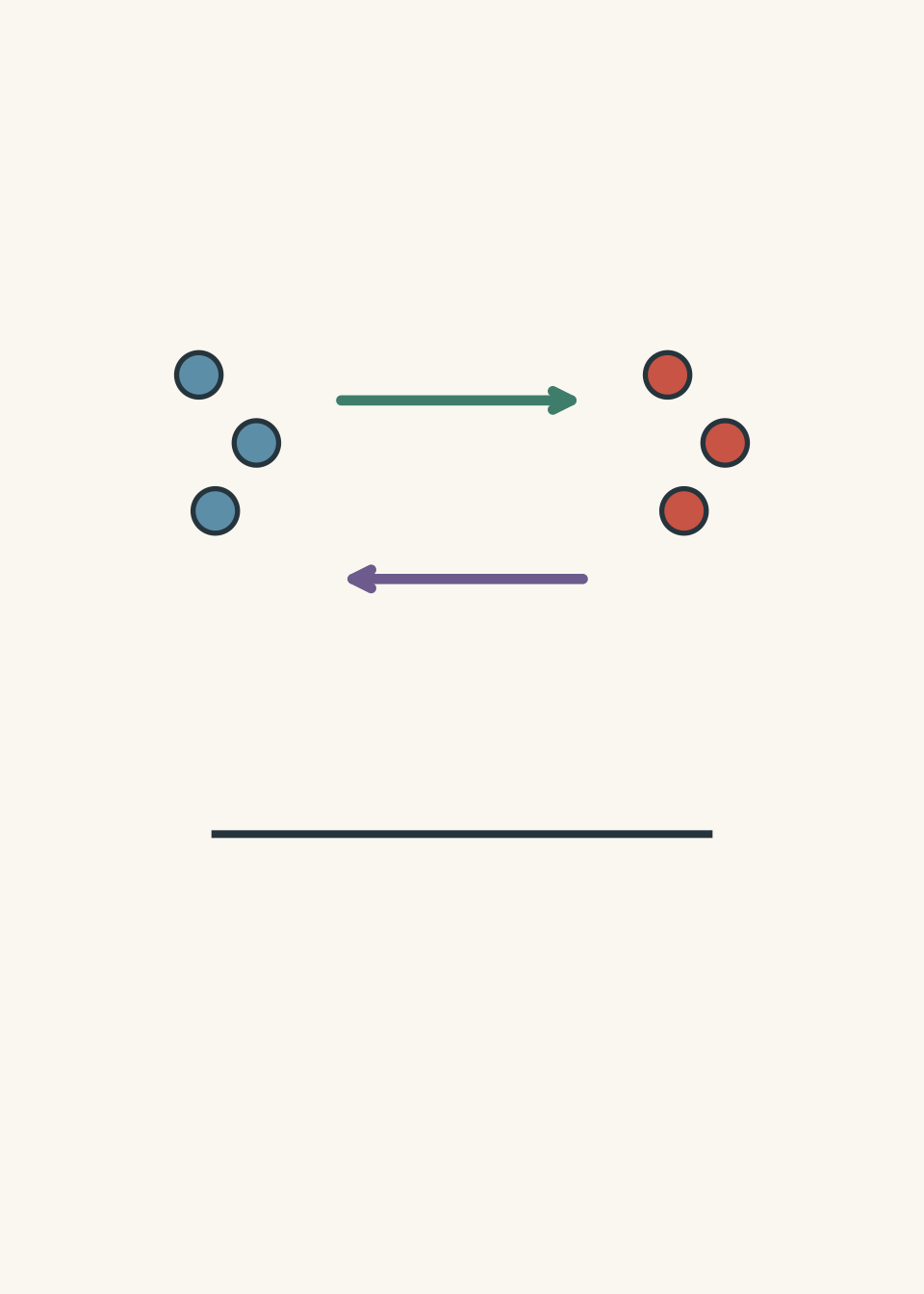
Imagine two students moving between two rooms. One student walks from Room A to Room B, while another walks back from Room B to Room A.
After a while, the number of students in each room might stay almost constant. Does that mean nobody is moving?
No. People are still changing rooms. The two movements just happen at the same rate.
Chemical equilibrium works in a similar way.
For a reversible reaction:
\[ \ce{A + B <=> C + D} \]
the forward reaction makes products, while the reverse reaction makes reactants again.
At equilibrium:
- the forward reaction is still occurring,
- the reverse reaction is still occurring,
- the rates of the two reactions are equal.
The concentrations of reactants and products remain constant, but they are not necessarily equal.
A useful first prediction:
A student sees an equilibrium mixture and says, “If I add more reactant, the reaction will use it up, so the reaction must move forward.”
That prediction is often correct, but the reason matters. The reaction does not “want” to remove the extra reactant. There is no intention or goal. The added reactant changes the reaction rates, and the system reaches a new equilibrium where the disturbance has been reduced.
This is the idea behind Le Chatelier’s principle:
If a system at equilibrium is disturbed, it shifts in the direction that reduces the effect of that disturbance.
The phrase “reduces the effect” is the key. It does not mean the system completely removes the change.
02Concentration changes: adding or removing chemicals
Start with a simple equilibrium:
\[ \ce{Fe^3+(aq) + SCN^-(aq) <=> FeSCN^2+(aq)} \]
The product, iron thiocyanate, has a deep red colour.
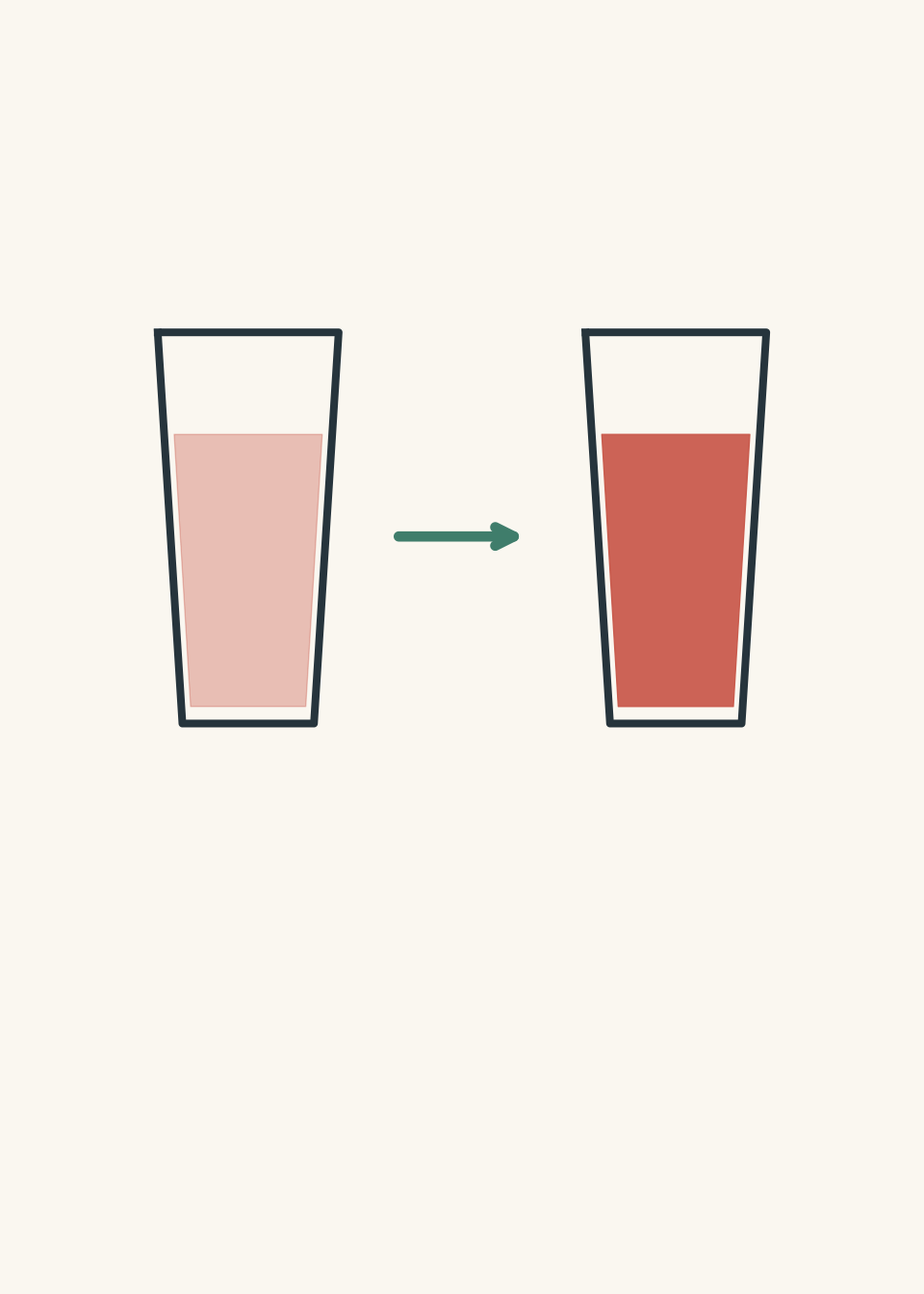
If the concentration of \(\mathrm{Fe}^{3+}\) increases, there are suddenly more iron ions available to react with thiocyanate ions.
Predict the shift:
- The system has too much \(\mathrm{Fe}^{3+}\).
- The forward reaction uses \(\mathrm{Fe}^{3+}\).
- The equilibrium shifts right.
- More red \(\ce{FeSCN^2+}\) forms.
If \(\ce{FeSCN^2+}\) is removed instead, the reverse reaction is favoured because the system replaces some of the lost product.
The important rule:
| Change | Equilibrium shift |
|---|---|
| Add reactant | Towards products |
| Remove reactant | Towards reactants |
| Add product | Towards reactants |
| Remove product | Towards products |
This is a prediction tool, not a calculation method. It tells you the direction of movement, not the final concentrations.
03Worked example: adding a reactant
Worked example: iron thiocyanate colour change
A solution contains the equilibrium:
\[ \ce{Fe^3+(aq) + SCN^-(aq) <=> FeSCN^2+(aq)} \]
Extra \(\mathrm{Fe}^{3+}\) ions are added. Predict the colour change.
Step 1
The concentration of a reactant, \(\mathrm{Fe}^{3+}\), has increased.
Step 2
The system has too much \(\mathrm{Fe}^{3+}\), so it shifts towards the side that consumes it.
Step 3
The equilibrium shifts right, producing more \(\ce{FeSCN^2+}\).
Step 4
\(\ce{FeSCN^2+}\) is red, so the solution becomes a deeper red colour.
The trap is thinking that the added iron ions disappear completely. They do not. The new equilibrium simply contains a greater amount of product than before.
04Temperature changes: heat behaves like a chemical substance
Temperature changes are different from concentration changes because heat is involved in the reaction itself.
Consider the cobalt chloride equilibrium:
\[ \ce{[Co(H2O)6]^2+(aq) + 4Cl^-(aq) <=> [CoCl4]^2-(aq) + 6H2O(l)} \]
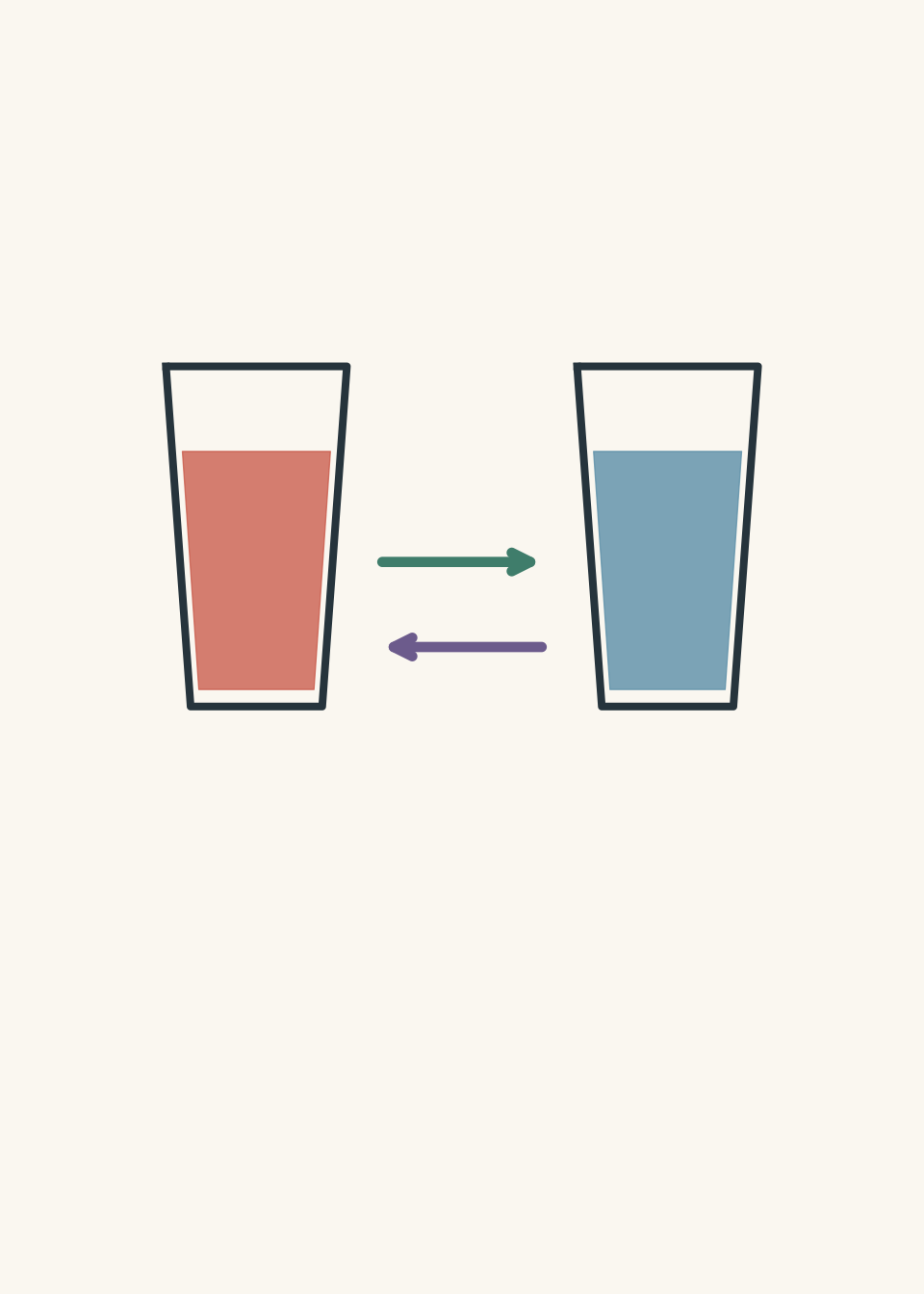
The hydrated cobalt ion, \(\ce{[Co(H2O)6]^2+}\), is pink.
The chloride complex, \(\ce{[CoCl4]^2-}\), is blue.
The forward reaction absorbs heat, so it is endothermic.
A useful way to think about this is to treat heat as a reactant:
\[ \text{heat} + \ce{reactants <=> products} \]
If the temperature increases, the system has extra “heat reactant”. It shifts in the direction that uses heat.
For an endothermic forward reaction:
- increase temperature → shift right,
- decrease temperature → shift left.
For an exothermic forward reaction, the opposite occurs.
A common mistake is assuming that a reaction always speeds up when heated, so it must produce more products.
Heating does increase the rates of both forward and reverse reactions. However, equilibrium position depends on which direction absorbs or releases heat.
Rate and equilibrium position are different ideas.
05Worked example: cobalt chloride equilibrium
The cobalt chloride equilibrium is heated:
\[ \ce{[Co(H2O)6]^2+(aq) + 4Cl^-(aq) <=> [CoCl4]^2-(aq) + 6H2O(l)} \]
The forward reaction is endothermic. Predict the colour change.
Step 1
The system has been heated, so heat has been added.
Step 2
Because the forward reaction absorbs heat, increasing temperature favours the forward reaction.
Step 3
The equilibrium shifts right, producing more \(\ce{[CoCl4]^2-}\).
Step 4
The blue colour becomes stronger because there is more blue \(\ce{[CoCl4]^2-}\).
06Pressure and volume changes: only gases care
Pressure changes only affect equilibria involving gases.
Consider:
\[ \ce{N2O4(g) <=> 2NO2(g)} \]
Nitrogen dioxide, \(\ce{NO2}\), is brown. Dinitrogen tetroxide, \(\ce{N2O4}\), is colourless.
Now imagine squeezing a gas mixture into a smaller container.
What would you predict?
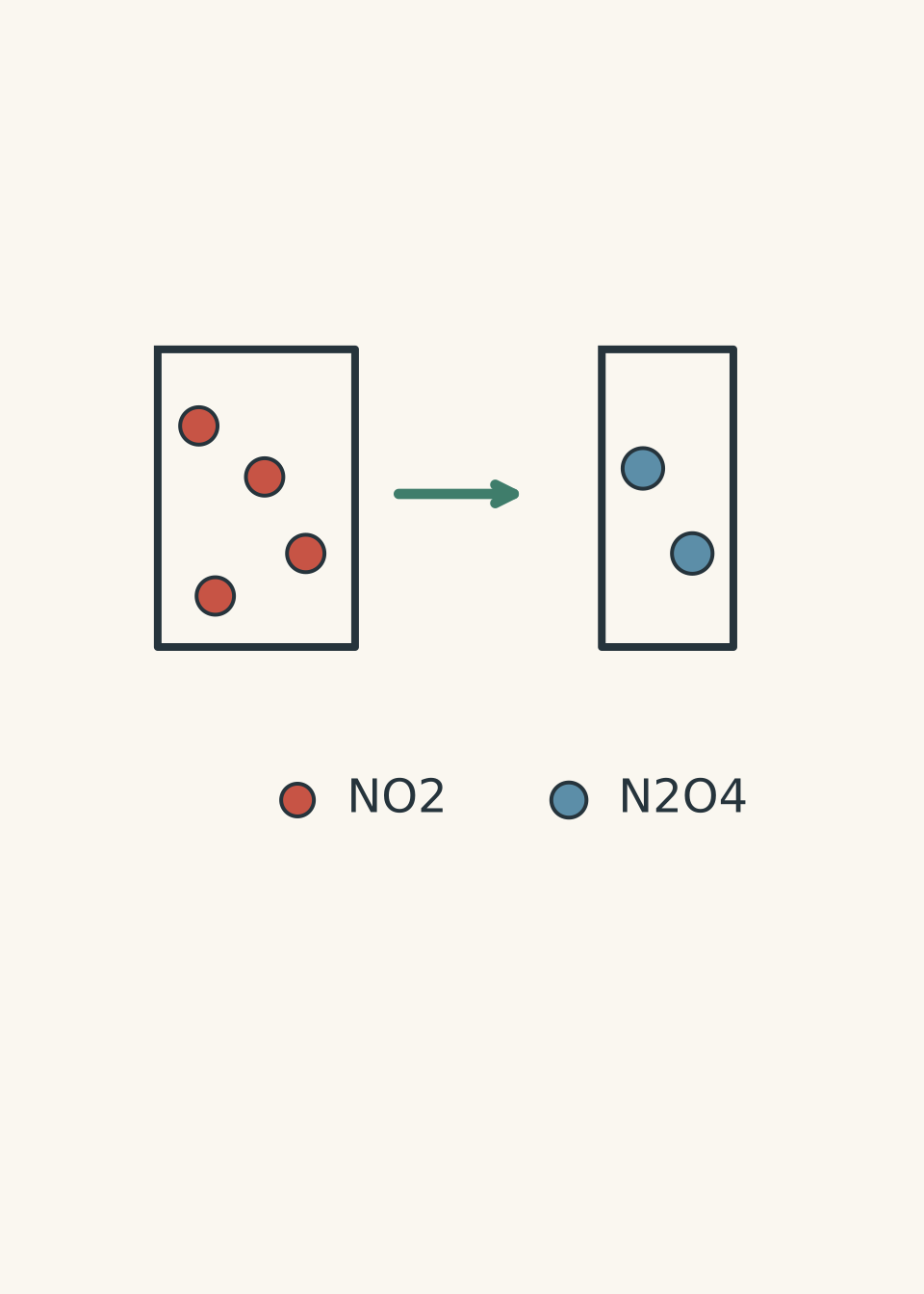
The gas particles are closer together, so the system has a higher pressure. The equilibrium shifts to reduce pressure.
The left side contains:
- 1 mole of gas.
The right side contains:
- 2 moles of gas.
The side with fewer gas particles creates lower pressure, so the equilibrium shifts left.
More \(\ce{N2O4}\) forms, and the brown colour fades.
The shortcut:
- Higher pressure → shift to fewer moles of gas.
- Lower pressure → shift to more moles of gas.
But there is an important limit.
If both sides have the same number of gas moles, pressure changes do not shift equilibrium.
For example:
\[ \ce{H2(g) + I2(g) <=> 2HI(g)} \]
There are 2 moles of gas on both sides. Changing volume changes pressure, but neither side reduces the pressure more than the other.
07Worked example: gas pressure and equilibrium
For the reaction:
\[ \ce{2SO2(g) + O2(g) <=> 2SO3(g)} \]
predict the effect of decreasing the container volume.
Step 1
Left side:
\[ 2 + 1 = 3 \text{ moles of gas} \]
Right side:
\[ 2 \text{ moles of gas} \]
Step 2
Decreasing volume increases pressure.
Step 3
The system shifts to the side with fewer gas particles to reduce pressure.
Step 4
The equilibrium shifts right, producing more \(\ce{SO3}\).
The tempting mistake is counting the number of chemical formulas instead of gas moles. The coefficient in the balanced equation is what matters.
08A decision process for HSC equilibrium questions
When you see an equilibrium disturbance:
- Write the balanced equation.
- Identify what changed.
- Ask which side reduces that change.
- Check whether that factor actually affects equilibrium.
A compact summary:
| Disturbance | Equilibrium response |
|---|---|
| Add reactant | Move towards products |
| Remove reactant | Move towards reactants |
| Add product | Move towards reactants |
| Remove product | Move towards products |
| Increase temperature | Move in the endothermic direction |
| Decrease temperature | Move in the exothermic direction |
| Increase pressure | Move to fewer gas moles |
| Decrease pressure | Move to more gas moles |
09Questions and solutions
Question 1
For the equilibrium:
\[ \ce{H2(g) + I2(g) <=> 2HI(g)} \]
hydrogen gas is added to the container. Predict the equilibrium shift.
Solution 1
The equilibrium shifts right, producing more \(\ce{HI}\).
Adding \(\ce{H2}\) increases the concentration of a reactant. The system reduces this disturbance by using some of the extra hydrogen through the forward reaction.
The trap is assuming that adding hydrogen increases the amount of every substance. The equilibrium shifts, but both reactants and products can still be present at the new equilibrium.
Question 2
The equilibrium:
\[ \ce{2NO2(g) <=> N2O4(g)} \]
is brown on the left and colourless on the right. A container is cooled. The forward reaction is exothermic. Predict the colour change.
Solution 2
The mixture becomes lighter brown because cooling shifts the equilibrium towards \(\ce{N2O4}\).
The forward reaction releases heat, so it is favoured when heat is removed. The system responds by producing more heat through the exothermic direction.
A common incorrect approach is to think cooling always favours the side with fewer particles. That rule only applies to pressure changes. Temperature changes depend on whether the reaction absorbs or releases heat.
Question 3
For the equilibrium:
\[ \ce{CaCO3(s) <=> CaO(s) + CO2(g)} \]
the volume of the container is decreased. Predict the effect on the amount of \(\ce{CO2}\) gas.
Solution 3
The amount of \(\ce{CO2}\) decreases because the equilibrium shifts left.
The left side has zero moles of gas, while the right side has one mole of gas. Decreasing volume increases pressure, so the system shifts towards the side with fewer gas particles.
The solids do not count in the pressure comparison. Students often include \(\ce{CaCO3}\) and \(\ce{CaO}\), but pure solids do not affect gas pressure.
Question 4
A student performs two changes to the cobalt chloride equilibrium:
\[ \ce{[Co(H2O)6]^2+(aq) + 4Cl^-(aq) <=> [CoCl4]^2-(aq) + 6H2O(l)} \]
The forward reaction is endothermic.
First, they heat the solution. Then they add concentrated chloride ions.
The student predicts:
“Both changes favour the blue product, so the blue colour will definitely become much stronger.”
Evaluate this prediction.
Solution 4
The prediction is partly correct but the conclusion is too certain. Both changes favour the blue product, but the final colour change depends on the size of each disturbance and the new equilibrium position.
Heating shifts the equilibrium right because the forward reaction absorbs heat. Adding chloride ions also shifts the equilibrium right because chloride is a reactant.
However, Le Chatelier’s principle predicts the direction of the shift, not the exact amount of product formed. The final colour intensity depends on the new concentrations of all species.
The tempting route is to treat equilibrium shifts as additive “points” that guarantee a huge change. The actual system responds continuously until the forward and reverse reaction rates become equal again.
Question 5
A sealed container contains:
\[ \ce{N2O4(g) <=> 2NO2(g)} \]
At equilibrium, the gas is pale brown. A student says:
“The container must contain mostly \(\ce{NO2}\), because \(\ce{NO2}\) is the coloured gas we can see.”
The container is then compressed, and the colour becomes less intense.
Explain why the student’s reasoning is wrong and use equilibrium ideas to describe what happened.
Solution 5
The student’s reasoning is wrong because the visible colour only shows that \(\ce{NO2}\) is present; it does not show that \(\ce{NO2}\) is the majority species.
At equilibrium, both \(\ce{NO2}\) and \(\ce{N2O4}\) are present. The brown colour comes from \(\ce{NO2}\), but a pale brown colour could occur even when much of the mixture is colourless \(\ce{N2O4}\).
When the container is compressed, the pressure increases. The equilibrium shifts left because the left side has fewer gas moles:
\[ \ce{2NO2(g) -> N2O4(g)} \]
More \(\ce{N2O4}\) forms, reducing the amount of brown \(\ce{NO2}\), so the colour becomes less intense.
The deeper lesson is that observations like colour are evidence, not direct measurements of concentration. A chemical system must be interpreted using the equilibrium model, not a single visible clue.
Understanding Le Chatelier’s principle gives you a way to predict what happens when conditions change. The next step is connecting these shifts to equilibrium constants, where you can move from predicting direction to calculating how much a system changes.