
Buffers in Natural Systems: HSC Chemistry Explained
Learn how buffers resist pH change in natural systems, why buffer capacity is limited, and how conjugate acid-base pairs stabilise pH.
A stream receives a small pulse of acid after heavy rain. Its pH drops a little, then barely changes. Another stream receives the same amount of acid and its pH crashes.
What made the difference?
It wasn’t that the first stream somehow had “less acid”. It had substances that could react with added acid before the hydrogen ion concentration changed very much. In other words, it had buffering capacity.
Before going further, predict this: if a natural system has a buffer, does that mean its pH can never change?
No. A buffer resists pH change; it doesn’t prevent it completely. That distinction is the key to understanding why buffers matter in natural systems.
01The problem buffers solve
Remember what pH measures:
\[ \mathrm{pH}=-\log_{10}[\mathrm{H}^{+}] \]
where \([\mathrm{H}^{+}]\) is the hydrogen ion concentration in \(\mathrm{mol\,L^{-1}}\).
Because the pH scale is logarithmic, a change of one pH unit corresponds to a tenfold change in \([\mathrm{H}^{+}]\). A system moving from pH 7 to pH 6 therefore hasn’t become “a little more acidic”. Its hydrogen ion concentration has increased by a factor of ten.
That can matter enormously in natural systems. Reaction rates, protein structure, mineral solubility, and the forms in which dissolved substances exist can all depend on pH.
So natural systems have a useful chemical problem to solve: how can they absorb modest additions of acid or base without allowing \([\mathrm{H}^{+}]\), and therefore pH, to swing wildly?
A buffer is one answer.
02Build the mental model first
Picture a crowded train platform with people waiting on both sides of a doorway.
If extra people suddenly arrive from one side, some of the crowd can move and make room. The number of people near the doorway changes, but not nearly as dramatically as it would if the platform were empty.
A buffer behaves a little like that. It contains chemical species able to respond in opposite directions:
- one species can consume added \(\mathrm{H}^{+}\),
- another can consume added \(\ce{OH-}\).
The analogy has limits. Molecules aren’t making decisions, and chemical equilibrium is governed by concentrations and equilibrium constants, not good crowd management. But the picture is useful: a buffer has chemical reserves in both directions.
03What a buffer actually contains
A common buffer contains a weak acid and its conjugate base.
We can represent the weak acid as \(\ce{HA}\):
\[ \ce{HA(aq) <=> H+(aq) + A-(aq)} \]
Here:
- \(\ce{HA}\) is the weak acid,
- \(\mathrm{A}^{-}\) is its conjugate base,
- \(\mathrm{H}^{+}\) is the hydrogen ion.
Both \(\ce{HA}\) and \(\mathrm{A}^{-}\) need to be present in appreciable amounts.
Why both?
Suppose acid is added. The extra \(\mathrm{H}^{+}\) can react with the conjugate base:
\[ \ce{A-(aq) + H+(aq) -> HA(aq)} \]
That removes much of the added \(\mathrm{H}^{+}\).
Now suppose base is added. The weak acid can react with the hydroxide ions:
\[ \ce{HA(aq) + OH-(aq) -> A-(aq) + H2O(l)} \]
That removes much of the added \(\ce{OH-}\).
The buffer therefore converts a strong acid or strong base into species that have a much smaller effect on pH.
04Why equilibrium helps stabilise pH
The equation
\[ \ce{HA(aq) <=> H+(aq) + A-(aq)} \]
is an equilibrium.
Suppose extra \(\mathrm{H}^{+}\) enters the system. The equilibrium responds in the direction that consumes some of that added \(\mathrm{H}^{+}\):
\[ \ce{H+(aq) + A-(aq) -> HA(aq)} \]
If \(\mathrm{H}^{+}\) is removed, for example because \(\ce{OH-}\) has been added, more \(\ce{HA}\) can ionise.
This is consistent with Le Chatelier’s principle, but don’t reduce buffer action to the sentence “equilibrium shifts”. The more useful chemical picture is that the buffer contains actual particles capable of reacting with the disturbance.
If there is almost no \(\mathrm{A}^{-}\) left, the buffer can’t keep removing added acid. If there is almost no \(\ce{HA}\) left, it can’t keep removing added base.
That is why every buffer has a limited capacity.
05Stable pH does not mean constant pH
This is the most tempting misconception.
A student might say:
“A buffer keeps pH constant.”
It feels reasonable because buffers are often described as maintaining pH.
But chemically, that’s too strong.
When acid is added, some \(\mathrm{A}^{-}\) is converted into \(\ce{HA}\). The ratio of acid to conjugate base changes, so the equilibrium position changes slightly. The hydrogen ion concentration therefore changes slightly too.
A better statement is:
A buffer reduces the size of a pH change when a limited amount of acid or base is added.
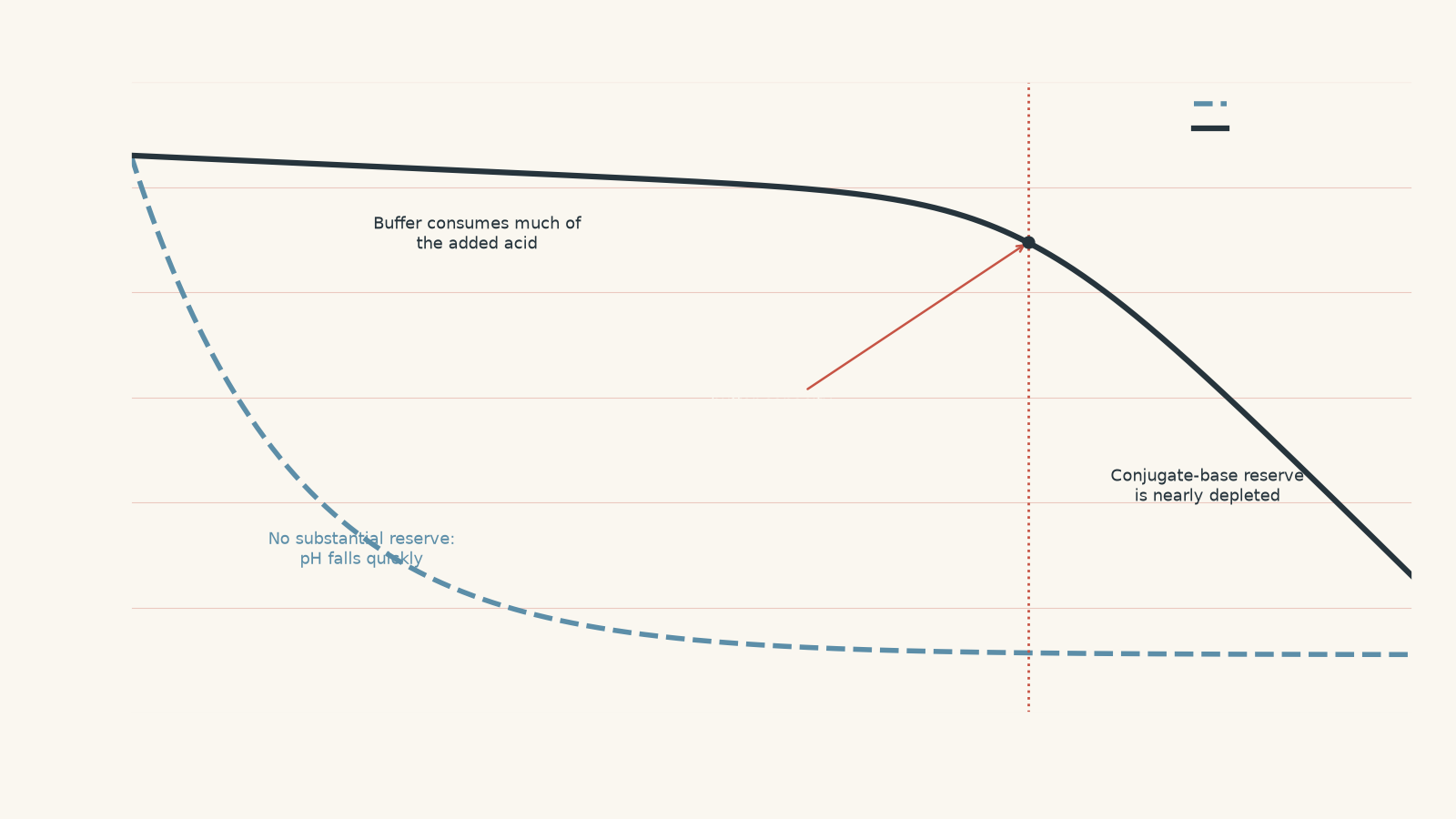
Once the buffer’s reacting component is substantially used up, the protection weakens and the pH can change rapidly.
06The weak acid equilibrium tells us where the pH comes from
For
\[ \ce{HA(aq) <=> H+(aq) + A-(aq)} \]
the acid dissociation constant is
\[ K_a=\frac{[\mathrm{H}^{+}][\mathrm{A}^{-}]}{[\ce{HA}]} \]
Rearranging gives
\[ [\mathrm{H}^{+}]=K_a\frac{[\ce{HA}]}{[\mathrm{A}^{-}]} \]
This equation is useful because it connects the pH directly to the balance between the weak acid and its conjugate base.
If \([\ce{HA}]\) and \([\mathrm{A}^{-}]\) are similar, the pH tends to sit near the acid’s \(pK_a\), where
\[ pK_a=-\log_{10}K_a \]
You don’t need to treat that as a magic buffer formula. It falls directly out of the equilibrium expression.
The bigger idea is this: buffer pH depends strongly on the ratio of the conjugate pair, while buffer capacity depends strongly on how much of both species is present.
Two buffers can therefore have the same initial pH but very different abilities to withstand added acid.
07Worked example: calculating the pH of a simple buffer
A buffer contains \(0.20\ \mathrm{mol\,L^{-1}}\) of a weak acid, \(\ce{HA}\), and \(0.10\ \mathrm{mol\,L^{-1}}\) of its conjugate base, \(\mathrm{A}^{-}\). The acid has \(K_a=1.8\times10^{-5}\). Calculate the approximate pH.
Step 1
\[ K_a=\frac{[\mathrm{H}^{+}][\mathrm{A}^{-}]}{[\ce{HA}]} \]
Step 2
\[ [\mathrm{H}^{+}]=K_a\frac{[\ce{HA}]}{[\mathrm{A}^{-}]} \]
Step 3
\[ \begin{aligned} [\mathrm{H}^{+}] &=(1.8\times10^{-5}) \frac{0.20}{0.10}\\ &=3.6\times10^{-5}\ \mathrm{mol\,L^{-1}} \end{aligned} \]
Step 4
\[ \begin{aligned} \mathrm{pH} &=-\log_{10}(3.6\times10^{-5})\\ &=4.44 \end{aligned} \]
The buffer has a pH of approximately \(4.44\).
Notice what sets that value. It isn’t simply “because a weak acid is present”. The pH depends on both \(K_a\) and the ratio \([\ce{HA}]/[\mathrm{A}^{-}]\).
08Natural example: the carbon dioxide-carbonic acid-bicarbonate system
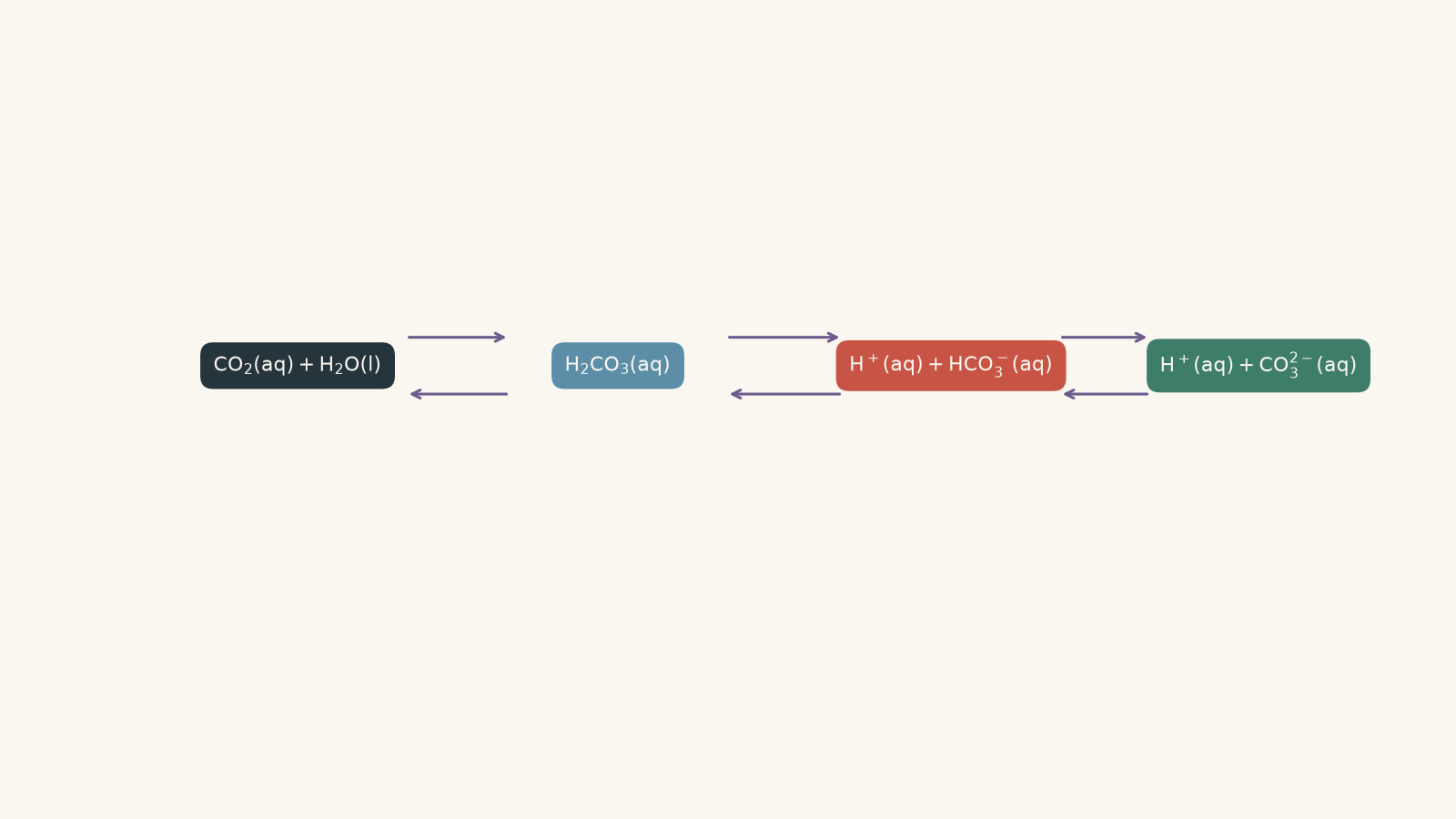
One of the most important natural buffering systems involves dissolved carbon dioxide and bicarbonate.
A simplified representation begins with:
\[ \ce{CO2(aq) + H2O(l) <=> H2CO3(aq)} \]
followed by:
\[ \ce{H2CO3(aq) <=> H+(aq) + HCO3-(aq)} \]
In real aqueous chemistry, dissolved carbon dioxide and carbonic acid are often considered together when modelling this system because only a relatively small fraction of hydrated carbon dioxide exists as molecular \(\ce{H2CO3}\). For HSC reasoning, the simplified equations still make the buffer mechanism visible.
If acid enters a bicarbonate-containing system, bicarbonate can consume hydrogen ions:
\[ \ce{HCO3-(aq) + H+(aq) <=> H2CO3(aq)} \]
The carbonic acid can then be connected to dissolved carbon dioxide:
\[ \ce{H2CO3(aq) <=> CO2(aq) + H2O(l)} \]
That helps explain why carbonate chemistry can reduce sudden pH changes in natural waters.
There is also a second dissociation:
\[ \ce{HCO3-(aq) <=> H+(aq) + CO3^2-(aq)} \]
so carbonate-containing waters involve several connected equilibria rather than one isolated reaction.
09Why some natural waters are better buffered than others
Imagine two lakes with the same starting pH of 7.5.
Would you expect them to respond identically to an equal amount of added acid?
Not necessarily.
One lake may contain substantial bicarbonate and carbonate from contact with carbonate-containing rocks. Another may contain much less of these species. Their initial pH values can be similar while their capacities to absorb additional acid are very different.
This is why measuring pH alone does not tell you everything about how chemically stable a natural water system will be.
Buffering depends on the amounts and identities of the acid-base species present.
This also connects naturally to acid-base measurements. A digital pH probe can track the pH as acid or base is added, making the resistance to change visible experimentally.
10Worked example: acid entering a natural buffer
A \(1.00\ \mathrm{L}\) model of a natural-water buffer initially contains \(0.0300\ \mathrm{mol}\) of \(\ce{HA}\) and \(0.0300\ \mathrm{mol}\) of \(\mathrm{A}^{-}\). The weak acid has \(K_a=4.5\times10^{-7}\).
Then \(0.00500\ \mathrm{mol}\) of strong acid is added. Assume the volume change is negligible.
Calculate the approximate pH after the acid is added.
Step 1
The added \(\mathrm{H}^{+}\) reacts with \(\mathrm{A}^{-}\):
\[ \ce{A- + H+ -> HA} \]
So \(0.00500\ \mathrm{mol}\) of \(\mathrm{A}^{-}\) is consumed, and \(0.00500\ \mathrm{mol}\) of \(\ce{HA}\) is formed.
Step 2
\[ \begin{aligned} n(\mathrm{A}^{-})&=0.0300-0.00500\\ &=0.0250\ \mathrm{mol} \end{aligned} \]
\[ \begin{aligned} n(\ce{HA})&=0.0300+0.00500\\ &=0.0350\ \mathrm{mol} \end{aligned} \]
Because the total volume is \(1.00\ \mathrm{L}\), the corresponding concentrations are \(0.0250\ \mathrm{mol\,L^{-1}}\) and \(0.0350\ \mathrm{mol\,L^{-1}}\).
Step 3
\[ [\mathrm{H}^{+}] =K_a\frac{[\ce{HA}]}{[\mathrm{A}^{-}]} \]
Substituting:
\[ \begin{aligned} [\mathrm{H}^{+}] &=(4.5\times10^{-7}) \frac{0.0350}{0.0250}\\ &=6.3\times10^{-7}\ \mathrm{mol\,L^{-1}} \end{aligned} \]
Step 4
\[ \begin{aligned} \mathrm{pH} &=-\log_{10}(6.3\times10^{-7})\\ &=6.20 \end{aligned} \]
So the pH after the acid addition is approximately \(6.20\).
What does that result mean?
Initially, because equal amounts of \(\ce{HA}\) and \(\mathrm{A}^{-}\) were present,
\[ [\mathrm{H}^{+}]\approx K_a=4.5\times10^{-7}\ \mathrm{mol\,L^{-1}} \]
giving an initial pH of about \(6.35\).
Adding \(0.00500\ \mathrm{mol}\) of strong acid changed the pH by only about \(0.15\) pH units because most of the added hydrogen ions were consumed by the conjugate base.
That is buffering in numerical form.
11Why buffers matter in living systems
Living systems are packed with chemical reactions whose behaviour depends on pH.
Proteins are a good example. Their structure and charge depend partly on whether particular functional groups are protonated or deprotonated. Large pH changes can therefore alter protein structure and function.
Biological fluids contain several buffering components, including bicarbonate, phosphate species, and proteins.
Blood is an important example, but it needs one extra layer of precision. Its pH stability is not produced by a sealed beaker containing a simple buffer. Chemical buffers act alongside physiological regulation, especially gas exchange through the lungs and longer-term ion regulation by the kidneys.
So saying “blood pH is maintained by the bicarbonate buffer” is an incomplete model.
A better statement is that bicarbonate chemistry is an important part of a larger regulated system.
12Buffering in soils and natural waters
Buffering also matters in soils, lakes, rivers, and oceans.
Depending on the system, resistance to pH change can involve:
- carbonate and bicarbonate equilibria,
- reactions involving minerals,
- weakly acidic or basic groups in organic matter,
- dissolved ions,
- surface reactions on soil particles.
That means there is no single universal “natural buffer”.
A limestone-rich environment, for example, can contain carbonate minerals that participate in acid-base chemistry. Acid entering such a system can promote reactions that consume \(\mathrm{H}^{+}\), reducing the immediate pH change.
The exact chemistry is more complicated than a textbook weak-acid buffer because dissolution, precipitation, gas exchange, and several equilibria can occur at once.
That complexity doesn’t replace the buffer idea. It extends it.
13Concentration matters as much as ratio
Suppose two buffers both contain equal concentrations of \(\ce{HA}\) and \(\mathrm{A}^{-}\).
Buffer A contains:
\[ [\ce{HA}]=[\mathrm{A}^{-}]=0.0010\ \mathrm{mol\,L^{-1}} \]
Buffer B contains:
\[ [\ce{HA}]=[\mathrm{A}^{-}]=0.100\ \mathrm{mol\,L^{-1}} \]
Because the ratios are the same, both can have approximately the same initial pH.
Now add the same amount of strong acid to each.
Which one should resist the change better?
Buffer B.
It has 100 times as much \(\mathrm{A}^{-}\) available per litre to consume added \(\mathrm{H}^{+}\). The ratio tells you a great deal about the pH; the actual quantities tell you how much disturbance the buffer can absorb.
This distinction is extremely useful in exam questions.
| Feature | Mainly depends on |
|---|---|
| Buffer pH | \(K_a\) and the ratio of conjugate acid to base |
| Buffer capacity | The actual amounts or concentrations of buffering species |
| Response to added acid | Amount of conjugate base available |
| Response to added base | Amount of weak acid available |
14When buffering fails
A buffer isn’t a chemical force field.
Consider a buffer containing \(0.010\ \mathrm{mol}\) of \(\mathrm{A}^{-}\). If \(0.002\ \mathrm{mol}\) of strong acid is added, plenty of \(\mathrm{A}^{-}\) remains.
But if \(0.010\ \mathrm{mol}\) of \(\mathrm{H}^{+}\) is added, essentially all of that \(\mathrm{A}^{-}\) can be converted to \(\ce{HA}\).
Add even more strong acid, and there is no longer a substantial reserve of conjugate base to absorb it. The excess \(\mathrm{H}^{+}\) can then dominate the pH.
So “buffered” is never enough information on its own. You also need to ask: buffered against how much acid or base?
This is the same logic behind acid-base titration curves. A buffered region can resist pH change for a while, but once the relevant reacting species becomes depleted, the curve becomes much steeper. The connection is useful when studying industrial acid-base analysis and titration.
15Questions and solutions
Question 1
A natural pond contains a weak acid, \(\ce{HA}\), and its conjugate base, \(\mathrm{A}^{-}\).
Explain how the pond’s buffer responds when a small amount of strong acid is added.
Solution 1
The added hydrogen ions are mainly consumed by the conjugate base, so the pH decreases by less than it would in an unbuffered pond.
The important reaction is:
\[ \ce{A-(aq) + H+(aq) -> HA(aq)} \]
The concentration of \(\mathrm{A}^{-}\) decreases, while the concentration of \(\ce{HA}\) increases.
The tempting answer is simply “the equilibrium shifts left”. That is not wrong, but it misses the physical reason for the buffering: particles of \(\mathrm{A}^{-}\) actually react with much of the added \(\mathrm{H}^{+}\).
Because the \([\ce{HA}]/[\mathrm{A}^{-}]\) ratio changes, the pH still falls slightly. A buffer reduces the pH change; it does not force the pH to remain exactly constant.
Question 2
Two \(1.00\ \mathrm{L}\) solutions contain the same weak acid, for which \(K_a=1.0\times10^{-6}\).
Buffer X contains \(0.0100\ \mathrm{mol}\) each of \(\ce{HA}\) and \(\mathrm{A}^{-}\).
Buffer Y contains \(0.100\ \mathrm{mol}\) each of \(\ce{HA}\) and \(\mathrm{A}^{-}\).
- Compare their initial pH values.
- Then \(0.00500\ \mathrm{mol}\) of strong acid is added to each. Assume negligible volume change. Calculate the new pH of each buffer.
- Explain what the comparison shows about buffer capacity.
Solution 2
Both buffers initially have pH \(6.00\), but Buffer Y resists the added acid much more effectively because it contains larger absolute amounts of both buffering species.
For both initial buffers,
\[ [\ce{HA}]=[\mathrm{A}^{-}] \]
so
\[ [\mathrm{H}^{+}] =K_a\frac{[\ce{HA}]}{[\mathrm{A}^{-}]} =1.0\times10^{-6}\ \mathrm{mol\,L^{-1}} \]
Therefore,
\[ \mathrm{pH}=6.00 \]
For Buffer X, the added acid reacts according to:
\[ \ce{A- + H+ -> HA} \]
New amounts are:
\[ \begin{aligned} n(\mathrm{A}^{-})&=0.0100-0.00500=0.00500\ \mathrm{mol}\\ n(\ce{HA})&=0.0100+0.00500=0.0150\ \mathrm{mol} \end{aligned} \]
Thus,
\[ \begin{aligned} [\mathrm{H}^{+}] &=(1.0\times10^{-6}) \frac{0.0150}{0.00500}\\ &=3.0\times10^{-6}\ \mathrm{mol\,L^{-1}} \end{aligned} \]
and
\[ \mathrm{pH}=-\log_{10}(3.0\times10^{-6})=5.52 \]
For Buffer Y:
\[ \begin{aligned} n(\mathrm{A}^{-})&=0.100-0.00500=0.0950\ \mathrm{mol}\\ n(\ce{HA})&=0.100+0.00500=0.105\ \mathrm{mol} \end{aligned} \]
So,
\[ \begin{aligned} [\mathrm{H}^{+}] &=(1.0\times10^{-6}) \frac{0.105}{0.0950}\\ &=1.11\times10^{-6}\ \mathrm{mol\,L^{-1}} \end{aligned} \]
and
\[ \mathrm{pH}=-\log_{10}(1.11\times10^{-6})=5.95 \]
Buffer X changes from pH \(6.00\) to \(5.52\), while Buffer Y changes only from \(6.00\) to \(5.95\).
The tempting conclusion from their identical initial pH is that they are equally good buffers. They aren’t. Their conjugate-pair ratios are initially identical, so their pH values match, but Buffer Y has far more particles available to react with added acid.
Question 3
A student compares two natural-water samples.
- Sample A starts at pH 7.8.
- Sample B also starts at pH 7.8.
After equal small amounts of strong acid are added to equal volumes, Sample A falls to pH 7.6, while Sample B falls to pH 6.4.
The student concludes: “Sample A must originally have contained fewer hydrogen ions because its pH changed less.”
Assess this conclusion and give a more chemically useful explanation of the observations.
Solution 3
The conclusion is incorrect: because both samples initially had pH 7.8, they initially had the same hydrogen ion concentration, but Sample A had greater effective buffering against the added acid.
For either sample initially,
\[ [\mathrm{H}^{+}]=10^{-7.8}\ \mathrm{mol\,L^{-1}} \]
so their starting \([\mathrm{H}^{+}]\) values were equal.
The different responses therefore cannot be explained by Sample A simply “starting with fewer hydrogen ions”.
A more useful explanation is that Sample A contained a larger effective reserve of substances capable of consuming added \(\mathrm{H}^{+}\). These might include bicarbonate or other acid-base species, depending on the chemistry of the water.
The key evidence is not the original pH but the response to disturbance.
A tempting mistake is to treat pH as a complete description of acid-base behaviour. It tells us the hydrogen ion concentration at that moment, but not how much acid the system can absorb before that concentration changes substantially.
The experiment therefore provides evidence that Sample A has greater acid-buffering capacity under the conditions tested.
Question 4
Two \(1.00\ \mathrm{L}\) aquatic systems contain the same weak-acid/conjugate-base pair, with \(K_a=1.0\times10^{-7}\).
System P contains:
\[ 0.0900\ \mathrm{mol}\ \ce{HA} \]
and
\[ 0.0100\ \mathrm{mol}\ \mathrm{A}^{-} \]
System Q contains:
\[ 0.0100\ \mathrm{mol}\ \ce{HA} \]
and
\[ 0.0900\ \mathrm{mol}\ \mathrm{A}^{-} \]
- Calculate the initial pH of each system.
- An environmental disturbance may add either \(0.00800\ \mathrm{mol}\) of strong acid or \(0.00800\ \mathrm{mol}\) of strong base. Determine which system is better protected against each disturbance.
- Explain why it would be misleading to describe one system simply as “the better buffer”.
Assume negligible volume change.
Solution 4
System Q is better protected against added acid, while System P is better protected against added base; neither is simply “better” in every direction.
For System P:
\[ [\mathrm{H}^{+}] =K_a\frac{[\ce{HA}]}{[\mathrm{A}^{-}]} \]
so
\[ \begin{aligned} [\mathrm{H}^{+}] &=(1.0\times10^{-7}) \frac{0.0900}{0.0100}\\ &=9.0\times10^{-7}\ \mathrm{mol\,L^{-1}} \end{aligned} \]
Therefore,
\[ \mathrm{pH}=6.05 \]
For System Q:
\[ \begin{aligned} [\mathrm{H}^{+}] &=(1.0\times10^{-7}) \frac{0.0100}{0.0900}\\ &=1.11\times10^{-8}\ \mathrm{mol\,L^{-1}} \end{aligned} \]
so
\[ \mathrm{pH}=7.95 \]
Now consider added acid.
The acid reacts with \(\mathrm{A}^{-}\):
\[ \ce{A- + H+ -> HA} \]
System P has only \(0.0100\ \mathrm{mol}\) of \(\mathrm{A}^{-}\). After \(0.00800\ \mathrm{mol}\) of acid is added:
\[ \begin{aligned} n(\mathrm{A}^{-})&=0.00200\ \mathrm{mol}\\ n(\ce{HA})&=0.0980\ \mathrm{mol} \end{aligned} \]
Then:
\[ \begin{aligned} [\mathrm{H}^{+}] &=(1.0\times10^{-7}) \frac{0.0980}{0.00200}\\ &=4.90\times10^{-6}\ \mathrm{mol\,L^{-1}} \end{aligned} \]
giving
\[ \mathrm{pH}=5.31 \]
System Q begins with much more \(\mathrm{A}^{-}\). After the same acid addition:
\[ \begin{aligned} n(\mathrm{A}^{-})&=0.0820\ \mathrm{mol}\\ n(\ce{HA})&=0.0180\ \mathrm{mol} \end{aligned} \]
Therefore,
\[ \begin{aligned} [\mathrm{H}^{+}] &=(1.0\times10^{-7}) \frac{0.0180}{0.0820}\\ &=2.20\times10^{-8}\ \mathrm{mol\,L^{-1}} \end{aligned} \]
and
\[ \mathrm{pH}=7.66 \]
So Q is much better protected against added acid because it contains a larger reserve of conjugate base.
For added strong base, the relevant reaction is:
\[ \ce{HA + OH- -> A- + H2O} \]
Now the situation reverses. System P contains \(0.0900\ \mathrm{mol}\) of \(\ce{HA}\), whereas System Q contains only \(0.0100\ \mathrm{mol}\). System P therefore has the larger reserve available to consume added \(\ce{OH-}\).
The tempting route is to look only at total buffer concentration. Both systems contain \(0.100\ \mathrm{mol}\) of buffering species, so that would suggest equal performance.
The missing constraint is direction. Resistance to added acid depends particularly on the amount of conjugate base available, while resistance to added base depends particularly on the amount of weak acid available.
“Buffer capacity” therefore needs context: capacity against what disturbance?
Question 5
A closed \(1.00\ \mathrm{L}\) model lake contains a buffer consisting of \(0.0200\ \mathrm{mol}\) of a weak acid, \(\ce{HA}\), and \(0.0200\ \mathrm{mol}\) of its conjugate base, \(\mathrm{A}^{-}\). The acid has
\[ K_a=1.0\times10^{-7} \]
Two disturbances occur in sequence.
First, \(0.0180\ \mathrm{mol}\) of strong acid enters the lake.
Later, a process removes \(0.0180\ \mathrm{mol}\) of \(\ce{HA}\) from the water without directly adding or removing \(\mathrm{H}^{+}\), \(\ce{OH-}\), or \(\mathrm{A}^{-}\).
A student argues:
“The second change removes exactly the same number of moles that the first disturbance added, so the system should return to its original pH.”
Determine whether the final pH is equal to the original pH. Calculate the original pH, the pH after the acid addition, and the final pH. Assume negligible volume change and that the stated removal of \(\ce{HA}\) occurs without any other reaction.
Solution 5
The final pH is not equal to the original pH; under the stated model, it rises to approximately \(7.96\), even though \(0.0180\ \mathrm{mol}\) was involved in both disturbances.
Initially:
\[ n(\ce{HA})=n(\mathrm{A}^{-})=0.0200\ \mathrm{mol} \]
Because the concentrations are equal,
\[ [\mathrm{H}^{+}]=K_a=1.0\times10^{-7}\ \mathrm{mol\,L^{-1}} \]
so the original pH is
\[ \mathrm{pH}=7.00 \]
Now add \(0.0180\ \mathrm{mol}\) of strong acid.
The hydrogen ions react with \(\mathrm{A}^{-}\):
\[ \ce{A- + H+ -> HA} \]
The new amounts are:
\[ \begin{aligned} n(\mathrm{A}^{-})&=0.0200-0.0180\\ &=0.00200\ \mathrm{mol} \end{aligned} \]
and
\[ \begin{aligned} n(\ce{HA})&=0.0200+0.0180\\ &=0.0380\ \mathrm{mol} \end{aligned} \]
Using the equilibrium expression:
\[ \begin{aligned} [\mathrm{H}^{+}] &=(1.0\times10^{-7}) \frac{0.0380}{0.00200}\\ &=1.90\times10^{-6}\ \mathrm{mol\,L^{-1}} \end{aligned} \]
Therefore,
\[ \mathrm{pH}=5.72 \]
Next, \(0.0180\ \mathrm{mol}\) of \(\ce{HA}\) is removed.
That leaves:
\[ \begin{aligned} n(\ce{HA})&=0.0380-0.0180\\ &=0.0200\ \mathrm{mol} \end{aligned} \]
while
\[ n(\mathrm{A}^{-})=0.00200\ \mathrm{mol} \]
So:
\[ \begin{aligned} [\mathrm{H}^{+}] &=(1.0\times10^{-7}) \frac{0.0200}{0.00200}\\ &=1.0\times10^{-6}\ \mathrm{mol\,L^{-1}} \end{aligned} \]
This gives
\[ \mathrm{pH}=6.00 \]
So the final pH is \(6.00\), not \(7.96\) and not the original \(7.00\).
The crucial point is that equal numbers of moles being added and later removed do not imply that the original chemical state has been restored.
The first disturbance did not simply add \(0.0180\ \mathrm{mol}\) of \(\ce{HA}\). It converted \(0.0180\ \mathrm{mol}\) of \(\mathrm{A}^{-}\) into \(\ce{HA}\). That altered both members of the conjugate pair:
\[ (0.0200,\ 0.0200) \longrightarrow (0.0380,\ 0.00200) \]
where the pair represents \((n(\ce{HA}),n(\mathrm{A}^{-}))\).
Removing \(0.0180\ \mathrm{mol}\) of \(\ce{HA}\) then gives:
\[ (0.0380,\ 0.00200) \longrightarrow (0.0200,\ 0.00200) \]
That is not the original state.
The tempting argument tracks only the number \(0.0180\ \mathrm{mol}\). The governing constraint is the composition of the conjugate pair. Buffer pH depends on the ratio between \(\ce{HA}\) and \(\mathrm{A}^{-}\), and that ratio has changed from \(1:1\) initially to \(10:1\) finally.
This is why natural buffering has to be understood as a system of linked reactions and equilibria, not as a chemical undo button.
The next useful step is to connect this idea to titration curves. A buffer region, the half-equivalence point, and the sudden pH change near equivalence all follow from the same question we have used throughout: which acid-base species are present, how much of each remains, and what happens when one of them begins to run out?