
Qualitative Tests for Aqueous Anions: HSC Chemistry Guide
Learn how to identify common aqueous anions using chemical tests, observations, and reaction evidence. This HSC Chemistry guide explains the reasoning behind each test.
A clear solution can look completely different from the ions dissolved inside it. A beaker of salty water, a cleaning product, and a river sample might all appear colourless, but the dissolved ions could be very different.
So how could a chemist identify what is actually there?
You cannot usually “see” an ion directly. Instead, you add a reagent that makes the ion reveal itself through a predictable change: a precipitate forms, a gas is released, a colour appears, or a smell is produced.
Before reading on, predict this:
You have two clear solutions. One contains chloride ions, \( \mathrm{Cl}^{-} \), and the other contains iodide ions, \( \mathrm{I}^{-} \). You add the same reagent to both. Would you expect the observations to be identical?
The answer is no. Although both ions are halides and behave similarly, their reactions produce different coloured precipitates. The small differences between ions become the evidence we use for identification.

01The basic idea: turning invisible ions into visible evidence
A qualitative test does not measure how much of a substance is present. It answers a simpler question:
“Is this ion likely to be present?”
The word qualitative means we are looking at qualities, such as colour, gas formation, or whether a solid appears.
A useful way to think about the process is:
- Start with an unknown aqueous solution.
- Add a reagent that reacts with a possible ion.
- Observe the change.
- Compare the observation with known reactions.
For example, chloride ions are invisible in solution. But if silver nitrate solution is added, chloride ions form silver chloride:
\[ \ce{Ag+ (aq) + Cl- (aq) -> AgCl(s)} \]
Silver chloride is a white precipitate, so the ion has effectively “left a fingerprint”.

This model is useful, but it is not perfect. A white precipitate does not automatically prove chloride is present. Other ions can sometimes create similar observations, and the chemist must choose tests carefully to avoid confusing one ion for another.
That is why HSC Chemistry focuses on selective tests and using multiple pieces of evidence.
02A quick decision map for common HSC anions
The following anions can be identified using a small number of standard reactions:
| Anion | Formula | Main test | Positive observation |
|---|---|---|---|
| Chloride | \( \mathrm{Cl}^{-} \) | Add acidified silver nitrate | White precipitate |
| Bromide | \( \mathrm{Br}^{-} \) | Add acidified silver nitrate | Cream precipitate |
| Iodide | \( \mathrm{I}^{-} \) | Add acidified silver nitrate | Yellow precipitate |
| Hydroxide | \( \ce{OH^-} \) | Test pH / indicator | Alkaline solution |
| Ethanoate (acetate) | \( \ce{CH3COO^-} \) | Add acid | Vinegar smell from ethanoic acid |
| Carbonate | \( \ce{CO3^2-} \) | Add acid | Carbon dioxide gas |
| Sulfate | \( \ce{SO4^2-} \) | Add acidified barium solution | White precipitate |
| Phosphate | \( \ce{PO4^3-} \) | Add ammonium molybdate reagent | Yellow precipitate |
The key exam skill is not memorising isolated reactions. It is matching:
ion → reagent → observation → chemical explanation
03Halide ions: chloride, bromide, and iodide
The halide ions are a good place to start because they show how a tiny chemical difference creates a visible difference.
Imagine three people wearing identical jackets. From a distance they look the same, but their shoes are different colours. The shoes are the clue that lets you identify them.
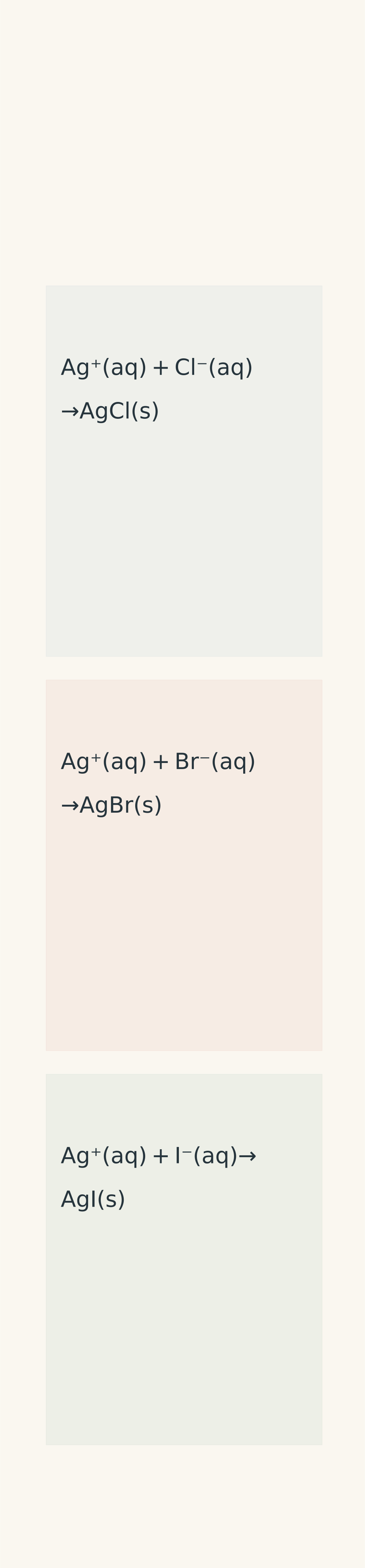
The halide ions are similar because they all react with silver ions:
\[ \ce{Ag+ (aq) + X- (aq) -> AgX(s)} \]
where \(X^-\) represents a halide ion.
The precipitate colour changes:
- \( \ce{AgCl} \): white
- \( \ce{AgBr} \): cream
- \( \ce{AgI} \): yellow
Why acidify before adding silver nitrate?
A common HSC question asks why nitric acid is added first.
The reason is interference.
A solution might contain other ions that also react with silver ions. Acidifying removes some unwanted possibilities, while nitrate ions do not create a precipitate with silver ions.
The test is not just “add silver nitrate and look”. The preparation step improves the reliability of the conclusion.
Worked example: Identifying a halide ion
A student adds acidified silver nitrate to an unknown solution. A pale yellow precipitate forms. Identify the anion.
Step 1
A silver nitrate precipitate test is used for halides.
Step 2
- \( \ce{AgCl} \) is white.
- \( \ce{AgBr} \) is cream.
- \( \ce{AgI} \) is yellow.
Step 3
The yellow precipitate corresponds to silver iodide:
\[ \ce{Ag+ (aq) + I- (aq) -> AgI(s)} \]
The unknown solution contains iodide ions, \( \mathrm{I}^{-} \).
The trap: a student may remember “halides give silver precipitates” but forget that the colour is what separates the three ions.
04Hydroxide ions: identifying alkaline solutions
Hydroxide ions are different because they usually do not form a solid with a simple added reagent. Instead, they change the acid-base behaviour of the solution.
If a solution contains \( \ce{OH^-} \), it is alkaline.
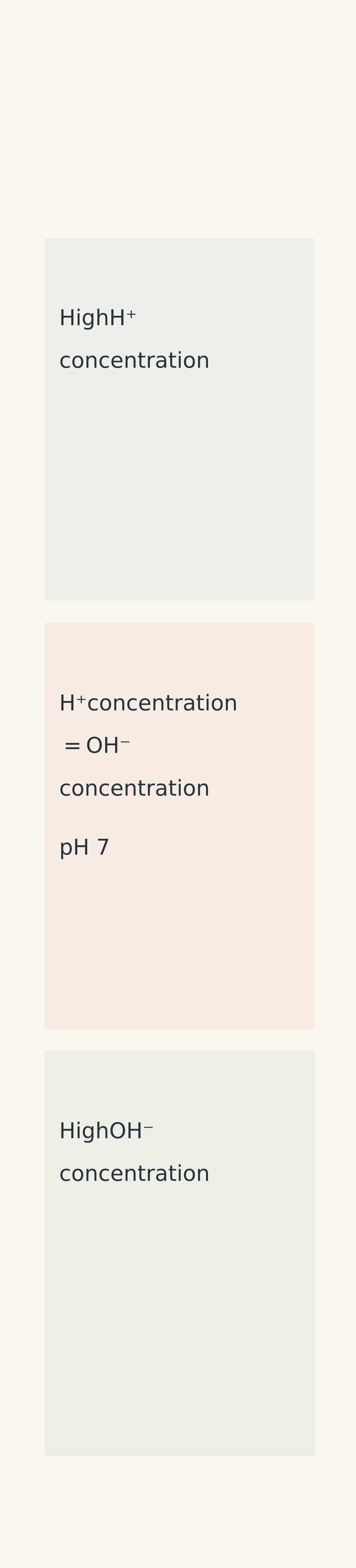
A simple model:
- Acids increase \( \mathrm{H}^{+} \).
- Bases increase \( \ce{OH^-} \).
Indicators respond because they detect the balance between these ions.
A student might predict:
“Every clear solution that turns blue with universal indicator must contain hydroxide ions.”
That is too confident. Many alkaline substances produce \( \ce{OH^-} \) in water, but the test tells you the solution is basic. It does not always identify the original dissolved compound.
For example:
\[ \ce{NaOH(aq) -> Na+ (aq) + OH- (aq)} \]
The hydroxide ion is the reason for the alkaline result.
05Carbonate ions: using gas as evidence
Carbonate ions are identified by their reaction with acids.
When an acid is added, carbon dioxide gas is released:
\[ \ce{CO3^2-(aq) + 2H+(aq) -> CO2(g) + H2O(l)} \]
The observation is fizzing or bubbling.
But the strongest confirmation is to test the gas with limewater:
\[ \ce{CO2(g) + Ca(OH)2(aq) -> CaCO3(s) + H2O(l)} \]
The limewater turns milky because calcium carbonate precipitates.

Worked example: Explaining a carbonate test
A student adds hydrochloric acid to a white powder. Bubbles form, and the gas turns limewater cloudy. Explain what this shows.
Step 1
Carbonate ions react with acids to produce carbon dioxide.
\[ \ce{CO3^2-(aq) + 2H+(aq) -> CO2(g) + H2O(l)} \]
Step 2
Carbon dioxide reacts with calcium hydroxide:
\[ \ce{CO2(g) + Ca(OH)2(aq) -> CaCO3(s) + H2O(l)} \]
The cloudy appearance comes from solid calcium carbonate.
Step 3
The sample contains carbonate ions, \( \ce{CO3^2-} \), because acid produced carbon dioxide that was confirmed by limewater.
The trap: bubbles alone are not enough. Other reactions can release gases, so the gas identity matters.
06Sulfate ions: finding a white precipitate that is not chloride
Sulfate ions are commonly tested using barium ions.
The reaction is:
\[ \ce{Ba^2+(aq) + SO4^2-(aq) -> BaSO4(s)} \]
Barium sulfate is a white precipitate.
The confusing part is that chloride ions also produce a white precipitate with silver ions. Colour alone is not enough. The reagent choice creates the difference.
A chemist is not asking:
“Did I get white?”
They are asking:
“Did I get the expected result from this specific chemical pathway?”
07Ethanoate ions: when the evidence is a smell
Ethanoate ions, \( \ce{CH3COO^-} \), are identified by adding an acid.
The reaction produces ethanoic acid:
\[ \ce{CH3COO^- (aq) + H+ (aq) -> CH3COOH(aq)} \]
Ethanoic acid has the familiar vinegar smell.
The analogy here is like recognising a song from one note. One clue can be useful, but it is less reliable if the environment interferes. Smell tests should be done carefully because many chemicals can be harmful if directly inhaled.
The analogy breaks down because chemical identification should rely on controlled observations, not personal judgement alone.
08Phosphate ions: a less obvious precipitate test
Phosphate ions are identified using ammonium molybdate reagent, producing a yellow precipitate.
This test is useful because phosphate does not give the same obvious reactions as halides, carbonate, or sulfate.
The important habit is to connect the observation back to the ion:
yellow precipitate + correct reagent → phosphate ions likely present.
09Comparing the tests: choosing the right evidence
When several ions are possible, use the test that separates them most clearly.
| Observation | Likely ion(s) | Next thought |
|---|---|---|
| White precipitate with silver nitrate | \( \mathrm{Cl}^{-} \) possible | Check halide colour carefully |
| Cream precipitate with silver nitrate | \( \mathrm{Br}^{-} \) | Consistent with silver bromide |
| Yellow precipitate with silver nitrate | \( \mathrm{I}^{-} \) | Consistent with silver iodide |
| Effervescence with acid | \( \ce{CO3^2-} \) possible | Confirm carbon dioxide |
| White precipitate with barium ions | \( \ce{SO4^2-} \) possible | Consider other possible precipitates |
| Alkaline indicator result | \( \ce{OH^-} \) present | Indicates basic conditions |
| Vinegar smell after acidification | \( \ce{CH3COO^-} \) possible | Handle carefully |
Qualitative analysis is really a logic problem. The reaction is the evidence, and the conclusion must follow from that evidence.
This connects closely with other analytical techniques, where chemists use measurable signals to identify substances, such as colourimetry and atomic absorption spectroscopy.
10Questions and solutions
Question 1
A student adds acidified silver nitrate to an unknown aqueous solution. A cream precipitate forms.
Identify the anion present.
Solution 1
The anion is bromide, \( \mathrm{Br}^{-} \).
The acidified silver nitrate test is used to identify halide ions. Silver ions react with bromide ions:
\[ \ce{Ag+(aq) + Br-(aq) -> AgBr(s)} \]
Silver bromide forms a cream precipitate.
The tempting mistake is to answer chloride because chloride also forms a precipitate with silver ions. The colour is the deciding evidence:
- chloride → white
- bromide → cream
- iodide → yellow
Question 2
A sample produces bubbles when hydrochloric acid is added. The gas turns limewater cloudy.
Identify the anion and explain the observations.
Solution 2
The anion is carbonate, \( \ce{CO3^2-} \).
The acid reacts with carbonate ions to produce carbon dioxide:
\[ \ce{CO3^2-(aq) + 2H+(aq) -> CO2(g) + H2O(l)} \]
The bubbles are carbon dioxide gas.
The gas then reacts with limewater:
\[ \ce{CO2(g) + Ca(OH)2(aq) -> CaCO3(s) + H2O(l)} \]
The calcium carbonate precipitate makes the limewater cloudy.
The trap is assuming that any fizzing means carbonate. The limewater test confirms the identity of the gas.
Question 3
Three unknown solutions are tested.
- Solution A forms a white precipitate with acidified silver nitrate.
- Solution B forms a yellow precipitate with acidified silver nitrate.
- Solution C forms a white precipitate with acidified barium nitrate.
Identify the most likely anions in A, B, and C.
Solution 3
The most likely anions are:
- Solution A: chloride, \( \mathrm{Cl}^{-} \)
- Solution B: iodide, \( \mathrm{I}^{-} \)
- Solution C: sulfate, \( \ce{SO4^2-} \)
For A:
\[ \ce{Ag+(aq) + Cl-(aq) -> AgCl(s)} \]
Silver chloride is white.
For B:
\[ \ce{Ag+(aq) + I-(aq) -> AgI(s)} \]
Silver iodide is yellow.
For C:
\[ \ce{Ba^2+(aq) + SO4^2-(aq) -> BaSO4(s)} \]
Barium sulfate is white.
The trap is focusing only on precipitate colour. Both chloride and sulfate can produce white solids, so the reagent used is essential evidence.
Question 4
A student claims:
“An unknown solution has a pH of 12, so it must contain sodium hydroxide.”
Evaluate this claim.
Solution 4
The claim is not justified. The solution contains hydroxide ions, \( \ce{OH^-} \), but the original dissolved substance is not proven to be sodium hydroxide.
A pH of 12 shows the solution is strongly alkaline. This means hydroxide ions are present in the solution.
For sodium hydroxide:
\[ \ce{NaOH(aq) -> Na+(aq) + OH-(aq)} \]
However, other substances can also produce hydroxide ions in water.
The mistake is confusing identifying an ion with identifying the entire compound. The pH test identifies the chemical behaviour of the solution, not necessarily the original source of the hydroxide ions.
Question 5
An unknown solution could contain chloride, bromide, iodide, or sulfate ions.
A student adds silver nitrate and observes a white precipitate. They confidently conclude that chloride ions are present.
Explain why this conclusion is reasonable but incomplete, and design a better testing approach.
Solution 5
The conclusion is incomplete because a white precipitate does not uniquely identify chloride ions.
The student’s reasoning is understandable:
\[ \ce{Ag+(aq) + Cl-(aq) -> AgCl(s)} \]
Silver chloride is white, so chloride is one possible explanation.
However, the evidence is not enough because the test only shows that a silver precipitate formed. The chemist must consider which ions react with which reagents.
A better approach is:
Step 1: Use acidified silver nitrate to identify halides.
Compare the precipitate colour:
- white → chloride possible
- cream → bromide likely
- yellow → iodide likely
Step 2: Test separately for sulfate using acidified barium nitrate:
\[ \ce{Ba^2+(aq) + SO4^2-(aq) -> BaSO4(s)} \]
A white barium sulfate precipitate indicates sulfate.
The deeper issue is that chemical tests are not magic labels. They are pieces of evidence. A strong conclusion requires the evidence to rule out realistic alternatives.
Qualitative analysis is the foundation for more advanced analytical chemistry. Once you can identify ions from observations, the next step is learning how chemists measure how much of a substance is present using techniques such as gravimetric analysis and instrumental methods.