
Conservation of Atoms in Chemical Reactions: HSC Chemistry Guide
Learn why atoms are conserved during chemical reactions and how to use atom counting to balance equations. Includes worked examples and practice questions.
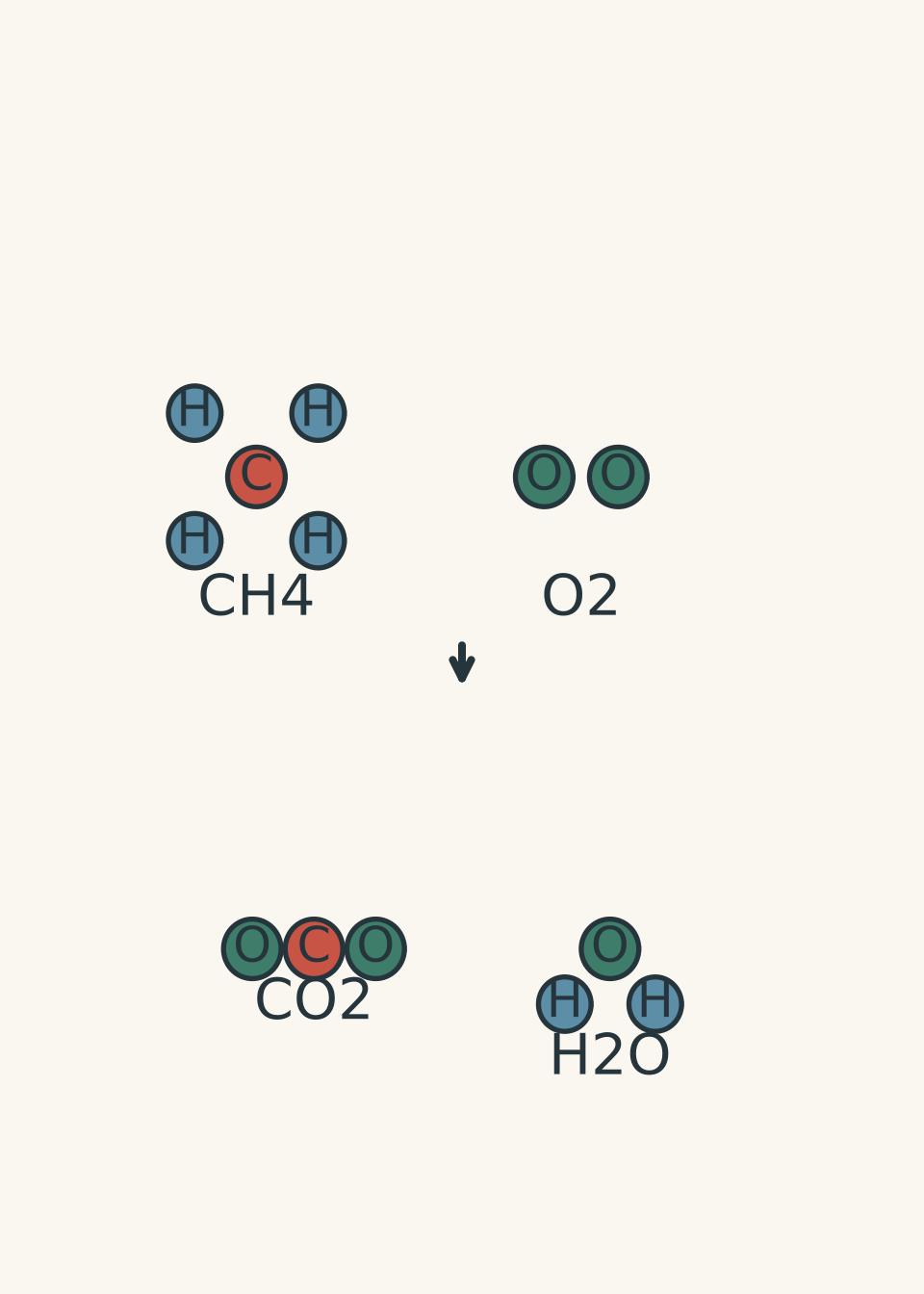
A student writes the equation for burning methane:
\[ \ce{CH4 + O2 -> CO2 + H2O} \]
It looks right. Methane reacts with oxygen, producing carbon dioxide and water. But something is wrong. Count the atoms.
Before the reaction, there are four hydrogen atoms in methane. After the reaction, there are only two hydrogen atoms in water. The carbon atoms are fine, but the hydrogen atoms seem to have disappeared.
Where did those missing atoms go?
They did not go anywhere. They have been hidden by an unbalanced equation. The atoms in a chemical reaction are rearranged, not created or destroyed. Understanding this idea is the key to balancing equations, checking whether a proposed reaction makes sense, and explaining chemical changes.
01The puzzle: how can substances change if atoms stay the same?
Imagine you have a box of coloured building blocks. You can pull the blocks apart and rebuild them into a different shape, but you cannot magically create extra blocks or make some vanish.
Chemical reactions work in a similar way.
A molecule of water can be broken apart into hydrogen and oxygen atoms. Those same atoms can later join in different arrangements to form other substances. The atoms have changed partners, but the total number of each type of atom stays constant.
A useful question to ask whenever you see a chemical equation is:
“If I counted each type of atom before and after, would I have the same number?”
Predict what should happen if a reaction starts with 10 oxygen atoms. Could the products contain 12 oxygen atoms?
No. The products could contain oxygen atoms arranged in different molecules, but there cannot be more oxygen atoms than you started with. The oxygen atoms in the products must have come from the reactants.
This idea is called the conservation of atoms.
02The first mental model: reactions are atom rearrangements
At the particle level, a chemical reaction is not atoms turning into different atoms.
A hydrogen atom remains hydrogen. A carbon atom remains carbon. An oxygen atom remains oxygen.
What changes is the arrangement.
For example, when hydrogen gas reacts with oxygen gas:
\[ \ce{2H2 + O2 -> 2H2O} \]
Before the reaction:
- hydrogen atoms are joined together as hydrogen molecules
- oxygen atoms are joined together as oxygen molecules
After the reaction:
- the same hydrogen and oxygen atoms are joined as water molecules
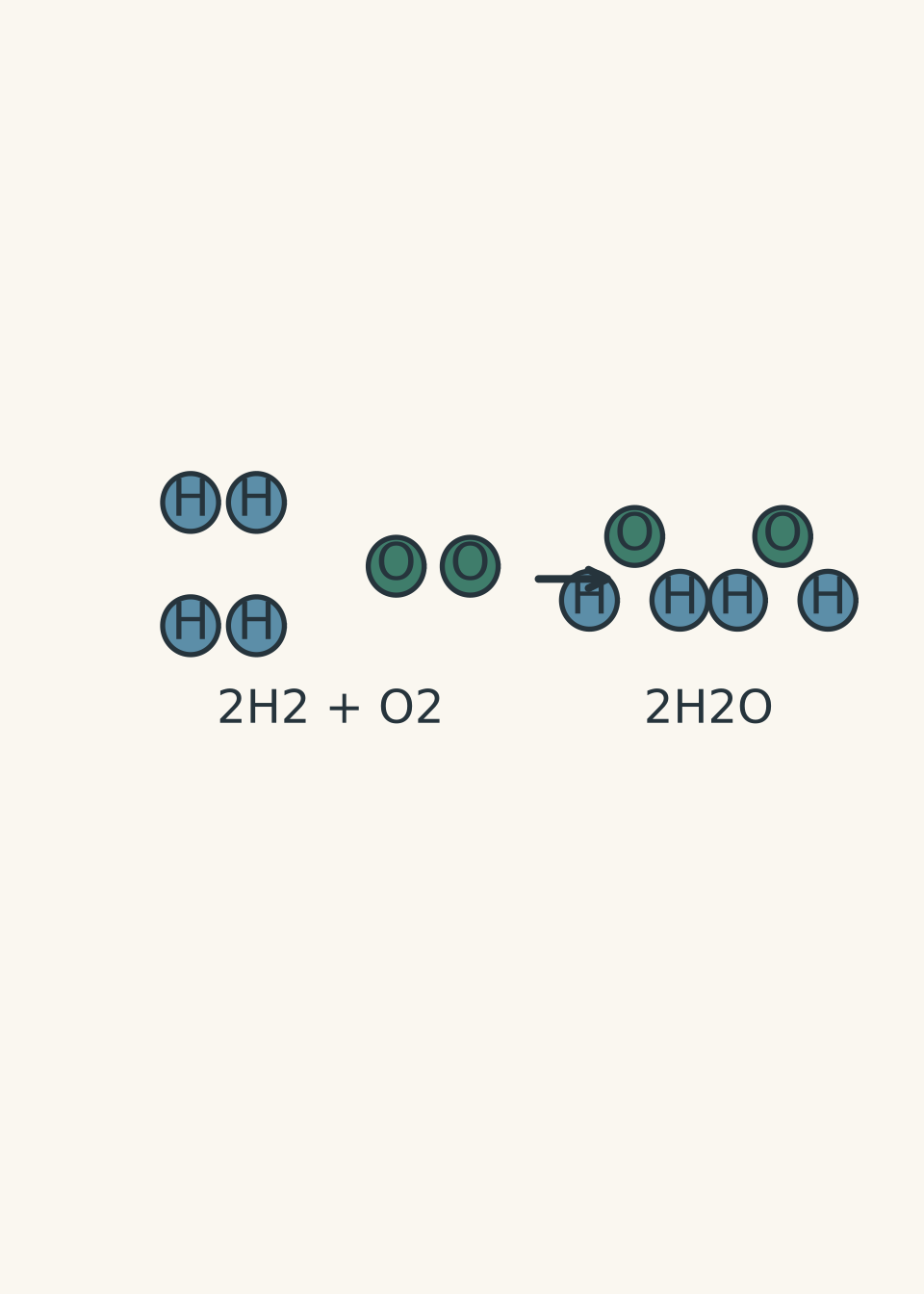
The equation does not say that hydrogen atoms become oxygen atoms or that new oxygen atoms appear. It says that existing atoms are reorganised.
A useful analogy is changing friendship groups at school. Imagine four hydrogen atoms and two oxygen atoms as students moving into new groups. The people are the same, but the groups they belong to have changed. The analogy breaks down because atoms do not choose, communicate, or move around consciously. Chemical reactions are controlled by energy changes and interactions between particles.
03Why chemical equations can accidentally break the rule
A chemical equation has two jobs:
- show which substances react and form
- show the correct number of particles involved
The formulas tell you what each substance is made from.
For example:
\[ \ce{H2O} \]
means each water molecule contains:
- 2 hydrogen atoms
- 1 oxygen atom
The small number after an element symbol is called a subscript. It tells you the number of atoms inside one molecule.
The large number in front of a formula is called a coefficient. It tells you how many particles of that substance are involved.
Compare:
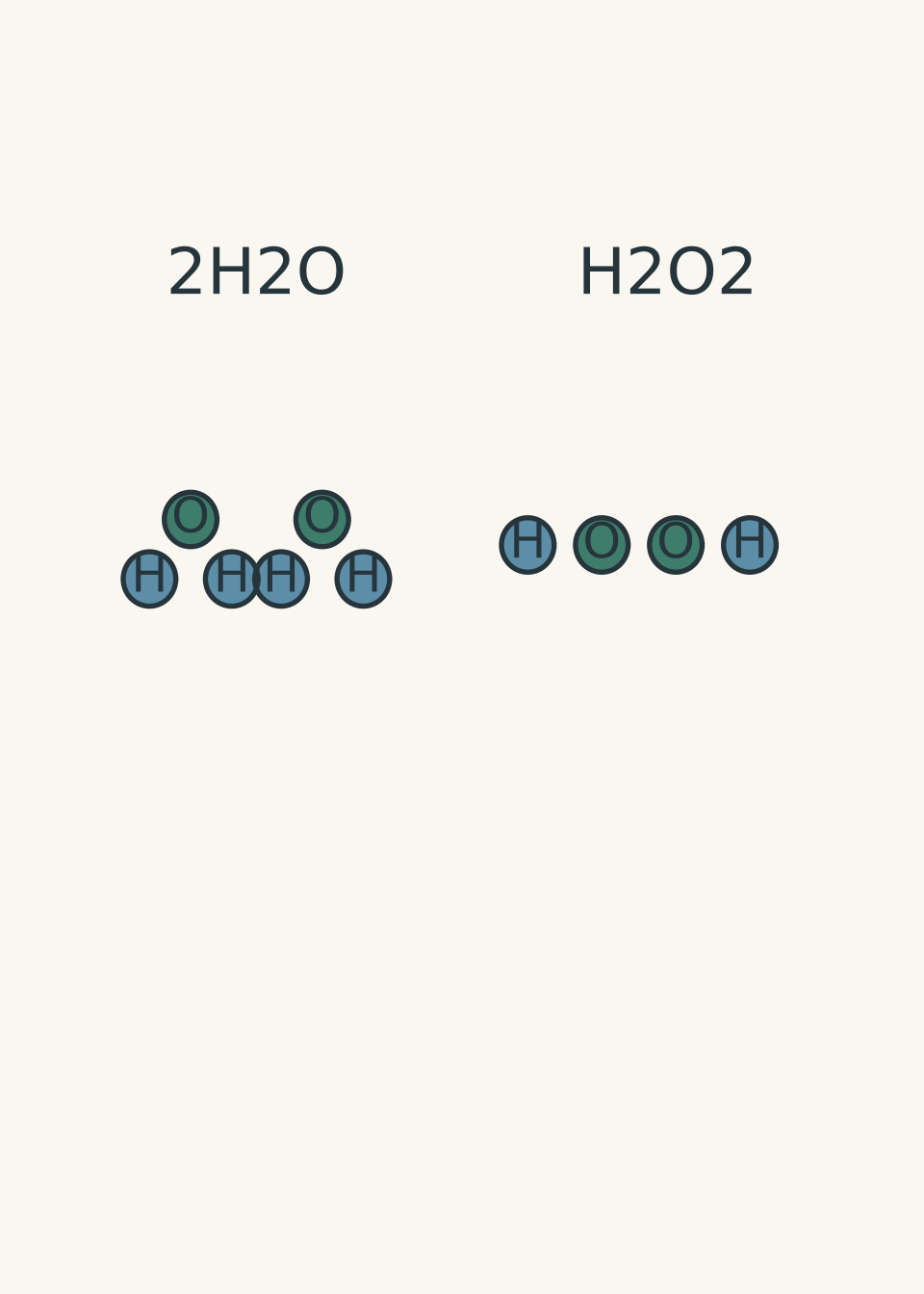
\[ \ce{2H2O} \]
with:
\[ \ce{H2O2} \]
They are not the same.
\(\ce{2H2O}\) means two water molecules:
- hydrogen atoms: \(2 \times 2 = 4\)
- oxygen atoms: \(2 \times 1 = 2\)
\(\ce{H2O2}\) means one hydrogen peroxide molecule:
- hydrogen atoms: 2
- oxygen atoms: 2
The atoms are counted differently because coefficients and subscripts have different meanings.
04Balancing equations: restoring atom conservation
When an equation is unbalanced, the chemical formulas are usually correct, but the number of each atom is wrong.
Take methane combustion:
\[ \ce{CH4 + O2 -> CO2 + H2O} \]
Count the atoms.
| Element | Reactants | Products |
|---|---|---|
| Carbon | 1 | 1 |
| Hydrogen | 4 | 2 |
| Oxygen | 2 | 3 |
Carbon is conserved. Hydrogen and oxygen are not.
The fix is not to change the formulas. Changing \(\ce{H2O}\) into \(\ce{H4O}\), for example, would create a different substance. Instead, change the coefficients.
The balanced equation is:
\[ \ce{CH4 + 2O2 -> CO2 + 2H2O} \]
Now count again:
| Element | Reactants | Products |
|---|---|---|
| Carbon | 1 | 1 |
| Hydrogen | 4 | 4 |
| Oxygen | 4 | 4 |
Every element is conserved.
05A simplified model: what about mass?
At HSC level, conservation of atoms is often connected with conservation of mass.
If atoms are not created or destroyed, then the total mass of those atoms must also remain the same in a closed system.
However, the system matters.
If you burn magnesium in an open container, the measured mass may increase:
\[ \ce{2Mg + O2 -> 2MgO} \]
A student might predict:
“Magnesium was the only solid I started with, so the product should weigh less.”
That prediction feels reasonable because the magnesium is visibly changing. But oxygen gas from the air has joined the magnesium. The extra mass came from oxygen atoms entering the system.
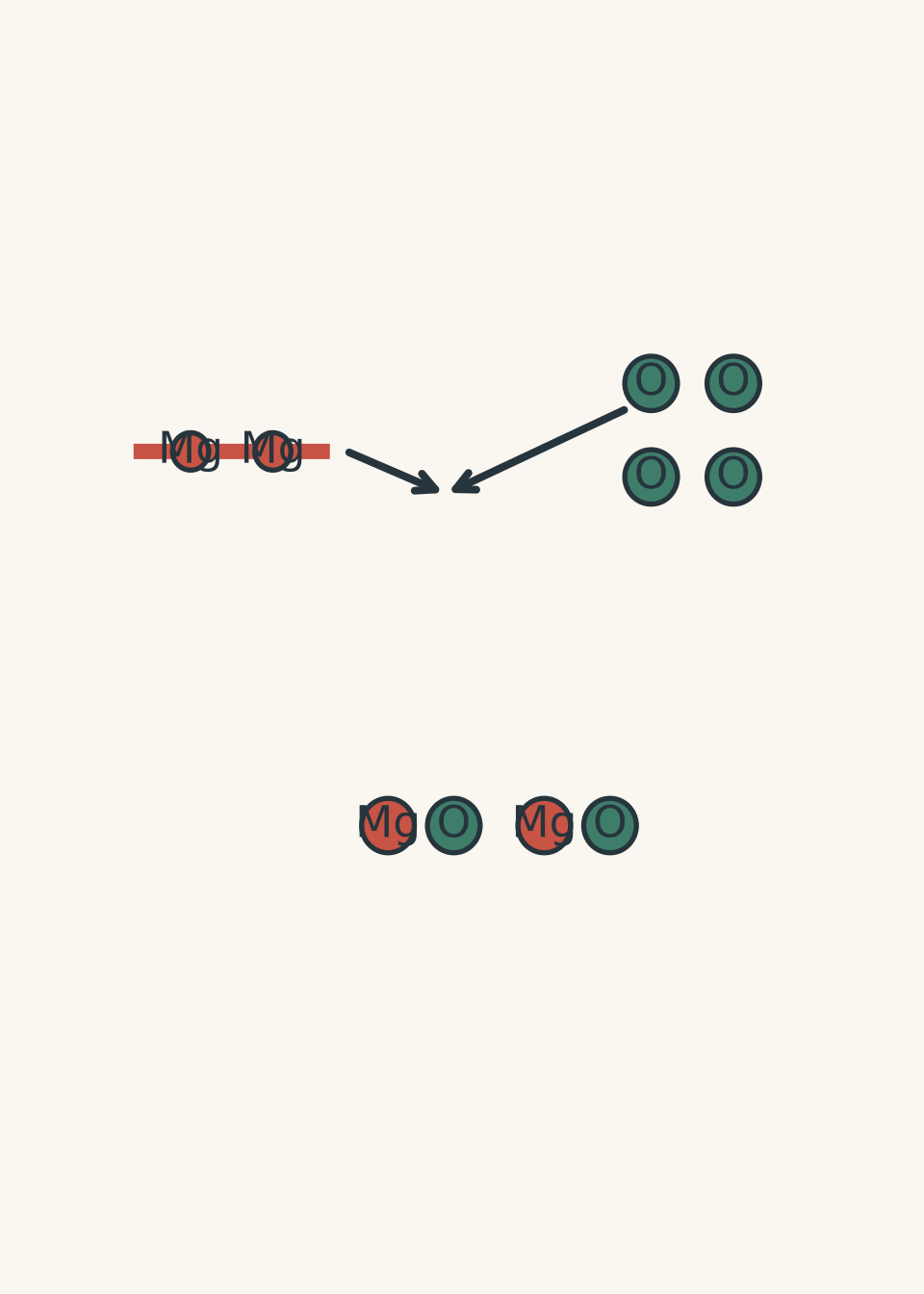
The conservation rule was never broken. The student simply did not include every reactant.
06Worked example: Balance the equation for aluminium reacting with oxygen
Worked example: Balance aluminium oxidation
Question: Balance the chemical equation for aluminium reacting with oxygen to form aluminium oxide.
\[ \ce{Al + O2 -> Al2O3} \]
Step 1
Reactants:
- aluminium: 1 atom
- oxygen: 2 atoms
Products:
- aluminium: 2 atoms
- oxygen: 3 atoms
The numbers do not match, so the equation does not conserve atoms.
Step 2
\[ \ce{2Al + O2 -> Al2O3} \]
Now aluminium is balanced, but oxygen is not.
Step 3
The product contains 3 oxygen atoms, while oxygen gas contains oxygen in pairs. The smallest common number of oxygen atoms is 6.
Use coefficients that give 6 oxygen atoms on both sides:
\[ \ce{4Al + 3O2 -> 2Al2O3} \]
Step 4
Reactants:
- aluminium: \(4\)
- oxygen: \(3 \times 2 = 6\)
Products:
- aluminium: \(2 \times 2 = 4\)
- oxygen: \(2 \times 3 = 6\)
The equation is balanced.
The important idea is that the coefficients changed the number of particles, not the identity of the substances.
07Worked example: Checking whether a combustion equation conserves atoms
Worked example: Identify and fix the atom imbalance
Question: A student writes the combustion equation for propane as:
\[ \ce{C3H8 + 5O2 -> 3CO2 + 4H2O} \]
Determine whether the equation conserves atoms.
Step 1
Reactants:
- carbon: \(3\)
- hydrogen: \(8\)
- oxygen: \(5 \times 2 = 10\)
Products:
- carbon: \(3 \times 1 = 3\)
- hydrogen: \(4 \times 2 = 8\)
- oxygen: \(3 \times 2 + 4 \times 1 = 10\)
Step 2
Carbon, hydrogen, and oxygen all have equal numbers on both sides.
Step 3
The equation already conserves atoms, so it is balanced.
The temptation is to assume combustion equations are always difficult because oxygen appears on both sides. The better approach is simpler: count atoms and let the numbers decide.
You can explore more examples of balancing reactions in How to Predict Products and Balance Chemical Equations.
08Common misconceptions about conservation of atoms
“Atoms disappear when a gas is produced”
A reaction such as an acid-carbonate reaction can produce carbon dioxide gas:
\[ \ce{2HCl + CaCO3 -> CaCl2 + H2O + CO2} \]
A student may think the solid carbonate has “lost” atoms because gas bubbles leave.
The atoms have not disappeared. Carbon and oxygen atoms from the carbonate have been rearranged into carbon dioxide molecules that leave the solution.
See Acid-Carbonate Reactions: Predicting Products and Balancing Equations for more examples.
“The number in a formula can be changed to balance atoms”
This is one of the most important traps.
You cannot change:
\[ \ce{CO2} \]
into:
\[ \ce{CO3} \]
just because you need more oxygen. \(\ce{CO2}\) and \(\ce{CO3}\) represent different substances.
Balance equations by changing coefficients, not subscripts.
09Questions and solutions
Question 1
A student writes the equation:
\[ \ce{H2 + O2 -> H2O} \]
Explain whether atoms are conserved and give the balanced equation.
Solution 1
The equation is not balanced because oxygen atoms are not conserved.
The reactants contain:
- hydrogen: \(2\) atoms
- oxygen: \(2\) atoms
The products contain:
- hydrogen: \(2\) atoms
- oxygen: \(1\) atom
The hydrogen atoms are conserved, but one oxygen atom appears to have disappeared. The correct balanced equation is:
\[ \ce{2H2 + O2 -> 2H2O} \]
Now the totals are:
- hydrogen: \(4\) atoms on both sides
- oxygen: \(2\) atoms on both sides
The key idea is that the coefficient changes the number of water molecules, allowing the original oxygen atoms to be accounted for.
Question 2
A sample of calcium carbonate reacts with hydrochloric acid:
\[ \ce{CaCO3 + 2HCl -> CaCl2 + H2O + CO2} \]
Explain why the carbon atoms in the calcium carbonate have not been destroyed, even though the solid disappears and gas is produced.
Solution 2
The carbon atoms have been rearranged into carbon dioxide molecules.
The reactant calcium carbonate contains one carbon atom per formula unit:
\[ \ce{CaCO3} \]
The product carbon dioxide also contains one carbon atom per molecule:
\[ \ce{CO2} \]
The solid disappears because the particles are now arranged as different substances. The carbon atoms have moved into the gas phase as part of carbon dioxide rather than being destroyed.
The common mistake is to connect “disappearing solid” with “lost atoms”. A physical appearance change does not mean atoms have vanished.
Question 3
A student burns \(10.0\ \text{g}\) of magnesium in oxygen. The magnesium oxide produced has a mass of \(16.6\ \text{g}\).
The student says, “The law of conservation of atoms has failed because the product gained mass.”
Explain why the student’s conclusion is incorrect.
Solution 3
The conclusion is incorrect because oxygen atoms from the air have become part of the magnesium oxide.
The reaction is:
\[ \ce{2Mg + O2 -> 2MgO} \]
The magnesium atoms were already present, but oxygen atoms entered the system from the surroundings.
The increase in mass is:
\[ 16.6\ \text{g} - 10.0\ \text{g} = 6.6\ \text{g} \]
That \(6.6\ \text{g}\) represents oxygen that reacted with magnesium.
The conservation principle only applies to the atoms included in the system being considered. If oxygen from the air is ignored, the calculation looks like mass has appeared from nowhere.
Question 4
Two possible equations are suggested for the formation of water.
Model A:
\[ \ce{H2 + O2 -> H2O} \]
Model B:
\[ \ce{2H2 + O2 -> 2H2O} \]
A student argues that Model A is better because it uses fewer molecules. Decide which model is chemically valid and explain why.
Solution 4
Model B is chemically valid because it conserves every atom.
Model A appears simpler, but its atom count fails:
Reactants:
- hydrogen: \(2\)
- oxygen: \(2\)
Products:
- hydrogen: \(2\)
- oxygen: \(1\)
One oxygen atom has no matching product atom.
Model B gives:
Reactants:
- hydrogen: \(2 \times 2 = 4\)
- oxygen: \(2\)
Products:
- hydrogen: \(2 \times 2 = 4\)
- oxygen: \(2 \times 1 = 2\)
The trap is assuming the shortest equation is automatically the best equation. Chemical equations must represent conservation of atoms first; simplicity comes second.
Question 5
A sealed container contains methane and oxygen. After a complete reaction, the container contains only carbon dioxide and water vapour.
A student measures the final substances and finds:
- carbon atoms: \(3.0 \times 10^{22}\)
- hydrogen atoms: \(1.2 \times 10^{23}\)
- oxygen atoms: \(1.5 \times 10^{23}\)
Before the reaction, the methane supplied all the carbon and hydrogen atoms. The oxygen came only from oxygen gas.
Determine the number of oxygen atoms that were present in the oxygen gas before the reaction. Explain your reasoning.
Solution 5
The oxygen gas initially contained \(1.5 \times 10^{23}\) oxygen atoms.
The reason is that oxygen atoms are conserved, and the only source of oxygen atoms in the products was the oxygen gas reactant.
The tempting route is to try to infer the original oxygen amount from the number of carbon dioxide and water molecules. That approach can work, but it is unnecessary here because the question gives the total number of oxygen atoms after the reaction and tells us there was no other oxygen source.
Because the container is sealed, no oxygen atoms entered or left. Therefore:
\[ \text{oxygen atoms before reaction} = \text{oxygen atoms after reaction} \]
\[ =1.5 \times 10^{23} \]
The deeper idea is that conservation laws are constraints on a whole system. The atoms may move between molecules and phases, but the total number of each element cannot change.
Understanding conservation of atoms makes the next step in chemistry much easier: predicting products and balancing more complicated reactions, including combustion, acid-base reactions, and precipitation reactions.