
Temperature and Gibbs Spontaneity for HSC Chemistry
Learn how temperature changes reaction spontaneity by comparing the signs and relative effects of enthalpy and entropy in the Gibbs free energy equation.
Put an ice cube at \(-10^\circ\text{C}\) and it stays solid. Put the same ice cube at \(20^\circ\text{C}\) and it melts spontaneously.
Here is the puzzle: melting absorbs heat, so \(\Delta H>0\). If absorbing energy is energetically unfavourable, why can increasing the temperature make melting spontaneous?
Predict the answer before reading on. Does heating change the sign of \(\Delta H\), or does it make another thermodynamic effect more important?
It is the second one. Temperature changes how strongly entropy contributes to spontaneity. That is the idea behind
\[ \Delta G=\Delta H-T\Delta S \]
and it gives us a reliable way to predict when heating helps a process, when it hurts, and when it can reverse which direction is spontaneous.
01Temperature changes the weight of entropy
For a process at constant temperature and pressure, Gibbs free energy change tells us whether the forward process is thermodynamically favourable under the stated conditions.
- \(\Delta G<0\): the forward process is spontaneous.
- \(\Delta G=0\): the system is at equilibrium.
- \(\Delta G>0\): the forward process is non-spontaneous; the reverse direction is favoured.
The equation is
\[ \Delta G=\Delta H-T\Delta S \]
where:
- \(\Delta G\) is the Gibbs free energy change, usually in \(\mathrm{kJ\,mol^{-1}}\),
- \(\Delta H\) is the enthalpy change, usually in \(\mathrm{kJ\,mol^{-1}}\),
- \(T\) is the absolute temperature in kelvin, \(\mathrm{K}\),
- \(\Delta S\) is the entropy change, often given in \(\mathrm{J\,mol^{-1}\,K^{-1}}\).
Before worrying about all four combinations of signs, look at the equation physically.
A negative \(\Delta H\) helps make \(\Delta G\) negative. So an exothermic process gets an energetic advantage.
A positive \(\Delta S\) also helps, because \(T\Delta S\) is then positive and is subtracted from \(\Delta H\). As temperature rises, that favourable entropy contribution becomes larger.
You can picture \(\Delta G\) as a slightly unfair scoreboard. \(\Delta H\) gives the starting score, while \(-T\Delta S\) gives a temperature-dependent adjustment. Turning up the temperature does not simply make every reaction “more spontaneous”. It turns up the influence of the entropy term.
That analogy has a limit. In real systems, \(\Delta H\) and \(\Delta S\) can themselves change with temperature, especially across phase changes. For most HSC calculations, however, we treat them as approximately constant over the temperature range given.
02The fastest way to predict the effect of heating
Suppose \(\Delta S>0\).
As \(T\) increases, \(T\Delta S\) becomes more positive, so subtracting it makes \(\Delta G\) smaller.
Therefore:
If \(\Delta S>0\), increasing temperature makes the forward process more thermodynamically favourable.
Now suppose \(\Delta S<0\).
Then \(T\Delta S\) is negative, so \(-T\Delta S\) is positive. Increasing \(T\) makes that positive contribution larger.
Therefore:
If \(\Delta S<0\), increasing temperature makes the forward process less thermodynamically favourable.
This is more useful than trying to memorise four unrelated cases. The sign of \(\Delta S\) tells you what heating does to \(\Delta G\).
Then \(\Delta H\) tells you where the process starts.
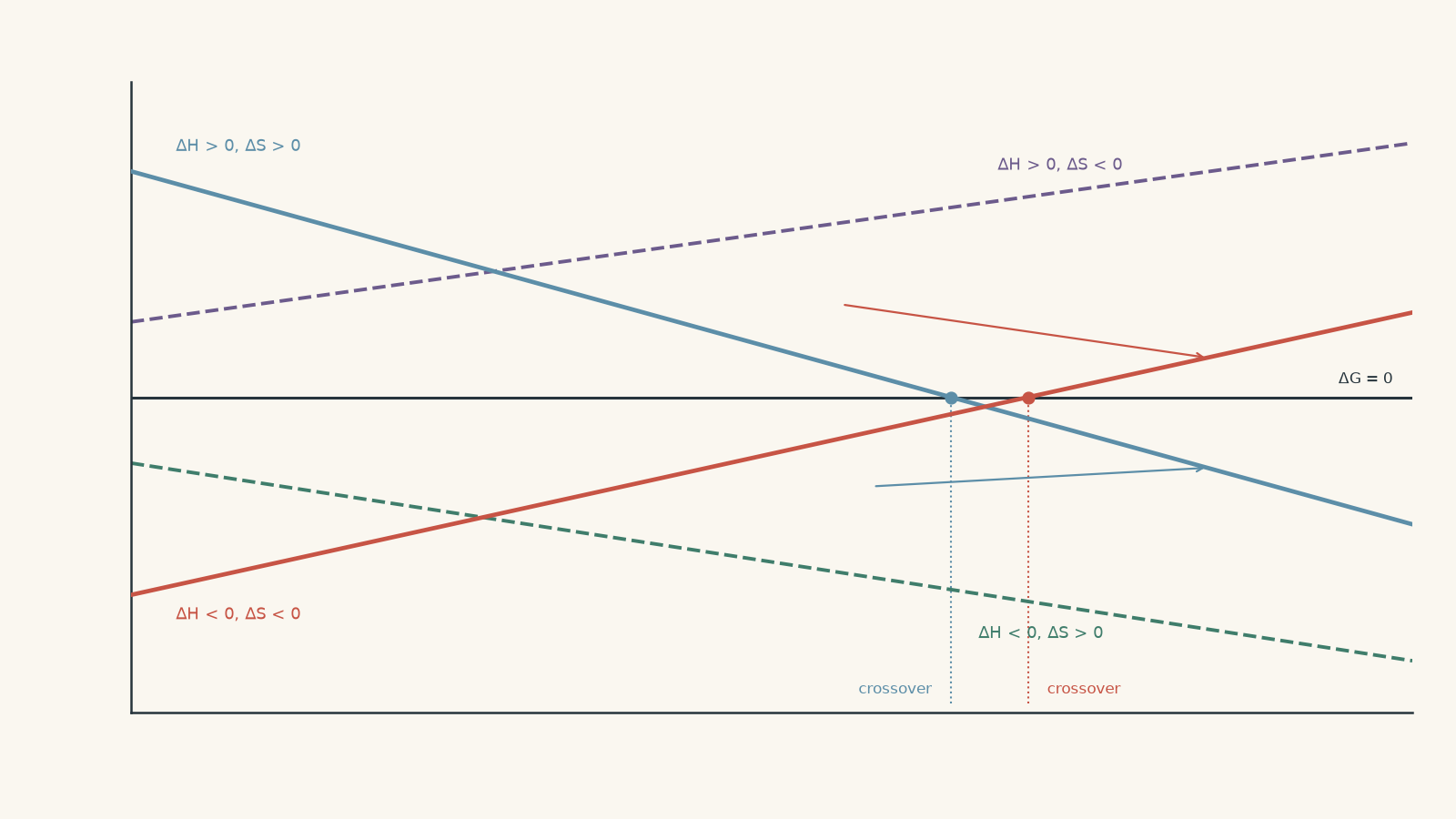
| \(\Delta H\) | \(\Delta S\) | Effect of increasing \(T\) | Spontaneity in the simple model |
|---|---|---|---|
| Negative | Positive | Makes \(\Delta G\) even more negative | Spontaneous at all temperatures |
| Positive | Negative | Makes \(\Delta G\) even more positive | Non-spontaneous at all temperatures |
| Positive | Positive | Lowers \(\Delta G\) | Non-spontaneous at low \(T\), spontaneous at high \(T\) |
| Negative | Negative | Raises \(\Delta G\) | Spontaneous at low \(T\), non-spontaneous at high \(T\) |
“All temperatures” here means all physically relevant temperatures over which the assumed values of \(\Delta H\) and \(\Delta S\) remain valid.
03Why only two sign combinations can switch
Consider a reaction with \(\Delta H>0\) and \(\Delta S>0\).
At low temperature, the positive \(\Delta H\) term can dominate:
\[ \Delta G>0 \]
At sufficiently high temperature, \(T\Delta S\) can become larger than \(\Delta H\):
\[ T\Delta S>\Delta H \]
so
\[ \Delta G<0 \]
The reaction switches from non-spontaneous to spontaneous.
Now consider \(\Delta H<0\) and \(\Delta S<0\). At low temperature, the favourable negative \(\Delta H\) dominates. At high temperature, however, the entropy contribution becomes increasingly unfavourable, so \(\Delta G\) can eventually become positive.
That gives the important pattern:
- \(\Delta H>0,\Delta S>0\): heating can switch spontaneity on.
- \(\Delta H<0,\Delta S<0\): heating can switch spontaneity off.
When \(\Delta H\) and \(\Delta S\) have opposite signs, both terms push \(\Delta G\) in the same direction, so there is no positive-temperature crossover in the simple model.
04Finding the temperature where spontaneity changes
At the crossover temperature, neither direction has a Gibbs free energy advantage:
\[ \Delta G=0 \]
Starting from
\[ \Delta G=\Delta H-T\Delta S \]
set \(\Delta G=0\):
\[ 0=\Delta H-T\Delta S \]
so
\[ T_{\text{switch}}=\frac{\Delta H}{\Delta S} \]
There is one extremely common trap here: the units of \(\Delta H\) and \(\Delta S\) must match.
If \(\Delta H\) is in \(\mathrm{kJ\,mol^{-1}}\) and \(\Delta S\) is in \(\mathrm{J\,mol^{-1}\,K^{-1}}\), convert one before dividing or substituting.
For example,
\[ 145\ \mathrm{J\,mol^{-1}\,K^{-1}} = 0.145\ \mathrm{kJ\,mol^{-1}\,K^{-1}} \]
Also, temperature must be in kelvin. Do not put a Celsius temperature directly into \(T\Delta S\).
Worked example: Can heating make an endothermic reaction spontaneous?
A hypothetical decomposition reaction,
\[ \ce{A(s) -> B(s) + C(g)} \]
has \(\Delta H=+58.0\ \mathrm{kJ\,mol^{-1}}\) and \(\Delta S=+145\ \mathrm{J\,mol^{-1}\,K^{-1}}\).
Calculate \(\Delta G\) at \(298\ \mathrm{K}\) and \(500\ \mathrm{K}\), and determine the temperature at which the reaction changes from non-spontaneous to spontaneous.
Step 1
\[ \Delta S=145\ \mathrm{J\,mol^{-1}\,K^{-1}} =0.145\ \mathrm{kJ\,mol^{-1}\,K^{-1}} \]
Step 2
\[ \begin{aligned} \Delta G&=\Delta H-T\Delta S\\ &=58.0-(298)(0.145)\\ &=58.0-43.21\\ &=+14.8\ \mathrm{kJ\,mol^{-1}} \end{aligned} \]
Because \(\Delta G>0\), the forward reaction is non-spontaneous at \(298\ \mathrm{K}\).
Step 3
\[ \begin{aligned} \Delta G&=58.0-(500)(0.145)\\ &=58.0-72.5\\ &=-14.5\ \mathrm{kJ\,mol^{-1}} \end{aligned} \]
At \(500\ \mathrm{K}\), \(\Delta G<0\), so the forward reaction is spontaneous.
Step 4
\[ \begin{aligned} T_{\text{switch}} &=\frac{\Delta H}{\Delta S}\\ &=\frac{58.0}{0.145}\\ &=400\ \mathrm{K} \end{aligned} \]
At \(400\ \mathrm{K}\), \(\Delta G=0\). Below \(400\ \mathrm{K}\), the positive enthalpy term dominates. Above \(400\ \mathrm{K}\), the favourable entropy term is large enough to overcome it.
This is the same basic reason an entropy-increasing process such as melting can become favourable when temperature rises.
Worked example: When does an exothermic reaction stop being spontaneous?
A hypothetical reaction,
\[ \ce{D(g) + E(g) -> F(s)} \]
has \(\Delta H=-72.0\ \mathrm{kJ\,mol^{-1}}\) and \(\Delta S=-160\ \mathrm{J\,mol^{-1}\,K^{-1}}\).
Determine the temperature range over which the reaction is spontaneous, and check your prediction at \(350\ \mathrm{K}\) and \(600\ \mathrm{K}\).
Step 1
Both \(\Delta H\) and \(\Delta S\) are negative. The negative enthalpy favours the reaction, but the negative entropy means increasing temperature raises \(\Delta G\).
So the reaction should be spontaneous at low temperatures and non-spontaneous at sufficiently high temperatures.
Step 2
\[ \Delta S=-0.160\ \mathrm{kJ\,mol^{-1}\,K^{-1}} \]
\[ \begin{aligned} T_{\text{switch}} &=\frac{-72.0}{-0.160}\\ &=450\ \mathrm{K} \end{aligned} \]
Step 3
\[ \begin{aligned} \Delta G &=-72.0-(350)(-0.160)\\ &=-72.0+56.0\\ &=-16.0\ \mathrm{kJ\,mol^{-1}} \end{aligned} \]
The reaction is spontaneous at \(350\ \mathrm{K}\).
Step 4
\[ \begin{aligned} \Delta G &=-72.0-(600)(-0.160)\\ &=-72.0+96.0\\ &=+24.0\ \mathrm{kJ\,mol^{-1}} \end{aligned} \]
The reaction is non-spontaneous at \(600\ \mathrm{K}\).
Being exothermic did not make the reaction spontaneous at every temperature. At high temperature, its entropy decrease became costly enough to outweigh the favourable enthalpy change.
05The two misconceptions worth catching early
The first tempting idea is:
Exothermic reactions are spontaneous.
Sometimes. Not always.
An exothermic reaction has \(\Delta H<0\), which helps make \(\Delta G\) negative. But if \(\Delta S<0\), increasing temperature creates an opposing \( -T\Delta S\) contribution. At a high enough temperature, that contribution can win.
The reverse mistake is also common: an endothermic reaction is not automatically non-spontaneous. If \(\Delta S>0\), sufficiently high temperature can make \(T\Delta S\) larger than \(\Delta H\).
The second misconception is that spontaneous means fast.
It does not. Gibbs free energy describes thermodynamic favourability, not reaction rate. A process can have \(\Delta G<0\) and still occur extremely slowly because it has a large activation energy.
A catalyst can change how quickly equilibrium is approached. It does not change \(\Delta H\), \(\Delta S\), \(\Delta G\), or the temperature at which \(\Delta G\) changes sign.
For a broader treatment of this distinction, see Gibbs Free Energy and Reaction Spontaneity for HSC Chemistry.
06A better exam decision rule
When you see a question about temperature and spontaneity, work in this order.
- Look at the sign of \(\Delta S\). This tells you what increasing temperature does to \(\Delta G\).
- Look at the sign of \(\Delta H\). This tells you whether enthalpy initially helps or opposes the reaction.
- Decide whether a change of spontaneity is even possible.
- If a crossover is possible, set \(\Delta G=0\) and calculate \(T=\Delta H/\Delta S\).
- Match the units before doing any arithmetic.
- State which side of the calculated temperature is spontaneous. A crossover temperature by itself is not a complete answer.
There is also a useful graphical version. If \(\Delta H\) and \(\Delta S\) are treated as constant,
\[ \Delta G=\Delta H-T\Delta S \]
has the form of a straight-line equation.
The starting value is controlled by \(\Delta H\), while the gradient is \(-\Delta S\).
So:
- positive \(\Delta S\) gives a downward-sloping \(\Delta G\) line,
- negative \(\Delta S\) gives an upward-sloping line.
A line can cross \(\Delta G=0\) at most once. That fact becomes surprisingly useful in harder questions.
07Where the simple model can break
When an HSC question asks you to predict temperature effects from fixed \(\Delta H\) and \(\Delta S\), it is usually asking you to assume those values stay approximately constant.
That is a model, not a universal law about their numerical values.
Over a large temperature range, heat capacities can make \(\Delta H\) and \(\Delta S\) change. More dramatically, a substance might melt, boil, or undergo another phase transition. The thermodynamic data for the relevant reaction can then change.
This is why you should not blindly calculate one crossover temperature and extrapolate it across every imaginable temperature.
If standard-state quantities are supplied, the same reasoning is written as
\[ \Delta G^\circ=\Delta H^\circ-T\Delta S^\circ \]
The circles simply indicate standard-state quantities. The temperature logic is unchanged.
For more on the language used around favourable and unfavourable processes, see Reaction Spontaneity and Gibbs Free Energy: HSC Chemistry.
08Questions and solutions
Question 1
A reaction has
\[ \Delta H=+24.0\ \mathrm{kJ\,mol^{-1}} \]
and
\[ \Delta S=+80.0\ \mathrm{J\,mol^{-1}\,K^{-1}} \]
Calculate the temperature at which \(\Delta G=0\). Determine whether the reaction is spontaneous at \(250\ \mathrm{K}\) and \(350\ \mathrm{K}\).
Solution 1
The reaction is non-spontaneous at \(250\ \mathrm{K}\), reaches \(\Delta G=0\) at \(300\ \mathrm{K}\), and is spontaneous at \(350\ \mathrm{K}\).
First convert the entropy change:
\[ 80.0\ \mathrm{J\,mol^{-1}\,K^{-1}} = 0.0800\ \mathrm{kJ\,mol^{-1}\,K^{-1}} \]
The crossover temperature is
\[ \begin{aligned} T_{\text{switch}} &=\frac{\Delta H}{\Delta S}\\ &=\frac{24.0}{0.0800}\\ &=300\ \mathrm{K} \end{aligned} \]
At \(250\ \mathrm{K}\),
\[ \begin{aligned} \Delta G &=24.0-(250)(0.0800)\\ &=24.0-20.0\\ &=+4.0\ \mathrm{kJ\,mol^{-1}} \end{aligned} \]
so the reaction is non-spontaneous.
At \(350\ \mathrm{K}\),
\[ \begin{aligned} \Delta G &=24.0-(350)(0.0800)\\ &=24.0-28.0\\ &=-4.0\ \mathrm{kJ\,mol^{-1}} \end{aligned} \]
so the reaction is spontaneous.
The tempting mistake is to see \(\Delta H>0\) and immediately call the reaction non-spontaneous. The positive entropy change means increasing temperature steadily lowers \(\Delta G\), eventually overcoming the endothermic enthalpy change.
Question 2
For the hypothetical reaction
\[ \ce{2A(g) -> B(g)} \]
\[ \Delta H=-96.0\ \mathrm{kJ\,mol^{-1}} \]
and
\[ \Delta S=-180\ \mathrm{J\,mol^{-1}\,K^{-1}} \]
A student claims that the reaction must be spontaneous at every temperature because it is exothermic.
Calculate the maximum temperature at which the reaction is spontaneous under the constant-\(\Delta H\), constant-\(\Delta S\) model. Verify your conclusion by calculating \(\Delta G\) at \(450\ \mathrm{K}\) and \(600\ \mathrm{K}\).
Solution 2
The reaction is spontaneous below about \(533\ \mathrm{K}\), not at every temperature. It is spontaneous at \(450\ \mathrm{K}\) but non-spontaneous at \(600\ \mathrm{K}\).
Convert the entropy change:
\[ \Delta S=-0.180\ \mathrm{kJ\,mol^{-1}\,K^{-1}} \]
At the crossover,
\[ \begin{aligned} T_{\text{switch}} &=\frac{-96.0}{-0.180}\\ &=533.3\ \mathrm{K} \end{aligned} \]
Because \(\Delta H<0\) and \(\Delta S<0\), the reaction is favoured at temperatures below this value.
At \(450\ \mathrm{K}\),
\[ \begin{aligned} \Delta G &=-96.0-(450)(-0.180)\\ &=-96.0+81.0\\ &=-15.0\ \mathrm{kJ\,mol^{-1}} \end{aligned} \]
so the forward reaction is spontaneous.
At \(600\ \mathrm{K}\),
\[ \begin{aligned} \Delta G &=-96.0-(600)(-0.180)\\ &=-96.0+108\\ &=+12.0\ \mathrm{kJ\,mol^{-1}} \end{aligned} \]
so it is non-spontaneous.
The student’s reasoning notices the favourable negative \(\Delta H\) but ignores entropy. Converting two gas particles into one tends to reduce the number of possible arrangements of matter, which is consistent with the supplied negative \(\Delta S\). At high temperature, that entropy penalty becomes large enough to reverse the sign of \(\Delta G\).
Question 3
For the decomposition
\[ \ce{MCO3(s) -> MO(s) + CO2(g)} \]
suppose
\[ \Delta H=+162\ \mathrm{kJ\,mol^{-1}} \]
and
\[ \Delta S=+150\ \mathrm{J\,mol^{-1}\,K^{-1}} \]
over the temperature range being considered.
Determine whether the reaction is thermodynamically spontaneous at \(900\ \mathrm{K}\) and \(1200\ \mathrm{K}\).
A catalyst is then added at \(900\ \mathrm{K}\). Could the catalyst make the forward reaction spontaneous at that temperature? Explain why a spontaneous reaction at \(1200\ \mathrm{K}\) could nevertheless occur slowly.
Solution 3
The decomposition is non-spontaneous at \(900\ \mathrm{K}\) and spontaneous at \(1200\ \mathrm{K}\). A catalyst cannot make it thermodynamically spontaneous at \(900\ \mathrm{K}\), and spontaneity at \(1200\ \mathrm{K}\) does not guarantee a fast reaction.
First convert
\[ \Delta S=0.150\ \mathrm{kJ\,mol^{-1}\,K^{-1}} \]
At \(900\ \mathrm{K}\),
\[ \begin{aligned} \Delta G &=162-(900)(0.150)\\ &=162-135\\ &=+27\ \mathrm{kJ\,mol^{-1}} \end{aligned} \]
The forward reaction is therefore non-spontaneous.
At \(1200\ \mathrm{K}\),
\[ \begin{aligned} \Delta G &=162-(1200)(0.150)\\ &=162-180\\ &=-18\ \mathrm{kJ\,mol^{-1}} \end{aligned} \]
so the forward reaction is spontaneous.
The crossover temperature is
\[ T_{\text{switch}} = \frac{162}{0.150} = 1080\ \mathrm{K} \]
A catalyst provides an alternative reaction pathway with a lower activation energy. It affects kinetics, not the values of \(\Delta H\), \(\Delta S\), or \(\Delta G\). The catalyst therefore cannot move the \(1080\ \mathrm{K}\) thermodynamic crossover.
The tempting argument is that “a catalyst makes reactions happen, so perhaps it can make \(\Delta G\) negative”. That mixes up rate and thermodynamic direction. Even at \(1200\ \mathrm{K}\), where \(\Delta G<0\), the reaction could remain slow if the uncatalysed activation-energy barrier is large.
Question 4
A system can undergo these two hypothetical reactions:
\[ \ce{A -> B} \]
with
\[ \Delta H_1=+40.0\ \mathrm{kJ\,mol^{-1}},\qquad \Delta S_1=+100\ \mathrm{J\,mol^{-1}\,K^{-1}} \]
and
\[ \ce{B -> C} \]
with
\[ \Delta H_2=-60.0\ \mathrm{kJ\,mol^{-1}},\qquad \Delta S_2=-50.0\ \mathrm{J\,mol^{-1}\,K^{-1}} \]
Assume the values remain constant.
For \(300\ \mathrm{K}\), \(800\ \mathrm{K}\), and \(1500\ \mathrm{K}\):
- determine the sign of \(\Delta G\) for each individual reaction,
- determine the sign of \(\Delta G\) for the overall reaction \(\ce{A -> C}\),
- decide whether a negative \(\Delta G\) for \(\ce{A -> C}\) proves that the sequence \(\ce{A -> B -> C}\) will proceed spontaneously as written.
Solution 4
The overall reaction \(\ce{A -> C}\) is spontaneous at all three temperatures. However, \(\ce{A -> B}\) is non-spontaneous at \(300\ \mathrm{K}\), \(\ce{B -> C}\) is non-spontaneous at \(1500\ \mathrm{K}\), and a negative overall \(\Delta G\) does not prove that the proposed two-step pathway will proceed spontaneously.
Convert the entropy values:
\[ \Delta S_1=+0.100\ \mathrm{kJ\,mol^{-1}\,K^{-1}} \]
\[ \Delta S_2=-0.0500\ \mathrm{kJ\,mol^{-1}\,K^{-1}} \]
For reaction 1,
\[ \Delta G_1=40.0-0.100T \]
For reaction 2,
\[ \begin{aligned} \Delta G_2 &=-60.0-T(-0.0500)\\ &=-60.0+0.0500T \end{aligned} \]
At \(300\ \mathrm{K}\),
\[ \Delta G_1=40.0-30.0=+10.0\ \mathrm{kJ\,mol^{-1}} \]
\[ \Delta G_2=-60.0+15.0=-45.0\ \mathrm{kJ\,mol^{-1}} \]
At \(800\ \mathrm{K}\),
\[ \Delta G_1=40.0-80.0=-40.0\ \mathrm{kJ\,mol^{-1}} \]
\[ \Delta G_2=-60.0+40.0=-20.0\ \mathrm{kJ\,mol^{-1}} \]
At \(1500\ \mathrm{K}\),
\[ \Delta G_1=40.0-150=-110\ \mathrm{kJ\,mol^{-1}} \]
\[ \Delta G_2=-60.0+75.0=+15.0\ \mathrm{kJ\,mol^{-1}} \]
Now combine the two reactions using the fact that enthalpy and entropy are state functions:
\[ \Delta H_{\text{overall}} = 40.0+(-60.0) = -20.0\ \mathrm{kJ\,mol^{-1}} \]
and
\[ \Delta S_{\text{overall}} = 100+(-50) = +50.0\ \mathrm{J\,mol^{-1}\,K^{-1}} \]
or
\[ \Delta S_{\text{overall}} = +0.0500\ \mathrm{kJ\,mol^{-1}\,K^{-1}} \]
Therefore,
\[ \Delta G_{\text{overall}} = -20.0-0.0500T \]
For every positive temperature, both terms are negative. The overall reaction is therefore spontaneous throughout the modelled temperature range.
Numerically:
\[ \begin{aligned} \Delta G_{\text{overall}}(300) &=-35.0\ \mathrm{kJ\,mol^{-1}}\\ \Delta G_{\text{overall}}(800) &=-60.0\ \mathrm{kJ\,mol^{-1}}\\ \Delta G_{\text{overall}}(1500) &=-95.0\ \mathrm{kJ\,mol^{-1}} \end{aligned} \]
The tempting conclusion is that if \(\ce{A -> C}\) has \(\Delta G<0\), every imagined intermediate step must also have \(\Delta G<0\). That does not follow.
Gibbs free energy compares the initial and final states. It does not tell us that a particular mechanism is the pathway taken. At \(300\ \mathrm{K}\), for example, the overall change to \(C\) is thermodynamically favourable even though the separately specified standard change \(\ce{A -> B}\) is unfavourable.
Thermodynamic favourability of the overall reaction and feasibility of a proposed step-by-step mechanism are different questions.
Question 5
A reaction behaves strangely when studied over a wide temperature range.
For \(300\leq T<700\ \mathrm{K}\),
\[ \Delta H=-45.0\ \mathrm{kJ\,mol^{-1}} \]
and
\[ \Delta S=-90.0\ \mathrm{J\,mol^{-1}\,K^{-1}} \]
At \(700\ \mathrm{K}\), the product changes to a different stable phase. For \(T\geq700\ \mathrm{K}\), the thermodynamic data for forming that stable product phase are instead
\[ \Delta H=+81.0\ \mathrm{kJ\,mol^{-1}} \]
and
\[ \Delta S=+90.0\ \mathrm{J\,mol^{-1}\,K^{-1}} \]
Assume each pair of values is constant within its stated temperature range.
Between \(300\ \mathrm{K}\) and \(1100\ \mathrm{K}\):
- determine all temperature ranges in which the forward reaction is spontaneous,
- identify every temperature at which \(\Delta G=0\),
- explain why a student who observes spontaneity at \(300\ \mathrm{K}\), non-spontaneity at \(600\ \mathrm{K}\), and spontaneity again at \(1000\ \mathrm{K}\) has not discovered a contradiction in thermodynamics.
Solution 5
The reaction is spontaneous from \(300\ \mathrm{K}\) up to \(500\ \mathrm{K}\), becomes non-spontaneous between \(500\ \mathrm{K}\) and \(900\ \mathrm{K}\), and becomes spontaneous again above \(900\ \mathrm{K}\). The two equilibrium temperatures are \(500\ \mathrm{K}\) and \(900\ \mathrm{K}\). There is no contradiction because the reaction cannot be described by one fixed pair of \(\Delta H\) and \(\Delta S\) across the entire temperature range.
For the lower-temperature phase,
\[ \Delta S=-0.0900\ \mathrm{kJ\,mol^{-1}\,K^{-1}} \]
so
\[ \begin{aligned} \Delta G &=-45.0-T(-0.0900)\\ &=-45.0+0.0900T \end{aligned} \]
Set \(\Delta G=0\):
\[ \begin{aligned} 0&=-45.0+0.0900T\\ T&=\frac{45.0}{0.0900}\\ &=500\ \mathrm{K} \end{aligned} \]
Because this expression increases with temperature, \(\Delta G<0\) below \(500\ \mathrm{K}\) and \(\Delta G>0\) above \(500\ \mathrm{K}\).
Therefore, within the first data range:
- \(300\leq T<500\ \mathrm{K}\): spontaneous,
- \(T=500\ \mathrm{K}\): \(\Delta G=0\),
- \(500<T<700\ \mathrm{K}\): non-spontaneous.
At \(700\ \mathrm{K}\), the stable product phase changes, so a different set of thermodynamic data must be used.
For this higher-temperature phase,
\[ \Delta S=+0.0900\ \mathrm{kJ\,mol^{-1}\,K^{-1}} \]
and
\[ \Delta G=81.0-0.0900T \]
Set \(\Delta G=0\):
\[ \begin{aligned} 0&=81.0-0.0900T\\ T&=\frac{81.0}{0.0900}\\ &=900\ \mathrm{K} \end{aligned} \]
This expression decreases as temperature rises. Therefore:
- \(700\leq T<900\ \mathrm{K}\): non-spontaneous,
- \(T=900\ \mathrm{K}\): \(\Delta G=0\),
- \(900<T\leq1100\ \mathrm{K}\): spontaneous.
The result initially looks impossible if you remember only the four-sign table. With one constant pair of \(\Delta H\) and \(\Delta S\),
\[ \Delta G=\Delta H-T\Delta S \]
is a straight line in \(T\). A straight line can cross \(\Delta G=0\) only once.
So a process that is spontaneous, then non-spontaneous, then spontaneous again cannot be explained by one unchanging pair of \(\Delta H\) and \(\Delta S\).
The phase change is the crucial constraint. It changes the thermodynamic description of the final state, so the relevant \(\Delta H\) and \(\Delta S\) values change as well. The \(\Delta G\)-versus-\(T\) relationship is therefore piecewise rather than one straight line.
That is the deeper lesson behind temperature and spontaneity: the sign table is powerful only after you have checked that you are still describing the same thermodynamic states with the same valid data.
09What this idea lets you understand next
Once you can separate the enthalpy contribution from the temperature-dependent entropy contribution, temperature effects stop being a four-case memory exercise.
You can look at a reaction and ask three more useful questions: which term is helping, which term becomes more important as temperature rises, and can their competition ever make \(\Delta G\) cross zero?
That same reasoning leads directly into chemical equilibrium. At the temperature where \(\Delta G=0\), the thermodynamic driving forces are balanced. Changing temperature away from that point changes that balance, which is why temperature can alter which side of an equilibrium is favoured.