
Decomposition Reactions: Predicting Products in HSC Chemistry
Learn how to recognise decomposition reactions, predict likely products, balance equations, and apply conservation of mass in HSC Chemistry problems.
Heat a piece of limestone strongly enough and its mass falls. Nothing has been scraped off, and the solid has not simply melted. So where did the missing mass go?
Before reading on, predict the products. Limestone is mostly calcium carbonate, \(\ce{CaCO3}\). If heating causes it to break apart, which atoms must still be present afterwards?
The calcium, carbon, and oxygen atoms cannot disappear. Instead, they are rearranged into calcium oxide and carbon dioxide:
\[ \ce{CaCO3(s) -> CaO(s) + CO2(g)} \]
The carbon dioxide escapes as a gas, so the solid left behind has less mass. This is a decomposition reaction: one compound breaks into two or more simpler substances.
That basic idea is easy. The useful skill is being able to recognise when decomposition is happening and, more importantly, predict what the products should be.
01The mental model: one structure comes apart
Picture a compound as a set of atoms connected in a particular arrangement. A decomposition reaction starts with one type of compound and rearranges its atoms into two or more products.
A simplified pattern is:
\[ \ce{AB -> A + B} \]
For example, hydrogen peroxide decomposes into water and oxygen:
\[ \ce{2H2O2(aq) -> 2H2O(l) + O2(g)} \]
The important feature is not that every compound literally splits into two pieces called A and B. It is that one reactant produces multiple products.
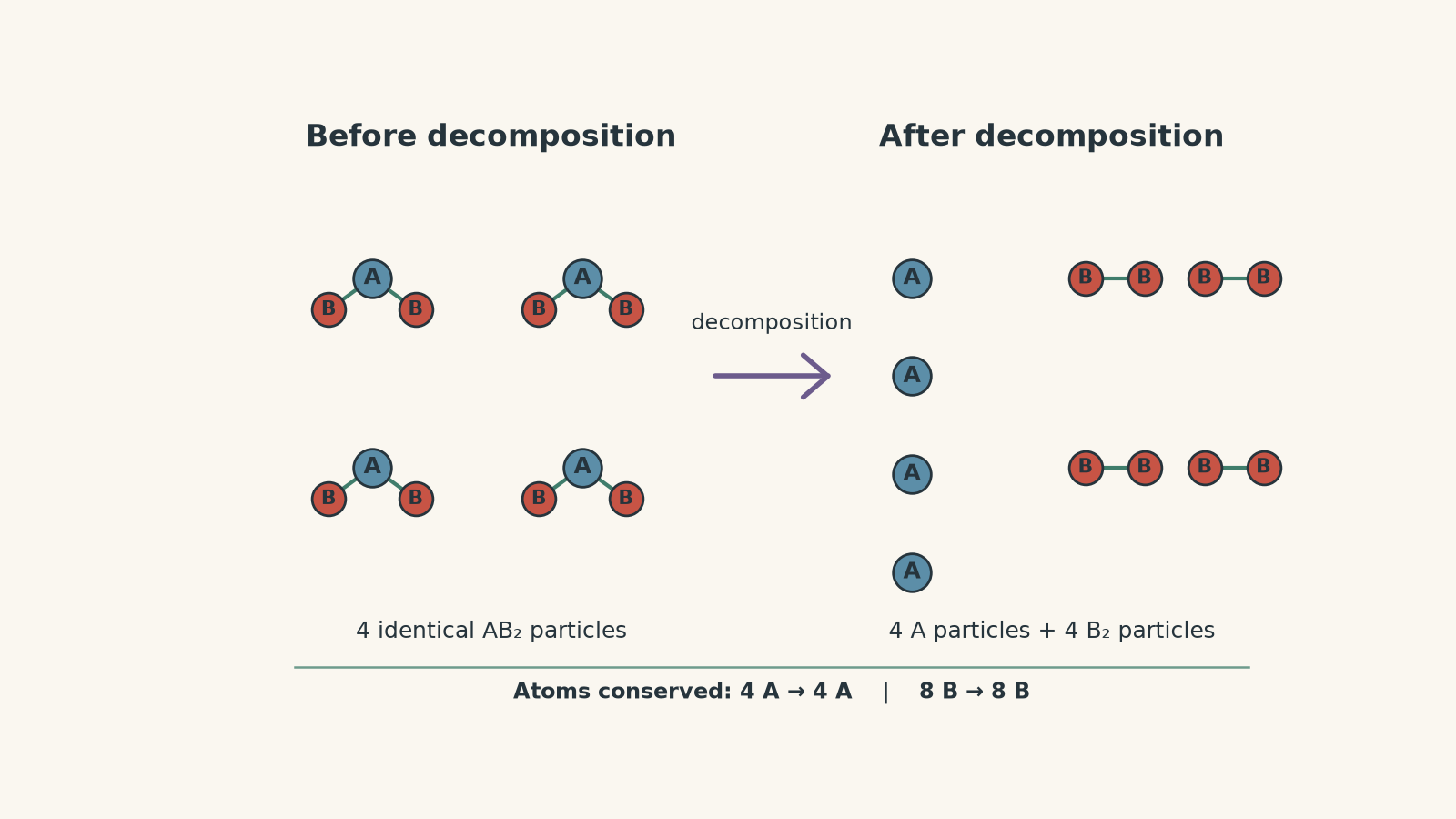
A slightly silly way to picture it is a couple deciding they are better off apart. Before the reaction, there is one relationship. Afterwards, there are multiple independent parties. The analogy helps with the overall direction, one thing becoming several things, but chemistry is stricter than dating. Atoms cannot ghost each other and vanish. Every atom present before the reaction must still be accounted for afterwards.
That conservation of atoms is the same idea developed in more detail in Rearrangement of Atoms in Reactions.
02How to recognise a decomposition reaction
Start by looking at the reactant side of the equation.
A decomposition reaction normally has:
- one compound as the chemical reactant
- two or more products
- an energy input such as heat, light, or electricity in many cases
For example:
\[ \ce{2HgO(s) -> 2Hg(l) + O2(g)} \]
One compound, mercury(II) oxide, forms two simpler substances.
Compare that with:
\[ \ce{2Mg(s) + O2(g) -> 2MgO(s)} \]
That is not decomposition. Two reactants combine to form one product, so it follows the opposite broad pattern, a synthesis reaction. You can compare the two reaction types in Synthesis Reactions: Predicting Products and Balancing Equations.
A useful first decision rule is therefore:
| Pattern | Likely reaction type |
|---|---|
| One compound \(\rightarrow\) multiple products | Decomposition |
| Multiple reactants \(\rightarrow\) one main product | Synthesis |
This is a recognition rule, not a complete explanation. Real equations can contain catalysts, conditions above the arrow, or several products. You still need chemical knowledge to predict which products form.
03Energy often causes the compound to break down
Many compounds are stable until energy is supplied.
Three common ways to cause decomposition are:
- thermal decomposition: energy is supplied by heating
- photodecomposition: energy is supplied by light
- electrolytic decomposition: electrical energy drives the reaction
For example, calcium carbonate undergoes thermal decomposition:
\[ \ce{CaCO3(s) -> CaO(s) + CO2(g)} \]
Silver chloride can decompose when exposed to light:
\[ \ce{2AgCl(s) -> 2Ag(s) + Cl2(g)} \]
Water can be decomposed using electrical energy:
\[ \ce{2H2O(l) -> 2H2(g) + O2(g)} \]
Notice something important. Heat, light, and electricity are not extra chemical reactants. They supply energy to the system.
That means an equation can still represent decomposition even when a condition such as “heat” appears near the reaction arrow.
04Predicting products: do not just split the formula
Suppose you are given:
\[ \ce{CaCO3 -> ?} \]
A tempting approach is to look at the formula and cut it into pieces somehow:
\[ \ce{CaCO3 -> Ca + C + O3} \]
That fails immediately. \(\ce{O3}\) is ozone, and there is no reason calcium carbonate should simply fall into the pieces suggested by its written formula.
Chemical formulae tell you composition, not automatically the products of a reaction.
Product prediction therefore needs two ideas:
- recognise the type of compound
- know the characteristic decomposition behaviour of that type
Then you balance the equation.
Do not balance first and hope the products reveal themselves. Balancing can only adjust coefficients. It cannot tell you which substances should exist.
05Pattern 1: many metal carbonates form a metal oxide and carbon dioxide
A very useful thermal decomposition pattern is:
\[ \ce{metal carbonate -> metal oxide + carbon dioxide} \]
For calcium carbonate:
\[ \ce{CaCO3(s) -> CaO(s) + CO2(g)} \]
Check the atoms.
| Element | Left | Right |
|---|---|---|
| Ca | 1 | 1 |
| C | 1 | 1 |
| O | 3 | \(1 + 2 = 3\) |
The equation is already balanced.
For copper(II) carbonate:
\[ \ce{CuCO3(s) -> CuO(s) + CO2(g)} \]
Again, the carbonate produces the corresponding metal oxide plus carbon dioxide.
This pattern is useful, but it is not a licence to claim that every carbonate decomposes under the same conditions. Thermal stability varies between compounds. In an HSC product-prediction question, use the reaction information and chemical context you are given rather than treating a pattern as a universal law.
Worked example: How much carbon dioxide forms from calcium carbonate?
A \(10.0\ \text{g}\) sample of pure calcium carbonate is completely thermally decomposed. Calculate the mass of carbon dioxide produced.
Step 1
\[ \ce{CaCO3(s) -> CaO(s) + CO2(g)} \]
The mole ratio is:
\[ 1\ \text{mol }\ce{CaCO3} : 1\ \text{mol }\ce{CO2} \]
Step 2
Using atomic masses \(Ca = 40.08\), \(C = 12.01\), and \(O = 16.00\):
\[ M(\ce{CaCO3}) = 40.08 + 12.01 + 3(16.00) = 100.09\ \text{g mol}^{-1} \]
where \(M\) is molar mass.
Using \(n = \frac{m}{M}\), where \(n\) is amount in moles and \(m\) is mass:
\[ n(\ce{CaCO3}) = \frac{10.0\ \text{g}}{100.09\ \text{g mol}^{-1}} = 0.0999\ \text{mol} \]
Step 3
Because the ratio is \(1:1\):
\[ n(\ce{CO2}) = 0.0999\ \text{mol} \]
Step 4
\[ M(\ce{CO2}) = 12.01 + 2(16.00) = 44.01\ \text{g mol}^{-1} \]
\[ m(\ce{CO2}) = nM = (0.0999\ \text{mol})(44.01\ \text{g mol}^{-1}) = 4.40\ \text{g} \]
So \(4.40\ \text{g}\) of carbon dioxide is produced.
The original \(10.0\ \text{g}\) has not lost \(4.40\ \text{g}\) of matter from the universe. That mass has become gaseous \(\ce{CO2}\). If the gas escapes the reaction vessel, only the remaining solid is weighed.
06Pattern 2: metal hydrogen carbonates can form a carbonate, carbon dioxide, and water
Hydrogen carbonates give a slightly less obvious decomposition pattern.
For example, heating sodium hydrogen carbonate gives:
\[ \ce{2NaHCO3(s) -> Na2CO3(s) + CO2(g) + H2O(g)} \]
There are three products rather than two.
This is a useful reminder that “decomposition” does not mean “one compound splits exactly in half”. It only means that one compound is transformed into multiple simpler substances.
Try predicting the coefficient in front of \(\ce{NaHCO3}\) before checking the atom counts.
If you wrote a coefficient of 1, the sodium atoms would not balance because \(\ce{Na2CO3}\) contains two sodium atoms. We therefore need 2:
| Element | Left in \(\ce{2NaHCO3}\) | Right |
|---|---|---|
| Na | 2 | 2 |
| H | 2 | 2 |
| C | 2 | \(1 + 1 = 2\) |
| O | 6 | \(3 + 2 + 1 = 6\) |
Everything is conserved.
Worked example: How much sodium carbonate remains?
A \(16.8\ \text{g}\) sample of sodium hydrogen carbonate is heated until it has completely decomposed according to:
\[ \ce{2NaHCO3(s) -> Na2CO3(s) + CO2(g) + H2O(g)} \]
Calculate the mass of sodium carbonate produced.
Step 1
Using \(Na = 22.99\), \(H = 1.008\), \(C = 12.01\), and \(O = 16.00\):
\[ M(\ce{NaHCO3}) = 22.99 + 1.008 + 12.01 + 3(16.00) = 84.01\ \text{g mol}^{-1} \]
Step 2
\[ n(\ce{NaHCO3}) = \frac{16.8\ \text{g}}{84.01\ \text{g mol}^{-1}} = 0.200\ \text{mol} \]
Step 3
From the balanced equation:
\[ 2\ \text{mol }\ce{NaHCO3} : 1\ \text{mol }\ce{Na2CO3} \]
Therefore:
\[ n(\ce{Na2CO3}) = 0.200\ \text{mol}\times\frac{1}{2} = 0.100\ \text{mol} \]
Step 4
\[ M(\ce{Na2CO3}) = 2(22.99) + 12.01 + 3(16.00) = 105.99\ \text{g mol}^{-1} \]
\[ m(\ce{Na2CO3}) = (0.100\ \text{mol})(105.99\ \text{g mol}^{-1}) = 10.6\ \text{g} \]
So \(10.6\ \text{g}\) of sodium carbonate remains.
The solid product weighs less than the original \(16.8\ \text{g}\) because carbon dioxide and water leave as gases.
07Pattern 3: some compounds release oxygen
Several useful decomposition reactions produce oxygen gas.
Hydrogen peroxide is one example:
\[ \ce{2H2O2(aq) -> 2H2O(l) + O2(g)} \]
A metal chlorate can also decompose into a metal chloride and oxygen. For potassium chlorate:
\[ \ce{2KClO3(s) -> 2KCl(s) + 3O2(g)} \]
There is a trap here.
A student may reason, “The compound contains oxygen, so decomposition must release \(\ce{O2}\).”
That prediction feels reasonable because elemental oxygen is commonly found as \(\ce{O2}\). But the first half of the argument does not follow. A compound containing oxygen does not necessarily release oxygen gas when it decomposes.
Calcium carbonate contains oxygen, but its oxygen atoms finish in both \(\ce{CaO}\) and \(\ce{CO2}\):
\[ \ce{CaCO3 -> CaO + CO2} \]
Product prediction depends on the chemical behaviour of the compound, not just on spotting an element in its formula.
08Predict the substances first, then balance
When asked to complete a decomposition equation, use this order.
1. Confirm that decomposition is plausible.
Look for one compound producing multiple substances.
2. Identify the compound family.
For example, is it a carbonate, hydrogen carbonate, peroxide, or another compound whose decomposition behaviour you know?
3. Predict actual chemical substances.
Write correct formulae for the products.
4. Check that every element is represented.
No element may appear from nowhere or disappear.
5. Balance using coefficients only.
Never change a subscript just to make the atom counts work.
Consider:
\[ \ce{KClO3 -> KCl + O2} \]
The substances are correct, but the equation is not balanced.
There are three oxygen atoms on the left and two on the right. The smallest common total is six oxygen atoms, so use \(2\ce{KClO3}\) and \(3\ce{O2}\):
\[ \ce{2KClO3 -> 2KCl + 3O2} \]
Do not turn \(\ce{O2}\) into something like \(\ce{O3}\) just to fix the arithmetic. Changing a subscript changes the chemical substance.
09What “simpler substances” actually means
Textbooks often say that decomposition turns one compound into “simpler substances”. That is useful language, but it can be misunderstood.
“Simpler” does not necessarily mean:
- individual atoms
- elements only
- smaller coefficients
- exactly two products
For example:
\[ \ce{2NaHCO3 -> Na2CO3 + CO2 + H2O} \]
Every product is still a compound. The reaction is decomposition because one reactant compound has produced several products.
Likewise:
\[ \ce{2H2O -> 2H2 + O2} \]
produces elements.
Both fit the decomposition idea even though their products look quite different.
10A compact product-prediction guide
These patterns are useful starting points when the reaction conditions support them.
| Reactant type | Common decomposition pattern | Example |
|---|---|---|
| Many metal carbonates | metal oxide + \(\ce{CO2}\) | \(\ce{CaCO3 -> CaO + CO2}\) |
| Metal hydrogen carbonates | metal carbonate + \(\ce{CO2}\) + \(\ce{H2O}\) | \(\ce{2NaHCO3 -> Na2CO3 + CO2 + H2O}\) |
| Hydrogen peroxide | water + oxygen | \(\ce{2H2O2 -> 2H2O + O2}\) |
| Some metal chlorates | metal chloride + oxygen | \(\ce{2KClO3 -> 2KCl + 3O2}\) |
| Water under electrolysis | hydrogen + oxygen | \(\ce{2H2O -> 2H2 + O2}\) |
Use this table as a set of chemical patterns, not as a substitute for thinking. The reaction conditions and identity of the compound still matter.
11The most common mistakes
Mistake 1: assuming decomposition always produces elements
It does not.
\[ \ce{CaCO3 -> CaO + CO2} \]
Both products are compounds.
Mistake 2: splitting a formula wherever it looks convenient
A formula tells you which atoms are present. It does not tell you the reaction pathway.
For \(\ce{CaCO3}\), writing \(\ce{Ca + C + O2}\) merely conserves some symbols after balancing. It does not make the equation chemically correct.
Mistake 3: balancing before deciding the products
Coefficients can fix atom counts. They cannot fix incorrect chemistry.
First ask, “What substances should form?” Then ask, “How many of each substance are needed?”
Mistake 4: changing subscripts
Suppose you have:
\[ \ce{H2O -> H2 + O2} \]
You need two water molecules:
\[ \ce{2H2O -> 2H2 + O2} \]
Changing \(\ce{H2O}\) into \(\ce{H2O2}\) would not be balancing water. You would have replaced water with hydrogen peroxide.
Mistake 5: thinking a mass decrease violates conservation of mass
If a decomposition produces a gas and the container is open, the gas can leave.
The measured mass of the remaining solid decreases, but the total mass of all products still matches the mass of reactant that decomposed, assuming no material enters or leaves except the products being considered.
That distinction becomes especially useful when interpreting heating experiments.
12Questions and solutions
Question 1
A student heats copper(II) carbonate and observes that a black solid forms while a gas is released.
Predict the products, write a balanced chemical equation, and identify the reaction type.
Solution 1
The products are copper(II) oxide and carbon dioxide, and the reaction is a thermal decomposition reaction.
Copper(II) carbonate is a metal carbonate. A common thermal decomposition pattern for metal carbonates is:
\[ \ce{metal carbonate -> metal oxide + carbon dioxide} \]
For copper(II) carbonate:
\[ \ce{CuCO3(s) -> CuO(s) + CO2(g)} \]
The equation is already balanced. There is one Cu atom, one C atom, and three O atoms on each side.
The black solid is \(\ce{CuO}\), while \(\ce{CO2}\) leaves as a gas. It is decomposition because one compound produces two products.
A common mistake would be to predict copper metal and oxygen simply because both elements occur in the original compound. The reaction pattern of the carbonate determines the products.
Question 2
Potassium chlorate decomposes to potassium chloride and oxygen gas.
Write the balanced chemical equation. Then calculate the amount, in moles, of oxygen produced when \(0.400\ \text{mol}\) of potassium chlorate completely decomposes.
Solution 2
The balanced equation is \(\ce{2KClO3 -> 2KCl + 3O2}\), and \(0.600\ \text{mol}\) of oxygen is produced.
Start with the correct products:
\[ \ce{KClO3 -> KCl + O2} \]
Balance the oxygen first. Six oxygen atoms can be obtained using \(2\ce{KClO3}\) and \(3\ce{O2}\):
\[ \ce{2KClO3 -> 2KCl + 3O2} \]
The mole ratio is therefore:
\[ 2\ \text{mol }\ce{KClO3} : 3\ \text{mol }\ce{O2} \]
So:
\[ n(\ce{O2}) = 0.400\ \text{mol} \times \frac{3\ \text{mol }\ce{O2}} {2\ \text{mol }\ce{KClO3}} = 0.600\ \text{mol} \]
Therefore, \(0.600\ \text{mol}\) of \(\ce{O2}\) is produced.
The key trap is the \(2:3\) ratio. The coefficients in a balanced equation determine mole ratios. They are not automatically \(1:1\).
Question 3
A \(25.0\ \text{g}\) sample of pure calcium carbonate is heated until it completely decomposes.
\[ \ce{CaCO3(s) -> CaO(s) + CO2(g)} \]
Calculate the expected mass of calcium oxide remaining. Use \(M(\ce{CaCO3}) = 100.09\ \text{g mol}^{-1}\) and \(M(\ce{CaO}) = 56.08\ \text{g mol}^{-1}\).
Solution 3
The expected mass of calcium oxide is \(14.0\ \text{g}\).
First find the amount of calcium carbonate:
\[ n(\ce{CaCO3}) = \frac{25.0\ \text{g}} {100.09\ \text{g mol}^{-1}} = 0.2498\ \text{mol} \]
The balanced equation shows a \(1:1\) mole ratio:
\[ 1\ \text{mol }\ce{CaCO3} : 1\ \text{mol }\ce{CaO} \]
Therefore:
\[ n(\ce{CaO}) = 0.2498\ \text{mol} \]
Convert this to mass:
\[ m(\ce{CaO}) = nM = (0.2498\ \text{mol})(56.08\ \text{g mol}^{-1}) = 14.0\ \text{g} \]
Therefore, \(14.0\ \text{g}\) of calcium oxide remains.
The missing \(11.0\ \text{g}\) has not been destroyed. It leaves as carbon dioxide:
\[ 25.0\ \text{g} - 14.0\ \text{g} = 11.0\ \text{g} \]
This question tests the difference between the mass of the solid remaining and the total mass of all reaction products.
Question 4
A student is told that an unknown pure solid has the formula \(\ce{XCO3}\), where X is a metal that forms a \(2+\) ion. When heated, the solid decomposes completely according to:
\[ \ce{XCO3(s) -> XO(s) + CO2(g)} \]
The student starts with \(5.00\ \text{g}\) of \(\ce{XCO3}\) and obtains \(2.80\ \text{g}\) of \(\ce{XO}\).
Explain why it would be incorrect to calculate the mass of carbon dioxide by finding moles first. Then determine the mass of carbon dioxide produced without identifying X.
Solution 4
The mass of carbon dioxide is \(2.20\ \text{g}\), and identifying the metal or calculating moles is unnecessary.
Because the decomposition is complete and the sample is pure, the original mass must equal the total mass of the products:
\[ m(\ce{XCO3}) = m(\ce{XO}) + m(\ce{CO2}) \]
Therefore:
\[ m(\ce{CO2}) = 5.00\ \text{g} - 2.80\ \text{g} = 2.20\ \text{g} \]
So \(2.20\ \text{g}\) of carbon dioxide is produced.
It would not be chemically wrong to use a mole calculation if the identity of X were known. The problem is that X is unknown, so the molar masses of \(\ce{XCO3}\) and \(\ce{XO}\) cannot yet be calculated directly.
The stronger method is to notice that the question can be solved immediately using conservation of mass. The tempting mistake is to assume that every quantitative chemistry problem must begin with \(n = \frac{m}{M}\).
Question 5
Two students heat identical \(10.00\ \text{g}\) samples of the same pure metal carbonate.
Student A heats the sample in an open crucible until decomposition is complete. The final solid has a mass of \(6.40\ \text{g}\).
Student B heats the same amount of the carbonate in a perfectly sealed container. After complete decomposition and cooling back to the starting temperature, no material has escaped.
Student B claims, “My balance should also read \(6.40\ \text{g}\), because the carbonate has decomposed and only \(6.40\ \text{g}\) of solid remains.”
Evaluate this claim. Assume the reaction produces only a solid metal oxide and carbon dioxide gas.
Solution 5
Student B’s claim is incorrect. The sealed container still contains the full \(10.00\ \text{g}\) of reaction products, although only \(6.40\ \text{g}\) is solid.
For Student A, the loss in measured solid mass is:
\[ 10.00\ \text{g} - 6.40\ \text{g} = 3.60\ \text{g} \]
That \(3.60\ \text{g}\) corresponds to carbon dioxide that escaped from the open crucible.
For Student B, decomposition still produces the same quantities:
\[ 6.40\ \text{g solid oxide} + 3.60\ \text{g carbon dioxide} = 10.00\ \text{g total products} \]
Because the container is sealed, the carbon dioxide remains inside it. If the complete sealed system is weighed before and after the reaction under equivalent conditions, its mass remains unchanged.
The trap is confusing mass of the solid product with mass of the whole chemical system. Decomposition can change which substances are present and whether they are solids or gases without changing the total amount of matter in a closed system.
13What decomposition lets you work out next
Once you can recognise decomposition and predict sensible products, the next step is no longer just naming a reaction type. You can use the balanced equation to connect what happens at the particle level with measurements in the laboratory.
A falling solid mass can tell you how much gas escaped. A gas volume can tell you how much reactant decomposed. An unexpected final mass can suggest incomplete decomposition, impurities, or another reaction.
The reaction pattern starts the reasoning, but conservation of atoms and stoichiometry make the prediction testable.