
Strong Acid-Weak Base Titration Curves for HSC Chemistry
Learn how to analyse strong acid-weak base titration curves, calculate equivalence-point pH, choose indicators, and avoid common HSC mistakes.
Suppose you place hydrochloric acid in a conical flask and slowly add ammonia from a burette. Eventually, you will have added exactly enough \(\ce{NH3}\) to react with every mole of strong acid.
Predict the pH at that exact point. Is it 7 because the acid and base have neutralised each other?
That is the tempting answer. It is also the key mistake this titration exposes. At equivalence, the strong acid is gone, but the weak base has been converted into its conjugate acid. That conjugate acid reacts with water, so the equivalence point is acidic.
Understanding that one idea lets you make sense of the whole titration curve rather than memorising its shape.
01What is happening as the weak base is added?
We will use a common example: hydrochloric acid, \(\ce{HCl}\), in the flask, with ammonia, \(\ce{NH3}\), added from the burette.
Because \(\ce{HCl}\) is a strong acid, it is essentially fully ionised in water. The important reaction is
\[
\ce{H3O+ + NH3 -> NH4+ + H2O}
\]
Ammonia accepts a proton and becomes ammonium, \(\ce{NH4+}\).
Picture the flask as a slightly awkward party. Before equivalence, there is excess \(\ce{H3O+}\), so every \(\ce{NH3}\) molecule that arrives is immediately paired off as \(\ce{NH4+}\). There is practically no free ammonia left over to make the solution basic.
At equivalence, all the excess \(\ce{H3O+}\) has been used. The flask is now full of \(\ce{NH4+}\), and that species is a weak acid.
The analogy breaks because ions aren’t actually choosing partners. The extent of proton transfer is controlled by equilibrium. But the picture correctly reminds us to ask which species are left after the stoichiometric reaction.
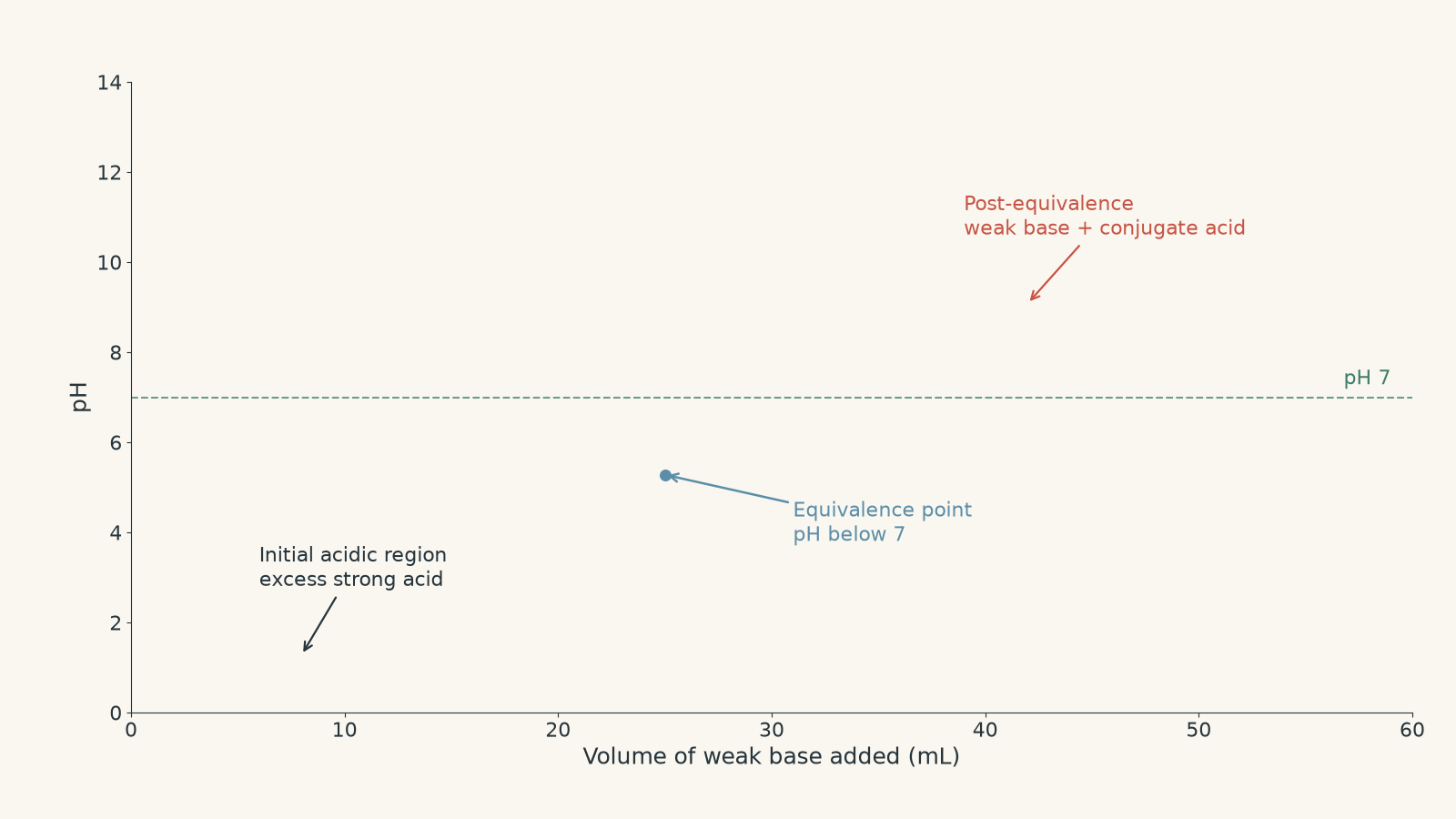
The calculation method changes as we move along the curve.
| Position on curve | What controls the pH? | Main calculation |
|---|---|---|
| Before equivalence | Excess strong acid | Find remaining \(\ce{H3O+}\) after neutralisation |
| At equivalence | Conjugate acid of the weak base | Weak-acid equilibrium |
| After equivalence | Excess weak base together with its conjugate acid | Weak-base/conjugate-acid equilibrium |
| Far beyond equivalence | Increasingly dominated by added weak base | Weak-base equilibrium, with dilution considered |
The important decision is therefore not simply, “What acid and base did I start with?” It is, “What is actually present in the flask at this point?”
02Before equivalence: the strong acid wins
Suppose there are initially \(n_\text{acid}\) moles of strong acid, and you have added \(n_\text{base}\) moles of a monoprotic weak base such as \(\ce{NH3}\).
Before equivalence,
\[
n_\text{acid}>n_\text{base}
\]
so the amount of excess \(\ce{H3O+}\) is
\[
n(\ce{H3O+})_\text{remaining}=n_\text{acid}-n_\text{base}
\]
You then divide by the total solution volume to find \([\ce{H3O+}]\).
The weak base does not get its own separate weak-base equilibrium calculation here. Almost all of it has already been protonated by the excess strong acid.
This is an easy place to confuse a strong acid-weak base titration with a weak acid-strong base titration. The species present are different, so a memorised formula can send you in completely the wrong direction.
03Equivalence does not mean pH 7
At the equivalence point,
\[
n_\text{acid}=n_\text{base added}
\]
That is a stoichiometric statement. It says nothing by itself about pH.
For our ammonia example, all the added \(\ce{NH3}\) has become \(\ce{NH4+}\). The solution therefore contains ammonium ions, which can donate a proton to water:
\[
\ce{NH4+ + H2O <=> NH3 + H3O+}
\]
That production of \(\ce{H3O+}\) makes the equivalence solution acidic.
More generally, if the weak base is represented by \(\ce{B}\), its conjugate acid is \(\ce{BH+}\):
\[
\ce{BH+ + H2O <=> B + H3O+}
\]
Its acid dissociation constant is
\[
K_a=\frac{[\ce{B}][\ce{H3O+}]}{[\ce{BH+}]}
\]
The weak base and its conjugate acid are linked by
\[
K_aK_b=K_w
\]
so
\[
K_a=\frac{K_w}{K_b}
\]
where \(K_b\) is the base dissociation constant of \(\ce{B}\), and \(K_w=1.0\times10^{-14}\) at \(25^\circ\text{C}\).
This relationship tells us something useful before we calculate anything: a weaker base has a stronger conjugate acid. Therefore, all else being equal, a weaker weak base gives a lower equivalence-point pH.
Worked example: Find the equivalence-point pH
25.00 mL of \(0.100\text{ mol L}^{-1}\) \(\ce{HCl}\) is titrated with \(0.100\text{ mol L}^{-1}\) \(\ce{NH3}\). At \(25^\circ\text{C}\), \(K_b(\ce{NH3})=1.8\times10^{-5}\). Calculate the volume of ammonia required for equivalence and the pH at equivalence.
Step 1
\[
n(\ce{HCl})=CV
=(0.100)(0.02500)
=2.500\times10^{-3}\text{ mol}
\]
At equivalence, the same amount of ammonia must have been added.
Step 2
\[
V=\frac{n}{C}
=\frac{2.500\times10^{-3}}{0.100}
=0.02500\text{ L}
=25.00\text{ mL}
\]
Step 3
At equivalence, the \(2.500\times10^{-3}\) mol of ammonia has been converted into \(2.500\times10^{-3}\) mol of \(\ce{NH4+}\).
The total volume is
\[
25.00+25.00=50.00\text{ mL}=0.05000\text{ L}
\]
so
\[
[\ce{NH4+}]
=\frac{2.500\times10^{-3}}{0.05000}
=0.0500\text{ mol L}^{-1}
\]
Step 4
\[
K_a=\frac{K_w}{K_b}
=\frac{1.0\times10^{-14}}{1.8\times10^{-5}}
=5.56\times10^{-10}
\]
Step 5
Let \(x=[\ce{H3O+}]\) formed by the reaction
\[
\ce{NH4+ + H2O <=> NH3 + H3O+}
\]
The exact equilibrium expression is
\[
5.56\times10^{-10}
=\frac{x^2}{0.0500-x}
\]
Because \(x\) will be very small compared with \(0.0500\text{ mol L}^{-1}\), we can use \(0.0500-x\approx0.0500\):
\[
\begin{aligned}
5.56\times10^{-10}
&\approx\frac{x^2}{0.0500}\\
x^2&=(5.56\times10^{-10})(0.0500)\\
x&=5.27\times10^{-6}\text{ mol L}^{-1}
\end{aligned}
\]
Step 6
\[
\text{pH}
=-\log(5.27\times10^{-6})
=5.28
\]
The equivalence point is therefore at pH \(5.28\), not pH 7. Equal reacting amounts have been reached, but the product \(\ce{NH4+}\) makes the solution acidic.
04Why the curve rises sharply near equivalence
Far before equivalence, there is plenty of strong acid left. Adding a small amount of weak base removes only a small fraction of that excess acid, so the pH changes fairly slowly.
Close to equivalence, almost all the strong acid has already been consumed. One extra drop now represents a much larger fraction of what remains, so the pH changes rapidly.
There is still a steep section, but it is different from the almost symmetric strong acid-strong base curve. The equivalence point sits below 7, and the basic side of the rise is moderated by the weakness of the titrant.
Worked example: Follow the pH through the equivalence region
The same \(25.00\text{ mL}\) sample of \(0.100\text{ mol L}^{-1}\) \(\ce{HCl}\) is titrated with \(0.100\text{ mol L}^{-1}\) \(\ce{NH3}\), where \(K_b=1.8\times10^{-5}\). Calculate the pH after 24.50 mL and 25.50 mL of ammonia have been added.
The equivalence volume is 25.00 mL, so the two measurements sit just before and just after equivalence.
Step 1
Initial acid:
\[
n(\ce{H3O+})=(0.100)(0.02500)
=2.500\times10^{-3}\text{ mol}
\]
Ammonia added:
\[
n(\ce{NH3})=(0.100)(0.02450)
=2.450\times10^{-3}\text{ mol}
\]
The remaining strong acid is therefore
\[
2.500\times10^{-3}-2.450\times10^{-3}
=5.00\times10^{-5}\text{ mol}
\]
The total volume is \(49.50\text{ mL}=0.04950\text{ L}\), giving
\[
\begin{aligned}
[\ce{H3O+}]
&=\frac{5.00\times10^{-5}}{0.04950}\\
&=1.01\times10^{-3}\text{ mol L}^{-1}
\end{aligned}
\]
Therefore,
\[
\text{pH}=3.00
\]
Step 2
The ammonia added is
\[
(0.100)(0.02550)
=2.550\times10^{-3}\text{ mol}
\]
The first \(2.500\times10^{-3}\) mol reacts with the acid, producing that amount of \(\ce{NH4+}\).
The excess ammonia is
\[
2.550\times10^{-3}-2.500\times10^{-3}
=5.00\times10^{-5}\text{ mol}
\]
We now have both \(\ce{NH3}\) and \(\ce{NH4+}\).
Step 3
For ammonia,
\[
K_b=\frac{[\ce{NH4+}][\ce{OH-}]}{[\ce{NH3}]}
\]
Because both species are in the same total volume, their concentration ratio equals their mole ratio:
\[
\frac{[\ce{NH3}]}{[\ce{NH4+}]}
=\frac{5.00\times10^{-5}}{2.500\times10^{-3}}
=0.0200
\]
Rearranging the \(K_b\) expression gives, to an excellent approximation here,
\[
\begin{aligned}
[\ce{OH-}]
&=K_b\frac{[\ce{NH3}]}{[\ce{NH4+}]}\\
&=(1.8\times10^{-5})(0.0200)\\
&=3.60\times10^{-7}\text{ mol L}^{-1}
\end{aligned}
\]
Thus
\[
\begin{aligned}
\text{pOH}&=-\log(3.60\times10^{-7})=6.44\\
\text{pH}&=14.00-6.44=7.56
\end{aligned}
\]
Just 0.50 mL before equivalence, the pH is about \(3.00\). Just 0.50 mL after equivalence, it is about \(7.56\).
That rapid change is the steep part of the titration curve.
Notice something else: being past equivalence does not mean the solution suddenly behaves like a flask of pure ammonia. A large amount of \(\ce{NH4+}\) is present, and it suppresses the ionisation of \(\ce{NH3}\).
05The most tempting misconception: equivalence means neutral
The word neutralisation causes trouble here.
A student might reason:
Acid + base neutralise each other, so the equivalence point must be neutral.
The first half is useful. The second does not follow.
Neutralisation tells you the stoichiometric reacting amounts. The pH after that reaction depends on the acid-base behaviour of the products.
For a strong acid and weak base:
- the strong acid protonates the weak base;
- at equivalence, neither reactant is present in stoichiometric excess;
- the conjugate acid of the weak base remains;
- that conjugate acid reacts with water to produce \(\ce{H3O+}\);
- therefore, \(\text{pH}<7\) at equivalence.
There is a second misconception hiding nearby: “A weak base cannot completely neutralise a strong acid.”
For the usual weak bases considered in HSC Chemistry, proton transfer from a strong acid to the weak base is strongly favoured. The reason the equivalence solution is acidic is not that a large amount of the original strong acid somehow survived. The acidity mainly comes from the conjugate acid formed during neutralisation.
06What happens after equivalence?
Once the equivalence volume has been passed, there is more weak base than the original strong acid can consume.
Now both forms are present:
- \(\ce{B}\), the excess weak base
- \(\ce{BH+}\), produced during neutralisation
These form a conjugate acid-base pair.
For
\[
\ce{B + H2O <=> BH+ + OH-}
\]
the equilibrium expression is
\[
K_b=\frac{[\ce{BH+}][\ce{OH-}]}{[\ce{B}]}
\]
Rearranging,
\[
[\ce{OH-}]
=K_b\frac{[\ce{B}]}{[\ce{BH+}]}
\]
provided the equilibrium change is small compared with the concentrations already present.
You can also describe the same system using the conjugate acid:
\[
\text{pH}=\text{p}K_a+\log\left(\frac{[\ce{B}]}{[\ce{BH+}]}\right)
\]
The chemistry is the same either way. Do not choose a formula first and then try to force the flask to fit it. Identify the species first.
07Choosing an indicator
An indicator should change colour within the steep section of the titration curve.
It does not have to change at exactly one mathematical pH value. Indicators change over a pH range, so that range needs to sit where a tiny change in titrant volume produces a large change in pH.
For a strong acid-weak base titration, the equivalence point is acidic. An indicator such as phenolphthalein, whose transition occurs on the basic side, is therefore often a poor choice.
Do not memorise “strong acid plus weak base means indicator X” without looking at the curve or data. The exact equivalence pH depends on the weak base’s \(K_b\), the concentrations, and dilution.
The decision rule is more reliable:
- locate the steep section of the curve;
- locate the indicator’s transition range;
- choose an indicator whose transition occurs substantially inside that steep section.
08A useful distinction about half-equivalence
You may have learned that at half-equivalence, the concentrations of a weak species and its conjugate are equal.
That statement depends on which reagent starts in the flask.
If weak base is in the flask and strong acid is added, then before equivalence the acid converts some \(\ce{B}\) into \(\ce{BH+}\). At half-equivalence, equal amounts of \(\ce{B}\) and \(\ce{BH+}\) can be present.
But this article has mainly considered the opposite direction: strong acid in the flask and weak base added.
Before equivalence in that arrangement, the strong acid is still in excess. The weak base being added is protonated rather than accumulating as free \(\ce{B}\). There is therefore no ordinary \(\ce{B}/\ce{BH+}\) buffer region before equivalence.
Same chemicals. Different order of addition. Different species present at the same fraction of the way to equivalence.
That is why drawing a quick mole picture is safer than applying a remembered “half-equivalence rule”.
09Questions and solutions
Question 1
30.00 mL of \(0.0800\text{ mol L}^{-1}\) \(\ce{HNO3}\) is titrated with \(0.120\text{ mol L}^{-1}\) \(\ce{NH3}\). At \(25^\circ\text{C}\), \(K_b(\ce{NH3})=1.8\times10^{-5}\).
Calculate:
a. the volume of ammonia required to reach equivalence
b. the pH at equivalence
Solution 1
The equivalence volume is \(20.00\text{ mL}\), and the equivalence-point pH is approximately \(5.29\). The pH is below 7 because the product \(\ce{NH4+}\) is a weak acid.
The initial amount of nitric acid is
\[
n=(0.0800)(0.03000)
=2.400\times10^{-3}\text{ mol}
\]
At equivalence, the same amount of ammonia is required:
\[
\begin{aligned}
V(\ce{NH3})
&=\frac{2.400\times10^{-3}}{0.120}\\
&=0.02000\text{ L}\\
&=20.00\text{ mL}
\end{aligned}
\]
The total volume at equivalence is
\[
30.00+20.00=50.00\text{ mL}=0.05000\text{ L}
\]
so
\[
[\ce{NH4+}]
=\frac{2.400\times10^{-3}}{0.05000}
=0.0480\text{ mol L}^{-1}
\]
The conjugate-acid constant is
\[
K_a=\frac{1.0\times10^{-14}}{1.8\times10^{-5}}
=5.56\times10^{-10}
\]
Using
\[
K_a\approx\frac{x^2}{0.0480}
\]
gives
\[
\begin{aligned}
x&=\sqrt{(5.56\times10^{-10})(0.0480)}\\
&=5.16\times10^{-6}\text{ mol L}^{-1}
\end{aligned}
\]
where \(x=[\ce{H3O+}]\).
Therefore,
\[
\text{pH}=-\log(5.16\times10^{-6})=5.29
\]
The tempting route is to assign pH 7 because the reacting amounts are equal. The missing constraint is the acid-base behaviour of the salt: \(\ce{NH4+}\) remains in solution and produces \(\ce{H3O+}\).
Question 2
25.00 mL of \(0.120\text{ mol L}^{-1}\) \(\ce{HCl}\) is titrated with \(0.150\text{ mol L}^{-1}\) methylamine, \(\ce{CH3NH2}\). At \(25^\circ\text{C}\),
\[
K_b(\ce{CH3NH2})=4.4\times10^{-4}
\]
Calculate:
a. the pH after 15.00 mL of methylamine has been added
b. the equivalence volume
c. the pH at equivalence
Solution 2
The pH after 15.00 mL is \(1.73\), equivalence occurs at \(20.00\text{ mL}\), and the equivalence-point pH is approximately \(5.91\). Different regions require different models because the species controlling pH change during the titration.
Initially,
\[
n(\ce{HCl})=(0.120)(0.02500)
=3.000\times10^{-3}\text{ mol}
\]
After 15.00 mL of methylamine,
\[
n(\ce{CH3NH2})
=(0.150)(0.01500)
=2.250\times10^{-3}\text{ mol}
\]
The strong acid is still in excess:
\[
n(\ce{H3O+})_\text{remaining}
=3.000\times10^{-3}-2.250\times10^{-3}
=7.50\times10^{-4}\text{ mol}
\]
The total volume is
\[
25.00+15.00=40.00\text{ mL}=0.04000\text{ L}
\]
so
\[
[\ce{H3O+}]
=\frac{7.50\times10^{-4}}{0.04000}
=1.875\times10^{-2}\text{ mol L}^{-1}
\]
and
\[
\text{pH}=1.73
\]
For equivalence,
\[
V=\frac{3.000\times10^{-3}}{0.150}
=0.02000\text{ L}
=20.00\text{ mL}
\]
At equivalence, \(3.000\times10^{-3}\) mol of \(\ce{CH3NH3+}\) is present in a total volume of \(45.00\text{ mL}\):
\[
[\ce{CH3NH3+}]
=\frac{3.000\times10^{-3}}{0.04500}
=0.0667\text{ mol L}^{-1}
\]
Its \(K_a\) is
\[
K_a=\frac{1.0\times10^{-14}}{4.4\times10^{-4}}
=2.27\times10^{-11}
\]
Thus,
\[
\begin{aligned}
[\ce{H3O+}]
&\approx\sqrt{K_aC}\\
&=\sqrt{(2.27\times10^{-11})(0.0667)}\\
&=1.23\times10^{-6}\text{ mol L}^{-1}
\end{aligned}
\]
and
\[
\text{pH}=5.91
\]
A tempting mistake is to use the weak-base \(K_b\) calculation at both points. At 15.00 mL, however, there is still substantial excess strong acid, so that excess \(\ce{H3O+}\) controls the pH. At equivalence, the strong acid has been consumed, so the conjugate acid equilibrium takes over.
Question 3
An unknown strong acid is titrated with a weak base. Around the equivalence point, the experimentally determined curve rises steeply from approximately pH 4.3 to pH 6.3. The equivalence point is near pH 5.3.
The available indicators are:
| Indicator | Approximate transition range |
|---|---|
| Methyl orange | pH 3.1-4.4 |
| Methyl red | pH 4.4-6.2 |
| Bromothymol blue | pH 6.0-7.6 |
| Phenolphthalein | pH 8.2-10.0 |
a. Which indicator is the most appropriate of those listed?
b. A student instead uses phenolphthalein and calculates the acid concentration from the volume of weak base added at the colour change. Would the calculated acid concentration tend to be too high or too low? Explain.
Solution 3
Methyl red is the most appropriate choice, and using phenolphthalein would tend to produce a calculated acid concentration that is too high.
Methyl red changes colour over pH 4.4-6.2, almost entirely inside the stated steep region of pH 4.3-6.3. This means only a very small change in titrant volume is needed to carry the solution across the indicator’s transition range.
Phenolphthalein does not begin changing until about pH 8.2. According to the supplied curve information, that is well beyond the equivalence region.
Because weak base is being added from the burette, reaching this excessively high endpoint pH requires adding more titrant than the true equivalence volume.
If the student then assumes
\[
n_\text{acid}=C_\text{base}V_\text{endpoint}
\]
the oversized endpoint volume produces an oversized calculated amount of acid. Dividing by the original acid volume therefore gives an acid concentration that is too high.
The tempting approach is to choose any indicator that eventually changes colour. The actual constraint is that an endpoint is useful only if its transition corresponds closely to the rapid pH change around equivalence.
Question 4
Two experiments use the same solutions at \(25^\circ\text{C}\):
- \(25.00\text{ mL}\) of \(0.100\text{ mol L}^{-1}\) \(\ce{HCl}\)
- \(25.00\text{ mL}\) of \(0.100\text{ mol L}^{-1}\) \(\ce{NH3}\), with \(K_b=1.8\times10^{-5}\)
In Experiment A, the \(\ce{HCl}\) starts in the flask and \(\ce{NH3}\) is added from the burette.
In Experiment B, the \(\ce{NH3}\) starts in the flask and \(\ce{HCl}\) is added from the burette.
For each experiment:
a. calculate the pH when 12.50 mL of titrant has been added
b. compare the pH values at equivalence
c. explain why the two titration curves are not simply mirror images of each other about pH 7
Solution 4
At 12.50 mL, Experiment A has pH \(1.48\), while Experiment B has pH approximately \(9.26\). At equivalence, however, both experiments have the same pH, approximately \(5.28\). The curves differ because reversing which reagent is added changes the species that coexist before equivalence.
In Experiment A, the flask initially contains
\[
(0.100)(0.02500)=2.500\times10^{-3}\text{ mol}
\]
of strong acid.
After 12.50 mL of ammonia has been added,
\[
n(\ce{NH3})=(0.100)(0.01250)
=1.250\times10^{-3}\text{ mol}
\]
so the remaining strong acid is
\[
2.500\times10^{-3}-1.250\times10^{-3}
=1.250\times10^{-3}\text{ mol}
\]
The total volume is \(37.50\text{ mL}=0.03750\text{ L}\):
\[
[\ce{H3O+}]
=\frac{1.250\times10^{-3}}{0.03750}
=0.0333\text{ mol L}^{-1}
\]
Therefore,
\[
\text{pH}=1.48
\]
The tempting thought is that “halfway to equivalence” should create equal amounts of ammonia and ammonium. It does not in this direction. Every mole of ammonia added has been protonated, while strong acid remains in excess.
In Experiment B, the flask instead begins with \(2.500\times10^{-3}\) mol of ammonia.
Adding \(1.250\times10^{-3}\) mol of strong acid converts exactly that amount of ammonia to \(\ce{NH4+}\):
\[
\begin{aligned}
n(\ce{NH3})_\text{remaining}
&=1.250\times10^{-3}\text{ mol}\\
n(\ce{NH4+})
&=1.250\times10^{-3}\text{ mol}
\end{aligned}
\]
The weak base and conjugate acid are therefore present in equal amounts.
For this pair,
\[
\text{p}K_b=-\log(1.8\times10^{-5})=4.74
\]
With equal \(\ce{NH3}\) and \(\ce{NH4+}\),
\[
[\ce{OH-}]=K_b
\]
so
\[
\text{pOH}=4.74
\]
and
\[
\text{pH}=14.00-4.74=9.26
\]
At equivalence, both experiments have mixed exactly \(25.00\text{ mL}\) of each original solution. The final physical mixture is therefore the same in both cases: \(2.500\times10^{-3}\) mol of \(\ce{NH4+}\) in \(50.00\text{ mL}\).
Thus,
\[
[\ce{NH4+}]=0.0500\text{ mol L}^{-1}
\]
and, as calculated earlier,
\[
\text{pH}\approx5.28
\]
The curves are not mirror images because a strong acid and a weak base do not have equal and opposite behaviour. Before equivalence in Experiment A, excess strong acid controls the pH. Before equivalence in Experiment B, a mixture of weak base and conjugate acid develops.
The order of addition does not change the final equivalence mixture, but it completely changes the path taken to reach it.
Question 5
25.00 mL of \(0.100\text{ mol L}^{-1}\) \(\ce{HCl}\) is titrated with \(0.100\text{ mol L}^{-1}\) of an unknown weak base \(\ce{B}\) at \(25^\circ\text{C}\).
The equivalence volume is 25.00 mL, and the measured equivalence-point pH is 4.70.
A student claims:
“As soon as more than 25.00 mL of base has been added, base is in excess, so the pH must be above 7.”
Use the titration data to test the claim.
a. Determine \(K_b\) for \(\ce{B}\).
b. Calculate the pH after 25.50 mL of the weak base has been added.
c. Determine approximately what total volume of weak base must be added before the solution reaches pH 7.00.
d. Explain why the solution can remain acidic even though the weak base is already in stoichiometric excess.
Solution 5
The claim is false. The weak base has \(K_b\approx1.26\times10^{-6}\); after 25.50 mL has been added the pH is only about \(6.40\), and approximately \(26.99\text{ mL}\) of base is required to reach pH 7.00.
At equivalence, all \(2.500\times10^{-3}\) mol of weak base added has been converted into \(\ce{BH+}\).
The total volume is \(50.00\text{ mL}\), so
\[
[\ce{BH+}]
=\frac{2.500\times10^{-3}}{0.05000}
=0.0500\text{ mol L}^{-1}
\]
The measured pH is 4.70, hence
\[
[\ce{H3O+}]
=10^{-4.70}
=1.995\times10^{-5}\text{ mol L}^{-1}
\]
For
\[
\ce{BH+ + H2O <=> B + H3O+}
\]
the exact concentration relationship is
\[
K_a
=\frac{x^2}{0.0500-x}
\]
where \(x=1.995\times10^{-5}\text{ mol L}^{-1}\).
Therefore,
\[
\begin{aligned}
K_a
&=\frac{(1.995\times10^{-5})^2}
{0.0500-1.995\times10^{-5}}\\
&\approx7.97\times10^{-9}
\end{aligned}
\]
Hence,
\[
\begin{aligned}
K_b
&=\frac{K_w}{K_a}\\
&=\frac{1.0\times10^{-14}}{7.97\times10^{-9}}\\
&=1.26\times10^{-6}
\end{aligned}
\]
Now consider 25.50 mL of base.
The total amount of base added is
\[
(0.100)(0.02550)
=2.550\times10^{-3}\text{ mol}
\]
Of this, \(2.500\times10^{-3}\) mol was needed to reach equivalence. The stoichiometric excess of \(\ce{B}\) is only
\[
5.00\times10^{-5}\text{ mol}
\]
Meanwhile, approximately \(2.500\times10^{-3}\) mol of \(\ce{BH+}\) is already present.
First find \(\text{p}K_a\):
\[
\text{p}K_a=-\log(7.97\times10^{-9})=8.10
\]
For the \(\ce{B}/\ce{BH+}\) pair,
\[
\text{pH}
=\text{p}K_a+\log\left(\frac{[\ce{B}]}{[\ce{BH+}]}\right)
\]
Because both species occupy the same volume, the mole ratio can be used:
\[
\begin{aligned}
\text{pH}
&=8.10+\log\left(
\frac{5.00\times10^{-5}}
{2.500\times10^{-3}}
\right)\\
&=8.10+\log(0.0200)\\
&=6.40
\end{aligned}
\]
So the flask is already past equivalence, yet its pH is still acidic.
Now find how much excess \(\ce{B}\) is needed for pH 7.00.
Using
\[
7.00
=8.10+\log\left(\frac{n(\ce{B})}{n(\ce{BH+})}\right)
\]
gives
\[
\log\left(\frac{n(\ce{B})}{n(\ce{BH+})}\right)
=-1.10
\]
so
\[
\frac{n(\ce{B})}{n(\ce{BH+})}
=10^{-1.10}
\approx0.0797
\]
With approximately \(2.500\times10^{-3}\) mol of \(\ce{BH+}\),
\[
\begin{aligned}
n(\ce{B})_\text{excess}
&=(0.0797)(2.500\times10^{-3})\\
&=1.99\times10^{-4}\text{ mol}
\end{aligned}
\]
At \(0.100\text{ mol L}^{-1}\), that requires an additional
\[
\begin{aligned}
V_\text{excess}
&=\frac{1.99\times10^{-4}}{0.100}\\
&=1.99\times10^{-3}\text{ L}\\
&=1.99\text{ mL}
\end{aligned}
\]
beyond the 25.00 mL equivalence volume.
Therefore,
\[
V_\text{total}\approx25.00+1.99=26.99\text{ mL}
\]
The tempting argument focuses only on which reactant is in stoichiometric excess. That tells us that free weak base is present, but it does not tell us the pH by itself.
Immediately after equivalence, there may be a tiny amount of \(\ce{B}\) sitting beside a much larger amount of its conjugate acid, \(\ce{BH+}\). The conjugate acid suppresses the base equilibrium, and the ratio can still favour an acidic pH.
That gives the titration curve a useful lesson beyond this one calculation: equivalence, neutral pH, and the point where a solution changes from acidic to basic are three different ideas. Keeping them separate is essential when you move on to buffers, indicator selection, and the interpretation of unfamiliar titration curves.