
Reaction Spontaneity and Gibbs Free Energy: HSC Chemistry
Learn how to describe spontaneous and nonspontaneous processes using enthalpy, entropy, Gibbs free energy, temperature, and equilibrium. Includes worked examples and challenging HSC-style questions.
Rip open an instant cold pack and the contents can dissolve while the pack gets colder. The process absorbs heat from its surroundings, yet it still happens without you continuously forcing it.
So make a prediction: if a reaction is endothermic, must it be nonspontaneous?
No. Heat flow is only part of the decision. A process can absorb energy and still be thermodynamically favoured because of what happens to the distribution of matter and energy. To describe that properly, we need the terms spontaneous, nonspontaneous, entropy, and Gibbs free energy.
01What does spontaneous actually mean?
In chemistry, a spontaneous process is one that is thermodynamically favoured in the stated direction under the stated conditions.
That wording is more careful than saying it “happens by itself”. A spontaneous process may still need to be started. It may also happen painfully slowly.
Consider two observations:
- ice melts spontaneously in a warm room;
- diamond can be thermodynamically favoured to change towards graphite under ordinary conditions, but you do not see your jewellery turning into pencil lead.
The second example exposes an important distinction.
Spontaneity tells you whether there is a thermodynamic driving force. It does not tell you the rate.
A process can therefore be:
- spontaneous and fast,
- spontaneous and extremely slow, or
- nonspontaneous in the direction you are considering.
A nonspontaneous process is not thermodynamically favoured in that direction under those conditions. It can still be made to occur if it is driven by another process or by an external energy source.
Electrolysis is a familiar example. An electrical power supply can drive a chemical change that would not proceed spontaneously in that direction.
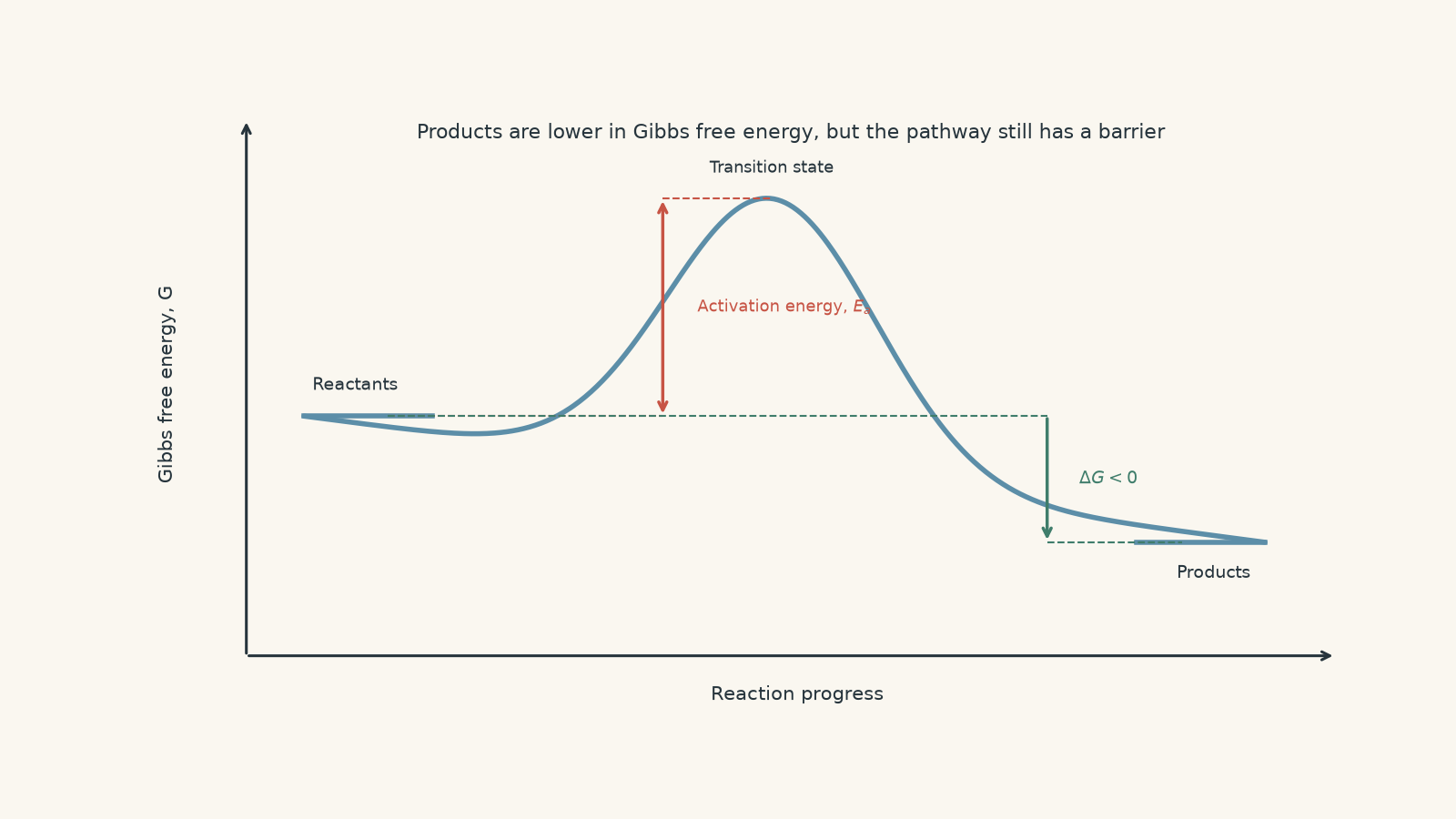
The useful mental model is a ball sitting on one side of a hill. The other side may be lower, so rolling there is thermodynamically favourable, but the ball still has to get over the hill first.
The lower final position represents a negative Gibbs free energy change. The hill represents activation energy.
The analogy stops there. Chemical particles are not literal balls following one path, and real reaction rates depend on molecular collisions, temperature, concentration, catalysts, and reaction mechanisms.
02Why enthalpy alone cannot decide spontaneity
It is tempting to learn:
Exothermic reactions happen. Endothermic reactions do not.
That rule fails.
An exothermic process has \(\Delta H < 0\), meaning the system releases heat at constant pressure. This often helps make a process spontaneous, but it is not the only effect.
There is another tendency: systems can move towards states in which matter and energy have more possible ways of being distributed.
This is described using entropy.
A useful picture of entropy
Imagine 20 students entering an otherwise empty cinema.
There are relatively few ways for all 20 to be squeezed into one particular section. There are vastly more ways for them to occupy seats throughout the cinema.
The spread-out situation corresponds loosely to greater entropy because there are more possible arrangements.
For particles, entropy is more precise than “messiness”. It concerns the number of microscopic ways that particles and energy can be distributed while producing the same overall state.
Processes that often increase entropy include:
- a solid becoming a liquid,
- a liquid becoming a gas,
- a gas expanding into a larger volume,
- an increase in the number of gaseous particles, and
- some dissolving processes.
The cinema analogy is useful for picturing different arrangements, but molecules also distribute energy between different motions and energy states. Entropy is therefore not simply a measure of how untidy something looks.
03Gibbs free energy combines the two effects
At constant temperature and pressure, spontaneity can be predicted using Gibbs free energy:
\[ \Delta G = \Delta H - T\Delta S \]
where:
- \(\Delta G\) is the Gibbs free energy change, usually in \(\text{kJ mol}^{-1}\),
- \(\Delta H\) is the enthalpy change, usually in \(\text{kJ mol}^{-1}\),
- \(T\) is the absolute temperature in kelvin, \(\text{K}\),
- \(\Delta S\) is the entropy change, which must be converted to \(\text{kJ mol}^{-1}\text{K}^{-1}\) if \(\Delta H\) is in kilojoules.
The sign of \(\Delta G\) gives the thermodynamic prediction.
| Gibbs free energy change | Meaning |
|---|---|
| \(\Delta G < 0\) | Forward process is spontaneous under the stated conditions |
| \(\Delta G = 0\) | System is at equilibrium |
| \(\Delta G > 0\) | Forward process is nonspontaneous; the reverse direction is thermodynamically favoured |
Notice what is missing from that table: reaction speed.
A large negative \(\Delta G\) does not guarantee a fast reaction.
04What the equation is really balancing
The two terms in
\[ \Delta G = \Delta H - T\Delta S \]
represent two contributions.
A negative \(\Delta H\) favours spontaneity. Releasing heat makes \(\Delta G\) more negative.
A positive \(\Delta S\) also favours spontaneity because \(T\Delta S\) is then positive and is subtracted from \(\Delta H\).
This gives four important combinations.
| \(\Delta H\) | \(\Delta S\) | General prediction |
|---|---|---|
| negative | positive | spontaneous at all temperatures |
| positive | negative | nonspontaneous at all temperatures |
| negative | negative | spontaneous at sufficiently low temperatures |
| positive | positive | spontaneous at sufficiently high temperatures |
The last two rows are the interesting ones because temperature can reverse the thermodynamic prediction.
Why?
Because temperature multiplies the entropy term. At high \(T\), \(T\Delta S\) matters more.
Worked example: Is an exothermic reaction spontaneous?
A reaction has \(\Delta H=-43.5\text{ kJ mol}^{-1}\) and \(\Delta S=-95.0\text{ J mol}^{-1}\text{K}^{-1}\). Determine whether the reaction is spontaneous at \(298\text{ K}\).
Step 1
The negative enthalpy change favours spontaneity, but the negative entropy change opposes it. We therefore cannot decide from the signs alone.
Step 2
\[ -95.0\text{ J mol}^{-1}\text{K}^{-1} = -0.0950\text{ kJ mol}^{-1}\text{K}^{-1} \]
This conversion matters. Mixing joules and kilojoules is one of the easiest ways to produce a completely wrong \(\Delta G\).
Step 3
\[ \begin{aligned} \Delta G &= \Delta H-T\Delta S\\ &=(-43.5)-(298)(-0.0950)\\ &=-43.5+28.31\\ &=-15.2\text{ kJ mol}^{-1} \end{aligned} \]
Step 4
Because \(\Delta G<0\), the forward reaction is spontaneous at \(298\text{ K}\).
The important point is that entropy actually works against the reaction here. The reaction is spontaneous because the favourable enthalpy contribution is larger at this temperature.
05Temperature can change the answer
Now predict what happens for a reaction with both \(\Delta H>0\) and \(\Delta S>0\).
At low temperature, the positive \(\Delta H\) may dominate, giving \(\Delta G>0\). At higher temperature, the positive \(T\Delta S\) term becomes larger. Because that term is subtracted, \(\Delta G\) can eventually become negative.
The reaction changes from nonspontaneous to spontaneous.
At the boundary between the two behaviours,
\[ \Delta G=0 \]
so
\[ 0=\Delta H-T\Delta S \]
and therefore
\[ T=\frac{\Delta H}{\Delta S} \]
provided the enthalpy and entropy units are consistent.
Worked example: Find the temperature where spontaneity changes
A reaction has \(\Delta H=+64.0\text{ kJ mol}^{-1}\) and \(\Delta S=+185\text{ J mol}^{-1}\text{K}^{-1}\). Determine the temperature at which \(\Delta G=0\), then classify the reaction at \(298\text{ K}\) and \(373\text{ K}\).
Step 1
\[ 185\text{ J mol}^{-1}\text{K}^{-1} = 0.185\text{ kJ mol}^{-1}\text{K}^{-1} \]
Step 2
\[ \begin{aligned} T &=\frac{\Delta H}{\Delta S}\\ &=\frac{64.0\text{ kJ mol}^{-1}} {0.185\text{ kJ mol}^{-1}\text{K}^{-1}}\\ &=346\text{ K} \end{aligned} \]
So the changeover occurs at approximately \(346\text{ K}\), or \(73^\circ\text{C}\).
Step 3
\[ \begin{aligned} \Delta G &=64.0-(298)(0.185)\\ &=+8.87\text{ kJ mol}^{-1} \end{aligned} \]
The reaction is nonspontaneous in the forward direction at \(298\text{ K}\).
Step 4
\[ \begin{aligned} \Delta G &=64.0-(373)(0.185)\\ &=-5.01\text{ kJ mol}^{-1} \end{aligned} \]
The reaction is spontaneous in the forward direction at \(373\text{ K}\).
This is why “endothermic means nonspontaneous” is unsafe. Here the reaction remains endothermic at both temperatures, but becomes spontaneous once the entropy contribution is large enough.
06The three words students most often mix up
Spontaneous does not mean exothermic
An endothermic process can be spontaneous.
If \(\Delta H>0\) but \(\Delta S>0\), sufficiently high temperature can make
\[ T\Delta S>\Delta H \]
giving \(\Delta G<0\).
Melting above a substance’s melting point is the basic pattern: energy is absorbed, yet the liquid state is thermodynamically favoured.
Spontaneous does not mean fast
Thermodynamics and kinetics answer different questions.
Thermodynamics asks:
Which direction is favoured?
Kinetics asks:
How quickly can the system get there?
A spontaneous reaction may have a large activation energy and therefore be extremely slow. A catalyst can lower the activation energy and increase the rate, but it does not change \(\Delta G\).
That also means a catalyst cannot turn a thermodynamically nonspontaneous process into a spontaneous one.
Nonspontaneous does not mean impossible
If \(\Delta G>0\), the process is nonspontaneous in that direction under the stated conditions.
That is not the same as saying the process can never occur.
You might:
- supply electrical energy,
- couple it to another favourable process, or
- change temperature, pressure, or composition until the thermodynamic conditions change.
The phrase “under the stated conditions” matters.
07Be precise about standard conditions
You may encounter quantities written as \(\Delta H^\circ\), \(\Delta S^\circ\), or \(\Delta G^\circ\).
The superscript \(^{\circ}\) tells you that the value refers to standard-state conditions.
A negative \(\Delta G^\circ\) means the forward reaction is thermodynamically favoured from standard-state conditions. It does not mean every possible mixture of reactants and products must always move forwards.
The actual direction of an equilibrium system also depends on its current composition.
That connects spontaneity to the reaction quotient \(Q\) and equilibrium constant \(K\):
- if \(Q<K\), there is a net spontaneous change towards products;
- if \(Q>K\), there is a net spontaneous change towards reactants;
- if \(Q=K\), the system is at equilibrium and the Gibbs free energy change for an infinitesimal net reaction is zero.
This is a more precise way to think than labelling an entire reversible reaction simply “spontaneous” forever.
08A compact decision method
When an HSC question asks about spontaneity, work in this order:
- Check the direction being discussed.
- Note the stated temperature and conditions.
- Identify the signs of \(\Delta H\) and \(\Delta S\).
- Convert \(\Delta S\) into units consistent with \(\Delta H\).
- Calculate \(\Delta G=\Delta H-T\Delta S\) if numerical data are supplied.
- Use the sign of \(\Delta G\), not the sign of \(\Delta H\), to classify the process.
- Keep rate and activation energy out of the conclusion unless the question specifically asks about kinetics.
A strong final sentence usually looks like this:
“The reaction is spontaneous in the forward direction at \(298\text{ K}\) because \(\Delta G<0\).”
That is much more precise than “the reaction works because it releases energy”.
09Questions and solutions
Question 1
A reaction has \(\Delta H=-25.0\text{ kJ mol}^{-1}\) and \(\Delta S=+80.0\text{ J mol}^{-1}\text{K}^{-1}\).
Calculate \(\Delta G\) at \(298\text{ K}\) and state whether the forward reaction is spontaneous.
Solution 1
The forward reaction is spontaneous at \(298\text{ K}\) because \(\Delta G=-48.8\text{ kJ mol}^{-1}\).
First convert the entropy change:
\[ 80.0\text{ J mol}^{-1}\text{K}^{-1} = 0.0800\text{ kJ mol}^{-1}\text{K}^{-1} \]
Then calculate:
\[ \begin{aligned} \Delta G &=\Delta H-T\Delta S\\ &=-25.0-(298)(0.0800)\\ &=-25.0-23.84\\ &=-48.84\text{ kJ mol}^{-1} \end{aligned} \]
Therefore,
\[ \Delta G\approx-48.8\text{ kJ mol}^{-1} \]
The negative enthalpy change and positive entropy change both favour spontaneity.
A tempting mistake is to stop after noticing that the reaction is exothermic. That happens to give the correct prediction here, but for the wrong reason. The proper thermodynamic test is the sign of \(\Delta G\).
Question 2
A process has \(\Delta H=+31.0\text{ kJ mol}^{-1}\) and \(\Delta S=+95.0\text{ J mol}^{-1}\text{K}^{-1}\).
Determine:
a. the temperature at which \(\Delta G=0\),
b. whether the process is spontaneous at \(310\text{ K}\), and
c. whether the process is spontaneous at \(340\text{ K}\).
Explain why the result does not contradict the fact that the process is endothermic.
Solution 2
The changeover occurs at approximately \(326\text{ K}\); the process is nonspontaneous at \(310\text{ K}\) but spontaneous at \(340\text{ K}\).
Convert the entropy change first:
\[ 95.0\text{ J mol}^{-1}\text{K}^{-1} = 0.0950\text{ kJ mol}^{-1}\text{K}^{-1} \]
For part a, at the boundary,
\[ \Delta G=0 \]
so
\[ \begin{aligned} T &=\frac{\Delta H}{\Delta S}\\ &=\frac{31.0}{0.0950}\\ &=326\text{ K} \end{aligned} \]
At \(310\text{ K}\):
\[ \begin{aligned} \Delta G &=31.0-(310)(0.0950)\\ &=31.0-29.45\\ &=+1.55\text{ kJ mol}^{-1} \end{aligned} \]
Since \(\Delta G>0\), the forward process is nonspontaneous at \(310\text{ K}\).
At \(340\text{ K}\):
\[ \begin{aligned} \Delta G &=31.0-(340)(0.0950)\\ &=31.0-32.30\\ &=-1.30\text{ kJ mol}^{-1} \end{aligned} \]
Since \(\Delta G<0\), the forward process is spontaneous at \(340\text{ K}\).
The tempting argument is that \(\Delta H>0\), so the process cannot be spontaneous. That ignores the positive entropy change. As temperature rises, the favourable \(T\Delta S\) contribution becomes large enough to outweigh the positive enthalpy change.
Question 3
For a reaction,
\[ \Delta H=-72.0\text{ kJ mol}^{-1} \]
and
\[ \Delta S=-150\text{ J mol}^{-1}\text{K}^{-1} \]
A student claims, “The reaction is exothermic, so heating it will make it even more spontaneous.”
Test this claim by:
a. finding the temperature at which \(\Delta G=0\),
b. calculating \(\Delta G\) at \(400\text{ K}\), and
c. calculating \(\Delta G\) at \(520\text{ K}\).
Solution 3
The student’s claim is incorrect: this reaction is spontaneous below \(480\text{ K}\), but increasing the temperature beyond \(480\text{ K}\) makes the forward reaction nonspontaneous.
First convert the entropy change:
\[ -150\text{ J mol}^{-1}\text{K}^{-1} = -0.150\text{ kJ mol}^{-1}\text{K}^{-1} \]
At the changeover temperature,
\[ \begin{aligned} 0&=\Delta H-T\Delta S\\ T&=\frac{\Delta H}{\Delta S}\\ &=\frac{-72.0}{-0.150}\\ &=480\text{ K} \end{aligned} \]
At \(400\text{ K}\):
\[ \begin{aligned} \Delta G &=-72.0-(400)(-0.150)\\ &=-72.0+60.0\\ &=-12.0\text{ kJ mol}^{-1} \end{aligned} \]
The forward reaction is spontaneous at \(400\text{ K}\).
At \(520\text{ K}\):
\[ \begin{aligned} \Delta G &=-72.0-(520)(-0.150)\\ &=-72.0+78.0\\ &=+6.0\text{ kJ mol}^{-1} \end{aligned} \]
The forward reaction is nonspontaneous at \(520\text{ K}\).
The subtlety is the negative entropy change. Increasing temperature increases the magnitude of \(T\Delta S\). Because \(\Delta S\) is negative, subtracting \(T\Delta S\) adds an increasingly large positive contribution to \(\Delta G\).
So heating does not automatically favour spontaneity. It strengthens the effect of entropy, whatever the sign of \(\Delta S\).
Question 4
At \(298\text{ K}\), a reaction has \(\Delta G=-18\text{ kJ mol}^{-1}\). A sealed sample containing the reactants shows no detectable product after several days.
A catalyst is then added, and the products form rapidly.
A student concludes:
“Before the catalyst was added, the reaction was nonspontaneous. The catalyst changed \(\Delta G\) from positive to negative.”
Evaluate this conclusion. Explain what the observations actually tell you about thermodynamics, activation energy, reaction rate, and equilibrium.
Solution 4
The conclusion is incorrect: the reaction was already thermodynamically spontaneous before the catalyst was added, and the catalyst did not change \(\Delta G\).
The supplied value is
\[ \Delta G=-18\text{ kJ mol}^{-1} \]
so the forward direction is thermodynamically favoured under the stated conditions.
The lack of detectable product over several days therefore cannot be used to infer that \(\Delta G>0\). Instead, it suggests a kinetic barrier. The reaction may have a large activation energy, so only a very small fraction of collisions can follow the successful reaction pathway.
Adding the catalyst provides an alternative pathway with a lower activation energy. The reaction rate therefore increases.
However, a catalyst does not change the initial or final thermodynamic states. Consequently, it does not change:
- \(\Delta G\),
- \(\Delta H\),
- the equilibrium constant at that temperature, or
- the equilibrium composition.
It accelerates both the forward and reverse reactions, allowing equilibrium to be reached more quickly.
The tempting route is to use “nothing observable happened” as evidence for nonspontaneity. That confuses kinetics with thermodynamics. A reaction can be strongly thermodynamically favoured and still be too slow to notice.
Question 5
Consider the equilibrium
\[ \ce{2NO2(g) <=> N2O4(g)} \]
at a particular temperature. Its equilibrium constant is
\[ K_c=5.0 \]
and a standard-state thermodynamic calculation for the forward reaction gives \(\Delta G^\circ<0\).
Two mixtures are prepared at the same temperature.
For mixture A:
\[ [\ce{NO2}]=0.40\text{ mol L}^{-1} \]
and
\[ [\ce{N2O4}]=0.20\text{ mol L}^{-1} \]
For mixture B:
\[ [\ce{NO2}]=0.20\text{ mol L}^{-1} \]
and
\[ [\ce{N2O4}]=0.80\text{ mol L}^{-1} \]
A student argues that because \(\Delta G^\circ<0\), the forward reaction must be spontaneous in both mixtures.
Determine the spontaneous net direction for each mixture and explain how opposite directions are possible for the same reaction at the same temperature.
Solution 5
Mixture A will undergo a net spontaneous change towards \(\ce{N2O4}\), while mixture B will undergo a net spontaneous change towards \(\ce{NO2}\); the negative value of \(\Delta G^\circ\) does not force every possible mixture to move forwards.
For this reaction,
\[ Q_c=\frac{[\ce{N2O4}]}{[\ce{NO2}]^2} \]
For mixture A:
\[ \begin{aligned} Q_c &=\frac{0.20}{(0.40)^2}\\ &=\frac{0.20}{0.16}\\ &=1.25 \end{aligned} \]
Since
\[ Q_c<K_c \]
the mixture contains too little product relative to its equilibrium composition. There will be a net forward reaction, producing more \(\ce{N2O4}\).
For mixture B:
\[ \begin{aligned} Q_c &=\frac{0.80}{(0.20)^2}\\ &=\frac{0.80}{0.040}\\ &=20 \end{aligned} \]
Since
\[ Q_c>K_c \]
the mixture contains too much product relative to equilibrium. There will be a net reverse reaction, producing more \(\ce{NO2}\).
The tempting argument uses \(\Delta G^\circ<0\) as though it were a permanent label attached to the forward equation. The superscript \(^{\circ}\) is the key constraint: \(\Delta G^\circ\) describes the free-energy change between standard states.
The actual spontaneous direction of a particular mixture depends on its current state.
Both samples have the same reaction, temperature, and equilibrium constant, yet their compositions place them on opposite sides of equilibrium. Mixture A moves forwards towards equilibrium. Mixture B moves backwards towards exactly the same equilibrium condition.
Once either mixture reaches equilibrium,
\[ Q_c=K_c \]
and there is no net thermodynamic tendency in either direction. The forward and reverse reactions can still continue microscopically, but their rates are equal.
That gives the most useful connection to the next part of equilibrium chemistry: spontaneity is not simply a permanent property of an equation. \(\Delta G\) describes the thermodynamic direction from a particular state, \(Q\) tells you where the system currently sits, and \(K\) tells you where equilibrium lies. Kinetics then answers the separate question of how quickly the system can get there.