
Enthalpy of Respiration: Energy Cycles for HSC Chemistry
Learn how to analyse the enthalpy change of respiration using chemical equations, Hess's law, formation enthalpies, and energy cycles.
Your cells can oxidise glucose without a flame, while a bomb calorimeter can oxidise glucose by something much closer to burning. The routes look completely different. So should they have different enthalpy changes?
Predict before going further. If both processes start with the same amounts of glucose and oxygen, and finish with the same amounts of carbon dioxide and water in the same physical states, does the route matter?
For enthalpy, it does not. The route can involve one reaction or fifty. The overall enthalpy change depends on the chemical states at the start and finish. That is exactly why Hess’s law is so useful for analysing respiration.
01Start with the two endpoints
The simplified overall equation for aerobic respiration is
\[
\ce{C6H12O6 + 6O2 -> 6CO2 + 6H2O}
\]
One mole of glucose reacts with six moles of oxygen to form six moles of carbon dioxide and six moles of water.
This equation is a summary. A cell does not smash glucose and oxygen together in one enormous reaction. Respiration happens through many chemical steps.
That detail matters enormously for reaction rates and biological energy transfer. But for the overall enthalpy change, we can temporarily ignore the route and compare the starting and finishing states.
Enthalpy change is defined as
\[
\Delta H = H_{\text{products}}-H_{\text{reactants}}
\]
where \(H\) is enthalpy and \(\Delta H\) is the change in enthalpy.
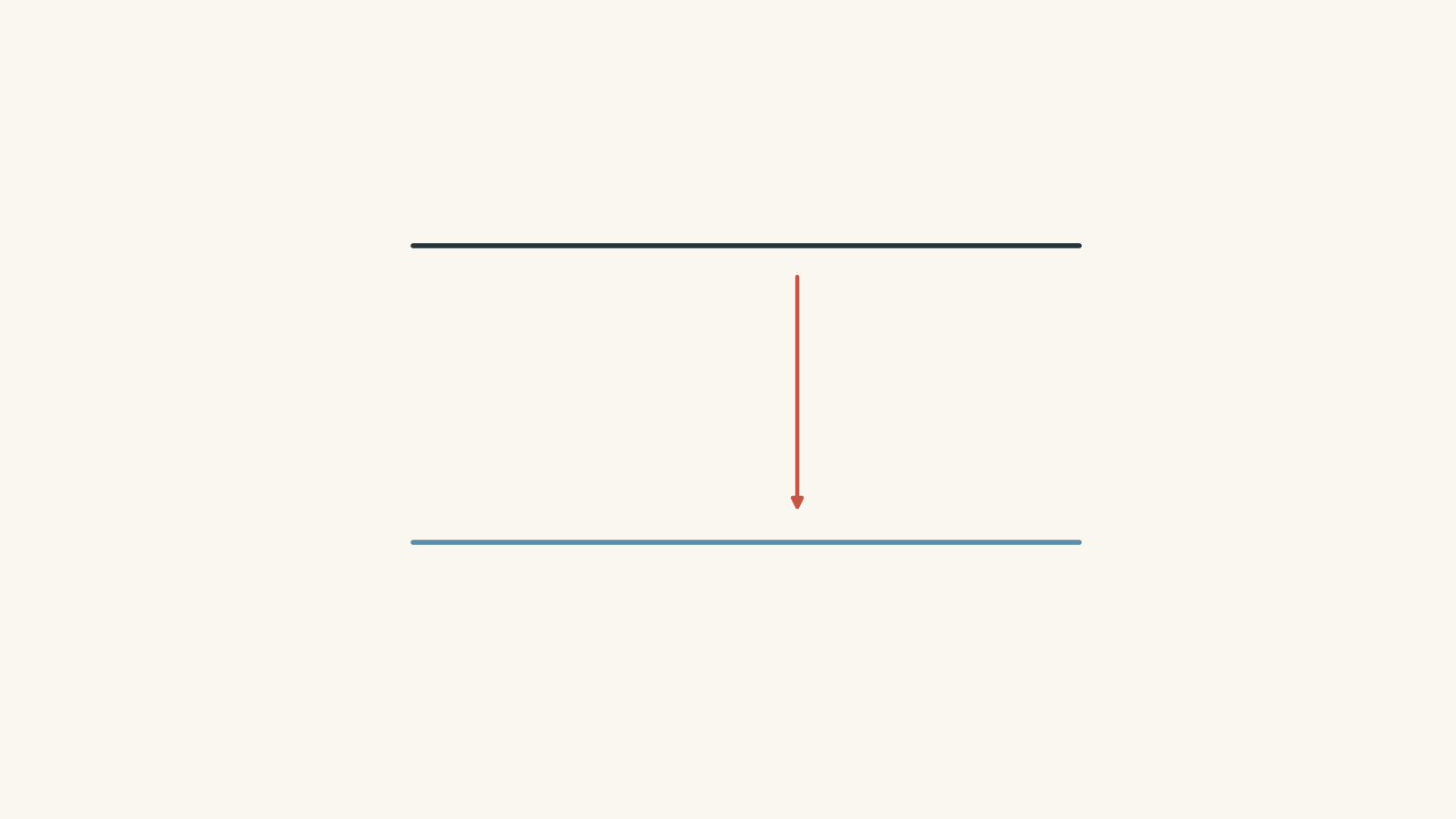
If the products have lower enthalpy than the reactants, then
\[
\Delta H<0
\]
and the reaction is exothermic.
For respiration, the overall oxidation of glucose is exothermic. The products are at a lower enthalpy than the reactants.
02Why the pathway does not change the overall enthalpy
Picture two people trying to get from level 8 of a car park to level 2.
One takes the lift. The other follows six irritating ramps around the building because apparently the lift is “too easy”.
Their routes are different, but both finish six levels below where they started.
Enthalpy works similarly. If the chemical system begins and ends in the same states, its overall enthalpy change is fixed. The individual steps can be different.
The analogy stops there. Enthalpy is not literal height, and different reaction pathways can have completely different activation energies, rates, and mechanisms.
The thermochemical rule is Hess’s law:
\[
\Delta H_{\text{overall}}
=
\Delta H_1+\Delta H_2+\Delta H_3+\cdots
\]
This gives you three operations that appear constantly in HSC questions.
| What you do to an equation | What happens to \(\Delta H\) |
|---|---|
| Reverse the reaction | Reverse the sign of \(\Delta H\) |
| Multiply every coefficient by \(k\) | Multiply \(\Delta H\) by \(k\) |
| Add reactions together | Add their \(\Delta H\) values |
| Cancel a species from both sides | Only cancel it if the chemical species and physical state match |
That last row is easy to underestimate. \(\ce{H2O(l)}\) and \(\ce{H2O(g)}\) are not the same thermochemical state.
03Respiration and photosynthesis form a useful energy cycle
At the level of their simplified overall equations, photosynthesis and aerobic respiration point in opposite directions.
A simplified photosynthesis equation can be written as
\[
\ce{6CO2 + 6H2O -> C6H12O6 + 6O2}
\]
Reverse it:
\[
\ce{C6H12O6 + 6O2 -> 6CO2 + 6H2O}
\]
and you have the overall respiration equation.
That gives an immediate prediction. If a particular photosynthesis equation has an enthalpy change of \(+X\), what should the reversed respiration equation have?
It must be \(-X\), provided the states and quantities in the two equations really are exact reverses.
This is a Hess’s law statement, not a claim that respiration is simply “photosynthesis running backwards” inside a cell. Their actual biochemical mechanisms are different.
If you want to see the reverse direction treated in detail, compare this with enthalpy of photosynthesis.
Worked example: Reverse the photosynthesis equation
A thermochemical model gives
\[
\ce{6CO2(g) + 6H2O(l) -> C6H12O6(s) + 6O2(g)}
\qquad
\Delta H=+2800\ \mathrm{kJ\,mol^{-1}}
\]
Determine the enthalpy change for the reverse reaction.
Step 1
\[
\ce{C6H12O6(s) + 6O2(g) -> 6CO2(g) + 6H2O(l)}
\]
Step 2
The entire equation has been reversed.
Step 3
\[
\Delta H=-2800\ \mathrm{kJ\,mol^{-1}}
\]
The negative sign means the reverse process is exothermic. For every mole of glucose reacting according to this equation, the system decreases in enthalpy by \(2800\ \mathrm{kJ}\).
The common mistake is to keep \(+2800\ \mathrm{kJ\,mol^{-1}}\) because none of the coefficients changed. Reversing an equation always reverses the direction of the enthalpy change as well.
04Calculating respiration enthalpy from formation data
Sometimes the question will not give you the reverse of another reaction. Instead, it gives standard enthalpies of formation.
The standard enthalpy of formation, \(\Delta H_f^\circ\), is the enthalpy change for forming one mole of a substance from its constituent elements in their standard states.
For a reaction,
\[
\Delta H^\circ_{\mathrm{rxn}}
=
\sum n\Delta H_f^\circ(\text{products})
–
\sum n\Delta H_f^\circ(\text{reactants})
\]
Here:
- \(\Delta H^\circ_{\mathrm{rxn}}\) is the standard reaction enthalpy in \(\mathrm{kJ\,mol^{-1}}\)
- \(n\) is the stoichiometric coefficient
- \(\Delta H_f^\circ\) is a standard enthalpy of formation in \(\mathrm{kJ\,mol^{-1}}\)
The coefficients are not decoration. Six moles of carbon dioxide contribute six times the formation enthalpy of one mole of carbon dioxide.
Also remember that an element in its standard state has
\[
\Delta H_f^\circ=0
\]
So, when \(\ce{O2(g)}\) appears in the calculation, its standard enthalpy of formation is zero.
That does not mean oxygen is chemically unimportant. It only means the chosen reference enthalpy for forming \(\ce{O2(g)}\) from an element already in its standard state is zero.
Worked example: Calculate respiration from formation enthalpies
For the reaction
\[
\ce{C6H12O6(s) + 6O2(g) -> 6CO2(g) + 6H2O(l)}
\]
use the following data:
| Substance | \(\Delta H_f^\circ\) (\(\mathrm{kJ\,mol^{-1}}\)) |
|---|---|
| \(\ce{C6H12O6(s)}\) | \(-1276\) |
| \(\ce{O2(g)}\) | \(0\) |
| \(\ce{CO2(g)}\) | \(-394\) |
| \(\ce{H2O(l)}\) | \(-286\) |
Calculate \(\Delta H^\circ_{\mathrm{rxn}}\).
Step 1
\[
\begin{aligned}
\sum n\Delta H_f^\circ(\text{products})
&=6(-394)+6(-286)\\
&=-2364-1716\\
&=-4080\ \mathrm{kJ\,mol^{-1}}
\end{aligned}
\]
Step 2
\[
\begin{aligned}
\sum n\Delta H_f^\circ(\text{reactants})
&=(-1276)+6(0)\\
&=-1276\ \mathrm{kJ\,mol^{-1}}
\end{aligned}
\]
Step 3
\[
\begin{aligned}
\Delta H^\circ_{\mathrm{rxn}}
&=-4080-(-1276)\\
&=-2804\ \mathrm{kJ\,mol^{-1}}
\end{aligned}
\]
So,
\[
\Delta H^\circ_{\mathrm{rxn}}=-2804\ \mathrm{kJ\,mol^{-1}}
\]
The products are \(2804\ \mathrm{kJ\,mol^{-1}}\) lower in enthalpy than the reactants according to these supplied data.
Notice the double negative in the final calculation. A surprisingly large number of enthalpy mistakes are actually subtraction mistakes wearing a chemistry costume.
05Why the state symbols matter
Suppose a question changes
\[
\ce{6H2O(l)}
\]
to
\[
\ce{6H2O(g)}
\]
The chemical formula is still \(\ce{H2O}\), but the final state is different.
Water vapour has a higher enthalpy than liquid water because energy must be supplied to vaporise the liquid. Therefore, forming gaseous water instead of liquid water makes the respiration reaction less exothermic.
You can picture the cycle as
\[
\ce{glucose + oxygen -> carbon dioxide + liquid water}
\]
followed backwards by vaporising the water:
\[
\ce{6H2O(l) -> 6H2O(g)}
\]
If the second step is endothermic, adding it makes the overall \(\Delta H\) less negative.
This is an important correction to the simple idea that “only the formulas matter”. For thermochemistry, the exact initial and final states matter.
06Enthalpy belongs to the equation as written
A value such as
\[
\Delta H=-2800\ \mathrm{kJ\,mol^{-1}}
\]
does not mean “every mole involved releases \(2800\ \mathrm{kJ}\)”.
It belongs to one mole of reaction as written.
For
\[
\ce{C6H12O6 + 6O2 -> 6CO2 + 6H2O}
\]
one mole of reaction consumes:
- \(1\) mol glucose
- \(6\) mol oxygen
and produces:
- \(6\) mol carbon dioxide
- \(6\) mol water
If only \(0.20\) mol glucose reacts completely, the reaction has occurred \(0.20\) times, so its enthalpy change is also multiplied by \(0.20\).
If you’re given mass instead, refresh the mole relationship first:
\[
n=\frac{m}{M}
\]
where \(n\) is amount in moles, \(m\) is mass in grams, and \(M\) is molar mass in \(\mathrm{g\,mol^{-1}}\).
07The biggest misconception: “respiration is not combustion, so its enthalpy must be different”
This sounds reasonable at first.
A burning substance may have a flame and a rapid temperature rise. Cellular respiration proceeds through controlled stages. Surely those must release different total amounts of energy?
Not if you are comparing exactly the same initial and final thermochemical states.
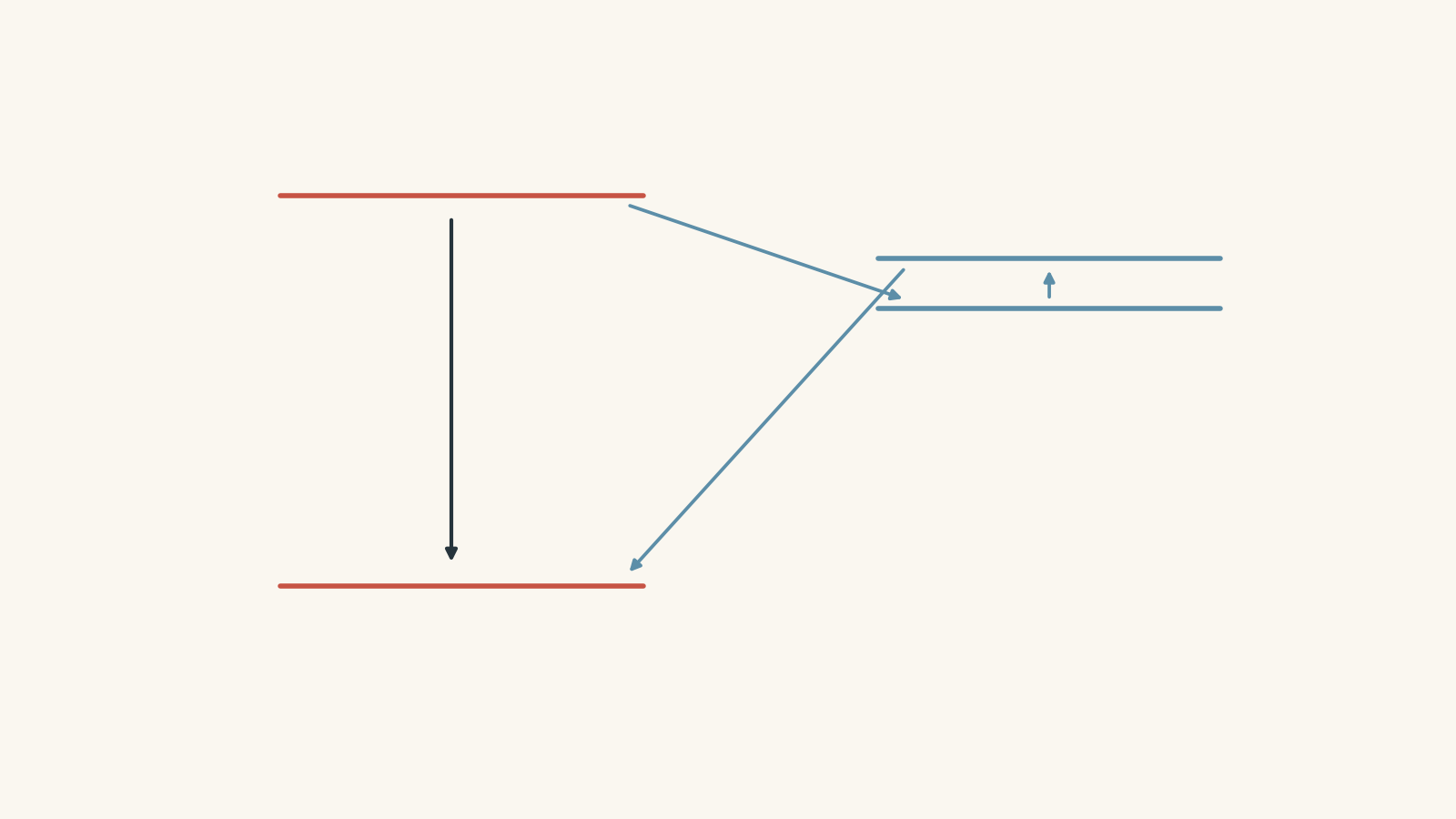
Imagine a deliberately unrealistic thermochemical detour:
\[
\ce{glucose -> intermediates -> more intermediates -> CO2 + H2O}
\]
Every individual step has its own \(\Delta H\). Some could even be endothermic.
But adding all the steps cancels the intermediates:
\[
\Delta H_{\mathrm{overall}}
=
\Delta H_1+\Delta H_2+\cdots
\]
The total must match any other route connecting the same endpoints.
That is the useful part of calling enthalpy a state function.
What can differ between the routes are things such as the mechanism, activation energies, rate, intermediate species, and how energy is transferred during the process. Hess’s law is not saying those are identical.
08A reliable decision process for respiration questions
When an enthalpy question mentions respiration, resist the urge to hunt for a memorised number. Work from the chemical information.
- Write the required overall equation.
- Check every coefficient.
- Check every state symbol.
- Decide whether the supplied equations need reversing or multiplying.
- Make those same changes to their \(\Delta H\) values.
- Add the equations and cancel genuine intermediates.
- Check the sign against the physical meaning.
- If a mass is given, convert it to moles before scaling the reaction enthalpy.
For a negative answer, ask: does it make sense that the stated process is exothermic?
For a positive answer, ask: have I accidentally calculated the reverse process?
Those checks will not prove your arithmetic is correct, but they catch many wrong answers immediately.
09Questions and solutions
Question 1
For the thermochemical equation
\[
\ce{C6H12O6(s) + 6O2(g) -> 6CO2(g) + 6H2O(l)}
\qquad
\Delta H=-2800\ \mathrm{kJ\,mol^{-1}}
\]
calculate the enthalpy change when \(0.250\ \mathrm{mol}\) of glucose reacts completely.
Solution 1
The enthalpy change is \(-700\ \mathrm{kJ}\), meaning \(700\ \mathrm{kJ}\) is released for the stated amount of glucose.
The equation assigns \(-2800\ \mathrm{kJ}\) to \(1\ \mathrm{mol}\) of glucose reacting.
For \(0.250\ \mathrm{mol}\),
\[
\begin{aligned}
\Delta H
&=0.250\ \mathrm{mol}
\times
(-2800\ \mathrm{kJ\,mol^{-1}})\\
&=-700\ \mathrm{kJ}
\end{aligned}
\]
The tempting mistake is to use the coefficient \(6\) somewhere simply because several species have coefficients of six. The amount of reaction here is fixed directly by glucose: \(1\) mol glucose corresponds to \(1\) mol of the thermochemical reaction.
Question 2
A thermochemical detour uses the following two reactions:
\[
\ce{C6H12O6(s) -> 2C2H5OH(l) + 2CO2(g)}
\qquad
\Delta H=-70\ \mathrm{kJ\,mol^{-1}}
\]
and
\[
\ce{C2H5OH(l) + 3O2(g) -> 2CO2(g) + 3H2O(l)}
\qquad
\Delta H=-1365\ \mathrm{kJ\,mol^{-1}}
\]
Use Hess’s law to determine \(\Delta H\) for
\[
\ce{C6H12O6(s) + 6O2(g) -> 6CO2(g) + 6H2O(l)}
\]
This detour is a thermochemical construction, not a proposed mechanism for aerobic respiration.
Solution 2
The overall enthalpy change is \(-2800\ \mathrm{kJ\,mol^{-1}}\).
The first equation produces \(2\) mol of ethanol, but the second equation consumes only \(1\) mol of ethanol each time. We therefore need to double the second equation.
\[
\ce{2C2H5OH(l) + 6O2(g) -> 4CO2(g) + 6H2O(l)}
\]
Its enthalpy must also be doubled:
\[
\Delta H=2(-1365)=-2730\ \mathrm{kJ\,mol^{-1}}
\]
Now add it to the first equation:
\[
\ce{C6H12O6(s) -> 2C2H5OH(l) + 2CO2(g)}
\]
\[
\ce{2C2H5OH(l) + 6O2(g) -> 4CO2(g) + 6H2O(l)}
\]
The \(2\ce{C2H5OH(l)}\) cancels because it is produced in one step and consumed in the other.
The remaining equation is
\[
\ce{C6H12O6(s) + 6O2(g) -> 6CO2(g) + 6H2O(l)}
\]
and
\[
\begin{aligned}
\Delta H_{\mathrm{overall}}
&=-70+(-2730)\\
&=-2800\ \mathrm{kJ\,mol^{-1}}
\end{aligned}
\]
The tempting route is to add \(-70\) and \(-1365\) immediately. That fails because the chemical equations do not yet cancel: two moles of ethanol are formed, so two moles must be consumed.
This is the same bookkeeping principle used in more complicated Hess’s law stepped-reaction problems.
Question 3
For a particular set of states,
\[
\ce{C6H12O6(s) + 6O2(g) -> 6CO2(g) + 6H2O(l)}
\]
has
\[
\Delta H=-2800\ \mathrm{kJ\,mol^{-1}}
\]
The enthalpy of vaporisation of water under the conditions being considered is
\[
\ce{H2O(l) -> H2O(g)}
\qquad
\Delta H=+44.0\ \mathrm{kJ\,mol^{-1}}
\]
Calculate the enthalpy change for
\[
\ce{C6H12O6(s) + 6O2(g) -> 6CO2(g) + 6H2O(g)}
\]
Then explain why the answer is less negative even though the same formulas appear in both respiration equations.
Solution 3
The required enthalpy change is \(-2536\ \mathrm{kJ\,mol^{-1}}\); it is less negative because gaseous water is at a higher enthalpy than liquid water.
Start with respiration producing liquid water:
\[
\Delta H_1=-2800\ \mathrm{kJ\,mol^{-1}}
\]
We then need to vaporise all six moles of water:
\[
\ce{6H2O(l) -> 6H2O(g)}
\]
so
\[
\begin{aligned}
\Delta H_2
&=6(44.0)\\
&=+264\ \mathrm{kJ\,mol^{-1}}
\end{aligned}
\]
Adding the two processes gives
\[
\begin{aligned}
\Delta H_{\mathrm{overall}}
&=-2800+264\\
&=-2536\ \mathrm{kJ\,mol^{-1}}
\end{aligned}
\]
The reaction still releases energy, but less is released by the time the products have reached the higher-enthalpy gaseous-water state.
A tempting argument is that both equations contain “six waters”, so their enthalpy changes should be identical. The problem is that \(\ce{H2O(l)}\) and \(\ce{H2O(g)}\) are different thermochemical states. Hess’s law requires identical endpoints, not merely identical molecular formulas.
If the six moles of water vapour later condensed,
\[
\ce{6H2O(g) -> 6H2O(l)}
\]
the condensation step would have
\[
\Delta H=-264\ \mathrm{kJ\,mol^{-1}}
\]
and the complete sequence would return to
\[
-2536-264=-2800\ \mathrm{kJ\,mol^{-1}}
\]
as Hess’s law requires.
Question 4
A \(0.0500\ \mathrm{mol}\) sample of glucose is consumed by two processes.
Process R is complete aerobic oxidation:
\[
\ce{C6H12O6 + 6O2 -> 6CO2 + 6H2O}
\qquad
\Delta H_R=-2800\ \mathrm{kJ\,mol^{-1}}
\]
Process F is represented by
\[
\ce{C6H12O6 -> 2C2H5OH + 2CO2}
\qquad
\Delta H_F=-70.0\ \mathrm{kJ\,mol^{-1}}
\]
After all the glucose has been consumed, \(0.240\ \mathrm{mol}\) of carbon dioxide has formed.
Determine:
a. the amount of glucose that followed each process
b. the total enthalpy change predicted from the two pathways
c. whether a calorimeter reading of only \(92.0\ \mathrm{kJ}\) released can be explained just by the mixture of the two pathways.
Assume the equations and enthalpies above completely describe the relevant chemical changes.
Solution 4
The sample contains \(0.0350\ \mathrm{mol}\) of glucose following process R and \(0.0150\ \mathrm{mol}\) following process F; the predicted enthalpy change is \(-99.05\ \mathrm{kJ}\), so a reading of \(92.0\ \mathrm{kJ}\) released cannot be explained by the pathway mixture alone.
Let \(x\) be the moles of glucose undergoing process R and \(y\) the moles undergoing process F.
Because all \(0.0500\ \mathrm{mol}\) of glucose is consumed,
\[
x+y=0.0500
\]
Process R makes \(6\) mol of \(\ce{CO2}\) per mole of glucose, while process F makes \(2\).
Therefore,
\[
6x+2y=0.240
\]
Substitute
\[
y=0.0500-x
\]
into the carbon dioxide equation:
\[
\begin{aligned}
6x+2(0.0500-x)&=0.240\\
6x+0.100-2x&=0.240\\
4x&=0.140\\
x&=0.0350\ \mathrm{mol}
\end{aligned}
\]
Then
\[
y=0.0500-0.0350=0.0150\ \mathrm{mol}
\]
So part (a) gives
\[
n_R=0.0350\ \mathrm{mol}
\]
and
\[
n_F=0.0150\ \mathrm{mol}
\]
For process R,
\[
\begin{aligned}
\Delta H_R
&=(0.0350)(-2800)\\
&=-98.0\ \mathrm{kJ}
\end{aligned}
\]
For process F,
\[
\begin{aligned}
\Delta H_F
&=(0.0150)(-70.0)\\
&=-1.05\ \mathrm{kJ}
\end{aligned}
\]
Therefore,
\[
\begin{aligned}
\Delta H_{\mathrm{total}}
&=-98.0-1.05\\
&=-99.05\ \mathrm{kJ}
\end{aligned}
\]
So the chemical model predicts \(99.05\ \mathrm{kJ}\) released.
The calorimeter records only \(92.0\ \mathrm{kJ}\) released. Under the assumptions in the question, changing the proportions of R and F cannot fix this discrepancy because the measured amount of \(\ce{CO2}\), together with total glucose consumption, has already fixed those proportions.
The tempting route is to use the calorimeter value to invent a different mixture of the two pathways. That ignores the independent stoichiometric constraint from the carbon dioxide measurement.
Some other assumption would have to fail: for example, the calorimeter may not have captured all energy transferred as heat, or an additional chemical process may have occurred.
Question 5
A hypothetical system completely oxidises \(1.00\ \mathrm{mol}\) of glucose according to
\[
\ce{C6H12O6 + 6O2 -> 6CO2 + 6H2O}
\qquad
\Delta H=-2803\ \mathrm{kJ\,mol^{-1}}
\]
At the same time, energy is coupled to another chemical process:
\[
\ce{A -> B}
\qquad
\Delta H=+38.0\ \mathrm{kJ\,mol^{-1}}
\]
During glucose oxidation, \(20.0\ \mathrm{mol}\) of \(\ce{A}\) initially changes to \(\ce{B}\). Before the observation period ends, \(13.0\ \mathrm{mol}\) of \(\ce{B}\) changes back to \(\ce{A}\).
Assume all quantities refer to the same conditions and that these are the only relevant reactions.
Determine:
a. the net amount of \(\ce{A}\) converted to \(\ce{B}\) at the end of the observation period
b. the enthalpy change for the complete system during that period
c. the cumulative enthalpy change if all remaining \(\ce{B}\) later returns to \(\ce{A}\)
d. why the statement “respiration is \(-2803\ \mathrm{kJ\,mol^{-1}}\), so the whole system must always change by \(-2803\ \mathrm{kJ}\)” fails during the observation period.
Solution 5
At the end of the observation period, \(7.0\ \mathrm{mol}\) of \(\ce{A}\) has been converted net to \(\ce{B}\), the complete system has \(\Delta H=-2537\ \mathrm{kJ}\), and after all remaining \(\ce{B}\) returns to \(\ce{A}\), the cumulative enthalpy change becomes \(-2803\ \mathrm{kJ}\).
First track the auxiliary chemical system.
Initially,
\[
20.0\ \mathrm{mol}
\]
of \(\ce{A}\) converts to \(\ce{B}\).
Then
\[
13.0\ \mathrm{mol}
\]
of \(\ce{B}\) returns to \(\ce{A}\).
Therefore, the net change is
\[
20.0-13.0=7.0\ \mathrm{mol}
\]
of
\[
\ce{A -> B}
\]
So part (a) is \(7.0\ \mathrm{mol}\) net conversion.
The enthalpy associated with this net conversion is
\[
\begin{aligned}
\Delta H_{\ce{A -> B}}
&=(7.0\ \mathrm{mol})(+38.0\ \mathrm{kJ\,mol^{-1}})\\
&=+266\ \mathrm{kJ}
\end{aligned}
\]
Respiration contributes
\[
-2803\ \mathrm{kJ}
\]
for the \(1.00\ \mathrm{mol}\) of glucose.
Therefore, for the complete system during the observation period,
\[
\begin{aligned}
\Delta H_{\mathrm{system}}
&=-2803+266\\
&=-2537\ \mathrm{kJ}
\end{aligned}
\]
This is less negative than the respiration value because part of the overall enthalpy decrease has been accompanied by an endothermic change in another part of the chemical system.
Now allow the remaining \(7.0\ \mathrm{mol}\) of \(\ce{B}\) to return to \(\ce{A}\).
Reversing
\[
\ce{A -> B}
\qquad
\Delta H=+38.0\ \mathrm{kJ\,mol^{-1}}
\]
gives
\[
\ce{B -> A}
\qquad
\Delta H=-38.0\ \mathrm{kJ\,mol^{-1}}
\]
For \(7.0\ \mathrm{mol}\),
\[
\begin{aligned}
\Delta H
&=(7.0)(-38.0)\\
&=-266\ \mathrm{kJ}
\end{aligned}
\]
The cumulative change is therefore
\[
\begin{aligned}
\Delta H_{\mathrm{cumulative}}
&=-2537-266\\
&=-2803\ \mathrm{kJ}
\end{aligned}
\]
The subtle point is the definition of the system’s endpoints.
A student may focus only on the carbon-containing respiration equation and argue that complete oxidation of one mole of glucose fixes the answer at \(-2803\ \mathrm{kJ}\). That value is correct for the respiration reaction by itself.
But at the end of the observation period, the complete system has also changed \(7.0\ \mathrm{mol}\) of \(\ce{A}\) into \(\ce{B}\). Its final chemical state is therefore not the same as the final state of respiration alone.
Only when all \(\ce{B}\) has returned to \(\ce{A}\) do the auxiliary species finish where they started. Their net contribution then cancels, leaving the original respiration enthalpy of \(-2803\ \mathrm{kJ}\).
That is the deeper version of Hess’s law: you cannot decide whether two processes have the same \(\Delta H\) by looking at one interesting molecule. You must compare the complete initial and final states of the system.
10What this lets you do next
Once you can treat respiration as an energy cycle, you no longer need a special “respiration formula” for every question. You can reconstruct an unknown enthalpy from reversed reactions, formation data, phase changes, or a chain of intermediate reactions.
The next useful step is recognising when the data describe the same endpoints by a different route, and when one apparently small change – especially a physical state or an uncancelled species – means the endpoints are no longer the same. That distinction is what turns Hess’s law from equation juggling into a reliable way of analysing chemical energy.