
Primary Alcohol Oxidation Products: Aldehydes and Acids
Learn how to predict whether oxidation of a primary alcohol forms an aldehyde or a carboxylic acid, and how distillation and reflux control the outcome.
Suppose you oxidise ethanol and collect ethanal. You leave the same reaction running for longer, with plenty of oxidant, and now the main organic product is ethanoic acid.
Same starting alcohol. Same carbon skeleton. Different product.
So what actually decides whether a primary alcohol stops at an aldehyde or keeps going to a carboxylic acid?
Before reading on, make a prediction. If the aldehyde is the first oxidation product, how could you stop it from being oxidised again?
The trick is to remove the aldehyde from the reaction mixture as it forms. That single idea explains why distillation tends to favour aldehydes, while reflux with excess oxidant favours carboxylic acids.
01Start by checking that the alcohol is primary
The two-stage oxidation pathway in this guide applies to primary alcohols.
A primary alcohol has its hydroxyl group, \(\ce{-OH}\), attached to a carbon that is bonded to only one other carbon atom.
For example:
\[
\ce{CH3CH2OH}
\]
is ethanol. The carbon carrying the \(\ce{-OH}\) group is attached to only one other carbon, so ethanol is primary.
Likewise,
\[
\ce{CH3CH2CH2OH}
\]
is propan-1-ol, another primary alcohol.
If deciding whether an alcohol is primary still feels shaky, revise primary, secondary and tertiary alcohols first. The classification matters because secondary and tertiary alcohols do not follow the same product pathway.
02What oxidation actually changes
Picture the carbon carrying the \(\ce{-OH}\) group in a primary alcohol.
Its general structure is:
\[
\ce{R-CH2OH}
\]
Here, \(\ce{R}\) represents the rest of the carbon chain.
During the first oxidation step, this carbon loses hydrogen and forms a carbon-oxygen double bond. The product is an aldehyde:
\[
\ce{R-CH2OH + [O] -> R-CHO + H2O}
\]
The symbol \(\ce{[O]}\) means an oxidising agent is providing the oxidation. It does not mean a free oxygen atom is floating around in the flask.
So the pattern is:
\[
\text{primary alcohol} \rightarrow \text{aldehyde}
\]
For ethanol:
\[
\ce{CH3CH2OH + [O] -> CH3CHO + H2O}
\]
Ethanol becomes ethanal.
Now make another prediction. Is ethanal necessarily the final product?
No. Aldehydes can themselves be oxidised.
The aldehyde gains another oxygen at its functional group and becomes a carboxylic acid:
\[
\ce{R-CHO + [O] -> R-COOH}
\]
So the complete pathway is:
\[
\text{primary alcohol} \rightarrow \text{aldehyde} \rightarrow \text{carboxylic acid}
\]
For ethanol:
\[
\ce{CH3CH2OH -> CH3CHO -> CH3COOH}
\]
or, with the compound names:
\[
\text{ethanol} \rightarrow \text{ethanal} \rightarrow \text{ethanoic acid}
\]
The carbon chain has not changed. Two carbons went in, and two carbons remain in each organic product.
That carbon-count check is useful in exams. Ordinary oxidation of a primary alcohol does not magically add or remove carbon atoms.
03Why there are two possible products
It is tempting to think that the oxidising agent somehow has an “aldehyde setting” and an “acid setting”.
It doesn’t.
The aldehyde is an intermediate. Once formed, it can stay in contact with the oxidising agent and undergo a second oxidation.
The experiment therefore has two competing possibilities:
- remove the aldehyde soon after it forms, or
- keep it in the reaction mixture so it can be oxidised again.
A slightly silly way to picture it is an aldehyde trying to leave a party before someone convinces it to stay for another round. Distillation gives it an exit. Reflux keeps sending it back inside.
The analogy breaks because molecules aren’t making decisions. Distillation and reflux simply change where the molecules go and how long they remain in contact with the oxidising mixture.
04Making an aldehyde: oxidise and distil
To obtain an aldehyde from a primary alcohol, the reaction conditions are controlled so that the aldehyde is removed as it forms.
A common school-level oxidant is acidified potassium dichromate, often represented simply using \(\ce{[O]}\) in organic equations.
The mixture is heated using a distillation setup.
Why distillation?
The aldehyde product is sufficiently volatile to travel as vapour into the condenser. It cools, condenses, and is collected away from the oxidising mixture.
That physical separation matters. Once the aldehyde leaves the reaction flask, it is much less available for the second oxidation step.
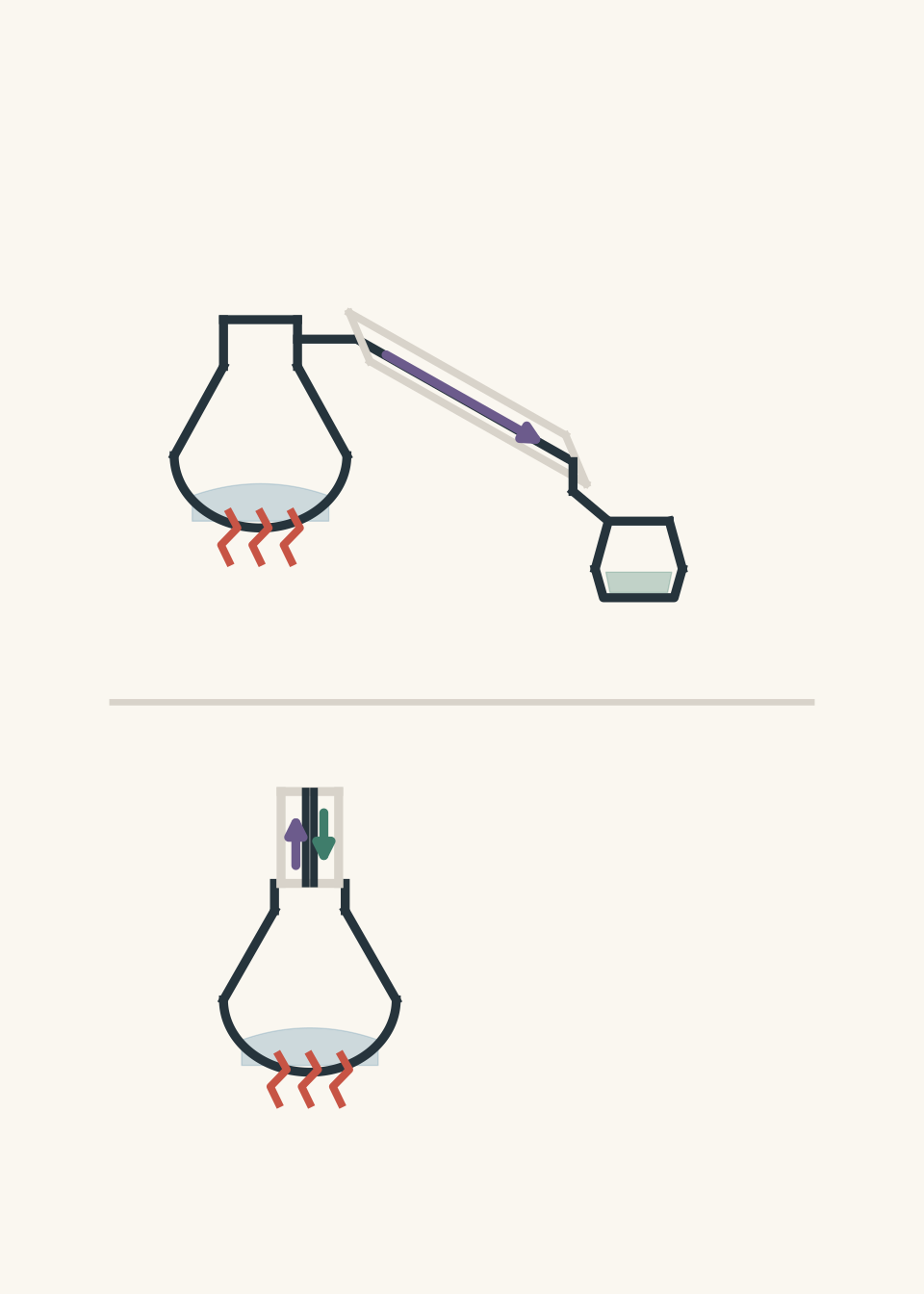
This is an important precision point: distillation does not make further oxidation chemically impossible.
If an aldehyde remains in contact with the oxidant for long enough, it can still become a carboxylic acid. Distillation favours the aldehyde because it removes the aldehyde from the reaction environment.
Worked example: Oxidising propan-1-ol to an aldehyde
Propan-1-ol is heated with an oxidising agent using a distillation apparatus. Predict the main organic product, give its name and condensed structural formula, and write the oxidation equation.
Step 1
Propan-1-ol is a primary alcohol:
\[
\ce{CH3CH2CH2OH}
\]
The \(\ce{-OH}\)-bearing carbon is bonded to only one other carbon.
Step 2
The first oxidation product of a primary alcohol is an aldehyde:
\[
\text{primary alcohol} \rightarrow \text{aldehyde}
\]
Because the product is being distilled from the reaction mixture, we expect oxidation to stop mainly at this first stage.
Step 3
Propan-1-ol contains three carbons, so the aldehyde also contains three carbons:
\[
\ce{CH3CH2CHO}
\]
Its name is propanal.
Step 4
\[
\ce{CH3CH2CH2OH + [O] -> CH3CH2CHO + H2O}
\]
The main organic product is propanal. Distillation removes propanal from the oxidising mixture, reducing its opportunity to undergo further oxidation.
05Making a carboxylic acid: oxidation under reflux
Suppose instead that we want the primary alcohol to oxidise as far as the carboxylic acid.
Now removing the aldehyde would be unhelpful. We want it to remain in contact with the oxidising agent.
The mixture is therefore commonly heated under reflux with sufficient oxidant.
In a reflux setup, vapour rises into a condenser, cools, and flows back into the same reaction flask.
Nothing important is being collected in a separate receiver.
That means the aldehyde intermediate remains in the reaction system:
\[
\ce{R-CH2OH -> R-CHO -> R-COOH}
\]
The two individual oxidation steps are:
\[
\ce{R-CH2OH + [O] -> R-CHO + H2O}
\]
and
\[
\ce{R-CHO + [O] -> R-COOH}
\]
Adding them gives the overall equation:
\[
\ce{R-CH2OH + 2[O] -> R-COOH + H2O}
\]
Notice that complete oxidation to the carboxylic acid requires twice the \(\ce{[O]}\) represented in the first oxidation step.
This does not mean real laboratory reactions proceed as perfectly separated one-mole stages. The equations are a useful stoichiometric model of the overall chemical change.
Worked example: Following a branched primary alcohol through both oxidation stages
2-methylpropan-1-ol is oxidised under two different conditions.
- In experiment A, the product is removed by distillation as it forms.
- In experiment B, the alcohol is heated under reflux with excess oxidant.
Predict the main organic product in each experiment.
Step 1
2-methylpropan-1-ol can be written as:
\[
\ce{(CH3)2CHCH2OH}
\]
Although the molecule is branched, the carbon carrying the \(\ce{-OH}\) group is bonded to only one other carbon. It is still a primary alcohol.
Step 2
Distillation favours removal of the first oxidation product.
Replace the terminal \(\ce{-CH2OH}\) group with \(\ce{-CHO}\):
\[
\ce{(CH3)2CHCH2OH + [O] -> (CH3)2CHCHO + H2O}
\]
The product is 2-methylpropanal.
The branch has not moved. Oxidation changes the functional group, not the carbon skeleton.
Step 3
Under reflux with excess oxidant, the aldehyde remains available for further oxidation.
The final functional group is therefore \(\ce{-COOH}\):
\[
\ce{(CH3)2CHCH2OH + 2[O] -> (CH3)2CHCOOH + H2O}
\]
The product is 2-methylpropanoic acid.
Step 4
Both experiments begin with exactly the same primary alcohol. The different products arise because experiment A removes the intermediate aldehyde, while experiment B keeps it in contact with the oxidising agent.
06The decision rule worth remembering
For a primary alcohol, do not try to memorise separate reactions as isolated facts.
Follow this sequence:
| Information in the question | Main product to predict |
|---|---|
| Primary alcohol, controlled oxidation, product distilled as it forms | Aldehyde |
| Primary alcohol, limited oxidation with rapid product removal | Aldehyde |
| Primary alcohol, excess oxidant, heated under reflux | Carboxylic acid |
| Aldehyde exposed to further oxidation | Carboxylic acid |
The key question is not simply “Is there an oxidising agent?”
Ask:
Does the aldehyde stay in contact with the oxidising conditions?
If yes, further oxidation is possible.
If it is removed promptly, the aldehyde can be collected.
07How to name the products without rebuilding the molecule
Once you recognise a primary alcohol, product naming is usually quite mechanical.
Start with the same carbon skeleton.
For the aldehyde, replace the alcohol ending with -al.
For the carboxylic acid, use -oic acid.
For example:
| Primary alcohol | Aldehyde | Carboxylic acid |
|---|---|---|
| methanol | methanal | methanoic acid |
| ethanol | ethanal | ethanoic acid |
| propan-1-ol | propanal | propanoic acid |
| butan-1-ol | butanal | butanoic acid |
| 2-methylpropan-1-ol | 2-methylpropanal | 2-methylpropanoic acid |
The carbonyl carbon of an aldehyde and the carboxyl carbon of a carboxylic acid are both included in the main chain when naming the product.
Do not shorten the chain because the end carbon now looks different.
08Distinguishing an aldehyde from a carboxylic acid
Sometimes the question gives you an unknown oxidation product rather than telling you how it was prepared.
The structures provide the first distinction:
- an aldehyde contains the terminal group \(\ce{-CHO}\)
- a carboxylic acid contains \(\ce{-COOH}\)
Their chemical behaviour is also different.
A particularly useful distinction is their reaction with carbonate or hydrogencarbonate ions.
Carboxylic acids react with sodium hydrogencarbonate to release carbon dioxide:
\[
\ce{RCOOH + NaHCO3 -> RCOONa + H2O + CO2}
\]
You would observe effervescence.
An ordinary aldehyde does not give this acid-carbonate reaction.
So if two possible oxidation products are propanal and propanoic acid, adding sodium hydrogencarbonate gives a simple distinction:
- propanoic acid: bubbles of \(\ce{CO2}\)
- propanal: no acid-carbonate effervescence
Aldehydes can also be identified using aldehyde-specific oxidation tests such as Tollens’ reagent. A positive Tollens’ test can produce a silver deposit because the aldehyde is oxidised while silver ions are reduced.
For most HSC product-prediction questions, though, you should first use the functional group and the reaction conditions. Laboratory tests are supporting evidence, not a substitute for understanding the pathway.
09The most tempting misconception: “limited oxidant means aldehyde”
This idea is only partly useful.
A student might reason:
One oxidation step needs one \(\ce{[O]}\), so if I don’t add much oxidant, I must get only aldehyde.
Why does that feel reasonable?
Because the equations suggest a neat sequence:
\[
\ce{alcohol -> aldehyde -> acid}
\]
But a real flask contains huge numbers of molecules reacting at different moments. It is possible for some aldehyde molecules to undergo their second oxidation while some alcohol molecules have not yet undergone their first.
So oxidant quantity alone does not guarantee a perfectly pure aldehyde.
The stronger exam reasoning is:
- controlled amount of oxidant can help limit further oxidation, but
- removing the aldehyde by distillation is what prevents prolonged contact with the oxidising mixture.
Likewise, excess oxidant alone does not explain everything. Reflux matters because it keeps reactants and intermediates in the reaction system.
10Another common trap: changing the carbon chain
Consider butan-1-ol:
\[
\ce{CH3CH2CH2CH2OH}
\]
Its first oxidation product is:
\[
\ce{CH3CH2CH2CHO}
\]
not a three-carbon aldehyde.
The \(\ce{-CH2OH}\) carbon has not disappeared. It has become the carbon of the \(\ce{-CHO}\) group.
Further oxidation gives:
\[
\ce{CH3CH2CH2COOH}
\]
Again, all four carbons remain.
A useful check is therefore:
\[
\text{number of carbon atoms before oxidation}
=
\text{number of carbon atoms in the organic product}
\]
for the ordinary primary-alcohol oxidation reactions considered here.
11A compact method for exam questions
When you see a primary-alcohol oxidation question, work through four decisions.
- Identify the carbon carrying the \(\ce{-OH}\) group. Confirm that the alcohol is primary.
- Keep the carbon skeleton unchanged.
- Read the conditions. Distillation generally points to an aldehyde; reflux with excess oxidant points to a carboxylic acid.
- Check the functional group you have drawn: \(\ce{-CHO}\) for an aldehyde or \(\ce{-COOH}\) for a carboxylic acid.
Then write the equation.
For the first oxidation:
\[
\ce{RCH2OH + [O] -> RCHO + H2O}
\]
For complete oxidation:
\[
\ce{RCH2OH + 2[O] -> RCOOH + H2O}
\]
That is a much safer method than trying to recognise products from memory.
12Questions and solutions
Question 1
Propan-1-ol is heated under reflux with excess acidified oxidising agent.
a. Name the final organic product.
b. Write its condensed structural formula.
c. Write an overall oxidation equation using \(\ce{[O]}\).
Solution 1
The final product is propanoic acid, \(\ce{CH3CH2COOH}\), because a primary alcohol heated under reflux with excess oxidant can undergo both oxidation stages.
Propan-1-ol is:
\[
\ce{CH3CH2CH2OH}
\]
It is primary because the carbon carrying the \(\ce{-OH}\) group is bonded to only one other carbon.
Under reflux, the first product, propanal, remains in the reaction mixture and can be oxidised again:
\[
\ce{CH3CH2CH2OH -> CH3CH2CHO -> CH3CH2COOH}
\]
The overall equation is:
\[
\ce{CH3CH2CH2OH + 2[O] -> CH3CH2COOH + H2O}
\]
A tempting mistake is to give propanal simply because primary alcohols form aldehydes. That is only the first stage. The reflux conditions and excess oxidant allow the reaction to continue.
Question 2
Two students oxidise identical samples of butan-1-ol using the same oxidising agent.
Student A heats the mixture and continuously collects a volatile organic product by distillation.
Student B heats the mixture under reflux with excess oxidant.
a. Predict the main organic product obtained by each student.
b. Explain why their products differ even though they began with the same alcohol and oxidising agent.
c. Suggest one chemical test that could distinguish the two predicted products.
Solution 2
Student A should mainly obtain butanal, while Student B should mainly obtain butanoic acid.
For Student A, the first oxidation is:
\[
\ce{CH3CH2CH2CH2OH + [O] -> CH3CH2CH2CHO + H2O}
\]
The butanal is removed from the reaction system by distillation. This limits its contact with the oxidising agent and therefore reduces further oxidation.
For Student B, reflux keeps volatile substances within the reaction system. Butanal formed in the first oxidation remains available for a second oxidation:
\[
\ce{CH3CH2CH2CHO + [O] -> CH3CH2CH2COOH}
\]
The overall change is:
\[
\ce{CH3CH2CH2CH2OH + 2[O] -> CH3CH2CH2COOH + H2O}
\]
The important difference is therefore not the identity of the starting alcohol or oxidant. It is what happens to the aldehyde intermediate after it forms.
One suitable distinguishing test is to add sodium hydrogencarbonate.
Butanoic acid reacts and releases carbon dioxide:
\[
\ce{CH3CH2CH2COOH + NaHCO3 -> CH3CH2CH2COONa + H2O + CO2}
\]
Butanal does not undergo this acid-hydrogencarbonate reaction.
The tempting route is to say that “distillation causes oxidation to an aldehyde” and “reflux causes oxidation to an acid”. More precisely, neither apparatus changes the underlying sequence. The apparatus changes whether the aldehyde is removed or kept in contact with the oxidant.
Question 3
A student is told that an unknown compound is either 2-methylpropan-1-ol or 2-methylpropanal.
The student adds acidified potassium dichromate to a sample, warms it, and observes evidence that the dichromate has been reduced.
The student concludes that the unknown must be 2-methylpropan-1-ol because “alcohols are oxidised by dichromate”.
Is the conclusion valid? Explain how the two compounds could be distinguished more reliably.
Solution 3
No. The observation does not uniquely identify 2-methylpropan-1-ol because both the primary alcohol and the aldehyde can be oxidised by a suitable oxidising agent.
The primary alcohol can undergo:
\[
\ce{(CH3)2CHCH2OH + [O] -> (CH3)2CHCHO + H2O}
\]
But the aldehyde can also undergo further oxidation:
\[
\ce{(CH3)2CHCHO + [O] -> (CH3)2CHCOOH}
\]
So evidence that the oxidising agent has reacted does not, by itself, tell us which starting compound was present.
A more selective approach would test specifically for an aldehyde. For example, Tollens’ reagent can distinguish an ordinary aldehyde from the corresponding alcohol because the aldehyde reduces the silver-containing reagent.
Alternatively, the compounds could be investigated by their different functional-group reactions rather than assuming that potassium dichromate reacts only with alcohols.
The tempting mistake is to treat acidified dichromate as an “alcohol test”. In this system, it is an oxidising agent, and aldehydes are also capable of being oxidised. The exact functional group being tested matters.
Question 4
A chemist oxidises a primary alcohol \(\ce{RCH2OH}\). Analysis later shows that the reaction mixture contains three organic species:
- unreacted \(\ce{RCH2OH}\)
- the aldehyde \(\ce{RCHO}\)
- the carboxylic acid \(\ce{RCOOH}\)
A student says this is impossible:
“The alcohol must all become aldehyde before any aldehyde can become acid. Oxidation happens in stages.”
Assess the student’s claim. Your explanation should distinguish between a reaction pathway for one molecule and the composition of an entire reaction mixture.
Solution 4
The student’s claim is incorrect. An individual molecule follows the sequence alcohol \(\rightarrow\) aldehyde \(\rightarrow\) carboxylic acid, but an entire flask does not have to complete one stage for every molecule before any molecule begins the next stage.
For any particular molecule, the primary alcohol cannot jump directly past the aldehyde stage in the simplified HSC reaction model:
\[
\ce{RCH2OH + [O] -> RCHO + H2O}
\]
followed by:
\[
\ce{RCHO + [O] -> RCOOH}
\]
However, a reaction mixture contains an enormous number of molecules. They do not all react simultaneously.
At one moment:
- some alcohol molecules may not yet have been oxidised,
- some may have undergone one oxidation and exist as aldehydes, and
- some aldehyde molecules may already have undergone the second oxidation and become carboxylic acids.
So finding all three species in the same mixture is entirely consistent with the pathway.
The tempting interpretation is to read the two equations as a timetable for the whole flask: “finish reaction 1 everywhere, then start reaction 2”. Chemical equations show permitted transformations and stoichiometric relationships. They do not imply that every molecule reaches each stage at the same time.
This is also why distillation is so useful when preparing an aldehyde. It physically removes some aldehyde molecules before they have much opportunity to enter the second oxidation step.
Question 5
One mole of a primary alcohol, \(\ce{RCH2OH}\), is mixed with an oxidising agent. Express the oxidising capacity in units of \(\ce{[O]}\), where:
\[
\ce{RCH2OH + [O] -> RCHO + H2O}
\]
and
\[
\ce{RCHO + [O] -> RCOOH}
\]
Exactly \(1.50\) mol of \(\ce{[O]}\) is consumed. Assume there are no other oxidation products and no loss of carbon-containing material.
A student argues:
“The first \(1.00\) mol of \(\ce{[O]}\) converts all \(1.00\) mol of alcohol into aldehyde. The remaining \(0.50\) mol of \(\ce{[O]}\) then converts half of that aldehyde into acid. Therefore the final mixture must contain \(0.50\) mol aldehyde and \(0.50\) mol carboxylic acid.”
Is that final composition forced by the information given? If not, determine what can actually be concluded about the possible amounts of alcohol, aldehyde, and carboxylic acid.
Solution 5
No. The mixture does not have to contain exactly \(0.50\) mol aldehyde and \(0.50\) mol carboxylic acid. That is one possible composition, but the oxidant consumption alone does not prove that every alcohol molecule completed its first oxidation before any aldehyde underwent its second.
Let:
- \(x\) be the amount of unreacted alcohol, in mol,
- \(y\) be the amount of aldehyde, in mol, and
- \(z\) be the amount of carboxylic acid, in mol.
Because we began with \(1.00\) mol of carbon-containing alcohol and have assumed no carbon-containing material is lost:
\[
x+y+z=1.00
\]
An alcohol molecule still present has consumed no \(\ce{[O]}\).
An aldehyde molecule has undergone one oxidation, so each mole of aldehyde represents \(1\) mol of \(\ce{[O]}\) consumed.
A carboxylic acid molecule has undergone two oxidation stages, so each mole of acid represents \(2\) mol of \(\ce{[O]}\) consumed.
Therefore:
\[
y+2z=1.50
\]
From the material balance:
\[
y=1.00-x-z
\]
Substitute this into the oxidant balance:
\[
\begin{aligned}
1.00-x-z+2z &= 1.50\\
z-x &= 0.50\\
z &= x+0.50
\end{aligned}
\]
Then:
\[
\begin{aligned}
y &=1.00-x-(x+0.50)\\
&=0.50-2x
\end{aligned}
\]
Amounts cannot be negative, so:
\[
x\geq 0
\]
and
\[
0.50-2x\geq0
\]
which gives:
\[
0\leq x\leq0.25
\]
The possible compositions therefore satisfy:
\[
0\leq x\leq0.25
\]
for the alcohol,
\[
0\leq y\leq0.50
\]
for the aldehyde, and
\[
0.50\leq z\leq0.75
\]
for the carboxylic acid, with the three amounts linked by the equations above.
For example, the student’s proposed mixture,
\[
x=0,\qquad y=0.50,\qquad z=0.50
\]
does satisfy both balances.
But another allowed composition is:
\[
x=0.10,\qquad y=0.30,\qquad z=0.60
\]
Check the total organic amount:
\[
0.10+0.30+0.60=1.00\text{ mol}
\]
and the oxidant consumption:
\[
(0.30)(1)+(0.60)(2)=1.50\text{ mol of }\ce{[O]}
\]
So the same total oxidant consumption can correspond to different reaction-mixture compositions.
The hinge is the difference between stoichiometry and reaction history. Stoichiometry tells us what overall balances must be satisfied. It does not tell us the order in which different molecules reacted.
To determine a unique final composition, we would need extra information about reaction extent, separation, kinetics, or experimental conditions.
That same idea explains the practical distinction between distillation and reflux. Controlling primary-alcohol oxidation is not merely a matter of drawing the correct functional groups. It is about controlling what happens to the aldehyde intermediate after it forms.
Once that pathway is clear, it becomes much easier to compare oxidation with other alcohol reactions where the carbon skeleton is retained but the functional group changes, such as dehydration of alcohols. The useful question is always the same: what part of the molecule changes, what conditions cause that change, and what competing pathway do those conditions favour?