
How to Identify an Unknown Alcohol from Its Oxidation Product
Learn how to identify an unknown alcohol by analysing its oxidation product. Work backwards from aldehydes, ketones, and carboxylic acids to determine the original alcohol's structure, with HSC Chemistry examples and practice questions.
An unknown alcohol has the molecular formula \(\ce{C4H10O}\). It is oxidised using acidified potassium dichromate(VI), and the main organic product is butanone.
Can you work backwards to identify the alcohol?
There are several alcohols with the formula \(\ce{C4H10O}\), so the molecular formula alone isn’t enough. The oxidation product gives you a much stronger clue: butanone is a ketone, which tells us that the original alcohol was secondary. Its carbon skeleton then allows us to identify the alcohol as butan-2-ol.
This is the central method: identify the oxidation product’s functional group, use it to classify the original alcohol, then reconstruct the original structure without changing its carbon skeleton.
01Start with the oxidation product, not the unknown alcohol
When an alcohol is oxidised under ordinary HSC reaction conditions, its product depends on the type of alcohol.
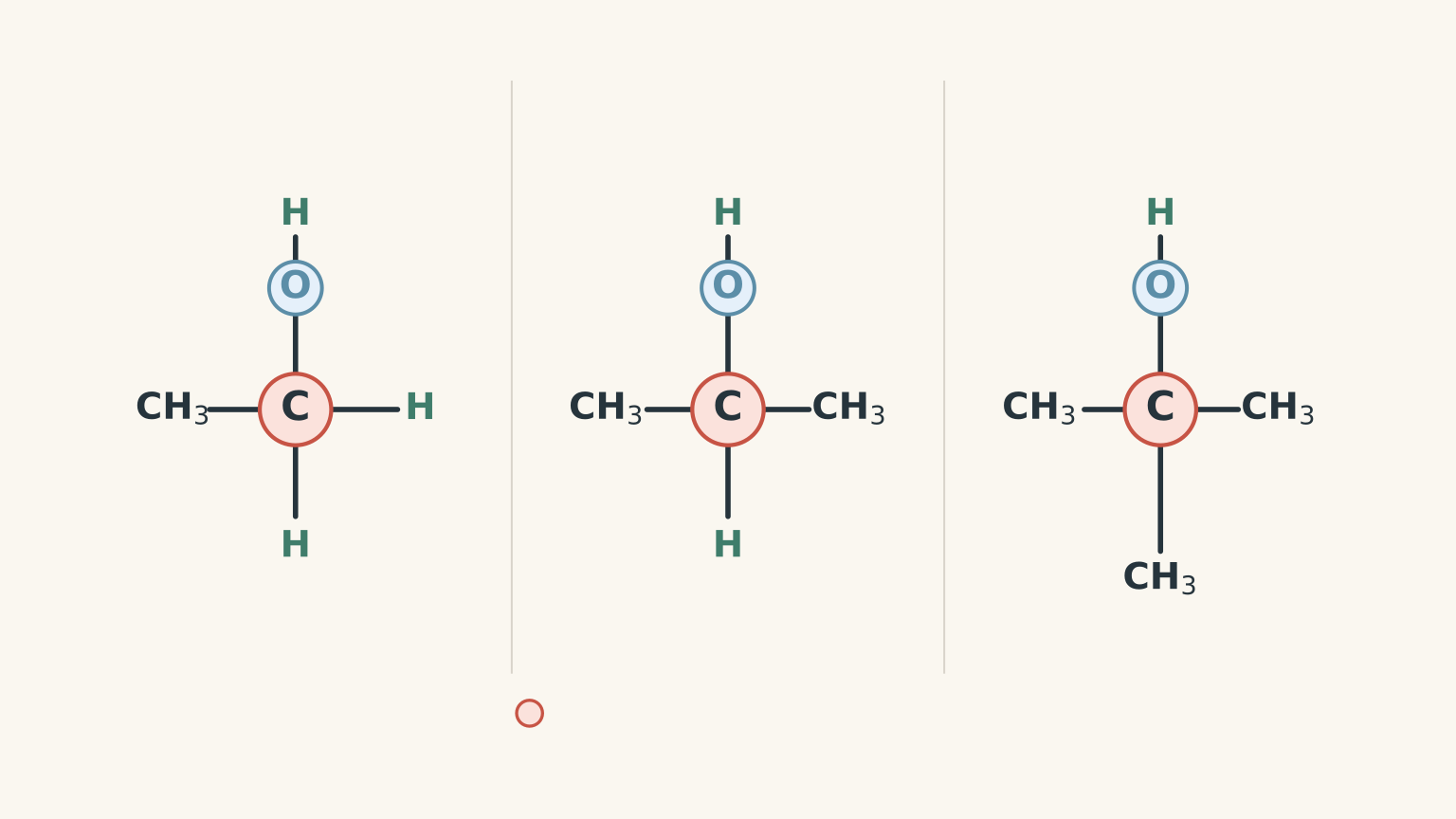
The important feature is the carbon directly bonded to the hydroxyl group, \(\ce{-OH}\). Count how many other carbon atoms are attached to this carbon.
Due to technical limitations, this figure may display incorrectly or contain inaccuracies. Please check key details against your course materials.
| Original alcohol | Carbon atoms attached to the \(\ce{C-OH}\) carbon | Typical oxidation product |
|---|---|---|
| Primary | 1 | Aldehyde, or carboxylic acid under further oxidation |
| Secondary | 2 | Ketone |
| Tertiary | 3 | No reaction under ordinary HSC oxidation conditions |
This table is your first diagnostic tool.
What does each product tell you?
An aldehyde indicates a primary alcohol.
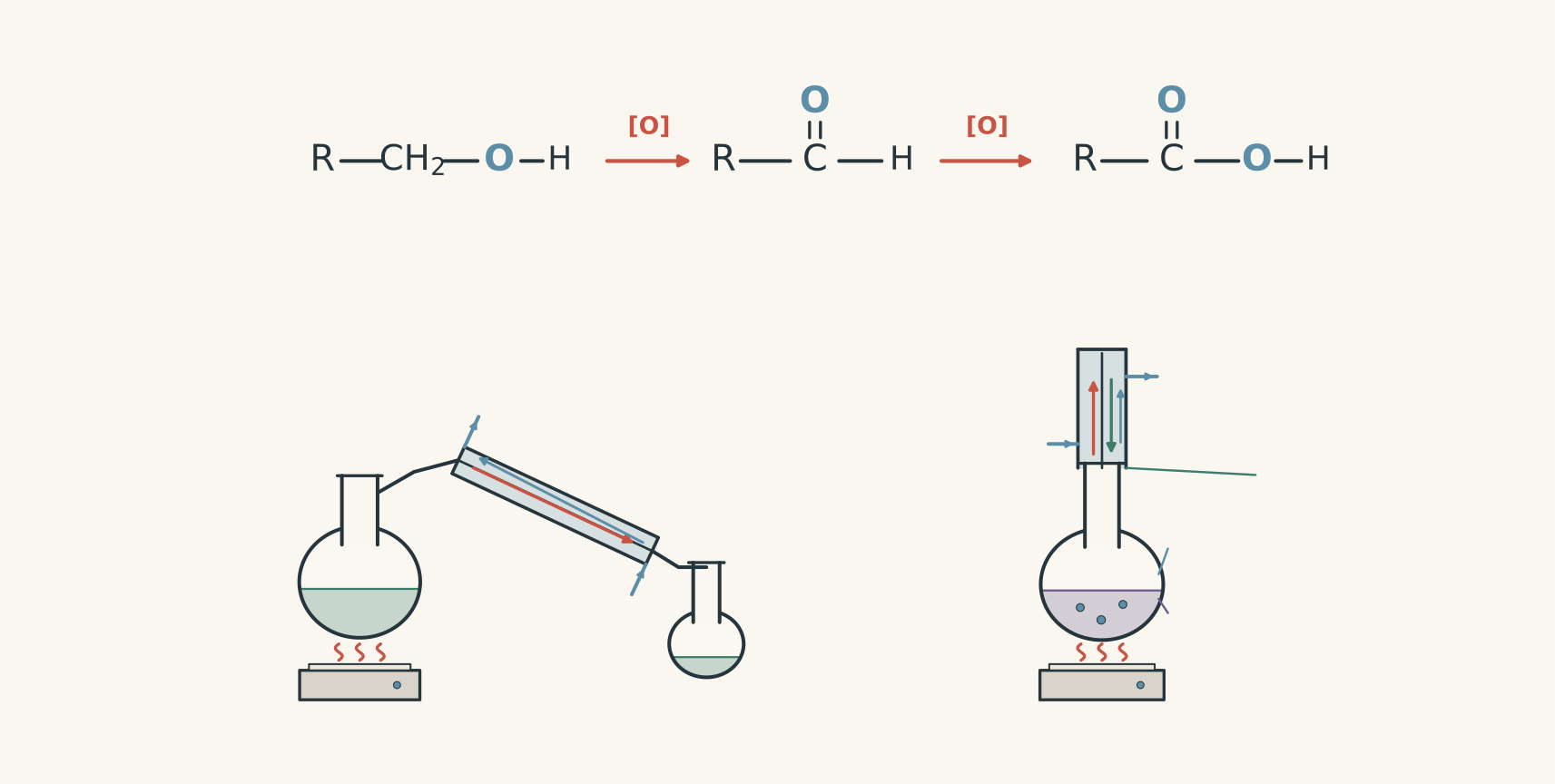
A primary alcohol has the general structure \(\ce{R-CH2OH}\). Oxidation removes hydrogen and forms a carbon-oxygen double bond:
\[ \ce{R-CH2OH + [O] -> R-CHO + H2O} \]
The product contains the aldehyde group, \(\ce{-CHO}\).
A ketone indicates a secondary alcohol.
A secondary alcohol has the general structure \(\ce{R-CH(OH)-R'}\). Oxidation forms a carbon-oxygen double bond at the same carbon:
\[ \ce{R-CH(OH)-R' + [O] -> R-CO-R' + H2O} \]
The product contains a ketone group, \(\ce{C=O}\), between two carbon groups.
No oxidation indicates a possible tertiary alcohol.
A tertiary alcohol has three carbon groups attached to the carbon carrying the \(\ce{-OH}\) group. That carbon has no hydrogen attached to it.
Under ordinary HSC oxidation conditions, forming a carbonyl group would require breaking a carbon-carbon bond. Tertiary alcohols therefore resist oxidation by the usual oxidising agents.
Be careful with this last conclusion. A missing reaction does not automatically prove that an alcohol is tertiary. The oxidising agent might be ineffective, the reaction might not have occurred properly, or the conditions might be unsuitable. You need evidence that the oxidation test actually worked.
The important distinction: aldehyde versus carboxylic acid
A carboxylic acid can also indicate that the original alcohol was primary.
Primary alcohols can undergo two stages of oxidation:
\[ \ce{R-CH2OH -> R-CHO -> R-COOH} \]
The conditions determine whether the reaction stops at the aldehyde or continues to the carboxylic acid.
| Reaction conditions | Main product from a primary alcohol |
|---|---|
| Controlled oxidation, with the aldehyde distilled off as it forms | Aldehyde |
| Heating under reflux with excess oxidising agent | Carboxylic acid |
This means an unknown alcohol that produces a carboxylic acid under reflux is not a different class of alcohol from one that produces an aldehyde. Both results are consistent with a primary alcohol.
For a more detailed explanation of how these conditions control the product, see Oxidation of Alcohols: Predicting HSC Chemistry Products.
Due to technical limitations, this figure may display incorrectly or contain inaccuracies. Please check key details against your course materials.
02Work backwards to reconstruct the alcohol
Knowing the alcohol was primary or secondary is only half the job. You may also need to identify its exact structure.
The useful rule is that ordinary oxidation changes the functional group but preserves the carbon skeleton.
In other words, don’t rearrange the carbon chain when reconstructing the alcohol.
Reversing an aldehyde to a primary alcohol
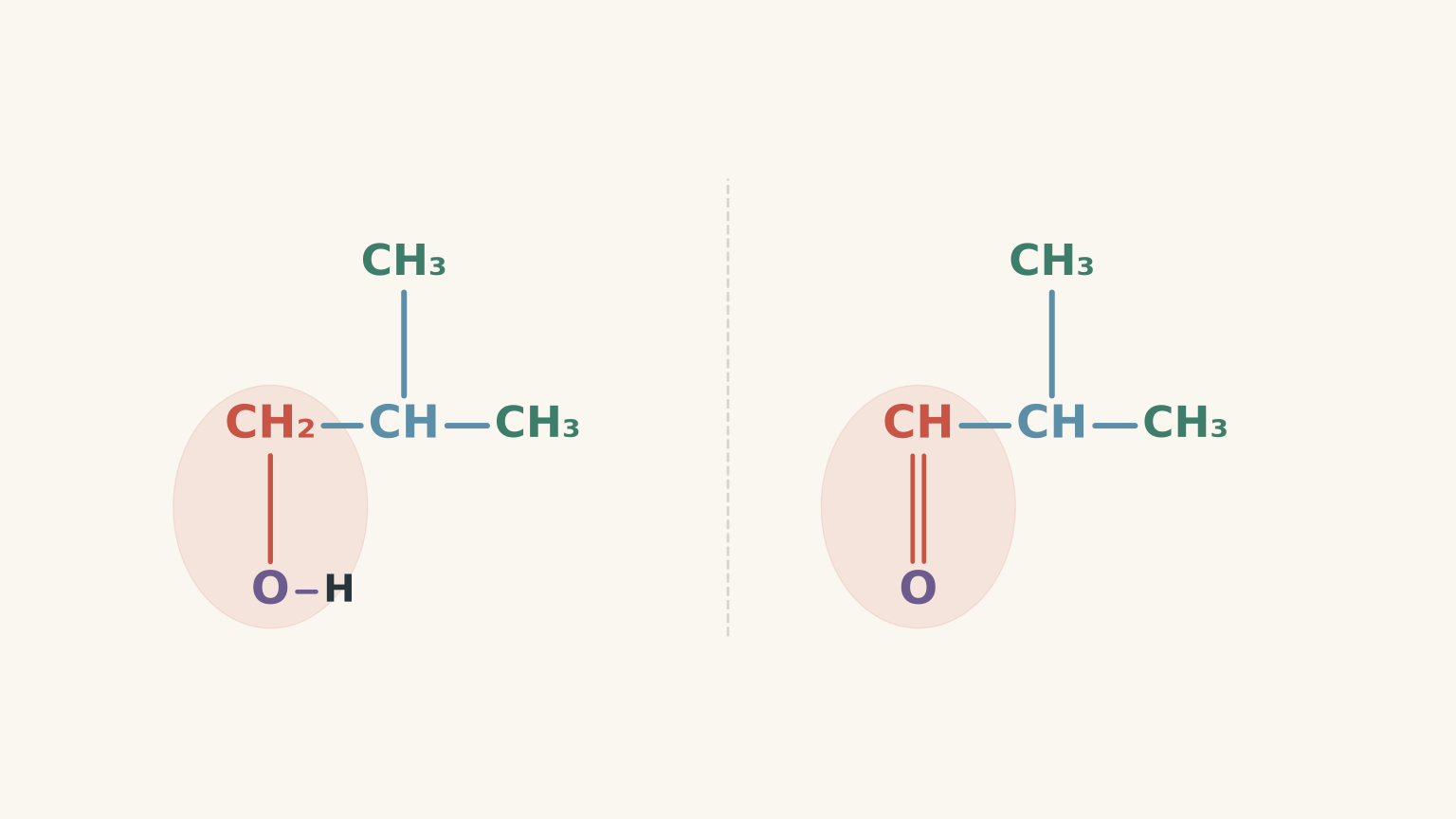
Suppose the oxidation product is 2-methylpropanal:
\[ \ce{(CH3)2CHCHO} \]
It contains four carbon atoms and has an aldehyde group.
To reconstruct the original alcohol:
- Keep the existing carbon skeleton.
- Replace the aldehyde group, \(\ce{-CHO}\), with \(\ce{-CH2OH}\).
- Name the resulting alcohol.
The original alcohol is 2-methylpropan-1-ol:
\[ \ce{(CH3)2CHCH2OH} \]
Due to technical limitations, this figure may display incorrectly or contain inaccuracies. Please check key details against your course materials.
Notice that the carbon count stays at four. The oxidation has not created a new carbon chain or removed a carbon atom.
Reversing a ketone to a secondary alcohol
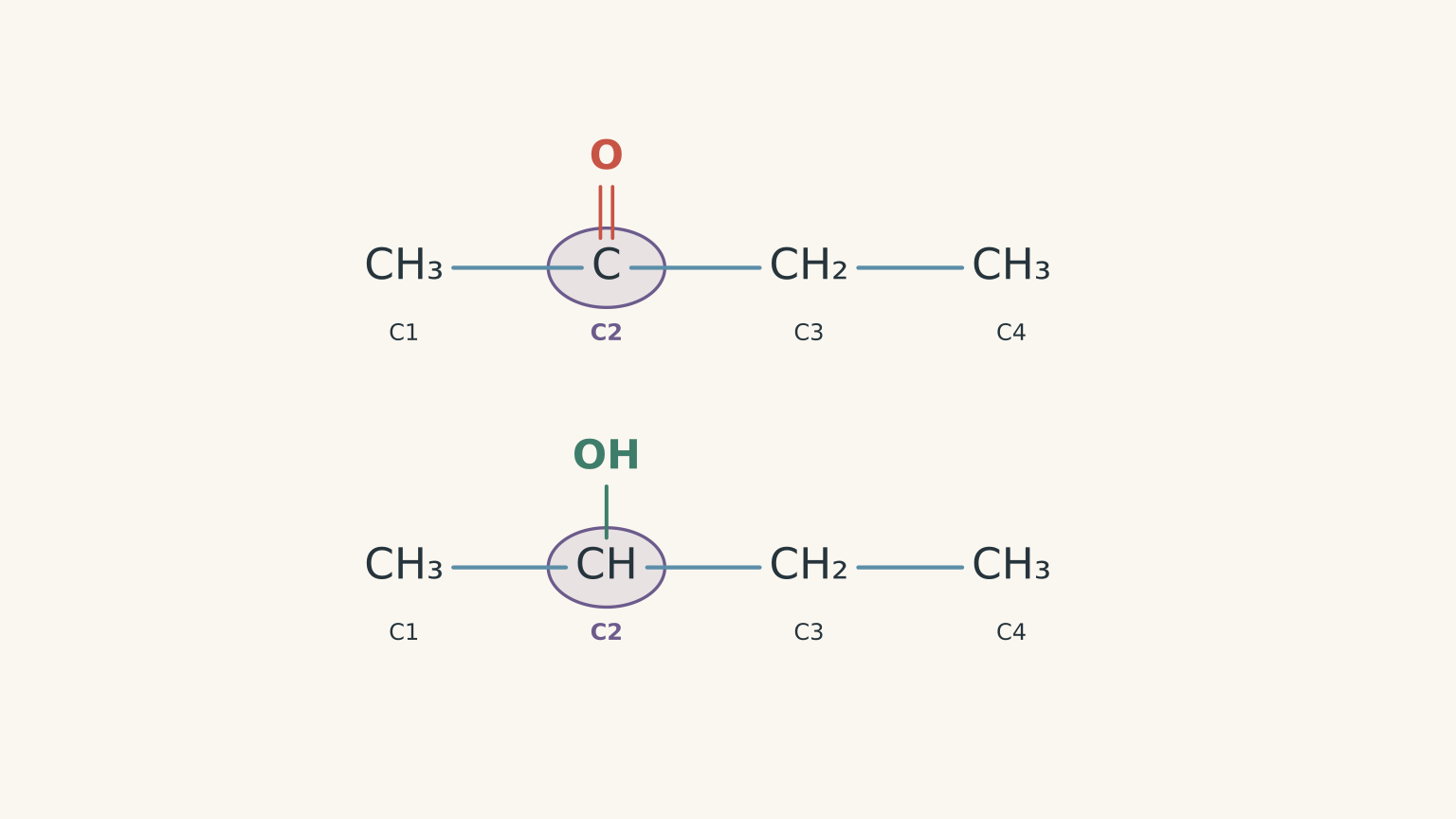
Now suppose the product is butanone:
\[ \ce{CH3COCH2CH3} \]
To reconstruct the alcohol, replace the carbonyl group, \(\ce{C=O}\), with a hydroxyl-bearing carbon, \(\ce{CH(OH)}\).
\[ \ce{CH3COCH2CH3 -> CH3CH(OH)CH2CH3} \]
The original alcohol is butan-2-ol.
The carbonyl carbon is now bonded to two other carbon atoms and one hydrogen, confirming that the alcohol was secondary.
Due to technical limitations, this figure may display incorrectly or contain inaccuracies. Please check key details against your course materials.
A quick structural reconstruction table
| Oxidation product | Reverse the functional group to obtain | Original alcohol class |
|---|---|---|
| Aldehyde, \(\ce{R-CHO}\) | \(\ce{R-CH2OH}\) | Primary |
| Carboxylic acid, \(\ce{R-COOH}\) | \(\ce{R-CH2OH}\) | Primary |
| Ketone, \(\ce{R-CO-R'}\) | \(\ce{R-CH(OH)-R'}\) | Secondary |
This works because the carbon atoms in the product retain their original connectivity during ordinary alcohol oxidation.
There is one limitation: if you only know the product’s functional group, you can identify the alcohol class, but not necessarily its exact carbon skeleton. You need the product’s structural formula or enough additional information to determine the arrangement of its carbon atoms.
03How would you test an unknown alcohol experimentally?
Imagine you’re given a labelled sample, U, and asked to determine whether it is primary, secondary, or tertiary.
You need more than a reaction equation. You need a reliable observation and a way to identify the organic product.
Setting up the oxidation experiment
A common school laboratory oxidising agent is acidified potassium dichromate(VI), \(\ce{K2Cr2O7}\).
For a reflux experiment:
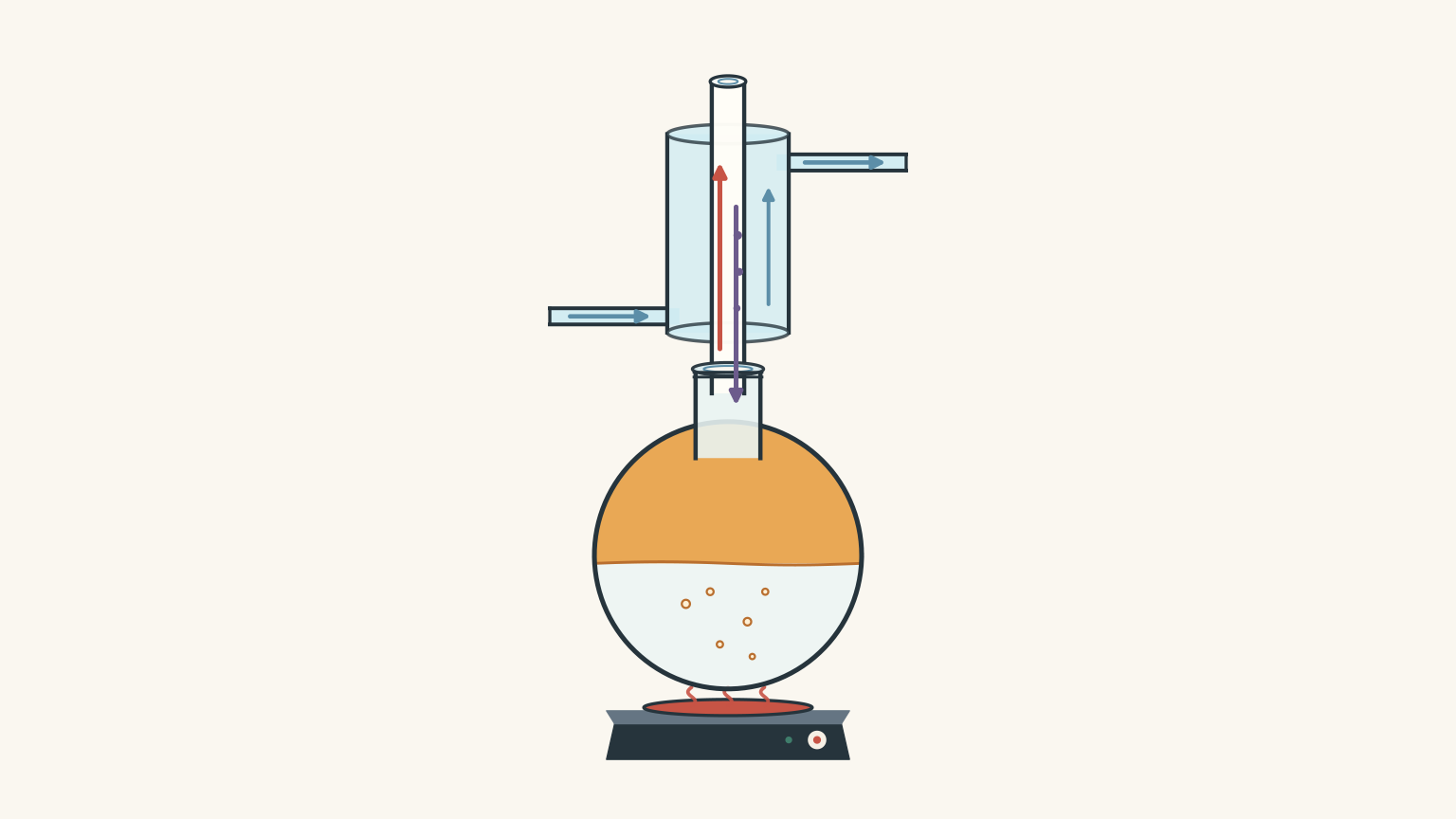
- Place a small quantity of the unknown alcohol and acidified potassium dichromate(VI) in a round-bottom flask.
- Attach a vertical water-cooled condenser above the flask.
- Run cooling water into the lower condenser connection and out through the upper connection.
- Heat the flask gently. Vapour rises, condenses inside the condenser, and flows back into the flask.
The condenser allows the reaction mixture to be heated without losing volatile substances.
Due to technical limitations, this figure may display incorrectly or contain inaccuracies. Please check key details against your course materials.
What should you observe?
Acidified potassium dichromate(VI) is orange. During a successful oxidation, chromium(VI) ions are reduced to chromium(III) ions, which are green in aqueous solution.
The expected colour change is:
\[ \text{Orange} \longrightarrow \text{Green} \]
However, this observation has a limitation.
It tells you that a redox reaction has occurred. It does not tell you whether the organic product is an aldehyde, ketone, or carboxylic acid.
You must identify the organic product separately.
| Observation or identified product | What it tells you |
|---|---|
| Orange dichromate turns green | Oxidation has occurred |
| Aldehyde identified | Original alcohol was primary |
| Ketone identified | Original alcohol was secondary |
| Carboxylic acid identified | Original alcohol was primary under ordinary oxidation conditions |
| No colour change and no oxidation product | Possible tertiary alcohol, provided the test was valid |
Why the experimental design matters
Suppose your goal is to collect an aldehyde from a primary alcohol.
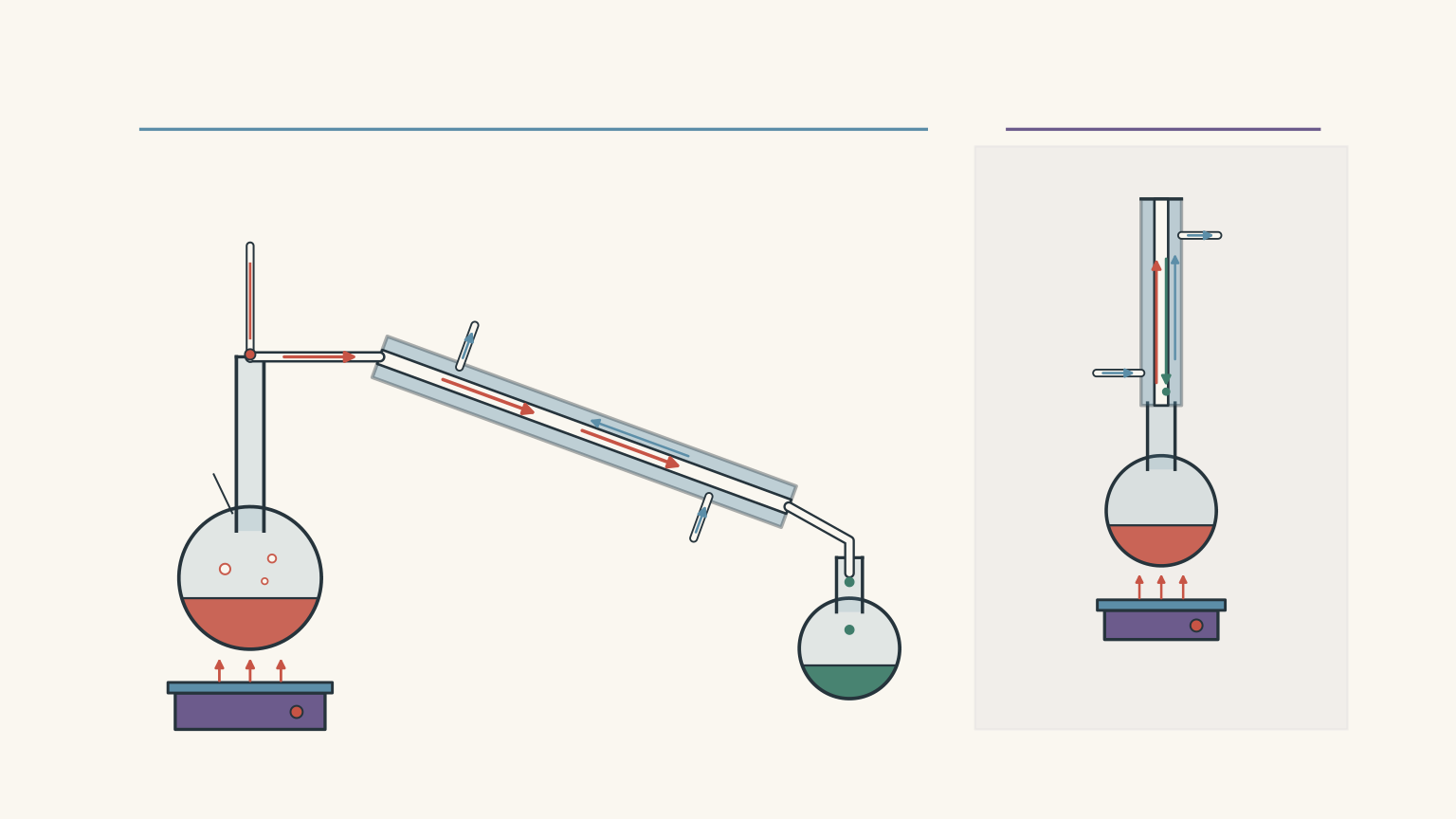
Reflux is not the best arrangement. It returns condensed vapour to the flask, allowing the aldehyde to remain in contact with the oxidising agent.
Instead, use a distillation arrangement. Vapour leaves the heated reaction flask, travels through a sloping condenser, and collects in a separate receiving flask.
Due to technical limitations, this figure may display incorrectly or contain inaccuracies. Please check key details against your course materials.
The difference is important:
- Distillation removes the volatile aldehyde as it forms, reducing further oxidation.
- Reflux returns condensed vapour to the reaction mixture, allowing a primary alcohol’s aldehyde intermediate to undergo further oxidation.
The original reflux design is useful for obtaining a carboxylic acid from a primary alcohol, but it is poorly suited to collecting the aldehyde intermediate.
There is another limitation worth remembering. An orange-to-green colour change alone cannot establish the alcohol’s class. A secondary alcohol and a primary alcohol can both produce this observation.
A sound investigation therefore uses a control. A known oxidisable alcohol should be tested under the same conditions. If the control reacts but the unknown does not, the evidence for a tertiary alcohol becomes stronger.
Even then, you should identify the organic product whenever possible rather than relying on the absence of a reaction.
04Use substitution and elimination to check the reconstructed structure
Oxidation is particularly useful because the product’s functional group tells you about the original alcohol.
But alcohols can also undergo substitution and elimination. These reactions provide additional ways to test whether your reconstructed structure makes sense.
The important distinction is what happens to the carbon skeleton and the hydroxyl group.
Substitution: replace the hydroxyl group
In a substitution reaction, the hydroxyl group is replaced by a halogen.
For example, an alcohol reacts with hydrogen bromide:
\[ \ce{R-OH + HBr -> R-Br + H2O} \]
The hydroxyl group is replaced by bromine, producing a bromoalkane.
The reaction generally requires suitable hydrogen halide conditions, such as concentrated HBr, with heating where necessary.
Consider the alcohol we identified earlier:
\[ \ce{(CH3)2CHCH2OH} \]
This is 2-methylpropan-1-ol.
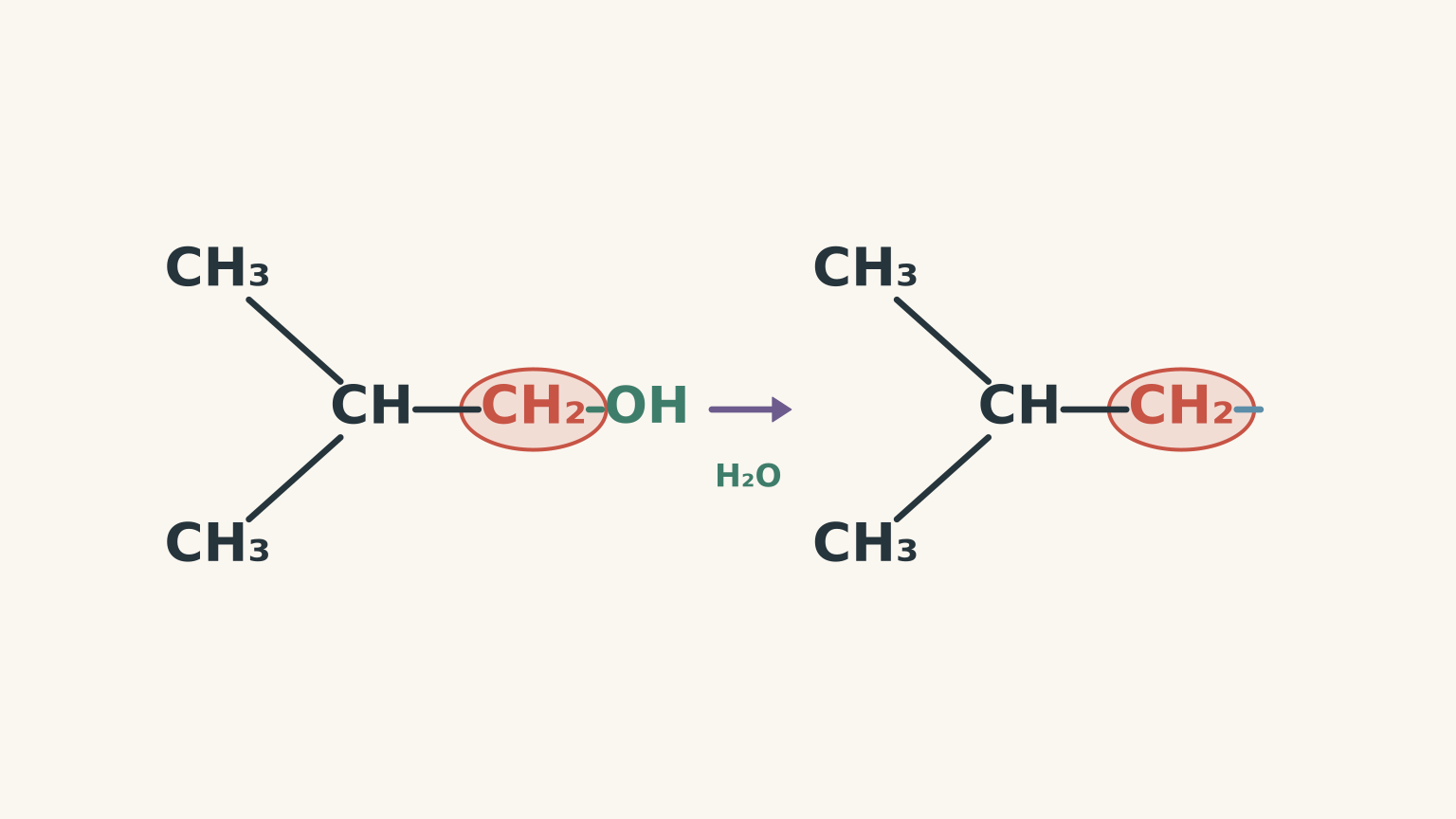
With HBr, the substitution product is 1-bromo-2-methylpropane:
\[ \ce{(CH3)2CHCH2OH + HBr} \]
\[ \ce{-> (CH3)2CHCH2Br + H2O} \]
Due to technical limitations, this figure may display incorrectly or contain inaccuracies. Please check key details against your course materials.
Notice that the carbon skeleton is preserved. The reaction changes the functional group, not the arrangement of the carbon atoms.
This is useful when checking a proposed alcohol structure against an independently identified halogenoalkane product.
Elimination: remove groups to form an alkene
Elimination works differently.
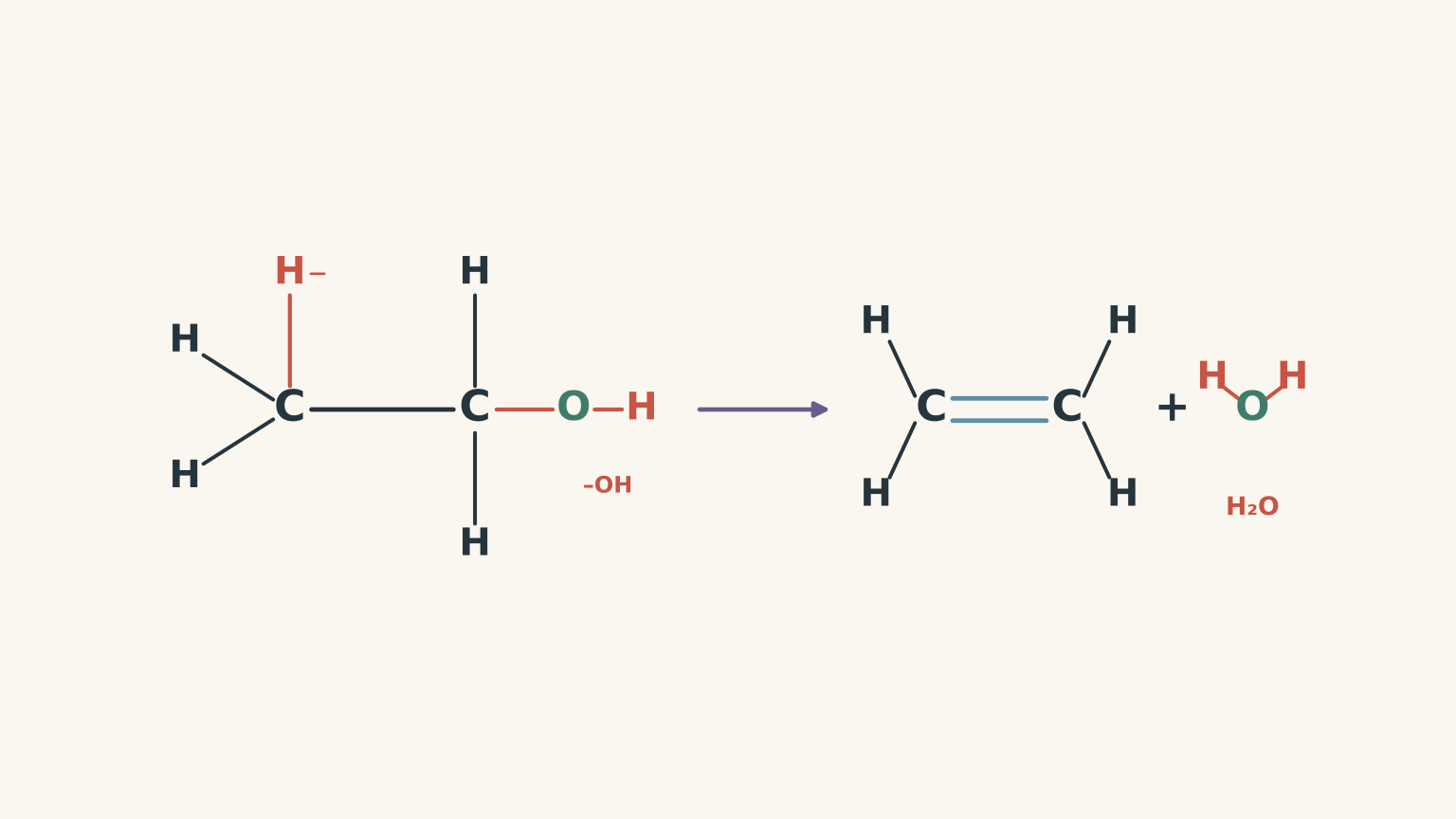
Instead of replacing \(\ce{-OH}\) with another group, the alcohol loses water. A hydrogen atom is removed from a neighbouring carbon, and a carbon-carbon double bond forms.
This is called dehydration.
A common set of conditions is concentrated sulfuric acid and heat.
For example, ethanol dehydrates to ethene:
\[ \ce{CH3CH2OH ->[conc.\ H2SO4,\ \Delta] CH2=CH2 + H2O} \]
The \(\ce{-OH}\) group and a hydrogen from the adjacent carbon are removed together as water.
Due to technical limitations, this figure may display incorrectly or contain inaccuracies. Please check key details against your course materials.
The general idea is:
\[ \text{Alcohol} \rightarrow \text{Alkene} + \text{Water} \]
The location of the new double bond depends on which neighbouring carbon loses a hydrogen.
This creates an important limitation: an alkene does not always identify one unique starting alcohol.
For example, 2-methylpropan-1-ol can dehydrate to 2-methylpropene:
\[ \ce{(CH3)2CHCH2OH -> (CH3)2C=CH2 + H2O} \]
But 2-methylpropan-2-ol can also produce 2-methylpropene through dehydration.
The two alcohols are different structural isomers, yet they can share an elimination product.
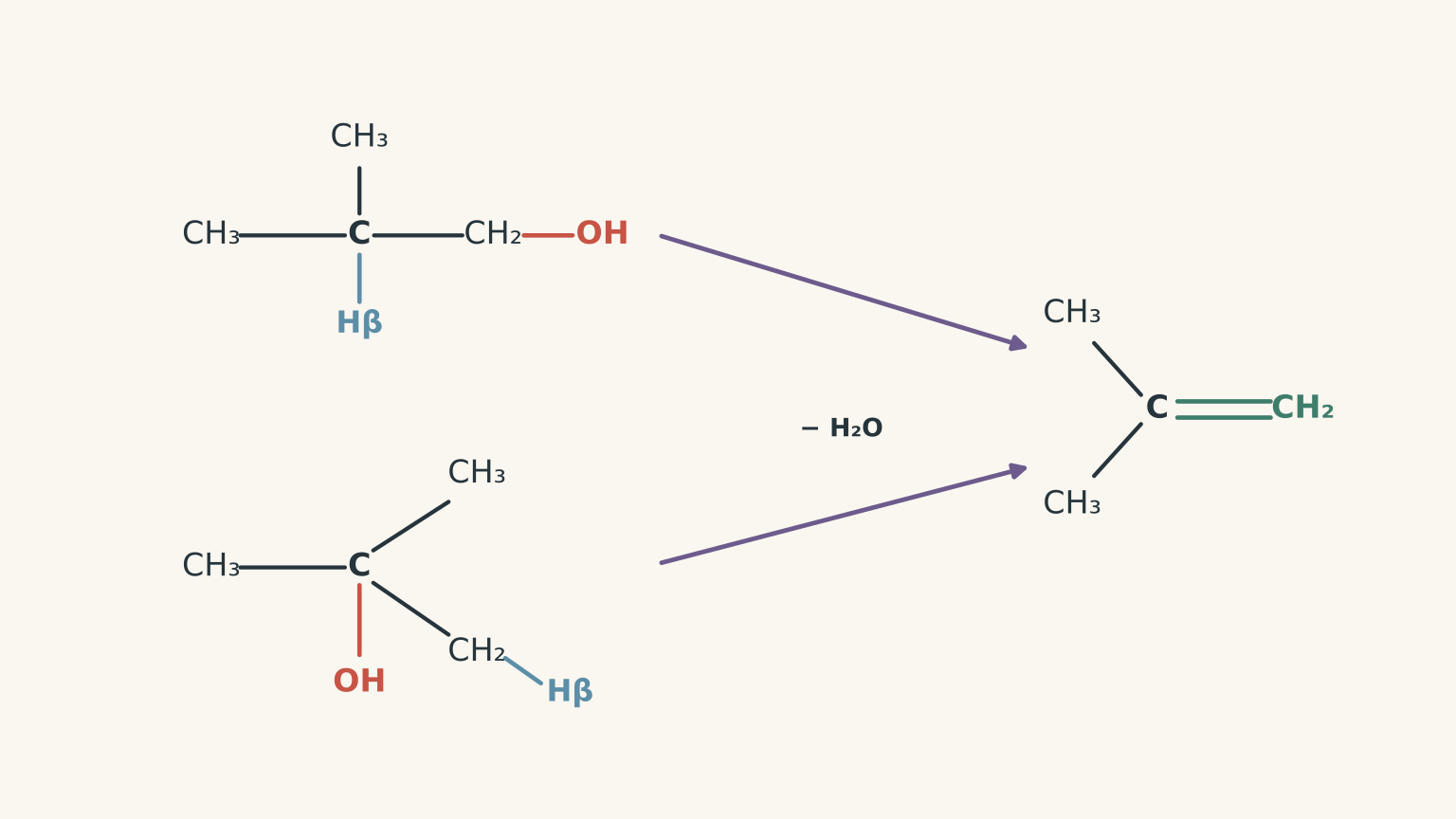
Due to technical limitations, this figure may display incorrectly or contain inaccuracies. Please check key details against your course materials.
This is why you shouldn’t use an elimination product as your only evidence when identifying an unknown alcohol.
Oxidation and elimination provide different information:
| Reaction | Main structural change | What it helps establish |
|---|---|---|
| Oxidation | Alcohol becomes a carbonyl compound or carboxylic acid | Whether the alcohol was primary or secondary, or resisted ordinary oxidation |
| Substitution | \(\ce{-OH}\) is replaced by a halogen | Whether the proposed carbon skeleton is consistent with the halogenoalkane |
| Elimination | Water is removed and a carbon-carbon double bond forms | Which alkene structures are accessible from the alcohol |
Use the reactions together where information is available. An oxidation product is usually the stronger starting point for identifying the alcohol’s class.
05A practical method for identifying an unknown alcohol
When you are given an oxidation product in an exam, follow this sequence.
Step 1: Identify the product’s functional group.
Look for:
- \(\ce{-CHO}\): aldehyde
- \(\ce{-COOH}\): carboxylic acid
- \(\ce{C=O}\) between two carbon groups: ketone
Step 2: Determine the original alcohol class.
- Aldehyde: primary alcohol.
- Carboxylic acid: primary alcohol.
- Ketone: secondary alcohol.
- No reaction: possible tertiary alcohol, provided the conditions and experiment are valid.
Step 3: Read the reaction conditions.
For a primary alcohol, check whether the aldehyde was distilled away or whether the mixture was heated under reflux with excess oxidant.
This explains why the product is an aldehyde or carboxylic acid.
Step 4: Reverse the functional-group change.
- Replace \(\ce{-CHO}\) with \(\ce{-CH2OH}\).
- Replace \(\ce{-COOH}\) with \(\ce{-CH2OH}\).
- Replace \(\ce{C=O}\) with \(\ce{CH(OH)}\) for a ketone.
Step 5: Check the carbon skeleton and molecular formula.
Count the carbon atoms. Check the branching and the position of the functional group.
Your reconstructed alcohol should have the expected molecular formula and preserve the original carbon connectivity.
Step 6: Use other reactions as supporting evidence.
If substitution or elimination products are supplied, check whether they are consistent with your proposed alcohol.
Don’t assume that one alkene or one halogenoalkane must identify the starting alcohol uniquely.
Worked example: An unknown alcohol produces a branched ketone
An unknown saturated, acyclic, monohydric alcohol has the molecular formula \(\ce{C5H12O}\). It is heated under reflux with excess acidified potassium dichromate(VI). The organic product is identified as 3-methylbutan-2-one, with the condensed structural formula \(\ce{CH3COCH(CH3)CH3}\).
Identify the original alcohol and write a balanced oxidation equation using \(\ce{[O]}\).
Step 1
The product contains a carbonyl group, \(\ce{C=O}\), bonded to two carbon groups.
It is a ketone.
Step 2
Ordinary oxidation of a secondary alcohol produces a ketone.
Therefore, the unknown alcohol was secondary.
Step 3
The product is:
\[ \ce{CH3COCH(CH3)CH3} \]
Replace the carbonyl group with \(\ce{CH(OH)}\):
\[ \ce{CH3CH(OH)CH(CH3)CH3} \]
Step 4
The longest chain containing the hydroxyl-bearing carbon has four carbon atoms.
The hydroxyl group is on carbon 2, and there is a methyl branch on carbon 3.
The original alcohol is 3-methylbutan-2-ol.
Step 5
\[ \begin{aligned} &\ce{CH3CH(OH)CH(CH3)CH3}\\ &\ce{+ [O]}\\ &\ce{-> CH3COCH(CH3)CH3 + H2O} \end{aligned} \]
The equation preserves all five carbon atoms.
The molecular formula of the reconstructed alcohol is also \(\ce{C5H12O}\), matching the information in the question.
Identified The unknown alcohol is 3-methylbutan-2-ol.
Worked example: Identify an alcohol from a carboxylic acid and calculate the product mass
An unknown saturated, acyclic, monohydric alcohol is completely oxidised under reflux with excess acidified potassium dichromate(VI).
The reaction starts with \(0.0150\ \mathrm{mol}\) of alcohol and produces 2-methylbutanoic acid.
Identify the original alcohol and calculate the theoretical mass of acid produced.
The molar mass of 2-methylbutanoic acid is \(102.13\ \mathrm{g\,mol^{-1}}\).
Step 1
The product is a carboxylic acid.
Under these conditions, the acid is formed by further oxidation of an aldehyde intermediate from a primary alcohol.
Therefore, the unknown alcohol was primary.
Step 2
The structural formula of 2-methylbutanoic acid is:
\[ \ce{CH3CH2CH(CH3)COOH} \]
Replace the terminal \(\ce{-COOH}\) group with \(\ce{-CH2OH}\):
\[ \ce{CH3CH2CH(CH3)CH2OH} \]
The original alcohol is 2-methylbutan-1-ol.
Step 3
The overall oxidation equation is:
\[ \ce{R-CH2OH + 2[O] -> R-COOH + H2O} \]
One mole of primary alcohol produces one mole of carboxylic acid.
Therefore:
\[ n(\text{acid})=0.0150\ \mathrm{mol} \]
Step 4
Use:
\[ m=nM \]
where \(m\) is mass in grams, \(n\) is amount in moles, and \(M\) is molar mass in grams per mole.
Substitute:
\[ \begin{aligned} m &= 0.0150 \times 102.13\\ &=1.53195\ \mathrm{g}\\ &\approx 1.53\ \mathrm{g} \end{aligned} \]
Step 5
The theoretical mass of 2-methylbutanoic acid is \(1.53\ \mathrm{g}\).
This assumes complete conversion of the alcohol and no product loss during isolation. An actual experiment may produce less acid because of incomplete reaction or losses during separation.
The calculation confirms the one-to-one mole relationship, while the product’s structural formula identifies the carbon skeleton.
06Questions and solutions
Question 1
An unknown alcohol is warmed with acidified potassium dichromate(VI). The reaction uses a distillation apparatus, and the organic product is collected as it forms.
The product is pentanal, \(\ce{CH3CH2CH2CH2CHO}\).
Identify the original alcohol and write a balanced oxidation equation using \(\ce{[O]}\).
Solution 1
The original alcohol is pentan-1-ol, a primary alcohol.
The product contains an aldehyde group, \(\ce{-CHO}\). Under ordinary alcohol oxidation conditions, aldehydes are formed from primary alcohols.
Reverse the functional-group change:
\[ \ce{CH3CH2CH2CH2CHO} \]
becomes
\[ \ce{CH3CH2CH2CH2CH2OH} \]
The original structure has five carbon atoms and its hydroxyl group is on carbon 1.
The oxidation equation is:
\[ \ce{CH3CH2CH2CH2CH2OH + [O] -> CH3CH2CH2CH2CHO + H2O} \]
Distillation removes the pentanal as it forms, reducing the opportunity for further oxidation to pentanoic acid.
Question 2
An unknown alcohol has the molecular formula \(\ce{C6H14O}\). It is oxidised using acidified potassium dichromate(VI), producing a ketone with the condensed structural formula:
\[ \ce{CH3CH2COCH(CH3)CH3} \]
Determine:
a) The class of the original alcohol.
b) Its condensed structural formula and IUPAC name.
c) The balanced oxidation equation using \(\ce{[O]}\).
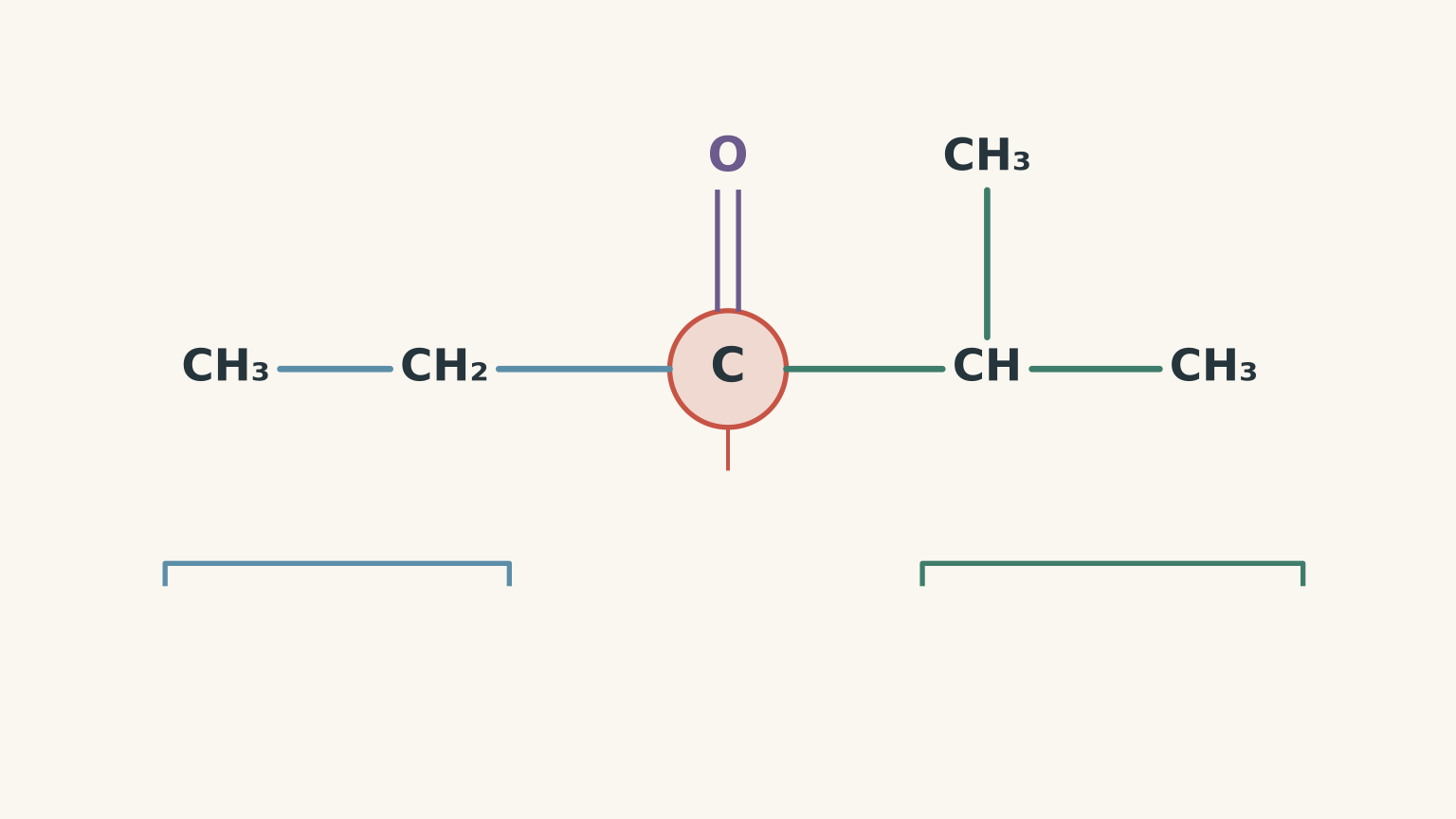
Due to technical limitations, this figure may display incorrectly or contain inaccuracies. Please check key details against your course materials.
Solution 2
The original alcohol was secondary, specifically 2-methylpentan-3-ol.
a) Alcohol classification
The product contains a ketone group.
Ordinary oxidation of a secondary alcohol produces a ketone, so the original alcohol must have been secondary.
b) Reconstruct the alcohol
Start with the product:
\[ \ce{CH3CH2COCH(CH3)CH3} \]
Replace the carbonyl group with \(\ce{CH(OH)}\):
\[ \ce{CH3CH2CH(OH)CH(CH3)CH3} \]
The longest chain contains five carbon atoms.
Numbering from the right gives the hydroxyl group position 3 and the methyl branch position 2.
The IUPAC name is 2-methylpentan-3-ol.
Its molecular formula is \(\ce{C6H14O}\), as required.
c) Oxidation equation
\[ \begin{aligned} &\ce{CH3CH2CH(OH)CH(CH3)CH3}\\ &\ce{+ [O]}\\ &\ce{-> CH3CH2COCH(CH3)CH3 + H2O} \end{aligned} \]
The carbonyl carbon remains connected to the same two carbon groups. Only the functional group changes.
Question 3
An unknown saturated, acyclic, monohydric alcohol has a mass of \(2.00\ \mathrm{g}\). Its molecular formula is \(\ce{C5H12O}\).
The alcohol is heated under reflux with excess acidified potassium dichromate(VI). The isolated organic product is \(1.76\ \mathrm{g}\) of 3-methylbutanoic acid.
Given:
- Molar mass of the alcohol: \(88.15\ \mathrm{g\,mol^{-1}}\).
- Molar mass of 3-methylbutanoic acid: \(102.13\ \mathrm{g\,mol^{-1}}\).
Determine:
a) The original alcohol’s class and IUPAC name.
b) The theoretical mass of carboxylic acid.
c) The percentage yield of the acid.
Solution 3
The original alcohol was the primary alcohol 3-methylbutan-1-ol, and the percentage yield of 3-methylbutanoic acid was \(76.0\%\).
a) Identify the original alcohol
The product is a carboxylic acid.
Because the reaction uses excess oxidising agent under reflux, a primary alcohol can oxidise through an aldehyde intermediate to a carboxylic acid.
Therefore, the original alcohol was primary.
The product’s condensed structural formula is:
\[ \ce{CH3CH(CH3)CH2COOH} \]
Reverse the terminal carboxyl group to obtain:
\[ \ce{CH3CH(CH3)CH2CH2OH} \]
This is 3-methylbutan-1-ol.
b) Calculate the theoretical acid mass
First, calculate the initial amount of alcohol:
\[ n=\frac{m}{M} \]
\[ n(\text{alcohol})=\frac{2.00}{88.15} \]
\[ =0.02269\ \mathrm{mol} \]
The overall oxidation has a 1:1 mole ratio between alcohol and carboxylic acid.
Therefore:
\[ n(\text{acid})=0.02269\ \mathrm{mol} \]
Calculate the theoretical acid mass:
\[ \begin{aligned} m &= nM\\ &=0.02269\times102.13\\ &=2.317\ \mathrm{g}\\ &\approx2.32\ \mathrm{g} \end{aligned} \]
c) Calculate the percentage yield
Use:
\[ \text{Percentage yield} = \frac{\text{Actual yield}}{\text{Theoretical yield}} \times100 \]
Substitute:
\[ \begin{aligned} \text{Percentage yield} &=\frac{1.76}{2.317}\times100\\ &=75.96\%\\ &\approx76.0\% \end{aligned} \]
The experiment produced \(76.0\%\) of the theoretical amount of acid.
The difference could result from incomplete conversion or losses during product separation and collection. It does not change the structural identification of the original alcohol.
Question 4
An unknown pure alcohol, U, has the molecular formula \(\ce{C4H10O}\).
It is one of the four saturated, acyclic alcohol structural isomers with this formula:
- Butan-1-ol
- Butan-2-ol
- 2-methylpropan-1-ol
- 2-methylpropan-2-ol
The following experiments are performed:
- U is heated under reflux with acidified potassium dichromate(VI). The solution remains orange, and no oxidation product is detected.
- A known sample of propan-2-ol tested under the same conditions turns the solution green.
- Dehydration of U using concentrated sulfuric acid and heat produces 2-methylpropene.
Assume that U is pure, the reaction mixture is prepared correctly, and the oxidation test is valid.
a) Identify U.
b) Explain why the dehydration product alone cannot identify U uniquely.
c) Predict the organic product when U reacts with concentrated HBr.
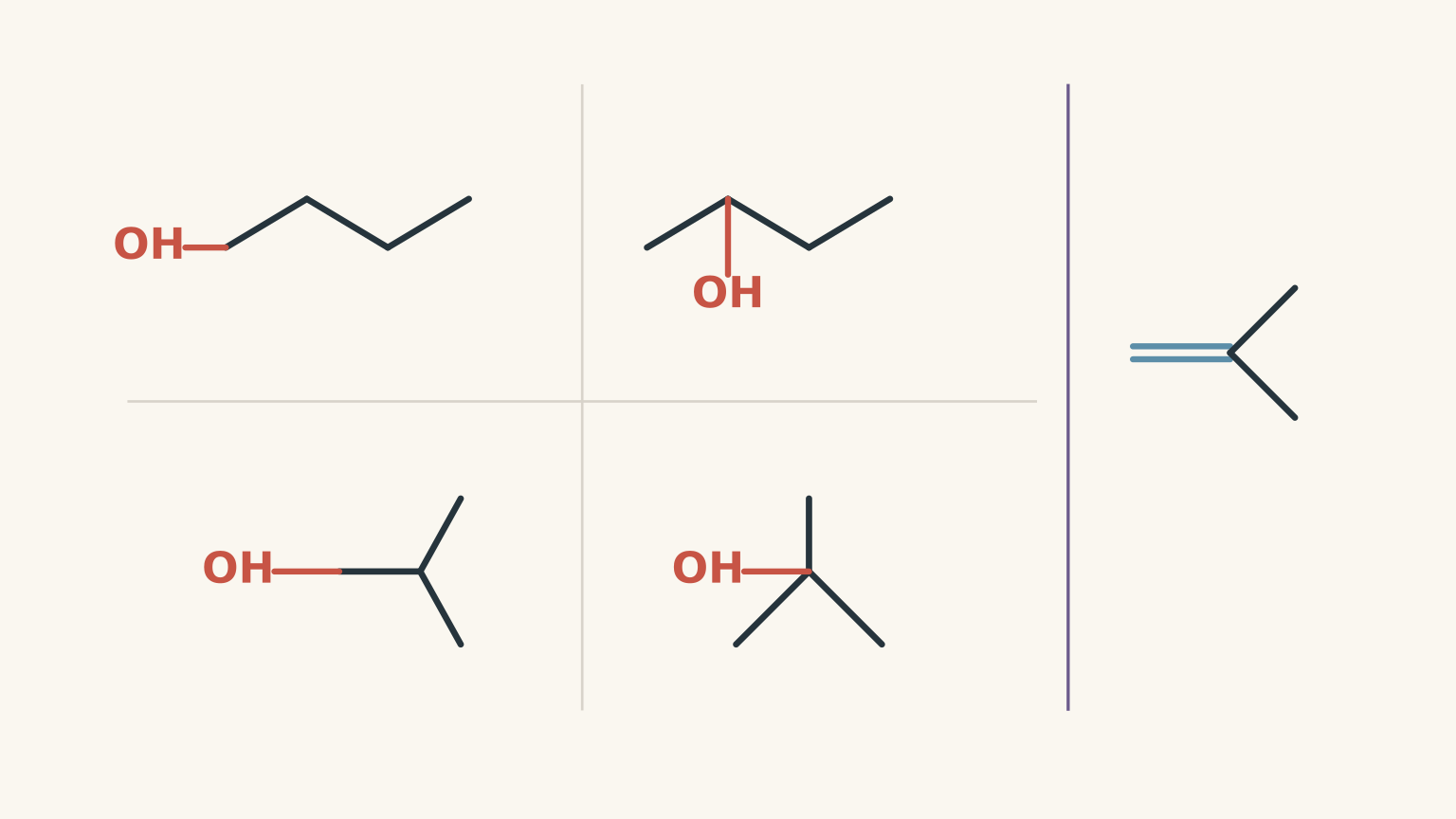
Due to technical limitations, this figure may display incorrectly or contain inaccuracies. Please check key details against your course materials.
Solution 4
U is 2-methylpropan-2-ol, a tertiary alcohol. Its substitution product with HBr is 2-bromo-2-methylpropane.
a) Identify U
The oxidation experiment produces no reaction under the stated conditions.
The orange dichromate solution remains orange, meaning there is no evidence that chromium(VI) has been reduced to chromium(III).
The positive control is important. Propan-2-ol turns the solution green, showing that the oxidising agent and reaction conditions can successfully oxidise a secondary alcohol.
Of the four possible alcohols, only 2-methylpropan-2-ol is tertiary.
Its structure is:
\[ \ce{(CH3)3COH} \]
The carbon carrying the hydroxyl group is bonded to three other carbon atoms and has no hydrogen attached.
It therefore resists ordinary oxidation to a carbonyl compound.
b) Explain the limitation of dehydration evidence
It is tempting to identify U as 2-methylpropan-1-ol because that alcohol also dehydrates to 2-methylpropene.
However, 2-methylpropan-2-ol can produce the same alkene through elimination of a hydrogen from one of its neighbouring methyl groups.
Therefore, both alcohol isomers can produce 2-methylpropene.
The dehydration product alone cannot distinguish them.
The oxidation result provides the deciding evidence: 2-methylpropan-1-ol is primary and should undergo oxidation, whereas 2-methylpropan-2-ol resists ordinary oxidation.
c) Predict the substitution product
Concentrated HBr replaces the hydroxyl group with bromine:
\[ \ce{(CH3)3COH + HBr -> (CH3)3CBr + H2O} \]
The product is 2-bromo-2-methylpropane.
The carbon skeleton remains unchanged.
This provides another reaction pathway consistent with the identified tertiary alcohol.
Question 5
An unknown compound X is a saturated, acyclic, monohydric alcohol with the molecular formula \(\ce{C5H12O}\).
Three observations are recorded:
- Dehydration of X using concentrated sulfuric acid and heat produces a mixture containing 2-methylbut-1-ene.
- A separate sample of X is heated under reflux with excess acidified potassium dichromate(VI). The oxidising agent changes from orange to green.
- The isolated organic oxidation product is identified as 2-methylbutanoic acid, with the structural formula \(\ce{CH3CH2CH(CH3)COOH}\).
A student argues:
“The dehydration product proves that X is 2-methylbutan-2-ol. Tertiary alcohols dehydrate readily, so the acid result must be incorrect.”
Evaluate the student’s reasoning.
Determine the structure and name of X, explain why the dehydration observation is not decisive, and predict the product when X undergoes substitution with concentrated HBr.
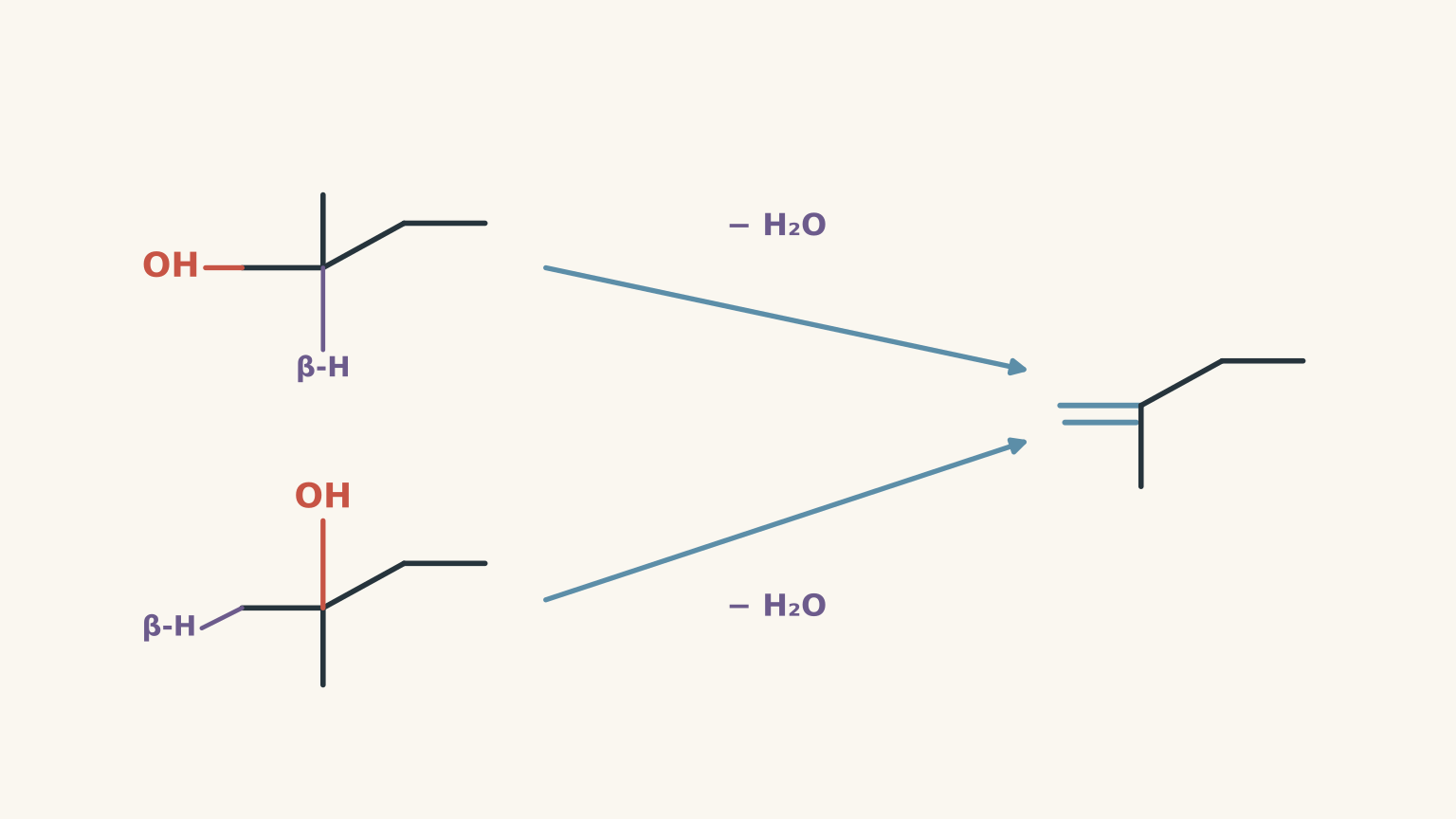
Due to technical limitations, this figure may display incorrectly or contain inaccuracies. Please check key details against your course materials.
Solution 5
The student’s conclusion is incorrect. X is 2-methylbutan-1-ol, a primary alcohol, and its substitution product with HBr is 1-bromo-2-methylbutane.
The decisive evidence is the identified carboxylic acid, not the alkene.
Step 1: Work backwards from the carboxylic acid
The identified product is 2-methylbutanoic acid:
\[ \ce{CH3CH2CH(CH3)COOH} \]
A carboxylic acid formed through ordinary alcohol oxidation under reflux with excess oxidant indicates that the original alcohol was primary.
Reverse the terminal functional group:
\[ \ce{-COOH -> -CH2OH} \]
This gives:
\[ \ce{CH3CH2CH(CH3)CH2OH} \]
The original alcohol is 2-methylbutan-1-ol.
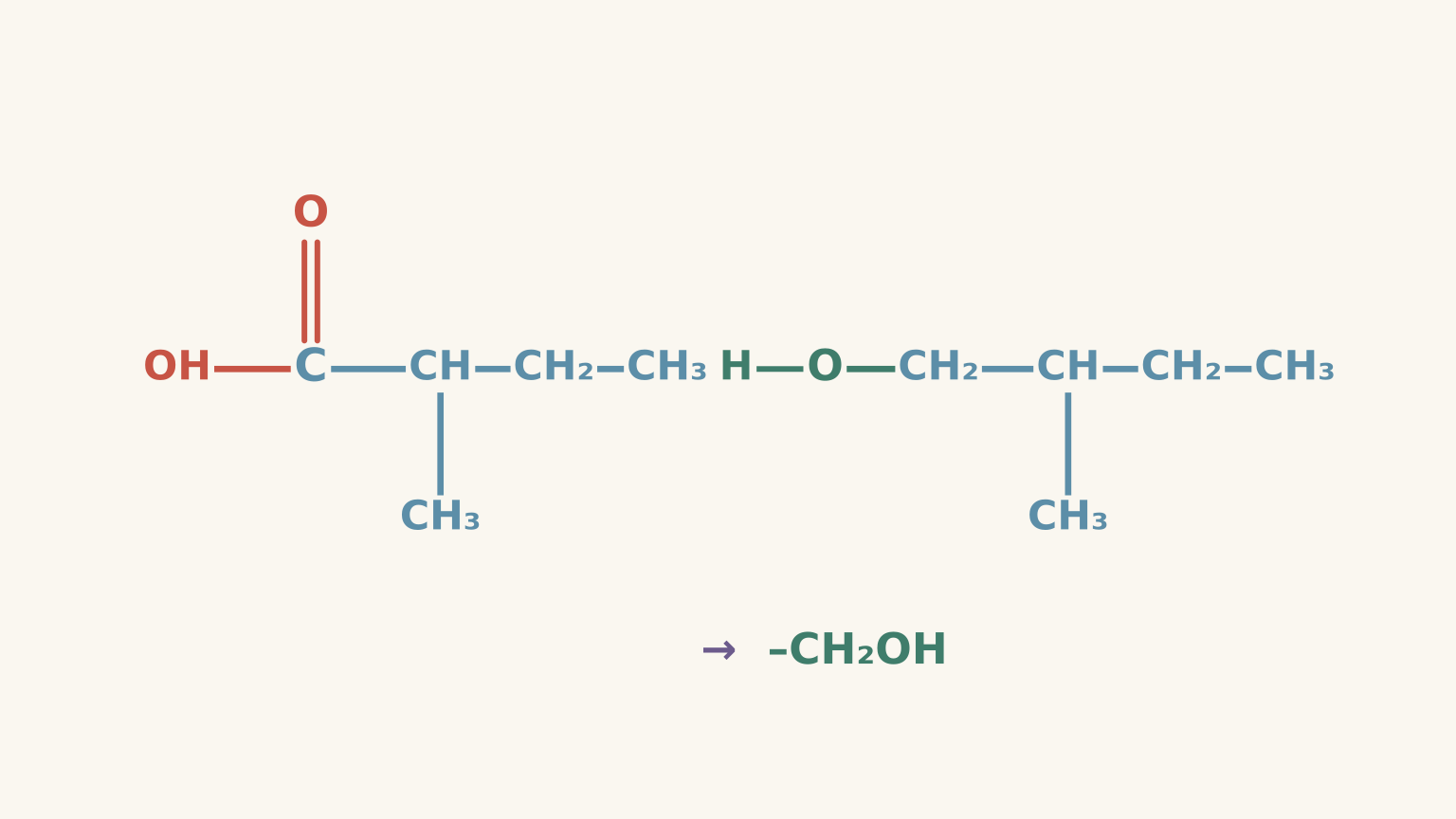
Due to technical limitations, this figure may display incorrectly or contain inaccuracies. Please check key details against your course materials.
Step 2: Explain the dehydration result
The student has made a reasonable observation but drawn an unjustified conclusion.
2-methylbutan-1-ol can dehydrate to 2-methylbut-1-ene:
\[ \ce{CH3CH2CH(CH3)CH2OH} \]
\[ \ce{-> CH2=C(CH3)CH2CH3 + H2O} \]
However, 2-methylbutan-2-ol can also produce 2-methylbut-1-ene by eliminating a hydrogen from one of its neighbouring methyl groups.
It can also form 2-methylbut-2-ene.
So the presence of 2-methylbut-1-ene does not uniquely identify the starting alcohol.
The tempting assumption is that a dehydration product must reveal the exact position of the original hydroxyl group. It doesn’t, because different alcohol structures can lose water to produce the same alkene.
Step 3: Use the oxidation result to resolve the ambiguity
The isolated product is a carboxylic acid.
Under the stated conditions, this is consistent with oxidation of a primary alcohol through an aldehyde intermediate.
A tertiary alcohol such as 2-methylbutan-2-ol would not undergo this ordinary oxidation pathway.
The change from orange to green supports the occurrence of a redox reaction, while the identified acid provides the structural evidence.
Together, these observations rule out the student’s proposed tertiary alcohol.
Step 4: Predict the substitution product
The original alcohol is:
\[ \ce{CH3CH2CH(CH3)CH2OH} \]
Reaction with concentrated HBr replaces the hydroxyl group with bromine:
\[ \ce{CH3CH2CH(CH3)CH2OH + HBr} \]
\[ \ce{-> CH3CH2CH(CH3)CH2Br + H2O} \]
The product is 1-bromo-2-methylbutane.
This retains the original five-carbon skeleton and provides a further prediction consistent with the reconstructed alcohol.
The key reasoning: dehydration identifies an alkene that the alcohol can produce, but oxidation identifies the alcohol class. When the two observations appear to point in different directions, use the complete set of reaction evidence rather than treating one product as a unique fingerprint.
07Where to go next
Once you can identify the original alcohol from its oxidation product, the next step is predicting how reaction conditions affect the product.
In particular, practise distinguishing controlled oxidation to an aldehyde from further oxidation to a carboxylic acid. The companion guide, Primary Alcohol Oxidation Products: Aldehydes and Acids, develops that distinction in more detail.
For unfamiliar exam questions, keep returning to one principle: identify the product’s functional group first, then reverse the chemical change while preserving the carbon skeleton. That is much more reliable than trying to memorise every possible alcohol and its oxidation product.