
Oxidation of Alcohols: Predicting HSC Chemistry Products
Learn how to predict oxidation products for primary, secondary, and tertiary alcohols, and how distillation, reflux, and excess oxidant affect the result.
Take propan-1-ol and oxidise it. What should the product be: propanal or propanoic acid?
Annoyingly, both can be correct.
The difference is not the starting alcohol. It is the reaction conditions. A primary alcohol can be oxidised once to an aldehyde, then oxidised again to a carboxylic acid. If you want the aldehyde, you have to stop the reaction at the right moment. If you keep the aldehyde sitting in hot oxidising mixture, it usually won’t politely wait there.
Before reading on, predict this: if you heat a primary alcohol under reflux with excess oxidising agent, will you obtain mainly the aldehyde or the carboxylic acid?
The carboxylic acid. Reflux keeps the reaction mixture together, giving the intermediate aldehyde the chance to undergo its second oxidation.
01First decide what kind of alcohol you have
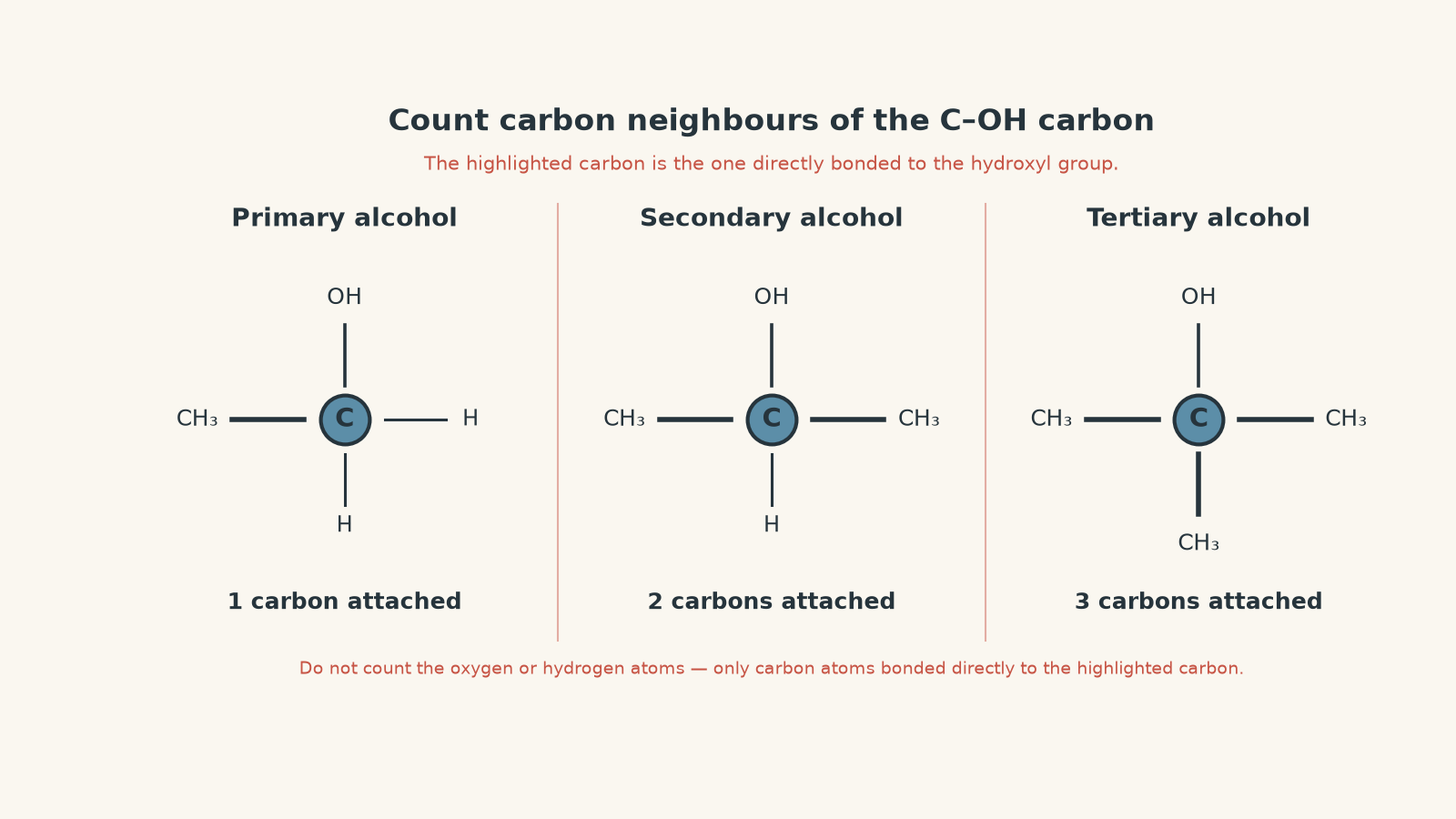
The most important carbon is the carbon directly bonded to the \(\ce{-OH}\) group. We classify the alcohol by asking how many other carbon atoms are attached to that carbon.
| Alcohol type | Carbon groups attached to the \(\ce{C-OH}\) carbon | Example |
|---|---|---|
| Primary | 1 | propan-1-ol, \(\ce{CH3CH2CH2OH}\) |
| Secondary | 2 | propan-2-ol, \(\ce{CH3CH(OH)CH3}\) |
| Tertiary | 3 | 2-methylpropan-2-ol, \(\ce{(CH3)3COH}\) |
This classification tells you how far ordinary oxidation can go.
A useful first picture is to imagine oxidation as removing hydrogen from around the \(\ce{C-OH}\) part of the molecule while increasing the bonding between carbon and oxygen.
That picture is useful, but it is simplified. Organic oxidation is more precisely associated with carbon gaining bonds to oxygen, losing bonds to hydrogen, or both.
02What actually changes during alcohol oxidation?
Look at ethanol:
\[
\ce{CH3CH2OH + [O] -> CH3CHO + H2O}
\]
The symbol \(\ce{[O]}\) means an oxidising agent is supplying the oxidation needed for the transformation. It does not mean a free oxygen atom is floating around in solution.
The carbon carrying the \(\ce{-OH}\) group begins with:
- one bond to oxygen through \(\ce{-OH}\)
- two bonds to hydrogen.
After oxidation to ethanal, that carbon has a carbon-oxygen double bond, \(\ce{C=O}\), and only one hydrogen.
The carbon has become more oxidised.
The product contains the aldehyde functional group:
\[
\ce{-CHO}
\]
But ethanal can be oxidised again:
\[
\ce{CH3CHO + [O] -> CH3COOH}
\]
Now the product is ethanoic acid, containing the carboxyl group \(\ce{-COOH}\).
Combining the two stages gives:
\[
\ce{CH3CH2OH + 2[O] -> CH3COOH + H2O}
\]
So a primary alcohol has a two-stage oxidation pathway:
\[
\ce{primary alcohol -> aldehyde -> carboxylic acid}
\]
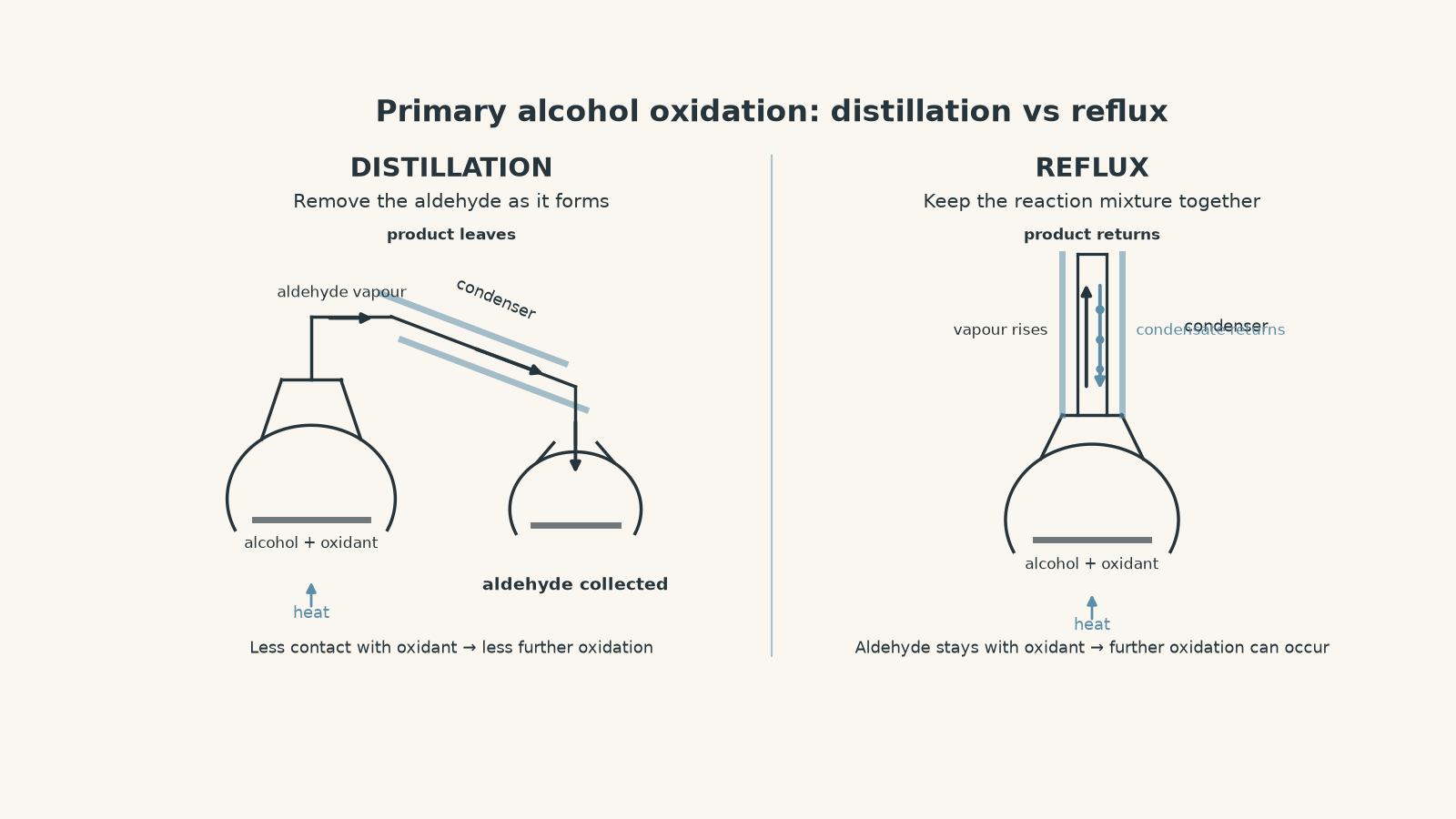
Think of it as a train with two stops. The aldehyde is the first station and the carboxylic acid is the second. Distillation lets you drag the aldehyde off the train at the first station. Reflux leaves it trapped on board long enough to reach the second.
The analogy breaks because molecules do not literally move through two neatly separated stages one molecule at a time. In the flask, several species may be present simultaneously.
03Primary alcohols: the conditions choose the product
A common HSC oxidising agent is acidified potassium dichromate(VI), usually written as acidified \(\ce{K2Cr2O7}\). Acidified potassium permanganate, \(\ce{KMnO4}\), can also act as an oxidising agent.
For product prediction, the key distinction is usually this:
| Conditions | Main product from a primary alcohol |
|---|---|
| Controlled oxidation, with the aldehyde distilled off as it forms | Aldehyde |
| Heating under reflux with excess oxidising agent | Carboxylic acid |
Why distillation helps produce an aldehyde
Suppose ethanol is being oxidised to ethanal.
Ethanal is volatile. If it is distilled from the reaction mixture as it forms, it spends less time in contact with the oxidising agent.
That reduces further oxidation:
\[
\ce{CH3CH2OH + [O] -> CH3CHO + H2O}
\]
The important idea is not simply “use less heat”. It is to remove the aldehyde from the oxidising environment.
Why reflux produces the carboxylic acid
In reflux, vapour rises into a condenser, cools, and returns to the reaction flask. Volatile substances are therefore not deliberately removed from the reacting mixture.
The aldehyde remains in contact with the oxidising agent and can be oxidised further:
\[
\ce{CH3CH2OH + 2[O] -> CH3COOH + H2O}
\]
Worked example: Oxidising butan-1-ol under controlled conditions
Butan-1-ol is warmed with acidified potassium dichromate(VI), and the organic product is distilled from the reaction mixture as it forms. Predict the organic product and write an equation.
Step 1
Butan-1-ol has the structure:
\[
\ce{CH3CH2CH2CH2OH}
\]
The carbon bonded to \(\ce{-OH}\) is attached to only one other carbon, so this is a primary alcohol.
Step 2
The product is being distilled away during oxidation. That points to controlled oxidation to the aldehyde rather than continued oxidation to the carboxylic acid.
Step 3
\[
\ce{CH3CH2CH2CH2OH + [O] -> CH3CH2CH2CHO + H2O}
\]
The product is butanal.
Step 4
The carbon skeleton has not changed. The terminal \(\ce{-CH2OH}\) group has been converted into \(\ce{-CHO}\).
If the same reaction mixture were instead heated under reflux with excess oxidising agent, butanoic acid would be expected.
04Secondary alcohols stop at ketones
Now consider propan-2-ol:
\[
\ce{CH3CH(OH)CH3}
\]
The carbon bearing the \(\ce{-OH}\) group is bonded to two other carbon atoms, so it is secondary.
Oxidation produces a ketone:
\[
\ce{CH3CH(OH)CH3 + [O] -> CH3COCH3 + H2O}
\]
The product is propanone.
Notice what changed. The \(\ce{C-OH}\) carbon lost its hydrogen, and the carbon-oxygen single bond became part of a \(\ce{C=O}\) double bond.
For normal HSC product prediction:
\[
\ce{secondary alcohol -> ketone}
\]
Ketones are not readily oxidised further by the usual alcohol-oxidation conditions without breaking carbon-carbon bonds. So you do not continue from “ketone” to “carboxylic acid” in the same way as you do with an aldehyde.
Worked example: Identify the product from pentan-2-ol
Pentan-2-ol is heated under reflux with excess acidified potassium dichromate(VI). Predict the organic product and write an equation.
Step 1
Pentan-2-ol can be written as:
\[
\ce{CH3CH(OH)CH2CH2CH3}
\]
That carbon is attached to two other carbon atoms. Pentan-2-ol is therefore secondary.
Step 2
A secondary alcohol is oxidised to a ketone.
The \(\ce{CH(OH)}\) section becomes \(\ce{C=O}\).
Step 3
\[
\ce{CH3CH(OH)CH2CH2CH3 + [O] -> CH3COCH2CH2CH3 + H2O}
\]
The product is pentan-2-one.
Step 4
Under ordinary HSC alcohol-oxidation conditions, no further oxidation product is expected. Reflux makes sure oxidation can proceed, but it does not magically turn the ketone into the corresponding carboxylic acid.
That last point catches people. “Excess oxidant” does not mean “keep adding oxygen groups until something happens”. The structure of the molecule determines which oxidation pathway is available.
05Why tertiary alcohols behave differently
Consider 2-methylpropan-2-ol:
\[
\ce{(CH3)3COH}
\]
The carbon bonded to \(\ce{-OH}\) is attached to three carbon atoms.
Now inspect that same carbon carefully. How many hydrogen atoms are directly attached to it?
None.
That is the crucial difference.
The usual oxidation of a primary or secondary alcohol forms a carbonyl group, \(\ce{C=O}\), by removing hydrogen associated with the alcohol-bearing carbon and the hydroxyl group.
A tertiary alcohol does not have the required hydrogen on the alcohol-bearing carbon.
So under the ordinary oxidation conditions considered in HSC Chemistry:
\[
\ce{tertiary alcohol -> no reaction}
\]
This does not mean a tertiary alcohol is physically incapable of oxidation under every imaginable condition. Very harsh oxidation can break carbon-carbon bonds and form other products. That chemistry is not the ordinary alcohol-to-carbonyl pathway used for HSC product prediction.
06The decision rule worth learning
When an exam gives you an alcohol and an oxidising agent, do not start by naming random products. Work through three questions.
- Is the alcohol primary, secondary, or tertiary?
- If it is primary, are the conditions designed to remove the aldehyde or keep it reacting?
- Does your proposed product preserve the carbon skeleton expected for ordinary alcohol oxidation?
That gives this reaction map:
| Starting alcohol | Conditions | Expected organic product |
|---|---|---|
| Primary | Controlled oxidation and distillation | Aldehyde |
| Primary | Excess oxidant and reflux | Carboxylic acid |
| Secondary | Oxidising conditions | Ketone |
| Tertiary | Ordinary acidified dichromate or permanganate conditions | No reaction |
07The misconception: “primary means aldehyde”
This is only half a rule.
A student might see propan-1-ol and immediately write propanal:
\[
\ce{CH3CH2CH2OH -> CH3CH2CHO}
\]
That feels reasonable because primary alcohols do form aldehydes.
But the aldehyde is itself readily oxidised. If the question says “heat under reflux with excess acidified potassium dichromate”, stopping at propanal ignores the conditions.
Under those conditions:
\[
\ce{CH3CH2CH2OH + 2[O] -> CH3CH2COOH + H2O}
\]
The major product is propanoic acid.
A better rule is:
Primary tells you the pathway. The conditions tell you where along that pathway the reaction is intended to stop.
08Using the oxidising agent as evidence
Acidified dichromate provides a useful observation during oxidation. Dichromate(VI) ions are orange and are reduced to chromium(III) ions, which are green in aqueous solution.
So when an oxidisable primary or secondary alcohol reacts successfully with acidified dichromate, an orange-to-green colour change may be observed.
Do not reverse the logic too aggressively, though. A colour observation can support the conclusion that a redox reaction occurred, but the colour alone does not tell you whether the organic product was an aldehyde, ketone, or carboxylic acid. You still need the alcohol structure and reaction conditions.
09Writing oxidation equations without losing atoms
For the organic equation, \(\ce{[O]}\) notation is useful because it lets you focus on the functional-group change.
For a primary alcohol oxidised to an aldehyde:
\[
\ce{RCH2OH + [O] -> RCHO + H2O}
\]
Here, \(\ce{R}\) represents the rest of the hydrocarbon chain.
For further oxidation:
\[
\ce{RCHO + [O] -> RCOOH}
\]
Overall:
\[
\ce{RCH2OH + 2[O] -> RCOOH + H2O}
\]
For a secondary alcohol:
\[
\ce{R2CHOH + [O] -> R2C=O + H2O}
\]
The shortcut is useful only if you still understand what it represents. \(\ce{[O]}\) is bookkeeping for oxidation, not the complete ionic chemistry of the oxidising agent.
10Questions and solutions
Question 1
Ethanol is gently warmed with acidified potassium dichromate(VI), and ethanal is distilled from the reaction mixture as it forms.
Name the organic product and write an equation for its formation.
Solution 1
The organic product is ethanal, \(\ce{CH3CHO}\).
Ethanol is a primary alcohol because the carbon bonded to the \(\ce{-OH}\) group is attached to one other carbon. Controlled oxidation of a primary alcohol can therefore produce an aldehyde.
Because the ethanal is distilled away as it forms, further oxidation is reduced.
The equation is:
\[
\ce{CH3CH2OH + [O] -> CH3CHO + H2O}
\]
The tempting mistake is to write ethanoic acid simply because ethanol can eventually form it. The distillation condition is the constraint that changes the expected product.
Question 2
Two separate samples contain butan-1-ol.
Sample A is oxidised with acidified potassium dichromate(VI), and the organic product is distilled off as it forms.
Sample B is heated under reflux with excess acidified potassium dichromate(VI).
For each sample:
a. name the major organic product
b. write an appropriate oxidation equation
c. explain why the products differ even though the starting alcohol is identical.
Solution 2
Sample A produces butanal, while Sample B produces butanoic acid.
For Sample A:
\[
\ce{CH3CH2CH2CH2OH + [O] -> CH3CH2CH2CHO + H2O}
\]
For Sample B:
\[
\ce{CH3CH2CH2CH2OH + 2[O] -> CH3CH2CH2COOH + H2O}
\]
Butan-1-ol is primary, so its oxidation pathway is:
\[
\ce{butan-1-ol -> butanal -> butanoic acid}
\]
In Sample A, butanal is removed by distillation as it forms. This limits its contact with the oxidising agent and helps stop oxidation at the aldehyde.
In Sample B, reflux returns volatile material to the reaction flask. The intermediate butanal remains exposed to excess oxidising agent and is further oxidised to butanoic acid.
The tempting route is to think “same reactant plus same oxidising agent means same product”. The missing information in that reasoning is the physical reaction setup. Here, distillation and reflux determine whether the intermediate remains available for a second oxidation step.
Question 3
Three unlabelled alcohols are known to be butan-1-ol, butan-2-ol, and 2-methylpropan-2-ol.
Separate samples are heated with acidified potassium dichromate(VI).
Sample X produces a ketone.
Sample Y shows no oxidation under these conditions.
Sample Z can form an aldehyde if the organic product is removed as it forms.
Identify X, Y, and Z. For X and Z, write equations for the stated oxidation.
Solution 3
X is butan-2-ol, Y is 2-methylpropan-2-ol, and Z is butan-1-ol.
Sample X produces a ketone, so it must contain a secondary alcohol. Butan-2-ol is secondary:
\[
\ce{CH3CH(OH)CH2CH3 + [O] -> CH3COCH2CH3 + H2O}
\]
The ketone formed is butan-2-one.
Sample Y shows no ordinary alcohol oxidation, which identifies the tertiary alcohol, 2-methylpropan-2-ol. Its alcohol-bearing carbon has no hydrogen attached, so the normal carbonyl-forming oxidation pathway is unavailable.
Sample Z can form an aldehyde, so it must contain the primary alcohol, butan-1-ol:
\[
\ce{CH3CH2CH2CH2OH + [O] -> CH3CH2CH2CHO + H2O}
\]
The aldehyde is butanal.
A tempting mistake is to distinguish the compounds by carbon-chain shape alone. Branching is not the deciding factor. The exact constraint is the number of carbon atoms attached to the carbon carrying the \(\ce{-OH}\) group.
Question 4
A student oxidises pentan-1-ol with acidified potassium dichromate(VI). The student wants pentanal.
They suggest two changes to “make sure oxidation happens completely”:
- use a large excess of oxidising agent
- heat the mixture under reflux for longer.
Another student argues that these changes make the desired product less likely.
Which student is correct? Explain the competing processes and write equations showing what happens to pentan-1-ol and to any pentanal that remains in the reaction mixture.
Solution 4
The second student is correct: excess oxidising agent and prolonged reflux make pentanoic acid more likely, not pentanal.
The first oxidation step is:
\[
\ce{CH3CH2CH2CH2CH2OH + [O] -> CH3CH2CH2CH2CHO + H2O}
\]
Pentan-1-ol is primary, so pentanal is a valid intermediate product.
However, pentanal can itself be oxidised:
\[
\ce{CH3CH2CH2CH2CHO + [O] -> CH3CH2CH2CH2COOH}
\]
The overall reaction is therefore:
\[
\ce{CH3CH2CH2CH2CH2OH + 2[O] -> CH3CH2CH2CH2COOH + H2O}
\]
The first student’s reasoning contains a subtle trap. “Complete reaction” sounds desirable, but it matters which reaction is being completed. If the target is an intermediate, forcing the system towards more extensive oxidation works against the desired outcome.
Reflux keeps pentanal in contact with the oxidising mixture, while excess oxidant makes further oxidation readily available. To favour pentanal, the product should instead be removed from the oxidising environment as it forms, commonly by distillation.
The deeper principle is that yield of an intermediate is not necessarily maximised by pushing every possible reaction as far as it can go.
Question 5
Three compounds have the same molecular formula, \(\ce{C4H10O}\), and each is an alcohol.
Compound A can be oxidised under controlled conditions to compound P. P is then readily oxidised again to compound Q.
Compound B is oxidised to compound R, but R is not readily oxidised further under the same ordinary conditions without carbon-carbon bond cleavage.
Compound C does not undergo the usual alcohol oxidation with acidified potassium dichromate(VI).
A student makes the following argument:
“A, B, and C must simply be primary, secondary, and tertiary respectively. Therefore their exact structures are obvious.”
Determine all three alcohol structures. Then assess the student’s final claim that the structures are obvious from the oxidation behaviour alone. Explain why the molecular formula changes the strength of the conclusion.
Solution 5
A is butan-1-ol, B is butan-2-ol, and C is 2-methylpropan-2-ol, but this conclusion requires both the oxidation evidence and the molecular formula \(\ce{C4H10O}\).
First use the oxidation behaviour.
A forms a product P that can be oxidised again. That is characteristic of:
\[
\ce{primary alcohol -> aldehyde -> carboxylic acid}
\]
So A must be a primary alcohol.
B forms R, which does not undergo the corresponding easy second oxidation. That is consistent with:
\[
\ce{secondary alcohol -> ketone}
\]
So B must be secondary.
C resists the usual oxidation, so C is tertiary.
At this point, however, the student’s claim that the exact structures are automatically known is too strong. Oxidation behaviour identifies alcohol class, not usually one unique molecule. Many different primary alcohols, for example, show the same broad behaviour.
Now use the additional constraint \(\ce{C4H10O}\).
Possible alcohol structural isomers include:
- butan-1-ol, primary
- butan-2-ol, secondary
- 2-methylpropan-1-ol, primary
- 2-methylpropan-2-ol, tertiary.
There are actually two primary alcohols with this molecular formula. Therefore the statement “A is primary” alone does not uniquely distinguish butan-1-ol from 2-methylpropan-1-ol.
This means the information given is still insufficient to determine A uniquely.
So the uniquely justified conclusions are:
- B is butan-2-ol
- C is 2-methylpropan-2-ol
- A could be butan-1-ol or 2-methylpropan-1-ol.
The tempting route is to assume there is exactly one primary, one secondary, and one tertiary alcohol for a given formula. The molecular formula \(\ce{C4H10O}\) exposes why that assumption fails: structural isomerism creates two different primary alcohols.
To distinguish the two possibilities for A, further structural evidence would be needed, such as identifying the oxidation product or using spectroscopic data.
That is the useful next step in alcohol chemistry: reaction behaviour can identify a functional-group environment, but it does not always determine an entire structure. The same habit of separating “what the reaction proves” from “what I am assuming” becomes important when you study other alcohol reactions, including dehydration of alcohols and substitution with hydrogen halides.