
Qualitative Tests for Organic Functional Groups in HSC Chemistry
Learn how to test for carbon-carbon double bonds, oxidisable alcohols, and carboxylic acids using characteristic qualitative reactions and observations.
You have three colourless organic liquids in unlabelled bottles. One contains a carbon-carbon double bond, one contains an alcohol group, and one contains a carboxylic acid group. Their appearances tell you almost nothing.
So how could you identify them without needing to determine their entire molecular structures?
The useful idea is that functional groups control characteristic reactions. Instead of asking, “What molecule is this?”, qualitative testing asks a narrower question: “What functional group behaves this way?”
Before reading on, predict what a useful chemical test should do. Should it simply react, or should it produce something you can actually observe?
It needs both. A reaction is only useful as a qualitative test if it gives a clear observation such as a colour change, bubbles of gas, or another visible change.
For the HSC, three especially useful tests are:
| Functional group being tested | Reagent | Positive observation | Main chemical change |
|---|---|---|---|
| Carbon-carbon double bond, \(\ce{C=C}\) | Bromine water | Orange/brown colour disappears | Addition across the double bond |
| Alcohol hydroxyl group, \(\ce{-OH}\) | Acidified dichromate solution, for oxidisable alcohols | Orange changes towards green | Alcohol is oxidised; \(\ce{Cr2O7^2-}\) is reduced |
| Carboxylic acid, \(\ce{-COOH}\) | Sodium hydrogen carbonate, \(\ce{NaHCO3}\) | Effervescence as \(\ce{CO2}\) forms | Acid-carbonate reaction |
The observations are worth memorising. The reactions behind them are what make the tests reliable.
01Testing for a carbon-carbon double bond
Imagine a carbon-carbon single bond as two people holding one hand. They can rotate around each other reasonably freely. A double bond is more restrictive: alongside the main bond is another part of the bonding arrangement that can be broken during an addition reaction.
That picture is simplified, but it gives us the important prediction. An alkene’s \(\ce{C=C}\) bond has electrons that can react with substances that an ordinary alkane usually will not react with under the same conditions.
The bromine water test
Bromine water contains dissolved bromine, \(\ce{Br2}\), and has an orange to brown colour.
Add bromine water to an alkene and shake the mixture. The bromine colour disappears.
Why?
The bromine reacts by addition across the carbon-carbon double bond. Each carbon gains a bromine atom.
For ethene:
\[ \ce{CH2=CH2 + Br2 -> CH2Br-CH2Br} \]
The coloured \(\ce{Br2}\) is consumed, so the solution is decolourised.
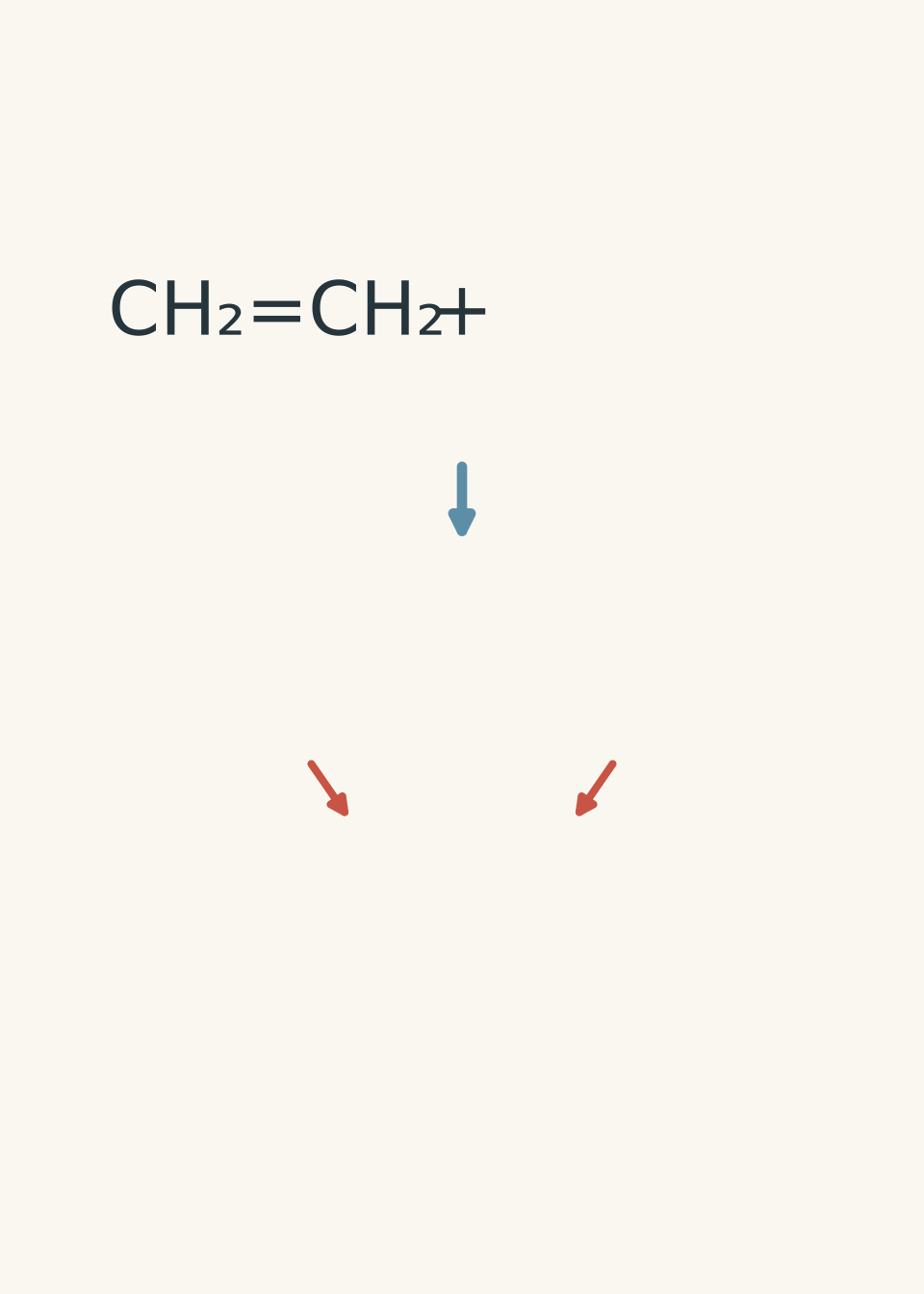
A common mistake is to say that “the double bond breaks”. That is too loose. The carbon atoms do not separate. The \(\ce{C=C}\) becomes a \(\ce{C-C}\) bond as the molecule forms two new carbon-bromine bonds.
Worked example: identifying an unsaturated compound
A student adds bromine water separately to hexane and hex-1-ene. The bromine water remains orange with hexane but becomes colourless with hex-1-ene. Explain the observations.
Step 1
Hexane is an alkane containing only carbon-carbon single bonds. Hex-1-ene contains a \(\ce{C=C}\) double bond.
Step 2
Hex-1-ene undergoes an addition reaction with bromine:
\[ \ce{CH2=CH(CH2)3CH3 + Br2 -> CH2Br-CHBr(CH2)3CH3} \]
Step 3
Because the bromine is consumed, its orange/brown colour disappears.
Under the usual conditions of this qualitative test, hexane does not react appreciably with bromine water, so the bromine colour remains.
The key conclusion is not merely “hex-1-ene reacts”. It is that the observation provides evidence for a carbon-carbon double bond.
02Testing for an alcohol hydroxyl group
Now suppose bromine water stays orange. That rules out an easily detected \(\ce{C=C}\), but it does not tell you whether the compound is an alcohol.
Alcohols contain a hydroxyl functional group, \(\ce{-OH}\), attached to a saturated carbon atom.
One useful HSC reaction is oxidation using acidified dichromate.
Dichromate ions, \(\ce{Cr2O7^2-}\), are orange. When they act as an oxidising agent, chromium(VI) is reduced to chromium(III), producing a green solution.
So the visible evidence is:
orange \(\rightarrow\) green
But there is an important limitation.
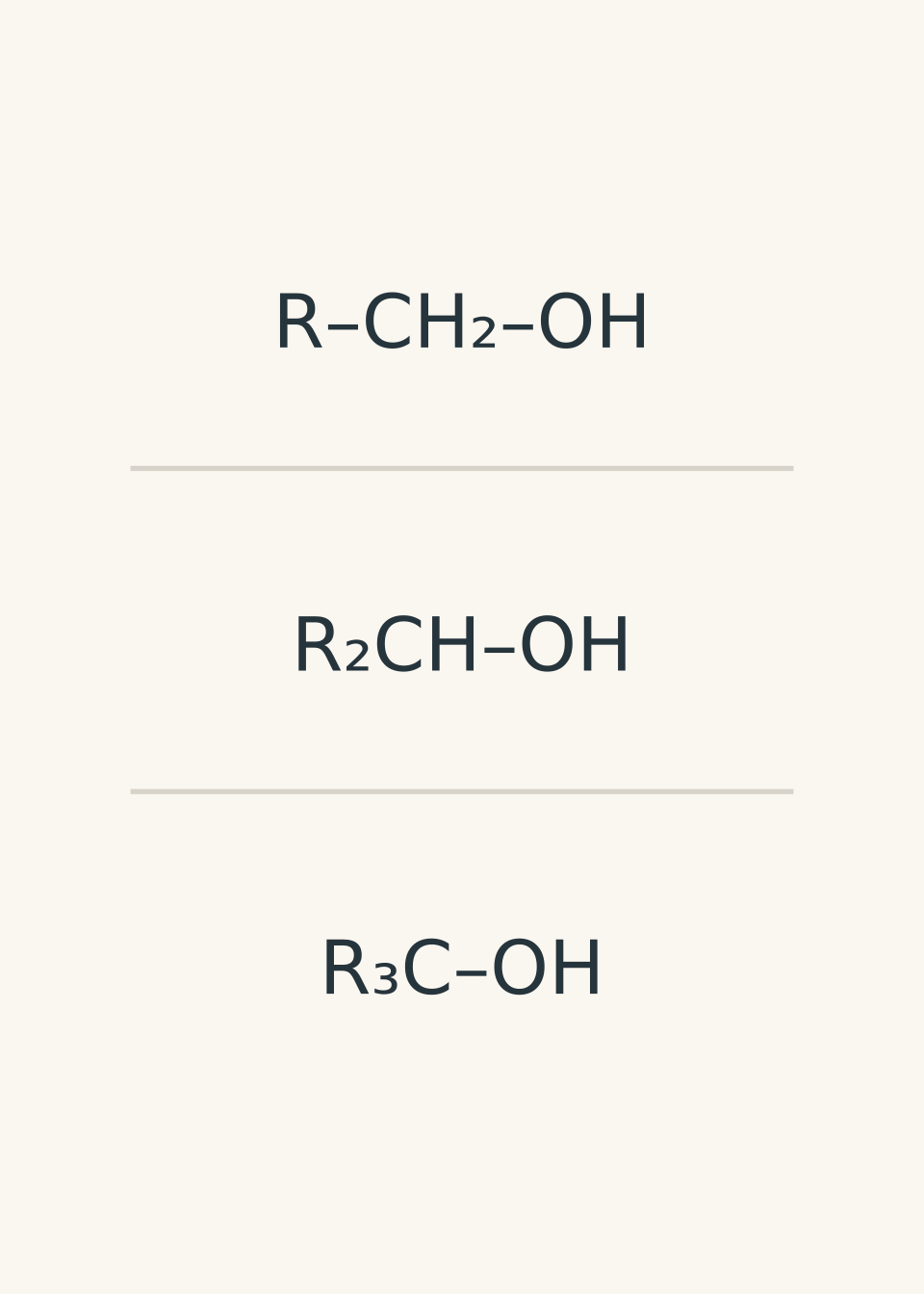
Not every molecule containing an \(\ce{-OH}\) group gives the same dichromate result. Primary and secondary alcohols can be oxidised under the usual test conditions. Tertiary alcohols generally cannot be oxidised this way without breaking carbon-carbon bonds.
That means acidified dichromate is better described as a test for an oxidisable alcohol than as an infallible test for every possible hydroxyl-containing organic compound.
Primary and secondary alcohols
A primary alcohol can first be oxidised to an aldehyde and then, under stronger or prolonged oxidising conditions, to a carboxylic acid.
For ethanol:
\[ \ce{CH3CH2OH ->[oxidation] CH3CHO ->[further\ oxidation] CH3COOH} \]
A secondary alcohol is oxidised to a ketone.
For propan-2-ol:
\[ \ce{CH3CHOHCH3 ->[oxidation] CH3COCH3} \]
In both cases, the alcohol is oxidised while the orange dichromate ions are reduced, producing the green colour associated with \(\mathrm{Cr}^{3+}\).
A tertiary alcohol does not have the required hydrogen attached to the carbon bearing the \(\ce{-OH}\) group. Under normal HSC oxidation conditions, that blocks the straightforward oxidation pathway.
Worked example: distinguishing two alcohols
Two colourless liquids are propan-2-ol and 2-methylpropan-2-ol. Acidified dichromate is added and the mixtures are warmed gently. One changes from orange towards green, while the other remains orange. Identify each liquid.
Step 1
Propan-2-ol has the structure \(\ce{CH3CHOHCH3}\). The carbon carrying the \(\ce{-OH}\) group is bonded to two other carbon atoms, so it is a secondary alcohol.
2-methylpropan-2-ol has the structure \(\ce{(CH3)3COH}\). Its \(\ce{-OH}\)-bearing carbon is bonded to three other carbon atoms, so it is tertiary.
Step 2
A secondary alcohol can be oxidised to a ketone:
\[ \ce{CH3CHOHCH3 ->[oxidation] CH3COCH3} \]
The dichromate oxidising agent is reduced, so its colour changes from orange towards green.
The tertiary alcohol does not undergo the corresponding oxidation under these conditions.
Step 3
The liquid producing the orange-to-green colour change is propan-2-ol.
The liquid for which the solution remains orange is 2-methylpropan-2-ol.
The result also shows why “acidified dichromate tests for \(\ce{-OH}\)” is an incomplete rule. The structure around that hydroxyl group matters.
03Testing for a carboxylic acid
Suppose another sample causes universal indicator to show acidic conditions. Is that enough to prove it contains a carboxylic acid?
No.
Many substances can produce an acidic solution. A stronger qualitative test uses sodium hydrogen carbonate, \(\ce{NaHCO3}\).
Carboxylic acids react with hydrogen carbonate ions to produce carbon dioxide gas. The bubbles give an immediate visible observation.
The general reaction is:
\[ \ce{RCOOH + NaHCO3 -> RCOONa + H2O + CO2} \]
Here, \(\ce{R}\) represents the rest of the organic molecule.
For ethanoic acid:
\[ \ce{CH3COOH + NaHCO3 -> CH3COONa + H2O + CO2} \]
So the positive observation is effervescence: visible bubbling caused by \(\ce{CO2(g)}\).
You can picture the test as a very tiny, much less dramatic version of acid meeting bicarbonate in a kitchen experiment. The useful part of that analogy is the gas formation. The analogy stops there: in chemical analysis, the identity, concentration, and conditions of the reagents matter, so “it fizzed” is not automatically proof unless you know what was mixed.
Worked example: using the gas as evidence
A student adds sodium hydrogen carbonate solution to 5.0 mL of an unknown organic liquid. Rapid bubbling occurs. The gas is passed through limewater, which becomes cloudy. Explain what the observations suggest.
Step 1
Effervescence after adding \(\ce{NaHCO3}\) suggests an acid-hydrogen carbonate reaction.
For a carboxylic acid:
\[ \ce{RCOOH + NaHCO3 -> RCOONa + H2O + CO2} \]
Step 2
The reaction predicts that carbon dioxide should be produced.
Step 3
Passing the gas through limewater produces a cloudy suspension because carbon dioxide reacts with calcium hydroxide to form insoluble calcium carbonate:
\[ \ce{CO2 + Ca(OH)2 -> CaCO3(s) + H2O} \]
Step 4
Together, the observations provide strong evidence that the unknown contains a carboxylic acid functional group.
Notice the wording: evidence, not magical certainty. Good qualitative analysis combines the expected reaction with the expected observation.
04Choosing the right test
Students often learn these tests as three disconnected facts:
- alkene → bromine water,
- alcohol → dichromate,
- carboxylic acid → hydrogen carbonate.
That works until a molecule contains more than one functional group.
A better approach is to ask what each reagent actually responds to.
| Test | What causes the positive result? | What a negative result tells you |
|---|---|---|
| Bromine water | A reactive unsaturated bond such as \(\ce{C=C}\) consumes bromine | No detectable \(\ce{C=C}\) under the test conditions |
| Acidified dichromate | An oxidisable group transfers electrons to chromium(VI), including primary and secondary alcohols | It may not be an oxidisable alcohol; it does not prove that no \(\ce{-OH}\) group exists |
| \(\ce{NaHCO3}\) | An acidic proton capable of reacting to release \(\ce{CO2}\), as in a carboxylic acid | No carboxylic-acid-type reaction detected |
This becomes important with molecules such as hydroxy acids or unsaturated acids.
For example, consider:
\[ \ce{CH2=CHCOOH} \]
This molecule contains both a carbon-carbon double bond and a carboxylic acid group.
Predict the result before reading on. Would you expect it to test positive with bromine water, sodium hydrogen carbonate, or only one of them?
Both.
The \(\ce{C=C}\) can consume bromine, while the \(\ce{-COOH}\) group can react with hydrogen carbonate to release carbon dioxide. Functional-group tests are not labels that assign a molecule to one box. A molecule can contain several functional groups and therefore give several positive tests.
05Observation is not the same as explanation
In an exam response, keep three layers separate:
- Observation: what you actually see.
- Inference: what functional group the observation supports.
- Explanation: what reaction caused the observation.
For bromine water:
The orange/brown bromine water is decolourised. This indicates a carbon-carbon double bond because bromine undergoes addition across the \(\ce{C=C}\), consuming \(\ce{Br2}\).
For acidified dichromate:
The solution changes from orange towards green. This is consistent with oxidation of a primary or secondary alcohol while chromium(VI) is reduced to chromium(III).
For sodium hydrogen carbonate:
Effervescence occurs. This supports the presence of a carboxylic acid because the acid reacts with \(\ce{HCO3^-}\) to produce \(\ce{CO2(g)}\).
Saying only “positive test” throws away the useful chemistry.
06The most tempting misconception: one test identifies the whole molecule
A positive qualitative test identifies a chemical behaviour associated with part of the molecule. It usually does not determine the complete molecular structure.
Suppose an unknown decolourises bromine water. You can reasonably infer that a reactive unsaturated group such as a carbon-carbon double bond is present under the intended HSC conditions.
You cannot immediately say, “Therefore, the compound is propene.”
Ethene, propene, but-1-ene, but-2-ene, and thousands of other compounds could produce the same broad observation.
Qualitative tests narrow the possibilities. Other evidence – such as further chemical tests or spectroscopic data – can then narrow them further.
07Questions and solutions
Question 1
Three separate samples contain hexane, hex-1-ene, and hexanoic acid.
For each reagent below, state which compound would give the expected positive result and describe the observation.
a. Bromine water
b. Sodium hydrogen carbonate solution
Solution 1
a. Hex-1-ene decolourises bromine water; hexane and hexanoic acid do not give the expected alkene test under these conditions.
Hex-1-ene contains a carbon-carbon double bond. Bromine undergoes addition across the \(\ce{C=C}\), so the orange/brown colour of \(\ce{Br2}\) disappears.
A simplified structural equation is:
\[ \ce{CH2=CH(CH2)3CH3 + Br2 -> CH2Br-CHBr(CH2)3CH3} \]
The tempting mistake is to choose hexanoic acid because it is “more reactive” than hexane. Reactivity is not one universal scale. Bromine water is being used here because of its characteristic reaction with the \(\ce{C=C}\) group.
b. Hexanoic acid produces effervescence with sodium hydrogen carbonate.
The carboxylic acid group reacts according to:
\[ \ce{C5H11COOH + NaHCO3 -> C5H11COONa + H2O + CO2} \]
The bubbles are carbon dioxide gas.
Hexane and hex-1-ene do not contain the \(\ce{-COOH}\) group required for this acid-hydrogen carbonate reaction.
Question 2
An unknown compound has molecular formula \(\ce{C3H6O2}\). It produces rapid effervescence when sodium hydrogen carbonate is added but does not decolourise bromine water.
A student concludes that the compound must be methyl ethanoate, \(\ce{CH3COOCH3}\).
Assess the student’s conclusion.
Solution 2
The conclusion is incorrect; the observations instead support propanoic acid, \(\ce{CH3CH2COOH}\), as the relevant structure.
The crucial evidence is the reaction with sodium hydrogen carbonate. A carboxylic acid reacts to release carbon dioxide:
\[ \ce{CH3CH2COOH + NaHCO3 -> CH3CH2COONa + H2O + CO2} \]
That explains the observed effervescence.
Methyl ethanoate is an ester. Although it has the same molecular formula, \(\ce{C3H6O2}\), it does not contain a carboxylic acid \(\ce{-COOH}\) group and would not be expected to produce the same immediate \(\ce{CO2}\) evolution with \(\ce{NaHCO3}\).
The negative bromine-water test also tells us there is no detected carbon-carbon double bond, which is consistent with propanoic acid.
The tempting route is to rely on molecular formula alone. That fails because structural isomers can have the same molecular formula but different functional groups and therefore different chemical reactions.
Question 3
Three unlabelled bottles contain propan-1-ol, propan-2-ol, and 2-methylpropan-2-ol.
A student tests each with acidified dichromate and gently warms the mixtures.
a. Predict the observations.
b. Explain why this test cannot distinguish propan-1-ol from propan-2-ol using the initial colour change alone.
c. Explain why 2-methylpropan-2-ol behaves differently.
Solution 3
Propan-1-ol and propan-2-ol produce an orange-to-green dichromate colour change, while 2-methylpropan-2-ol is expected to leave the dichromate orange under the usual conditions. The initial colour change therefore separates the tertiary alcohol from the other two but does not distinguish the primary and secondary alcohols.
a. Propan-1-ol is a primary alcohol, so it can be oxidised:
\[ \ce{CH3CH2CH2OH ->[oxidation] CH3CH2CHO} \]
and, under further oxidation:
\[ \ce{CH3CH2CHO ->[oxidation] CH3CH2COOH} \]
Propan-2-ol is secondary and is oxidised to propanone:
\[ \ce{CH3CHOHCH3 ->[oxidation] CH3COCH3} \]
In both reactions, orange chromium(VI) species are reduced to green chromium(III) species.
b. Both alcohols therefore cause the same broad visible observation: orange changes towards green. That observation proves that oxidation occurred but does not, on its own, reveal whether the starting alcohol was primary or secondary.
c. In 2-methylpropan-2-ol, the carbon carrying the \(\ce{-OH}\) group is bonded to three carbon groups and has no hydrogen attached to it.
The standard oxidation of an alcohol to a carbonyl compound requires changes involving that carbon and its attached hydrogen. A tertiary alcohol therefore cannot follow the usual pathway without breaking a carbon-carbon bond.
The tempting mistake is to think every molecule containing \(\ce{-OH}\) must give the same dichromate test. The local structure around the \(\ce{-OH}\) group determines whether straightforward oxidation is possible.
Question 4
A colourless organic compound \(X\) contains only carbon, hydrogen, and oxygen.
The following results are obtained using fresh portions of \(X\):
- bromine water is rapidly decolourised;
- sodium hydrogen carbonate produces effervescence;
- the gas formed turns limewater cloudy.
A student argues that one of the tests must be wrong because “a compound can’t be both an alkene and a carboxylic acid”.
a. Assess this argument.
b. Give a possible structural formula for \(X\).
c. Explain both positive tests using your proposed structure.
d. State why the test results still do not prove your particular structure is the unique structure of \(X\).
Solution 4
The student’s argument is wrong. One molecule can contain both a carbon-carbon double bond and a carboxylic acid group, so both tests can genuinely be positive. A suitable example is propenoic acid, \(\ce{CH2=CHCOOH}\).
a. Functional-group classifications are not mutually exclusive. A molecule can contain several functional groups at once.
The student has treated names such as “alkene” and “carboxylic acid” as though they were boxes that a molecule can enter only one at a time. The chemical tests respond to particular structural features, not to a single overall label.
b. One possible structure is:
\[ \ce{CH2=CHCOOH} \]
c. The carbon-carbon double bond reacts with bromine by addition, consuming coloured \(\ce{Br2}\). A simplified representation is:
\[ \ce{CH2=CHCOOH + Br2 -> CH2Br-CHBr-COOH} \]
Therefore, bromine water is decolourised.
The carboxylic acid group reacts with sodium hydrogen carbonate:
\[ \ce{CH2=CHCOOH + NaHCO3 -> CH2=CHCOONa + H2O + CO2} \]
The released carbon dioxide causes effervescence.
The cloudy limewater provides supporting evidence for the identity of the gas:
\[ \ce{CO2 + Ca(OH)2 -> CaCO3(s) + H2O} \]
d. The tests establish evidence for a \(\ce{C=C}\) group and a carboxylic acid group. They do not specify the complete carbon skeleton.
A larger unsaturated carboxylic acid could give the same pair of qualitative observations. Additional information, such as molecular formula or spectroscopic evidence, would be required to identify the exact structure uniquely.
The deeper constraint is that each test gives local structural information. Combining two local clues narrows the possibilities strongly, but it still may not reconstruct the entire molecule.
Question 5
An unknown compound \(Y\) is known to contain exactly four carbon atoms and one \(\ce{-OH}\) group. No other oxygen atoms are present.
A fresh sample of \(Y\) decolourises bromine water.
A second fresh sample of \(Y\), when treated with acidified dichromate under suitable oxidation conditions, produces an orange-to-green colour change.
A student proposes that these two results independently prove that \(Y\) contains “an alkene group and an alcohol group”, then claims that the tests reveal nothing more about how those groups are arranged.
Evaluate that claim. In particular:
a. State what each observation establishes.
b. Explain what additional structural restriction the dichromate result places on the carbon carrying the \(\ce{-OH}\) group.
c. Construct one possible structure for \(Y\) that satisfies all the evidence.
d. Construct a four-carbon structural isomer containing both \(\ce{C=C}\) and \(\ce{-OH}\) that would pass the bromine-water test but would not be expected to give the same dichromate result.
e. Explain why comparing your answers to parts c and d reveals more structural information than treating the two tests as unrelated checkboxes.
Solution 5
The student’s claim is only partly correct. The tests do establish both a carbon-carbon double bond and a hydroxyl-containing alcohol structure, but the positive dichromate test also constrains the environment around the carbon carrying the \(\ce{-OH}\) group: it must be oxidisable under the test conditions rather than tertiary.
a. Decolourisation of bromine water provides evidence for a reactive carbon-carbon double bond.
The positive acidified-dichromate test shows that an oxidisable group is present. Given the supplied information that \(Y\) contains one \(\ce{-OH}\) group and no other oxygen atoms, this is consistent with the \(\ce{-OH}\) belonging to a primary or secondary alcohol.
So the two observations do not merely say “double bond present” and “OH present”. The second observation says something about the carbon framework immediately surrounding the \(\ce{-OH}\).
b. The carbon bearing the \(\ce{-OH}\) group cannot have the ordinary structure of a tertiary alcohol if the observed oxidation is to occur by the standard HSC pathway.
A primary or secondary alcohol has a hydrogen on the carbon bearing the hydroxyl group and can undergo oxidation without first requiring cleavage of a carbon-carbon bond.
c. One possible compound is but-3-en-1-ol:
\[ \ce{HOCH2CH2CH=CH2} \]
It contains four carbon atoms, one \(\ce{-OH}\) group, and one \(\ce{C=C}\).
Its double bond accounts for bromine-water decolourisation.
Its \(\ce{-OH}\) group is on a primary carbon, so the alcohol can be oxidised. The oxidation can be represented in stages as:
\[ \ce{HOCH2CH2CH=CH2 ->[oxidation] OHCCH2CH=CH2 ->[further\ oxidation] HOOCCH2CH=CH2} \]
The important point for the test is that oxidation occurs, so dichromate is reduced and the orange-to-green change is observed.
d. Now consider:
\[ \ce{CH2=C(OH)(CH3)2} \]
That attempted structure is impossible because the central carbon would exceed carbon’s normal valency: it would have a double bond plus three additional single bonds.
This is exactly where the question becomes more interesting. You cannot invent the required counterexample merely by drawing a double bond somewhere and making the alcohol tertiary. The four-carbon skeleton, valency rules, and the locations of both functional features must all be satisfied simultaneously.
Try instead to build a tertiary alcohol first. A tertiary alcohol requires the hydroxyl-bearing carbon to have three carbon neighbours. With only four carbon atoms in total, that carbon and its three carbon substituents already use all four carbons, giving the skeleton of 2-methylpropan-2-ol:
\[ \ce{(CH3)3COH} \]
There is nowhere to insert a carbon-carbon double bond without changing the bonding around the central carbon or violating carbon’s valency.
Therefore, no four-carbon structure with one ordinary alcohol \(\ce{-OH}\), a \(\ce{C=C}\) double bond, and a tertiary alcohol centre can satisfy all the stated conditions.
This means the requested isomer in part d does not exist.
e. That impossibility is the key structural deduction.
At first, the two tests look independent:
- bromine water tells us about a \(\ce{C=C}\);
- dichromate tells us about alcohol oxidation.
But once the molecule is restricted to exactly four carbon atoms, the facts interact.
A tertiary alcohol requires one carbon bonded to three other carbons. That uses the entire four-carbon framework. A carbon-carbon double bond would then require one of those carbons to form an additional bond beyond what the saturated tertiary skeleton permits.
So the bromine-water result and the molecular size already make a tertiary alcohol impossible. The positive dichromate result is therefore not merely another isolated tick: it is consistent with a structural restriction that can also be reached by analysing carbon valency and connectivity.
The tempting route is to treat qualitative tests as a memorised flowchart in which each reagent supplies one disconnected label. The stronger approach is to combine every piece of evidence – observations, functional-group behaviour, carbon count, and valency – and ask which structures can satisfy all of them at once.
That way of thinking leads directly into the next stage of organic structure determination: using several independent pieces of chemical and spectroscopic evidence together to eliminate structures that look plausible when considered one clue at a time.