
Ideal Gas Law and Gas Relationships for HSC Chemistry
Learn how pressure, volume, temperature, and amount are connected by the ideal gas law, and how Boyle's, Charles's, Gay-Lussac's, and Avogadro's laws follow from it.
Seal a gas inside a rigid metal bottle and heat it. The bottle does not get bigger, and no gas enters or leaves. What happens to the pressure?
A tempting prediction is that the pressure stays the same because there is still the same amount of gas in the same space. But the pressure rises. Heating makes the particles move faster, so they strike the walls more often and with greater changes in momentum.
Now change the experiment. Put the gas in a syringe with a movable plunger instead. Heat it while keeping the pressure constant. This time the gas can expand.
The same gas behaves differently because pressure, volume, temperature, and amount are linked. The ideal gas law gives us one model that connects all four.
01Start with the particles
Picture gas particles moving randomly inside a container. Between collisions, the particles travel through mostly empty space.
Three ideas matter immediately:
- Pressure comes from particles colliding with the container walls.
- Temperature tells us about the average kinetic energy of the particles.
- Volume determines how much space those particles have to move through.
The amount of gas matters too. More particles means more opportunities for collisions with the walls.
This gives us some useful predictions.
If you squash a gas into a smaller volume without changing its temperature, what should happen to the pressure?
The particles have less distance to travel before reaching a wall, so wall collisions happen more frequently. Pressure rises.
If you heat a gas while its volume cannot change, the particles move faster. Collisions with the walls happen more frequently and involve larger momentum changes. Again, pressure rises.
This particle model gives us the direction of each relationship. The equations tell us exactly how large the change should be for an ideal gas.
02The ideal gas law
For an ideal gas,
\[ PV=nRT \]
where:
- \(P\) is the gas pressure
- \(V\) is the gas volume
- \(n\) is the amount of gas in moles
- \(R\) is the ideal gas constant
- \(T\) is the absolute temperature in kelvin
A very convenient value for HSC calculations is
\[ R=8.314\ \text{kPa L mol}^{-1}\text{K}^{-1} \]
when pressure is measured in kilopascals and volume is measured in litres.
This works because \(1\ \text{kPa L}=1\ \text{J}\).
The equation is more useful if you read it as a relationship rather than a formula to memorise:
\[ P=\frac{nRT}{V} \]
Pressure increases if:
- \(n\) increases
- \(T\) increases
- \(V\) decreases
That matches our particle model.
Kelvin is not optional
Gas-law calculations use absolute temperature, so temperature must be in kelvin.
Convert using
\[ T(\text{K})=T(^{\circ}\text{C})+273.15 \]
For example,
\[ 25.0^{\circ}\text{C}=298.15\ \text{K} \]
Why can’t we just use Celsius?
Suppose a gas warms from \(10^{\circ}\text{C}\) to \(20^{\circ}\text{C}\). In Celsius, the number has doubled. Has the particles’ average kinetic energy doubled?
No.
The temperatures are about \(283\ \text{K}\) and \(293\ \text{K}\), so the absolute temperature has increased by only about 3.5%.
Gas laws depend on absolute temperature, not the position of the Celsius zero point.
03What does “ideal” actually mean?
The ideal gas law is a model. It treats gas particles as if:
- their individual volumes are negligible compared with the container volume
- there are no significant attractive or repulsive forces between them except during collisions
- collisions are elastic
Real molecules do occupy space, and they do attract one another.
The ideal model generally becomes more accurate when a gas is at relatively low pressure and high temperature. Under those conditions, particles are far apart and intermolecular attractions have less influence on the bulk behaviour.
At high pressures, particles are packed closer together, so their own volume matters more. At low temperatures, attractions between particles become more important.
So \(PV=nRT\) is not a claim that real gas particles are tiny non-interacting mathematical dots. It is a model that works extremely well under many ordinary conditions.
04Worked example: finding the amount of gas
A sealed flask contains a gas at a pressure of \(102\ \text{kPa}\), a volume of \(2.40\ \text{L}\), and a temperature of \(27.0^{\circ}\text{C}\). Calculate the amount of gas in the flask.
Step 1
\[ T=27.0+273.15=300.15\ \text{K} \]
Step 2
\[ PV=nRT \]
so
\[ n=\frac{PV}{RT} \]
Step 3
The pressure is already in kPa and the volume is in L, so we can use \(R=8.314\ \text{kPa L mol}^{-1}\text{K}^{-1}\).
\[ n=\frac{(102\ \text{kPa})(2.40\ \text{L})} {(8.314\ \text{kPa L mol}^{-1}\text{K}^{-1})(300.15\ \text{K})} =0.0981\ \text{mol} \]
Step 4
The flask contains approximately
\[ \boxed{0.0981\ \text{mol}} \]
of gas.
Notice that the units cancel to leave moles. Unit cancellation is not decoration. It is one of the quickest ways to catch a bad substitution.
05The four familiar gas laws come from one equation
You may meet Boyle’s law, Charles’s law, Gay-Lussac’s law, and Avogadro’s law as four separate rules.
They aren’t really four unrelated facts. Each is a special case of
\[ PV=nRT \]
where some variables are held constant.
| Relationship | Constant quantities | Result |
|---|---|---|
| Boyle’s law | \(n,T\) | \(P\propto \frac{1}{V}\) |
| Charles’s law | \(n,P\) | \(V\propto T\) |
| Gay-Lussac’s law | \(n,V\) | \(P\propto T\) |
| Avogadro’s law | \(P,T\) | \(V\propto n\) |
The important skill is not remembering four names. It is noticing what has been kept constant.
06Boyle’s law: pressure and volume
Suppose temperature and amount of gas stay constant.
From
\[ PV=nRT \]
the right-hand side is constant, so
\[ PV=\text{constant} \]
For two states of the same gas,
\[ P_1V_1=P_2V_2 \]
This is Boyle’s law.
Pressure and volume are inversely proportional. If the volume halves, the pressure doubles, provided temperature and amount remain constant.
Think of pushing in a bicycle pump while blocking the outlet. The gas particles are being squeezed into less space, so they reach the walls more frequently.
The simple picture is useful, but it has a limitation: compressing a real gas can also change its temperature. Boyle’s law applies only if temperature is constant between the states being compared.
07Charles’s law: volume and temperature
Now suppose pressure and amount remain constant.
From
\[ PV=nRT \]
we get
\[ V\propto T \]
and therefore
\[ \frac{V_1}{T_1}=\frac{V_2}{T_2} \]
This is Charles’s law.
If absolute temperature rises by 10%, volume rises by 10%, provided pressure and amount stay constant.
Imagine a gas beneath a freely moving piston. Heating makes the particles move faster, which would initially increase the pressure. The higher pressure then pushes the piston outward. Expansion continues until the internal pressure again matches the external pressure.
So “heating makes a gas expand” is incomplete. A gas expands on heating when the conditions allow its volume to change while pressure remains constant.
08Gay-Lussac’s law: pressure and temperature
Suppose volume and amount remain constant.
Then
\[ P\propto T \]
so
\[ \frac{P_1}{T_1}=\frac{P_2}{T_2} \]
This is Gay-Lussac’s law.
This is the rigid-bottle situation from the opening.
If a sealed rigid container is heated from \(300\ \text{K}\) to \(330\ \text{K}\), its absolute temperature rises by 10%. Its pressure also rises by 10%, assuming ideal behaviour.
Again, this statement depends on the hidden conditions: the volume must be fixed, and no gas can enter or leave.
09Avogadro’s law: volume and amount
Suppose pressure and temperature remain constant.
Then
\[ V\propto n \]
or
\[ \frac{V_1}{n_1}=\frac{V_2}{n_2} \]
This is Avogadro’s law.
Double the amount of an ideal gas while keeping pressure and temperature fixed, and its volume doubles.
Why? Adding particles would initially increase the collision rate and therefore the pressure. If the pressure must remain constant, the gas has to occupy a larger volume.
A slightly silly way to picture this is a group of people being added to a quiet party while everyone insists on maintaining the same amount of personal space. If the number of people doubles, the room needs to become roughly twice as large.
The analogy breaks because gas particles do not consciously preserve personal space, and real particles interact through intermolecular forces. The useful part is simply the proportional relationship between particle number and required volume.
10One relationship can handle changing conditions
The named gas laws are useful when two variables stay constant.
But sometimes more than two things change.
Starting from
\[ PV=nRT \]
divide both sides by \(nT\):
\[ \frac{PV}{nT}=R \]
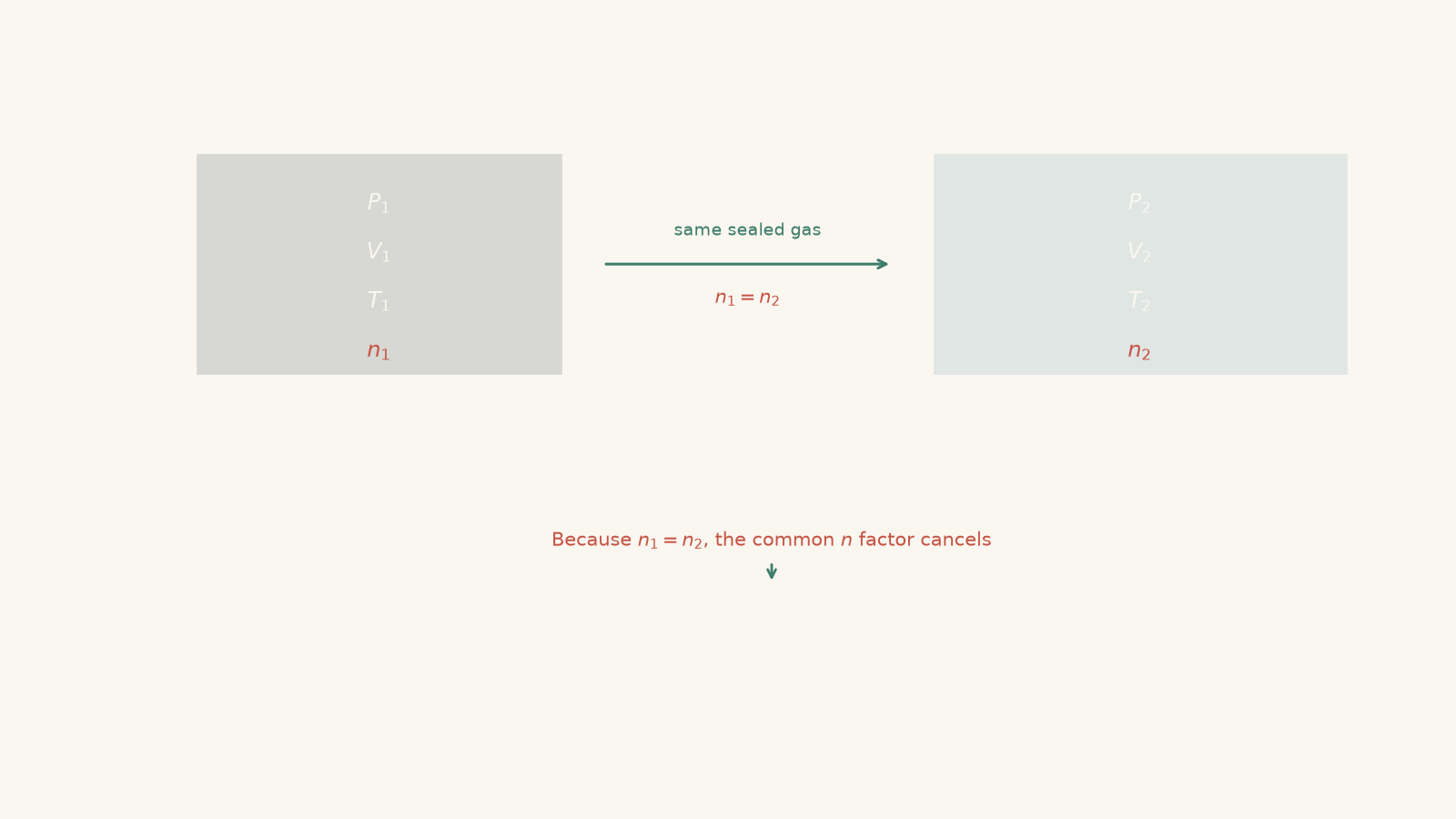
For two states,
\[ \frac{P_1V_1}{n_1T_1} = \frac{P_2V_2}{n_2T_2} \]
This is the most general linked relationship for an ideal gas.
If the amount of gas does not change, \(n_1=n_2\), so the \(n\) terms cancel:
\[ \frac{P_1V_1}{T_1} = \frac{P_2V_2}{T_2} \]
This is often called the combined gas law.
11A practical decision rule
Before choosing an equation, write down what changes and what stays constant.
| Situation | Equation usually most direct |
|---|---|
| One state, with \(P,V,n,T\) information | \(PV=nRT\) |
| Only \(P\) and \(V\) change | \(P_1V_1=P_2V_2\) |
| Only \(V\) and \(T\) change | \(\frac{V_1}{T_1}=\frac{V_2}{T_2}\) |
| Only \(P\) and \(T\) change | \(\frac{P_1}{T_1}=\frac{P_2}{T_2}\) |
| Only \(V\) and \(n\) change | \(\frac{V_1}{n_1}=\frac{V_2}{n_2}\) |
| \(P,V,T\) all change, but \(n\) is constant | \(\frac{P_1V_1}{T_1}=\frac{P_2V_2}{T_2}\) |
| Amount of gas also changes | \(\frac{P_1V_1}{n_1T_1}=\frac{P_2V_2}{n_2T_2}\) |
You do not need to force every problem into a named law. Start with the physical conditions, then simplify the ideal gas law.
12Worked example: pressure after heating and expansion
A sealed flexible gas container initially holds gas at \(98.0\ \text{kPa}\), \(1.80\ \text{L}\), and \(18.0^{\circ}\text{C}\). It is heated to \(72.0^{\circ}\text{C}\), and its volume increases to \(2.10\ \text{L}\). Calculate the final pressure.
Step 1
The container is sealed, so the amount of gas is constant.
Pressure, volume, and temperature all change. That means the combined gas law is appropriate:
\[ \frac{P_1V_1}{T_1} = \frac{P_2V_2}{T_2} \]
Step 2
\[ T_1=18.0+273.15=291.15\ \text{K} \]
\[ T_2=72.0+273.15=345.15\ \text{K} \]
Step 3
\[ P_2=\frac{P_1V_1T_2}{T_1V_2} \]
Step 4
\[ \begin{aligned} P_2 &= \frac{(98.0\ \text{kPa})(1.80\ \text{L})(345.15\ \text{K})} {(291.15\ \text{K})(2.10\ \text{L})} \\ &=99.6\ \text{kPa} \end{aligned} \]
Therefore,
\[ \boxed{P_2=99.6\ \text{kPa}} \]
Step 5
Heating tends to increase the pressure. Expansion tends to decrease it.
Here, those two effects nearly cancel, leaving the final pressure only slightly above the initial \(98.0\ \text{kPa}\).
That interpretation matters. A calculator result around \(300\ \text{kPa}\), for example, should immediately make you suspicious.
13Why proportional reasoning is powerful
You can often predict the direction of a change before calculating.
From
\[ P=\frac{nRT}{V} \]
suppose the amount stays constant.
If temperature doubles while volume also doubles,
\[ P_2=P_1 \]
because the two changes cancel.
If temperature doubles while volume halves,
\[ P_2=4P_1 \]
because the temperature gives a factor of \(2\), while dividing the volume by \(2\) gives another factor of \(2\).
This way of thinking is especially useful in harder questions. It lets you estimate the answer before doing any arithmetic.
14The most common misconception: following only one variable
Suppose a sealed balloon is warmed.
A student might say, “Higher temperature means higher pressure.”
That prediction makes sense if volume is fixed. But a balloon can expand.
As the gas warms, both pressure and volume may change. The final result depends on the external pressure, the balloon’s elasticity, and how much it expands.
The rule \(P\propto T\) only applies when volume and amount are constant.
This is the major trap with gas laws: every proportional statement contains hidden conditions.
Do not write
\[ P\propto T \]
and mentally forget the words “at constant volume and amount”.
15A second trap: pressure must be absolute
In the ideal gas law, pressure means absolute pressure.
A pressure gauge often reports pressure relative to atmospheric pressure. That is called gauge pressure.
If a tyre gauge reads \(220\ \text{kPa}\), and atmospheric pressure is \(101\ \text{kPa}\), the absolute pressure is approximately
\[ P_{\text{absolute}} = 220+101 = 321\ \text{kPa} \]
Using \(220\ \text{kPa}\) directly in an ideal gas calculation would be incorrect if that value is gauge pressure.
Gas laws are based on a true zero of pressure, just as temperature relationships require a true zero of temperature.
16Questions and solutions
Question 1
A gas occupies \(3.00\ \text{L}\) at \(120\ \text{kPa}\). It is compressed at constant temperature to \(2.40\ \text{L}\). The amount of gas does not change.
Calculate the final pressure.
Solution 1
The final pressure is
\[ \boxed{150\ \text{kPa}} \]
because temperature and amount are constant, so Boyle’s law applies:
\[ P_1V_1=P_2V_2 \]
Rearranging,
\[ P_2=\frac{P_1V_1}{V_2} \]
Substitute:
\[ P_2 = \frac{(120\ \text{kPa})(3.00\ \text{L})} {2.40\ \text{L}} = 150\ \text{kPa} \]
The gas has been compressed to a smaller volume, so an increase in pressure is physically sensible.
Question 2
A gas occupies \(850\ \text{mL}\) at \(15.0^{\circ}\text{C}\). It is heated at constant pressure until its temperature reaches \(45.0^{\circ}\text{C}\). The amount of gas is unchanged.
Calculate the final volume.
A student argues that because \(45\) is three times \(15\), the final volume should be \(2550\ \text{mL}\). Explain the error.
Solution 2
The final volume is approximately
\[ \boxed{939\ \text{mL}} \]
and the student’s factor-of-three argument fails because gas-law temperature ratios must use kelvin, not degrees Celsius.
At constant pressure and amount, Charles’s law applies:
\[ \frac{V_1}{T_1}=\frac{V_2}{T_2} \]
Convert the temperatures:
\[ T_1=15.0+273.15=288.15\ \text{K} \]
\[ T_2=45.0+273.15=318.15\ \text{K} \]
Rearrange:
\[ V_2=V_1\frac{T_2}{T_1} \]
Substitute:
\[ \begin{aligned} V_2 &=(850\ \text{mL}) \frac{318.15\ \text{K}}{288.15\ \text{K}} \\ &=939\ \text{mL} \end{aligned} \]
The absolute temperature rises by only about 10.4%, so the volume rises by the same percentage.
The tempting misconception comes from treating \(0^{\circ}\text{C}\) as zero thermal energy. It is not. \(0^{\circ}\text{C}\) is \(273.15\ \text{K}\).
Question 3
A rigid \(5.00\ \text{L}\) vessel contains \(0.200\ \text{mol}\) of an ideal gas at \(300\ \text{K}\).
An additional \(0.0500\ \text{mol}\) of gas is added while the vessel is heated to \(360\ \text{K}\). The volume remains fixed.
The initial pressure is \(99.8\ \text{kPa}\).
Without first using the ideal gas constant, predict whether the final pressure will be less than, equal to, or greater than \(120\ \text{kPa}\). Then calculate the final pressure.
Solution 3
The final pressure is
\[ \boxed{150\ \text{kPa}} \]
so it is greater than \(120\ \text{kPa}\).
Because the volume is fixed,
\[ P\propto nT \]
The amount increases from \(0.200\ \text{mol}\) to
\[ n_2=0.250\ \text{mol} \]
which is a factor of
\[ \frac{0.250}{0.200}=1.25 \]
The temperature increases by a factor of
\[ \frac{360}{300}=1.20 \]
Therefore, the pressure should increase by
\[ 1.25\times1.20=1.50 \]
So even before calculating precisely,
\[ P_2=1.50P_1 \]
which is clearly more than \(120\ \text{kPa}\).
Using the general two-state relationship,
\[ \frac{P_1V_1}{n_1T_1} = \frac{P_2V_2}{n_2T_2} \]
and cancelling the unchanged volume gives
\[ \frac{P_1}{n_1T_1} = \frac{P_2}{n_2T_2} \]
Therefore,
\[ P_2 = P_1 \frac{n_2T_2}{n_1T_1} \]
Substituting,
\[ \begin{aligned} P_2 &= (99.8\ \text{kPa}) \frac{(0.250\ \text{mol})(360\ \text{K})} {(0.200\ \text{mol})(300\ \text{K})} \\ &=149.7\ \text{kPa} \end{aligned} \]
So,
\[ \boxed{P_2\approx150\ \text{kPa}} \]
The important idea is that two effects raise the pressure at once: there are more particles, and those particles have greater average kinetic energy.
Question 4
Two sealed rigid vessels have the same volume and are at the same temperature.
Vessel A contains \(0.40\ \text{mol}\) of helium. Vessel B contains \(0.40\ \text{mol}\) of carbon dioxide.
A student claims that vessel B must have the higher pressure because carbon dioxide molecules have a much greater molar mass than helium atoms.
Using the ideal gas model, determine whether the student is correct and explain the molecular reasoning.
Solution 4
The student is incorrect. Under the ideal gas model, the two vessels have the same pressure.
For each vessel,
\[ P=\frac{nRT}{V} \]
The values of \(n\), \(R\), \(T\), and \(V\) are identical, so the calculated pressure must also be identical.
Molar mass does not appear in the ideal gas equation.
At the same temperature, helium atoms have a higher average speed than carbon dioxide molecules because helium particles are lighter. However, a faster light particle produces a smaller momentum change in an individual collision than a heavier particle travelling more slowly.
For an ideal gas, these effects combine so that gases with the same amount, volume, and temperature produce the same pressure.
The tempting misconception is to assume that heavier molecules must hit the walls “harder”, so they must create more pressure. That considers particle mass without also considering how molecular speed depends on mass at the same temperature.
Question 5
A sealed cylinder fitted with a frictionless movable piston contains an ideal gas. Initially,
\[ P_1=100\ \text{kPa},\quad V_1=2.00\ \text{L},\quad T_1=300\ \text{K} \]
The gas is heated to \(450\ \text{K}\). During heating, the piston moves outward until the volume becomes \(3.00\ \text{L}\).
A student says, “The temperature increased by 50%, so the pressure must also increase by 50%.”
Determine the final pressure and explain exactly why this reasoning fails.
Solution 5
The final pressure is
\[ \boxed{100\ \text{kPa}} \]
so the pressure does not increase at all.
The amount of gas is constant, but both volume and temperature change. Therefore, we use
\[ \frac{P_1V_1}{T_1} = \frac{P_2V_2}{T_2} \]
Rearranging,
\[ P_2 = P_1 \frac{V_1T_2}{T_1V_2} \]
Substitute:
\[ \begin{aligned} P_2 &= (100\ \text{kPa}) \frac{(2.00\ \text{L})(450\ \text{K})} {(300\ \text{K})(3.00\ \text{L})} \\ &=100\ \text{kPa} \end{aligned} \]
The temperature increased by a factor of
\[ \frac{450}{300}=1.50 \]
but the volume also increased by a factor of
\[ \frac{3.00}{2.00}=1.50 \]
Since
\[ P\propto \frac{T}{V} \]
for a fixed amount of gas, the two factors cancel exactly.
The student’s reasoning uses Gay-Lussac’s relationship \(P\propto T\), but that relationship requires constant volume. Here the piston is free to move, so the volume is not constant.
Question 6
A sealed sample of ideal gas begins at \(300\ \text{K}\).
It is heated while its volume is reduced. After the change, its pressure is exactly twice its original pressure.
A student concludes that the final temperature must be \(600\ \text{K}\).
Is that conclusion justified? If not, derive a relationship between the final temperature and final volume, and give one possible final state.
Solution 6
The conclusion is not justified because both temperature and volume changed. A doubling of pressure does not by itself tell us that the absolute temperature doubled.
For a fixed amount of gas,
\[ \frac{P_1V_1}{T_1} = \frac{P_2V_2}{T_2} \]
We are told that
\[ P_2=2P_1 \]
and
\[ T_1=300\ \text{K} \]
Substitute these relationships:
\[ \frac{P_1V_1}{300} = \frac{(2P_1)V_2}{T_2} \]
Cancel \(P_1\):
\[ \frac{V_1}{300} = \frac{2V_2}{T_2} \]
Rearranging,
\[ T_2 = 600\frac{V_2}{V_1} \]
Because the gas is compressed,
\[ V_2<V_1 \]
so
\[ T_2<600\ \text{K} \]
One possible final state is
\[ V_2=0.75V_1 \]
Then
\[ T_2 = 600(0.75) = 450\ \text{K} \]
So a possible final condition is
\[ \boxed{T_2=450\ \text{K},\quad V_2=0.75V_1} \]
with the pressure doubled.
The obvious method fails because \(P\propto T\) is only valid when volume is constant. Once several variables change together, the full relationship has to be considered.
17Where this leads next
The ideal gas law does more than connect four variables. It gives you a way to move between a gas’s macroscopic measurements and the amount of substance present.
Once \(n\) is known, you can connect gas measurements to molar mass, chemical equations, reacting quantities, and equilibrium calculations. The useful habit stays the same: identify what is physically changing, identify what is being held constant, and only then choose the equation.