
Enthalpy of Neutralisation: HSC Chemistry Calorimetry Guide
Learn how to measure heat released during acid-base neutralisation, calculate enthalpy of neutralisation, and evaluate calorimetry results.
Mix equal volumes of hydrochloric acid and sodium hydroxide, and the temperature rises. Nothing is burning. There is no flame. Yet chemical energy has clearly gone somewhere.
Before reading on, predict this: if the solution gets hotter, should the enthalpy change of the neutralisation be positive or negative?
It is negative. The reacting system loses energy as heat, while the solution and calorimeter gain that energy. The thermometer records the gain by the surroundings; from that, we work backwards to estimate the energy released by the reaction.
That sounds simple. The difficult part is keeping three ideas separate: how much heat the solution absorbed, how many moles actually reacted, and what the sign of the reaction enthalpy should be.
01What the thermometer actually measures
Imagine mixing an acid and a base in an insulated cup. At the particle level, hydrogen ions and hydroxide ions react to form water:
\[ \ce{H+(aq) + OH-(aq) -> H2O(l)} \]
The products are at lower enthalpy than the reactants. The energy difference is transferred into the surroundings, mainly the solution.
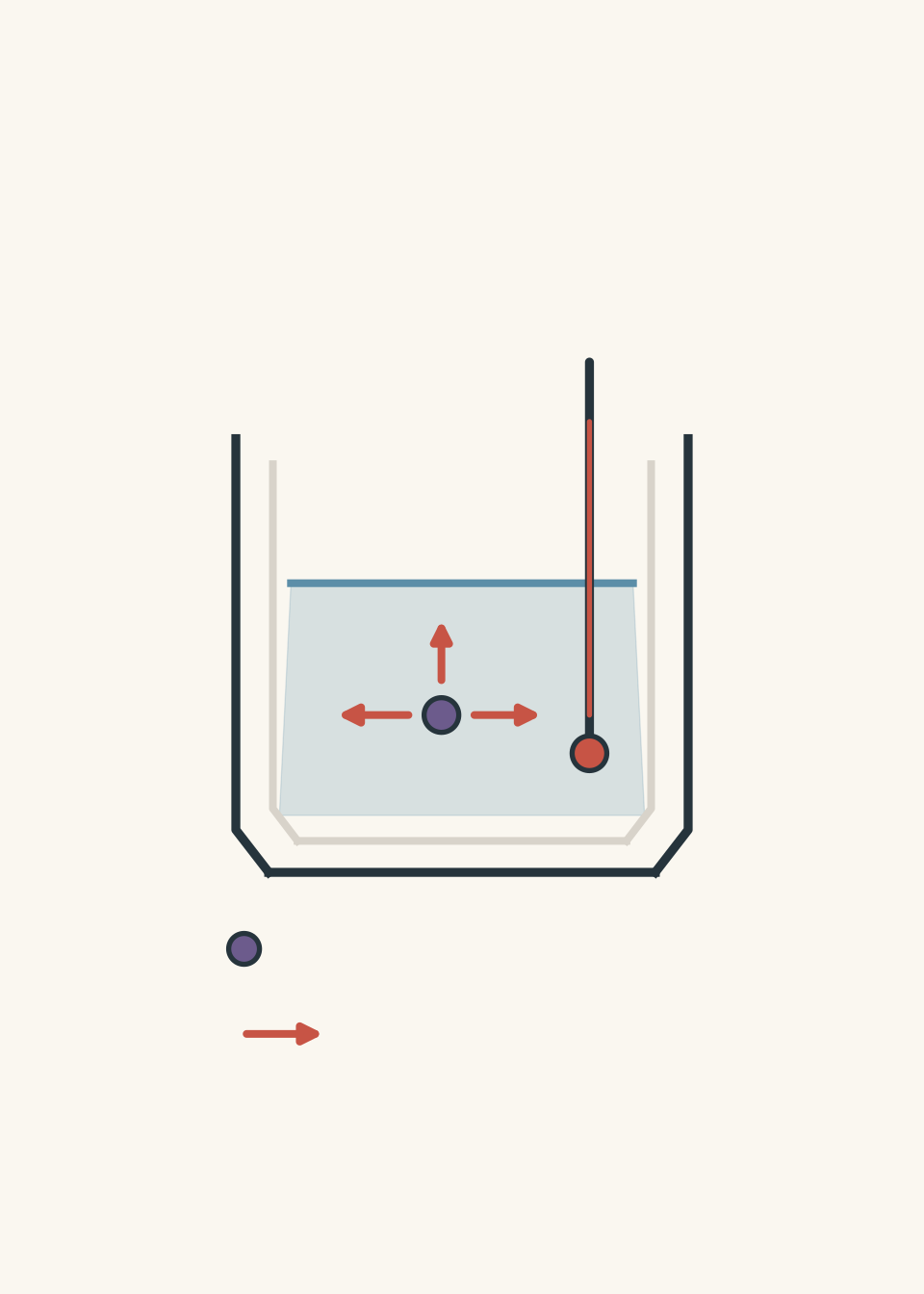
The thermometer does not measure enthalpy directly. It measures a temperature change.
If the solution warms from \(T_i\) to \(T_f\),
\[ \Delta T = T_f-T_i \]
where:
- \(T_i\) is the initial temperature in °C,
- \(T_f\) is the final temperature in °C, and
- \(\Delta T\) is the temperature change in °C.
A temperature difference of 1 °C is the same size as a temperature difference of 1 K, so either unit can be used for \(\Delta T\).
We then estimate the heat absorbed by the solution using
\[ q_{\text{solution}}=mc\Delta T \]
where:
- \(q_{\text{solution}}\) is the heat absorbed by the solution, in J,
- \(m\) is the mass of solution, in g,
- \(c\) is the specific heat capacity of the solution, in \(\mathrm{J\,g^{-1}\,^{\circ}C^{-1}}\), and
- \(\Delta T\) is the temperature change.
For dilute aqueous solutions, HSC questions often allow the approximation
\[ c=4.18\ \mathrm{J\,g^{-1}\,^{\circ}C^{-1}} \]
and a density of
\[ 1.00\ \mathrm{g\,mL^{-1}} \]
unless other values are provided.
So 100 mL of dilute solution is treated as having a mass of approximately 100 g.
02The sign is easy to reverse
Suppose the temperature increases. Then \(q_{\text{solution}}\) is positive because the solution has gained heat.
But where did that heat come from?
The reaction.
So, if we assume the heat released by the reaction is absorbed by the solution,
\[ q_{\text{reaction}}=-q_{\text{solution}} \]
This minus sign matters.
A neutralisation that makes the surroundings warmer is exothermic, so its enthalpy change is negative.
One useful mental picture is a bank transfer. If the solution’s energy account gains 2.5 kJ, the reaction’s account must have lost approximately 2.5 kJ. The analogy breaks because energy is not literally stored in bank accounts, and a real calorimeter can leak energy into the cup, air, and thermometer. But it gets the sign convention right.
03From heat released to enthalpy of neutralisation
Heat alone is not enough.
Suppose Experiment A releases 3 kJ and Experiment B releases 6 kJ. Has Experiment B got a more exothermic enthalpy of neutralisation?
Not necessarily. It may simply have involved twice as many moles.
Enthalpy of neutralisation is expressed per mole of reaction, normally per mole of water formed by the acid-base reaction.
For a monoprotic strong acid reacting with a strong base,
\[ \ce{H+(aq) + OH-(aq) -> H2O(l)} \]
one mole of \(\mathrm{H}^{+}\) reacting with one mole of \(\ce{OH-}\) forms one mole of water.
The experimental molar enthalpy change is
\[ \Delta H_{\text{neut}}=\frac{q_{\text{reaction}}}{n} \]
where:
- \(\Delta H_{\text{neut}}\) is the enthalpy of neutralisation in \(\mathrm{kJ\,mol^{-1}}\),
- \(q_{\text{reaction}}\) is the heat change of the reaction in kJ, and
- \(n\) is the amount, in mol, corresponding to the neutralisation reaction.
For the usual strong acid-strong base reaction, \(n\) is the moles of water formed.
The calculation therefore has a clear order:
| Stage | What you find | Key idea |
|---|---|---|
| 1 | \(\Delta T\) | Measure the temperature rise |
| 2 | \(q_{\text{solution}}\) | Use \(mc\Delta T\) |
| 3 | \(q_{\text{reaction}}\) | Reverse the sign |
| 4 | moles reacting | Use stoichiometry and the limiting reagent |
| 5 | \(\Delta H_{\text{neut}}\) | Divide heat by moles reacted |
Do not jump straight from temperature rise to \(\Delta H\). A large temperature rise can come from a large amount reacting, a small mass of solution being heated, or both.
Worked example: Calculating enthalpy from a temperature rise
50.0 mL of \(1.00\ \mathrm{mol\,L^{-1}}\) hydrochloric acid is mixed with 50.0 mL of \(1.00\ \mathrm{mol\,L^{-1}}\) sodium hydroxide. Both solutions are initially at \(21.5^\circ\mathrm{C}\). The highest temperature reached is \(28.0^\circ\mathrm{C}\).
Assume a density of \(1.00\ \mathrm{g\,mL^{-1}}\) and a specific heat capacity of \(4.18\ \mathrm{J\,g^{-1}\,^{\circ}C^{-1}}\). Calculate the experimental enthalpy of neutralisation.
Step 1
\[ \Delta T=28.0-21.5=6.5^\circ\mathrm{C} \]
Step 2
The total volume is
\[ 50.0+50.0=100.0\ \mathrm{mL} \]
Using a density of \(1.00\ \mathrm{g\,mL^{-1}}\),
\[ m=100.0\ \mathrm{g} \]
Step 3
\[ \begin{aligned} q_{\text{solution}}&=mc\Delta T\\ &=(100.0)(4.18)(6.5)\\ &=2717\ \mathrm{J}\\ &=2.717\ \mathrm{kJ} \end{aligned} \]
The solution gained 2.717 kJ.
Step 4
\[ q_{\text{reaction}}=-2.717\ \mathrm{kJ} \]
The negative sign tells us that the neutralisation released heat.
Step 5
For hydrochloric acid,
\[ n(\ce{HCl})=cV=(1.00)(0.0500)=0.0500\ \mathrm{mol} \]
For sodium hydroxide,
\[ n(\ce{NaOH})=(1.00)(0.0500)=0.0500\ \mathrm{mol} \]
They react in a 1:1 ratio, so \(0.0500\) mol of water forms.
Step 6
\[ \begin{aligned} \Delta H_{\text{neut}} &=\frac{-2.717}{0.0500}\\ &=-54.3\ \mathrm{kJ\,mol^{-1}} \end{aligned} \]
The measured neutralisation releases about \(54.3\ \mathrm{kJ}\) for every mole of water formed.
This is slightly less exothermic than the value of roughly \(-57\ \mathrm{kJ\,mol^{-1}}\) commonly expected for dilute strong acid-strong base neutralisations. That difference is believable: a simple school calorimeter does not capture every joule released.
04Why strong acids and strong bases give similar values
Hydrochloric acid reacting with sodium hydroxide can be written as
\[ \ce{HCl(aq) + NaOH(aq) -> NaCl(aq) + H2O(l)} \]
Nitric acid reacting with potassium hydroxide gives
\[ \ce{HNO3(aq) + KOH(aq) -> KNO3(aq) + H2O(l)} \]
These look like different reactions. But strong acids and strong bases are essentially fully ionised in dilute aqueous solution.
For the first reaction, the important ions are
\[ \ce{H+(aq) + Cl-(aq) + Na+(aq) + OH-(aq)} \]
The \(\mathrm{Na}^{+}\) and \(\mathrm{Cl}^{-}\) ions remain in solution. They are spectator ions.
The same cancellation happens with \(\mathrm{K}^{+}\) and \(\ce{NO3-}\). In both cases, the underlying reaction is approximately
\[ \ce{H+(aq) + OH-(aq) -> H2O(l)} \]
That is why different dilute strong acid-strong base combinations tend to have similar enthalpies of neutralisation.
If the acid-base particle picture itself is shaky, the Brønsted-Lowry acids and bases guide is worth reviewing first.
You can picture the spectator ions as two friends who came along on a date but do not actually get involved. The \(\mathrm{H}^{+}\) and \(\ce{OH-}\) are the ones whose relationship changes; the spectators arrive in solution and leave still dissolved. The analogy stops there, because ions are hydrated particles interacting continuously with water, not tiny people hovering politely at another table.
05What changes when the calorimeter absorbs heat?
Our first model assumed
\[ -q_{\text{reaction}}=q_{\text{solution}} \]
That is useful, but incomplete.
The cup, thermometer, and other parts of the calorimeter may also warm up. If the calorimeter has heat capacity \(C_{\text{cal}}\), then
\[ q_{\text{cal}}=C_{\text{cal}}\Delta T \]
where \(C_{\text{cal}}\) is measured in \(\mathrm{J\,^{\circ}C^{-1}}\) or \(\mathrm{J\,K^{-1}}\).
A better energy balance is
\[ -q_{\text{reaction}}=q_{\text{solution}}+q_{\text{cal}} \]
so
\[ q_{\text{reaction}} =-\left(mc\Delta T+C_{\text{cal}}\Delta T\right) \]
This explains a common experimental result. If you ignore the energy absorbed by the calorimeter, the calculated magnitude of \(q_{\text{reaction}}\) is too small. Your calculated \(\Delta H\) becomes less negative than it should be.
Worked example: Limiting reagent and calorimeter heat capacity
40.0 mL of \(1.50\ \mathrm{mol\,L^{-1}}\) nitric acid is mixed with 60.0 mL of \(0.800\ \mathrm{mol\,L^{-1}}\) potassium hydroxide. Both begin at \(23.0^\circ\mathrm{C}\), and the final temperature is \(29.0^\circ\mathrm{C}\).
The calorimeter has a heat capacity of \(35.0\ \mathrm{J\,^{\circ}C^{-1}}\). Assume the mixed solution has density \(1.00\ \mathrm{g\,mL^{-1}}\) and specific heat capacity \(4.18\ \mathrm{J\,g^{-1}\,^{\circ}C^{-1}}\).
Calculate the enthalpy of neutralisation.
Step 1
For nitric acid,
\[ n(\ce{HNO3})=(1.50)(0.0400)=0.0600\ \mathrm{mol} \]
For potassium hydroxide,
\[ n(\ce{KOH})=(0.800)(0.0600)=0.0480\ \mathrm{mol} \]
The reaction is 1:1:
\[ \ce{HNO3(aq) + KOH(aq) -> KNO3(aq) + H2O(l)} \]
So \(\ce{KOH}\) is limiting, and \(0.0480\) mol of water forms.
Using \(0.0600\) mol because there were more moles of acid would be a stoichiometry error.
Step 2
\[ \Delta T=29.0-23.0=6.0^\circ\mathrm{C} \]
Step 3
The total mass is approximately
\[ m=40.0+60.0=100.0\ \mathrm{g} \]
Therefore,
\[ \begin{aligned} q_{\text{solution}} &=(100.0)(4.18)(6.0)\\ &=2508\ \mathrm{J} \end{aligned} \]
Step 4
\[ \begin{aligned} q_{\text{cal}} &=C_{\text{cal}}\Delta T\\ &=(35.0)(6.0)\\ &=210\ \mathrm{J} \end{aligned} \]
So the total measured heat absorbed is
\[ 2508+210=2718\ \mathrm{J}=2.718\ \mathrm{kJ} \]
Step 5
\[ q_{\text{reaction}}=-2.718\ \mathrm{kJ} \]
Step 6
\[ \begin{aligned} \Delta H_{\text{neut}} &=\frac{-2.718}{0.0480}\\ &=-56.6\ \mathrm{kJ\,mol^{-1}} \end{aligned} \]
The value is close to the expected range for a strong acid-strong base neutralisation.
Notice how the calorimeter correction mattered. If we had used only \(q_{\text{solution}}\), we would have obtained about \(-52.3\ \mathrm{kJ\,mol^{-1}}\), making the reaction appear considerably less exothermic.
06Weak acids change the energy story
Now predict what happens if hydrochloric acid is replaced by ethanoic acid at the same concentration.
Would you expect exactly the same enthalpy of neutralisation?
No.
Ethanoic acid is a weak acid, meaning only a fraction of its molecules are ionised at any instant:
\[ \ce{CH3COOH(aq) <=> H+(aq) + CH3COO-(aq)} \]
As hydroxide ions remove \(\mathrm{H}^{+}\),
\[ \ce{H+(aq) + OH-(aq) -> H2O(l)} \]
the equilibrium shifts and more ethanoic acid ionises.
Energy is involved in that ionisation process. The measured enthalpy therefore reflects more than the strong acid-strong base step alone.
The overall equation is
\[ \ce{CH3COOH(aq) + OH-(aq) -> CH3COO-(aq) + H2O(l)} \]
For many weak acids, this overall neutralisation is less exothermic than the corresponding reaction involving a strong acid because some of the energy released by forming water is effectively offset by the energy required for further ionisation of the weak acid.
The tempting explanation is simply, “weak acids react less strongly.”
That wording is too vague.
A weak acid can still react essentially completely with a sufficient amount of strong base. “Weak” describes the extent of ionisation in water, not whether the neutralisation somehow gives up halfway.
07Evaluating a neutralisation calorimetry experiment
A calculated value can be numerically neat and experimentally poor.
The useful question is not just, “What went wrong?” It is, “How would that error change the measured temperature and therefore the calculated \(\Delta H\)?”
| Experimental issue | Likely consequence |
|---|---|
| Heat escapes to the surrounding air | Measured \(\Delta T\) is too small, so \(\Delta H\) is usually not negative enough |
| Cup absorbs heat but its heat capacity is ignored | Measured reaction heat is underestimated, so \(\Delta H\) is not negative enough |
| Temperature is recorded after the true maximum has passed | \(\Delta T\) is too small |
| Solutions are not initially at the same temperature | Using either starting temperature directly can give the wrong \(\Delta T\) |
| Density is assumed to be \(1.00\ \mathrm{g\,mL^{-1}}\) | Calculated \(q\) may be slightly too high or too low |
| Specific heat capacity is assumed to equal that of water | Calculated \(q\) may be slightly too high or too low |
| Actual concentrations differ from labelled values | The calculated number of moles reacting may be wrong |
| Acid or base is transferred incompletely | Fewer moles react than expected |
| More concentrated solutions are used | Heats of dilution and non-ideal behaviour can make the simple model less accurate |
There is an important pattern here. Heat loss to the environment and ignoring the calorimeter’s own heat capacity both usually make the measured enthalpy less negative.
But not every error has a guaranteed direction. If your assumed concentration is wrong, for example, the result could shift either way.
A better experimental design
To improve the measurement, you could:
- use a well-insulated calorimeter with a lid,
- measure the heat capacity of the calorimeter,
- allow both reactant solutions to reach the same initial temperature,
- transfer solutions quickly and completely,
- stir consistently,
- record temperature frequently around the maximum,
- use accurately known concentrations and volumes, and
- repeat trials and examine the spread of results.
A more sophisticated treatment can plot temperature against time and extrapolate back towards the mixing time to estimate the temperature rise before substantial heat loss occurred.
That is an evaluation, not just a list of “human errors”. Each change targets a physical weakness in the energy measurement.
08One more trap: a bigger temperature rise does not automatically mean a bigger enthalpy
Suppose two reactions each release exactly 2.0 kJ.
In one experiment, that energy heats 100 g of solution. In another, it heats only 50 g.
Which solution has the larger temperature rise?
The 50 g sample.
From
\[ \Delta T=\frac{q}{mc} \]
halving \(m\) doubles \(\Delta T\), assuming \(q\) and \(c\) stay the same.
So comparing raw temperature rises is not enough. You must account for the mass being heated and the number of moles reacting.
This distinction is useful when analysing neutralisation in practical settings too. The chemistry determines the energy change, while the amount and thermal properties of the surroundings determine how dramatic the temperature change appears. The neutralisation in everyday and industrial processes guide develops that distinction further.
09Questions and solutions
Question 1
25.0 mL of \(1.00\ \mathrm{mol\,L^{-1}}\) hydrochloric acid is mixed with 25.0 mL of \(1.00\ \mathrm{mol\,L^{-1}}\) sodium hydroxide. Both solutions begin at \(20.0^\circ\mathrm{C}\), and the maximum temperature is \(26.4^\circ\mathrm{C}\).
Assume a density of \(1.00\ \mathrm{g\,mL^{-1}}\) and a specific heat capacity of \(4.18\ \mathrm{J\,g^{-1}\,^{\circ}C^{-1}}\). Ignore the heat capacity of the calorimeter.
Calculate the experimental enthalpy of neutralisation.
Solution 1
The experimental enthalpy of neutralisation is \(-53.5\ \mathrm{kJ\,mol^{-1}}\).
The solution warms by
\[ \Delta T=26.4-20.0=6.4^\circ\mathrm{C} \]
The total mass of solution is approximately
\[ m=25.0+25.0=50.0\ \mathrm{g} \]
so the heat absorbed by the solution is
\[ \begin{aligned} q_{\text{solution}} &=mc\Delta T\\ &=(50.0)(4.18)(6.4)\\ &=1337.6\ \mathrm{J}\\ &=1.3376\ \mathrm{kJ} \end{aligned} \]
Therefore,
\[ q_{\text{reaction}}=-1.3376\ \mathrm{kJ} \]
The amount of hydrochloric acid is
\[ n=(1.00)(0.0250)=0.0250\ \mathrm{mol} \]
and the same amount of sodium hydroxide is present. They react 1:1, so \(0.0250\) mol of water forms.
Thus,
\[ \begin{aligned} \Delta H_{\text{neut}} &=\frac{-1.3376}{0.0250}\\ &=-53.5\ \mathrm{kJ\,mol^{-1}} \end{aligned} \]
The tempting mistake is to report \(+53.5\ \mathrm{kJ\,mol^{-1}}\) because \(mc\Delta T\) is positive. That positive value belongs to the solution. The reaction lost that energy, so its enthalpy change is negative.
Question 2
30.0 mL of \(1.20\ \mathrm{mol\,L^{-1}}\) hydrochloric acid is mixed with 50.0 mL of \(0.600\ \mathrm{mol\,L^{-1}}\) sodium hydroxide. The solutions have the same initial temperature. The temperature increases by \(5.00^\circ\mathrm{C}\).
Assume a density of \(1.00\ \mathrm{g\,mL^{-1}}\), a specific heat capacity of \(4.18\ \mathrm{J\,g^{-1}\,^{\circ}C^{-1}}\), and negligible calorimeter heat capacity.
Calculate the experimental enthalpy of neutralisation.
Solution 2
The experimental enthalpy of neutralisation is \(-55.7\ \mathrm{kJ\,mol^{-1}}\), based on \(0.0300\) mol of water formed.
First identify the limiting reagent.
For hydrochloric acid,
\[ n(\ce{HCl})=(1.20)(0.0300)=0.0360\ \mathrm{mol} \]
For sodium hydroxide,
\[ n(\ce{NaOH})=(0.600)(0.0500)=0.0300\ \mathrm{mol} \]
Because the reaction is 1:1, sodium hydroxide is limiting. Only \(0.0300\) mol can neutralise.
The total solution mass is approximately
\[ m=30.0+50.0=80.0\ \mathrm{g} \]
so
\[ \begin{aligned} q_{\text{solution}} &=(80.0)(4.18)(5.00)\\ &=1672\ \mathrm{J}\\ &=1.672\ \mathrm{kJ} \end{aligned} \]
Therefore,
\[ q_{\text{reaction}}=-1.672\ \mathrm{kJ} \]
and
\[ \begin{aligned} \Delta H_{\text{neut}} &=\frac{-1.672}{0.0300}\\ &=-55.7\ \mathrm{kJ\,mol^{-1}} \end{aligned} \]
A tempting route is to divide by the \(0.0360\) mol of acid present. That fails because not all of that acid reacts. Excess hydrochloric acid remains after the hydroxide ions have been consumed.
Question 3
A student carries out two neutralisation experiments using identical calorimeters.
Experiment A mixes equal amounts of \(1.00\ \mathrm{mol\,L^{-1}}\) hydrochloric acid and sodium hydroxide.
Experiment B uses the same volumes and concentrations, but replaces hydrochloric acid with ethanoic acid.
Both acids are completely neutralised by the sodium hydroxide. Experiment B gives a smaller temperature increase.
Explain why the observation does not mean that less ethanoic acid reacted. Give one experimental issue that could also produce a smaller temperature increase and explain how you would distinguish it from a genuine chemical difference.
Solution 3
The smaller temperature rise can occur even if the same number of moles is neutralised because ethanoic acid is only partially ionised before the reaction, so its overall neutralisation has a different energy change from the strong acid reaction.
Hydrochloric acid is a strong acid and is essentially fully ionised:
\[ \ce{HCl(aq) -> H+(aq) + Cl-(aq)} \]
Its neutralisation is therefore dominated by
\[ \ce{H+(aq) + OH-(aq) -> H2O(l)} \]
Ethanoic acid is weak:
\[ \ce{CH3COOH(aq) <=> H+(aq) + CH3COO-(aq)} \]
As \(\mathrm{H}^{+}\) is consumed, further ethanoic acid must ionise. The energy associated with that process alters the overall enthalpy:
\[ \ce{CH3COOH(aq) + OH-(aq) -> CH3COO-(aq) + H2O(l)} \]
The tempting conclusion is that a weak acid “does not react fully”. In this experiment, that is not the issue. With sufficient strong base, essentially all of the ethanoic acid can be neutralised even though it was not initially fully ionised.
Heat loss could also give Experiment B a smaller measured temperature rise. For example, if it were mixed more slowly or left uncovered for longer, more energy could escape.
To separate a genuine chemical difference from an experimental one, the student should control the apparatus, volumes, concentrations, starting temperatures, mixing procedure, and timing, then repeat both experiments. A persistent difference under matched conditions supports a genuine enthalpy difference; an inconsistent difference points towards experimental variation.
Question 4
A calorimeter is first calibrated using a strong acid-strong base reaction.
25.0 mL of \(1.00\ \mathrm{mol\,L^{-1}}\) hydrochloric acid is mixed with 25.0 mL of \(1.00\ \mathrm{mol\,L^{-1}}\) sodium hydroxide. The temperature increases by \(6.20^\circ\mathrm{C}\).
Assume the true enthalpy of neutralisation under these conditions is \(-57.3\ \mathrm{kJ\,mol^{-1}}\), the solution density is \(1.00\ \mathrm{g\,mL^{-1}}\), and its specific heat capacity is \(4.18\ \mathrm{J\,g^{-1}\,^{\circ}C^{-1}}\).
The same calorimeter is then used with 25.0 mL of \(1.00\ \mathrm{mol\,L^{-1}}\) ethanoic acid and 25.0 mL of \(1.00\ \mathrm{mol\,L^{-1}}\) sodium hydroxide. The temperature rises by \(5.80^\circ\mathrm{C}\).
Assuming heat loss to the external surroundings is negligible:
- determine the heat capacity of the calorimeter,
- determine the enthalpy change for the ethanoic acid neutralisation, and
- use the two enthalpy values to infer the approximate enthalpy associated with ionising one mole of ethanoic acid under these conditions.
Solution 4
The calorimeter heat capacity is approximately \(22.0\ \mathrm{J\,^{\circ}C^{-1}}\), the ethanoic acid neutralisation enthalpy is approximately \(-53.6\ \mathrm{kJ\,mol^{-1}}\), and the implied ionisation enthalpy is approximately \(+3.7\ \mathrm{kJ\,mol^{-1}}\).
For the calibration reaction, the amount neutralised is
\[ n=(1.00)(0.0250)=0.0250\ \mathrm{mol} \]
The true heat released is therefore
\[ \begin{aligned} q_{\text{reaction}} &=n\Delta H\\ &=(0.0250)(-57.3)\\ &=-1.4325\ \mathrm{kJ} \end{aligned} \]
so the solution plus calorimeter must absorb
\[ 1432.5\ \mathrm{J} \]
The solution alone absorbs
\[ \begin{aligned} q_{\text{solution}} &=(50.0)(4.18)(6.20)\\ &=1295.8\ \mathrm{J} \end{aligned} \]
Therefore the calorimeter absorbs
\[ q_{\text{cal}}=1432.5-1295.8=136.7\ \mathrm{J} \]
Using
\[ q_{\text{cal}}=C_{\text{cal}}\Delta T \]
gives
\[ C_{\text{cal}}=\frac{136.7}{6.20}=22.0\ \mathrm{J\,^{\circ}C^{-1}} \]
Now apply that calibration to the ethanoic acid experiment.
The solution absorbs
\[ \begin{aligned} q_{\text{solution}} &=(50.0)(4.18)(5.80)\\ &=1212.2\ \mathrm{J} \end{aligned} \]
The calorimeter absorbs
\[ q_{\text{cal}}=(22.0)(5.80)=127.6\ \mathrm{J} \]
Hence,
\[ q_{\text{reaction}} =-(1212.2+127.6) =-1339.8\ \mathrm{J} \]
or
\[ -1.3398\ \mathrm{kJ} \]
Again, \(0.0250\) mol of acid is neutralised, so
\[ \begin{aligned} \Delta H &=\frac{-1.3398}{0.0250}\\ &=-53.6\ \mathrm{kJ\,mol^{-1}} \end{aligned} \]
Now compare the two overall processes.
For the strong acid,
\[ \ce{H+(aq) + OH-(aq) -> H2O(l)} \]
with
\[ \Delta H=-57.3\ \mathrm{kJ\,mol^{-1}} \]
For ethanoic acid,
\[ \ce{CH3COOH(aq) + OH-(aq) -> CH3COO-(aq) + H2O(l)} \]
with
\[ \Delta H=-53.6\ \mathrm{kJ\,mol^{-1}} \]
We can think of the weak-acid reaction as two linked processes:
\[ \ce{CH3COOH(aq) -> H+(aq) + CH3COO-(aq)} \]
followed by
\[ \ce{H+(aq) + OH-(aq) -> H2O(l)} \]
By Hess’s law,
\[ \Delta H_{\text{ionisation}}+(-57.3)=-53.6 \]
so
\[ \Delta H_{\text{ionisation}}=+3.7\ \mathrm{kJ\,mol^{-1}} \]
The important trap is to compare \(6.20^\circ\mathrm{C}\) and \(5.80^\circ\mathrm{C}\) directly and call their ratio the enthalpy ratio. The calorimeter itself absorbs energy, so its heat capacity must be included before the chemical enthalpies are compared.
Question 5
40.0 mL of \(1.00\ \mathrm{mol\,L^{-1}}\) hydrochloric acid is initially at \(18.0^\circ\mathrm{C}\). It is mixed rapidly with 60.0 mL of \(1.00\ \mathrm{mol\,L^{-1}}\) sodium hydroxide initially at \(24.0^\circ\mathrm{C}\).
The highest temperature after mixing is \(26.0^\circ\mathrm{C}\).
Assume:
- no heat is exchanged with the external surroundings,
- the calorimeter has negligible heat capacity,
- both solutions have density \(1.00\ \mathrm{g\,mL^{-1}}\),
- both have specific heat capacity \(4.18\ \mathrm{J\,g^{-1}\,^{\circ}C^{-1}}\), and
- volumes are additive.
A student calculates \(\Delta T=26.0-18.0=8.0^\circ\mathrm{C}\) and concludes that the neutralisation enthalpy is about \(-84\ \mathrm{kJ\,mol^{-1}}\).
Determine the correct enthalpy of neutralisation and explain precisely why the student’s choice of \(\Delta T\) fails.
Solution 5
The correct enthalpy of neutralisation is approximately \(-46.0\ \mathrm{kJ\,mol^{-1}}\). The student’s \(8.0^\circ\mathrm{C}\) temperature change incorrectly treats all warming above the acid’s initial temperature as heat released by the reaction, even though the hotter sodium hydroxide would have warmed the acid even if no reaction occurred.
The key is to ask a counterfactual question: what temperature would the mixture reach if the two solutions were mixed but no neutralisation released any energy?
Because the solutions have the same specific heat capacity and density, energy conservation during simple thermal mixing gives
\[ m_1c(T_{\text{mix}}-T_1) + m_2c(T_{\text{mix}}-T_2)=0 \]
The common \(c\) cancels:
\[ 40.0(T_{\text{mix}}-18.0) + 60.0(T_{\text{mix}}-24.0)=0 \]
Expanding,
\[ 40.0T_{\text{mix}}-720 + 60.0T_{\text{mix}}-1440=0 \]
so
\[ 100T_{\text{mix}}=2160 \]
and
\[ T_{\text{mix}}=21.6^\circ\mathrm{C} \]
Therefore the neutralisation itself raises the mixture from the no-reaction baseline of \(21.6^\circ\mathrm{C}\) to \(26.0^\circ\mathrm{C}\):
\[ \Delta T_{\text{reaction}}=26.0-21.6=4.4^\circ\mathrm{C} \]
The total solution mass is
\[ m=40.0+60.0=100.0\ \mathrm{g} \]
so the heat absorbed because of the reaction is
\[ \begin{aligned} q_{\text{solution}} &=(100.0)(4.18)(4.4)\\ &=1839.2\ \mathrm{J}\\ &=1.8392\ \mathrm{kJ} \end{aligned} \]
Therefore,
\[ q_{\text{reaction}}=-1.8392\ \mathrm{kJ} \]
Now determine the amount neutralised.
The hydrochloric acid contains
\[ n(\ce{HCl})=(1.00)(0.0400)=0.0400\ \mathrm{mol} \]
The sodium hydroxide contains
\[ n(\ce{NaOH})=(1.00)(0.0600)=0.0600\ \mathrm{mol} \]
Hydrochloric acid is limiting, so \(0.0400\) mol of water forms.
Hence,
\[ \begin{aligned} \Delta H_{\text{neut}} &=\frac{-1.8392}{0.0400}\\ &=-46.0\ \mathrm{kJ\,mol^{-1}} \end{aligned} \]
The student’s calculation feels reasonable because \(18.0^\circ\mathrm{C}\) really is one measured starting temperature. But it is not the correct thermal reference state for the whole reacting mixture.
Part of the acid’s warming from \(18.0^\circ\mathrm{C}\) occurs simply because it is mixed with a larger volume of solution at \(24.0^\circ\mathrm{C}\). At the same time, that hotter sodium hydroxide cools. Only the increase above the energy-balanced mixing temperature of \(21.6^\circ\mathrm{C}\) can be attributed to the reaction under the stated assumptions.
This is the broader lesson of neutralisation calorimetry: \(mc\Delta T\) is only useful after you decide exactly what system is gaining heat, what temperature change belongs to the reaction, and how many moles caused it. Once that energy accounting is secure, the same reasoning leads naturally into Hess’s law, calorimeter calibration, and comparisons between strong and weak acid-base reactions.