
Electronegativity and Bond Type: HSC Chemistry Guide
Learn how electronegativity differences explain non-polar covalent, polar covalent, and ionic bonding, with worked examples and HSC-style practice.
Hydrogen gas, \(\ce{H2}\), hydrogen chloride, \(\ce{HCl}\), and sodium chloride, \(\ce{NaCl}\), all involve attractions between atoms. Yet we describe the H-H bond as non-polar covalent, H-Cl as polar covalent, and Na-Cl as largely ionic. What changes?
Before reading on, make a prediction. If two bonded atoms pull equally strongly on their bonding electrons, where should those electrons spend most of their time? Now imagine one atom pulls much harder. The answer to those two questions is the basic idea behind electronegativity.
01Start with the pull on bonding electrons
In a covalent bond, two atoms share a pair of electrons. “Share” does not necessarily mean “share equally”.
Picture two people holding opposite ends of a doona. If they pull equally hard, the doona stays roughly centred. If one person pulls harder, more of the doona ends up on their side.
Electronegativity works a little like that. It measures an atom’s ability to attract bonding electrons towards itself.
The analogy has limits. Electrons are not chunks of fabric sitting in one fixed place, and even strongly ionic bonds are not perfectly described by one atom permanently owning an electron. The useful part of the analogy is simply the competition: bonded atoms can attract the shared electron density by different amounts.
What does a high electronegativity mean?
An atom with a high electronegativity pulls bonding electrons towards itself strongly.
An atom with a low electronegativity has a weaker attraction for those bonding electrons.
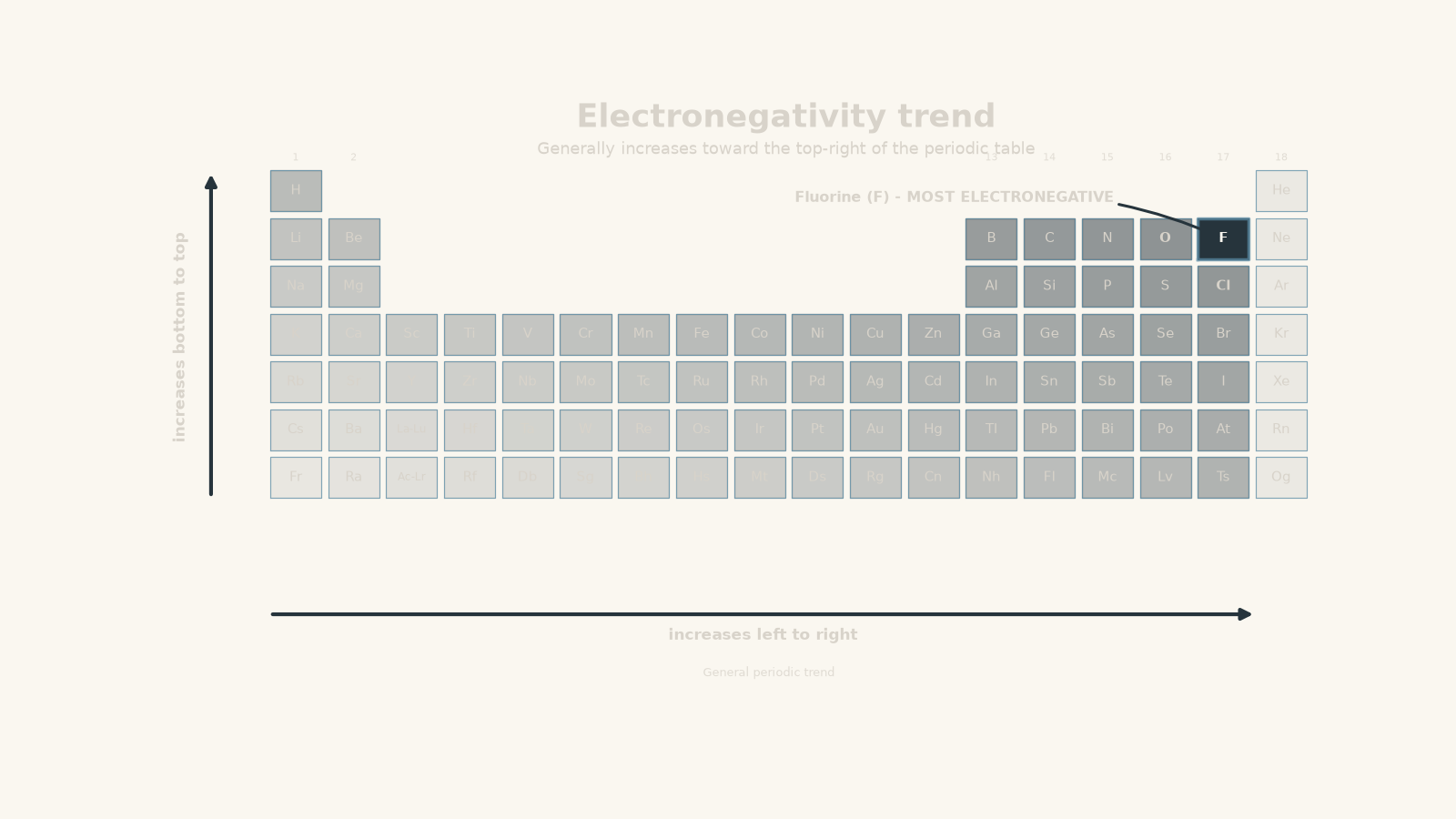
Across the periodic table, electronegativity generally:
- increases from left to right across a period
- decreases as you move down a group
- is highest near fluorine in the top-right region of the periodic table
This makes sense if you remember two earlier ideas. Across a period, nuclear charge increases while the bonding electrons remain in roughly the same principal energy level. Down a group, extra electron shells increase distance and shielding.
02Electronegativity difference tells us how uneven the bond is
Suppose atoms \(A\) and \(B\) have electronegativities \(\chi_A\) and \(\chi_B\). The electronegativity difference is
\[
\Delta EN = |\chi_A-\chi_B|
\]
The absolute-value signs mean we only care about the size of the difference, not whether the subtraction gives a positive or negative number.
Electronegativity values are dimensionless, so \(\Delta EN\) has no unit.
The bigger the difference, the more strongly one atom pulls electron density towards itself.
That gives us a useful progression:
| Electronegativity difference | Typical bond description | What is happening to the electrons? |
|---|---|---|
| Small, roughly \(0\) to \(0.4\) | Non-polar covalent | Electron density is shared fairly evenly |
| Intermediate, roughly \(0.4\) to \(1.7\) | Polar covalent | Electron density is shared unevenly |
| Large, roughly above \(1.7\) | Predominantly ionic | Electron density is strongly associated with the more electronegative atom |
These boundaries are rules of thumb, not laws of nature. Different tables and textbooks may use slightly different cut-offs. Bonding exists on a continuum, so you should not imagine an invisible switch at \(\Delta EN=1.70\) that suddenly converts a covalent bond into an ionic one.
For HSC questions, use the electronegativities or classification guidance provided in the question where possible. More importantly, explain the trend: greater electronegativity difference means greater bond polarity and greater ionic character.
03Non-polar covalent bonds: neither atom wins the tug-of-war
Consider \(\ce{Cl2}\).
Both chlorine atoms have exactly the same electronegativity. Therefore,
\[
\Delta EN = |3.16-3.16|=0
\]
Neither chlorine atom attracts the bonding electrons more strongly than the other.
The electron density is therefore distributed symmetrically between the two atoms, giving a non-polar covalent bond.
This happens automatically when two identical atoms bond, such as \(\ce{H2}\), \(\ce{N2}\), \(\ce{O2}\), and \(\ce{F2}\).
Different atoms can also form bonds that are treated as approximately non-polar if their electronegativities are very similar.
Worked example: Is a C-H bond polar?
Using electronegativity values of 2.55 for carbon and 2.20 for hydrogen, classify the C-H bond.
Step 1
\[
\Delta EN = |2.55-2.20|=0.35
\]
Step 2
A value of \(0.35\) is small, so the C-H bond is usually treated as approximately non-polar covalent at HSC level.
Step 3
Carbon does attract the bonding electrons slightly more strongly than hydrogen, so the sharing is not mathematically perfect. However, the difference is small enough that we usually treat the bond as non-polar for simple bonding classifications.
This is a useful reminder that the categories are models. Real bonds do not have to fit perfectly into neat boxes.
04Polar covalent bonds: the electrons are shared, but unevenly
Now consider \(\ce{HCl}\).
Chlorine is substantially more electronegative than hydrogen:
\[
\Delta EN = |3.16-2.20|=0.96
\]
The electrons are still shared, so the bond is covalent. However, the electron density is shifted towards chlorine.
That unequal distribution creates partial charges:
\[
\ce{H^{\delta+}-Cl^{\delta-}}
\]
The symbol \(\delta\), the Greek letter delta, means “partial”. Chlorine has not gained a full \(-1\) charge, and hydrogen has not gained a full \(+1\) charge. The bond is somewhere between perfectly equal sharing and complete charge separation.
The chlorine end is \(\delta-\) because it has greater electron density. The hydrogen end is \(\delta+\) because electron density has been pulled away from it.
That is a polar covalent bond.
A common mistake is to assign the negative end to the atom with more electrons overall. That is not the rule. Compare electronegativity. The more electronegative atom gets the \(\delta-\) end.
05Ionic bonding: when the difference becomes very large
Now compare sodium and chlorine.
Using electronegativities of 0.93 for sodium and 3.16 for chlorine,
\[
\Delta EN = |3.16-0.93|=2.23
\]
This is a much larger difference than in H-Cl.
A simple model says sodium loses an electron to form \(\mathrm{Na}^{+}\), while chlorine gains an electron to form \(\mathrm{Cl}^{-}\):
\[
\ce{Na -> Na+ + e-}
\]
\[
\ce{Cl + e- -> Cl-}
\]
The oppositely charged ions are then attracted by electrostatic forces. In solid sodium chloride, this attraction extends through a giant three-dimensional ionic lattice rather than producing separate little \(\ce{NaCl}\) molecules.
That is why simply saying “an ionic bond is where an electron is transferred” is incomplete. Electron transfer explains the formation of the ions. Ionic bonding itself is the electrostatic attraction between oppositely charged ions.
Worked example: Classifying the bonding in magnesium oxide
Magnesium has electronegativity 1.31 and oxygen has electronegativity 3.44. Use these values to explain why magnesium oxide is predominantly ionic.
Step 1
\[
\Delta EN = |3.44-1.31|=2.13
\]
There are no units because electronegativity is dimensionless.
Step 2
A difference of \(2.13\) is large. Oxygen attracts electrons much more strongly than magnesium, so the bonding has strong ionic character.
Step 3
Magnesium can lose two electrons to form \(\mathrm{Mg}^{2+}\), while oxygen can gain two electrons to form \(\mathrm{O}^{2-}\):
\[
\ce{Mg -> Mg^2+ + 2e-}
\]
\[
\ce{O + 2e- -> O^2-}
\]
Step 4
The \(\mathrm{Mg}^{2+}\) and \(\mathrm{O}^{2-}\) ions experience strong electrostatic attraction in an ionic lattice.
So the large electronegativity difference helps explain why magnesium oxide is classified as predominantly ionic.
06Bonding is a continuum, not three separate universes
The labels non-polar covalent, polar covalent, and ionic are useful, but nature does not divide bonds into three perfectly separate categories.
Imagine gradually increasing the electronegativity of one atom in a bond. The electron density would gradually shift towards that atom. Nothing magical happens when the difference passes a particular decimal value.
The most useful mental model is therefore:
\[
\text{equal sharing}
\longrightarrow
\text{unequal sharing}
\longrightarrow
\text{increasing charge separation}
\]
or, in bonding language,
\[
\text{non-polar covalent}
\longrightarrow
\text{polar covalent}
\longrightarrow
\text{increasing ionic character}
\]
This is why a bond close to a textbook cut-off should not be classified with false precision.
If \(\Delta EN=1.69\), it would be poor chemistry to argue that the bond must be fundamentally different from one with \(\Delta EN=1.71\). Use electronegativity as evidence, then consider other information about the substance when it is available.
07The most tempting misconception: ionic means the electrons are completely gone
Students are often shown diagrams where a metal hands an electron to a non-metal. That model is useful because it explains ion formation.
It becomes misleading if you interpret it too literally.
Real electron density is not divided into perfectly owned parcels. Even substances we classify as ionic can have some covalent character, while strongly polar covalent bonds can show substantial charge separation.
So what should you say in an exam?
For a large electronegativity difference, it is safe to say that the bond has strong ionic character and that the substance can be modelled as oppositely charged ions held by electrostatic attraction. Avoid claiming that electronegativity alone proves perfectly complete electron transfer.
08Bond polarity is not the same as molecular polarity
This distinction causes a lot of avoidable mistakes.
Electronegativity difference tells you whether an individual bond is polar. It does not, by itself, tell you whether an entire molecule is polar.
For example, each C-O bond in carbon dioxide is polar because oxygen is more electronegative than carbon. But \(\ce{CO2}\) is linear:
\[
\ce{O=C=O}
\]
The two bond dipoles point in opposite directions and cancel.
So \(\ce{CO2}\) contains polar covalent bonds but is a non-polar molecule overall.
That does not contradict electronegativity. It just means you have moved to the next question: once you know the polarity of each bond, how are those bonds arranged in three-dimensional space?
09A quick decision process
When you are given two bonded atoms and asked about bond type:
- Find the electronegativity of each atom.
- Calculate \(\Delta EN\) using the absolute difference.
- Use the size of \(\Delta EN\) to judge the extent of unequal electron sharing.
- Identify the more electronegative atom. In a polar covalent bond, it becomes \(\delta-\).
- Treat numerical cut-offs as approximate rather than absolute.
- If the question gives physical evidence, such as conductivity or melting behaviour, use that evidence too.
The key idea is not memorising \(0.4\) and \(1.7\). The key idea is understanding what those numbers represent: how unequal the attraction for bonding electrons has become.
10Questions and solutions
Question 1
Phosphorus has electronegativity 2.19 and chlorine has electronegativity 3.16. Classify a P-Cl bond and identify which atom carries the partial negative charge.
Solution 1
The P-Cl bond is polar covalent, and chlorine carries the partial negative charge.
The electronegativity difference is
\[
\Delta EN=|3.16-2.19|=0.97
\]
A difference of \(0.97\) indicates noticeably unequal sharing but is not large enough, using the usual approximate guide, to describe the bond as predominantly ionic.
Chlorine is more electronegative, so it attracts the bonding electron density towards itself:
\[
\ce{P^{\delta+}-Cl^{\delta-}}
\]
The important reasoning is that the sign of the partial charge comes from which atom is more electronegative, not from which atom appears first in the formula.
Question 2
Use the following electronegativities:
- hydrogen: 2.20
- sulfur: 2.58
- oxygen: 3.44
Compare an S-H bond with an O-H bond.
Which bond is more polar, and which atom is \(\delta-\) in each bond?
Solution 2
The O-H bond is more polar. Sulfur is \(\delta-\) in S-H, while oxygen is \(\delta-\) in O-H.
For S-H,
\[
\Delta EN=|2.58-2.20|=0.38
\]
For O-H,
\[
\Delta EN=|3.44-2.20|=1.24
\]
The O-H bond has the larger electronegativity difference, so its bonding electrons are shared much more unevenly.
In S-H, sulfur is slightly more electronegative than hydrogen, so electron density is shifted towards sulfur.
In O-H, oxygen is substantially more electronegative than hydrogen, so electron density is shifted towards oxygen.
A common trap is to say that both bonds are equally polar because they both contain hydrogen. Bond polarity depends on the difference between both atoms, not on the identity of just one atom.
Question 3
A student calculates an electronegativity difference of exactly \(1.70\) for a bond and writes:
“Because \(1.70\) is the ionic cut-off, this bond is definitely ionic and has no covalent character.”
Evaluate the student’s conclusion.
Solution 3
The student’s conclusion is too absolute. An electronegativity difference of \(1.70\) places the bond near a conventional boundary, so electronegativity alone does not justify claiming that the bond is completely ionic with no covalent character.
Values such as \(0.4\) and \(1.7\) are approximate classification guides. They help us describe a continuous change in electron distribution.
A bond with \(\Delta EN=1.69\) is not suddenly a fundamentally different physical object from one with \(\Delta EN=1.70\) or \(1.71\).
The better conclusion is that the bond has substantial polarity and significant ionic character. If further evidence is supplied, such as the structure of the substance, melting behaviour, or electrical conductivity, that evidence should also be used to decide how the substance is best modelled.
The misconception is treating a convenient classroom boundary as an exact law of nature.
Question 4
A hypothetical solid, \(\ce{MX}\), contains two different elements whose electronegativity difference is \(1.55\).
A student therefore predicts that the solid must consist of discrete polar covalent molecules.
Experimental observations show that the solid:
- has a high melting temperature
- does not conduct electricity while solid
- conducts electricity when molten
Which model is better supported by all the evidence: a molecular covalent solid or an ionic lattice? Explain why the electronegativity calculation alone was not enough.
Solution 4
An ionic lattice is better supported by the full set of evidence.
A \(\Delta EN\) of \(1.55\) lies near the region where a simple numerical guide may suggest strong polar-covalent character. However, the cut-off is only approximate.
The physical observations provide stronger structural evidence.
A high melting temperature is consistent with strong electrostatic attractions that require substantial energy to overcome. Failure to conduct as a solid is also expected for an ionic lattice because the ions are fixed in position.
When the substance melts, the ions become mobile. The molten substance can therefore conduct electricity because charged particles can move through it.
A simple molecular covalent substance would not normally gain mobile charged particles merely by melting.
The trap was assuming that one electronegativity number overrides every other observation. Electronegativity difference is evidence about bond character, not an infallible test that replaces experimental data.
Question 5
Use the following electronegativities:
- carbon: 2.55
- nitrogen: 3.04
- fluorine: 3.98
A molecule of \(\ce{CF4}\) is tetrahedral and perfectly symmetrical. A molecule of \(\ce{NF3}\) is trigonal pyramidal.
Compare the polarity of a C-F bond with an N-F bond, then determine whether each whole molecule is polar or non-polar.
Solution 5
A C-F bond is more polar than an N-F bond, but \(\ce{CF4}\) is non-polar overall while \(\ce{NF3}\) is polar overall.
First calculate the electronegativity differences.
For C-F,
\[
\Delta EN=|3.98-2.55|=1.43
\]
For N-F,
\[
\Delta EN=|3.98-3.04|=0.94
\]
Both bonds are polar covalent, and fluorine is \(\delta-\) in both cases. The C-F bond has the larger electronegativity difference, so it has the greater bond polarity.
However, molecular polarity depends on both bond polarity and molecular shape.
In tetrahedral \(\ce{CF4}\), the four identical C-F bond dipoles are arranged symmetrically. Their effects cancel, so the molecule has no overall dipole and is non-polar.
In trigonal pyramidal \(\ce{NF3}\), the three N-F bond dipoles do not cancel completely. The molecule therefore has an overall dipole and is polar.
The tempting mistake is to assume that a molecule containing very polar bonds must itself be polar. Electronegativity tells you about each bond first. Molecular geometry determines whether those bond dipoles reinforce or cancel one another.
Once you can use electronegativity to predict bond polarity, the next useful step is to combine that information with molecular shape. That lets you predict whole-molecule polarity, which then helps explain intermolecular forces, boiling temperatures, solubility, and many of the physical properties that appear later in HSC Chemistry.