
Reduction Potentials of Galvanic Half-Cells: HSC Chemistry
Learn how reduction potentials are measured, compared, and used to predict galvanic cell behaviour. Includes worked examples, experimental interpretation, and challenging HSC-style questions.
A zinc-copper galvanic cell gives a voltmeter reading of about \(1.10\ \text{V}\) under standard conditions. What does that number belong to? Is zinc’s reduction potential \(-1.10\ \text{V}\)? Is copper’s \(+1.10\ \text{V}\)?
Neither. The voltmeter measures the difference between the two half-cells. That creates the central problem of reduction potentials: you can’t measure one half-cell’s potential by itself. You need to compare it with another half-cell whose potential is already known.
Before going further, make a prediction. If you swap the two voltmeter leads without changing anything else, what should happen?
The size of the reading should stay the same, but its sign should reverse. The chemistry hasn’t changed. You’ve only changed which electrode the meter treats as positive.
01What the voltmeter is actually measuring
Picture two floors in a building. If one floor is \(4\ \text{m}\) above another, you know the height difference, but you still don’t know either floor’s height above sea level.
Electrode potentials work similarly. A voltmeter can measure the potential difference between two electrodes, but it can’t reveal an absolute electrode potential.
The analogy has a limit. Electrode potential isn’t a literal height, and electrons aren’t simply falling downhill through space. The useful part of the analogy is that only a difference can be measured directly.
In a galvanic cell:
- oxidation occurs at the anode
- reduction occurs at the cathode
- electrons move through the external circuit from anode to cathode
- the anode is the negative electrode
- the cathode is the positive electrode.
For a cell operating under standard conditions,
\[
E^\circ_{\text{cell}}
=
E^\circ_{\text{red,cathode}}
–
E^\circ_{\text{red,anode}}
\]
where:
- \(E^\circ_{\text{cell}}\) is the standard cell potential, in volts (\(\text{V}\))
- \(E^\circ_{\text{red,cathode}}\) is the standard reduction potential of the cathode half-cell
- \(E^\circ_{\text{red,anode}}\) is the standard reduction potential listed for the half-cell that is actually operating in reverse, as the anode.
A spontaneous galvanic cell has \(E^\circ_{\text{cell}}>0\) for the reaction proceeding in its spontaneous direction.
That equation is really a comparison rule. The half-cell with the more positive reduction potential becomes the cathode. The half-cell with the less positive, or more negative, reduction potential becomes the anode.
02How can one half-cell have a reduction potential at all?
Suppose you make a \(\ce{Cu^2+/Cu}\) half-cell. You place copper metal into a solution containing \(\mathrm{Cu}^{2+}\).
The half-equation is written as a reduction:
\[
\ce{Cu^2+(aq) + 2e- -> Cu(s)}
\]
You might want to connect a voltmeter to that copper electrode and simply read its reduction potential.
There is an immediate problem: a voltmeter needs two electrical connections. One half-cell isn’t enough.
So chemists choose a reference half-cell and define its standard reduction potential as exactly \(0.00\ \text{V}\). The reference is the standard hydrogen electrode, or SHE.
Its reduction half-equation is:
\[
\ce{2H+(aq) + 2e- -> H2(g)}
\]
with
\[
E^\circ = 0.00\ \text{V}
\]
by convention.
Under standard conditions, the hydrogen electrode uses hydrogen gas, hydrogen ions at standard concentration, and a platinum electrode that provides a conducting surface without being consumed.
Standard electrode potentials are normally quoted at \(25^\circ\text{C}\), with dissolved species at \(1.0\ \text{mol L}^{-1}\), gases at standard pressure, and pure solids or liquids in their standard states.
The zero isn’t claiming that the hydrogen half-cell has “no electrical behaviour”. It is simply the agreed reference point.
03Measuring an unknown half-cell
Imagine you want the standard reduction potential of an unknown \(\ce{M^2+/M}\) half-cell.
You connect it to a reference half-cell using a salt bridge and a high-resistance voltmeter.
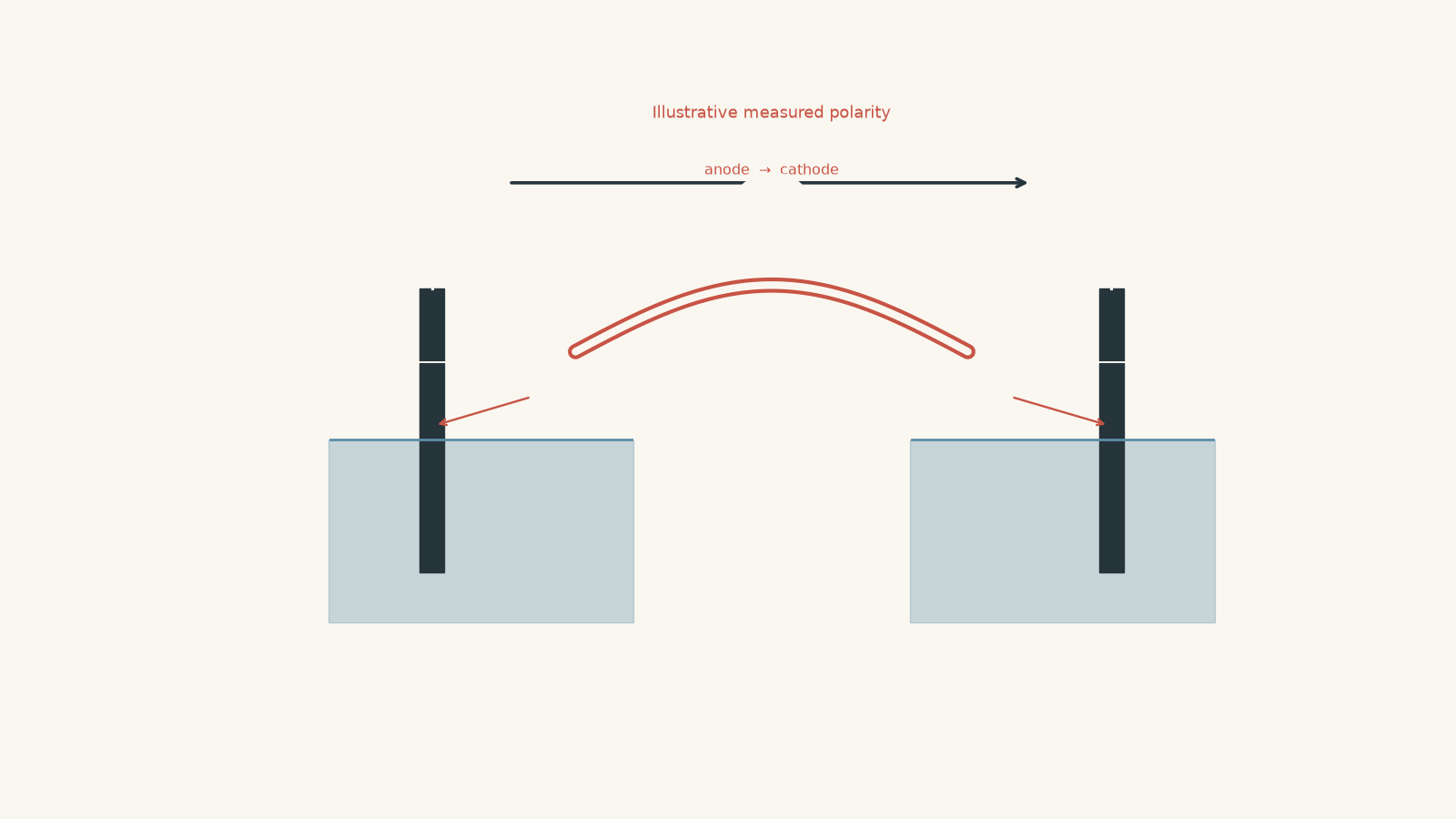
The salt bridge matters because electrons moving through the wire would quickly create charge imbalance in the two solutions. Ions in the salt bridge migrate to maintain electrical neutrality.
The voltmeter should have a high resistance so that very little current flows while the potential is being measured. If the cell runs strongly while you’re trying to measure it, concentrations near the electrodes can change and the measured voltage may drift.
The experimental logic is:
- Prepare both half-cells under the required conditions.
- Connect them with a salt bridge.
- Connect the electrodes to a voltmeter.
- Record which electrode is positive.
- Record the magnitude of the potential difference.
- Use the known reduction potential of the reference half-cell to calculate the unknown value.
The polarity is essential. A voltage of \(0.60\ \text{V}\) doesn’t tell you enough by itself. You also need to know which half-cell was the cathode.
A useful decision rule
If the unknown half-cell is the cathode,
\[
E^\circ_{\text{cell}}
=
E^\circ_{\text{unknown}}
–
E^\circ_{\text{reference}}
\]
so
\[
E^\circ_{\text{unknown}}
=
E^\circ_{\text{cell}}
+
E^\circ_{\text{reference}}
\]
If the unknown half-cell is the anode,
\[
E^\circ_{\text{cell}}
=
E^\circ_{\text{reference}}
–
E^\circ_{\text{unknown}}
\]
so
\[
E^\circ_{\text{unknown}}
=
E^\circ_{\text{reference}}
–
E^\circ_{\text{cell}}
\]
Don’t memorise both forms if that makes things worse. Start with
\[
E^\circ_{\text{cell}}
=
E^\circ_{\text{cathode}}
–
E^\circ_{\text{anode}}
\]
and substitute carefully.
04What does a more positive reduction potential mean?
Consider these standard reduction potentials:
| Reduction half-equation | \(E^\circ\) |
|---|---|
| \(\ce{Ag+ + e- -> Ag}\) | \(+0.80\ \text{V}\) |
| \(\ce{Cu^2+ + 2e- -> Cu}\) | \(+0.34\ \text{V}\) |
| \(\ce{2H+ + 2e- -> H2}\) | \(0.00\ \text{V}\) |
| \(\ce{Fe^2+ + 2e- -> Fe}\) | \(-0.44\ \text{V}\) |
| \(\ce{Zn^2+ + 2e- -> Zn}\) | \(-0.76\ \text{V}\) |
A more positive value means the reduction reaction has a greater tendency to occur when compared under the same standard conditions.
So if silver and zinc half-cells are connected, which reduction happens?
Silver. Its reduction potential, \(+0.80\ \text{V}\), is much more positive than zinc’s \(-0.76\ \text{V}\).
Therefore:
Cathode:
\[
\ce{Ag+ + e- -> Ag}
\]
Anode, with the listed zinc reduction equation reversed:
\[
\ce{Zn -> Zn^2+ + 2e-}
\]
This also explains a useful connection with metal reactivity. Metals such as zinc, magnesium, and aluminium are readily oxidised, so their metal-ion reduction potentials tend to be quite negative. You can connect this electrochemical view with the patterns in The Metal Activity Series: Practical HSC Chemistry Guide.
Be careful with the wording, though. A very positive reduction potential means the oxidised species on the left of the reduction equation is a strong oxidising agent. A very negative reduction potential usually means the reduced species on the right is a strong reducing agent when the reaction is reversed.
05Worked example: calculating the voltage of a silver-iron cell
A standard galvanic cell is made from the half-cells \(\ce{Ag+/Ag}\) and \(\ce{Fe^2+/Fe}\).
Given:
\[
E^\circ(\ce{Ag+/Ag})=+0.80\ \text{V}
\]
and
\[
E^\circ(\ce{Fe^2+/Fe})=-0.44\ \text{V}
\]
Determine the cathode, anode, direction of electron flow, overall reaction, and standard cell potential.
Step 1
Silver has \(+0.80\ \text{V}\), while iron has \(-0.44\ \text{V}\). Silver is therefore reduced at the cathode.
\[
\ce{Ag+ + e- -> Ag}
\]
Iron is oxidised at the anode:
\[
\ce{Fe -> Fe^2+ + 2e-}
\]
Step 2
Multiply the silver half-equation by two:
\[
\ce{2Ag+ + 2e- -> 2Ag}
\]
Then add the half-equations:
\[
\ce{2Ag+ + Fe -> 2Ag + Fe^2+}
\]
Step 3
\[
\begin{aligned}
E^\circ_{\text{cell}}
&=
E^\circ_{\text{cathode}}
–
E^\circ_{\text{anode}}\\
&=
(+0.80)-(-0.44)\\
&=
+1.24\ \text{V}
\end{aligned}
\]
Step 4
The positive \(1.24\ \text{V}\) value shows that the reaction written above is spontaneous under standard conditions. Electrons travel from the iron electrode to the silver electrode through the external circuit.
Notice something important: we multiplied the silver half-equation by two when balancing electrons, but we did not multiply \(+0.80\ \text{V}\) by two.
Electrode potentials are not multiplied by stoichiometric coefficients.
06Worked example: using a measured cell voltage to find an unknown potential
An unknown standard half-cell \(\ce{X^2+/X}\) is connected to a standard \(\ce{Cu^2+/Cu}\) half-cell.
The copper electrode is positive, and the measured cell potential is \(0.71\ \text{V}\).
Given:
\[
E^\circ(\ce{Cu^2+/Cu})=+0.34\ \text{V}
\]
Determine \(E^\circ(\ce{X^2+/X})\). Then predict the standard cell potential when the \(X\) half-cell is connected to a \(\ce{Zn^2+/Zn}\) half-cell with \(E^\circ=-0.76\ \text{V}\).
Step 1
Copper is the positive electrode, so copper is the cathode. The unknown \(X\) electrode is the anode.
Therefore,
\[
\begin{aligned}
E^\circ_{\text{cell}}
&=
E^\circ_{\ce{Cu^2+/Cu}}
–
E^\circ_{\ce{X^2+/X}}\\
0.71
&=
0.34-E^\circ_{\ce{X^2+/X}}
\end{aligned}
\]
Step 2
\[
\begin{aligned}
E^\circ_{\ce{X^2+/X}}
&=
0.34-0.71\\
&=
-0.37\ \text{V}
\end{aligned}
\]
So the unknown standard reduction potential is \(-0.37\ \text{V}\).
Step 3
\[
E^\circ(\ce{X^2+/X})=-0.37\ \text{V}
\]
\[
E^\circ(\ce{Zn^2+/Zn})=-0.76\ \text{V}
\]
The \(X\) half-cell has the more positive reduction potential, so \(X^{2+}\) is reduced and zinc is oxidised.
Step 4
\[
\begin{aligned}
E^\circ_{\text{cell}}
&=
(-0.37)-(-0.76)\\
&=
+0.39\ \text{V}
\end{aligned}
\]
The spontaneous reaction is
\[
\ce{X^2+ + Zn -> X + Zn^2+}
\]
and the standard cell potential is \(0.39\ \text{V}\).
The useful part of the first measurement was not just the \(0.71\ \text{V}\). The observation that copper was positive told us which way to subtract.
07Reduction potentials are always written as reductions
Electrochemical tables use a consistent convention: every half-equation is written as a reduction.
For example,
\[
\ce{Zn^2+ + 2e- -> Zn}
\qquad
E^\circ=-0.76\ \text{V}
\]
In a zinc-copper galvanic cell, zinc actually undergoes oxidation:
\[
\ce{Zn -> Zn^2+ + 2e-}
\]
You do not need to hunt for a separate “oxidation potential” before using the usual HSC equation. Keep both tabulated values as reduction potentials and calculate
\[
E^\circ_{\text{cell}}
=
E^\circ_{\text{red,cathode}}
–
E^\circ_{\text{red,anode}}
\]
This avoids one of the most common sign errors.
You may also see oxidation potentials defined by changing the sign when a half-equation is reversed. That is mathematically valid, but mixing both conventions halfway through a calculation is where mistakes multiply.
08Why the potential isn’t multiplied when you balance electrons
Suppose we combine:
\[
\ce{Ag+ + e- -> Ag}
\qquad
E^\circ=+0.80\ \text{V}
\]
with
\[
\ce{Cu^2+ + 2e- -> Cu}
\qquad
E^\circ=+0.34\ \text{V}
\]
The spontaneous reaction is
\[
\ce{2Ag+ + Cu -> 2Ag + Cu^2+}
\]
Two silver ions are needed because copper releases two electrons.
A tempting calculation is
\[
2(0.80)-0.34
\]
but that is wrong.
Potential is energy transferred per unit charge. Doubling the reaction doubles the amount of chemical change and the total charge transferred, so the ratio represented by voltage does not double.
The correct calculation is simply
\[
E^\circ_{\text{cell}}
=
0.80-0.34
=
0.46\ \text{V}
\]
Balance the chemical equation. Don’t scale the electrode potentials.
09Standard potential and measured potential are not always the same thing
The little degree symbol in \(E^\circ\) matters.
\(E^\circ\) means the potential under standard conditions. A potential measured under different concentrations, pressures, or temperatures is an electrode potential \(E\), but not necessarily the standard electrode potential \(E^\circ\).
Imagine a student looks up
\[
E^\circ(\ce{Cu^2+/Cu})=+0.34\ \text{V}
\]
and then prepares a copper half-cell using a very dilute \(\mathrm{Cu}^{2+}\) solution.
Should they expect its actual electrode potential to be exactly \(+0.34\ \text{V}\)?
No. The standard value belongs to standard conditions. Changing the concentration changes the balance between the oxidised and reduced forms and therefore changes the measured electrode potential.
At HSC level, the key experimental lesson is simple: if you are trying to measure or compare standard reduction potentials, control the conditions.
This is also why a disagreement between your experimental value and a data table does not automatically prove the table is wrong.
10What can shift or spoil an experimental reading?
A good electrochemical measurement is more than “stick two metals in beakers and read the screen”.
| Experimental issue | Why it matters |
|---|---|
| Ion concentrations are not standard | The measured electrode potentials may differ from \(E^\circ\) |
| Temperature changes | Electrode potentials are temperature-dependent |
| Gas pressure is incorrect in a gas half-cell | The half-cell is no longer under standard conditions |
| Salt bridge is missing or poorly connected | Charge separation develops and sustained electron flow is prevented |
| Electrode surfaces are dirty or coated | Electron-transfer behaviour may become slow or unstable |
| Solutions contaminate one another | The intended half-cell compositions change |
| A low-resistance load is used instead of a voltmeter | Significant current can change concentrations and cause the measured voltage to fall |
| Polarity is not recorded | You know the size of the difference, but not which half-cell has the greater reduction potential |
Surface area deserves one extra comment. Making an electrode larger does not ideally change its equilibrium electrode potential just because there is “more metal”. It can change the rate at which electrode reactions occur and make practical measurements more stable, but reduction potential is not proportional to electrode area.
11Reading reduction-potential data without getting trapped
A useful interpretation table is:
| Observation or value | What you can conclude |
|---|---|
| More positive \(E^\circ_{\text{red}}\) | Greater tendency for the listed reduction to occur |
| Less positive or more negative \(E^\circ_{\text{red}}\) | Greater tendency for the reverse oxidation when paired with a more positive half-cell |
| Positive electrode in a galvanic cell | Cathode |
| Negative electrode in a galvanic cell | Anode |
| \(E^\circ_{\text{cell}}>0\) | Overall reaction as written is spontaneous under standard conditions |
| \(E^\circ_{\text{cell}}<0\) | Reverse the proposed reaction to obtain the spontaneous direction |
| Larger positive \(E^\circ_{\text{cell}}\) | Larger standard potential difference between the selected half-cells |
For metal/metal-ion half-cells, the link with reactivity is especially useful. Highly reactive metals are readily oxidised, so their reduction potentials tend to be very negative. The pattern isn’t something to memorise as two unrelated lists; it is another way of expressing the chemistry behind the periodic patterns in metal activity.
12The misconceptions worth catching early
One tempting idea is that a positive reduction potential means the electrode itself is always positive. It doesn’t. The sign of \(E^\circ\) tells you the half-cell’s potential relative to the standard hydrogen electrode. The physical electrode becomes positive or negative only relative to the other half-cell it is connected to.
Another is that a negative \(E^\circ\) means reduction “can’t happen”. It can. A \(\ce{Zn^2+/Zn}\) half-cell with \(E^\circ=-0.76\ \text{V}\) will act as the cathode if it is paired with an even more negative half-cell, such as \(\ce{Mg^2+/Mg}\).
The comparison decides the direction.
Finally, don’t treat a data-book \(E^\circ\) value as an unchanging property that applies under every experimental condition. It is a standard-state reference value. That distinction becomes especially important when concentration changes.
13Questions and solutions
Question 1
A galvanic cell is constructed under standard conditions from:
\[
\ce{Mg^2+ + 2e- -> Mg}
\qquad
E^\circ=-2.37\ \text{V}
\]
and
\[
\ce{Cu^2+ + 2e- -> Cu}
\qquad
E^\circ=+0.34\ \text{V}
\]
Identify the anode and cathode, state the direction of electron flow, write the overall reaction, and calculate \(E^\circ_{\text{cell}}\).
Solution 1
Copper is the cathode, magnesium is the anode, electrons flow from magnesium to copper, and \(E^\circ_{\text{cell}}=2.71\ \text{V}\).
Copper has the more positive reduction potential, so reduction occurs there:
\[
\ce{Cu^2+ + 2e- -> Cu}
\]
Magnesium therefore undergoes oxidation:
\[
\ce{Mg -> Mg^2+ + 2e-}
\]
The overall reaction is
\[
\ce{Mg + Cu^2+ -> Mg^2+ + Cu}
\]
The standard cell potential is
\[
\begin{aligned}
E^\circ_{\text{cell}}
&=
E^\circ_{\text{cathode}}
–
E^\circ_{\text{anode}}\\
&=
(+0.34)-(-2.37)\\
&=
+2.71\ \text{V}
\end{aligned}
\]
The positive result confirms that the reaction is spontaneous in the direction written under standard conditions.
A tempting error is to decide that magnesium must be the cathode because it is “more reactive”. Its high reactivity actually means magnesium metal is readily oxidised, which is why its reduction potential is so negative.
Question 2
An unknown standard half-cell \(\ce{M^2+/M}\) is connected to a standard zinc half-cell.
The red, positive voltmeter lead is connected to the zinc electrode and the black lead is connected to \(M\). The meter reads \(+0.45\ \text{V}\).
Given
\[
E^\circ(\ce{Zn^2+/Zn})=-0.76\ \text{V}
\]
determine:
- \(E^\circ(\ce{M^2+/M})\)
- which electrode would be the cathode if \(M\) were connected to an \(\ce{Fe^2+/Fe}\) half-cell with \(E^\circ=-0.44\ \text{V}\)
- the standard potential of that \(M\)-iron cell.
Solution 2
The unknown reduction potential is \(-1.21\ \text{V}\); iron would be the cathode when paired with \(M\), and that cell would have \(E^\circ_{\text{cell}}=0.77\ \text{V}\).
Because the red lead is attached to zinc and the meter reading is positive, zinc is the positive electrode. In a galvanic cell, that means zinc is the cathode.
Therefore,
\[
\begin{aligned}
E^\circ_{\text{cell}}
&=
E^\circ_{\ce{Zn^2+/Zn}}
–
E^\circ_{\ce{M^2+/M}}\\
0.45
&=
-0.76-E^\circ_{\ce{M^2+/M}}
\end{aligned}
\]
Rearranging,
\[
\begin{aligned}
E^\circ_{\ce{M^2+/M}}
&=
-0.76-0.45\\
&=
-1.21\ \text{V}
\end{aligned}
\]
Now compare \(M\) with iron:
\[
E^\circ_{\ce{M^2+/M}}=-1.21\ \text{V}
\]
\[
E^\circ_{\ce{Fe^2+/Fe}}=-0.44\ \text{V}
\]
Iron has the more positive reduction potential, so iron is the cathode.
The standard cell potential is
\[
\begin{aligned}
E^\circ_{\text{cell}}
&=
(-0.44)-(-1.21)\\
&=
+0.77\ \text{V}
\end{aligned}
\]
The tempting route is to see a meter reading of \(+0.45\ \text{V}\) and call that the unknown half-cell’s reduction potential. The meter is not measuring \(M\) alone. The polarity tells us zinc is \(0.45\ \text{V}\) above \(M\), which places \(M\) below zinc at \(-1.21\ \text{V}\).
Question 3
A student constructs a cell using a platinum electrode in a solution containing \(\mathrm{Fe}^{3+}\) and \(\mathrm{Fe}^{2+}\), connected to a standard \(\ce{Cu^2+/Cu}\) half-cell.
The standard reduction potentials are:
\[
\ce{Fe^3+ + e- -> Fe^2+}
\qquad
E^\circ=+0.77\ \text{V}
\]
\[
\ce{Cu^2+ + 2e- -> Cu}
\qquad
E^\circ=+0.34\ \text{V}
\]
Under standard conditions, the expected cell potential would therefore be \(0.43\ \text{V}\), with the iron-ion half-cell as the cathode.
The student instead measures \(0.28\ \text{V}\), still with the iron-ion half-cell positive. They later discover that their iron solution contained \(0.10\ \text{mol L}^{-1}\) \(\mathrm{Fe}^{3+}\) and \(1.0\ \text{mol L}^{-1}\) \(\mathrm{Fe}^{2+}\).
Does the measurement show that the tabulated \(E^\circ\) value of \(+0.77\ \text{V}\) is wrong? Explain the direction of the discrepancy.
Solution 3
No. The measurement does not show that the tabulated \(+0.77\ \text{V}\) value is wrong; the iron-ion half-cell was not under standard conditions, and its actual reduction potential was lower than its standard value.
The listed reduction process is
\[
\ce{Fe^3+ + e- -> Fe^2+}
\]
In the student’s half-cell, the reactant \(\mathrm{Fe}^{3+}\) is less concentrated than under standard conditions, while the product \(\mathrm{Fe}^{2+}\) is present at a higher concentration relative to it.
That makes the forward reduction less favourable than it would be under the standard-state mixture. The actual reduction potential of the \(\ce{Fe^3+/Fe^2+}\) half-cell therefore falls below \(+0.77\ \text{V}\).
The cell voltage consequently falls below the standard prediction of
\[
\begin{aligned}
E^\circ_{\text{cell}}
&=
0.77-0.34\\
&=
0.43\ \text{V}
\end{aligned}
\]
The observed \(0.28\ \text{V}\) is still positive with the iron-ion electrode as the cathode, so its actual reduction potential remains above that of the copper half-cell under these experimental conditions.
The tempting conclusion is “experimental number different from data-book number, therefore somebody’s value is wrong”. The hidden constraint is the degree symbol: \(E^\circ\) describes standard conditions. The experiment did not satisfy them.
Question 4
Four unknown half-cells, \(A\), \(B\), \(C\), and \(D\), are tested under identical controlled conditions. The first four measurements are repeated several times and are reproducible.
- \(A\) is positive relative to \(B\) by \(0.52\ \text{V}\).
- \(B\) is positive relative to \(C\) by \(0.21\ \text{V}\).
- \(A\) is positive relative to \(C\) by \(0.73\ \text{V}\).
- \(D\) is positive relative to \(C\) by \(0.44\ \text{V}\).
A fifth measurement, performed only once, reports that \(D\) is positive relative to \(A\) by \(0.09\ \text{V}\).
Use the first four measurements to:
- rank the half-cells from highest to lowest reduction potential
- predict the voltage and polarity that should be observed when \(A\) and \(D\) are connected
- decide whether the fifth measurement can be correct
- state whether the absolute reduction potentials of \(A\), \(B\), \(C\), and \(D\) can be found from these measurements alone.
Solution 4
The order is \(A>D>B>C\); \(A\) should be positive relative to \(D\) by \(0.29\ \text{V}\); the fifth measurement is inconsistent with the reproducible data; and the absolute reduction potentials cannot be found without a reference value.
Choose \(C\) temporarily as a zero point. This does not mean its actual reduction potential is \(0.00\ \text{V}\); it is just a convenient way to track differences.
Since \(B\) is \(0.21\ \text{V}\) above \(C\),
\[
E_B-E_C=0.21\ \text{V}
\]
so relative to our temporary zero,
\[
E_B=0.21\ \text{V}
\]
Since \(A\) is \(0.73\ \text{V}\) above \(C\),
\[
E_A=0.73\ \text{V}
\]
This also agrees with the separate measurements because
\[
0.52+0.21=0.73\ \text{V}
\]
For \(D\),
\[
E_D-E_C=0.44\ \text{V}
\]
so
\[
E_D=0.44\ \text{V}
\]
The relative order is therefore
\[
A>D>B>C
\]
The predicted difference between \(A\) and \(D\) is
\[
\begin{aligned}
E_A-E_D
&=
0.73-0.44\\
&=
0.29\ \text{V}
\end{aligned}
\]
So \(A\), not \(D\), should be positive by \(0.29\ \text{V}\).
The reported fifth result, with \(D\) positive by \(0.09\ \text{V}\), cannot fit the first four reproducible measurements under the same conditions. Its polarity is reversed and its magnitude is inconsistent.
A loose approach might try to average all five measurements. That would hide the real problem. Potential differences must be mutually consistent. If \(A\) sits \(0.73\ \text{V}\) above \(C\), and \(D\) sits \(0.44\ \text{V}\) above \(C\), their difference is fixed at \(0.29\ \text{V}\).
Finally, the absolute reduction potentials cannot be determined. We know all their separations, but we could add the same number to every potential without changing any measured cell voltage.
For example, the relative set
\[
A=0.73,\quad D=0.44,\quad B=0.21,\quad C=0.00
\]
produces exactly the same voltage differences as
\[
A=1.03,\quad D=0.74,\quad B=0.51,\quad C=0.30
\]
all in volts.
One half-cell must be tied to an agreed reference value before the absolute \(E\) values can be assigned. That is exactly the job performed by a reference electrode such as the standard hydrogen electrode.
Question 5
Two half-cells both use the same \(\ce{Cu^2+/Cu}\) redox couple and identical copper electrodes at the same temperature.
The left half-cell contains \(1.0\ \text{mol L}^{-1}\) \(\mathrm{Cu}^{2+}\). The right half-cell contains \(0.010\ \text{mol L}^{-1}\) \(\mathrm{Cu}^{2+}\).
They are joined by a salt bridge and connected to a high-resistance voltmeter. The meter shows that the left electrode is positive.
A student argues:
“Both half-cells have the same standard reduction potential, \(+0.34\ \text{V}\), so their voltage difference must be zero. The voltmeter reading proves something is wrong.”
Explain why the student’s conclusion fails. Identify the cathode and anode, state the direction of electron flow, describe the electrode reactions, predict what happens to the voltage as the cell operates, and explain what this experiment reveals about the meaning of \(E^\circ\).
Solution 5
The reading is entirely possible: the left, more concentrated half-cell is the cathode, the right, more dilute half-cell is the anode, electrons travel from right to left, and the voltage tends towards zero as the two concentrations move towards equality.
Both half-cells do indeed have the same standard reduction potential:
\[
E^\circ(\ce{Cu^2+/Cu})=+0.34\ \text{V}
\]
But only the left half-cell is initially at the standard \(\mathrm{Cu}^{2+}\) concentration. The right half-cell contains only \(0.010\ \text{mol L}^{-1}\) \(\mathrm{Cu}^{2+}\).
The student’s hidden assumption is that \(E^\circ\) and the actual electrode potential \(E\) are always identical. They aren’t. \(E^\circ\) applies to a specified standard state.
In the more concentrated left solution, reduction of copper ions is relatively more favourable:
\[
\ce{Cu^2+(aq) + 2e- -> Cu(s)}
\]
So the left electrode acts as the cathode.
At the dilute right electrode, the reverse process occurs:
\[
\ce{Cu(s) -> Cu^2+(aq) + 2e-}
\]
so the right electrode is the anode.
Electrons therefore move through the wire from the right electrode to the left electrode.
Now follow what that does to the concentrations.
At the right anode, copper atoms become \(\mathrm{Cu}^{2+}\), increasing the copper-ion concentration.
At the left cathode, \(\mathrm{Cu}^{2+}\) ions are removed from solution and deposited as copper metal, decreasing the copper-ion concentration.
The cell is therefore reducing the concentration difference that created its voltage in the first place.
As the concentrations become more similar, the potential difference becomes smaller. If the two half-cells eventually reach the same relevant conditions, the driving force disappears and the voltage tends towards \(0\ \text{V}\).
The salt bridge follows the same charge-balance logic as any galvanic cell. Anions migrate towards the right-hand anode compartment, where extra positive \(\mathrm{Cu}^{2+}\) ions are being produced. Cations migrate towards the left-hand cathode compartment, where positive \(\mathrm{Cu}^{2+}\) ions are being consumed.
The tempting answer was based on a true statement used outside its limits: both half-cells have the same \(E^\circ\). The crucial distinction is that they do not have the same actual \(E\) under these different concentrations.
That is the deeper purpose of a standard reduction-potential table. It gives you a common reference for comparing half-cells under specified conditions. It does not say that a particular redox couple carries one fixed voltage regardless of its surroundings.
Once that distinction is clear, reduction-potential measurements become much more useful. They let you move beyond memorising an activity series and instead predict which species will be oxidised, which will be reduced, the direction of electron flow, and the voltage a galvanic cell should produce – while also recognising when experimental conditions mean the standard table is no longer the whole story.