
Preparing and Testing a Buffer for HSC Chemistry
Learn how to prepare an acid-conjugate base buffer, test its resistance to added acid and base, and calculate pH changes and buffer capacity.
Imagine two solutions with nearly the same starting pH. You add a small amount of hydrochloric acid to each. One solution’s pH crashes. The other barely moves.
What is the second solution doing with the added acid?
Before reading on, make a prediction. A buffer contains an acid, so should adding more acid simply make it acidic very quickly? That sounds reasonable, but it misses the important part: a buffer contains a weak acid and a substantial amount of its conjugate base. The conjugate base can remove much of the added acid before it is free to change the pH.
That gives us a useful experimental goal: prepare a buffer, add measured amounts of strong acid and strong base, and test whether its pH really changes less than an unbuffered solution.
01The basic idea: a buffer has two chemical “defences”
We will use an ethanoic acid/ethanoate buffer. Ethanoic acid is the weak acid, \(\ce{CH3COOH}\), and ethanoate is its conjugate base, \(\ce{CH3COO-}\).
Ethanoic acid establishes this equilibrium:
\[ \ce{CH3COOH + H2O <=> H3O+ + CH3COO-} \]
A solution containing only ethanoic acid is not a particularly effective buffer. We need a substantial amount of \(\ce{CH3COO-}\) as well. Sodium ethanoate provides it:
\[ \ce{CH3COONa -> Na+ + CH3COO-} \]
Now predict what happens if a little hydrochloric acid is added. The acid increases the amount of \(\ce{H3O+}\). Which buffer species can react with that?
The ethanoate ion can:
\[ \ce{CH3COO- + H3O+ -> CH3COOH + H2O} \]
Much of the added \(\ce{H3O+}\) is converted into the weak acid. The pH still falls, but by much less than it would in water.
If sodium hydroxide is added instead, the weak acid reacts with the added hydroxide ions:
\[ \ce{CH3COOH + OH- -> CH3COO- + H2O} \]
The pH rises, but again, the change is reduced.
A slightly silly way to picture this is as two friends at a party dealing with awkward arrivals. Ethanoate deals with incoming acid, while ethanoic acid deals with incoming base. If only one friend is there, half the problems go straight through. If both are there in decent amounts, most small disturbances get intercepted.
The analogy breaks once too much acid or base arrives. Chemical buffers have a finite amount of each component. They cannot keep intercepting added ions forever.
02What a buffer actually does
A buffer does not keep pH perfectly constant. It resists pH change.
That distinction matters experimentally. If a buffer starts at pH 4.76 and falls to pH 4.67 after acid is added, it has not “failed”. A change of 0.09 pH units may be very small compared with the same addition to an unbuffered solution.
The two buffer components have different jobs.
| Disturbance | Main reaction | Composition change | Expected pH change |
|---|---|---|---|
| Add strong acid | \(\ce{A- + H3O+ -> HA + H2O}\) | \(\mathrm{A}^{-}\) decreases, \(\ce{HA}\) increases | Small decrease |
| Add strong base | \(\ce{HA + OH- -> A- + H2O}\) | \(\ce{HA}\) decreases, \(\mathrm{A}^{-}\) increases | Small increase |
| Add too much acid | Eventually most \(\mathrm{A}^{-}\) is used up | Acid-removing capacity collapses | Large decrease |
| Add too much base | Eventually most \(\ce{HA}\) is used up | Base-removing capacity collapses | Large increase |
Here, \(\ce{HA}\) represents a weak acid and \(\mathrm{A}^{-}\) represents its conjugate base.
03Why the acid and conjugate base do not simply destroy each other
A common prediction is that putting an acid and a base together should make them neutralise completely.
That is what happens when suitable amounts of a strong acid and strong base react. A buffer is different. Its components are a weak acid and its conjugate base, and they are connected by an equilibrium rather than a one-way complete neutralisation.
For ethanoic acid:
\[ \ce{CH3COOH <=> H+ + CH3COO-} \]
The solution naturally contains both forms.
This is also why mixing \(\ce{HCl}\) and \(\ce{NaOH}\) together does not produce an HCl/NaCl “buffer”. After complete neutralisation, there is no useful weak acid/conjugate base pair left.
04Connecting the composition to pH
The acid dissociation constant for a weak acid is
\[ K_a=\frac{[\ce{H3O+}][\mathrm{A}^{-}]}{[\ce{HA}]} \]
where \(K_a\) measures the extent of acid ionisation, \([\ce{H3O+}]\) is the hydronium concentration, \([\mathrm{A}^{-}]\) is the conjugate-base concentration, and \([\ce{HA}]\) is the weak-acid concentration.
Using \(pK_a=-\log K_a\), this can be rearranged to give the Henderson-Hasselbalch equation:
\[ \mathrm{pH}=pK_a+\log\left(\frac{[\mathrm{A}^{-}]}{[\ce{HA}]}\right) \]
If you need a refresher on what \(K_a\) and \(pK_a\) actually tell you about an acid, see Ka, pKa and Acid Strength: HSC Chemistry Guide.
The equation contains a useful piece of chemistry.
If the weak acid and conjugate base are present in equal concentrations,
\[ [\mathrm{A}^{-}]=[\ce{HA}] \]
so their ratio is 1. Since \(\log 1=0\),
\[ \mathrm{pH}=pK_a \]
For ethanoic acid at typical laboratory conditions, \(pK_a\) is about 4.76. An ethanoic acid/ethanoate buffer containing equal amounts of the two species therefore has a pH close to 4.76.
This first model is useful, but not exact. The Henderson-Hasselbalch equation assumes behaviour close to an ideal solution, and \(pK_a\) itself changes somewhat with temperature. A pH probe measures the actual solution, so your experimental result does not have to land exactly on the calculated value.
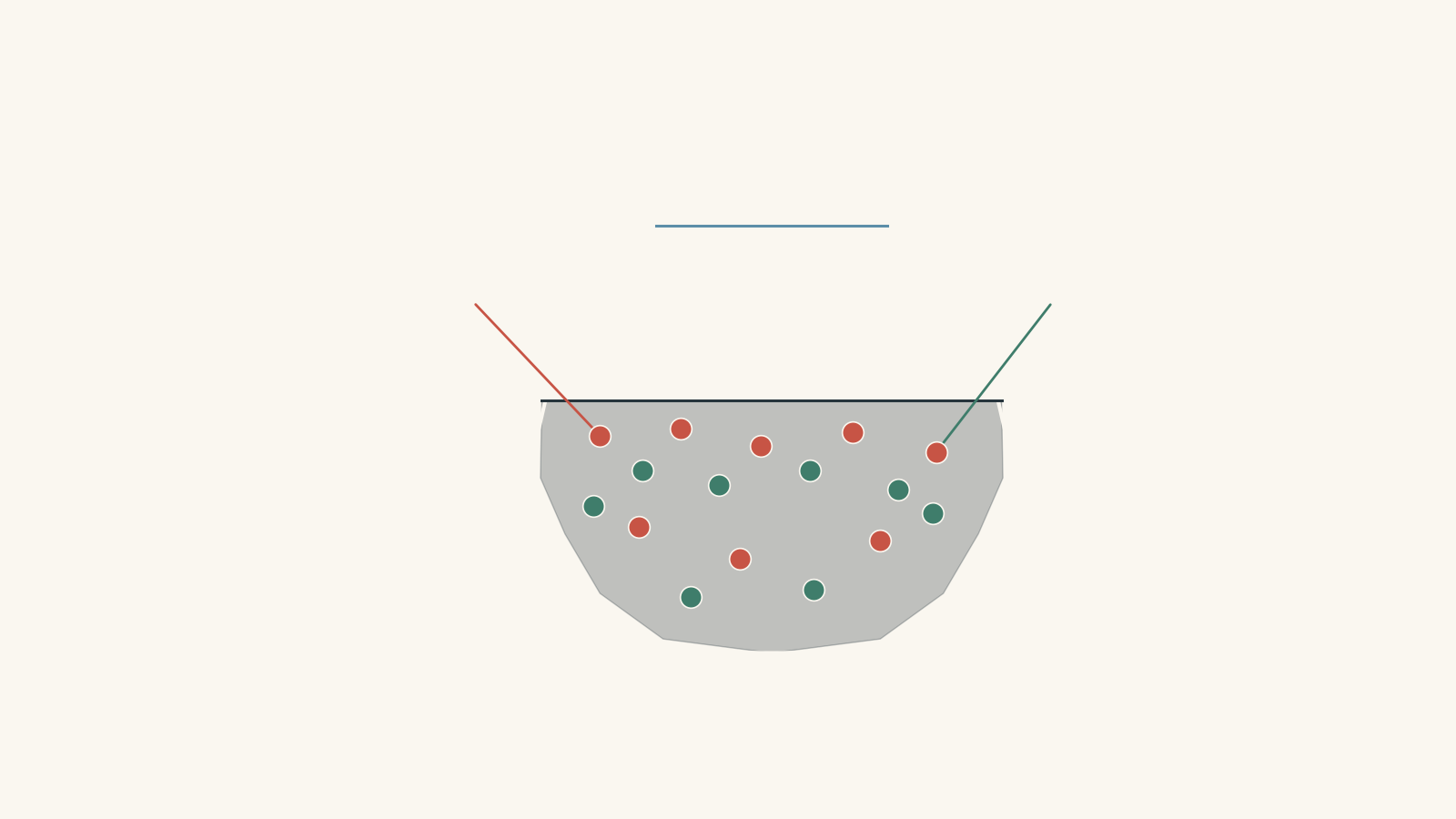
05How to prepare an ethanoic acid/ethanoate buffer
Suppose the available stock solutions are:
- \(0.200\ \mathrm{mol\,L^{-1}}\) ethanoic acid, \(\ce{CH3COOH}\)
- \(0.200\ \mathrm{mol\,L^{-1}}\) sodium ethanoate, \(\ce{CH3COONa}\)
A simple buffer near pH 4.76 can be prepared by using equal moles of the acid and conjugate base.
For example:
- Pipette \(25.0\ \mathrm{mL}\) of \(0.200\ \mathrm{mol\,L^{-1}}\) ethanoic acid into a \(100.0\ \mathrm{mL}\) volumetric flask.
- Add \(25.0\ \mathrm{mL}\) of \(0.200\ \mathrm{mol\,L^{-1}}\) sodium ethanoate solution.
- Add deionised water until close to the calibration line.
- Mix, then add water carefully until the bottom of the meniscus sits on the calibration line.
- Stopper and invert the flask several times to mix thoroughly.
Each starting solution contributes
\[ n=cV=(0.200)(0.0250)=5.00\times10^{-3}\ \mathrm{mol} \]
After dilution to \(100.0\ \mathrm{mL}\), each buffer component has a concentration of
\[ c=\frac{5.00\times10^{-3}}{0.1000} =0.0500\ \mathrm{mol\,L^{-1}} \]
Because the acid and conjugate base concentrations are equal, the expected pH is approximately
\[ \mathrm{pH}=pK_a=4.76 \]
06Testing whether the buffer actually works
A calculated pH does not demonstrate buffering by itself. You need to disturb the system and measure how strongly it responds.
A useful investigation uses separate aliquots for acid and base additions.
Equipment and solutions
You could use:
- prepared ethanoic acid/ethanoate buffer
- \(0.100\ \mathrm{mol\,L^{-1}}\) hydrochloric acid
- \(0.100\ \mathrm{mol\,L^{-1}}\) sodium hydroxide
- deionised water for comparison
- beakers
- volumetric pipette or measuring pipette
- burette or suitable graduated apparatus
- calibrated pH probe
- distilled or deionised water for rinsing the probe
Dilute hydrochloric acid and sodium hydroxide can still damage eyes and irritate skin. Wear appropriate eye protection and follow the school’s risk-assessment procedures.
A good testing method
Place \(20.0\ \mathrm{mL}\) of buffer into one beaker and \(20.0\ \mathrm{mL}\) into a second.
Measure the initial pH of both.
To the first aliquot, add hydrochloric acid in small measured portions, such as \(0.50\ \mathrm{mL}\) at a time. Stir after each addition and record the pH.
Use the second, fresh aliquot for sodium hydroxide additions.
For a comparison, repeat the additions using the same volume of an unbuffered solution, such as deionised water. The starting pH will be different, so compare the change in pH, not just the final pH.
For more reliable measurements, calibrate the pH probe before use, rinse it between solutions, and avoid wiping the sensing bulb harshly. More detail on measurement technique is covered in Digital Probes for Acid-Base Analysis in HSC Chemistry.
A useful results table would look like this:
| Cumulative acid added, mL | Moles \(\ce{HCl}\) added, mol | Buffer pH | Unbuffered pH |
|---|---|---|---|
| 0.00 | 0 | ||
| 0.50 | |||
| 1.00 | |||
| 1.50 | |||
| 2.00 |
Use a separate table for sodium hydroxide.
Plotting pH against moles of strong acid or base added makes the resistance much easier to see. The buffer graph should initially be much flatter.
07The calculation rule that prevents most buffer mistakes
When a strong acid or strong base is added to a buffer, there are two chemical stages.
First, the added strong acid or base reacts essentially completely with one buffer component.
Second, the remaining weak acid/conjugate base pair establishes its new equilibrium.
So the reliable rule is:
Do stoichiometry first. Do the buffer equilibrium second.
Do not put the original concentrations straight into the Henderson-Hasselbalch equation after adding \(\ce{HCl}\) or \(\ce{NaOH}\). The strong acid or base has changed the amounts of \(\ce{HA}\) and \(\mathrm{A}^{-}\).
Worked example: How much does the pH change after adding HCl?
A \(20.0\ \mathrm{mL}\) sample of an ethanoic acid/ethanoate buffer contains \(0.0500\ \mathrm{mol\,L^{-1}}\) \(\ce{CH3COOH}\) and \(0.0500\ \mathrm{mol\,L^{-1}}\) \(\ce{CH3COO-}\). Its \(pK_a\) is 4.76. Calculate the pH after \(1.00\ \mathrm{mL}\) of \(0.100\ \mathrm{mol\,L^{-1}}\) HCl is added.
Step 1
\[ \begin{aligned} n(\ce{CH3COOH})&=(0.0500)(0.0200)=1.00\times10^{-3}\ \mathrm{mol}\\ n(\ce{CH3COO-})&=(0.0500)(0.0200)=1.00\times10^{-3}\ \mathrm{mol} \end{aligned} \]
So there is initially \(1.00\ \mathrm{mmol}\) of each.
Step 2
\[ n(\ce{HCl})=(0.100)(0.00100) =1.00\times10^{-4}\ \mathrm{mol} =0.100\ \mathrm{mmol} \]
Step 3
\[ \ce{CH3COO- + H3O+ -> CH3COOH + H2O} \]
Therefore,
\[ \begin{aligned} n(\ce{CH3COO-})&=1.00-0.100=0.900\ \mathrm{mmol}\\ n(\ce{CH3COOH})&=1.00+0.100=1.100\ \mathrm{mmol} \end{aligned} \]
Step 4
Because both species are in the same final volume, the concentration ratio is equal to the mole ratio.
\[ \begin{aligned} \mathrm{pH} &=4.76+\log\left(\frac{0.900}{1.100}\right)\\ &=4.67 \end{aligned} \]
The pH has fallen from about 4.76 to 4.67: a change of only about \(0.09\) pH units.
For comparison, putting the same \(0.100\ \mathrm{mmol}\) of HCl into \(20.0\ \mathrm{mL}\) of pure water gives an approximate hydrogen-ion concentration after mixing of
\[ [\ce{H3O+}] =\frac{1.00\times10^{-4}}{0.0210} =4.76\times10^{-3}\ \mathrm{mol\,L^{-1}} \]
so
\[ \mathrm{pH}\approx2.32 \]
That contrast is the experimental signature you are looking for.
Worked example: Prepare a buffer at a chosen pH
You need \(250.0\ \mathrm{mL}\) of an ethanoic acid/ethanoate buffer with a total buffer concentration of \(0.100\ \mathrm{mol\,L^{-1}}\) and pH 5.06. The available ethanoic acid and sodium ethanoate stock solutions are both \(0.500\ \mathrm{mol\,L^{-1}}\). Take \(pK_a=4.76\). Calculate the required volume of each stock solution.
Step 1
\[ \begin{aligned} 5.06&=4.76+\log\left(\frac{[\ce{CH3COO-}]}{[\ce{CH3COOH}]}\right)\\ 0.30&=\log\left(\frac{[\ce{CH3COO-}]}{[\ce{CH3COOH}]}\right) \end{aligned} \]
Therefore,
\[ \frac{[\ce{CH3COO-}]}{[\ce{CH3COOH}]} =10^{0.30}\approx2.00 \]
So the buffer needs about twice as much ethanoate as ethanoic acid.
Step 2
\[ n_{\text{total}}=cV=(0.100)(0.2500)=0.0250\ \mathrm{mol} \]
Let the amount of ethanoic acid be \(x\). The amount of ethanoate is then \(2x\).
\[ x+2x=0.0250 \]
\[ x=8.33\times10^{-3}\ \mathrm{mol} \]
Therefore,
\[ n(\ce{CH3COOH})=8.33\times10^{-3}\ \mathrm{mol} \]
and
\[ n(\ce{CH3COO-})=1.67\times10^{-2}\ \mathrm{mol} \]
Step 3
For ethanoic acid:
\[ V=\frac{n}{c} =\frac{8.33\times10^{-3}}{0.500} =0.0167\ \mathrm{L} =16.7\ \mathrm{mL} \]
For sodium ethanoate:
\[ V=\frac{1.67\times10^{-2}}{0.500} =0.0333\ \mathrm{L} =33.3\ \mathrm{mL} \]
Step 4
Measure \(16.7\ \mathrm{mL}\) of the \(0.500\ \mathrm{mol\,L^{-1}}\) ethanoic acid solution and \(33.3\ \mathrm{mL}\) of the \(0.500\ \mathrm{mol\,L^{-1}}\) sodium ethanoate solution into a \(250.0\ \mathrm{mL}\) volumetric flask, then dilute to the calibration line with deionised water.
The larger amount of conjugate base shifts the buffer pH above the \(pK_a\), which is exactly what the Henderson-Hasselbalch equation predicts.
08Buffer capacity: why concentration matters as well as pH
Here is the trap: two buffers can have exactly the same pH and still respond very differently when acid is added.
Suppose both contain equal concentrations of ethanoic acid and ethanoate. Both therefore have pH close to 4.76.
Buffer A contains \(0.0500\ \mathrm{mol\,L^{-1}}\) of each species.
Buffer B contains only \(0.00500\ \mathrm{mol\,L^{-1}}\) of each.
Their ratios are identical, so their initial pH values are approximately identical.
But Buffer A contains ten times as many moles of acid-removing and base-removing species in a given volume. It can absorb a much larger disturbance before one component is depleted.
This is buffer capacity: the amount of strong acid or strong base that can be added before the pH changes substantially.
So there are two separate questions:
- What is the buffer’s pH? Look mainly at the ratio \([\mathrm{A}^{-}]/[\ce{HA}]\).
- How much disturbance can it handle? Look at the actual amounts of \(\mathrm{A}^{-}\) and \(\ce{HA}\).
Dilution exposes the difference nicely. Moderate dilution of a buffer changes both concentrations by roughly the same factor, so the ratio remains similar and the pH may barely change. But the diluted sample contains fewer moles of buffering species per millilitre, so its capacity is lower.
09Where the simple buffer calculation stops working
The Henderson-Hasselbalch equation is useful only while meaningful amounts of both members of the conjugate pair remain.
Suppose a sample contains \(1.00\ \mathrm{mmol}\) of \(\ce{CH3COO-}\). If you add \(0.20\ \mathrm{mmol}\) of strong acid, there is still plenty of ethanoate left. A buffer calculation makes sense.
If you add \(1.50\ \mathrm{mmol}\) of strong acid, all \(1.00\ \mathrm{mmol}\) of ethanoate is consumed and \(0.50\ \mathrm{mmol}\) of strong acid remains in excess.
At that point, writing
\[ \mathrm{pH}=pK_a+\log\left(\frac{[\mathrm{A}^{-}]}{[\ce{HA}]}\right) \]
is not merely inaccurate. The buffer pair has effectively been overwhelmed because \(\mathrm{A}^{-}\) has been depleted.
The excess strong acid now dominates the pH.
That gives you another decision rule:
Before using a buffer equation, check that the added strong acid or base has not consumed an entire buffer component.
10Questions and solutions
Question 1
A buffer contains propanoic acid, \(\ce{CH3CH2COOH}\), and propanoate ions, \(\ce{CH3CH2COO-}\).
Explain how the buffer responds when:
a. a small amount of HCl is added
b. a small amount of NaOH is added.
In each case, state whether the pH increases or decreases.
Solution 1
The pH decreases slightly when HCl is added and increases slightly when NaOH is added because the conjugate pair removes much of the added strong acid or base before it can produce a large pH change.
For added HCl, the important incoming species is \(\ce{H3O+}\). Propanoate ions consume it:
\[ \ce{CH3CH2COO- + H3O+ -> CH3CH2COOH + H2O} \]
The amount of propanoate decreases and the amount of propanoic acid increases. Some disturbance remains, so the pH falls, but only slightly if the addition is small relative to the buffer capacity.
For added NaOH, the weak acid consumes hydroxide ions:
\[ \ce{CH3CH2COOH + OH- -> CH3CH2COO- + H2O} \]
The amount of propanoic acid decreases and the amount of propanoate increases, so the pH rises slightly.
The tempting mistake is to say that a buffer “prevents pH change”. It does not. It reduces the size of the change.
Question 2
Two \(100.0\ \mathrm{mL}\) ethanoic acid/ethanoate buffers both have an initial pH of 4.76.
Buffer A contains \(0.0500\ \mathrm{mol\,L^{-1}}\) \(\ce{CH3COOH}\) and \(0.0500\ \mathrm{mol\,L^{-1}}\) \(\ce{CH3COO-}\).
Buffer B contains \(0.00500\ \mathrm{mol\,L^{-1}}\) of each species.
A \(10.0\ \mathrm{mL}\) volume of \(0.100\ \mathrm{mol\,L^{-1}}\) HCl is added to each buffer.
Take \(pK_a=4.76\).
Calculate the approximate final pH of each solution and explain why equal initial pH does not mean equal buffer capacity.
Solution 2
Buffer A finishes at approximately pH 4.58, while Buffer B is overwhelmed and falls to approximately pH 2.34. The two solutions begin at the same pH because their acid-to-base ratios are the same, but Buffer A contains ten times as many moles of each buffer component.
For Buffer A, the initial amount of each species is
\[ n=(0.0500)(0.1000) =5.00\times10^{-3}\ \mathrm{mol} =5.00\ \mathrm{mmol} \]
The amount of HCl added is
\[ n=(0.100)(0.0100) =1.00\times10^{-3}\ \mathrm{mol} =1.00\ \mathrm{mmol} \]
The strong acid reacts with ethanoate:
\[ \ce{CH3COO- + H3O+ -> CH3COOH + H2O} \]
After reaction,
\[ n(\ce{CH3COO-})=4.00\ \mathrm{mmol} \]
and
\[ n(\ce{CH3COOH})=6.00\ \mathrm{mmol} \]
Therefore,
\[ \begin{aligned} \mathrm{pH} &=4.76+\log\left(\frac{4.00}{6.00}\right)\\ &=4.58 \end{aligned} \]
Buffer A is still a genuine buffer because substantial amounts of both species remain.
For Buffer B, the initial amount of each component is
\[ n=(0.00500)(0.1000) =0.500\ \mathrm{mmol} \]
But \(1.00\ \mathrm{mmol}\) of HCl is added. The HCl consumes all \(0.500\ \mathrm{mmol}\) of ethanoate, leaving
\[ 1.00-0.500=0.500\ \mathrm{mmol} \]
of strong acid in excess.
The final volume is
\[ 100.0+10.0=110.0\ \mathrm{mL} =0.1100\ \mathrm{L} \]
so the excess hydronium concentration is approximately
\[ [\ce{H3O+}] =\frac{0.500\times10^{-3}}{0.1100} =4.55\times10^{-3}\ \mathrm{mol\,L^{-1}} \]
Hence,
\[ \mathrm{pH} =-\log(4.55\times10^{-3}) \approx2.34 \]
The remaining weak acid makes only a small additional contribution compared with the excess strong acid.
The tempting route is to notice that both buffers start at pH 4.76 and assume that they must behave similarly. The missing constraint is the number of moles available to consume the added acid. Buffer pH depends strongly on a ratio; buffer capacity depends on actual amounts.
Question 3
A student mixes \(50.0\ \mathrm{mL}\) of \(0.200\ \mathrm{mol\,L^{-1}}\) ethanoic acid with \(25.0\ \mathrm{mL}\) of \(0.200\ \mathrm{mol\,L^{-1}}\) NaOH, then dilutes the mixture to \(100.0\ \mathrm{mL}\).
Take \(pK_a=4.76\).
a. Show that the resulting solution is a buffer and calculate its initial pH.
b. HCl is then added until the pH reaches 4.46. Calculate the amount of HCl that has reacted with the buffer.
c. At that point, how many additional millimoles of HCl could be consumed stoichiometrically before the ethanoate component is exhausted?
Solution 3
The mixture becomes an equal-mole ethanoic acid/ethanoate buffer with initial pH 4.76; reaching pH 4.46 requires about \(1.66\ \mathrm{mmol}\) of HCl, leaving about \(3.34\ \mathrm{mmol}\) of ethanoate available to react with further acid.
For part a, the initial amount of ethanoic acid is
\[ n(\ce{CH3COOH}) =(0.200)(0.0500) =0.0100\ \mathrm{mol} =10.0\ \mathrm{mmol} \]
The amount of NaOH is
\[ n(\ce{OH-}) =(0.200)(0.0250) =0.00500\ \mathrm{mol} =5.00\ \mathrm{mmol} \]
The hydroxide partially neutralises the weak acid:
\[ \ce{CH3COOH + OH- -> CH3COO- + H2O} \]
Therefore \(5.00\ \mathrm{mmol}\) of ethanoic acid is consumed and \(5.00\ \mathrm{mmol}\) of ethanoate is formed.
The solution now contains
\[ 5.00\ \mathrm{mmol}\ \ce{CH3COOH} \]
and
\[ 5.00\ \mathrm{mmol}\ \ce{CH3COO-} \]
so it is a buffer with equal amounts of acid and conjugate base.
Thus,
\[ \mathrm{pH}=pK_a=4.76 \]
The tempting mistake is to see “NaOH” and assume that the final solution must simply be alkaline. The strong base is not left over. It is the reagent used to convert part of the weak acid into its conjugate base.
For part b, let \(x\) be the number of millimoles of HCl added.
The HCl converts ethanoate into ethanoic acid, so the new amounts are
\[ n(\ce{CH3COO-})=5.00-x \]
and
\[ n(\ce{CH3COOH})=5.00+x \]
Using the final pH,
\[ 4.46 =4.76+\log\left(\frac{5.00-x}{5.00+x}\right) \]
Therefore,
\[ \frac{5.00-x}{5.00+x}=10^{-0.30}=0.501 \]
Solving,
\[ 5.00-x=0.501(5.00+x) \]
\[ x\approx1.66\ \mathrm{mmol} \]
So approximately \(1.66\ \mathrm{mmol}\) of HCl has reacted.
The remaining ethanoate is
\[ 5.00-1.66=3.34\ \mathrm{mmol} \]
Therefore, for part c, another \(3.34\ \mathrm{mmol}\) of HCl could be consumed stoichiometrically before the ethanoate is exhausted.
That does not mean the pH stays near 4.46 until the last ion disappears. As the ethanoate amount becomes small, the buffer becomes progressively less effective, and the Henderson-Hasselbalch model eventually ceases to be useful.
Question 4
A student tries to prove that an ethanoic acid/ethanoate solution is a buffer.
They place \(20.0\ \mathrm{mL}\) of the solution in one beaker. Its initial pH is 4.76.
They add \(1.00\ \mathrm{mL}\) of \(0.100\ \mathrm{mol\,L^{-1}}\) HCl and measure pH 4.67. They then add \(1.00\ \mathrm{mL}\) of \(0.100\ \mathrm{mol\,L^{-1}}\) NaOH to the same beaker and measure a pH close to 4.76 again.
They write:
“The pH returned to its original value after both acid and base were added, proving that the solution resists both acid and base.”
However, when the same sequence is performed on deionised water, its pH also falls sharply after the HCl and then returns towards its original value after the NaOH.
Evaluate the student’s conclusion and design a better test of buffering.
Solution 4
The student’s experiment does not prove resistance to both acid and base because the second reagent partly undoes the first disturbance; acid and base resistance must be tested on separate fresh aliquots.
The first step is meaningful. Adding HCl to the buffer and measuring only a small pH decrease gives evidence that the buffer resists added acid.
The problem appears when NaOH is added to the same sample.
The added HCl supplied
\[ n(\ce{HCl}) =(0.100)(0.00100) =0.100\ \mathrm{mmol} \]
The later NaOH also supplied
\[ n(\ce{NaOH}) =(0.100)(0.00100) =0.100\ \mathrm{mmol} \]
Acid and base therefore oppose one another stoichiometrically. In an unbuffered solution,
\[ \ce{H3O+ + OH- -> 2H2O} \]
so an approximately equal amount of NaOH can remove the hydronium introduced by the HCl. A return towards the starting pH is therefore not unique evidence for buffering.
The tempting interpretation is that “returning to the original pH” must mean the buffer repaired the disturbance. The control experiment exposes the flaw: ordinary acid-base neutralisation can produce a similar result.
A better design would use at least four separate samples:
- fresh buffer aliquot for HCl additions
- fresh buffer aliquot for NaOH additions
- fresh unbuffered comparison solution for HCl additions
- fresh unbuffered comparison solution for NaOH additions
Each sample should begin with the same volume. The concentrations and volumes of added HCl and NaOH should also be controlled.
The pH should be measured before addition and after each small addition. The useful dependent variable is the change in pH,
\[ \Delta\mathrm{pH}=\mathrm{pH}_{\text{after}}-\mathrm{pH}_{\text{before}} \]
and a stronger analysis would graph pH against moles of strong acid or base added.
Probe calibration, temperature, stirring time, and measurement technique should be kept consistent.
A matched unbuffered solution beginning at approximately the same pH would make the comparison even stronger, because it removes starting pH as a competing explanation.
The correct evidence for buffering is not that the pH eventually returns after opposite reagents are added. It is that a fresh buffer undergoes a much smaller pH change than an appropriate unbuffered comparison when both receive the same individual disturbance.
Question 5
An unknown \(\ce{HA/A-}\) buffer has \(pK_a=4.76\). A \(100.0\ \mathrm{mL}\) sample has an initial pH of 4.76.
Two fresh, identical \(100.0\ \mathrm{mL}\) samples are tested.
- Sample 1 receives \(2.00\ \mathrm{mL}\) of \(0.100\ \mathrm{mol\,L^{-1}}\) HCl and reaches pH 4.58.
- Sample 2 receives \(2.00\ \mathrm{mL}\) of \(0.100\ \mathrm{mol\,L^{-1}}\) NaOH and reaches pH 4.94.
a. Use the data to estimate the initial number of millimoles of \(\ce{HA}\) and \(\mathrm{A}^{-}\) in each \(100.0\ \mathrm{mL}\) sample.
b. Hence estimate the initial concentration of each buffer component.
c. A student now takes only \(10.0\ \mathrm{mL}\) of the original buffer and dilutes it to \(100.0\ \mathrm{mL}\). They argue:
“The \(\mathrm{A}^{-}/\ce{HA}\) ratio is still 1, so the diluted buffer will have the same pH and will resist the same \(2.00\ \mathrm{mL}\) HCl addition just as well.”
Evaluate both parts of this claim and estimate the pH after the HCl addition to the diluted sample.
Solution 5
The original sample contains about \(0.98\ \mathrm{mmol}\) of each buffer component, or about \(9.8\times10^{-3}\ \mathrm{mol\,L^{-1}}\) of each; tenfold dilution leaves the initial pH close to 4.76 but destroys enough buffer capacity that the same HCl addition overwhelms the conjugate base and drives the pH to roughly 3.0.
For part a, the initial pH equals \(pK_a\), so initially
\[ \frac{[\mathrm{A}^{-}]}{[\ce{HA}]}=1 \]
and the two species contain equal numbers of moles.
Let the initial amount of each be \(n\) millimoles.
The amount of HCl added to Sample 1 is
\[ n(\ce{HCl}) =(0.100)(0.00200) =2.00\times10^{-4}\ \mathrm{mol} =0.200\ \mathrm{mmol} \]
The HCl converts \(\mathrm{A}^{-}\) into \(\ce{HA}\), so after reaction:
\[ n(\mathrm{A}^{-})=n-0.200 \]
and
\[ n(\ce{HA})=n+0.200 \]
Using the measured pH,
\[ 4.58 =4.76+\log\left(\frac{n-0.200}{n+0.200}\right) \]
Therefore,
\[ \frac{n-0.200}{n+0.200} =10^{-0.18} \approx0.661 \]
So
\[ n-0.200=0.661(n+0.200) \]
\[ n\approx0.98\ \mathrm{mmol} \]
The NaOH result provides a useful independent check. Added hydroxide converts \(\ce{HA}\) into \(\mathrm{A}^{-}\), giving
\[ \frac{n+0.200}{n-0.200} =10^{4.94-4.76} =10^{0.18} \]
which is the reciprocal relationship expected from the acid experiment. It gives essentially the same value of \(n\).
For part b,
\[ c=\frac{0.98\times10^{-3}}{0.1000} \approx9.8\times10^{-3}\ \mathrm{mol\,L^{-1}} \]
So each component initially has a concentration of approximately
\[ 9.8\times10^{-3}\ \mathrm{mol\,L^{-1}} \]
For part c, the student’s first statement is approximately correct.
Taking \(10.0\ \mathrm{mL}\) of the buffer and diluting it to \(100.0\ \mathrm{mL}\) reduces both concentrations by the same factor. Their ratio remains approximately 1, so
\[ \mathrm{pH}\approx pK_a\approx4.76 \]
The trap is the second statement. The pH ratio has been preserved, but the number of moles present in the new \(100.0\ \mathrm{mL}\) sample has not.
The \(10.0\ \mathrm{mL}\) portion originally contains only
\[ 0.98\times\frac{10.0}{100.0} =0.098\ \mathrm{mmol} \]
of \(\ce{HA}\) and the same amount of \(\mathrm{A}^{-}\).
Adding \(2.00\ \mathrm{mL}\) of \(0.100\ \mathrm{mol\,L^{-1}}\) HCl supplies
\[ 0.200\ \mathrm{mmol} \]
of strong acid.
But only about \(0.098\ \mathrm{mmol}\) of \(\mathrm{A}^{-}\) is available to remove it.
All of the conjugate base is consumed, leaving approximately
\[ 0.200-0.098=0.102\ \mathrm{mmol} \]
of excess strong acid.
The final volume is approximately
\[ 100.0+2.00=102.0\ \mathrm{mL} =0.1020\ \mathrm{L} \]
so
\[ [\ce{H3O+}] \approx \frac{0.102\times10^{-3}}{0.1020} \approx1.00\times10^{-3}\ \mathrm{mol\,L^{-1}} \]
Therefore,
\[ \mathrm{pH}\approx3.00 \]
The remaining weak acid slightly affects the exact value, so 3.00 should be understood as an appropriate strong-acid-dominated approximation.
This is the important hinge: Henderson-Hasselbalch explains why dilution may leave a buffer’s initial pH almost unchanged, but it does not say that dilution leaves its capacity unchanged. The ratio survived. The chemical reserve did not.
That distinction is what makes buffer experiments more useful than simply measuring an initial pH. Once you can separate pH from capacity, the same reasoning carries directly into weak-acid titration curves, where the buffer region appears before equivalence, and into natural systems where a stable pH depends on both the conjugate-pair ratio and how much buffering material is actually present.