
Hess’s Law with Bond Energies: Estimate Reaction Enthalpy
Learn how to estimate reaction enthalpy from average bond energies by comparing bonds broken with bonds formed. Includes worked examples, phase corrections, and challenging HSC-style questions.
A combustion reaction can release a large amount of heat even though every bond you break requires energy. That sounds backwards at first. If breaking bonds costs energy, why does burning methane make the surroundings hotter instead of colder?
Before calculating anything, make a prediction. In an exothermic reaction, is more energy absorbed breaking the reactant bonds, or released forming the product bonds?
The second. Breaking bonds always costs energy, but forming new bonds releases energy. An exothermic reaction happens when the energy released by forming the product bonds is greater than the energy needed to break the reactant bonds.
That simple comparison is the basis of using average bond energies with Hess’s Law.
01Why bond breaking and bond forming have opposite signs
Imagine every bond comes with a break-up fee. Separating the bonded atoms means paying that fee, so energy must enter the system.
Forming a bond is the reverse process. The atoms move into a lower-energy arrangement, so energy leaves the system.
The relationship analogy is useful up to a point: ending the bond costs energy, while forming the new one gives energy back. Molecules, thankfully, don’t have awkward conversations afterwards. More importantly, real chemical bonds are quantum-mechanical interactions, so the analogy tells you the energy direction, not what a bond physically is.
The quantity we use is the bond enthalpy, usually written \(D\). It is the enthalpy required to break one mole of a particular bond in gaseous molecules.
For example, if
\[ D(\ce{H-H}) = 436\ \mathrm{kJ\,mol^{-1}} \]
then breaking one mole of \(\ce{H-H}\) bonds requires about \(436\ \mathrm{kJ}\).
Bond breaking therefore contributes positively to the reaction enthalpy.
Bond formation is the reverse process. Forming one mole of those same \(\ce{H-H}\) bonds would release approximately \(436\ \mathrm{kJ}\), contributing \(-436\ \mathrm{kJ}\).
If you want a refresher on why stronger bonds require more energy to break, see Bond Enthalpy and Conservation of Energy in HSC Chemistry.
02The Hess’s Law idea hiding inside the formula
Suppose you want the enthalpy change for a reaction, but you only have bond-energy data.
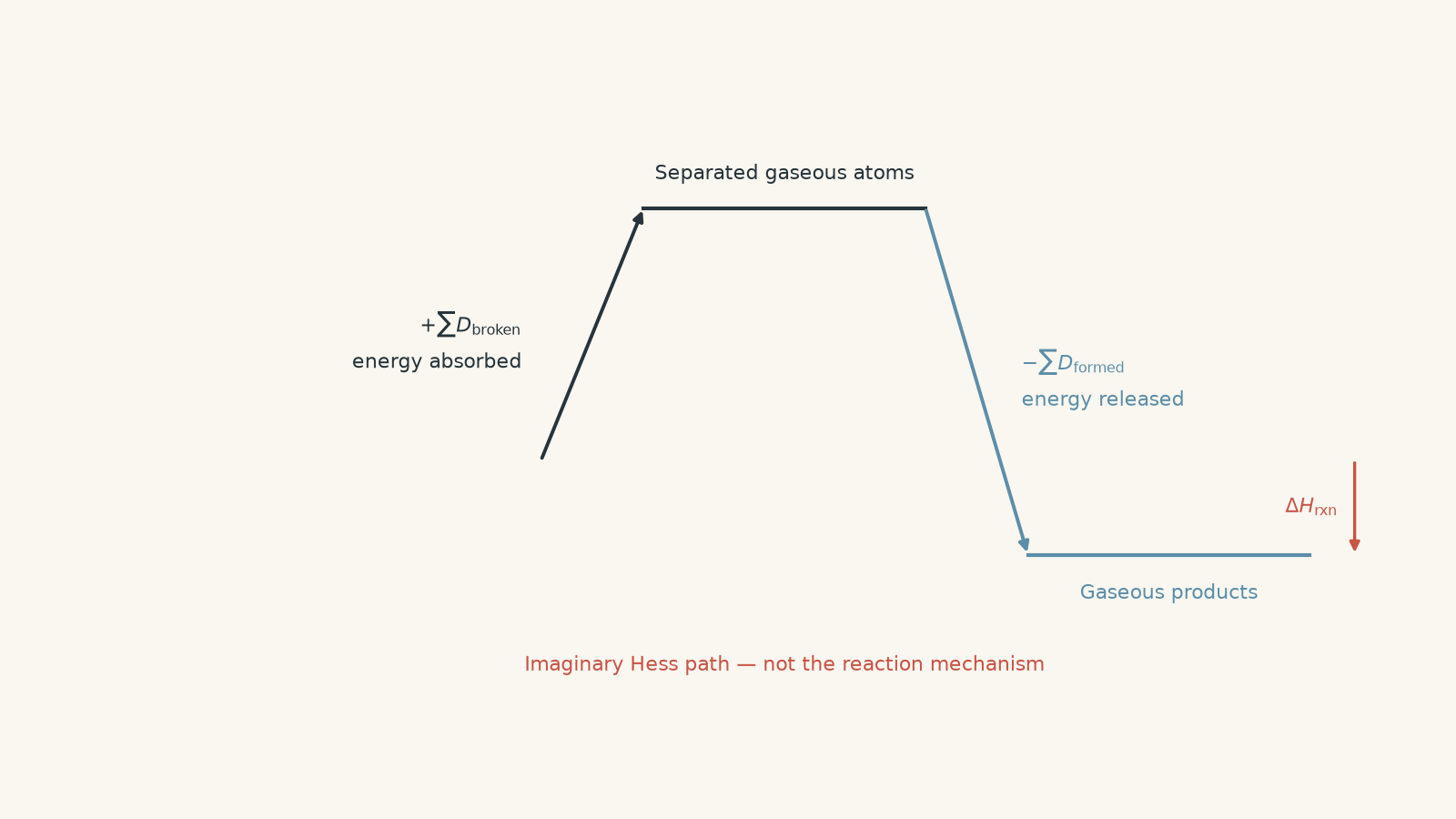
Hess’s Law says the overall enthalpy change depends only on the initial and final states. It does not depend on the imaginary route you choose between them.
So choose a deliberately ridiculous route:
- Break every relevant bond in the gaseous reactants until you have separated gaseous atoms.
- Rearrange those atoms however you like.
- Form all the bonds needed to make the gaseous products.
The first stage absorbs energy. The final stage releases energy.
That gives the equation
\[ \Delta H_{\text{rxn}} \approx \sum D(\text{bonds broken})-\sum D(\text{bonds formed}) \]
where:
- \(\Delta H_{\text{rxn}}\) is the estimated reaction enthalpy,
- \(D\) is an average bond enthalpy, usually in \(\mathrm{kJ\,mol^{-1}}\),
- \(\sum D(\text{bonds broken})\) is the total energy needed to break the reactant bonds, and
- \(\sum D(\text{bonds formed})\) is the total energy released when the product bonds form.
Notice the word approximately. Hess’s Law itself is exact. The approximation comes from using average bond enthalpies instead of the exact bond enthalpy in each particular molecule.
What the sign tells you
| Result | Energy comparison | Meaning |
|---|---|---|
| \(\Delta H<0\) | More energy released forming bonds than absorbed breaking bonds | Exothermic |
| \(\Delta H>0\) | More energy absorbed breaking bonds than released forming bonds | Endothermic |
| \(\Delta H\approx0\) | The two totals are similar | Little net enthalpy change |
A common mistake is to say an exothermic reaction occurs because “the reactant bonds release energy when they break”. They don’t. Bond breaking always requires energy.
The reaction is exothermic because the new bonds formed release even more.
03A reliable method for bond-energy questions
For an HSC calculation, use the same sequence each time.
- Balance the chemical equation.
- Work out which bonds are present in the reactants.
- Work out which bonds are present in the products.
- Add the bond enthalpies for bonds broken.
- Add the bond enthalpies for bonds formed.
- Calculate
\[ \Delta H=\sum D_{\text{broken}}-\sum D_{\text{formed}} \]
- Check the sign against the chemistry. If you expected a strongly exothermic combustion reaction and obtained a large positive value, investigate your bond counting before accepting it.
You can count every bond on both sides. If the same number of a particular bond occurs on each side, you can also cancel those bonds first. That often saves work.
The cancellation is accounting, though. It does not prove those particular bonds remain untouched during the real reaction mechanism.
Worked example: Forming hydrogen chloride
Estimate the reaction enthalpy for
\[ \ce{H2(g) + Cl2(g) -> 2HCl(g)} \]
using:
- \(D(\ce{H-H})=436\ \mathrm{kJ\,mol^{-1}}\)
- \(D(\ce{Cl-Cl})=243\ \mathrm{kJ\,mol^{-1}}\)
- \(D(\ce{H-Cl})=431\ \mathrm{kJ\,mol^{-1}}\)
Step 1
One \(\ce{H-H}\) bond and one \(\ce{Cl-Cl}\) bond must be broken.
\[ \sum D_{\text{broken}} =436+243 =679\ \mathrm{kJ\,mol^{-1}} \]
Step 2
Two molecules of \(\ce{HCl}\) are produced, so two \(\ce{H-Cl}\) bonds form.
\[ \sum D_{\text{formed}} =2(431) =862\ \mathrm{kJ\,mol^{-1}} \]
Step 3
\[ \begin{aligned} \Delta H &=\sum D_{\text{broken}}-\sum D_{\text{formed}}\\ &=679-862\\ &=-183\ \mathrm{kJ\,mol^{-1}} \end{aligned} \]
The reaction is estimated to have
\[ \Delta H=-183\ \mathrm{kJ\,mol^{-1}} \]
for the reaction as written.
The negative sign makes physical sense. Breaking the original bonds costs \(679\ \mathrm{kJ\,mol^{-1}}\), but forming the new bonds releases about \(862\ \mathrm{kJ\,mol^{-1}}\). The extra \(183\ \mathrm{kJ\,mol^{-1}}\) is released overall.
Worked example: Hydrogenating ethene
Estimate the enthalpy change for
\[ \ce{C2H4(g) + H2(g) -> C2H6(g)} \]
using:
- \(D(\ce{C=C})=614\ \mathrm{kJ\,mol^{-1}}\)
- \(D(\ce{C-C})=347\ \mathrm{kJ\,mol^{-1}}\)
- \(D(\ce{C-H})=413\ \mathrm{kJ\,mol^{-1}}\)
- \(D(\ce{H-H})=436\ \mathrm{kJ\,mol^{-1}}\)
Step 1
Ethene contains one \(\ce{C=C}\) bond and four \(\ce{C-H}\) bonds. The hydrogen molecule contributes one \(\ce{H-H}\) bond.
Ethane contains one \(\ce{C-C}\) bond and six \(\ce{C-H}\) bonds.
Four \(\ce{C-H}\) bonds appear on both sides, so they can cancel in the enthalpy bookkeeping.
The net bond changes are therefore:
- break one \(\ce{C=C}\),
- break one \(\ce{H-H}\),
- form one \(\ce{C-C}\), and
- form two additional \(\ce{C-H}\) bonds.
Step 2
\[ \begin{aligned} \sum D_{\text{broken}} &=614+436\\ &=1050\ \mathrm{kJ\,mol^{-1}} \end{aligned} \]
Step 3
\[ \begin{aligned} \sum D_{\text{formed}} &=347+2(413)\\ &=1173\ \mathrm{kJ\,mol^{-1}} \end{aligned} \]
Step 4
\[ \begin{aligned} \Delta H &=1050-1173\\ &=-123\ \mathrm{kJ\,mol^{-1}} \end{aligned} \]
So the estimated enthalpy change is
\[ \Delta H=-123\ \mathrm{kJ\,mol^{-1}} \]
The hydrogenation is exothermic because the new \(\ce{C-C}\) and \(\ce{C-H}\) bonding releases more energy than is required to break the \(\ce{C=C}\) and \(\ce{H-H}\) bonds.
There is a subtle point here. Cancelling four \(\ce{C-H}\) bonds does not mean four particular bonds physically sit untouched while the reaction happens. It only means their contributions are identical on both sides of this simplified energy calculation.
04Why bond-energy answers are estimates
Average bond energies are useful because they let us calculate an enthalpy without knowing every microscopic detail of the reaction.
That usefulness comes with limits.
The same bond type does not always have exactly the same energy
A \(\ce{C-H}\) bond in methane does not have exactly the same bond enthalpy as every \(\ce{C-H}\) bond in every other molecule.
Its strength depends on the surrounding atoms and electronic environment.
A bond-energy table therefore gives an average value representing many chemical environments. When you use \(413\ \mathrm{kJ\,mol^{-1}}\) for a \(\ce{C-H}\) bond, you are using a model, not claiming every \(\ce{C-H}\) bond has precisely that value.
This distinction becomes important when two reactions contain the same types of bond changes but occur in different molecules.
Phases matter
Average bond enthalpies are generally defined for bonds in gaseous molecules.
Suppose a reaction produces \(\ce{H2O(l)}\). A calculation using \(\ce{O-H}\) bond energies naturally gives you information about gaseous molecular water first.
To reach liquid water, you need another Hess’s Law step:
\[ \ce{H2O(g) -> H2O(l)} \]
Condensation is exothermic. If the enthalpy of vaporisation is \(\Delta H_{\text{vap}}\), then
\[ \Delta H_{\text{cond}}=-\Delta H_{\text{vap}} \]
Likewise, if a molecular reactant begins as a liquid but you want to use gaseous bond enthalpies, you can first imagine vaporising it:
\[ \ce{X(l) -> X(g)} \]
which contributes \(+\Delta H_{\text{vap}}\).
This is a genuine use of Hess’s Law: construct a path for which you have data, then add the steps.
Bond-energy accounting is not a reaction mechanism
If identical bond contributions cancel from both sides of a calculation, that does not tell you which bonds actually break during the mechanism.
Thermodynamics answers:
What is the energy difference between the initial and final states?
A mechanism answers:
What sequence of molecular events takes the system from one state to the other?
Those are different questions.
05Questions and solutions
Question 1
Estimate the enthalpy change for the combustion of methane to gaseous water:
\[ \ce{CH4(g) + 2O2(g) -> CO2(g) + 2H2O(g)} \]
Use:
- \(D(\ce{C-H})=413\ \mathrm{kJ\,mol^{-1}}\)
- \(D(\ce{O=O})=498\ \mathrm{kJ\,mol^{-1}}\)
- \(D(\ce{C=O})\) in \(\ce{CO2}=805\ \mathrm{kJ\,mol^{-1}}\)
- \(D(\ce{O-H})=463\ \mathrm{kJ\,mol^{-1}}\)
Solution 1
The estimated reaction enthalpy is \(\Delta H=-814\ \mathrm{kJ\,mol^{-1}}\), so the reaction is strongly exothermic.
The reactants contain four \(\ce{C-H}\) bonds and two \(\ce{O=O}\) bonds.
\[ \begin{aligned} \sum D_{\text{broken}} &=4(413)+2(498)\\ &=1652+996\\ &=2648\ \mathrm{kJ\,mol^{-1}} \end{aligned} \]
The products contain two \(\ce{C=O}\) bonds in one molecule of \(\ce{CO2}\), plus four \(\ce{O-H}\) bonds in two molecules of water.
\[ \begin{aligned} \sum D_{\text{formed}} &=2(805)+4(463)\\ &=1610+1852\\ &=3462\ \mathrm{kJ\,mol^{-1}} \end{aligned} \]
Therefore,
\[ \begin{aligned} \Delta H &=2648-3462\\ &=-814\ \mathrm{kJ\,mol^{-1}} \end{aligned} \]
The tempting mistake is to count four \(\ce{C=O}\) bonds because there are two oxygen atoms in \(\ce{CO2}\) and a coefficient of 2 in front of \(\ce{O2}\). The coefficient 2 belongs to oxygen on the reactant side. There is only one \(\ce{CO2}\) molecule in the balanced equation, containing two \(\ce{C=O}\) bonds.
The large negative value means product-bond formation releases substantially more energy than reactant-bond breaking requires.
Question 2
Estimate the enthalpy change for
\[ \ce{CH3OH(l) + \frac{3}{2}O2(g) -> CO2(g) + 2H2O(l)} \]
using:
- \(D(\ce{C-H})=413\ \mathrm{kJ\,mol^{-1}}\)
- \(D(\ce{C-O})=358\ \mathrm{kJ\,mol^{-1}}\)
- \(D(\ce{O-H})=463\ \mathrm{kJ\,mol^{-1}}\)
- \(D(\ce{O=O})=498\ \mathrm{kJ\,mol^{-1}}\)
- \(D(\ce{C=O})\) in \(\ce{CO2}=805\ \mathrm{kJ\,mol^{-1}}\)
- \(\Delta H_{\text{vap}}(\ce{CH3OH})=35\ \mathrm{kJ\,mol^{-1}}\)
- \(\Delta H_{\text{vap}}(\ce{H2O})=44\ \mathrm{kJ\,mol^{-1}}\)
Assume the listed bond enthalpies apply to gaseous molecules.
Solution 2
The estimated enthalpy change for the reaction with liquid methanol and liquid water is \(\Delta H=-708\ \mathrm{kJ\,mol^{-1}}\).
The important trap is phase. Using bond enthalpies directly first describes gaseous methanol reacting to form gaseous water. We then correct that imaginary reaction to the required liquid states.
Gaseous methanol contains three \(\ce{C-H}\) bonds, one \(\ce{C-O}\) bond, and one \(\ce{O-H}\) bond.
The total energy for bonds broken is
\[ \begin{aligned} \sum D_{\text{broken}} &=3(413)+358+463+\frac{3}{2}(498)\\ &=1239+358+463+747\\ &=2807\ \mathrm{kJ\,mol^{-1}} \end{aligned} \]
For gaseous products, one \(\ce{CO2}\) contains two \(\ce{C=O}\) bonds, while two \(\ce{H2O}\) molecules contain four \(\ce{O-H}\) bonds.
\[ \begin{aligned} \sum D_{\text{formed}} &=2(805)+4(463)\\ &=1610+1852\\ &=3462\ \mathrm{kJ\,mol^{-1}} \end{aligned} \]
So for
\[ \ce{CH3OH(g) + \frac{3}{2}O2(g) -> CO2(g) + 2H2O(g)} \]
the bond-energy estimate is
\[ \Delta H_{\text{gas}}=2807-3462=-655\ \mathrm{kJ\,mol^{-1}} \]
Now build a Hess’s Law path from the actual starting state.
First vaporise the liquid methanol:
\[ \ce{CH3OH(l) -> CH3OH(g)} \]
\[ \Delta H=+35\ \mathrm{kJ\,mol^{-1}} \]
Then carry out the estimated gas-phase reaction:
\[ \Delta H=-655\ \mathrm{kJ\,mol^{-1}} \]
Finally condense two moles of gaseous water:
\[ \ce{2H2O(g) -> 2H2O(l)} \]
\[ \Delta H=-2(44)=-88\ \mathrm{kJ\,mol^{-1}} \]
Adding the steps,
\[ \begin{aligned} \Delta H &=35-655-88\\ &=-708\ \mathrm{kJ\,mol^{-1}} \end{aligned} \]
A common wrong route is to subtract the methanol vaporisation enthalpy because the final reaction starts with a liquid. But to use gas-phase bond enthalpies, our imaginary path must first turn the liquid methanol into gas. Vaporisation requires energy, so that step is positive.
Question 3
Hydrogen peroxide can decompose according to
\[ \ce{H2O2(g) -> H2O(g) + \frac{1}{2}O2(g)} \]
Use:
- \(D(\ce{O-O})=146\ \mathrm{kJ\,mol^{-1}}\)
- \(D(\ce{O=O})=498\ \mathrm{kJ\,mol^{-1}}\)
- \(D(\ce{O-H})=463\ \mathrm{kJ\,mol^{-1}}\)
A student notices that there are two \(\ce{O-H}\) bonds on both sides and calculates the enthalpy using only the \(\ce{O-O}\) and \(\ce{O=O}\) bonds.
Another student argues that this must be wrong because “all the bonds in hydrogen peroxide have to be broken before the atoms can become products”.
Calculate the estimated reaction enthalpy, and decide what, if anything, the first student’s cancellation tells you about the actual reaction mechanism.
Solution 3
The estimated reaction enthalpy is \(\Delta H=-103\ \mathrm{kJ\,mol^{-1}}\), and cancelling the \(\ce{O-H}\) bonds is valid thermodynamic bookkeeping but tells us nothing definite about whether \(\ce{O-H}\) bonds break during the real mechanism.
Using the shorter calculation, the two \(\ce{O-H}\) bond contributions cancel because the same total number occurs on each side.
The remaining change is effectively:
- one \(\ce{O-O}\) bond broken,
- half a mole of \(\ce{O=O}\) bonds formed.
Therefore,
\[ \begin{aligned} \Delta H &=146-\frac{1}{2}(498)\\ &=146-249\\ &=-103\ \mathrm{kJ\,mol^{-1}} \end{aligned} \]
We can check this by following the longer imaginary Hess path and breaking every reactant bond.
Breaking the bonds in \(\ce{H2O2}\) requires
\[ \begin{aligned} \sum D_{\text{broken}} &=2(463)+146\\ &=1072\ \mathrm{kJ\,mol^{-1}} \end{aligned} \]
Forming the product bonds releases an amount corresponding to
\[ \begin{aligned} \sum D_{\text{formed}} &=2(463)+\frac{1}{2}(498)\\ &=926+249\\ &=1175\ \mathrm{kJ\,mol^{-1}} \end{aligned} \]
Hence,
\[ \Delta H=1072-1175=-103\ \mathrm{kJ\,mol^{-1}} \]
Both methods give the same result because the two \(2(463)\) terms cancel algebraically.
The tempting conclusion is that the \(\ce{O-H}\) bonds therefore remain physically intact. That does not follow. Hess’s Law allows us to invent an energy path that is completely different from the real molecular mechanism. Bond-energy calculations track the difference between initial and final states, not the sequence of collisions, intermediates, or bond-breaking events by which the reaction actually occurs.
Question 4
Two gas-phase hydrogenation reactions have experimentally measured enthalpy changes:
\[ \ce{C2H4(g) + H2(g) -> C2H6(g)} \qquad \Delta H=-125\ \mathrm{kJ\,mol^{-1}} \]
and
\[ \ce{C2H2(g) + 2H2(g) -> C2H6(g)} \qquad \Delta H=-311\ \mathrm{kJ\,mol^{-1}} \]
Use
- \(D(\ce{H-H})=436\ \mathrm{kJ\,mol^{-1}}\)
- \(D(\ce{C-H})=413\ \mathrm{kJ\,mol^{-1}}\)
- \(D(\ce{C-C})=347\ \mathrm{kJ\,mol^{-1}}\)
For parts (a) and (b), pretend the simple bond-additivity model is exact and use the experimental reaction enthalpies to infer effective values for \(D(\ce{C=C})\) and \(D(\ce{C#C})\).
Then:
(a) find the effective \(D(\ce{C=C})\),
(b) find the effective \(D(\ce{C#C})\),
(c) use those values to find the enthalpy for
\[ \ce{C2H2(g) + H2(g) -> C2H4(g)} \]
and verify it independently using Hess’s Law,
(d) explain why using tabulated averages \(D(\ce{C=C})=614\ \mathrm{kJ\,mol^{-1}}\) and \(D(\ce{C#C})=839\ \mathrm{kJ\,mol^{-1}}\) gives a different answer without implying that Hess’s Law has failed.
Solution 4
The effective values are \(D(\ce{C=C})=612\ \mathrm{kJ\,mol^{-1}}\) and \(D(\ce{C#C})=816\ \mathrm{kJ\,mol^{-1}}\), giving \(\Delta H=-186\ \mathrm{kJ\,mol^{-1}}\) for the first hydrogenation of ethyne. The same \(-186\ \mathrm{kJ\,mol^{-1}}\) follows exactly from Hess’s Law.
For the ethene reaction, cancel the four \(\ce{C-H}\) bonds that appear on both sides. The net changes are:
- break one \(\ce{C=C}\),
- break one \(\ce{H-H}\),
- form one \(\ce{C-C}\),
- form two \(\ce{C-H}\).
Let \(D(\ce{C=C})=x\).
\[ -125=x+436-\left[347+2(413)\right] \]
Since
\[ 347+2(413)=1173 \]
we obtain
\[ \begin{aligned} -125&=x+436-1173\\ -125&=x-737\\ x&=612\ \mathrm{kJ\,mol^{-1}} \end{aligned} \]
So
\[ D(\ce{C=C})=612\ \mathrm{kJ\,mol^{-1}} \]
under this effective model.
For the second reaction, ethyne initially contains two \(\ce{C-H}\) bonds, while ethane contains six. Cancelling the two already present leaves four additional \(\ce{C-H}\) bonds to form.
Let \(D(\ce{C#C})=y\).
\[ -311=y+2(436)-\left[347+4(413)\right] \]
The formed-bond total is
\[ 347+4(413)=1999\ \mathrm{kJ\,mol^{-1}} \]
so
\[ \begin{aligned} -311&=y+872-1999\\ -311&=y-1127\\ y&=816\ \mathrm{kJ\,mol^{-1}} \end{aligned} \]
Therefore,
\[ D(\ce{C#C})=816\ \mathrm{kJ\,mol^{-1}} \]
for this effective model.
Now consider
\[ \ce{C2H2 + H2 -> C2H4} \]
After cancelling the two \(\ce{C-H}\) bonds already present in ethyne, the relevant changes are:
- break one \(\ce{C#C}\),
- break one \(\ce{H-H}\),
- form one \(\ce{C=C}\),
- form two additional \(\ce{C-H}\).
Therefore,
\[ \begin{aligned} \Delta H &=816+436-\left[612+2(413)\right]\\ &=1252-1438\\ &=-186\ \mathrm{kJ\,mol^{-1}} \end{aligned} \]
Now check with Hess’s Law.
Call the ethyne-to-ethene reaction \(X\). Adding \(X\) to
\[ \ce{C2H4 + H2 -> C2H6} \]
must produce
\[ \ce{C2H2 + 2H2 -> C2H6} \]
Therefore,
\[ \Delta H_X+(-125)=-311 \]
so
\[ \Delta H_X=-311+125=-186\ \mathrm{kJ\,mol^{-1}} \]
The agreement is exact because the effective bond values were constructed from those same experimental enthalpies.
Now use the separate tabulated averages:
\[ \begin{aligned} \Delta H &=839+436-\left[614+2(413)\right]\\ &=1275-1440\\ &=-165\ \mathrm{kJ\,mol^{-1}} \end{aligned} \]
That result is different.
The tempting conclusion is that one route has broken Hess’s Law. It hasn’t. Hess’s Law relates exact enthalpy changes between defined states. The \(-165\ \mathrm{kJ\,mol^{-1}}\) value comes from average bond data collected across different molecular environments, so it is an estimate.
The \(-186\ \mathrm{kJ\,mol^{-1}}\) value came from the two supplied experimental reaction enthalpies using Hess’s Law. The disagreement exposes the approximation in the average bond model, not a failure of energy conservation.
Question 5
Consider two successive chlorination reactions:
\[ \ce{CH4(g) + Cl2(g) -> CH3Cl(g) + HCl(g)} \]
and
\[ \ce{CH3Cl(g) + Cl2(g) -> CH2Cl2(g) + HCl(g)} \]
Use the following average bond enthalpies:
- \(D(\ce{C-H})=413\ \mathrm{kJ\,mol^{-1}}\)
- \(D(\ce{Cl-Cl})=243\ \mathrm{kJ\,mol^{-1}}\)
- \(D(\ce{C-Cl})=338\ \mathrm{kJ\,mol^{-1}}\)
- \(D(\ce{H-Cl})=431\ \mathrm{kJ\,mol^{-1}}\)
A hypothetical calorimetry dataset gives:
\[ \Delta H_1=-101\ \mathrm{kJ\,mol^{-1}} \]
for the first reaction and
\[ \Delta H_2=-108\ \mathrm{kJ\,mol^{-1}} \]
for the second.
A student argues:
Both reactions break one \(\ce{C-H}\) and one \(\ce{Cl-Cl}\), then form one \(\ce{C-Cl}\) and one \(\ce{H-Cl}\). Hess’s Law therefore says their enthalpy changes must be identical, so the experimental data cannot both be correct.
Use the bond-energy model and Hess’s Law to evaluate that reasoning. Also determine the enthalpy change, from the hypothetical experimental data, for the overall reaction
\[ \ce{CH4(g) + 2Cl2(g) -> CH2Cl2(g) + 2HCl(g)} \]
Solution 5
The student’s conclusion is incorrect: the average bond-energy model predicts the same value for the two steps, but Hess’s Law does not require the two reaction enthalpies to be equal. Using the hypothetical experimental data, the overall enthalpy is \(-209\ \mathrm{kJ\,mol^{-1}}\).
For either chlorination step, the average bond model counts the same types of changes:
- break one \(\ce{C-H}\),
- break one \(\ce{Cl-Cl}\),
- form one \(\ce{C-Cl}\),
- form one \(\ce{H-Cl}\).
The estimated enthalpy is therefore
\[ \begin{aligned} \Delta H &=[413+243]-[338+431]\\ &=656-769\\ &=-113\ \mathrm{kJ\,mol^{-1}} \end{aligned} \]
So the average model predicts
\[ \Delta H_1\approx\Delta H_2\approx-113\ \mathrm{kJ\,mol^{-1}} \]
That makes the student’s argument feel convincing. The hidden mistake is treating an average bond enthalpy as though it were an exact energy assigned to every bond of that label.
A \(\ce{C-H}\) bond in \(\ce{CH4}\) does not have to have exactly the same dissociation enthalpy as a \(\ce{C-H}\) bond in \(\ce{CH3Cl}\). Likewise, the newly formed \(\ce{C-Cl}\) bond exists in a different electronic environment in \(\ce{CH3Cl}\) and \(\ce{CH2Cl2}\).
Hess’s Law says that the enthalpy change between a specified initial state and specified final state is independent of the route. It does not say that two different reactions must have equal enthalpies simply because a simplified model assigns them the same bond-type changes.
Using the hypothetical experimental data, add the two actual reaction equations:
\[ \ce{CH4 + Cl2 -> CH3Cl + HCl} \]
\[ \ce{CH3Cl + Cl2 -> CH2Cl2 + HCl} \]
The intermediate \(\ce{CH3Cl}\) cancels, leaving
\[ \ce{CH4 + 2Cl2 -> CH2Cl2 + 2HCl} \]
Hess’s Law therefore gives
\[ \begin{aligned} \Delta H_{\text{overall}} &=\Delta H_1+\Delta H_2\\ &=-101+(-108)\\ &=-209\ \mathrm{kJ\,mol^{-1}} \end{aligned} \]
If we instead used the average bond model for both steps, we would obtain
\[ 2(-113)=-226\ \mathrm{kJ\,mol^{-1}} \]
The \(17\ \mathrm{kJ\,mol^{-1}}\) difference is not evidence that Hess’s Law sometimes fails. The experimental enthalpies are attached to specific chemical states. The bond calculation replaces the exact energies of those states with averages.
That is the key distinction: Hess’s Law is the exact conservation rule; average bond energies are one approximate set of data that can be used inside it.
06What this lets you do next
Once you see bond-energy calculations as a Hess’s Law pathway, the formula becomes much harder to misuse. You are not memorising “broken minus formed” as an isolated trick. You are imagining the reactants taken up to separated gaseous atoms, then brought back down to the products.
That also tells you what to do when bond energies are not the most suitable data. If a question instead gives reaction enthalpies, formation enthalpies, combustion enthalpies, or phase changes, you can build a different route between the same initial and final states. The conservation principle stays the same.
The natural next step is to practise constructing and reversing those reaction pathways directly in Hess’s Law for Stepped Reactions in HSC Chemistry.