
Ionic Network Structures: HSC Chemistry Explained
Learn how giant ionic lattices are arranged and how electrostatic forces explain melting point, conductivity, brittleness, and solubility.
Drop a crystal of sodium chloride into water and it may disappear. Heat another crystal strongly and it refuses to melt until a very high temperature. Hit a crystal hard enough and it can shatter. These three behaviours look unrelated until you picture what is happening to the ions inside the solid.
Before reading on, make a prediction. In solid sodium chloride, are the \(\mathrm{Na}^{+}\) and \(\mathrm{Cl}^{-}\) ions arranged as separate little \(\ce{NaCl}\) pairs, or as one enormous repeating structure?
It is the second. An ionic solid is a giant ionic network, also called an ionic lattice. Understanding that network explains most of the physical properties of ionic compounds.
01Start with the arrangement, not the formula
The formula \(\ce{NaCl}\) can be misleading.
It does not mean that solid sodium chloride is made from individual \(\ce{NaCl}\) molecules. Instead, it tells us the simplest whole-number ratio of ions: one \(\mathrm{Na}^{+}\) ion for every one \(\mathrm{Cl}^{-}\) ion.
Inside the crystal, enormous numbers of positive and negative ions are arranged in a repeating three-dimensional pattern.

A useful first model is a room full of people who strongly prefer standing next to people wearing the opposite jersey. Positive ions are placed near negative ions, and negative ions are placed near positive ions.
The analogy has a limit. People can choose where to stand. Ions cannot. Their arrangement comes from electrostatic forces and the lowest-energy structure available to the solid.
Why does the arrangement repeat?
Opposite charges attract:
\[
\ce{cation+ <-> anion-}
\]
Like charges repel:
\[
\ce{cation+ <-> cation+}
\]
and
\[
\ce{anion- <-> anion-}
\]
The stable crystal arrangement therefore tends to place each ion near ions of opposite charge while keeping similarly charged ions from being unnecessarily close.
For sodium chloride, each \(\mathrm{Na}^{+}\) ion has six nearest \(\mathrm{Cl}^{-}\) neighbours, and each \(\mathrm{Cl}^{-}\) ion has six nearest \(\mathrm{Na}^{+}\) neighbours.
Do not turn that specific arrangement into a rule for every ionic compound. Different ions can form different lattice structures and have different coordination numbers. The important general idea is the same: ionic solids form extended three-dimensional arrangements held together by electrostatic attractions.
02What actually holds the lattice together?
An ionic bond is the electrostatic attraction between oppositely charged ions.
In an ionic network, an ion is not bonded to just one partner. Each ion experiences attractions to surrounding oppositely charged ions throughout the lattice, as well as repulsions from ions with the same charge.
This is why describing sodium chloride as a collection of separate \(\ce{Na+-Cl-}\) bonds misses the important part. The forces act through the whole structure.
Two factors are especially useful when comparing electrostatic attractions:
- the charges on the ions
- the distance between the ions
Greater ionic charges generally produce stronger attractions. Smaller distances between opposite charges also generally produce stronger attractions.
Coulomb’s law gives the underlying relationship for two charged particles:
\[
F = k\frac{|q_1q_2|}{r^2}
\]
where \(F\) is the magnitude of the electrostatic force, \(k\) is a constant, \(q_1\) and \(q_2\) are the charges, and \(r\) is the distance between the particles.
You normally do not use this equation to calculate the melting point of an ionic substance. A real lattice contains huge numbers of interacting ions, not one isolated pair. The relationship is still useful for reasoning: larger charge products and shorter ion separations tend to mean stronger electrostatic attractions.
03Why ionic solids usually have high melting points
Imagine trying to melt sodium chloride.
Melting does not mean destroying the ions themselves. The \(\mathrm{Na}^{+}\) and \(\mathrm{Cl}^{-}\) ions remain ions. What changes is their arrangement.
In the solid, the ions occupy fixed positions in an ordered lattice. In the liquid, the ions can move around one another.
To make that happen, enough energy must be supplied to overcome a substantial part of the electrostatic attraction holding the lattice together.
That requires a lot of energy, so ionic substances commonly have high melting and boiling points.
The tempting explanation is:
Ionic compounds have high melting points because ionic bonds are strong.
That is heading in the right direction, but it is incomplete. The important feature is the giant three-dimensional network of strong electrostatic attractions. There is not one bond that needs to be broken. The ordered lattice contains attractions in many directions.
Worked example: Which lattice should have stronger attractions?
Consider sodium chloride, \(\ce{NaCl}\), containing \(\mathrm{Na}^{+}\) and \(\mathrm{Cl}^{-}\), and magnesium oxide, \(\ce{MgO}\), containing \(\mathrm{Mg}^{2+}\) and \(\mathrm{O}^{2-}\). Predict which should have stronger electrostatic attractions overall.
Step 1
For \(\ce{NaCl}\), the magnitude of the charge product is proportional to:
\[
|( +1)(-1)| = 1
\]
For \(\ce{MgO}\):
\[
|( +2)(-2)| = 4
\]
Step 2
If the ion separation were the same, the electrostatic attraction between \(\mathrm{Mg}^{2+}\) and \(\mathrm{O}^{2-}\) would be stronger than between \(\mathrm{Na}^{+}\) and \(\mathrm{Cl}^{-}\).
Step 3
Real lattices also differ in ion size, separation, and crystal structure. The charge comparison alone does not give an exact force or melting point.
Step 4
\(\ce{MgO}\) has substantially stronger lattice attractions and therefore requires more energy to disrupt than \(\ce{NaCl}\).
This helps explain why magnesium oxide has a much higher melting point than sodium chloride.
04Why a solid ionic compound does not conduct electricity
An electric current requires mobile charged particles.
An ionic solid certainly contains charged particles. The problem is that they cannot move freely.
Each ion is locked into a position in the lattice. The ions can vibrate, but they cannot travel through the solid and carry charge from one place to another.
So a typical ionic compound:
- does not conduct electricity as a solid
- does conduct when molten
What changes during melting? Not the existence of ions. They were already there.
What changes is mobility.
Once the lattice has melted, positive and negative ions can move through the liquid. An applied electric field can therefore produce a flow of charge.
This is an important HSC decision rule:
Charged particles are not enough. The charged particles must also be mobile.
What about an ionic compound dissolved in water?
If an ionic substance dissolves, its ions become separated and surrounded by water molecules. These dissolved ions can move through the solution, so the solution can conduct electricity.
For example:
\[
\ce{NaCl(s) -> Na+(aq) + Cl-(aq)}
\]
The state symbols matter.
- \(\ce{NaCl(s)}\): ions exist, but are fixed in the lattice.
- \(\ce{Na+(aq)}\) and \(\ce{Cl-(aq)}\): ions are separated and mobile in solution.
Do not memorise “ionic compounds conduct electricity”. That statement is too broad. Their conductivity depends on their state.
05Why ionic crystals are brittle
Here is a stranger property. Ionic solids can be hard, yet brittle.
Those words are not opposites.
Hardness means a material resists being scratched, dented, or deformed.
Brittleness means it tends to fracture rather than deform substantially.
To see why an ionic crystal is brittle, imagine pushing one layer of ions sideways.
At first, each positive ion sits close to negative ions. But if the layer shifts far enough, positive ions can become aligned with positive ions, while negative ions become aligned with negative ions.
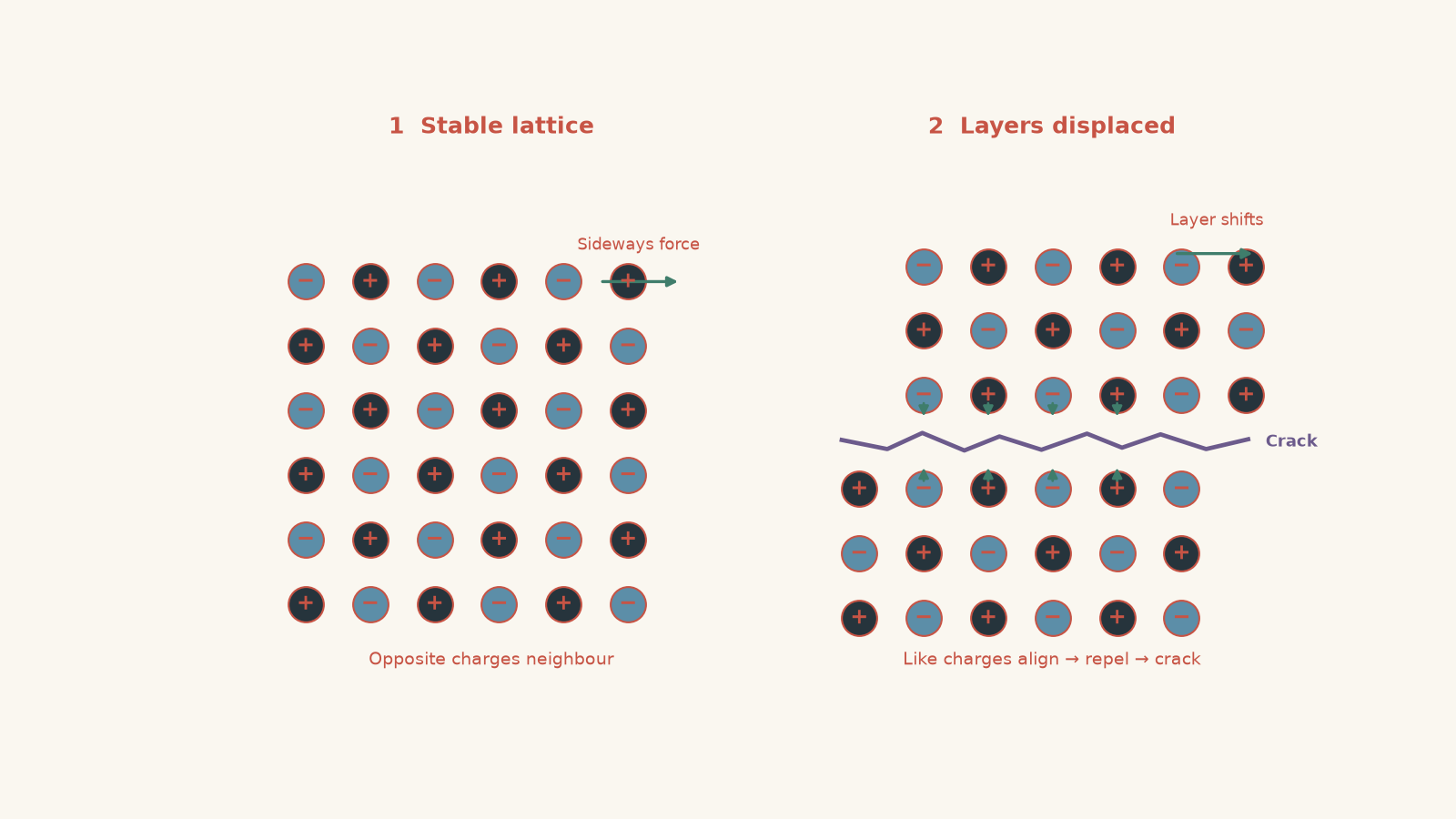
Now strong repulsive forces appear.
The crystal can lower this unfavourable interaction by splitting along a plane. The result is a fracture.
So ionic crystals are not brittle because the ionic attractions are weak. Almost the opposite is true. Their ordered charge arrangement means that shifting layers can suddenly create powerful repulsions.
Worked example: Why does the crystal crack instead of staying bent?
A crystal of an ionic compound is struck. A layer of ions shifts so that several positive ions become adjacent to positive ions. Explain why the crystal is likely to fracture.
Step 1
The original arrangement places oppositely charged ions near one another, producing attractive electrostatic forces.
Step 2
The impact moves part of the lattice relative to another part.
Step 3
After sufficient displacement, ions of the same charge can become closely aligned. Like charges repel.
Step 4
The strong repulsion pushes neighbouring sections of the lattice apart.
The crystal therefore fractures rather than allowing the layers to slide smoothly past each other. This is the microscopic reason ionic solids are typically brittle.
06Why water can pull some ionic lattices apart
A common shortcut says, “ionic compounds dissolve in water”.
That is not a reliable rule. Some ionic compounds are highly soluble, some are only slightly soluble, and some are effectively insoluble under ordinary conditions.
The useful question is this:
Can the interactions formed between the ions and water compensate sufficiently for disrupting the ionic lattice?
Water molecules are polar. The oxygen end carries a partial negative charge, while the hydrogen ends carry partial positive charges.
Around a cation, water molecules tend to orient with their oxygen ends towards the positive ion. Around an anion, the hydrogen ends tend to point towards the negative ion.
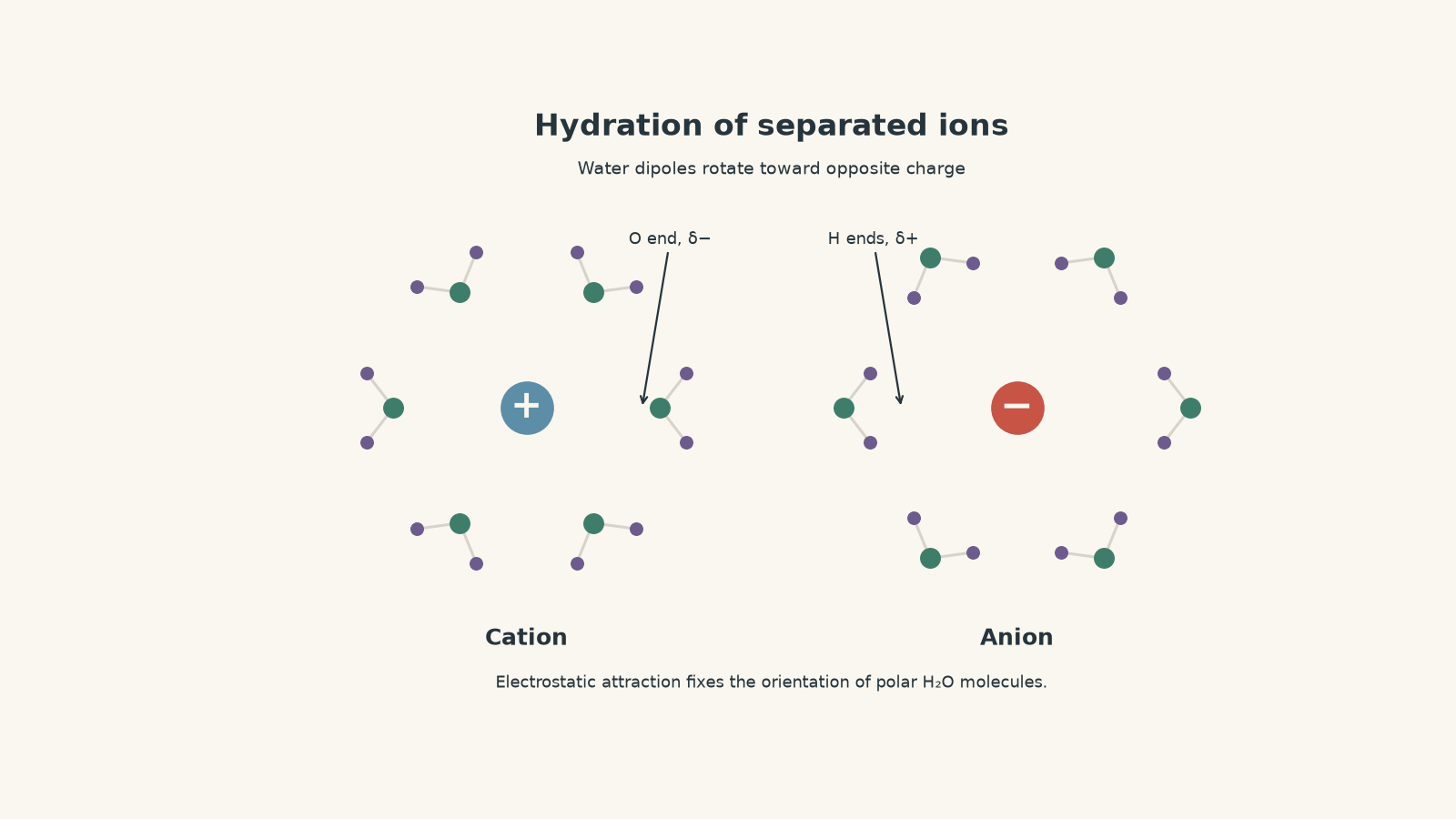
These ion-dipole attractions help stabilise separated ions in water.
For sodium chloride, we can represent the overall process as:
\[
\ce{NaCl(s) -> Na+(aq) + Cl-(aq)}
\]
But do not picture water as simply “snipping ionic bonds”.
Dissolution involves a competition between interactions. The lattice must be disrupted, and new ion-water interactions form. Whether dissolution is favourable depends on the balance of these effects, together with the increase in particle dispersal.
At HSC level, the important point is that strong ionic bonding does not automatically mean an ionic substance is insoluble.
07One structure explains several properties
The properties are easier to remember when you stop treating them as separate facts.
| Property | What is happening at particle level? |
|---|---|
| High melting point | Considerable energy is needed to disrupt the extended electrostatic attractions in the lattice. |
| Solid does not conduct | Charged ions are present, but they are fixed in position. |
| Molten substance conducts | Ions are free to move through the liquid and carry charge. |
| Aqueous solution may conduct | If the compound dissolves, the separated ions can move through the solution. |
| Hard | Strong electrostatic attractions resist displacement of ions. |
| Brittle | A shifted lattice can align like charges, producing strong repulsion and fracture. |
| Variable solubility in water | Dissolution depends on the competition between lattice interactions and stabilisation of ions by water. |
The same microscopic model keeps doing the work: charged particles arranged in an extended lattice, with strong electrostatic forces between them.
08The most tempting misconceptions
“An ionic solid contains molecules”
Usually, no.
A formula such as \(\ce{CaCl2}\) describes the ratio of ions in the giant lattice: one \(\mathrm{Ca}^{2+}\) ion for every two \(\mathrm{Cl}^{-}\) ions.
Calling one \(\ce{CaCl2}\) unit a molecule suggests a separate, self-contained particle that does not exist in the ionic crystal.
The term formula unit is more appropriate.
“The ions form only after the solid melts”
No. The ions already exist in the solid.
Melting changes their freedom of movement, not their charge.
“Ionic solids cannot conduct because their particles are neutral”
No. Their particles are ions, so they are charged.
The problem is mobility. The ions are held in fixed lattice positions.
“If an ionic compound has strong attractions, it must be insoluble”
Not necessarily.
Dissolving requires disruption of the lattice, but it also produces new interactions between the ions and the solvent. Solubility depends on the balance of these effects, not on lattice attraction alone.
“A higher ionic charge always guarantees a higher melting point”
Higher charges often strengthen electrostatic attractions, but that is only part of the comparison.
Ion size, distance between charges, and the actual lattice structure also matter. Charge is a powerful clue, not a complete melting-point calculator.
09Questions and solutions
Question 1
A sample of potassium bromide, \(\ce{KBr}\), does not conduct electricity while solid but conducts after melting. Explain both observations using its structure.
Solution 1
Solid \(\ce{KBr}\) does not conduct because its ions are fixed in the ionic lattice, while molten \(\ce{KBr}\) conducts because those ions become mobile.
Potassium bromide contains \(\mathrm{K}^{+}\) and \(\mathrm{Br}^{-}\) ions in both states.
In the solid, strong electrostatic attractions hold the ions in fixed positions. They can vibrate but cannot travel through the material, so there are no mobile charge carriers.
When the solid melts, the ordered lattice is disrupted. The \(\mathrm{K}^{+}\) and \(\mathrm{Br}^{-}\) ions can then move through the liquid and carry electric charge.
The trap is to say that melting “creates ions”. It does not. Melting makes existing ions mobile.
Question 2
Two ionic solids contain ions with the following charges:
- substance A: \(\mathrm{X}^{+}\) and \(\mathrm{Y}^{-}\)
- substance B: \(\mathrm{M}^{2+}\) and \(\mathrm{N}^{2-}\)
Assume, as a simplified model, that the distances between neighbouring opposite ions are equal. Which substance would have stronger electrostatic attraction between a neighbouring cation and anion? Explain why, and state one limitation of the comparison.
Solution 2
Substance B would have the stronger attraction in this simplified comparison because its neighbouring ions have a larger charge product.
For substance A, the magnitude of the charge product is:
\[
|( +1)(-1)| = 1
\]
For substance B:
\[
|( +2)(-2)| = 4
\]
Coulomb’s law gives:
\[
F = k\frac{|q_1q_2|}{r^2}
\]
where \(F\) is electrostatic force, \(k\) is a constant, \(q_1\) and \(q_2\) are the ionic charges, and \(r\) is their separation.
Because the question specifies the same \(r\), the larger charge product in substance B gives a stronger attraction between the neighbouring ions.
The limitation is that real ionic solids do not necessarily have equal ion separations or identical lattice structures. Therefore, this comparison predicts a trend in attraction but cannot by itself determine an exact melting point or lattice strength.
Question 3
A student says:
“An ionic crystal is brittle because its ionic bonds are weak and break easily.”
Explain what is wrong with this statement. Your answer should describe what happens to the ions when a sideways force is applied.
Solution 3
The statement is incorrect because ionic crystals can fracture even though the electrostatic attractions within the lattice are strong. Brittleness results from the charge arrangement, not from weak bonding.
Initially, the lattice is arranged so that oppositely charged ions are close to one another.
When a sideways force shifts one part of the lattice, layers of ions can become displaced. If the displacement brings positive ions alongside positive ions and negative ions alongside negative ions, strong electrostatic repulsions occur.
Those repulsions can force sections of the crystal apart, creating a fracture.
The misconception comes from assuming that “breaks easily” must mean “weak forces”. Brittleness instead describes how a material responds to deformation. A strongly bonded structure can still be brittle if a small displacement creates an unstable arrangement.
Question 4
A solid ionic compound has a high melting point but dissolves readily in water. A student argues that these observations contradict each other because “a strong lattice should be impossible for water to separate”.
Explain why the two observations can both be true.
Solution 4
There is no contradiction because melting and dissolving are different processes, and dissolution creates new interactions that can stabilise the separated ions.
A high melting point indicates that considerable energy is required to disrupt the ordered ionic lattice enough for the ions to move freely as a liquid.
During dissolution in water, the lattice must also be disrupted. However, water is polar, so new ion-dipole attractions form between water molecules and the separated ions.
Cations are stabilised by the partially negative oxygen regions of water molecules, while anions are stabilised by the partially positive hydrogen regions.
Whether an ionic compound dissolves depends on the overall balance between disrupting the lattice, forming ion-water interactions, and the effects associated with dispersing the particles.
The hidden assumption in the student’s argument is that dissolving only requires breaking attractions. It also forms new interactions.
Question 5
A student compares two hypothetical ionic compounds. Compound P contains \(\mathrm{A}^{+}\) and \(\mathrm{B}^{-}\). Compound Q contains \(\mathrm{C}^{2+}\) and \(\mathrm{D}^{2-}\).
They conclude:
“Each charge has doubled, so the attraction in Q must be exactly twice as strong, and its melting point must therefore be exactly twice as high.”
Identify two problems with this reasoning.
Solution 5
The reasoning fails because doubling both ionic charges does not merely double the charge product, and electrostatic force alone does not determine melting point in a simple proportional way.
First, consider the charge products.
For compound P:
\[
|( +1)(-1)| = 1
\]
For compound Q:
\[
|( +2)(-2)| = 4
\]
If the ion separation were identical, Coulomb’s law predicts that the pairwise electrostatic attraction associated with the charge product would be four times as large, not twice as large:
\[
F \propto |q_1q_2|
\]
The first error is therefore mathematical: both charges changed, so their effects multiply.
Second, the student has assumed that everything else is unchanged and that melting point scales directly with one pairwise force. Real ionic lattices can differ in ion size, distance between ions, coordination, and lattice arrangement. Melting also involves the behaviour of the entire solid, not one isolated cation-anion pair.
A larger ionic charge is therefore evidence for stronger electrostatic interactions, but it does not justify an exact numerical prediction of melting point.
10What this model lets you do next
Once you can move confidently between lattice structure, electrostatic forces, and macroscopic properties, several later chemistry ideas become much easier.
You can explain why changing ionic charge or ion size can change lattice strength. You can make better predictions about melting point and solubility. You can also compare ionic networks with metallic lattices and covalent network solids without relying on memorised property lists.
The useful habit is always the same: start with the particles, ask what forces act between them, work out whether those particles can move, and then predict what the bulk substance should do.