
Hyperfine Structure: How Nuclear and Electron Spins Split Atomic Levels
An accessible extension guide explaining how interactions between nuclear and electronic magnetic moments split atomic energy levels. Explore hydrogen's hyperfine structure, the 21-centimetre radio line, and the quantum physics behind these effects.
Rutherford’s nuclear model gave us a remarkably useful picture of the atom: a tiny, positively charged nucleus surrounded by electrons. But there was a problem. If an electron really moved around the nucleus like a planet, classical physics predicted that it should continuously lose energy and spiral into the nucleus. Atoms clearly don’t behave that way.
Bohr addressed this problem by introducing stationary energy levels. Electrons could occupy certain allowed energy states without continuously radiating energy. This explained the stability of hydrogen and its discrete emission spectrum, but it wasn’t the end of the story. Even an individual energy level can split into several extremely close energy levels.
One cause of this splitting is an interaction between the magnetic moment of the nucleus and the magnetic moment of the electrons. This is called hyperfine structure.
Hyperfine structure goes beyond the required NSW HSC Physics syllabus content. The Year 12 Matter, energy and the cosmos focus area provides the background needed to understand it, but this is extension material rather than an HSC assessment requirement.
01From Rutherford’s atom to stationary energy levels
Rutherford’s nuclear model developed from experiments in which alpha particles were directed towards thin metal foil. Most particles passed through, but a small number were deflected through large angles. This suggested that most of an atom’s volume was empty space, with almost all its positive charge and mass concentrated in a tiny nucleus.
The model explained these scattering observations. However, combining it with classical electromagnetism created a serious problem.
An electron travelling in a circular orbit is constantly changing direction. That means it is accelerating, even if its speed stays constant.
Classical electromagnetism predicts that an accelerating electric charge emits electromagnetic radiation. The electron should therefore lose energy, move into a smaller orbit, and eventually collapse into the nucleus.
That doesn’t happen.
There was another problem. When hydrogen gas is excited, it emits light at particular wavelengths. Its emission spectrum consists of distinct spectral lines, rather than a continuous range of wavelengths.
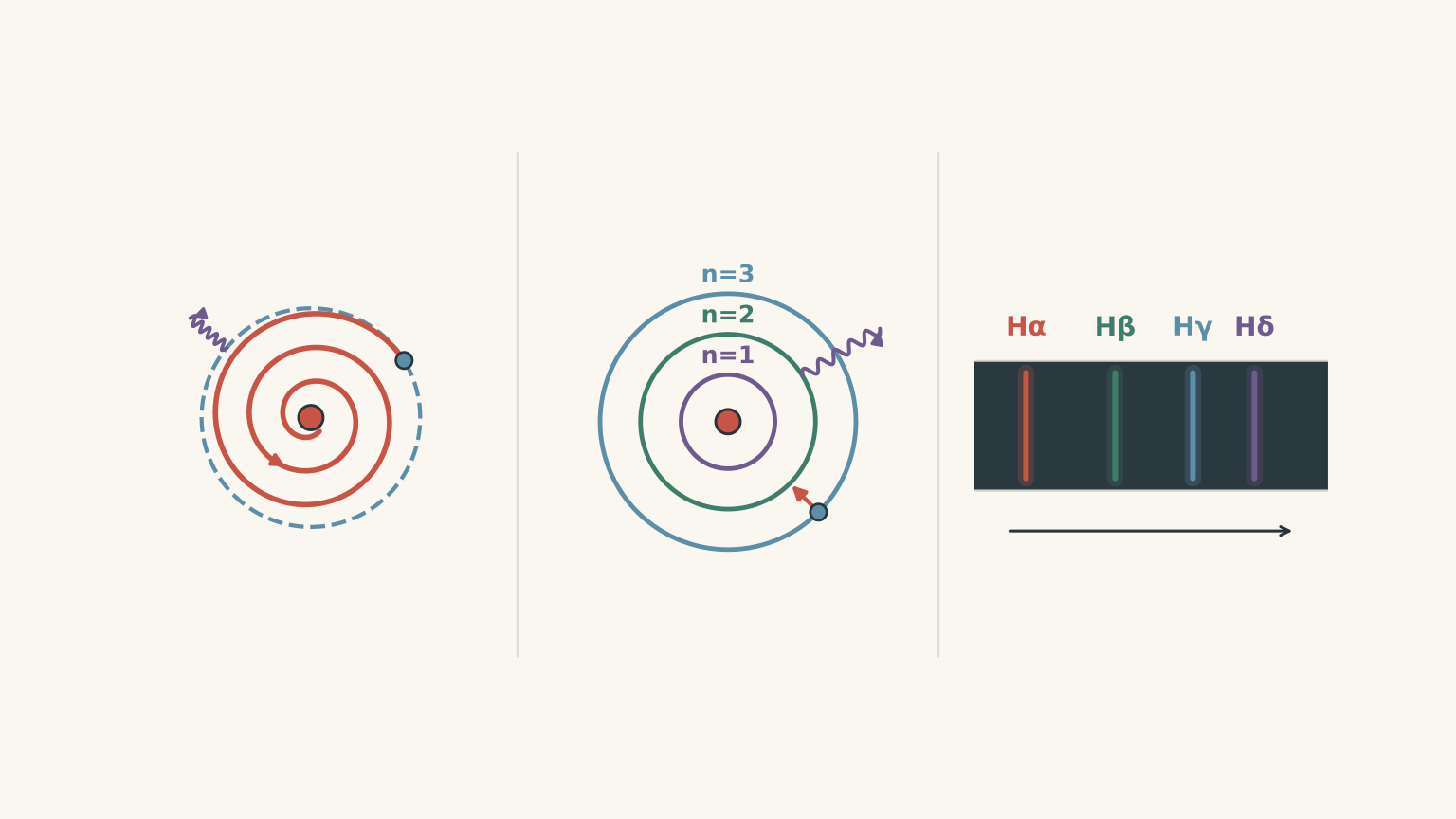
Due to technical limitations, this figure may display incorrectly or contain inaccuracies. Please check key details against your course materials.
Bohr’s solution: stationary states
In 1913, Niels Bohr proposed that electrons could occupy particular allowed energy states called stationary states.
His model introduced two important ideas:
- An electron in an allowed stationary state does not continuously emit electromagnetic radiation.
- An electron can move between allowed energy states by absorbing or emitting a photon.
The energy of the photon must equal the difference between the two energy levels:
\[ \Delta E=h\nu=\frac{hc}{\lambda} \]
Where:
- \(\Delta E\) is the energy difference between the states, measured in joules (J).
- \(h\) is Planck’s constant, \(6.626\times10^{-34}\ \mathrm{J\,s}\).
- \(\nu\) is the photon frequency, measured in hertz (Hz).
- \(c\) is the speed of light, approximately \(3.00\times10^8\ \mathrm{m\,s^{-1}}\).
- \(\lambda\) is the photon wavelength, measured in metres (m).
This explained why hydrogen produces discrete spectral lines. Only particular energy differences are available, so only particular photon frequencies can be emitted or absorbed.
However, Bohr’s model was not a complete description of the atom. It could explain important features of hydrogen, but it struggled with more complicated atoms and the finer details of atomic spectra.
Modern quantum mechanics replaced the idea of precise electron orbits with quantum states described by wavefunctions. These states still have definite allowed energies, but their internal structure can be more complicated than Bohr’s original model suggested.
That brings us to hyperfine structure.
02Why an atomic energy level can split further
Imagine that a spectrometer measures an atomic transition with extremely high precision. Instead of detecting one spectral line, it detects several very closely spaced lines.
The principal energy levels alone cannot explain this observation.
Something else must be contributing to the energy of the atom.
The missing ingredient is the nucleus’s magnetic properties.
Electrons have magnetic moments
You already know that moving electric charges can produce magnetic fields. Electrons have an additional magnetic property associated with their intrinsic angular momentum, called spin.
Spin is a fundamental quantum property of particles. It is not literally a tiny ball rotating around its own axis.
An electron’s spin gives it an associated magnetic dipole moment, which we can represent using the symbol \(\boldsymbol{\mu}_e\).
The electron is not the only particle with this property.
The proton inside a hydrogen nucleus also has spin and a magnetic dipole moment, represented by \(\boldsymbol{\mu}_I\).
The nucleus therefore behaves, in a simplified magnetic model, like a tiny magnetic dipole.
This means that the electron and nucleus can interact magnetically.
How do the two magnetic moments interact?
The electron’s magnetic moment produces a magnetic field that interacts with the nuclear magnetic moment.
A useful first model for the interaction energy is:
\[ U=-\boldsymbol{\mu}_I\cdot\mathbf B_e \]
Where:
- \(U\) is the magnetic interaction energy, measured in joules.
- \(\boldsymbol{\mu}_I\) is the nuclear magnetic dipole moment.
- \(\mathbf B_e\) is the magnetic field produced by the electrons at the nucleus.
The key idea is that the energy depends on the relationship between the nuclear magnetic moment and the magnetic field experienced by the nucleus.
Think of a compass needle placed in a magnetic field. Its orientation affects its magnetic potential energy. The nuclear magnetic moment behaves in a similar way when it interacts with the field produced by the electrons.
There is an important limitation to this analogy. An atom is not simply two tiny magnets with fixed directions. Its angular momentum and magnetic properties are quantised, and the allowed combined states must be described using quantum mechanics.
Also, be careful not to confuse an electron’s spin direction with its magnetic moment direction. Because the electron has negative electric charge, its magnetic moment points opposite to its spin angular momentum.
Why is the splitting so small?
The magnetic moments of nuclei are generally much smaller than those of electrons.
One reason is the large difference between the electron’s mass and the proton’s mass. The natural magnetic moment scale for a nucleus is much smaller because it depends on the proton’s much greater mass.
As a result, the interaction between nuclear and electronic magnetic moments usually produces a much smaller energy correction than the main electronic interactions.
This is why the splitting is called hyperfine structure: it reveals an exceptionally fine level of detail in atomic energy levels.
For the hydrogen atom, the proton has nuclear spin, and the electron has spin. Their magnetic interaction produces a small energy separation even when there is no externally applied magnetic field.
This last point matters. Hyperfine structure is caused by an internal interaction within the atom, not by placing the atom between the poles of an external magnet.
03How hyperfine energy levels are formed
To describe the splitting properly, we need to introduce three angular momentum quantum numbers.
| Symbol | Meaning |
|---|---|
| \(I\) | Nuclear spin quantum number |
| \(J\) | Total electronic angular momentum quantum number |
| \(F\) | Total atomic angular momentum quantum number, combining the nucleus and electrons |
For an atom with a single electron, the total electronic angular momentum comes from combining the electron’s orbital angular momentum \(L\) and spin angular momentum \(S\).
The nucleus has its own angular momentum, represented by \(I\).
When the nuclear and electronic angular momenta interact, they combine to produce the total atomic angular momentum \(F\).
The allowed values of \(F\) are:
\[ F=|I-J|,\ldots,I+J \]
The values increase in steps of one.
This means that an individual electronic energy level can split into multiple hyperfine levels.
The example of hydrogen
Hydrogen is the simplest useful example because its nucleus contains just one proton.
The proton has nuclear spin quantum number:
\[ I=\frac12 \]
For an electron in the ground-state \(1s\) orbital, the orbital angular momentum is zero, but the electron still has spin:
\[ J=\frac12 \]
Therefore, the allowed values of the total angular momentum are:
\[ F=\left|\frac12-\frac12\right|, \ldots, \frac12+\frac12 \]
So:
\[ \boxed{F=0,\ 1} \]
The original electronic energy level splits into two hyperfine energy levels.
The \(F=0\) level is called a singlet state, while the \(F=1\) level is called a triplet state.
In a simplified spin description, these are sometimes described as the antiparallel-spin and parallel-spin states, respectively. These descriptions are shorthand for the quantum states, rather than literal fixed orientations of two particles.
For hydrogen’s ground state, the \(F=1\) state has the higher energy.
Why does the triplet state have three possible substates?
Each value of \(F\) allows a set of magnetic quantum numbers, represented by \(m_F\).
These values range from \(-F\) to \(+F\), in steps of one.
The number of possible substates is therefore:
\[ N=2F+1 \]
For hydrogen:
| Hyperfine level | Allowed \(m_F\) values | Number of substates |
|---|---|---|
| \(F=1\), higher energy | \(-1,0,+1\) | 3 |
| \(F=0\), lower energy | \(0\) | 1 |
There are four possible combined spin states in total.
Importantly, in the absence of an external magnetic field, the three \(F=1\) substates have the same energy. They are three different quantum states, but they do not represent three different hyperfine energy levels.
Calculating the energy separation
For the simplest magnetic dipole hyperfine model, the energy of a hyperfine level can be written as:
\[ E_F=\frac{A}{2} \left[ F(F+1)-I(I+1)-J(J+1) \right] \]
Here, \(A\) is the magnetic dipole hyperfine coupling constant, measured in units of energy. Its sign determines the ordering of the hyperfine levels.
For hydrogen’s ground state, \(I=J=\frac12\).
For \(F=1\):
\[ \begin{aligned} E_1&=\frac{A}{2} \left[1(2)-\frac34-\frac34\right]\\ &=\frac{A}{4} \end{aligned} \]
For \(F=0\):
\[ \begin{aligned} E_0&=\frac{A}{2} \left[0-\frac34-\frac34\right]\\ &=-\frac{3A}{4} \end{aligned} \]
The energy separation is therefore:
\[ \Delta E=E_1-E_0 \]
\[ \boxed{\Delta E=A} \]
For hydrogen, the separation is approximately:
\[ \boxed{\Delta E=5.9\times10^{-6}\ \mathrm{eV}} \]
The energy difference is extremely small compared with the main electronic energy levels.
Hyperfine structure versus fine structure
It is easy to confuse hyperfine structure with fine structure. Both involve small corrections to the energy levels of atoms, but they have different physical origins.
| Structure | Main physical cause |
|---|---|
| Gross electronic structure | Electrostatic attraction between the nucleus and electrons |
| Fine structure | Relativistic effects and interactions involving electronic angular momentum, including spin-orbit coupling |
| Hyperfine structure | Interactions between nuclear electromagnetic moments and the electromagnetic fields produced by electrons |
| Zeeman splitting | Interaction of atomic magnetic moments with an externally applied magnetic field |
The distinction between hyperfine structure and the Zeeman effect is particularly important.
Hyperfine structure exists because of interactions within the atom. An external magnetic field is not required.
A magnetic field applied from outside can further split the magnetic substates of an existing hyperfine level. This additional effect is called Zeeman splitting.
04The 21-centimetre hydrogen line
The hyperfine splitting of hydrogen has an important consequence.
An electron and proton can move from the higher-energy \(F=1\) state to the lower-energy \(F=0\) state.
The atom releases the energy difference as a photon.
The photon energy is:
\[ \Delta E=h\nu=\frac{hc}{\lambda} \]
For hydrogen’s ground-state hyperfine transition, the frequency is approximately:
\[ \nu=1.4204\times10^9\ \mathrm{Hz} \]
This corresponds to a wavelength of approximately:
\[ \boxed{\lambda=0.211\ \mathrm m=21.1\ \mathrm{cm}} \]
This is known as the 21-centimetre line.
Notice something interesting: the electron does not move from one principal electronic energy level to another.
Both hyperfine states belong to the same \(1s\) electronic ground state. The transition changes the combined nuclear and electronic spin state, rather than the electron’s principal energy level.
It is often called a spin-flip transition.
Why does this matter in astronomy?
The 21-centimetre line is particularly important because neutral hydrogen is extremely common in interstellar space.
The transition is a magnetic dipole transition, which is much weaker than an ordinary strong electric dipole transition.
An isolated hydrogen atom in the upper hyperfine state has a spontaneous radiative lifetime of roughly ten million years.
That is an extraordinarily long time for an atomic transition.
So why can radio telescopes detect it?
Because interstellar gas contains enormous numbers of hydrogen atoms. Even though individual atoms emit these photons very rarely, the combined emission from vast clouds of hydrogen can be detected.
Radio astronomers use this emission to investigate the distribution of neutral hydrogen throughout the Milky Way and other galaxies.
A subtle point: three substates affect the population
Remember that the \(F=1\) hyperfine level contains three magnetic substates, while the \(F=0\) level contains only one.
This affects how many atoms occupy each energy level at thermal equilibrium.
The Boltzmann distribution describes how particles populate energy states at a given absolute temperature.
For the two hydrogen hyperfine levels, the ratio of their total populations is:
\[ \frac{N_1}{N_0} = 3e^{-\Delta E/(k_BT)} \]
Where:
- \(N_1\) is the total number of atoms in the \(F=1\) level.
- \(N_0\) is the number of atoms in the \(F=0\) level.
- The factor of 3 comes from the three substates of \(F=1\).
- \(\Delta E\) is the energy difference between the two levels.
- \(k_B\) is Boltzmann’s constant, approximately \(8.62\times10^{-5}\ \mathrm{eV\,K^{-1}}\).
- \(T\) is the absolute temperature in kelvin.
The important detail is that a higher-energy level does not necessarily contain fewer atoms in total when it has more available substates.
For hydrogen, the energy separation corresponds to a temperature of approximately:
\[ \frac{\Delta E}{k_B}\approx0.068\ \mathrm K \]
At temperatures much higher than this, the exponential factor approaches one, so:
\[ \frac{N_1}{N_0}\approx3 \]
The higher-energy level can therefore contain approximately three times as many atoms as the lower-energy level.
This does not mean the atom has a population inversion. Each individual \(F=1\) substate is still less populated than the \(F=0\) state at positive thermal equilibrium temperatures. The difference comes from having three available substates rather than one.
The Boltzmann model assumes thermal equilibrium. Real interstellar hydrogen populations can also be influenced by collisions and the surrounding radiation field, so the actual astronomical signal requires additional considerations.
05Worked examples
Worked example: calculating the energy of a 21-centimetre photon
A hydrogen atom undergoes the transition from the higher \(F=1\) hyperfine level to the lower \(F=0\) level. The emitted photon has a frequency of \(1.4204\times10^9\ \mathrm{Hz}\).
Calculate the photon’s wavelength and energy in electronvolts.
Step 1
For wavelength:
\[ \lambda=\frac{c}{\nu} \]
For photon energy:
\[ E=h\nu \]
Step 2
Using \(c=3.00\times10^8\ \mathrm{m\,s^{-1}}\):
\[ \begin{aligned} \lambda&=\frac{3.00\times10^8}{1.4204\times10^9}\\ &=0.2112\ \mathrm m \end{aligned} \]
Therefore:
\[ \boxed{\lambda\approx21.1\ \mathrm{cm}} \]
Step 3
\[ \begin{aligned} E&=h\nu\\ &=(6.626\times10^{-34})(1.4204\times10^9)\\ &=9.414\times10^{-25}\ \mathrm J \end{aligned} \]
Step 4
Using:
\[ 1\ \mathrm{eV}=1.602\times10^{-19}\ \mathrm J \]
We obtain:
\[ E=\frac{9.414\times10^{-25}}{1.602\times10^{-19}} \]
\[ \boxed{E=5.88\times10^{-6}\ \mathrm{eV}} \]
The photon has an energy of approximately \(5.9\times10^{-6}\ \mathrm{eV}\) and a wavelength of 21.1 cm.
This is a radio photon, not visible light. Its small energy reflects the very small separation between the hydrogen hyperfine levels.
Worked example: finding the hyperfine levels of an atom
Consider an atom with:
- Nuclear spin quantum number \(I=1\).
- Total electronic angular momentum quantum number \(J=\frac12\).
- A positive magnetic dipole coupling constant satisfying \(A/h=20.0\ \mathrm{MHz}\).
Assume that the magnetic dipole interaction dominates, the electric quadrupole contribution is negligible, and there is no external magnetic field.
Determine the allowed hyperfine levels, their relative energies, and the frequency corresponding to the separation between them.
Step 1
We use:
\[ F=|I-J|,\ldots,I+J \]
Substituting:
\[ F=\left|1-\frac12\right|,\ldots, 1+\frac12 \]
Therefore:
\[ \boxed{F=\frac12,\frac32} \]
The electronic level splits into two hyperfine levels.
Step 2
Use:
\[ E_F=\frac{A}{2} [F(F+1)-I(I+1)-J(J+1)] \]
For \(F=\frac32\):
\[ \begin{aligned} E_{3/2} &=\frac A2 \left[\frac{15}{4}-2-\frac34\right]\\ &=\frac A2 \end{aligned} \]
For \(F=\frac12\):
\[ \begin{aligned} E_{1/2} &=\frac A2 \left[\frac34-2-\frac34\right]\\ &=-A \end{aligned} \]
Because \(A\) is positive, the \(F=\frac32\) level is higher in energy.
Step 3
\[ \begin{aligned} \Delta E &=E_{3/2}-E_{1/2}\\ &=\frac A2-(-A)\\ &=\frac{3A}{2} \end{aligned} \]
Step 4
Since \(A/h=20.0\ \mathrm{MHz}\):
\[ \begin{aligned} \Delta\nu &=\frac{\Delta E}{h}\\ &=\frac{3A}{2h}\\ &=\frac32(20.0)\\ &=30.0\ \mathrm{MHz} \end{aligned} \]
Therefore:
\[ \boxed{\Delta\nu=30.0\ \mathrm{MHz}} \]
Step 5
Use:
\[ N=2F+1 \]
For \(F=\frac12\):
\[ N=2\left(\frac12\right)+1=2 \]
For \(F=\frac32\):
\[ N=2\left(\frac32\right)+1=4 \]
There are six substates altogether.
This also agrees with the total number of combined nuclear and electronic spin states:
\[ (2I+1)(2J+1)=3\times2=6 \]
The important result is that hyperfine splitting depends on both the nuclear and electronic angular momenta, as well as the interaction strength. Knowing the electron’s energy level alone is not enough to determine the complete atomic energy structure.
06Questions and solutions
Question 1
A radio telescope detects electromagnetic radiation with a wavelength of \(21.1\ \mathrm{cm}\), corresponding to the hydrogen ground-state hyperfine transition.
Calculate:
(a) The frequency of the radiation.
(b) The energy of an individual photon in electronvolts.
Use \(c=3.00\times10^8\ \mathrm{m\,s^{-1}}\), \(h=6.626\times10^{-34}\ \mathrm{J\,s}\), and \(1\ \mathrm{eV}=1.602\times10^{-19}\ \mathrm J\).
Solution 1
The frequency is approximately \(1.42\times10^9\ \mathrm{Hz}\), and the photon energy is approximately \(5.88\times10^{-6}\ \mathrm{eV}\).
(a) Calculate the frequency.
Start with:
\[ \nu=\frac{c}{\lambda} \]
Convert the wavelength into metres:
\[ \lambda=21.1\ \mathrm{cm}=0.211\ \mathrm m \]
Substitute:
\[ \begin{aligned} \nu&=\frac{3.00\times10^8}{0.211}\\ &=1.42\times10^9\ \mathrm{Hz} \end{aligned} \]
(b) Calculate the photon energy.
Use:
\[ E=h\nu \]
Substitute:
\[ \begin{aligned} E&=(6.626\times10^{-34})(1.42\times10^9)\\ &=9.41\times10^{-25}\ \mathrm J \end{aligned} \]
Convert into electronvolts:
\[ E=\frac{9.41\times10^{-25}}{1.602\times10^{-19}} \]
\[ \boxed{E=5.88\times10^{-6}\ \mathrm{eV}} \]
The extremely small photon energy is consistent with a transition between closely spaced hyperfine levels rather than two widely separated electronic energy levels.
Question 2
Two isotopes of the same element have identical electronic angular momentum quantum numbers, \(J=\frac12\), but different nuclear spin quantum numbers.
- Isotope X has \(I=0\).
- Isotope Y has \(I=\frac12\).
Both isotopes are examined using high-resolution spectroscopy in the absence of an external magnetic field.
(a) Determine the allowed values of \(F\) for each isotope.
(b) Predict the number of distinct magnetic-dipole hyperfine energy levels for each isotope.
(c) Explain why observing two hyperfine components for isotope Y, but not isotope X, supports the idea that the splitting is caused by nuclear magnetic interactions.
Assume other sources of spectral splitting and broadening can be ignored.
Solution 2
Isotope X has one magnetic-dipole hyperfine energy level, while isotope Y has two. This difference arises because only isotope Y has non-zero nuclear spin and therefore a nuclear magnetic dipole moment.
(a) Determine the allowed values of \(F\).
For isotope X:
\[ F=|I-J|,\ldots,I+J \]
Substituting:
\[ F=\left|0-\frac12\right| \]
Therefore:
\[ \boxed{F=\frac12} \]
For isotope Y:
\[ F=\left|\frac12-\frac12\right|, \ldots, \frac12+\frac12 \]
Therefore:
\[ \boxed{F=0,\ 1} \]
(b) Determine the number of energy levels.
Isotope X has only one allowed value of \(F\), so it has one hyperfine energy level in the magnetic-dipole model.
Isotope Y has two allowed values, so it has two hyperfine energy levels.
(c) Explain the physical reason.
For isotope X, the nuclear spin is zero. It therefore has no nuclear magnetic dipole moment to interact with the electronic magnetic field.
For isotope Y, the nuclear spin is non-zero. Its nuclear magnetic moment interacts with the electronic magnetic field, producing two different allowed total angular momentum states.
The absence of an external magnetic field is important. The splitting cannot be attributed to an ordinary external-field Zeeman effect.
An isotope shift caused by differences in nuclear mass or size would also be a different phenomenon. It can shift the position of a spectral line without producing the magnetic-dipole hyperfine multiplet described here.
Question 3
An atom has:
\[ I=\frac12,\qquad J=\frac32 \]
Its magnetic dipole hyperfine coupling constant is negative and satisfies:
\[ \frac{A}{h}=-8.0\ \mathrm{MHz} \]
Assume the magnetic dipole interaction is the only relevant hyperfine contribution and there is no external magnetic field.
Determine:
(a) The allowed values of \(F\).
(b) The energy of each hyperfine level in terms of \(A\).
(c) Which level has the higher energy.
(d) The frequency corresponding to the energy separation.
(e) The number of magnetic substates in each level.
Solution 3
The atom has two hyperfine levels, \(F=1\) and \(F=2\). Because the coupling constant is negative, the \(F=1\) level is higher in energy, and the frequency corresponding to the separation is \(16.0\ \mathrm{MHz}\).
(a) Determine the allowed values of \(F\).
Use:
\[ F=|I-J|,\ldots,I+J \]
Substitute:
\[ F=\left|\frac12-\frac32\right|, \ldots, \frac12+\frac32 \]
Therefore:
\[ \boxed{F=1,\ 2} \]
(b) Calculate the relative energies.
Use:
\[ E_F=\frac A2 [F(F+1)-I(I+1)-J(J+1)] \]
First calculate the shared terms:
\[ I(I+1)=\frac34 \]
\[ J(J+1)=\frac{15}{4} \]
For \(F=1\):
\[ \begin{aligned} E_1&=\frac A2 \left[2-\frac34-\frac{15}{4}\right]\\ &=-\frac{5A}{4} \end{aligned} \]
For \(F=2\):
\[ \begin{aligned} E_2&=\frac A2 \left[6-\frac34-\frac{15}{4}\right]\\ &=\frac{3A}{4} \end{aligned} \]
(c) Determine the energy ordering.
Since \(A\) is negative:
\[ E_1=-\frac{5A}{4}>0 \]
while:
\[ E_2=\frac{3A}{4}<0 \]
Therefore:
\[ \boxed{F=2\text{ is lower, and }F=1\text{ is higher}} \]
This is an important difference from the hydrogen ground-state example. The sign of the hyperfine coupling constant affects the energy ordering, so you cannot assume that the larger value of \(F\) always corresponds to the higher-energy level.
(d) Calculate the frequency separation.
\[ \Delta E=E_1-E_2 \]
\[ \begin{aligned} \Delta E &=-\frac{5A}{4}-\frac{3A}{4}\\ &=-2A \end{aligned} \]
The positive energy separation is therefore \(2|A|\).
Using \(\Delta\nu=\Delta E/h\):
\[ \begin{aligned} \Delta\nu&=2\left|\frac Ah\right|\\ &=2(8.0)\\ &=16.0\ \mathrm{MHz} \end{aligned} \]
\[ \boxed{\Delta\nu=16.0\ \mathrm{MHz}} \]
(e) Calculate the number of substates.
For \(F=1\):
\[ N=2(1)+1=3 \]
For \(F=2\):
\[ N=2(2)+1=5 \]
There are eight substates in total.
The result also agrees with:
\[ (2I+1)(2J+1)=2\times4=8 \]
The total number of states is conserved when the original electronic level splits into its hyperfine components.
Question 4
The ground-state electron in a hydrogen atom occupies the \(1s\) orbital.
A student argues:
“The electron has zero orbital angular momentum in the \(1s\) state, so it cannot produce a magnetic interaction with the proton. Therefore, hydrogen should have no hyperfine splitting in its ground state.”
Evaluate this argument.
Your response should distinguish between:
(a) Orbital angular momentum and electron spin.
(b) Total electronic angular momentum and nuclear spin.
(c) Why the \(1s\) state can still interact magnetically with the proton.
(d) What would happen to the magnetic-dipole hyperfine splitting if the nucleus had \(I=0\).
Solution 4
The student’s argument is incorrect. Zero orbital angular momentum does not mean zero electron magnetic moment because the electron still possesses intrinsic spin.
(a) Orbital angular momentum and electron spin
For a hydrogen \(1s\) electron:
\[ L=0 \]
This means the electron has zero orbital angular momentum.
However, the electron has intrinsic spin:
\[ S=\frac12 \]
The electron’s spin produces a magnetic dipole moment even when its orbital angular momentum is zero.
(b) Total electronic angular momentum and nuclear spin
For the hydrogen ground state, the electron’s total angular momentum is:
\[ J=\frac12 \]
The proton also possesses nuclear spin:
\[ I=\frac12 \]
The two angular momenta combine to produce:
\[ F=0,\ 1 \]
Therefore, two hyperfine energy levels are possible.
(c) Explain the magnetic interaction.
The electron’s spin magnetic moment can interact with the proton’s nuclear magnetic moment.
There is an additional detail for an \(s\) orbital. The electron’s probability density is non-zero at the nucleus.
This allows a particularly important magnetic interaction, called the Fermi contact interaction, to contribute to the hyperfine energy.
Consequently, the absence of orbital angular momentum does not eliminate hyperfine structure.
(d) Consider a nucleus with \(I=0\).
If the nuclear spin is zero, there is no nuclear magnetic dipole moment in this model.
The magnetic-dipole hyperfine interaction therefore disappears.
The key distinction is that electron spin and nuclear spin are separate properties. Removing the orbital contribution does not remove electron spin, but removing the nuclear magnetic moment removes the magnetic-dipole coupling responsible for the hydrogen ground-state splitting.
Question 5
A cloud of neutral hydrogen is in thermal equilibrium at a temperature of \(10\ \mathrm K\).
Its ground-state hyperfine structure consists of:
- A lower-energy \(F=0\) level with one magnetic substate.
- A higher-energy \(F=1\) level with three magnetic substates.
The energy separation is:
\[ \Delta E=5.9\times10^{-6}\ \mathrm{eV} \]
Use:
\[ k_B=8.62\times10^{-5}\ \mathrm{eV\,K^{-1}} \]
Assume there is no external magnetic field.
(a) Calculate the ratio of the total number of atoms in \(F=1\) to the total number in \(F=0\) at \(10\ \mathrm K\).
(b) Determine the temperature at which the two hyperfine levels contain equal total populations.
(c) A student observes that the higher-energy \(F=1\) level contains more atoms at \(10\ \mathrm K\). They conclude that the atom has a population inversion.
Is this conclusion correct? Use the populations per magnetic substate to justify your answer.
Solution 5
At \(10\ \mathrm K\), the higher-energy \(F=1\) level contains approximately 2.98 times as many atoms as the \(F=0\) level. However, this is not a population inversion because the \(F=1\) level has three magnetic substates rather than one.
This problem combines energy differences, angular momentum degeneracy, and thermal equilibrium.
(a) Calculate the population ratio.
At thermal equilibrium, the total population ratio is:
\[ \frac{N_1}{N_0} = \frac{d_1}{d_0} e^{-\Delta E/(k_BT)} \]
Here, \(d_1=3\) and \(d_0=1\).
Therefore:
\[ \frac{N_1}{N_0} = 3e^{-\Delta E/(k_BT)} \]
Substitute the given values:
\[ \frac{N_1}{N_0} = 3e^{-\frac{5.9\times10^{-6}} {(8.62\times10^{-5})(10)}} \]
First evaluate the exponent:
\[ \frac{\Delta E}{k_BT}=0.00684 \]
Therefore:
\[ \frac{N_1}{N_0} = 3e^{-0.00684} \]
\[ \boxed{\frac{N_1}{N_0}\approx2.98} \]
The higher-energy level contains approximately 2.98 times the total number of atoms in the lower-energy level.
This happens because the higher-energy level has three available substates.
(b) Determine the temperature at which the populations are equal.
We want:
\[ N_1=N_0 \]
Therefore:
\[ 3e^{-\Delta E/(k_BT)}=1 \]
Divide by three:
\[ e^{-\Delta E/(k_BT)}=\frac13 \]
Taking the natural logarithm:
\[ -\frac{\Delta E}{k_BT}=-\ln3 \]
Rearranging:
\[ T=\frac{\Delta E}{k_B\ln3} \]
Substitute:
\[ T= \frac{5.9\times10^{-6}} {(8.62\times10^{-5})(1.099)} \]
\[ \boxed{T\approx0.0623\ \mathrm K} \]
Above approximately \(0.0623\ \mathrm K\), the total population of the \(F=1\) level exceeds that of \(F=0\), under the stated thermal-equilibrium assumptions.
Below this temperature, the lower-energy level contains more atoms.
(c) Determine whether there is a population inversion.
The student’s conclusion is incorrect.
A population inversion does not simply mean that the total number of atoms in a higher-energy level exceeds the total number in a lower-energy level.
The populations must be compared per available substate.
For \(F=1\), there are three substates. For \(F=0\), there is only one.
The ratio of population per substate is therefore:
\[ \frac{N_1/3}{N_0/1} = \frac{N_1}{3N_0} \]
Using the thermal-equilibrium relationship:
\[ \frac{N_1}{3N_0} = e^{-\Delta E/(k_BT)} \]
At \(10\ \mathrm K\):
\[ \frac{N_1}{3N_0}=e^{-0.00684} \]
\[ \boxed{\frac{N_1/3}{N_0}\approx0.993} \]
The population per \(F=1\) substate is still slightly smaller than the population of the \(F=0\) substate.
There is no population inversion.
The tempting mistake is to compare the total populations without accounting for the different numbers of available quantum states.
This is a useful example of why energy-level diagrams must include degeneracy when discussing the behaviour of large collections of atoms.
07Where to go next
Hyperfine structure shows that an atomic energy level is not always a single, indivisible energy state. Interactions involving the nucleus can produce additional levels, even when the electron remains in exactly the same electronic state.
The next useful concept is the Zeeman effect: what happens when an external magnetic field is applied to an atom that already has hyperfine structure. You can then investigate how the magnetic substates split further, how the resulting spectral lines change, and how atomic transitions can reveal information about magnetic fields.
Further reading
The following university and educational resources support the physics discussed in this article:
- OpenStax – University Physics, Volume 3: Electron Spin. Covers electron spin, proton magnetic moments, and the hydrogen hyperfine transition.
- University of Manchester – Jodrell Bank: Atomic Hydrogen. Explains the 21-centimetre line, its energy separation, and its importance in radio astronomy.
- University of Sheffield – PHY242: Atomic Physics. Covers atomic energy levels, hyperfine states, and the astronomical applications of hydrogen emission.
- Australian National University – Hyperfine Structure. Provides further detail on angular momentum coupling, magnetic dipole interactions, and hyperfine energy levels.
- NESA – Physics 11-12 Syllabus (2025). Provides the NSW Physics course structure and the Matter, energy and the cosmos focus area.
“ `