
Solubility Rules and Precipitation Tests for HSC Chemistry
Learn how to use experimental observations and solubility rules to predict precipitates, write net ionic equations, and analyse common HSC precipitation reactions.
Two colourless solutions are mixed. A second later, the test tube turns cloudy and a solid begins to settle.
Where did the solid come from?
Take \(\ce{KCl(aq)}\) and \(\ce{AgNO3(aq)}\). Both dissolve in water, so it is tempting to predict that mixing them will simply give another clear solution. Before reading further, decide: do all four ions stay dissolved, or do some of them leave the solution?
The mixture turns cloudy white. The solid is silver chloride, \(\ce{AgCl(s)}\).
That observation is the starting point for solubility rules. They are not arbitrary facts somebody decided to put in a table. They are compact summaries of a pattern: some combinations of ions remain dissolved in water, while others form solids under the conditions of the experiment.
01What is actually moving around in the solution?
When potassium chloride dissolves, it does not stay as tiny intact \(\ce{KCl}\) units floating through the water. It separates into hydrated ions:
\[ \ce{KCl(aq) -> K+(aq) + Cl-(aq)} \]
Silver nitrate does the same:
\[ \ce{AgNO3(aq) -> Ag+(aq) + NO3-(aq)} \]
So before mixing, there are already four kinds of particles involved: \(\mathrm{K}^{+}\), \(\mathrm{Cl}^{-}\), \(\mathrm{Ag}^{+}\), and \(\ce{NO3-}\).
A slightly silly way to picture this is a party where everyone is moving around independently rather than arriving permanently attached to their date. When \(\mathrm{Ag}^{+}\) and \(\mathrm{Cl}^{-}\) encounter each other, they can become part of a solid crystal lattice and effectively leave the party floor.
The analogy stops there. Ions do not choose partners, and collisions happen constantly. Whether a solid forms and remains depends on the energetics and equilibrium of the system.
For this mixture, the overall equation is
\[ \ce{KCl(aq) + AgNO3(aq) -> AgCl(s) + KNO3(aq)} \]
The \(\mathrm{K}^{+}\) and \(\ce{NO3-}\) ions remain dissolved. They appear unchanged on both sides of the ionic equation, so they are called spectator ions.
The useful chemical change is therefore
\[ \ce{Ag+(aq) + Cl-(aq) -> AgCl(s)} \]
This is the net ionic equation.
02Running the three precipitation tests
A good precipitation experiment needs to make it obvious which two solutions produced each observation.
Place three clean test tubes in a rack from left to right and label them A, B, and C. Put a white card behind the rack so that faint cloudiness is easier to see. Use a separate clean pipette or dropper for each solution.
Add about \(1\ \text{mL}\) of the first solution to each tube:
- A: \(\ce{KCl(aq)}\)
- B: \(\ce{KI(aq)}\)
- C: \(\ce{Na2SO4(aq)}\)
Then add about \(1\ \text{mL}\) of the matching nitrate solution:
- A: \(\ce{AgNO3(aq)}\)
- B: \(\ce{Pb(NO3)2(aq)}\)
- C: \(\ce{Ba(NO3)2(aq)}\)
Swirl each tube gently and observe it against the white background.
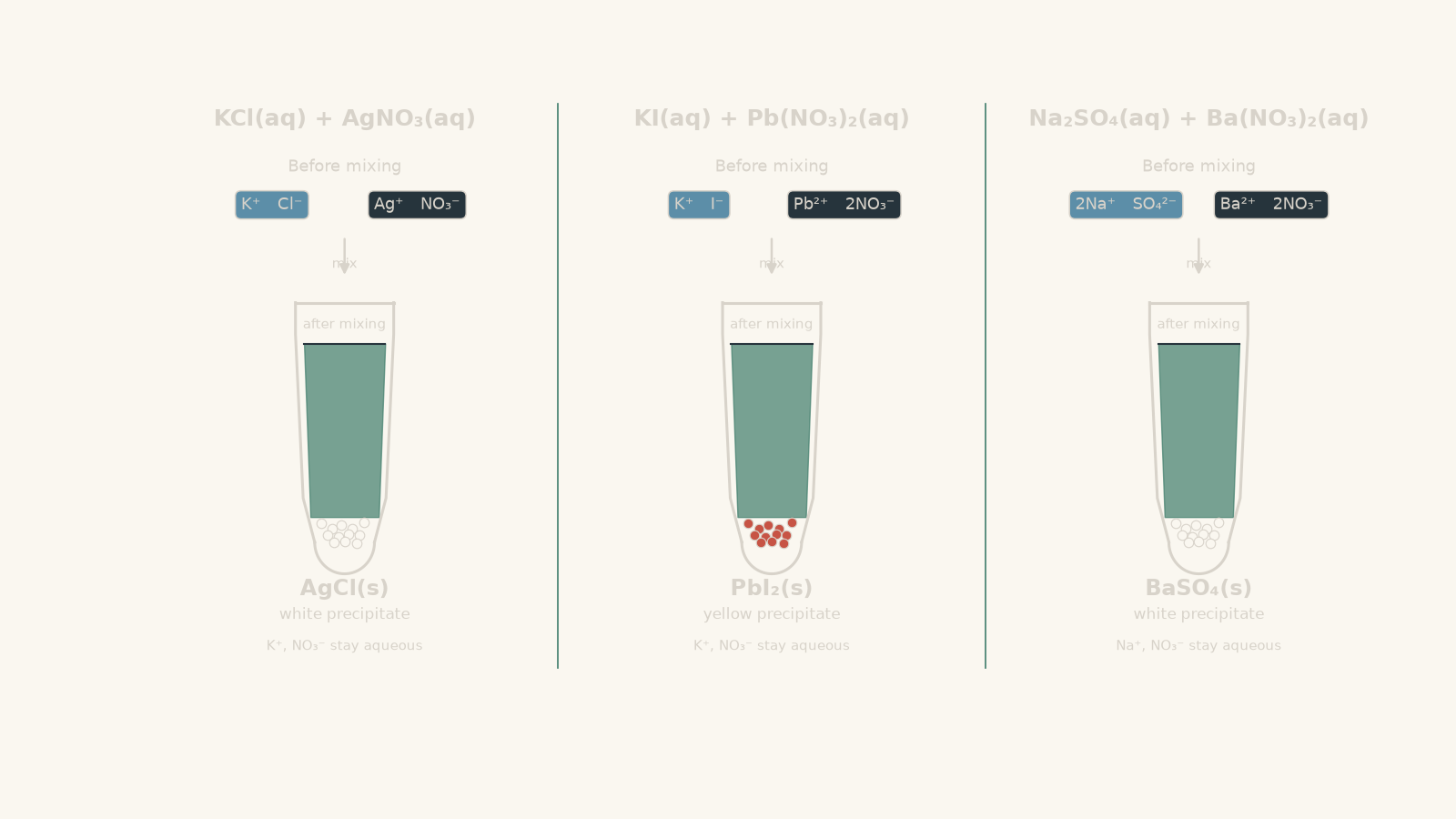
The expected results are:
| Mixture | Main observation | Precipitate | Net ionic equation |
|---|---|---|---|
| \(\ce{KCl + AgNO3}\) | White cloud or white solid | \(\ce{AgCl}\) | \(\ce{Ag+ + Cl- -> AgCl(s)}\) |
| \(\ce{KI + Pb(NO3)2}\) | Yellow solid | \(\ce{PbI2}\) | \(\ce{Pb^2+ + 2I- -> PbI2(s)}\) |
| \(\ce{Na2SO4 + Ba(NO3)2}\) | White cloud or white solid | \(\ce{BaSO4}\) | \(\ce{Ba^2+ + SO4^2- -> BaSO4(s)}\) |
These observations immediately tell us something important: being soluble before mixing does not mean every possible new ion combination will also be soluble.
Test 1: potassium chloride and silver nitrate
The ions present after the two solutions meet are
\[ \ce{K+, Cl-, Ag+, NO3-} \]
The new possible ion pair is \(\mathrm{Ag}^{+}\) with \(\mathrm{Cl}^{-}\). Silver chloride has very low solubility, so a white precipitate forms.
\[ \ce{Ag+(aq) + Cl-(aq) -> AgCl(s)} \]
Meanwhile, potassium nitrate remains dissolved.
A common mistake is to write \(\ce{KNO3}\) as another precipitate simply because the ions have “swapped partners”. The swap is only a useful bookkeeping idea. Solubility decides whether anything actually leaves the aqueous phase.
Test 2: potassium iodide and lead(II) nitrate
Now predict before looking at the equation. If \(\mathrm{Pb}^{2+}\) forms a neutral compound with \(\mathrm{I}^{-}\), how many iodide ions are required?
Two.
One \(\mathrm{Pb}^{2+}\) ion has a \(+2\) charge, so it combines with two \(\mathrm{I}^{-}\) ions:
\[ \ce{Pb^2+(aq) + 2I-(aq) -> PbI2(s)} \]
The precipitate is yellow.
The full equation is
\[ \ce{2KI(aq) + Pb(NO3)2(aq) -> PbI2(s) + 2KNO3(aq)} \]
The coefficient of 2 in front of \(\ce{KI}\) is not an optional balancing detail. It represents the actual \(2:1\) iodide-to-lead ratio in \(\ce{PbI2}\).
Test 3: sodium sulfate and barium nitrate
Sodium sulfate provides \(\ce{SO4^2-}\), while barium nitrate provides \(\mathrm{Ba}^{2+}\).
Their charges cancel in a \(1:1\) ratio:
\[ \ce{Ba^2+(aq) + SO4^2-(aq) -> BaSO4(s)} \]
Barium sulfate appears as a white precipitate.
The overall equation is
\[ \ce{Na2SO4(aq) + Ba(NO3)2(aq) -> BaSO4(s) + 2NaNO3(aq)} \]
Again, sodium and nitrate ions remain in solution.
03Why the experimental design matters
Imagine doing the experiment differently. You put \(\ce{KCl}\) into one test tube, add \(\ce{AgNO3}\), then add \(\ce{KI}\), then some \(\ce{Pb(NO3)2}\), and keep going.
You would certainly see some chemistry. You would also create a mess that is difficult to interpret.
After the first reaction, the tube already contains a solid and several dissolved ions. A later reagent could react with ions still in solution, with a newly added ion, or even with an existing precipitate. You would no longer know which single comparison produced the observation.
That first design therefore fails to control the chemical history of the sample.
A better design uses a fresh aliquot for every pair of solutions. Each tube or well contains only the ions required for that test. Separate droppers prevent one reagent contaminating another bottle.
For example, a dropper carrying traces of \(\ce{AgNO3}\) into the \(\ce{KCl}\) bottle could generate tiny amounts of \(\ce{AgCl}\) before the intended test even begins. A later student may then see cloudiness and draw the wrong conclusion.
For a careful school experiment:
- use fresh, labelled aliquots for each pair;
- use a separate dropper for each stock solution;
- compare against a white background;
- record the appearance before and after mixing;
- repeat doubtful observations;
- include a water blank if you need to check whether a stock solution was already cloudy.
Lead, silver, and soluble barium compounds also require appropriate laboratory handling and waste collection. They should be used in small quantities under the school’s laboratory procedures, rather than being discarded casually into a sink.
04What the experiment lets us infer
One precipitation test gives one piece of evidence. A large set of carefully chosen tests reveals patterns.
Those patterns become solubility rules.
For HSC problems, the following compact version covers many common cases:
| Ion or compound type | Useful solubility rule |
|---|---|
| Nitrates, \(\ce{NO3-}\) | Generally soluble |
| Group 1 ion salts, including \(\mathrm{Na}^{+}\) and \(\mathrm{K}^{+}\) | Generally soluble |
| Chlorides, \(\mathrm{Cl}^{-}\) | Generally soluble, with important exceptions including \(\mathrm{Ag}^{+}\) and \(\mathrm{Pb}^{2+}\) |
| Iodides, \(\mathrm{I}^{-}\) | Generally soluble, with important exceptions including \(\mathrm{Ag}^{+}\) and \(\mathrm{Pb}^{2+}\) |
| Sulfates, \(\ce{SO4^2-}\) | Generally soluble, with important exceptions including \(\mathrm{Ba}^{2+}\), \(\mathrm{Pb}^{2+}\), and some sparingly soluble salts such as calcium sulfate |
The wording “generally soluble” matters. A solubility rule is a working classification, not a statement that every substance fits perfectly into two absolute boxes.
Different data tables may also describe some salts as “slightly soluble” or “sparingly soluble”. If an HSC question supplies solubility information, use the supplied data.
Observation is not the same as conclusion
Suppose you mix \(\ce{KCl}\) and \(\ce{AgNO3}\) and observe a white precipitate.
The direct observation is:
A white solid forms when these two solutions are mixed.
Using the known ions present and the broader solubility pattern, you interpret that solid as \(\ce{AgCl}\).
What you have not shown from one experiment is that every nitrate on Earth is soluble, or that silver chloride has literally zero solubility.
That distinction matters when you are asked to “determine solubility rules experimentally”. Three reactions can demonstrate the logic of the rules and provide evidence for particular exceptions. A robust general rule comes from a much larger pattern of repeated observations across many salts.
05A better way to think about “insoluble”
In HSC questions, an insoluble product is usually treated as forming essentially completely as a precipitate.
That model is extremely useful.
It is still a model.
“Insoluble” does not mean that exactly zero ions remain in the water. It means the equilibrium strongly favours the solid under the relevant conditions, so the dissolved concentration is small enough that treating precipitation as complete is often an excellent approximation.
This also explains why concentration matters experimentally. At very low ion concentrations, a salt classified as insoluble may not produce an obvious visible precipitate.
So the decision rule is not really “these ions can never coexist in water”. The more accurate idea is “under ordinary test conditions, enough solid forms for us to classify this combination as insoluble or sparingly soluble”.
06How to predict a precipitate in an HSC question
When two ionic solutions are mixed, use the same sequence every time.
- Identify the ions supplied by each soluble compound.
- Pair each cation with the other solution’s anion.
- Use the solubility rules to decide whether either new combination is insoluble.
- If an insoluble compound forms, write it as \((s)\).
- Balance the overall equation.
- Write the complete ionic equation if required.
- Cancel spectator ions to obtain the net ionic equation.
For example, consider
\[ \ce{Na2SO4(aq) + Ba(NO3)2(aq)} \]
The ions are \(\mathrm{Na}^{+}\), \(\ce{SO4^2-}\), \(\mathrm{Ba}^{2+}\), and \(\ce{NO3-}\).
Possible new combinations are:
- \(\ce{BaSO4}\)
- \(\ce{NaNO3}\)
Nitrates and sodium salts are soluble. \(\ce{BaSO4}\) is not.
Therefore,
\[ \ce{Na2SO4(aq) + Ba(NO3)2(aq) -> BaSO4(s) + 2NaNO3(aq)} \]
and the useful ionic change is
\[ \ce{Ba^2+(aq) + SO4^2-(aq) -> BaSO4(s)} \]
07How much solid can such a tiny test produce?
Suppose a small-scale test mixes \(1.00\ \text{mL}\) of \(0.100\ \text{mol L}^{-1}\) \(\ce{AgNO3}\) with enough chloride ions to precipitate all the silver ions.
Using \(n=cV\), where \(n\) is amount in moles, \(c\) is concentration in \(\text{mol L}^{-1}\), and \(V\) is volume in litres:
\[ n(\mathrm{Ag}^{+})=(0.100)(1.00\times10^{-3}) =1.00\times10^{-4}\ \text{mol} \]
The net ionic equation has a \(1:1\) ratio:
\[ \ce{Ag+ + Cl- -> AgCl(s)} \]
so
\[ n(\ce{AgCl})=1.00\times10^{-4}\ \text{mol} \]
Using \(M(\ce{AgCl})=143.32\ \text{g mol}^{-1}\),
\[ m=nM =(1.00\times10^{-4})(143.32) =0.0143\ \text{g} \]
That is only about \(14\ \text{mg}\) of solid, yet a fine precipitate can make the whole liquid look cloudy.
This estimate assumes precipitation is effectively complete and the supplied concentration is accurate.
Worked example: Predict and quantify silver chloride formation
\(5.00\ \text{mL}\) of \(0.100\ \text{mol L}^{-1}\) \(\ce{AgNO3}\) is mixed with \(5.00\ \text{mL}\) of \(0.100\ \text{mol L}^{-1}\) \(\ce{KCl}\). Predict the observation, write the net ionic equation, and calculate the mass of precipitate formed. Assume precipitation is complete.
Step 1
The ions \(\mathrm{Ag}^{+}\) and \(\mathrm{Cl}^{-}\) form insoluble silver chloride. A white precipitate is expected.
\[ \ce{Ag+(aq) + Cl-(aq) -> AgCl(s)} \]
Step 2
For silver ions,
\[ n(\mathrm{Ag}^{+})=cV =(0.100)(5.00\times10^{-3}) =5.00\times10^{-4}\ \text{mol} \]
The chloride solution has the same concentration and volume, so
\[ n(\mathrm{Cl}^{-})=5.00\times10^{-4}\ \text{mol} \]
Step 3
The ratio is \(1:1\), so neither reagent is in excess.
\[ n(\ce{AgCl})=5.00\times10^{-4}\ \text{mol} \]
Step 4
Using \(M(\ce{AgCl})=143.32\ \text{g mol}^{-1}\),
\[ m=(5.00\times10^{-4})(143.32) =0.0717\ \text{g} \]
The mixture therefore forms approximately \(0.0717\ \text{g}\), or \(71.7\ \text{mg}\), of white \(\ce{AgCl}\).
The calculation gives more than a number. Equal moles of \(\mathrm{Ag}^{+}\) and \(\mathrm{Cl}^{-}\) were supplied, and their \(1:1\) reaction means both are almost completely consumed by the precipitation model.
Worked example: Which ion limits lead(II) iodide formation?
\(25.0\ \text{mL}\) of \(0.150\ \text{mol L}^{-1}\) \(\ce{KI}\) is mixed with \(20.0\ \text{mL}\) of \(0.100\ \text{mol L}^{-1}\) \(\ce{Pb(NO3)2}\). Calculate the mass of \(\ce{PbI2}\) precipitated and the concentration of excess \(\mathrm{Pb}^{2+}\) after mixing. Assume complete precipitation and additive solution volumes.
Step 1
\[ \ce{Pb^2+(aq) + 2I-(aq) -> PbI2(s)} \]
One mole of \(\mathrm{Pb}^{2+}\) requires two moles of \(\mathrm{I}^{-}\).
Step 2
Potassium iodide supplies one mole of \(\mathrm{I}^{-}\) per mole of \(\ce{KI}\):
\[ n(\mathrm{I}^{-})=(0.150)(25.0\times10^{-3}) =3.75\times10^{-3}\ \text{mol} \]
Lead(II) nitrate supplies one mole of \(\mathrm{Pb}^{2+}\) per mole of salt:
\[ n(\mathrm{Pb}^{2+})=(0.100)(20.0\times10^{-3}) =2.00\times10^{-3}\ \text{mol} \]
Step 3
To react with all \(2.00\times10^{-3}\ \text{mol}\) of \(\mathrm{Pb}^{2+}\), we would need
\[ 2(2.00\times10^{-3}) =4.00\times10^{-3}\ \text{mol} \]
of iodide.
Only \(3.75\times10^{-3}\ \text{mol}\) is available, so iodide is limiting.
The amount of \(\ce{PbI2}\) formed is therefore
\[ n(\ce{PbI2}) =\frac{3.75\times10^{-3}}{2} =1.875\times10^{-3}\ \text{mol} \]
Step 4
Using \(M(\ce{PbI2})\approx461.0\ \text{g mol}^{-1}\),
\[ m=(1.875\times10^{-3})(461.0) =0.864\ \text{g} \]
So approximately \(0.864\ \text{g}\) of yellow \(\ce{PbI2}\) forms.
Step 5
The amount of \(\mathrm{Pb}^{2+}\) consumed equals the amount of \(\ce{PbI2}\) formed:
\[ n_{\text{remaining}}(\mathrm{Pb}^{2+}) =2.00\times10^{-3}-1.875\times10^{-3} =1.25\times10^{-4}\ \text{mol} \]
The total volume is
\[ 25.0+20.0=45.0\ \text{mL}=0.0450\ \text{L} \]
Therefore,
\[ c(\mathrm{Pb}^{2+}) =\frac{1.25\times10^{-4}}{0.0450} =2.78\times10^{-3}\ \text{mol L}^{-1} \]
The important point is that forming a precipitate does not automatically mean both reacting ions have vanished. Iodide was limiting, so a small amount of \(\mathrm{Pb}^{2+}\) remains dissolved.
08Reading precipitate tests as evidence
A precipitation test is useful because it converts something invisible – dissolved ions – into an observable change.
But colour alone should not be treated as a magic identification system.
Both \(\ce{AgCl}\) and \(\ce{BaSO4}\) are white. If somebody hands you an unlabelled white powder, its colour does not tell you which one it is.
In these tests, identity comes from the whole chain of reasoning:
- which ions were initially present;
- which new ion combinations are possible;
- which of those combinations are poorly soluble;
- what colour or appearance is then observed.
The reagent history is part of the evidence.
This is why a properly labelled precipitation test is much stronger than simply saying “a white solid appeared”.
09Questions and solutions
Question 1
A student mixes aqueous \(\ce{Na2SO4}\) with aqueous \(\ce{Ba(NO3)2}\).
State the expected observation, identify the precipitate, write the net ionic equation, and identify the spectator ions.
Solution 1
A white \(\ce{BaSO4}\) precipitate forms, while \(\mathrm{Na}^{+}\) and \(\ce{NO3-}\) remain as spectator ions.
The dissolved ions are \(\mathrm{Na}^{+}\), \(\ce{SO4^2-}\), \(\mathrm{Ba}^{2+}\), and \(\ce{NO3-}\). Barium sulfate is insoluble under the usual HSC model, whereas sodium nitrate remains soluble.
The net ionic equation is
\[ \ce{Ba^2+(aq) + SO4^2-(aq) -> BaSO4(s)} \]
A tempting mistake is to include sodium or nitrate in the net ionic equation because they appear in the original formulas. They do not undergo the chemical change, so they cancel from the complete ionic equation.
Question 2
\(15.0\ \text{mL}\) of \(0.200\ \text{mol L}^{-1}\) \(\ce{AgNO3}\) is mixed with \(20.0\ \text{mL}\) of \(0.100\ \text{mol L}^{-1}\) \(\ce{KCl}\).
Assuming precipitation is complete:
a. determine the limiting ion;
b. calculate the mass of \(\ce{AgCl}\) formed; and
c. calculate the concentration of excess \(\mathrm{Ag}^{+}\) after mixing.
Use \(M(\ce{AgCl})=143.32\ \text{g mol}^{-1}\).
Solution 2
Chloride is limiting, \(0.2866\ \text{g}\) of \(\ce{AgCl}\) forms, and the remaining \(\mathrm{Ag}^{+}\) concentration is \(2.86\times10^{-2}\ \text{mol L}^{-1}\).
The governing equation is
\[ \ce{Ag+(aq) + Cl-(aq) -> AgCl(s)} \]
First calculate the initial amounts:
\[ \begin{aligned} n(\mathrm{Ag}^{+})&=(0.200)(15.0\times10^{-3})\\ &=3.00\times10^{-3}\ \text{mol} \end{aligned} \]
and
\[ \begin{aligned} n(\mathrm{Cl}^{-})&=(0.100)(20.0\times10^{-3})\\ &=2.00\times10^{-3}\ \text{mol} \end{aligned} \]
Because the reaction ratio is \(1:1\), chloride is limiting.
Therefore,
\[ n(\ce{AgCl})=2.00\times10^{-3}\ \text{mol} \]
and
\[ \begin{aligned} m(\ce{AgCl}) &=(2.00\times10^{-3})(143.32)\\ &=0.2866\ \text{g} \end{aligned} \]
The silver ions left over are
\[ 3.00\times10^{-3}-2.00\times10^{-3} =1.00\times10^{-3}\ \text{mol} \]
The final volume is
\[ 15.0+20.0=35.0\ \text{mL}=0.0350\ \text{L} \]
so
\[ \begin{aligned} c(\mathrm{Ag}^{+}) &=\frac{1.00\times10^{-3}}{0.0350}\\ &=2.86\times10^{-2}\ \text{mol L}^{-1} \end{aligned} \]
The tempting route is to see a precipitate and assume that “the silver has precipitated”. Only enough silver can precipitate to match the available chloride. The stoichiometric constraint leaves one-third of the original silver ions in solution.
Question 3
A student performs only these three experiments:
\[ \ce{KCl + AgNO3} \]
\[ \ce{KI + Pb(NO3)2} \]
\[ \ce{Na2SO4 + Ba(NO3)2} \]
A precipitate forms in every case.
The student concludes:
“These experiments prove that all nitrates, sodium salts, and potassium salts are soluble, while chlorides, iodides, and sulfates are insoluble.”
Evaluate the conclusion and describe how the experiment could be redesigned to produce stronger evidence for solubility rules.
Solution 3
The conclusion is too broad: the results support three particular precipitation reactions, but they do not prove those universal solubility statements.
In the first reaction, the evidence is consistent with \(\ce{AgCl}\) being insoluble while potassium and nitrate ions remain dissolved:
\[ \ce{Ag+(aq) + Cl-(aq) -> AgCl(s)} \]
In the second, the precipitate is \(\ce{PbI2}\):
\[ \ce{Pb^2+(aq) + 2I-(aq) -> PbI2(s)} \]
In the third, it is \(\ce{BaSO4}\):
\[ \ce{Ba^2+(aq) + SO4^2-(aq) -> BaSO4(s)} \]
The student’s biggest logical error is treating the behaviour of one salt containing an ion as proof about every salt containing that ion. For example, observing \(\ce{AgCl}\) precipitation does not show that every chloride is insoluble. The starting \(\ce{KCl}\) solution was itself evidence that at least one chloride is soluble.
A stronger investigation would test a larger range of cation-anion combinations using fresh aliquots. Each trial should change one ion combination while keeping the procedure, approximate concentrations, volumes, and observation method consistent.
For example, several different soluble cation sources could be tested against chloride, iodide, and sulfate solutions. Several nitrate salts could also be tested to see whether nitrate repeatedly remains in the aqueous phase.
Each pair should be tested in a separate well or tube, with dedicated droppers and suitable blanks.
The pattern across many observations could then support statements such as “chlorides are generally soluble, with particular exceptions”.
The tempting route is to think that three successful tests are enough because all three look chemically convincing. They are convincing evidence for those three mixtures, not a statistically or chemically complete survey of every salt in each family.
Question 4
A solution contains \(2.00\times10^{-3}\ \text{mol}\) of \(\mathrm{Cl}^{-}\) and \(2.00\times10^{-3}\ \text{mol}\) of \(\mathrm{I}^{-}\).
Exactly \(2.00\times10^{-3}\ \text{mol}\) of \(\mathrm{Ag}^{+}\) is added.
The HSC solubility rules classify both \(\ce{AgCl}\) and \(\ce{AgI}\) as insoluble.
Using only those qualitative solubility rules and ordinary precipitation stoichiometry:
a. can the exact amounts of \(\ce{AgCl}\) and \(\ce{AgI}\) in the final solid be determined?
b. what can be said about the total number of moles of silver-containing precipitate, assuming essentially all added silver ions precipitate?
c. calculate the possible mass range of the precipitate.
Use \(M(\ce{AgCl})=143.32\ \text{g mol}^{-1}\) and \(M(\ce{AgI})=234.77\ \text{g mol}^{-1}\).
Solution 4
The exact composition cannot be determined from the qualitative solubility rules alone, but the HSC complete-precipitation model predicts \(2.00\times10^{-3}\ \text{mol}\) of silver-containing solid with a mass between \(0.2866\ \text{g}\) and \(0.4695\ \text{g}\).
There are initially
\[ 2.00\times10^{-3}+2.00\times10^{-3} =4.00\times10^{-3}\ \text{mol} \]
of halide ions capable of forming a \(1:1\) silver halide.
Only \(2.00\times10^{-3}\ \text{mol}\) of \(\mathrm{Ag}^{+}\) is available. Silver is therefore insufficient to precipitate all the chloride and iodide.
Both relevant equations have a \(1:1\) ratio:
\[ \ce{Ag+ + Cl- -> AgCl(s)} \]
and
\[ \ce{Ag+ + I- -> AgI(s)} \]
Under the assumed model, the total amount of silver halide formed is therefore
\[ 2.00\times10^{-3}\ \text{mol} \]
The difficulty is deciding how much of that total is \(\ce{AgCl}\) and how much is \(\ce{AgI}\).
The qualitative rule only says that both are poorly soluble. It does not tell us their relative equilibrium behaviour strongly enough to calculate the final distribution.
The minimum possible mass under this simplified information would occur if all \(2.00\times10^{-3}\ \text{mol}\) were treated as \(\ce{AgCl}\):
\[ m_{\min} =(2.00\times10^{-3})(143.32) =0.2866\ \text{g} \]
The maximum would occur if all were \(\ce{AgI}\):
\[ m_{\max} =(2.00\times10^{-3})(234.77) =0.4695\ \text{g} \]
So
\[ 0.2866\ \text{g}\leq m_{\text{solid}}\leq0.4695\ \text{g} \]
under those limiting cases.
The tempting answer is to choose one precipitate because it appears “more insoluble” from memory. That introduces information not supplied by the qualitative rule. To predict the actual competition properly, relative solubilities or equilibrium data are required.
This question marks the boundary of the simple solubility-rule model: the rule can tell you that precipitation is expected, but not always how competing precipitations divide a limited reagent.
Question 5
A student prepares a precipitate using exactly \(1.00\times10^{-3}\ \text{mol}\) of \(\mathrm{Ag}^{+}\) and excess \(\mathrm{Cl}^{-}\).
The white solid is filtered and washed. Excess aqueous \(\ce{KI}\) is then added to the washed solid. The solid becomes yellow.
After it is filtered and dried again, its mass is \(0.235\ \text{g}\).
One student says:
“The iodide must have formed an extra layer of precipitate by reacting with leftover silver ions.”
Another says:
“The original silver chloride has probably been converted into a different silver compound.”
Determine which explanation is consistent with the evidence. Write an ionic equation for the change, identify the ion released into solution, and explain whether ordinary qualitative solubility rules alone would have predicted the direction of this process.
Assume the solids are completely washed and dried and that the conversion, if it occurs, is effectively complete.
Solution 5
The evidence is consistent with almost complete conversion of \(\ce{AgCl}\) into \(\ce{AgI}\), releasing \(\mathrm{Cl}^{-}\) into solution; the increase in mass does not require any additional silver ions.
Initially, \(1.00\times10^{-3}\ \text{mol}\) of silver ions produces the same amount of \(\ce{AgCl}\):
\[ n(\ce{AgCl})=1.00\times10^{-3}\ \text{mol} \]
Its expected mass is
\[ \begin{aligned} m(\ce{AgCl}) &=(1.00\times10^{-3})(143.32)\\ &=0.1433\ \text{g} \end{aligned} \]
Now test the second student’s model.
If each mole of \(\ce{AgCl}\) is converted into one mole of \(\ce{AgI}\), the amount of silver-containing solid is still \(1.00\times10^{-3}\ \text{mol}\). Silver atoms have been conserved.
The expected mass would be
\[ \begin{aligned} m(\ce{AgI}) &=(1.00\times10^{-3})(234.77)\\ &=0.2348\ \text{g} \end{aligned} \]
This agrees extremely closely with the measured \(0.235\ \text{g}\).
The reaction is therefore consistent with
\[ \ce{AgCl(s) + I-(aq) -> AgI(s) + Cl-(aq)} \]
The ion released into solution is \(\mathrm{Cl}^{-}\).
The solid becomes heavier because an iodide ion replaces a chloride ion for each silver ion in the crystal. Iodide has a substantially larger molar mass than chloride. No extra silver is required.
The first student’s explanation runs into a conservation problem. The original preparation used a known amount of \(\mathrm{Ag}^{+}\), followed by filtration and washing. There should not be a fresh \(1.00\times10^{-3}\ \text{mol}\) supply of dissolved silver ions available to make a completely separate layer of \(\ce{AgI}\).
The colour change from white to yellow supports the conversion model, but the mass is the stronger linked piece of evidence because its value matches the stoichiometry of \(\ce{AgI}\).
There is one final catch. Basic qualitative solubility rules describe both \(\ce{AgCl}\) and \(\ce{AgI}\) as insoluble. That classification alone does not tell you that the conversion should proceed from \(\ce{AgCl}\) towards \(\ce{AgI}\).
To predict the direction before observing it, you need more detailed information about their relative solubilities or equilibrium behaviour. Modern equilibrium data show that \(\ce{AgI}\) is much less soluble than \(\ce{AgCl}\), which explains why iodide can drive this replacement.
The tempting assumption is that once a precipitate has formed, it is chemically frozen forever. It is not. A precipitate is still part of an equilibrium system and can change when the surrounding solution changes.
10Where solubility rules lead next
Precipitation tests turn an invisible question – “which ions are present?” – into something observable. That is why the same logic becomes useful in qualitative analysis, where carefully chosen reagents can separate or identify ions in an unknown sample.
The next refinement is to stop treating “soluble” and “insoluble” as perfectly sharp categories. Concentration, equilibrium, and competing ions determine how much material actually remains dissolved. That is the bridge from a solubility table to a fuller equilibrium model.
The broader idea also appears whenever chemistry uses solubility to move one substance selectively into a liquid phase. A very different application is repeated extraction during cycad fruit detoxification, where repeated contact with water changes how much soluble material remains in the solid.