
How to Predict Products and Balance Chemical Equations
Learn how to write correct reaction products, balance equations using coefficients, and check that atoms are conserved. Includes worked examples, common mistakes, and HSC-style practice.
A strip of magnesium burns in oxygen and the solid left behind is heavier than the magnesium you started with. That can look like a problem for conservation of mass. Where did the extra mass come from?
Predict what must have happened before reading on. Did the magnesium atoms somehow become heavier, or did something else join them?
Oxygen from the air joined the magnesium. The atoms were rearranged into a new substance, magnesium oxide. No atoms had to appear from nowhere. A balanced equation is how we keep track of that rearrangement:
\[ \ce{2Mg(s) + O2(g) -> 2MgO(s)} \]
There are two magnesium atoms and two oxygen atoms represented on each side. The substances have changed, but the number of atoms of each element has not.
That is the real job of a balanced equation. It doesn’t just make the numbers “look right”. It communicates what substances react, what products form, and how the atoms are conserved.
01What a balanced equation is actually saying
Imagine you could zoom in far enough to watch a reaction particle by particle. Bonds would break, atoms would change partners, and new particles would form. The atoms themselves would remain.
For example:
\[ \ce{2H2 + O2 -> 2H2O} \]
Before the reaction, the equation represents four hydrogen atoms and two oxygen atoms. Afterwards, the same four hydrogen atoms and two oxygen atoms are arranged into two water molecules.
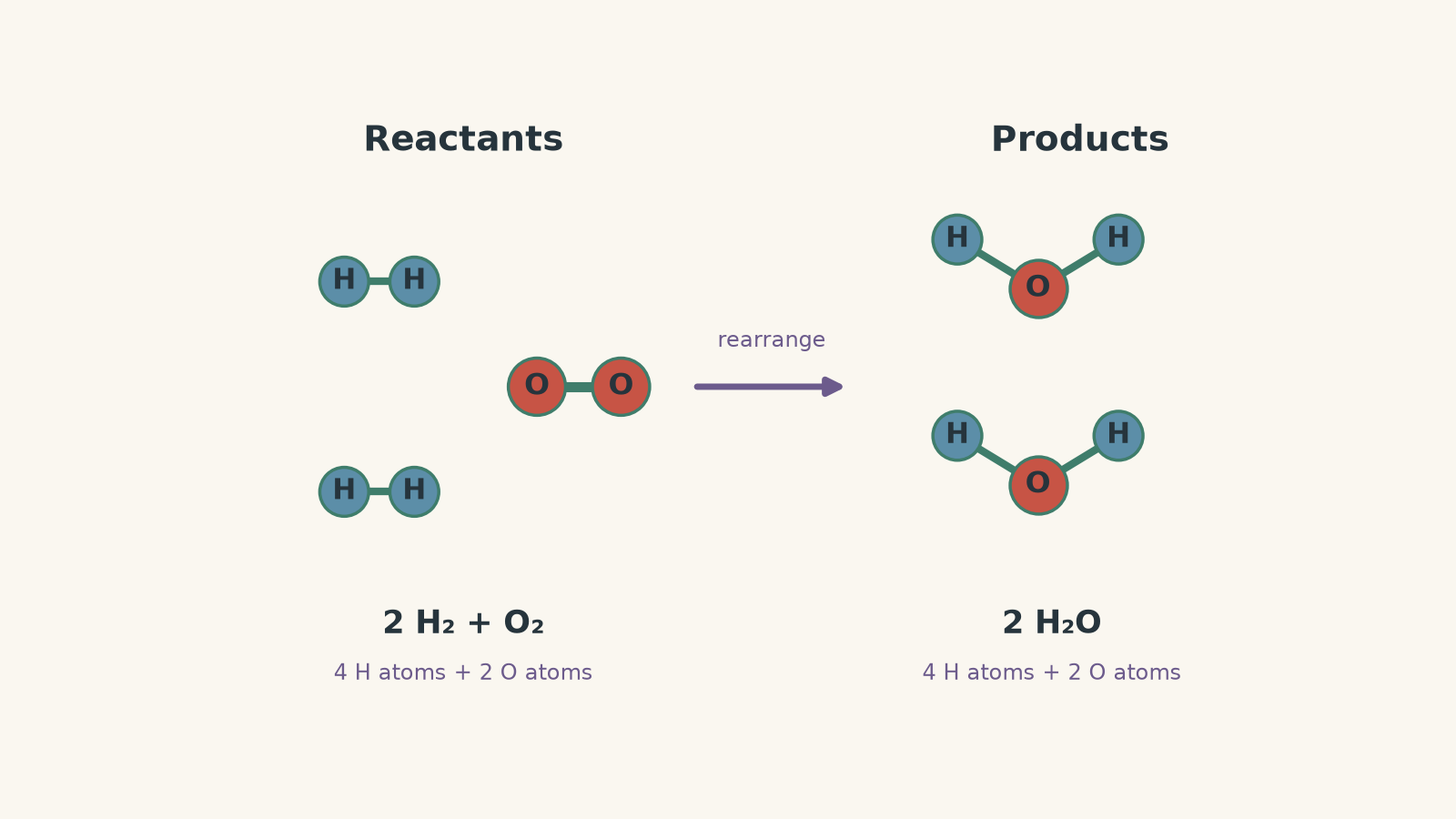
This gives you the most important mental model for balancing:
You are allowed to change how many particles participate. You are not allowed to change what each particle is.
That difference is why coefficients and subscripts do completely different jobs.
| Feature | Example | What it changes |
|---|---|---|
| Coefficient | \(\ce{2H2O}\) | Number of water particles |
| Subscript | \(\ce{H2O}\) | Composition of each water particle |
| State symbol | \(\ce{H2O(l)}\) | Physical state, not atom numbers |
A coefficient multiplies the entire formula. In \(\ce{3H2O}\), there are \(3 \times 2 = 6\) hydrogen atoms and \(3 \times 1 = 3\) oxygen atoms.
A subscript is part of the substance’s identity. Changing \(\ce{H2O}\) to \(\ce{H2O2}\) does not “balance water”. It changes water into hydrogen peroxide.
A slightly silly analogy helps here. Suppose every \(\ce{H2O}\) molecule is a fixed three-person group: two hydrogens and one oxygen. If you need more hydrogen atoms, you can invite another whole group. You can’t quietly turn one group into two hydrogens and two oxygens without creating a different substance.
The analogy breaks because atoms aren’t actually people in permanent groups. Chemical bonds can break and reform. But while writing a chemical equation, each chemical formula must still describe the correct substance.
02Product prediction comes before balancing
Consider this unfinished reaction:
\[ \ce{HCl + NaOH -> ?} \]
Could you balance it yet?
Not properly. You first need to know what the products are.
Hydrochloric acid reacting with sodium hydroxide is an acid-base neutralisation. The products are sodium chloride and water:
\[ \ce{HCl + NaOH -> NaCl + H2O} \]
Only after the correct formulas are present should you check the atom numbers. In this case, they are already balanced in a \(1:1:1:1\) ratio.
This distinction is easy to miss:
Predicting products is a chemistry problem. Balancing is an atom-accounting problem.
Balancing cannot rescue an incorrect product formula.
Some useful product patterns are:
| Reaction pattern | Typical products |
|---|---|
| Metal + oxygen | Metal oxide |
| Synthesis | One compound formed from simpler reactants |
| Complete combustion of a hydrocarbon | Carbon dioxide + water |
| Acid + base | Salt + water |
| Acid + carbonate | Salt + water + carbon dioxide |
| Two aqueous ionic compounds | Possible precipitate + remaining aqueous ions |
These patterns help you decide what might form, but the actual formulas still depend on the substances involved. For example, predicting an acid-carbonate reaction requires you to identify the correct salt before balancing. The acid-carbonate reactions guide develops that process in more detail.
03A reliable way to balance an equation
Once the reactant and product formulas are correct, use this sequence:
- Write correct formulas first. Do not change subscripts during balancing.
- Count each element on both sides. Include coefficients already present.
- Choose an element that is unbalanced and adjust coefficients only. It often helps to begin with an element appearing in one substance on each side.
- Recount after every change. One coefficient can affect several elements at once.
- Leave elements such as hydrogen and oxygen until later when they occur in several substances. This is a useful strategy, not an absolute rule.
- Finish with the smallest whole-number coefficients and check every element again.
You do not need to balance strictly from left to right. In fact, doing that mechanically often creates unnecessary work.
04Worked example: Aluminium reacting with oxygen
Balance the equation for aluminium reacting with oxygen to form aluminium oxide:
\[ \ce{Al + O2 -> Al2O3} \]
Step 1
Elemental aluminium is \(\ce{Al}\), elemental oxygen is diatomic \(\ce{O2}\), and aluminium oxide is \(\ce{Al2O3}\).
At this stage:
- left side: 1 Al and 2 O
- right side: 2 Al and 3 O
Both elements are unbalanced.
Step 2
We need a number of oxygen atoms that can be made from both groups of 2 and groups of 3. The smallest useful number is 6.
Put a coefficient of 3 before \(\ce{O2}\):
\[ \ce{Al + 3O2 -> Al2O3} \]
The left side now contains 6 oxygen atoms.
Put a coefficient of 2 before \(\ce{Al2O3}\):
\[ \ce{Al + 3O2 -> 2Al2O3} \]
The right side now also contains \(2 \times 3 = 6\) oxygen atoms.
Step 3
Two units of \(\ce{Al2O3}\) contain:
\[ 2 \times 2 = 4 \]
aluminium atoms.
So put a coefficient of 4 before \(\ce{Al}\):
\[ \boxed{\ce{4Al + 3O2 -> 2Al2O3}} \]
Step 4
| Element | Reactants | Products |
|---|---|---|
| Al | 4 | 4 |
| O | 6 | 6 |
The equation is balanced.
The coefficients tell us that four aluminium atoms react in the same particle ratio as three oxygen molecules to form two formula units of aluminium oxide. At a macroscopic level, those same coefficients become mole ratios.
05Polyatomic ions can sometimes save you work
Now consider:
\[ \ce{CaCO3 + HNO3 -> Ca(NO3)2 + H2O + CO2} \]
You could count every nitrogen and oxygen atom separately from the beginning. That works, but there is an easier way to see part of the structure.
The nitrate ion, \(\ce{NO3^-}\), appears intact in \(\ce{HNO3}\) and \(\ce{Ca(NO3)2}\). When a polyatomic ion remains unchanged across an equation, you can often treat it as a single group while balancing.
This is only a shortcut for counting. It does not mean the ions are permanently attached or that no microscopic changes occur.
Worked example: Calcium carbonate reacting with nitric acid
Balance:
\[ \ce{CaCO3 + HNO3 -> Ca(NO3)2 + H2O + CO2} \]
Step 1
There is one calcium atom on each side, so calcium is already balanced.
Step 2
The product \(\ce{Ca(NO3)2}\) contains two nitrate groups. The reactant \(\ce{HNO3}\) contains one nitrate group per formula unit.
We therefore need a coefficient of 2 before nitric acid:
\[ \ce{CaCO3 + 2HNO3 -> Ca(NO3)2 + H2O + CO2} \]
Step 3
Two \(\ce{HNO3}\) particles provide two hydrogen atoms. One \(\ce{H2O}\) contains two hydrogen atoms, so hydrogen is balanced.
Step 4
There is one carbon atom in \(\ce{CaCO3}\) and one in \(\ce{CO2}\). Carbon is balanced.
Step 5
Reactants contain:
\[ 3 + 2(3) = 9 \text{ O atoms} \]
Products contain:
\[ 6 + 1 + 2 = 9 \text{ O atoms} \]
So the balanced equation is:
\[ \boxed{\ce{CaCO3 + 2HNO3 -> Ca(NO3)2 + H2O + CO2}} \]
The coefficient ratio is \(1:2:1:1:1\).
Chemically, this equation tells us more than the atom count. Carbonate reacting with acid ultimately produces carbon dioxide and water, so stopping at an imagined “carbonic acid product” would miss what is actually observed.
06Why changing a subscript is the biggest balancing mistake
Suppose someone writes:
\[ \ce{H2 + O2 -> H2O} \]
They notice that there are two oxygen atoms on the left but only one on the right. So they change the product to:
\[ \ce{H2 + O2 -> H2O2} \]
The atoms now appear balanced. Is the equation correct?
No.
The equation now says hydrogen reacts with oxygen to produce hydrogen peroxide. The original product was water. The student has changed the reaction instead of balancing it.
The correct move is to change coefficients:
\[ \ce{2H2 + O2 -> 2H2O} \]
Now there are four H atoms and two O atoms on each side, while the product remains water.
A useful decision rule is:
If you find yourself editing a subscript while balancing, stop and ask whether you are changing the identity of a substance.
Usually, you are.
07Remember elemental molecules
Another common mistake happens before balancing even begins. Several elements exist as diatomic molecules in their elemental form.
For example, elemental oxygen is written \(\ce{O2}\), not \(\ce{O}\), and elemental chlorine is \(\ce{Cl2}\), not \(\ce{Cl}\).
That matters in equations such as:
\[ \ce{2Na + Cl2 -> 2NaCl} \]
Writing \(\ce{Na + Cl -> NaCl}\) would happen to produce equal atom counts, but it would not correctly represent elemental chlorine under ordinary conditions.
The familiar diatomic elemental substances you are expected to recognise are \(\ce{H2}\), \(\ce{N2}\), \(\ce{O2}\), \(\ce{F2}\), \(\ce{Cl2}\), \(\ce{Br2}\), and \(\ce{I2}\).
08State symbols communicate more than atom conservation
A complete symbolic equation may also include physical states:
- \(\ce{(s)}\): solid
- \(\ce{(l)}\): liquid
- \(\ce{(g)}\): gas
- \(\ce{(aq)}\): dissolved in water
For example:
\[ \ce{AgNO3(aq) + NaCl(aq) -> AgCl(s) + NaNO3(aq)} \]
The coefficients are all 1, so the equation is already balanced. But the state symbols reveal the important observation: solid silver chloride forms from two aqueous solutions.
That information becomes especially useful when you move from molecular equations to net ionic equations. The precipitation reactions and net ionic equations guide follows that next step.
09Fractions can be useful temporarily
Consider complete combustion of ethane:
\[ \ce{C2H6 + O2 -> CO2 + H2O} \]
Start with carbon:
\[ \ce{C2H6 + O2 -> 2CO2 + H2O} \]
Then hydrogen:
\[ \ce{C2H6 + O2 -> 2CO2 + 3H2O} \]
The products now contain \(4 + 3 = 7\) oxygen atoms. That requires \(\frac{7}{2}\) oxygen molecules:
\[ \ce{C2H6 + 7/2O2 -> 2CO2 + 3H2O} \]
A fraction is useful during the working because it preserves the correct atom ratio. For the conventional final equation, multiply every coefficient by 2:
\[ \boxed{\ce{2C2H6 + 7O2 -> 4CO2 + 6H2O}} \]
You have not changed the chemistry. Both equations describe the same proportional relationship. The second simply expresses it using the smallest whole-number coefficients.
For more practice with this particular reaction type, see combustion reactions: products and equations.
10A final balance check that catches most errors
Before accepting an equation, ask three separate questions.
Are the substances correct?
Check the reactant and product formulas before worrying about coefficients.
Are the atoms conserved?
Count every element on both sides, including coefficients.
Are the coefficients in their simplest whole-number ratio?
For example,
\[ \ce{4H2 + 2O2 -> 4H2O} \]
is balanced, but all coefficients share a factor of 2. The simplest form is:
\[ \ce{2H2 + O2 -> 2H2O} \]
This final check matters because a perfectly balanced equation can still communicate the wrong reaction if the formulas were wrong from the beginning.
11Questions and solutions
Question 1
Magnesium reacts with hydrochloric acid to form magnesium chloride and hydrogen gas.
Write and balance the symbolic equation.
Solution 1
The balanced equation is:
\[ \boxed{\ce{Mg + 2HCl -> MgCl2 + H2}} \]
Magnesium chloride has the formula \(\ce{MgCl2}\), so two chlorine atoms are required on the reactant side. Putting a coefficient of 2 before \(\ce{HCl}\) supplies those two chlorine atoms and also gives two hydrogen atoms:
\[ \ce{Mg + 2HCl -> MgCl2 + H2} \]
The atom count is:
| Element | Reactants | Products |
|---|---|---|
| Mg | 1 | 1 |
| H | 2 | 2 |
| Cl | 2 | 2 |
The key point is that the coefficient belongs before \(\ce{HCl}\). Changing its formula to something such as \(\ce{H2Cl}\) would invent a different substance.
Question 2
Calcium metal reacts with oxygen gas to form calcium oxide.
Predict the product formula and write the balanced equation.
Solution 2
The product is calcium oxide, \(\ce{CaO}\), and the balanced equation is:
\[ \boxed{\ce{2Ca + O2 -> 2CaO}} \]
Calcium forms \(\mathrm{Ca}^{2+}\) ions and oxide is \(\mathrm{O}^{2-}\), giving the neutral formula \(\ce{CaO}\).
Elemental oxygen must be written as \(\ce{O2}\). One \(\ce{O2}\) molecule supplies two oxygen atoms, so two formula units of calcium oxide are produced:
\[ \ce{2Ca + O2 -> 2CaO} \]
This requires two calcium atoms as well.
The tempting mistake is to write \(\ce{CaO2}\) simply because oxygen begins as \(\ce{O2}\). The \(\ce{O2}\) molecule does not remain intact in the product. Its atoms are rearranged.
Question 3
Phosphoric acid, \(\ce{H3PO4}\), reacts completely with potassium hydroxide, \(\ce{KOH}\), to produce potassium phosphate, \(\ce{K3PO4}\), and water.
Balance the equation and explain one efficient feature of your method.
Solution 3
The balanced equation is:
\[ \boxed{\ce{H3PO4 + 3KOH -> K3PO4 + 3H2O}} \]
Start with the phosphate group, \(\ce{PO4}\). One phosphate group appears in \(\ce{H3PO4}\) and one in \(\ce{K3PO4}\), so it is already balanced.
The product \(\ce{K3PO4}\) contains three potassium atoms. We therefore need three potassium hydroxide units:
\[ \ce{H3PO4 + 3KOH -> K3PO4 + H2O} \]
There are now six hydrogen atoms on the left:
\[ 3 + 3(1) = 6 \]
Three water molecules contain six hydrogen atoms, so:
\[ \ce{H3PO4 + 3KOH -> K3PO4 + 3H2O} \]
Checking oxygen gives:
\[ 4 + 3 = 7 \text{ O atoms on the left} \]
and
\[ 4 + 3 = 7 \text{ O atoms on the right} \]
Treating \(\ce{PO4}\) as one unchanged group makes the balancing quicker. The shortcut works here because the phosphate group appears intact on both sides.
Question 4
A student is trying to balance the formation of water and writes:
\[ \ce{H2 + O2 -> H2O} \]
They replace \(\ce{H2O}\) with \(\ce{H2O2}\) and argue that their new equation is balanced because both sides now contain two hydrogen atoms and two oxygen atoms.
Explain exactly what is wrong with this reasoning, then give the correct balanced equation.
Solution 4
The student’s atom count is balanced, but the equation is chemically wrong because changing \(\ce{H2O}\) to \(\ce{H2O2}\) changes the product from water to hydrogen peroxide.
A subscript is part of a substance’s formula. It cannot be adjusted merely to make atom numbers match.
The correct approach is to keep the formula \(\ce{H2O}\) and change coefficients:
\[ \boxed{\ce{2H2 + O2 -> 2H2O}} \]
The reactant side contains:
\[ 2(2) = 4 \text{ H atoms} \]
and
\[ 2 \text{ O atoms} \]
The product side contains:
\[ 2(2) = 4 \text{ H atoms} \]
and
\[ 2(1) = 2 \text{ O atoms} \]
So the atoms are conserved without changing the identity of water.
The trap is that “same number of atoms” is necessary for a correct equation, but it is not sufficient. The formulas must also represent the actual reactants and products.
Question 5
Aqueous aluminium sulfate reacts with aqueous barium nitrate. Insoluble barium sulfate forms, while aluminium nitrate remains dissolved.
Write the balanced symbolic equation, including state symbols. Then explain why counting sulfate and nitrate groups as units is more efficient than immediately counting every oxygen atom separately.
Solution 5
The balanced equation is:
\[ \boxed{\ce{Al2(SO4)3(aq) + 3Ba(NO3)2(aq) -> 3BaSO4(s) + 2Al(NO3)3(aq)}} \]
Begin with the formulas supplied by the ions.
Aluminium sulfate contains two aluminium ions and three sulfate ions:
\[ \ce{Al2(SO4)3} \]
Barium nitrate is:
\[ \ce{Ba(NO3)2} \]
The products are \(\ce{BaSO4}\) and \(\ce{Al(NO3)3}\).
There are three sulfate groups on the left, so place a coefficient of 3 before barium sulfate:
\[ \ce{Al2(SO4)3 + Ba(NO3)2 -> 3BaSO4 + Al(NO3)3} \]
That requires three barium atoms, so place a coefficient of 3 before barium nitrate:
\[ \ce{Al2(SO4)3 + 3Ba(NO3)2 -> 3BaSO4 + Al(NO3)3} \]
There are two aluminium atoms on the left, so place a coefficient of 2 before aluminium nitrate:
\[ \ce{Al2(SO4)3 + 3Ba(NO3)2 -> 3BaSO4 + 2Al(NO3)3} \]
Now check nitrate. The left side contains:
\[ 3 \times 2 = 6 \text{ nitrate groups} \]
The right side contains:
\[ 2 \times 3 = 6 \text{ nitrate groups} \]
Everything is balanced.
Counting sulfate and nitrate as intact groups is efficient because neither group changes composition between reactants and products. Counting every nitrogen and oxygen atom individually would still work, but it would hide the simple structure of the rearrangement and create more opportunities for arithmetic errors.
The state symbols also communicate the observation: \(\ce{BaSO4(s)}\) is the precipitate formed from the two aqueous solutions.
Question 6
A student balances the reaction between sodium carbonate and hydrochloric acid as:
\[ \ce{Na2CO3 + 2HCl -> 2NaCl + H2CO3} \]
They point out that every element is conserved and conclude that the equation must therefore be a complete description of the observed reaction.
Explain why atom conservation alone is not enough here, and write the equation for the products actually observed in an acid-carbonate reaction.
Solution 6
The student’s equation conserves atoms, but it does not give the final observable products of the acid-carbonate reaction.
In acidic solution, the carbonate ultimately forms carbon dioxide and water. The overall equation is:
\[ \boxed{\ce{Na2CO3 + 2HCl -> 2NaCl + H2O + CO2}} \]
Check the atoms.
On the reactant side:
\[ \ce{Na}: 2,\quad \ce{H}: 2,\quad \ce{C}: 1,\quad \ce{O}: 3,\quad \ce{Cl}: 2 \]
On the product side:
\[ \ce{Na}: 2,\quad \ce{H}: 2,\quad \ce{C}: 1,\quad \ce{O}: 1 + 2 = 3,\quad \ce{Cl}: 2 \]
So the final equation is also balanced.
The deeper issue is that balancing tests conservation, not product validity. More than one imagined equation can conserve the same atoms. Chemistry determines which products are actually formed.
That is why the correct order is to identify the reaction and products first, then balance the equation.
12What balanced equations let you do next
Once an equation is balanced, its coefficients stop being mere bookkeeping numbers. They become quantitative ratios.
From
\[ \ce{2H2 + O2 -> 2H2O} \]
you can read that 2 mol of \(\ce{H2}\) react with 1 mol of \(\ce{O2}\) to form 2 mol of \(\ce{H2O}\), assuming the reaction proceeds as represented.
That link between atom conservation and mole ratios is what makes balanced equations useful in stoichiometry. The same equations also become the starting point for identifying spectator ions, writing net ionic equations, comparing theoretical and actual yields, and deciding which reactant will run out first.
So the next useful question is no longer just, “Is the equation balanced?” It is, “What does this balanced ratio let me calculate about the reaction?”