
Enthalpy of Combustion of Alcohols: HSC Chemistry Guide
Learn how to measure and compare the enthalpy of combustion of alcohols, calculate experimental values, and evaluate the limitations of calorimetry methods.
Suppose two spirit burners sit under identical metal cans. One contains methanol and the other propan-1-ol. The propan-1-ol burner gives the water a larger temperature rise. Has that proved propan-1-ol has a more negative enthalpy of combustion?
Not yet. Predict what else matters before reading on. The mass of fuel burned matters. Its molar mass matters. Heat lost to the room matters. Even whether the flame burned completely matters. A temperature rise is only the first measurement; the real job is to work backwards from that measurement to the energy released by one mole of alcohol.
01What are we actually trying to measure?
When an alcohol burns completely in oxygen, its carbon atoms end up mainly in carbon dioxide, and its hydrogen atoms end up in water. For ethanol:
\[
\ce{C2H5OH(l) + 3O2(g) -> 2CO2(g) + 3H2O(l)}
\]
Combustion is exothermic. Energy leaves the reacting chemicals and is transferred to the surroundings.
The molar enthalpy of combustion, \(\Delta H_c\), is the enthalpy change when one mole of a substance undergoes complete combustion. Because combustion releases energy,
\[
\Delta H_c < 0
\]
So \(-1400\ \text{kJ mol}^{-1}\) represents a more exothermic combustion than \(-700\ \text{kJ mol}^{-1}\).
For a standard enthalpy of combustion, written \(\Delta H_c^\circ\), the reactants and products are considered in their standard states, normally at a specified temperature such as \(25^\circ\text{C}\) and a standard pressure of 100 kPa.
That last detail becomes important later. A school spirit-burner experiment does not perfectly reproduce those conditions, so what it produces is an experimental estimate of \(\Delta H_c\), not a direct measurement of the exact standard value.
02Follow the energy through the apparatus
The simplest useful setup is a spirit burner underneath a container of water.
From bottom to top:
- a spirit burner contains the alcohol,
- a wick carries liquid fuel upwards,
- the alcohol vapour burns at the wick,
- a metal can or calorimeter sits a fixed distance above the flame,
- a known mass of water sits inside the can,
- a thermometer or temperature probe measures the water temperature,
- a stirrer helps keep the water at a roughly uniform temperature.
Before burning, the capped spirit burner is weighed. The water temperature is recorded. The burner is lit, heat travels from the flame into the container and water, and the water temperature rises. The flame is then extinguished and capped, and the burner is weighed again.
The difference between the two burner masses is treated as the mass of alcohol burned.
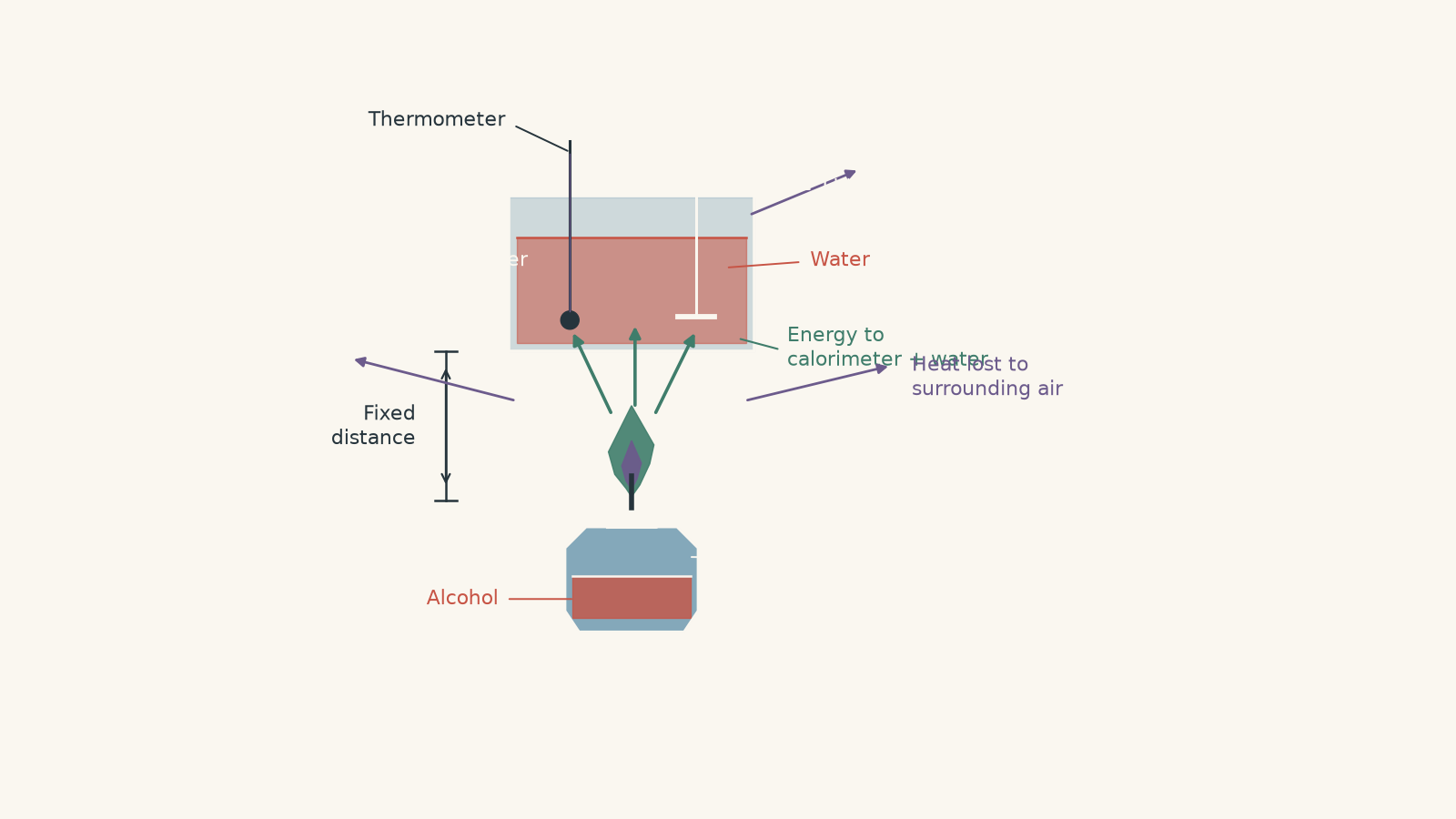
What should the first design show?
Imagine an ideal version of this experiment. No heat escapes. The alcohol burns completely. None evaporates without burning. Every joule released by the reaction ends up in the water.
What would happen?
The energy released by the fuel would equal the energy absorbed by the water:
\[
q_{\text{combustion}}=-q_{\text{water}}
\]
The negative sign is energy bookkeeping. The water gains energy, so \(q_{\text{water}}\) is positive. The reacting fuel loses energy to the surroundings, so its heat change is negative.
For water,
\[
q_{\text{water}}=mc\Delta T
\]
where:
- \(q_{\text{water}}\) is the heat absorbed by the water, in joules,
- \(m\) is the mass of water, in grams,
- \(c\) is the specific heat capacity of water, approximately \(4.18\ \text{J g}^{-1}\text{K}^{-1}\),
- \(\Delta T\) is the temperature change, in kelvin or degrees Celsius.
A temperature change of \(10^\circ\text{C}\) is also a change of \(10\ \text{K}\), so either numerical value works here.
Then we divide the heat released by the number of moles burned:
\[
\Delta H_c=\frac{q_{\text{combustion}}}{n}
\]
where \(n\) is the amount of alcohol burned, in moles.
That is the basic model. It is useful, but it is not yet accurate.
Worked example: Estimate ethanol’s enthalpy of combustion
An ethanol spirit burner heats \(100.0\ \text{g}\) of water from \(21.0^\circ\text{C}\) to \(35.8^\circ\text{C}\). The burner loses \(0.780\ \text{g}\) in mass. Estimate the molar enthalpy of combustion of ethanol. Use \(c_{\text{water}}=4.18\ \text{J g}^{-1}\text{K}^{-1}\) and \(M(\ce{C2H5OH})=46.07\ \text{g mol}^{-1}\).
Step 1
\[
\begin{aligned}
\Delta T &= 35.8-21.0\\
&=14.8^\circ\text{C}\\[4pt]
q_{\text{water}}&=mc\Delta T\\
&=(100.0)(4.18)(14.8)\\
&=6186\ \text{J}\\
&=6.186\ \text{kJ}
\end{aligned}
\]
In the simple model, the ethanol therefore released \(6.186\ \text{kJ}\).
Step 2
\[
\begin{aligned}
n&=\frac{m}{M}\\
&=\frac{0.780}{46.07}\\
&=0.01693\ \text{mol}
\end{aligned}
\]
Step 3
\[
\begin{aligned}
\Delta H_c
&=\frac{-6.186}{0.01693}\\
&=-365\ \text{kJ mol}^{-1}
\end{aligned}
\]
Step 4
The experimental estimate is \(-365\ \text{kJ mol}^{-1}\). The accepted standard value for ethanol is much more negative, at roughly \(-1367\ \text{kJ mol}^{-1}\).
That is not a tiny measurement disagreement. The apparatus has failed to capture a large fraction of the energy associated with the standard combustion process.
The useful question is now not simply “Was there error?” There obviously was. The useful question is: where did the missing energy go?
03The first model leaves out the calorimeter itself
The flame does not heat only the water. It also heats the metal can, lid, thermometer, and other nearby parts.
If the can absorbs energy but we calculate only \(q_{\text{water}}\), we underestimate the energy transferred from the fuel.
For a metal can, we can improve the calculation:
\[
q_{\text{absorbed}}=(m_wc_w+m_cc_c)\Delta T
\]
where \(m_w\) and \(c_w\) are the mass and specific heat capacity of water, while \(m_c\) and \(c_c\) are the corresponding quantities for the calorimeter.
Even this is still a model. It may leave out the lid, probe, stirrer, and energy escaping to the room.
Think of the calorimeter as a bucket trying to catch rain. Measuring the water in the bucket tells you how much rain it caught, not automatically how much rain fell. A bigger, better-positioned bucket improves the measurement, but any rain missing the bucket is still missing from your calculation.
Heat is not literally a fluid falling into a bucket, so the analogy stops there. Energy transfer depends on temperature differences, radiation, conduction, convection, and the geometry of the apparatus.
Worked example: Compare methanol and propan-1-ol fairly
A copper calorimeter of mass \(80.0\ \text{g}\) contains \(150.0\ \text{g}\) of water. In separate trials, methanol and propan-1-ol each raise the water and calorimeter temperature by \(15.0^\circ\text{C}\).
The methanol burner loses \(1.10\ \text{g}\). The propan-1-ol burner loses \(0.650\ \text{g}\).
Use:
- \(c_{\text{water}}=4.18\ \text{J g}^{-1}\text{K}^{-1}\),
- \(c_{\text{Cu}}=0.385\ \text{J g}^{-1}\text{K}^{-1}\),
- \(M(\ce{CH3OH})=32.04\ \text{g mol}^{-1}\),
- \(M(\ce{C3H7OH})=60.10\ \text{g mol}^{-1}\).
Calculate the experimental molar enthalpy of combustion of each alcohol.
Step 1
Because the same water, copper can, and temperature rise are used, the calculated energy absorbed is the same.
\[
\begin{aligned}
q_{\text{absorbed}}
&=[(150.0)(4.18)+(80.0)(0.385)](15.0)\\
&=9867\ \text{J}\\
&=9.867\ \text{kJ}
\end{aligned}
\]
Step 2
\[
\begin{aligned}
n(\ce{CH3OH})
&=\frac{1.10}{32.04}\\
&=0.0343\ \text{mol}
\end{aligned}
\]
So,
\[
\Delta H_c(\text{methanol})
=\frac{-9.867}{0.0343}
=-287\ \text{kJ mol}^{-1}
\]
Step 3
\[
\begin{aligned}
n(\ce{C3H7OH})
&=\frac{0.650}{60.10}\\
&=0.0108\ \text{mol}
\end{aligned}
\]
Therefore,
\[
\Delta H_c(\text{propan-1-ol})
=\frac{-9.867}{0.0108}
=-912\ \text{kJ mol}^{-1}
\]
Step 4
The experiment suggests propan-1-ol has a more negative molar enthalpy of combustion than methanol.
Notice the important part: both trials gave exactly the same temperature rise. That did not mean their molar enthalpies were equal. Far fewer moles of propan-1-ol were required to transfer the same measured quantity of energy.
The numerical values are still much less negative than reliable standard values, so we should trust the broad comparison more than the absolute numbers.
04Why does the simple experiment miss so much energy?
In a real spirit-burner experiment, several processes break the assumption
\[
q_{\text{combustion}}=-q_{\text{measured calorimeter}}
\]
Most of them make the calculated enthalpy of combustion too small in magnitude: for example, \(-600\ \text{kJ mol}^{-1}\) instead of \(-1300\ \text{kJ mol}^{-1}\).
| Limitation | What physically happens? | Likely effect on calculated \(\Delta H_c\) | Useful improvement |
|---|---|---|---|
| Heat loss to surroundings | Hot gases and the calorimeter warm the surrounding air | Too little \(q\) is measured, so the value is not negative enough | Draught shield, insulation, lid, more enclosed calorimeter |
| Calorimeter heat capacity ignored | The metal can, probe, and lid absorb energy | Measured \(q\) is too small | Include their heat capacities or calibrate the calorimeter |
| Incomplete combustion | Some carbon forms \(\ce{CO}\) or soot rather than fully oxidising to \(\ce{CO2}\) | Less energy is released than for complete combustion | Improve oxygen supply or use excess oxygen in a closed calorimeter |
| Alcohol evaporates without burning | Burner mass falls even though that fuel did not combust | Calculated moles burned are too large, so \(|\Delta H_c|\) is too small | Cap immediately and minimise time exposed |
| Hot combustion products escape | \(\ce{CO2}\) and water vapour leave carrying thermal energy | Calorimeter receives less energy | More enclosed heat-exchange system |
| Water evaporates from the calorimeter | Energy is used for vaporisation rather than raising measured temperature | Temperature rise is smaller | Use a lid |
| Changing flame-to-can distance | The fraction of flame energy reaching the can changes | Can bias comparisons between fuels | Clamp the burner and calorimeter at a fixed distance |
| Poor mixing | Thermometer may measure a local temperature rather than the average water temperature | Reading may be too high or too low | Stir consistently |
| Temperature reading uncertainty | Probe resolution, response time, and timing affect \(\Delta T\) | Can shift the result in either direction | Digital probe, consistent endpoint, repeated trials |
A black deposit underneath the can is particularly useful evidence. It suggests carbon-containing material has not been completely oxidised.
Do not write merely “soot causes heat loss”. The stronger reasoning is that soot is evidence of incomplete combustion. The chemical reaction has changed, so you are no longer measuring the energy release for complete combustion to \(\ce{CO2}\) and \(\ce{H2O}\).
05A better school experiment
The original open beaker design cannot properly control where the released energy goes. A revised setup should attack that problem rather than simply collect more decimal places.
A stronger school method would:
- use a metal calorimeter rather than a glass beaker,
- fit a lid around the thermometer or probe,
- keep the flame-to-calorimeter distance fixed,
- shield the apparatus from draughts without starving the flame of oxygen,
- stir the water continuously,
- begin different alcohol trials at similar temperatures,
- aim for a similar temperature rise for each fuel,
- cap and weigh the spirit burner promptly,
- use the same apparatus for every alcohol,
- repeat each trial and examine both the mean and the spread.
Why use a similar temperature rise?
Suppose methanol is stopped after a \(10^\circ\text{C}\) rise but butan-1-ol is allowed to reach a \(40^\circ\text{C}\) rise. The hotter second calorimeter has a larger temperature difference from the room, which increases heat transfer to its surroundings. The two fuels are now being measured under different heat-loss conditions.
Using the same final rise does not magically remove heat loss, but it makes the comparison fairer.
It is also useful to keep starting temperatures similar. Heat loss depends on the temperature difference between the apparatus and its surroundings, not just on the amount of fuel burned.
Reliability is not the same as validity
Suppose five ethanol trials produce:
\[
-620,\ -625,\ -617,\ -623,\ -621\ \text{kJ mol}^{-1}
\]
Those results are closely grouped. The method is reasonably repeatable.
But they can still all be systematically wrong.
A method can be reliable while having poor validity for measuring the true combustion enthalpy. Repeating a biased experiment very carefully gives a very precise biased answer.
This distinction is worth using in HSC experimental evaluation:
- reliability concerns consistency across repeated measurements,
- accuracy concerns closeness to an accepted or reference value,
- validity concerns whether the method actually measures the intended quantity fairly and with important variables controlled.
06The major revision: a bomb calorimeter
A bomb calorimeter solves several weaknesses of the open-flame design at once.
The fuel sample is placed inside a strong sealed metal vessel called the bomb. The vessel is filled with excess oxygen. An ignition system starts combustion inside it.
The bomb is submerged in a surrounding calorimeter containing water. A stirrer distributes thermal energy through the water, while a sensitive thermometer measures the temperature change.
So the path is:
fuel inside sealed bomb → ignition → combustion in excess oxygen → energy transferred through metal bomb → surrounding calorimeter and water → measured temperature increase.
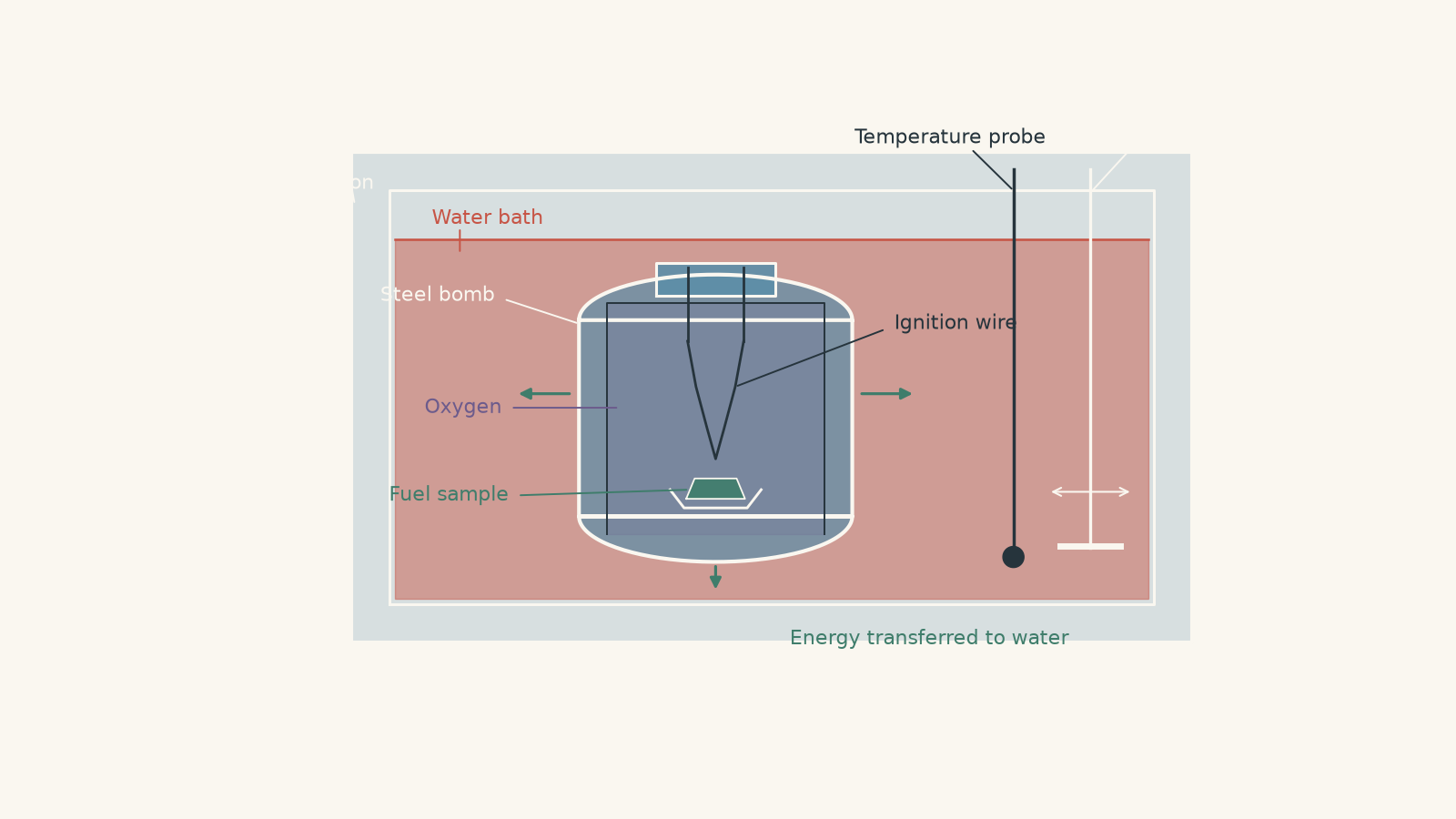
Compared with an open spirit burner, this design gives much stronger control over two major problems:
- Excess oxygen makes complete combustion much more likely.
- The reacting fuel is enclosed, so a much larger and more reproducible fraction of its released energy remains within the measured calorimeter system.
The calorimeter can also be calibrated using a reaction with a well-known energy release. Calibration determines the effective energy required to raise the whole calorimeter system by one degree, rather than pretending only the water absorbs heat.
A bomb calorimeter is not a magical zero-error box. It operates essentially at constant volume, and careful thermodynamic work is needed to convert its measured internal-energy change into the required enthalpy change. Professional measurements also account for ignition energy and other corrections.
For HSC reasoning, the main experimental lesson is simpler: the apparatus controls combustion and energy capture much better than an open flame beneath a can.
07What trend should alcohols show?
For a saturated monohydric alcohol with \(n\) carbon atoms, complete combustion can be represented by
\[
\ce{C_nH_{2n+1}OH + \frac{3n}{2}O2 -> nCO2 + (n+1)H2O}
\]
As the carbon chain becomes longer, the molar enthalpy of combustion generally becomes more negative.
Why?
Each successive member of the homologous series contains an additional \(\ce{CH2}\) unit. Complete combustion therefore produces additional strongly bonded products, principally more \(\ce{CO2}\) and \(\ce{H2O}\). The net energy released per mole of alcohol increases.
Be careful with the usual bond misconception. Breaking bonds does not release energy. Breaking bonds requires energy. Forming bonds releases energy.
You can picture combustion as a slightly grim chemistry breakup: separating the original bonds costs energy, while forming the new relationships in \(\ce{CO2}\) and \(\ce{H2O}\) releases energy. The products “pay back” more energy than the bond-breaking step required, so the overall process is exothermic.
The analogy stops being useful if we pretend every bond has one fixed price. Actual enthalpies depend on molecular environment and physical state.
Don’t explain the trend using only intermolecular forces
Students sometimes reason that larger alcohols have stronger intermolecular forces, therefore they release more energy when burned.
That mixes two different ideas.
Combustion mainly involves breaking and forming intramolecular covalent bonds. Intermolecular forces do affect properties such as volatility and boiling point, which can then affect the quality of the experiment. For example, a more volatile alcohol may lose more mass by evaporation before being burned.
If that distinction is fuzzy, revise intermolecular bonding in alcohols before trying to explain combustion trends from experimental data.
08How to judge whether a comparison is fair
When two alcohols are compared, do not ask only, “Which made the water hottest?”
Use this sequence.
First, check the energy absorbed:
\[
q=mc\Delta T
\]
or include the calorimeter as well if its heat capacity is known.
Then calculate the amount of fuel actually treated as burned:
\[
n=\frac{m}{M}
\]
Finally, calculate energy per mole:
\[
\Delta H_c=-\frac{q}{n}
\]
Only then compare the alcohols.
A useful experimental claim also needs a limitation attached to it. For example:
Propan-1-ol produced a more negative experimental molar enthalpy of combustion than ethanol under the same apparatus conditions. However, unequal incomplete combustion or evaporation could change the size of this difference.
That is much stronger than saying “propanol got hotter, so it has more energy”.
09Questions and solutions
Question 1
An ethanol burner heats \(100.0\ \text{g}\) of water through \(18.0^\circ\text{C}\). The mass of the burner decreases by \(0.750\ \text{g}\).
Calculate the experimental molar enthalpy of combustion of ethanol. Use \(c_{\text{water}}=4.18\ \text{J g}^{-1}\text{K}^{-1}\) and \(M(\ce{C2H5OH})=46.07\ \text{g mol}^{-1}\). Explain the sign of your answer.
Solution 1
The experimental molar enthalpy of combustion is approximately \(-462\ \text{kJ mol}^{-1}\). The negative sign shows that combustion is exothermic.
The water absorbs
\[
\begin{aligned}
q&=mc\Delta T\\
&=(100.0)(4.18)(18.0)\\
&=7524\ \text{J}\\
&=7.524\ \text{kJ}
\end{aligned}
\]
The amount of ethanol represented by the burner mass loss is
\[
\begin{aligned}
n&=\frac{m}{M}\\
&=\frac{0.750}{46.07}\\
&=0.01628\ \text{mol}
\end{aligned}
\]
Assuming the measured heat absorbed by the water came from combustion,
\[
\begin{aligned}
\Delta H_c
&=\frac{-7.524}{0.01628}\\
&=-462\ \text{kJ mol}^{-1}
\end{aligned}
\]
The tempting mistake is to report \(+462\ \text{kJ mol}^{-1}\) because the water gained energy. That positive \(q\) belongs to the water. The reaction itself released that energy, so its enthalpy change is negative.
The result is also much smaller in magnitude than the accepted value for ethanol. That is expected for an open spirit-burner arrangement because substantial energy does not reach the measured water.
Question 2
A copper calorimeter of mass \(60.0\ \text{g}\) contains \(150.0\ \text{g}\) of water.
In one trial, \(0.920\ \text{g}\) of ethanol is lost from a burner. In another, \(0.680\ \text{g}\) of propan-1-ol is lost. Each trial produces exactly a \(20.0^\circ\text{C}\) temperature rise.
Use:
- \(c_{\text{water}}=4.18\ \text{J g}^{-1}\text{K}^{-1}\),
- \(c_{\text{Cu}}=0.385\ \text{J g}^{-1}\text{K}^{-1}\),
- \(M(\ce{C2H5OH})=46.07\ \text{g mol}^{-1}\),
- \(M(\ce{C3H7OH})=60.10\ \text{g mol}^{-1}\).
Calculate the experimental \(\Delta H_c\) of each alcohol. Explain why equal temperature rises do not imply equal molar enthalpies of combustion.
Solution 2
The experimental values are approximately \(-651\ \text{kJ mol}^{-1}\) for ethanol and \(-1149\ \text{kJ mol}^{-1}\) for propan-1-ol. Propan-1-ol therefore appears more exothermic per mole in this experiment.
First calculate the energy absorbed by the water and copper:
\[
\begin{aligned}
q&=[m_wc_w+m_{\text{Cu}}c_{\text{Cu}}]\Delta T\\
&=[(150.0)(4.18)+(60.0)(0.385)](20.0)\\
&=13002\ \text{J}\\
&=13.002\ \text{kJ}
\end{aligned}
\]
For ethanol,
\[
\begin{aligned}
n&=\frac{0.920}{46.07}\\
&=0.01997\ \text{mol}\\[4pt]
\Delta H_c
&=\frac{-13.002}{0.01997}\\
&=-651\ \text{kJ mol}^{-1}
\end{aligned}
\]
For propan-1-ol,
\[
\begin{aligned}
n&=\frac{0.680}{60.10}\\
&=0.01131\ \text{mol}\\[4pt]
\Delta H_c
&=\frac{-13.002}{0.01131}\\
&=-1149\ \text{kJ mol}^{-1}
\end{aligned}
\]
The tempting argument is “same \(\Delta T\), therefore same combustion enthalpy”. The constraint it misses is amount of substance.
Both trials transferred the same measured energy to the calorimeter, but only \(0.01131\ \text{mol}\) of propan-1-ol was required compared with \(0.01997\ \text{mol}\) of ethanol. Energy per mole is therefore different.
Equal temperature rises are actually useful experimentally because they make the thermal conditions more comparable. They just do not remove the need to divide by moles.
Question 3
A group obtains the following experimental results using the same open spirit-burner apparatus.
| Alcohol | Experimental \(\Delta H_c\) (\(\text{kJ mol}^{-1}\)) | Observation |
|---|---|---|
| Methanol | \(-510\) | No visible soot |
| Ethanol | \(-690\) | Very little soot |
| Propan-1-ol | \(-790\) | Noticeable soot |
| Butan-1-ol | \(-760\) | Heavy soot |
A student concludes:
“The true molar enthalpy of combustion becomes more negative from methanol to propan-1-ol, then becomes less negative for butan-1-ol.”
Evaluate this conclusion and propose two experimental changes that would test it more convincingly.
Solution 3
The claimed reversal at butan-1-ol is not justified by these measurements. The butan-1-ol result is more likely to indicate a changing systematic error than strong evidence that the actual homologous-series trend reverses.
The first three measurements show an increasingly negative experimental \(\Delta H_c\). That is consistent with the expected trend as additional carbon and hydrogen atoms are available for complete oxidation.
The butan-1-ol result breaks the pattern, but the observation of heavy soot matters. Soot indicates incomplete combustion. If some carbon finishes as soot or \(\ce{CO}\) rather than \(\ce{CO2}\), the reaction releases less energy than complete combustion would.
That pushes the experimental value towards zero.
There is another problem: the systematic error does not have to be the same for every alcohol. Flame shape, oxygen mixing, volatility, burning rate, and soot formation can all change across the series. Using identical apparatus does not guarantee an identical percentage of energy is captured.
The tempting approach is to treat each measured number as an equally biased version of the true value. The evidence directly contradicts that assumption because the flame behaviour changes substantially.
Two useful improvements would be:
- Burn each alcohol with a controlled excess supply of oxygen, ideally in a much more enclosed calorimeter, to reduce differences in incomplete combustion.
- Reduce and control heat loss by using a lidded, insulated calorimeter at a fixed burner distance, with repeated trials under similar starting and finishing temperatures.
A bomb calorimeter would address both limitations much more effectively.
The experimental dataset can support the statement that the open-flame method becomes unreliable for comparing these fuels under the observed conditions. It cannot establish a genuine reversal in the underlying molar combustion enthalpy.
Question 4
An ethanol experiment is affected by both heat loss and evaporation.
The calorimeter has an effective heat capacity of \(0.500\ \text{kJ K}^{-1}\). Two runs give:
| Run | Temperature rise | Duration | Apparent burner mass loss |
|---|---|---|---|
| A | \(10.0\ \text{K}\) | \(2.0\ \text{min}\) | \(0.376\ \text{g}\) |
| B | \(25.0\ \text{K}\) | \(6.0\ \text{min}\) | \(0.992\ \text{g}\) |
A separate unlit control shows that ethanol evaporates from the uncapped burner at \(0.020\ \text{g min}^{-1}\).
During a burning trial, heat loss to the surroundings can be approximated by
\[
q_{\text{loss}}=k\overline{\Delta T}t
\]
where \(k=0.010\ \text{kJ min}^{-1}\text{K}^{-1}\), \(t\) is time in minutes, and \(\overline{\Delta T}\) is the average temperature difference above the starting temperature.
Assume the temperature rises approximately linearly, so
\[
\overline{\Delta T}=\frac{\Delta T}{2}
\]
Use \(M(\ce{C2H5OH})=46.07\ \text{g mol}^{-1}\).
Correct both runs for heat loss and alcohol evaporation. What does the agreement or disagreement between the corrected results tell you?
Solution 4
After both corrections, Run A gives about \(-699\ \text{kJ mol}^{-1}\) and Run B gives about \(-700\ \text{kJ mol}^{-1}\). Their close agreement supports the given error model, although it does not prove that every systematic error has been removed.
For Run A, the calorimeter absorbs
\[
q_{\text{cal}}=(0.500)(10.0)=5.00\ \text{kJ}
\]
The average temperature rise is \(5.0\ \text{K}\), so estimated heat loss is
\[
\begin{aligned}
q_{\text{loss}}
&=(0.010)(5.0)(2.0)\\
&=0.100\ \text{kJ}
\end{aligned}
\]
The reaction must therefore have supplied approximately
\[
q_{\text{released}}=5.00+0.100=5.10\ \text{kJ}
\]
The apparent mass loss is not all combustion. In \(2.0\) minutes, estimated evaporation is
\[
m_{\text{evap}}=(0.020)(2.0)=0.040\ \text{g}
\]
So the estimated mass actually combusted is
\[
0.376-0.040=0.336\ \text{g}
\]
and
\[
\begin{aligned}
n&=\frac{0.336}{46.07}\\
&=0.00729\ \text{mol}
\end{aligned}
\]
Therefore,
\[
\Delta H_c
=\frac{-5.10}{0.00729}
\approx -699\ \text{kJ mol}^{-1}
\]
Now consider Run B.
The calorimeter absorbs
\[
q_{\text{cal}}=(0.500)(25.0)=12.50\ \text{kJ}
\]
Its average temperature rise is \(12.5\ \text{K}\), giving
\[
\begin{aligned}
q_{\text{loss}}
&=(0.010)(12.5)(6.0)\\
&=0.750\ \text{kJ}
\end{aligned}
\]
Estimated reaction energy is therefore
\[
q_{\text{released}}=12.50+0.750=13.25\ \text{kJ}
\]
Estimated evaporation during six minutes is
\[
m_{\text{evap}}=(0.020)(6.0)=0.120\ \text{g}
\]
so the mass actually combusted is
\[
0.992-0.120=0.872\ \text{g}
\]
The amount combusted is
\[
\begin{aligned}
n&=\frac{0.872}{46.07}\\
&=0.01893\ \text{mol}
\end{aligned}
\]
Thus,
\[
\Delta H_c
=\frac{-13.25}{0.01893}
\approx -700\ \text{kJ mol}^{-1}
\]
The important reasoning is that two different parts of the calculation were wrong.
Heat loss made the numerator, the measured energy, too small. Evaporation made the denominator, the apparent number of moles burned, too large. Both errors pushed the uncorrected magnitude of \(\Delta H_c\) down.
The longer, hotter trial was affected more strongly by both processes.
A tempting response would be to correct only the missing heat because this is a “calorimetry” experiment. That still leaves the number of moles wrong. Energy measurements and amount measurements are equally capable of creating systematic error.
The convergence of the corrected values is evidence that the proposed heat-loss and evaporation models explain much of the difference between the runs. It is not proof that \(-700\ \text{kJ mol}^{-1}\) is the true standard value: incomplete combustion, unmeasured apparatus heat capacity, and other effects could still bias both trials in the same direction.
Question 5
A student redesigns an ethanol experiment and claims:
“If no heat escapes to the room, no ethanol evaporates, and combustion is complete, the measured result must equal the standard enthalpy of combustion.”
Consider an idealised case where one mole of ethanol undergoes complete combustion. All products leave at \(25^\circ\text{C}\), but the three moles of water produced leave as water vapour rather than liquid water.
The standard enthalpy of combustion of ethanol to liquid water is approximately
\[
-1367\ \text{kJ mol}^{-1}
\]
and the enthalpy of vaporisation of water at the relevant temperature may be approximated as
\[
\Delta H_{\text{vap}}=44.0\ \text{kJ mol}^{-1}
\]
Assuming all other conditions are equivalent, determine the enthalpy change when the combustion product is water vapour. Then evaluate the student’s claim.
Solution 5
The combustion producing water vapour would be approximately \(-1235\ \text{kJ mol}^{-1}\), so the student’s claim is false. Eliminating ordinary heat loss is not enough: the physical states of the products must also match the process used to define the standard enthalpy of combustion.
Complete ethanol combustion produces three moles of water per mole of ethanol:
\[
\ce{C2H5OH(l) + 3O2(g) -> 2CO2(g) + 3H2O}
\]
The quoted standard enthalpy, \(-1367\ \text{kJ mol}^{-1}\), corresponds to water in the liquid state.
If those three moles remain as vapour, energy that would otherwise be released when the water condenses has not been released.
For three moles of water,
\[
\begin{aligned}
\Delta H_{\text{vap,total}}
&=(3)(44.0)\\
&=132\ \text{kJ mol}^{-1}
\end{aligned}
\]
Producing gaseous water is therefore \(132\ \text{kJ mol}^{-1}\) less exothermic:
\[
\begin{aligned}
\Delta H_c(\ce{H2O(g)})
&=-1367+132\\
&=-1235\ \text{kJ mol}^{-1}
\end{aligned}
\]
The hinge in this question is the phrase “no heat escapes”.
It is tempting to imagine only two places for energy: either the calorimeter gets it or the room does. But energy can remain associated with the products because their final state is different.
Standard enthalpy values specify initial and final states. Changing \(\ce{H2O(l)}\) to \(\ce{H2O(g)}\) changes the thermodynamic process being measured, even in an otherwise perfect apparatus.
An actual open flame adds another complication: combustion products normally leave hot, so they can carry sensible thermal energy away as well. A perfect measurement therefore requires more than insulation. The reaction, product states, temperature, pressure, and system boundary must all correspond to the quantity being reported.
10Where this leads next
Once you can separate the chemical energy change from the flaws of the calorimeter, the next useful question is why successive alcohols differ by roughly predictable amounts.
That takes you from experimental calorimetry into Hess’s law, formation enthalpies, and bond enthalpies. Those tools let you calculate or explain combustion enthalpies using thermochemical pathways, rather than relying only on the fraction of a flame’s energy that a container of water happens to catch.