
Weak Acid-Strong Base Titrations: HSC Chemistry Guide
Learn how to analyse a weak acid-strong base titration curve, including buffer behaviour, half-equivalence, equivalence-point pH, and indicator choice.
You titrate a weak monoprotic acid, \(\ce{HA}\), with sodium hydroxide. At the equivalence point, the moles of acid and added hydroxide are equal. Before reading on, predict the pH: below 7, exactly 7, or above 7?
Exactly 7 sounds sensible. Acid plus base gives salt plus water, so surely they cancel.
For a weak acid and a strong base, though, the equivalence point is above pH 7. The strong base has removed protons from the weak acid, leaving its conjugate base, \(\mathrm{A}^{-}\). That conjugate base then reacts with water and produces \(\ce{OH-}\).
That one idea explains the most distinctive part of a weak acid-strong base titration curve.
01First, separate neutralisation from equilibrium
Before any base is added, a weak acid only partially ionises:
\[ \ce{HA + H2O <=> H3O+ + A-} \]
Its acid dissociation constant is
\[ K_a=\frac{[\ce{H3O+}][\mathrm{A}^{-}]}{[\ce{HA}]} \]
where \(K_a\) measures how strongly the acid tends to donate a proton. A smaller \(K_a\) means less ionisation and, therefore, a weaker acid.
Now add a strong base such as \(\ce{NaOH}\). The important reaction is
\[ \ce{HA + OH- -> A- + H2O} \]
Although \(\ce{HA}\) is a weak acid, this reaction goes essentially to completion under normal titration conditions. “Weak acid” means the acid only partially ionises in water. It does not mean it reacts only partially with a strong base.
This gives us a useful rule:
Do the neutralisation stoichiometry first. Then work out the equilibrium that controls the pH.
If you try to do both at once, weak acid titration calculations become much messier than they need to be.
You can picture \(\ce{HA}\) as a molecule carrying a proton in a backpack. Its conjugate base, \(\mathrm{A}^{-}\), is the same species after the backpack has been removed. Added \(\ce{OH-}\) is very good at taking that proton and turning it into water.
The analogy breaks because real molecules are not permanently assigned to one form. \(\ce{HA}\) and \(\mathrm{A}^{-}\) are continually interconverting through equilibrium.
02Reading the titration curve
A weak acid-strong base curve is easiest to understand by asking one question at each point:
What species is controlling the pH here?
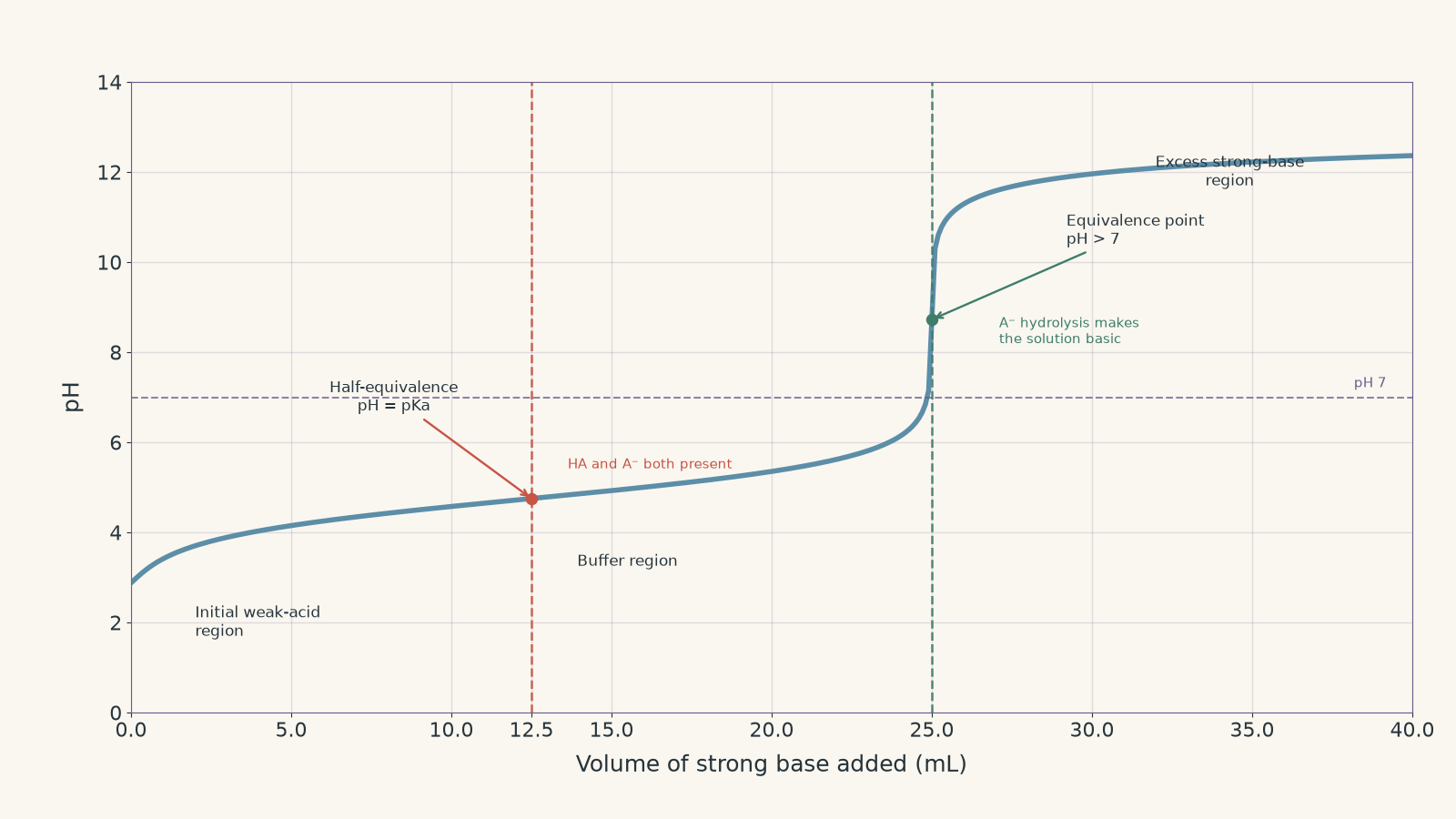
| Part of curve | Main species controlling pH | Main calculation |
|---|---|---|
| Before any base | Weak acid \(\ce{HA}\) | \(K_a\) equilibrium |
| Before equivalence | Mixture of \(\ce{HA}\) and \(\mathrm{A}^{-}\) | Neutralisation, then buffer equilibrium |
| Half-equivalence | Equal amounts of \(\ce{HA}\) and \(\mathrm{A}^{-}\) | \(\mathrm{pH}\approx\mathrm{p}K_a\) |
| Equivalence | Conjugate base \(\mathrm{A}^{-}\) | \(K_b\) hydrolysis |
| After equivalence | Excess \(\ce{OH-}\) | Excess strong-base concentration |
Before any base is added
Suppose the initial concentration of the weak acid is \(C\).
If \(x\) mol L\(^{-1}\) ionises, then approximately
\[ [\ce{H3O+}]=[\mathrm{A}^{-}]=x \]
and
\[ [\ce{HA}]=C-x \]
so
\[ K_a=\frac{x^2}{C-x} \]
If the acid ionises only slightly, \(x\ll C\), so we can often use
\[ [\ce{H3O+}]\approx\sqrt{K_aC} \]
This initial pH is higher than that of a strong acid at the same analytical concentration because the weak acid has not released all its available protons.
Before equivalence: the buffer region
Now imagine adding some \(\ce{NaOH}\), but not enough to reach equivalence.
The hydroxide reacts with \(\ce{HA}\):
\[ \ce{HA + OH- -> A- + H2O} \]
For every mole of \(\ce{OH-}\) added:
- one mole of \(\ce{HA}\) is consumed, and
- one mole of \(\mathrm{A}^{-}\) is formed.
You now have significant amounts of both a weak acid and its conjugate base. That is a buffer.
From
\[ K_a=\frac{[\ce{H3O+}][\mathrm{A}^{-}]}{[\ce{HA}]} \]
we can rearrange:
\[ [\ce{H3O+}]=K_a\frac{[\ce{HA}]}{[\mathrm{A}^{-}]} \]
Taking negative base-10 logarithms gives
\[ \mathrm{pH}=\mathrm{p}K_a+\log\left(\frac{[\mathrm{A}^{-}]}{[\ce{HA}]}\right) \]
where
\[ \mathrm{p}K_a=-\log K_a \]
Because \(\ce{HA}\) and \(\mathrm{A}^{-}\) are in the same total solution volume, their concentration ratio equals their mole ratio:
\[ \mathrm{pH}=\mathrm{p}K_a+\log\left(\frac{n(\mathrm{A}^{-})}{n(\ce{HA})}\right) \]
This equation is useful, but notice where it came from. It isn’t a separate magic rule. It is just the \(K_a\) expression rearranged after the neutralisation calculation has told us how much \(\ce{HA}\) and \(\mathrm{A}^{-}\) remain.
Half-equivalence: the useful landmark
At the half-equivalence point, half the original \(\ce{HA}\) has been converted to \(\mathrm{A}^{-}\).
So, to the usual HSC approximation,
\[ n(\ce{HA})=n(\mathrm{A}^{-}) \]
and therefore
\[ \frac{n(\mathrm{A}^{-})}{n(\ce{HA})}=1 \]
Since \(\log 1=0\),
\[ \boxed{\mathrm{pH}\approx\mathrm{p}K_a} \]
This is one of the most useful pieces of information you can read from a weak acid titration curve.
It does not mean the pH is halfway between the initial and equivalence-point pH. “Half-equivalence” refers to the amount of base added, not to a halfway pH.
Worked example: pH at half-equivalence
25.00 mL of \(0.100\ \mathrm{mol\,L^{-1}}\) ethanoic acid, with \(K_a=1.8\times10^{-5}\), is titrated with \(0.100\ \mathrm{mol\,L^{-1}}\) sodium hydroxide. Calculate the pH after 12.50 mL of sodium hydroxide has been added.
Step 1
\[ n(\ce{HA})=cV =(0.100)(0.02500) =2.500\times10^{-3}\ \mathrm{mol} \]
Step 2
\[ n(\ce{OH-}) =(0.100)(0.01250) =1.250\times10^{-3}\ \mathrm{mol} \]
This is exactly half the initial amount of acid.
Step 3
The hydroxide converts \(1.250\times10^{-3}\) mol of \(\ce{HA}\) into the same amount of \(\mathrm{A}^{-}\).
So after reaction,
\[ n(\ce{HA})=1.250\times10^{-3}\ \mathrm{mol} \]
and
\[ n(\mathrm{A}^{-})=1.250\times10^{-3}\ \mathrm{mol} \]
The two amounts are equal.
Step 4
\[ \mathrm{pH}\approx\mathrm{p}K_a=-\log(1.8\times10^{-5}) \]
\[ \mathrm{pH}\approx4.74 \]
The result means that the titration has reached the point where the weak acid and conjugate base are present in approximately equal amounts. This is also near the centre of the buffer region.
03What happens at equivalence?
The equivalence point is where the added hydroxide has reacted stoichiometrically with all the original weak acid.
For a monoprotic weak acid,
\[ n(\ce{OH-})_{\text{added}}=n(\ce{HA})_{\text{initial}} \]
At first glance, you might now expect neither acid nor base to remain.
But look at what the neutralisation reaction actually produced:
\[ \ce{HA + OH- -> A- + H2O} \]
The flask contains a substantial concentration of \(\mathrm{A}^{-}\).
And \(\mathrm{A}^{-}\) is a base.
It reacts with water:
\[ \ce{A- + H2O <=> HA + OH-} \]
This reaction is called hydrolysis. It produces hydroxide ions, making the solution basic.
For a conjugate acid-base pair,
\[ K_aK_b=K_w \]
so
\[ K_b=\frac{K_w}{K_a} \]
where \(K_b\) is the base dissociation constant of \(\mathrm{A}^{-}\), and \(K_w=1.0\times10^{-14}\) at \(25^\circ\mathrm{C}\).
This also explains an important trend. A weaker acid has a stronger conjugate base. So, if other conditions are similar, a weaker acid tends to give a more basic equivalence point.
Calculating equivalence-point pH
At equivalence:
- calculate the original moles of weak acid,
- calculate the total volume after mixing,
- use those values to find the concentration of \(\mathrm{A}^{-}\),
- calculate \(K_b\),
- use the hydrolysis equilibrium to find \([\ce{OH-}]\), then
- convert pOH to pH.
If the hydrolysis is small, then for conjugate-base concentration \(C\),
\[ [\ce{OH-}]\approx\sqrt{K_bC} \]
Worked example: equivalence pH and indicator choice
20.0 mL of \(0.150\ \mathrm{mol\,L^{-1}}\) propanoic acid is titrated with \(0.100\ \mathrm{mol\,L^{-1}}\) sodium hydroxide. For propanoic acid, \(K_a=1.3\times10^{-5}\). Calculate the pH at equivalence and decide whether phenolphthalein or methyl orange is the more suitable indicator.
Step 1
\[ n(\ce{HA}) =(0.150)(0.0200) =3.00\times10^{-3}\ \mathrm{mol} \]
Step 2
The reaction is 1:1, so
\[ n(\ce{OH-})=3.00\times10^{-3}\ \mathrm{mol} \]
Therefore,
\[ V(\ce{NaOH}) =\frac{n}{c} =\frac{3.00\times10^{-3}}{0.100} =0.0300\ \mathrm{L} \]
\[ V(\ce{NaOH})=30.0\ \mathrm{mL} \]
Step 3
The total volume is
\[ 20.0+30.0=50.0\ \mathrm{mL}=0.0500\ \mathrm{L} \]
All \(3.00\times10^{-3}\) mol of acid has been converted to \(\mathrm{A}^{-}\), so
\[ [\mathrm{A}^{-}] =\frac{3.00\times10^{-3}}{0.0500} =0.0600\ \mathrm{mol\,L^{-1}} \]
Step 4
\[ K_b=\frac{K_w}{K_a} =\frac{1.0\times10^{-14}}{1.3\times10^{-5}} =7.69\times10^{-10} \]
Step 5
\[ [\ce{OH-}] \approx\sqrt{K_b[\mathrm{A}^{-}]} \]
\[ [\ce{OH-}] =\sqrt{(7.69\times10^{-10})(0.0600)} =6.79\times10^{-6}\ \mathrm{mol\,L^{-1}} \]
Step 6
\[ \mathrm{pOH} =-\log(6.79\times10^{-6}) =5.17 \]
At \(25^\circ\mathrm{C}\),
\[ \mathrm{pH}+\mathrm{pOH}=14.00 \]
so
\[ \mathrm{pH}=14.00-5.17=8.83 \]
The equivalence solution is basic because propanoate ions hydrolyse to form \(\ce{OH-}\).
Phenolphthalein is the better indicator. Its transition range is roughly pH 8.2-10.0, which lies within the steep part of a typical weak acid-strong base titration curve near this equivalence point. Methyl orange changes at roughly pH 3.1-4.4, well before equivalence.
04After equivalence, stop treating it as a buffer problem
Once more strong base has been added than the weak acid can neutralise, excess \(\ce{OH-}\) remains.
Suppose the original acid contained \(2.50\times10^{-3}\) mol of \(\ce{HA}\), but you have now added \(3.00\times10^{-3}\) mol of \(\ce{OH-}\).
The excess is
\[ n(\ce{OH-})_{\text{excess}} =3.00\times10^{-3}-2.50\times10^{-3} =5.00\times10^{-4}\ \mathrm{mol} \]
You then divide that excess amount by the total solution volume to obtain \([\ce{OH-}]\).
At this stage the strong-base excess dominates the pH. The extra hydroxide generated by conjugate-base hydrolysis is normally tiny in comparison.
This is another common source of errors: students keep using \(K_a\) or the buffer equation even though the titration has already passed equivalence.
05A reliable decision rule
Before doing any pH calculation, locate yourself on the curve.
- No base added: use weak-acid equilibrium.
- Base added, but less than equivalence: do neutralisation in moles first, then use the remaining \(\ce{HA}/\mathrm{A}^{-}\) pair.
- Half-equivalence: use \(\mathrm{pH}\approx\mathrm{p}K_a\).
- Exactly at equivalence: calculate conjugate-base hydrolysis using \(K_b=K_w/K_a\).
- Past equivalence: calculate the concentration of excess strong \(\ce{OH-}\).
The arithmetic usually isn’t the hardest part. Choosing the correct chemical model is.
06Equivalence point and endpoint are not the same thing
The equivalence point is a stoichiometric condition. For a monoprotic acid titrated with hydroxide, it occurs when the amount of added \(\ce{OH-}\) equals the original amount of acid.
The endpoint is an experimental observation, such as an indicator changing colour.
A good indicator changes colour across the steep section of the titration curve, so its endpoint occurs very close to the true equivalence volume.
For a weak acid-strong base titration, the steep region is shifted into the basic range. This is why phenolphthalein is commonly suitable while methyl orange is generally not.
You do not need an indicator whose transition range is centred on the exact equivalence pH. You need its colour change to occur while the curve is steep, where a tiny extra volume of titrant produces a large pH change.
07The mistakes that feel reasonable
“Weak acid means it doesn’t react completely with the strong base”
The acid only partially ionises in water, but hydroxide removes \(\mathrm{H}^{+}\) from \(\ce{HA}\) very effectively. The neutralisation is treated as essentially complete before the remaining equilibrium is considered.
“Equivalence means the solution is neutral”
Equivalence means the reactants have been mixed in their stoichiometric proportions. It says nothing by itself about pH.
At weak acid-strong base equivalence, the conjugate base hydrolyses:
\[ \ce{A- + H2O <=> HA + OH-} \]
so the solution is basic.
“Half-equivalence means half the initial pH”
pH is logarithmic, so this idea has no basis.
Half-equivalence means half of the original acid amount has been neutralised. That produces approximately equal amounts of \(\ce{HA}\) and \(\mathrm{A}^{-}\), giving \(\mathrm{pH}\approx\mathrm{p}K_a\).
“Dilution doesn’t matter because the number of moles hasn’t changed”
In the buffer ratio,
\[ \frac{[\mathrm{A}^{-}]}{[\ce{HA}]} \]
the common solution volume cancels, so using mole ratios is convenient.
At equivalence, however, you need the actual concentration of \(\mathrm{A}^{-}\). Total volume matters.
That difference is easy to miss.
08Questions and solutions
Question 1
20.0 mL of \(0.100\ \mathrm{mol\,L^{-1}}\) ethanoic acid is titrated with \(0.100\ \mathrm{mol\,L^{-1}}\) sodium hydroxide. The acid has \(K_a=1.8\times10^{-5}\).
Calculate:
a. the volume of sodium hydroxide required to reach equivalence, and
b. the pH after 10.0 mL of sodium hydroxide has been added.
Solution 1
The equivalence volume is \(20.0\ \mathrm{mL}\), and the pH after \(10.0\ \mathrm{mL}\) has been added is approximately \(4.74\).
First find the initial amount of acid:
\[ n(\ce{HA}) =(0.100)(0.0200) =2.00\times10^{-3}\ \mathrm{mol} \]
At equivalence the same amount of hydroxide is required:
\[ V_{\text{eq}} =\frac{2.00\times10^{-3}}{0.100} =0.0200\ \mathrm{L} =20.0\ \mathrm{mL} \]
After \(10.0\ \mathrm{mL}\) of base has been added,
\[ n(\ce{OH-}) =(0.100)(0.0100) =1.00\times10^{-3}\ \mathrm{mol} \]
That is exactly half the amount required for equivalence.
The reaction
\[ \ce{HA + OH- -> A- + H2O} \]
therefore leaves
\[ 1.00\times10^{-3}\ \mathrm{mol} \]
of \(\ce{HA}\) and forms the same amount of \(\mathrm{A}^{-}\).
Hence,
\[ \mathrm{pH}\approx\mathrm{p}K_a =-\log(1.8\times10^{-5}) =4.74 \]
The tempting mistake is to try to find a pH halfway between the starting pH and equivalence pH. Half-equivalence refers to moles neutralised, and the useful consequence is equal amounts of the conjugate pair.
Question 2
25.0 mL of \(0.0800\ \mathrm{mol\,L^{-1}}\) propanoic acid is titrated with \(0.100\ \mathrm{mol\,L^{-1}}\) sodium hydroxide. For propanoic acid, \(K_a=1.3\times10^{-5}\).
Calculate the pH at equivalence. Then choose the more suitable indicator from:
- methyl orange, transition range approximately pH 3.1-4.4
- phenolphthalein, transition range approximately pH 8.2-10.0.
Explain your choice.
Solution 2
The equivalence-point pH is approximately \(8.77\), and phenolphthalein is the more suitable indicator.
The original amount of acid is
\[ n(\ce{HA}) =(0.0800)(0.0250) =2.00\times10^{-3}\ \mathrm{mol} \]
The required base volume is
\[ V_{\text{eq}} =\frac{2.00\times10^{-3}}{0.100} =0.0200\ \mathrm{L} =20.0\ \mathrm{mL} \]
At equivalence, all the weak acid has been converted into its conjugate base. The total solution volume is
\[ 25.0+20.0=45.0\ \mathrm{mL} =0.0450\ \mathrm{L} \]
Therefore,
\[ [\mathrm{A}^{-}] =\frac{2.00\times10^{-3}}{0.0450} =4.44\times10^{-2}\ \mathrm{mol\,L^{-1}} \]
The conjugate-base constant is
\[ K_b =\frac{1.0\times10^{-14}}{1.3\times10^{-5}} =7.69\times10^{-10} \]
For
\[ \ce{A- + H2O <=> HA + OH-} \]
we use
\[ [\ce{OH-}]\approx\sqrt{K_b[\mathrm{A}^{-}]} \]
so
\[ [\ce{OH-}] =\sqrt{(7.69\times10^{-10})(4.44\times10^{-2})} =5.85\times10^{-6}\ \mathrm{mol\,L^{-1}} \]
Thus,
\[ \mathrm{pOH} =-\log(5.85\times10^{-6}) =5.23 \]
and
\[ \mathrm{pH} =14.00-5.23 =8.77 \]
Phenolphthalein changes colour through the basic, steep section near equivalence. Methyl orange would begin changing while the solution was still well inside the acidic buffer region.
The trap is assuming that every acid-base equivalence point should be near pH 7. The conjugate base remaining in this flask prevents that.
Question 3
A 25.0 mL sample of an unknown monoprotic weak acid, \(\ce{HA}\), is titrated with \(0.100\ \mathrm{mol\,L^{-1}}\) sodium hydroxide.
The equivalence point occurs after \(30.0\ \mathrm{mL}\) of sodium hydroxide has been added. When \(15.0\ \mathrm{mL}\) has been added, the pH is 4.20.
Determine:
a. the initial concentration of \(\ce{HA}\),
b. \(K_a\) for the acid, and
c. the approximate pH at equivalence.
Assume \(K_w=1.0\times10^{-14}\) at \(25^\circ\mathrm{C}\).
Solution 3
The acid concentration is \(0.120\ \mathrm{mol\,L^{-1}}\), \(K_a=6.3\times10^{-5}\), and the equivalence-point pH is approximately \(8.47\).
At equivalence,
\[ n(\ce{HA})_{\text{initial}} =n(\ce{OH-})_{\text{added}} \]
so
\[ n(\ce{HA}) =(0.100)(0.0300) =3.00\times10^{-3}\ \mathrm{mol} \]
The initial acid concentration is therefore
\[ c(\ce{HA}) =\frac{3.00\times10^{-3}}{0.0250} =0.120\ \mathrm{mol\,L^{-1}} \]
The pH of 4.20 was measured after \(15.0\ \mathrm{mL}\) of base had been added. This is exactly half the \(30.0\ \mathrm{mL}\) equivalence volume.
Therefore,
\[ \mathrm{pH}\approx\mathrm{p}K_a \]
so
\[ \mathrm{p}K_a=4.20 \]
and
\[ K_a=10^{-4.20} =6.31\times10^{-5} \]
Now consider equivalence.
The total volume is
\[ 25.0+30.0=55.0\ \mathrm{mL} =0.0550\ \mathrm{L} \]
so the conjugate-base concentration is
\[ [\mathrm{A}^{-}] =\frac{3.00\times10^{-3}}{0.0550} =5.45\times10^{-2}\ \mathrm{mol\,L^{-1}} \]
Its base dissociation constant is
\[ K_b =\frac{1.0\times10^{-14}}{6.31\times10^{-5}} =1.58\times10^{-10} \]
Therefore,
\[ [\ce{OH-}] \approx\sqrt{(1.58\times10^{-10})(5.45\times10^{-2})} =2.94\times10^{-6}\ \mathrm{mol\,L^{-1}} \]
\[ \mathrm{pOH} =-\log(2.94\times10^{-6}) =5.53 \]
so
\[ \mathrm{pH}=14.00-5.53=8.47 \]
The key connection is that one titration curve can reveal two different properties. The equivalence volume tells you how many moles of acid were present, while the half-equivalence pH reveals the acid’s \(K_a\).
Question 4
Two samples contain the same weak monoprotic acid, with \(K_a=1.0\times10^{-5}\).
Sample A contains 25.0 mL of \(0.100\ \mathrm{mol\,L^{-1}}\) acid.
Sample B contains 50.0 mL of \(0.0500\ \mathrm{mol\,L^{-1}}\) acid.
Each sample is titrated separately with \(0.100\ \mathrm{mol\,L^{-1}}\) sodium hydroxide.
One student says, “The titration curves must be identical because the samples contain the same number of moles of the same acid.”
Another says, “The curves must be different at every point because the starting concentrations are different.”
Test both claims by calculating, for each sample:
a. the initial pH,
b. the equivalence volume,
c. the pH after \(20.0\ \mathrm{mL}\) of sodium hydroxide has been added, and
d. the equivalence-point pH.
State which features coincide and which do not.
Solution 4
Neither student is completely correct: both samples have the same equivalence volume and, under the usual buffer approximation, the same pH after \(20.0\ \mathrm{mL}\) of base, but their initial and equivalence-point pH values are different.
First compare the amounts of acid.
For A,
\[ n_A =(0.100)(0.0250) =2.50\times10^{-3}\ \mathrm{mol} \]
For B,
\[ n_B =(0.0500)(0.0500) =2.50\times10^{-3}\ \mathrm{mol} \]
So both contain exactly the same amount of acid.
For the initial pH, use
\[ [\ce{H3O+}]\approx\sqrt{K_aC} \]
For A,
\[ [\ce{H3O+}] \approx\sqrt{(1.0\times10^{-5})(0.100)} =1.00\times10^{-3}\ \mathrm{mol\,L^{-1}} \]
so
\[ \mathrm{pH}_A\approx3.00 \]
For B,
\[ [\ce{H3O+}] \approx\sqrt{(1.0\times10^{-5})(0.0500)} =7.07\times10^{-4}\ \mathrm{mol\,L^{-1}} \]
so
\[ \mathrm{pH}_B\approx3.15 \]
Their initial pH values differ because weak-acid equilibrium depends on concentration, not just total moles.
Now find the equivalence volumes.
Both contain \(2.50\times10^{-3}\) mol of acid, so both require
\[ V_{\text{eq}} =\frac{2.50\times10^{-3}}{0.100} =0.0250\ \mathrm{L} =25.0\ \mathrm{mL} \]
The equivalence volumes are identical.
After \(20.0\ \mathrm{mL}\) of base has been added,
\[ n(\ce{OH-}) =(0.100)(0.0200) =2.00\times10^{-3}\ \mathrm{mol} \]
For both flasks, neutralisation produces
\[ n(\mathrm{A}^{-})=2.00\times10^{-3}\ \mathrm{mol} \]
and leaves
\[ n(\ce{HA}) =2.50\times10^{-3}-2.00\times10^{-3} =5.00\times10^{-4}\ \mathrm{mol} \]
Therefore the mole ratio is the same in both:
\[ \frac{n(\mathrm{A}^{-})}{n(\ce{HA})} =\frac{2.00\times10^{-3}}{5.00\times10^{-4}} =4 \]
Since
\[ \mathrm{p}K_a=5.00 \]
the buffer calculation gives
\[ \mathrm{pH} =5.00+\log 4 =5.60 \]
for both samples.
This is the less obvious result. Their total solution volumes are different, but the common volume cancels from the ratio \([\mathrm{A}^{-}]/[\ce{HA}]\). The buffer pH therefore depends mainly on the mole ratio.
Now compare the equivalence points.
For A, the total volume at equivalence is
\[ 25.0+25.0=50.0\ \mathrm{mL} \]
so
\[ [\mathrm{A}^{-}]_A =\frac{2.50\times10^{-3}}{0.0500} =0.0500\ \mathrm{mol\,L^{-1}} \]
For B, the total volume is
\[ 50.0+25.0=75.0\ \mathrm{mL} \]
so
\[ [\mathrm{A}^{-}]_B =\frac{2.50\times10^{-3}}{0.0750} =0.0333\ \mathrm{mol\,L^{-1}} \]
Since
\[ K_b=\frac{1.0\times10^{-14}}{1.0\times10^{-5}} =1.0\times10^{-9} \]
for A,
\[ [\ce{OH-}] \approx\sqrt{(1.0\times10^{-9})(0.0500)} =7.07\times10^{-6}\ \mathrm{mol\,L^{-1}} \]
giving
\[ \mathrm{pH}_A\approx8.85 \]
For B,
\[ [\ce{OH-}] \approx\sqrt{(1.0\times10^{-9})(0.0333)} =5.77\times10^{-6}\ \mathrm{mol\,L^{-1}} \]
giving
\[ \mathrm{pH}_B\approx8.76 \]
So the two curves share some features but not others.
The first student’s argument notices correctly that total moles control the equivalence volume, but incorrectly assumes that every equilibrium depends only on moles. The second student’s argument notices the concentration difference but misses the fact that buffer pH depends on a ratio in which the common volume cancels.
This is why titration curves cannot be understood using one rule for the whole graph. Different regions are controlled by different constraints.
Question 5
25.0 mL of \(0.100\ \mathrm{mol\,L^{-1}}\) weak acid \(\ce{HA}\), with \(K_a=1.0\times10^{-5}\), is titrated with \(0.100\ \mathrm{mol\,L^{-1}}\) sodium hydroxide.
After \(12.50\ \mathrm{mL}\) of sodium hydroxide has been added, a student says:
“This is half-equivalence, so pH equals \(\mathrm{p}K_a\) exactly.”
Using the normal HSC treatment, calculate the pH.
Then test the word “exactly”. At this point, the total analytical concentration of acid species is
\[ [\ce{HA}]+[\mathrm{A}^{-}]=0.06667\ \mathrm{mol\,L^{-1}} \]
and
\[ [\mathrm{Na}^{+}]=0.03333\ \mathrm{mol\,L^{-1}} \]
For an electrically neutral solution,
\[ [\mathrm{Na}^{+}]+[\ce{H3O+}] = [\mathrm{A}^{-}]+[\ce{OH-}] \]
If the pH were exactly 5.000, determine whether this charge balance would hold. Hence decide whether the true pH must be slightly above or slightly below 5.000.
Explain why \(\mathrm{pH}=\mathrm{p}K_a\) is still an excellent rule for normal HSC titration calculations.
Solution 5
The normal HSC answer is \(\mathrm{pH}=5.00\), but this is not mathematically exact; the full equilibrium gives a pH that is very slightly above 5.000.
At half-equivalence, the usual stoichiometric treatment gives equal amounts of \(\ce{HA}\) and \(\mathrm{A}^{-}\).
Therefore,
\[ \mathrm{pH}\approx\mathrm{p}K_a =-\log(1.0\times10^{-5}) =5.00 \]
Now test whether pH 5.000 can be exact.
If
\[ \mathrm{pH}=5.000 \]
then
\[ [\ce{H3O+}]=1.00\times10^{-5}\ \mathrm{mol\,L^{-1}} \]
and, at \(25^\circ\mathrm{C}\),
\[ [\ce{OH-}] =\frac{1.0\times10^{-14}}{1.00\times10^{-5}} =1.00\times10^{-9}\ \mathrm{mol\,L^{-1}} \]
Also,
\[ K_a =\frac{[\ce{H3O+}][\mathrm{A}^{-}]}{[\ce{HA}]} \]
Since \(K_a=[\ce{H3O+}]=1.00\times10^{-5}\),
\[ \frac{[\mathrm{A}^{-}]}{[\ce{HA}]}=1 \]
The total concentration of the two acid forms is \(0.06667\ \mathrm{mol\,L^{-1}}\), so this would require
\[ [\mathrm{A}^{-}]=[\ce{HA}] \approx0.03333\ \mathrm{mol\,L^{-1}} \]
Now compare total positive and negative charge.
The positive-charge concentration would be approximately
\[ [\mathrm{Na}^{+}]+[\ce{H3O+}] = 0.03333+0.000010 \]
\[ =0.03334\ \mathrm{mol\,L^{-1}} \]
The negative-charge concentration would be approximately
\[ [\mathrm{A}^{-}]+[\ce{OH-}] = 0.03333+0.000000001 \]
which is slightly smaller.
So pH 5.000 does not satisfy exact electrical neutrality.
To restore charge balance, the solution needs slightly more negative charge from \(\mathrm{A}^{-}\) and less positive charge from \(\ce{H3O+}\). Both changes occur if \([\ce{H3O+}]\) falls slightly.
A smaller \([\ce{H3O+}]\) means a slightly higher pH.
So the exact value is just above 5.000.
The tempting argument was that adding half the stoichiometric amount of hydroxide must create exactly equal equilibrium concentrations of \(\ce{HA}\) and \(\mathrm{A}^{-}\). That ignores the small amounts of free \(\ce{H3O+}\) and \(\ce{OH-}\) that must also satisfy equilibrium and charge balance.
Why, then, do we happily use
\[ \mathrm{pH}=\mathrm{p}K_a \]
at half-equivalence?
Because the correction is tiny. The buffer species are present at concentrations of roughly \(10^{-2}\ \mathrm{mol\,L^{-1}}\), while \([\ce{H3O+}]\) is only about \(10^{-5}\ \mathrm{mol\,L^{-1}}\). The ignored contribution is thousands of times smaller than the main acid and conjugate-base concentrations.
So \(\mathrm{pH}\approx\mathrm{p}K_a\) is an excellent model at ordinary titration concentrations, even though “exactly equal” is a slightly stronger claim than the chemistry supports.
That distinction is useful beyond titrations. Equations such as the half-equivalence rule are models built from stated or hidden approximations. Knowing why the model works tells you when you can trust it.
09What this idea unlocks next
Once you can identify which species controls each section of the curve, a weak acid-strong base titration stops being one long calculation.
The initial region tells you about \(K_a\). The buffer region shows how a conjugate pair resists pH change. The half-equivalence point gives direct access to \(\mathrm{p}K_a\). The equivalence point reveals the basic behaviour of the conjugate base, and the final region is governed by excess strong base.
The next useful step is to connect this curve to buffer capacity and \(K_a\) determination from experimental titration data. That is where the shape of the graph becomes evidence, rather than just something to sketch.