
Neutralisation Models for Strong and Weak Acids and Bases
Learn how to model acid-base neutralisation using particle, symbolic, and titration-curve representations. Compare strong and weak reactants, equivalence points, buffers, and conjugate-species behaviour.
Suppose you titrate 25.0 mL of 0.100 mol L\(^{-1}\) hydrochloric acid and 25.0 mL of 0.100 mol L\(^{-1}\) ethanoic acid with the same 0.100 mol L\(^{-1}\) sodium hydroxide solution. Hydrochloric acid starts at a much lower pH. Which acid needs more sodium hydroxide to reach equivalence?
A tempting prediction is hydrochloric acid. It is the stronger acid, after all.
But both require exactly 25.0 mL of NaOH.
That result exposes one of the most important ideas in acid-base chemistry: acid strength tells you how readily an acid ionises, not how many moles of neutralisable acid are present. To model neutralisation properly, you need to keep three views connected: what the particles are doing, what the chemical equations say, and what a titration graph records.
01One reaction, three different views
Imagine zooming in on an acid-base mixture until you can see individual particles.
At that scale, neutralisation isn’t really about two labelled bottles called “acid” and “base”. It is about particular particles transferring or removing protons.
We can describe the same process at three levels:
| Representation | What it tells you | Main question |
|---|---|---|
| Particle | Which species are actually present? | What can react right now? |
| Symbolic | What reaction or equilibrium relates those particles? | What is consumed, and what is formed? |
| Graphical | How does the mixture change as one reactant is added? | What does the changing pH reveal? |
You need all three. An equation without a particle picture can hide an important equilibrium, while a titration curve without the chemistry behind it becomes a collection of shapes to memorise.
02Start with the particles: strong does not mean concentrated
Before worrying about neutralisation, separate two ideas that students often mix up.
Concentration tells you how much acid or base is present per unit volume.
Strength tells you how extensively that substance reacts with water to produce acidic or basic particles.
A strong acid such as HCl is effectively completely ionised in dilute aqueous solution:
\[
\ce{HCl + H2O -> H3O+ + Cl-}
\]
A weak acid such as ethanoic acid, \(\ce{CH3COOH}\), only partially ionises:
\[
\ce{CH3COOH + H2O <=> H3O+ + CH3COO-}
\]
So if you could inspect equal-concentration samples, the HCl solution would contain large numbers of \(\ce{H3O+}\) and \(\mathrm{Cl}^{-}\) ions. The ethanoic acid solution would contain mostly intact \(\ce{CH3COOH}\) molecules, plus smaller amounts of \(\ce{H3O+}\) and \(\ce{CH3COO-}\).
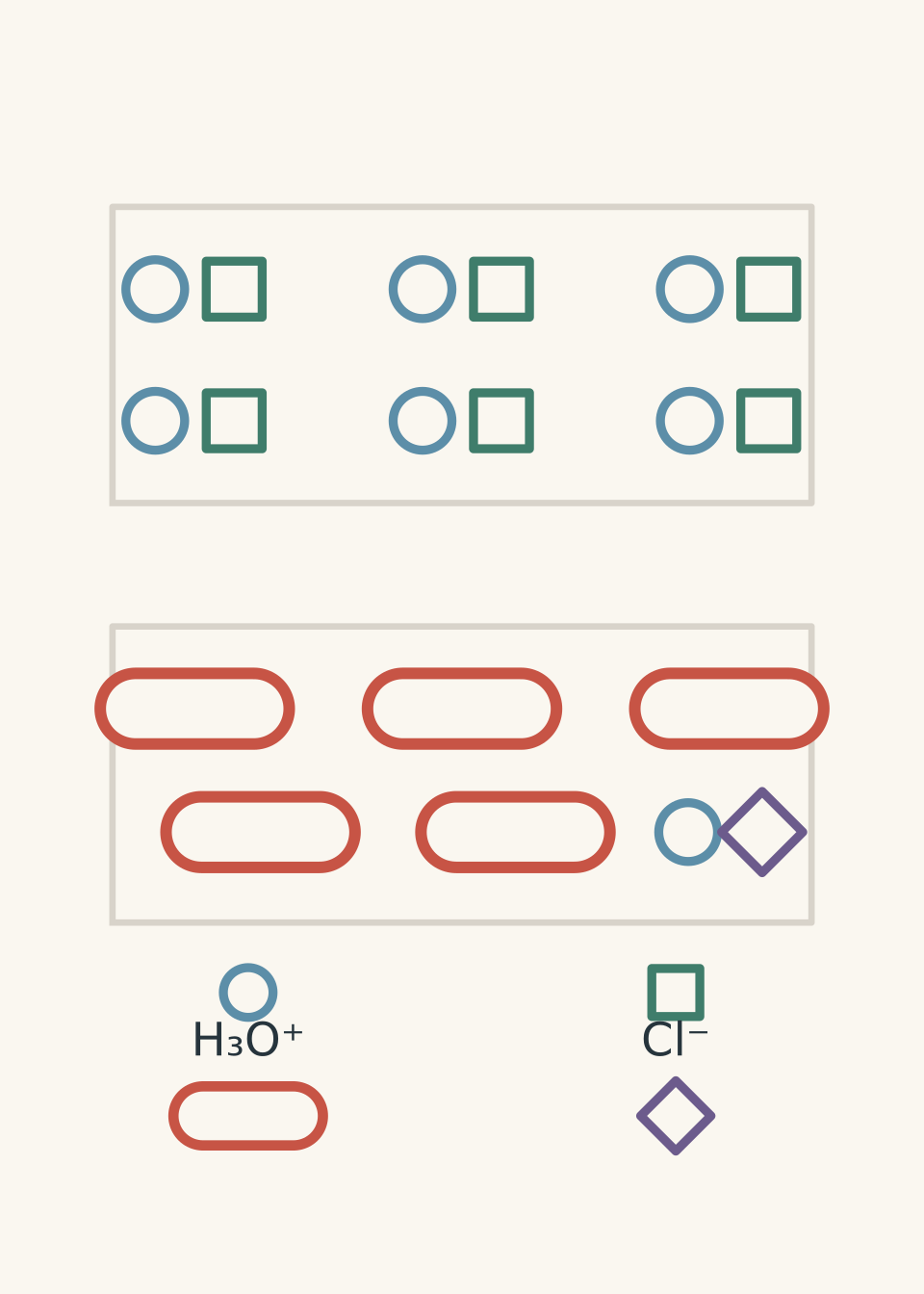
The same distinction applies to bases.
A strong soluble base such as sodium hydroxide dissociates essentially completely:
\[
\ce{NaOH -> Na+ + OH-}
\]
A weak base such as ammonia reacts only partially with water:
\[
\ce{NH3 + H2O <=> NH4+ + OH-}
\]
Here’s a slightly silly way to picture weak acids. A strong acid gives up nearly all of its available protons as soon as it enters the party. A weak acid is much more reluctant. That does not mean it has fewer protons available overall; it means fewer have been transferred at any one moment.
The analogy breaks because molecules aren’t making decisions. The actual reason is equilibrium.
03What happens when a strong acid meets a strong base?
Suppose HCl and NaOH are mixed.
Before mixing, the important reactive particles are \(\ce{H3O+}\) from the acid and \(\ce{OH-}\) from the base. Sodium and chloride ions are spectators.
The key reaction is:
\[
\ce{H3O+ + OH- -> 2H2O}
\]
This reaction proceeds overwhelmingly towards water.
If equal moles of \(\ce{H3O+}\) and \(\ce{OH-}\) are mixed, neither remains in stoichiometric excess. At 25°C, the resulting strong acid-strong base mixture is approximately neutral, with pH 7.
Notice what “neutral” does not mean. The beaker isn’t suddenly filled with pure water. It still contains ions such as \(\mathrm{Na}^{+}\) and \(\mathrm{Cl}^{-}\). They simply don’t appreciably make the solution acidic or basic.
04What changes when the acid is weak?
Now replace HCl with ethanoic acid.
Before any NaOH is added, most acid particles are still \(\ce{CH3COOH}\), not \(\ce{H3O+}\).
So what happens if you add \(\ce{OH-}\)?
You might predict that only the small amount of \(\ce{H3O+}\) already present can be neutralised. If that were true, a weak acid would require very little base.
It isn’t true.
As \(\ce{OH-}\) removes acidic particles, the acid equilibrium responds. More \(\ce{CH3COOH}\) ionises, replacing some of the \(\ce{H3O+}\) that has been removed. The process continues until the available acid has been converted to its conjugate base.
A very useful net ionic equation is therefore:
\[
\ce{CH3COOH + OH- -> CH3COO- + H2O}
\]
This equation captures the overall result better than pretending that the weak acid was fully ionised from the beginning.
So 1.00 mol of monoprotic \(\ce{CH3COOH}\) can still consume approximately 1.00 mol of \(\ce{OH-}\), even though only a small fraction of the acid was ionised initially.
That is why equal amounts of strong and weak monoprotic acids can have the same equivalence volume.
05The useful symbolic models for each combination
The equation you choose should reflect the particles that actually exist in significant amounts.
| Reactants | Useful net equation | Important consequence |
|---|---|---|
| Strong acid + strong base | \(\ce{H3O+ + OH- -> 2H2O}\) | Equivalence is about pH 7 at 25°C |
| Weak acid + strong base | \(\ce{HA + OH- -> A- + H2O}\) | Conjugate base \(\mathrm{A}^{-}\) remains at equivalence |
| Strong acid + weak base | \(\ce{H3O+ + B -> BH+ + H2O}\) | Conjugate acid \(\ce{BH+}\) remains |
| Weak acid + weak base | \(\ce{HA + B <=> A- + BH+}\) | Position of equilibrium depends on relative strengths |
Here, \(\ce{HA}\) represents a weak acid, \(\mathrm{A}^{-}\) its conjugate base, \(\ce{B}\) a weak base, and \(\ce{BH+}\) its conjugate acid.
There is an important writing rule hidden in this table. Don’t automatically split every substance into ions.
For example, writing
\[
\ce{H+ + OH- -> H2O}
\]
for ethanoic acid and sodium hydroxide hides the very feature that makes ethanoic acid weak. A more informative model keeps \(\ce{CH3COOH}\) intact:
\[
\ce{CH3COOH + OH- -> CH3COO- + H2O}
\]
06Equivalence does not mean pH 7
This is the second major misconception.
An equivalence point is a stoichiometric idea. It occurs when the reacting acid and base have been added in the mole ratio required by the reaction.
It does not mean:
- the pH must be 7,
- the solution contains no ions, or
- every species present is chemically neutral.
Consider ethanoic acid titrated with NaOH. At equivalence, essentially all the original \(\ce{CH3COOH}\) has been converted to \(\ce{CH3COO-}\).
Acetate is a weak base:
\[
\ce{CH3COO- + H2O <=> CH3COOH + OH-}
\]
That hydrolysis produces some \(\ce{OH-}\), so the equivalence solution is basic.
Now reverse the situation. If ammonia is titrated with a strong acid, the equivalence solution contains \(\ce{NH4+}\):
\[
\ce{NH4+ + H2O <=> NH3 + H3O+}
\]
The equivalence solution is therefore acidic.
At 25°C:
- strong acid + strong base: equivalence pH \(\approx 7\)
- weak acid + strong base: equivalence pH \(>7\)
- weak base + strong acid: equivalence pH \(<7\)
Weak acid-weak base systems require more care because both conjugate species can affect pH.
07The titration curve is a particle story drawn as a graph
A titration curve plots pH against the volume of titrant added.
It is tempting to memorise three vaguely S-shaped graphs. A better method is to ask what particles dominate each region.
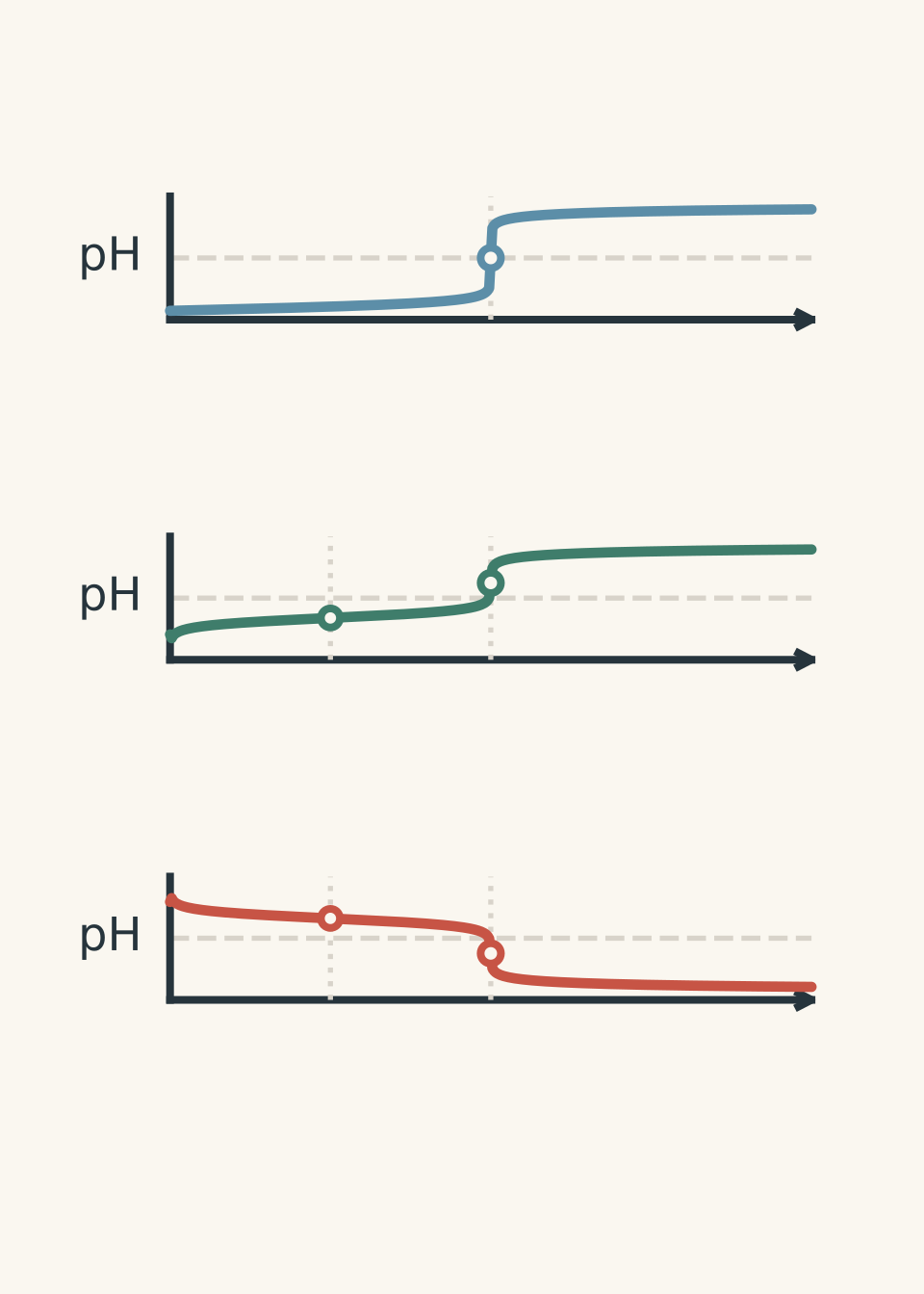
Strong acid titrated with strong base
Initially, excess \(\ce{H3O+}\) controls the pH.
As NaOH is added:
\[
\ce{H3O+ + OH- -> 2H2O}
\]
The amount of excess \(\ce{H3O+}\) falls. Close to equivalence, a tiny addition of NaOH can change the solution from having slight excess \(\ce{H3O+}\) to slight excess \(\ce{OH-}\). That gives the graph its steep section.
At equivalence, neither strong reactant is in excess, so pH is about 7 at 25°C.
After equivalence, excess added \(\ce{OH-}\) controls the pH.
Weak acid titrated with strong base
The beginning is different because most acid is present as \(\ce{HA}\).
Once some NaOH has been added, the beaker contains both \(\ce{HA}\) and \(\mathrm{A}^{-}\). This pair forms a buffer, so the pH rises more gradually than it does for a strong acid.
At half-equivalence, exactly half of the original acid has been converted to conjugate base:
\[
n(\ce{HA})=n(\mathrm{A}^{-})
\]
For the Henderson-Hasselbalch equation,
\[
\mathrm{pH}=\mathrm{p}K_a+\log\left(\frac{[\mathrm{A}^{-}]}{[\ce{HA}]}\right)
\]
the concentration ratio is 1, so:
\[
\mathrm{pH}=\mathrm{p}K_a
\]
At equivalence, \(\ce{HA}\) has been converted to \(\mathrm{A}^{-}\). The conjugate base hydrolyses, making the solution basic.
This is why a weak-acid titration curve contains information about \(K_a\), not merely the amount of acid. The relationship between acid strength and \(K_a\) is developed further in Ka, pKa and Acid Strength: HSC Chemistry Guide.
Weak base titrated with strong acid
This is the acid-base mirror image.
A weak base \(\ce{B}\) is progressively converted to \(\ce{BH+}\). Before equivalence, the \(\ce{B}/\ce{BH+}\) pair can form a buffer.
At equivalence, the conjugate acid \(\ce{BH+}\) reacts with water, so the pH is below 7.
08A reliable calculation order
Neutralisation calculations become much easier if you separate reaction stoichiometry from acid-base equilibrium.
Use this order:
- Convert volumes to litres.
- Calculate initial moles using \(n=cV\).
- Apply the neutralisation mole ratio.
- Decide what species remain after that reaction.
- Only then calculate the pH from the remaining strong acid, strong base, weak acid, weak base, or conjugate species.
This matters especially for weak acids and bases.
The fact that a reactant is weak does not mean you should begin every calculation with \(K_a\) or \(K_b\). If a strong titrant is being added, the near-complete neutralisation reaction is normally handled first.
Worked example: Strong acid with excess strong base
30.0 mL of 0.120 mol L\(^{-1}\) HCl is mixed with 20.0 mL of 0.150 mol L\(^{-1}\) NaOH. Calculate the final pH at 25°C.
Step 1
HCl is a strong monoprotic acid, so its amount gives the amount of acidic equivalents.
\[
n(\ce{HCl})=cV=(0.120)(0.0300)=3.60\times10^{-3}\text{ mol}
\]
So there are \(3.60\) mmol of acid.
Step 2
\[
n(\ce{OH-})=(0.150)(0.0200)=3.00\times10^{-3}\text{ mol}
\]
So there are \(3.00\) mmol of \(\ce{OH-}\).
Step 3
\[
\ce{H3O+ + OH- -> 2H2O}
\]
The base is limiting. The excess acid amount is:
\[
3.60-3.00=0.600\text{ mmol}
\]
or
\[
6.00\times10^{-4}\text{ mol}
\]
Step 4
The final volume is:
\[
30.0+20.0=50.0\text{ mL}=0.0500\text{ L}
\]
Therefore:
\[
[\ce{H3O+}]
=
\frac{6.00\times10^{-4}}{0.0500}
=
1.20\times10^{-2}\text{ mol L}^{-1}
\]
Step 5
\[
\mathrm{pH}=-\log(1.20\times10^{-2})=1.92
\]
The final pH is \(1.92\). The particle interpretation is equally important: all added \(\ce{OH-}\) has been consumed, and excess acidic particles remain.
Worked example: Why a weak-acid equivalence point is basic
25.0 mL of 0.100 mol L\(^{-1}\) ethanoic acid is titrated with 0.100 mol L\(^{-1}\) NaOH. The \(K_a\) of ethanoic acid is \(1.8\times10^{-5}\). Calculate the pH at the equivalence point at 25°C.
Step 1
\[
n(\ce{CH3COOH})
=
(0.100)(0.0250)
=
2.50\times10^{-3}\text{ mol}
\]
So there are \(2.50\) mmol of acid.
Step 2
The overall neutralisation is:
\[
\ce{CH3COOH + OH- -> CH3COO- + H2O}
\]
The mole ratio is 1:1, so \(2.50\) mmol of \(\ce{OH-}\) is required.
\[
V=\frac{n}{c}
=
\frac{2.50\times10^{-3}}{0.100}
=
0.0250\text{ L}
\]
So 25.0 mL of NaOH is required.
Notice that this is exactly the same equivalence volume that 25.0 mL of 0.100 mol L\(^{-1}\) HCl would require.
Step 3
All \(2.50\) mmol of ethanoic acid has been converted to acetate, \(\ce{CH3COO-}\).
The total volume is:
\[
25.0+25.0=50.0\text{ mL}=0.0500\text{ L}
\]
Therefore:
\[
[\ce{CH3COO-}]
=
\frac{2.50\times10^{-3}}{0.0500}
=
0.0500\text{ mol L}^{-1}
\]
Step 4
At 25°C,
\[
K_w=1.0\times10^{-14}
\]
and
\[
K_b=\frac{K_w}{K_a}
=
\frac{1.0\times10^{-14}}{1.8\times10^{-5}}
=
5.56\times10^{-10}
\]
Step 5
\[
\ce{CH3COO- + H2O <=> CH3COOH + OH-}
\]
Let the equilibrium concentration of newly formed \(\ce{OH-}\) be \(x\).
Using the usual small-\(x\) approximation:
\[
K_b
\approx
\frac{x^2}{0.0500}
\]
so
\[
x
=
\sqrt{(5.56\times10^{-10})(0.0500)}
=
5.27\times10^{-6}\text{ mol L}^{-1}
\]
Therefore:
\[
\mathrm{pOH}
=
-\log(5.27\times10^{-6})
=
5.28
\]
and
\[
\mathrm{pH}=14.00-5.28=8.72
\]
The equivalence-point pH is \(8.72\).
No excess NaOH is present. The basic pH comes from acetate reacting with water after the neutralisation stoichiometry is complete.
09What each part of a weak-acid titration means
For a weak monoprotic acid \(\ce{HA}\) titrated with a strong base, this compact model is worth knowing.
| Stage | Main acid-derived particles | Main pH idea |
|---|---|---|
| Before base is added | Mostly \(\ce{HA}\), some \(\mathrm{A}^{-}\) | Weak-acid equilibrium |
| Before equivalence | \(\ce{HA}\) and \(\mathrm{A}^{-}\) | Buffer |
| Half-equivalence | Equal amounts \(\ce{HA}\) and \(\mathrm{A}^{-}\) | \(\mathrm{pH}=\mathrm{p}K_a\) |
| Equivalence | Mostly \(\mathrm{A}^{-}\) | Conjugate-base hydrolysis |
| After equivalence | \(\mathrm{A}^{-}\) plus excess \(\ce{OH-}\) | Excess strong base controls pH |
The important move is to keep changing models as the composition changes. One equation does not control the whole titration.
10Questions and solutions
Question 1
20.0 mL of 0.150 mol L\(^{-1}\) nitric acid is titrated with 0.100 mol L\(^{-1}\) potassium hydroxide.
Calculate the volume of KOH required to reach equivalence, and state the approximate pH at equivalence at 25°C.
Solution 1
The equivalence volume is 30.0 mL of KOH, and the equivalence-point pH is approximately 7.00.
Nitric acid and potassium hydroxide are both strong, so the important neutralisation reaction is:
\[
\ce{H3O+ + OH- -> 2H2O}
\]
First calculate the acid amount:
\[
n(\ce{HNO3})
=
cV
=
(0.150)(0.0200)
=
3.00\times10^{-3}\text{ mol}
\]
The reaction requires the same amount of \(\ce{OH-}\):
\[
n(\ce{OH-})=3.00\times10^{-3}\text{ mol}
\]
Therefore:
\[
V(\ce{KOH})
=
\frac{n}{c}
=
\frac{3.00\times10^{-3}}{0.100}
=
0.0300\text{ L}
=
30.0\text{ mL}
\]
At equivalence, neither strong acid nor strong base is in excess. The remaining \(\mathrm{K}^{+}\) and \(\ce{NO3-}\) ions have negligible acid-base effect in this model, so the pH is approximately 7 at 25°C.
The tempting mistake is to judge equivalence from the combined volume or from equal concentrations. Equivalence depends on reacting moles and the reaction ratio.
Question 2
25.0 mL of 0.100 mol L\(^{-1}\) methanoic acid, \(\ce{HCOOH}\), is titrated with 0.100 mol L\(^{-1}\) NaOH.
After 15.0 mL of NaOH has been added, calculate the pH. Use \(K_a=1.8\times10^{-4}\).
Solution 2
The pH is approximately \(3.92\), because the solution contains a buffer made from remaining \(\ce{HCOOH}\) and formed \(\ce{HCOO-}\).
First calculate the initial acid amount:
\[
n(\ce{HCOOH})
=
(0.100)(0.0250)
=
2.50\times10^{-3}\text{ mol}
=
2.50\text{ mmol}
\]
The added hydroxide amount is:
\[
n(\ce{OH-})
=
(0.100)(0.0150)
=
1.50\times10^{-3}\text{ mol}
=
1.50\text{ mmol}
\]
Neutralisation occurs first:
\[
\ce{HCOOH + OH- -> HCOO- + H2O}
\]
Therefore:
\[
n(\ce{HCOOH})_{\text{remaining}}
=
2.50-1.50
=
1.00\text{ mmol}
\]
and
\[
n(\ce{HCOO-})=1.50\text{ mmol}
\]
Now calculate \(\mathrm{p}K_a\):
\[
\mathrm{p}K_a
=
-\log(1.8\times10^{-4})
=
3.74
\]
Because both species are in the same total volume, their concentration ratio equals their mole ratio:
\[
\mathrm{pH}
=
\mathrm{p}K_a+
\log\left(\frac{n(\ce{HCOO-})}{n(\ce{HCOOH})}\right)
\]
\[
\mathrm{pH}
=
3.74+
\log\left(\frac{1.50}{1.00}\right)
=
3.92
\]
The tempting route is to use the original weak-acid equilibrium immediately, as though the NaOH had merely diluted the acid. It has not. The \(\ce{OH-}\) first changes the actual numbers of \(\ce{HCOOH}\) and \(\ce{HCOO-}\); the equilibrium calculation comes afterwards.
Question 3
20.0 mL of 0.150 mol L\(^{-1}\) ammonia is titrated with 0.100 mol L\(^{-1}\) HCl. The \(K_b\) of ammonia is \(1.8\times10^{-5}\).
Calculate:
a. the volume of HCl required for equivalence, and
b. the pH at equivalence at 25°C.
Solution 3
The equivalence volume is 30.0 mL, and the equivalence-point pH is approximately \(5.24\).
The weak base reacts essentially stoichiometrically with the added strong acid:
\[
\ce{NH3 + H3O+ -> NH4+ + H2O}
\]
The initial amount of ammonia is:
\[
n(\ce{NH3})
=
(0.150)(0.0200)
=
3.00\times10^{-3}\text{ mol}
\]
A 1:1 reaction therefore requires \(3.00\times10^{-3}\) mol HCl:
\[
V(\ce{HCl})
=
\frac{3.00\times10^{-3}}{0.100}
=
0.0300\text{ L}
=
30.0\text{ mL}
\]
At equivalence, the ammonia has been converted to \(\ce{NH4+}\).
The total volume is:
\[
20.0+30.0=50.0\text{ mL}=0.0500\text{ L}
\]
so:
\[
[\ce{NH4+}]
=
\frac{3.00\times10^{-3}}{0.0500}
=
0.0600\text{ mol L}^{-1}
\]
Find \(K_a\) for \(\ce{NH4+}\):
\[
K_a
=
\frac{K_w}{K_b}
=
\frac{1.0\times10^{-14}}{1.8\times10^{-5}}
=
5.56\times10^{-10}
\]
The conjugate acid hydrolyses:
\[
\ce{NH4+ + H2O <=> NH3 + H3O+}
\]
Using \(x=[\ce{H3O+}]\):
\[
5.56\times10^{-10}
\approx
\frac{x^2}{0.0600}
\]
\[
x
=
\sqrt{(5.56\times10^{-10})(0.0600)}
=
5.78\times10^{-6}\text{ mol L}^{-1}
\]
Therefore:
\[
\mathrm{pH}
=
-\log(5.78\times10^{-6})
=
5.24
\]
The tempting prediction is that equivalence automatically means pH 7. The missing constraint is the particle left behind: \(\ce{NH4+}\) is a weak acid, so the equivalence solution is acidic.
Question 4
A 25.0 mL sample of 0.100 mol L\(^{-1}\) ethanoic acid is titrated to equivalence with 0.100 mol L\(^{-1}\) NaOH. Use \(K_a=1.8\times10^{-5}\).
At equivalence, a student says:
“The pH is above 7, so there must be some unreacted NaOH.”
Determine whether this statement is correct. Then calculate the approximate percentage of acetate ions that react with water at equilibrium, and explain how such a small fraction can still produce a noticeably basic pH.
Solution 4
The statement is incorrect: there is no stoichiometric excess of NaOH at equivalence, and only about \(0.0105\%\) of the acetate ions need to hydrolyse to give a pH of about \(8.72\).
Initially:
\[
n(\ce{CH3COOH})
=
(0.100)(0.0250)
=
2.50\times10^{-3}\text{ mol}
\]
Exactly the same amount of \(\ce{OH-}\) is added at equivalence:
\[
\ce{CH3COOH + OH- -> CH3COO- + H2O}
\]
So neither reactant is in stoichiometric excess. Instead, \(2.50\) mmol of acetate has been produced.
The total volume is 50.0 mL, giving:
\[
[\ce{CH3COO-}]_{\text{initial at equivalence}}
=
\frac{2.50\times10^{-3}}{0.0500}
=
0.0500\text{ mol L}^{-1}
\]
The acetate then undergoes hydrolysis:
\[
\ce{CH3COO- + H2O <=> CH3COOH + OH-}
\]
Its base constant is:
\[
K_b
=
\frac{1.0\times10^{-14}}{1.8\times10^{-5}}
=
5.56\times10^{-10}
\]
Let \(x\) be the amount hydrolysed in concentration units:
\[
K_b
\approx
\frac{x^2}{0.0500}
\]
\[
x
=
5.27\times10^{-6}\text{ mol L}^{-1}
\]
The fraction hydrolysed is therefore:
\[
\frac{5.27\times10^{-6}}{0.0500}
=
1.05\times10^{-4}
\]
As a percentage:
\[
(1.05\times10^{-4})(100)
=
0.0105\%
\]
That sounds tiny, and it is. But neutral water at 25°C contains only about \(1.0\times10^{-7}\) mol L\(^{-1}\) \(\ce{OH-}\). Producing \(5.27\times10^{-6}\) mol L\(^{-1}\) raises the hydroxide concentration to more than 50 times the neutral value.
The resulting pOH and pH are:
\[
\mathrm{pOH}=5.28
\]
\[
\mathrm{pH}=14.00-5.28=8.72
\]
The trap is to interpret “basic” as “leftover strong base”. pH tells you about the equilibrium concentration of \(\ce{H3O+}\) or \(\ce{OH-}\), not where those ions originally came from. Here, the \(\ce{OH-}\) is generated by acetate hydrolysis after the NaOH itself has been consumed.
Question 5
Two 25.0 mL monoprotic acid solutions, X and Y, both have an initial pH of exactly 3.00 at 25°C.
X is HCl.
Y is a weak acid \(\ce{HA}\) with:
\[
K_a=1.0\times10^{-5}
\]
Each acid is titrated separately with 0.100 mol L\(^{-1}\) NaOH.
A student argues that because the two acids begin at the same pH, they should require the same volume of NaOH to reach equivalence and should give similar titration curves.
Determine:
a. the concentration of each acid,
b. the equivalence volume for each titration,
c. the approximate pH of each solution after exactly 1.00 mL of NaOH has been added, and
d. why identical initial pH values fail to predict neutralising capacity.
Solution 5
The student’s conclusion is badly wrong: X is \(0.00100\) mol L\(^{-1}\), Y is \(0.101\) mol L\(^{-1}\), their equivalence volumes are 0.250 mL and 25.25 mL respectively, and after 1.00 mL of NaOH their pH values are approximately 11.46 and 3.62.
For both solutions:
\[
\mathrm{pH}=3.00
\]
so initially:
\[
[\ce{H3O+}]
=
1.00\times10^{-3}\text{ mol L}^{-1}
\]
For X, HCl is strong and essentially completely ionised. Therefore:
\[
c(\ce{HCl})
=
1.00\times10^{-3}\text{ mol L}^{-1}
\]
Its amount is:
\[
n
=
(1.00\times10^{-3})(0.0250)
=
2.50\times10^{-5}\text{ mol}
\]
The required NaOH volume is:
\[
V
=
\frac{2.50\times10^{-5}}{0.100}
=
2.50\times10^{-4}\text{ L}
=
0.250\text{ mL}
\]
Now consider Y.
The same initial pH tells us that its equilibrium \(\ce{H3O+}\) concentration is also \(1.00\times10^{-3}\) mol L\(^{-1}\), but most of Y has not ionised.
For
\[
\ce{HA + H2O <=> H3O+ + A-}
\]
let the initial formal acid concentration be \(C\). At equilibrium:
\[
[\ce{H3O+}]
=
[\mathrm{A}^{-}]
=
1.00\times10^{-3}\text{ mol L}^{-1}
\]
and:
\[
[\ce{HA}]
=
C-1.00\times10^{-3}
\]
Using \(K_a\):
\[
1.0\times10^{-5}
=
\frac{(1.00\times10^{-3})^2}
{C-1.00\times10^{-3}}
\]
Therefore:
\[
C-1.00\times10^{-3}
=
\frac{1.00\times10^{-6}}{1.0\times10^{-5}}
=
0.100
\]
so:
\[
C=0.101\text{ mol L}^{-1}
\]
Solution Y therefore contains:
\[
n(\ce{HA})
=
(0.101)(0.0250)
=
2.525\times10^{-3}\text{ mol}
\]
Its equivalence volume is:
\[
V
=
\frac{2.525\times10^{-3}}{0.100}
=
0.02525\text{ L}
=
25.25\text{ mL}
\]
Despite identical initial pH values, Y contains about 101 times as many moles of neutralisable acid.
Now add exactly 1.00 mL of NaOH to each.
The NaOH amount is:
\[
n(\ce{OH-})
=
(0.100)(0.00100)
=
1.00\times10^{-4}\text{ mol}
=
0.100\text{ mmol}
\]
For X, there were only \(0.0250\) mmol of HCl. After neutralisation:
\[
n(\ce{OH-})_{\text{excess}}
=
0.100-0.0250
=
0.0750\text{ mmol}
\]
The total volume is 26.0 mL:
\[
[\ce{OH-}]
=
\frac{7.50\times10^{-5}}{0.0260}
=
2.88\times10^{-3}\text{ mol L}^{-1}
\]
Therefore:
\[
\mathrm{pOH}
=
-\log(2.88\times10^{-3})
=
2.54
\]
\[
\mathrm{pH}
=
14.00-2.54
=
11.46
\]
X is already well beyond its equivalence point.
For Y, the same \(0.100\) mmol of NaOH converts only part of the weak acid to its conjugate base:
\[
\ce{HA + OH- -> A- + H2O}
\]
Initial weak acid:
\[
2.525\text{ mmol}
\]
After reaction:
\[
n(\ce{HA})=2.525-0.100=2.425\text{ mmol}
\]
and:
\[
n(\mathrm{A}^{-})=0.100\text{ mmol}
\]
Since:
\[
\mathrm{p}K_a
=
-\log(1.0\times10^{-5})
=
5.00
\]
the buffer pH is approximately:
\[
\mathrm{pH}
=
5.00+
\log\left(\frac{0.100}{2.425}\right)
\]
\[
\mathrm{pH}
=
3.62
\]
So an identical 1.00 mL addition leaves one solution strongly basic and the other still acidic.
The tempting assumption was that pH measures “how much acid is present”. It does not. Initial pH measures the equilibrium concentration of \(\ce{H3O+}\) at that moment. In the weak-acid solution, a large reservoir of mostly unionised \(\ce{HA}\) remains available to react as added \(\ce{OH-}\) removes acidic particles.
Graphically, X would reach equivalence almost immediately and then move into the excess-\(\ce{OH-}\) region. Y would show a long weak-acid buffer region and reach equivalence more than 25 mL later.
This is why a single pH measurement cannot tell you the total neutralising capacity of an unknown acid.
11What the model lets you read from a titration curve
Once you connect particles, equations, and graphs, titration curves stop being shapes you have to memorise.
A low initial pH can suggest a strong acid, but it does not by itself reveal how many moles of acid are present. The equivalence volume gives stoichiometric information. A buffer region reveals a weak acid or weak base and its conjugate partner. Half-equivalence can reveal \(K_a\) or \(K_b\), while equivalence-point pH tells you whether the conjugate species reacts significantly with water.
Those ideas are what allow an unknown solution to be identified quantitatively in an acid-base titration of an unknown. The next useful step is learning to read those chemical changes directly from titration curves and conductivity graphs, where the same neutralisation is represented by two different measured signals.