
Dehydration of Alcohols: HSC Chemistry Product Prediction
Learn how to write alcohol dehydration equations, state the required conditions, and predict possible and major alkene products for HSC Chemistry.
Heat pentan-2-ol with concentrated sulfuric acid and you do not get just one obvious alkene. The \(\ce{-OH}\) group can be removed, but the position of the new \(\ce{C=C}\) bond depends on which neighbouring carbon supplies the hydrogen.
Before reading on, predict this: if the \(\ce{-OH}\) group is attached to carbon 2, can the double bond form between carbons 3 and 4?
No. Dehydration forms the double bond beside the carbon that originally held the \(\ce{-OH}\) group. That simple restriction is the key to predicting products correctly.
01What dehydration actually removes
Dehydration means a molecule loses the elements of water, \(\ce{H2O}\). For an alcohol, the overall change is:
\[
\ce{alcohol -> alkene + H2O}
\]
A common HSC condition set is concentrated sulfuric acid, \(\ce{H2SO4}\), and strong heating.
The useful first model is this:
- find the carbon bonded to \(\ce{-OH}\),
- remove the \(\ce{-OH}\) from that carbon,
- remove an \(\ce{H}\) from an adjacent carbon,
- form a double bond between those two carbons.
Suppose the alcohol contains this section of chain:
\[
\ce{-CH2-CH(OH)-CH2-}
\]
The carbon carrying \(\ce{-OH}\) can form a double bond with either carbon directly beside it, provided that neighbouring carbon has a hydrogen available.
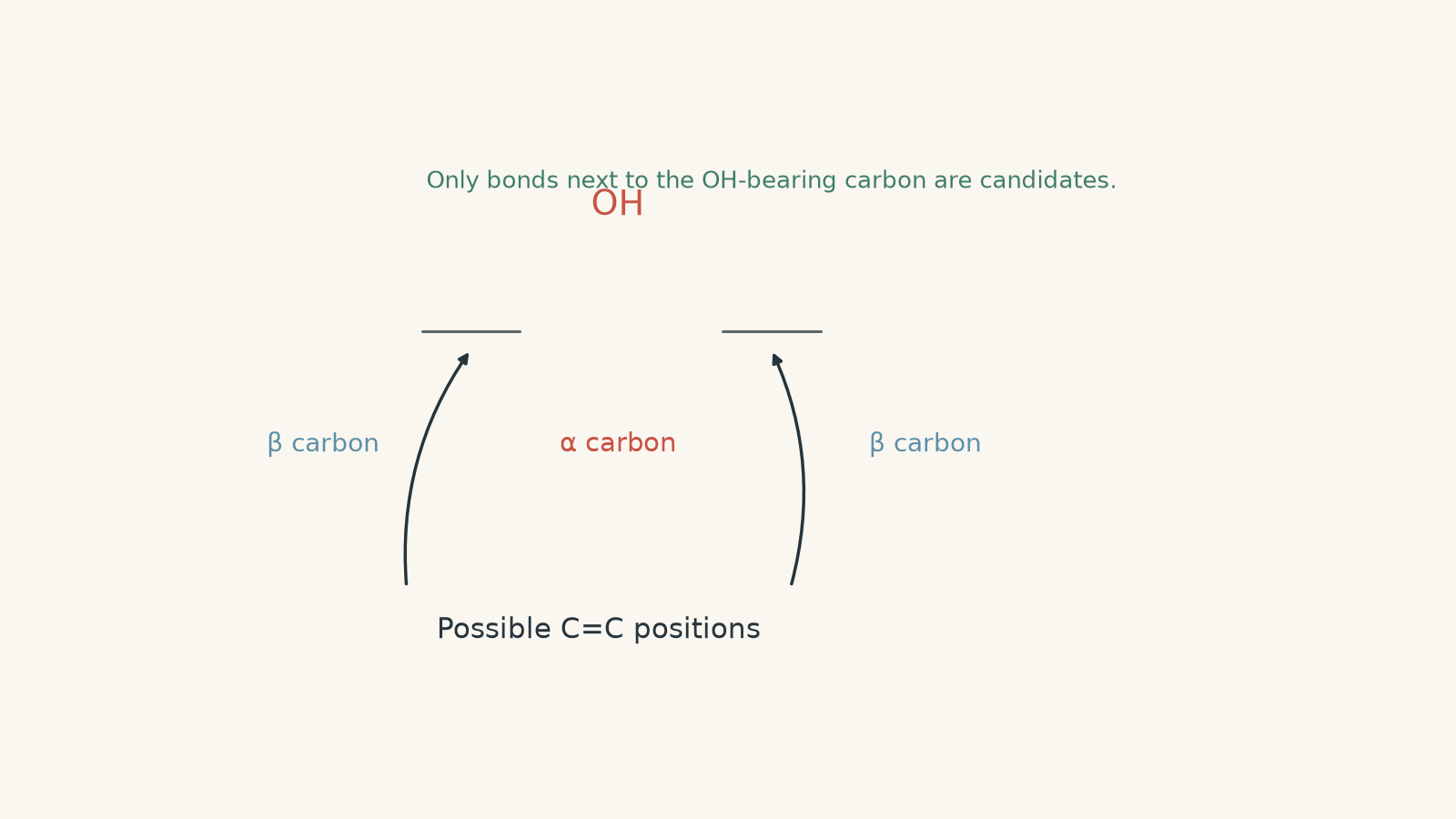
A useful name for the \(\ce{-OH}\)-bearing carbon is the alpha carbon. A carbon directly beside it is a beta carbon. You do not need those labels to solve the reaction, but they make the rule much easier to discuss.
Think of the carbon chain as seats in a row. The alpha carbon can only form the new double bond with someone sitting directly beside it. It cannot reach two seats away. The analogy stops there, of course: the actual reaction is controlled by electrons and an acid catalyst, not by carbon atoms deciding who to sit with.
02Why sulfuric acid and heat are needed
A tempting picture is that the \(\ce{-OH}\) group simply falls off the alcohol. It does not.
The \(\ce{-OH}\) group is a poor leaving group on its own. In an acidic mixture, the oxygen can gain a proton, making it much easier for water to leave. The remaining bond changes then produce the carbon-carbon double bond.
At HSC level, the important overall idea is:
\[
\ce{C-C-OH ->[\text{acid and heat}] C=C + H2O}
\]
The exact step-by-step mechanism depends on the structure of the alcohol, so the simple instruction to “remove \(\ce{H}\) and \(\ce{OH}\)” is bookkeeping rather than a literal description of one elementary step.
This is also different from the hydrogen bonding that gives alcohols their unusual physical properties. Hydrogen bonding is an intermolecular attraction; dehydration changes covalent bonds inside the molecule. If those ideas are getting mixed together, review intermolecular bonding in alcohols separately.
For an exam response, if the question asks for the conditions, stating concentrated \(\ce{H2SO4}\) and heat is usually the important part. Do not write only “acid”. The conditions are part of the reaction.
03A reliable method for predicting the alkene products
Use the same sequence every time.
Step 1: Find the carbon carrying the OH group
Call this the alpha carbon.
Step 2: Inspect every carbon directly attached to it
These are the possible beta carbons.
Do not inspect the whole molecule. Only directly adjacent carbons matter for the first product prediction.
Step 3: Check whether each beta carbon has a hydrogen
A beta carbon must lose a hydrogen if a double bond is to form between it and the alpha carbon.
No beta hydrogen means no ordinary dehydration product on that side.
Step 4: Draw a double bond to each allowed beta carbon
Keep the carbon skeleton unchanged unless a question explicitly introduces a more advanced rearrangement.
Step 5: Remove duplicates
Two different-looking elimination choices can produce exactly the same alkene because the molecule is symmetrical.
Step 6: If a major product is required, compare the allowed products
For the common acid-catalysed dehydrations considered at HSC level, the more substituted alkene is generally favoured.
That means an internal alkene is often favoured over a terminal alkene.
This rule is sometimes summarised as Zaitsev’s rule. But the order matters: first determine which products are actually possible, then compare them. You cannot use “more substituted is favoured” to invent a double bond where there is no beta hydrogen.
| Situation | What to predict |
|---|---|
| Only one beta carbon has an H | One constitutional alkene product |
| Two different beta positions have H atoms | Potentially two different alkene products |
| Two beta positions are equivalent by symmetry | They give the same constitutional product |
| A neighbouring carbon has no H | No double bond can form towards that carbon by ordinary dehydration |
| Several alkenes are possible | The more substituted alkene is often the major product |
Worked example: Propan-1-ol has only one elimination direction
Dehydrate propan-1-ol using concentrated sulfuric acid and heat. Write the structural equation and name the alkene product.
Step 1
In propan-1-ol,
\[
\ce{CH3CH2CH2OH}
\]
the \(\ce{-OH}\) group is on an end carbon.
Step 2
There is only one beta carbon because the alpha carbon is at the end of the chain. That beta carbon contains hydrogen atoms.
Step 3
The only possible new double bond is between carbons 1 and 2.
With concentrated \(\ce{H2SO4}\) and heat:
\[
\ce{CH3CH2CH2OH -> CH3CH=CH2 + H2O}
\]
The alkene is propene.
There is no second constitutional alkene to consider. A double bond between carbons 2 and 3 would require the \(\ce{-OH}\)-bearing carbon to somehow disappear from the elimination step, which is not what dehydration does.
Worked example: Butan-2-ol can eliminate in two directions
Butan-2-ol is heated with concentrated sulfuric acid. Predict the constitutional alkene products and identify the expected major product.
Step 1
Butan-2-ol is:
\[
\ce{CH3CH(OH)CH2CH3}
\]
The alpha carbon is carbon 2.
Step 2
Carbon 1 contains hydrogens, so a double bond can form between carbons 1 and 2.
Carbon 3 also contains hydrogens, so a double bond can form between carbons 2 and 3.
Step 3
Elimination towards carbon 1 gives:
\[
\ce{CH3CH(OH)CH2CH3 -> CH2=CHCH2CH3 + H2O}
\]
This product is but-1-ene.
Step 4
Elimination towards carbon 3 gives:
\[
\ce{CH3CH(OH)CH2CH3 -> CH3CH=CHCH3 + H2O}
\]
This product is but-2-ene.
Step 5
But-2-ene has the more substituted, internal double bond. Under the usual acid-catalysed dehydration conditions, it is therefore expected to be favoured over but-1-ene.
So the products are but-1-ene and but-2-ene, with but-2-ene expected to be the major constitutional product.
If a question is only asking for constitutional products, do not count the geometric forms of but-2-ene as different double-bond positions. Geometric isomerism is an extra layer, not a third place where elimination occurred.
04The mistakes that cause most wrong product predictions
Removing the hydrogen from the OH group
You might reason that water contains two hydrogens and one oxygen, so perhaps the alcohol simply loses its \(\ce{-OH}\) and the hydrogen already attached to that oxygen.
That does not produce the required carbon-carbon double bond.
For the product-prediction model, the crucial hydrogen is on a beta carbon. Removing that hydrogen allows a second bond to form between the alpha and beta carbons.
Moving the double bond wherever it looks most stable
The “more substituted alkene” rule only chooses between products that can actually form.
You must first check adjacency and beta hydrogens.
The safe order is:
- generate allowed products,
- remove duplicates,
- only then decide which is likely to be major.
Assuming every neighbouring carbon gives a different product
Symmetry can make two elimination directions equivalent.
If the left and right sides of the alcohol are chemically identical, eliminating towards either side may produce the same alkene after correct naming.
Forgetting the water
A complete dehydration equation needs both the alkene and \(\ce{H2O}\).
For example:
\[
\ce{CH3CH2OH -> CH2=CH2 + H2O}
\]
Check the atoms. Both sides contain two carbon atoms, six hydrogen atoms in total, and one oxygen atom.
That atom check is a quick way to catch a missing water molecule.
05Questions and solutions
Question 1
Ethanol is heated with concentrated sulfuric acid.
a. Name the organic product.
b. Write a balanced structural equation.
c. State the type of organic reaction occurring.
Solution 1
The organic product is ethene, and the reaction is a dehydration elimination reaction.
Ethanol has the structure:
\[
\ce{CH3CH2OH}
\]
The carbon carrying \(\ce{-OH}\) has only one neighbouring carbon. That neighbouring carbon contains hydrogens, so there is only one possible position for the new double bond.
With concentrated \(\ce{H2SO4}\) and heat:
\[
\ce{CH3CH2OH -> CH2=CH2 + H2O}
\]
The equation is balanced: both sides contain two carbon atoms, six hydrogen atoms in total, and one oxygen atom.
The tempting mistake is to describe this merely as “removing an OH group”. Dehydration removes the elements of water and forms a new \(\ce{C=C}\) bond, so it is an elimination reaction.
Question 2
A student heats \(8.80\ \mathrm{g}\) of pentan-2-ol with concentrated sulfuric acid.
a. Predict the constitutional alkene products and identify the expected major product.
b. The total isolated yield of alkene products is \(75.0\%\). Calculate the total mass of alkene mixture collected.
Use the molar masses \(M(\ce{C5H12O}) = 88.15\ \mathrm{g\,mol^{-1}}\) and \(M(\ce{C5H10}) = 70.13\ \mathrm{g\,mol^{-1}}\).
Assume one mole of alcohol undergoing dehydration produces one mole of alkene.
Solution 2
The alkene products are pent-1-ene and pent-2-ene, pent-2-ene is expected to be the major constitutional product, and the total isolated alkene mass is approximately \(5.25\ \mathrm{g}\).
Pentan-2-ol is:
\[
\ce{CH3CH(OH)CH2CH2CH3}
\]
The alpha carbon is carbon 2.
Removing a beta hydrogen from carbon 1 gives pent-1-ene:
\[
\ce{CH3CH(OH)CH2CH2CH3 -> CH2=CHCH2CH2CH3 + H2O}
\]
Removing a beta hydrogen from carbon 3 gives pent-2-ene:
\[
\ce{CH3CH(OH)CH2CH2CH3 -> CH3CH=CHCH2CH3 + H2O}
\]
Pent-2-ene has the more substituted internal double bond, so it is expected to be favoured.
For the mass calculation, first find the amount of pentan-2-ol:
\[
n(\text{alcohol})
=
\frac{m}{M}
=
\frac{8.80\ \mathrm{g}}{88.15\ \mathrm{g\,mol^{-1}}}
=
0.0998\ \mathrm{mol}
\]
Each dehydration pathway has the same overall mole ratio:
\[
1\ \mathrm{mol\ alcohol}:1\ \mathrm{mol\ alkene}
\]
It does not matter that two positional alkene products form because both have the molecular formula \(\ce{C5H10}\).
The theoretical total alkene mass is therefore:
\[
\begin{aligned}
m_{\text{theoretical}}
&= nM \\
&=(0.0998\ \mathrm{mol})(70.13\ \mathrm{g\,mol^{-1}})\\
&=7.00\ \mathrm{g}
\end{aligned}
\]
At a \(75.0\%\) isolated yield:
\[
m_{\text{actual}}
=
7.00\ \mathrm{g}\times 0.750
=
5.25\ \mathrm{g}
\]
So approximately \(5.25\ \mathrm{g}\) of the alkene mixture is collected.
The trap is thinking that the product mixture ruins the stoichiometry. It does not. Both pent-1-ene and pent-2-ene contain five carbons and have the same molar mass, and either pathway produces one mole of alkene per mole of alcohol.
Question 3
2-methylbutan-2-ol is dehydrated using concentrated sulfuric acid and heat.
Its condensed structural formula is:
\[
\ce{CH3C(OH)(CH3)CH2CH3}
\]
a. Predict all distinct constitutional alkene products.
b. Identify the expected major product.
c. Explain why the three carbon groups attached directly to the \(\ce{-OH}\)-bearing carbon do not produce three different alkene products.
Solution 3
The two distinct products are 2-methylbut-1-ene and 2-methylbut-2-ene, with 2-methylbut-2-ene expected to be the major product.
The alpha carbon is the carbon carrying \(\ce{-OH}\):
\[
\ce{CH3-C(OH)(CH3)-CH2-CH3}
\]
It is bonded to three beta carbons:
- one \(\ce{CH3}\) group on the left,
- another \(\ce{CH3}\) group attached as a branch,
- one \(\ce{CH2}\) group on the right.
All three beta carbons contain hydrogen, but that does not automatically mean three products.
Elimination towards either of the two methyl groups gives the same connectivity because those two methyl groups are equivalent:
\[
\ce{CH2=C(CH3)CH2CH3}
\]
This is 2-methylbut-1-ene.
Elimination towards the \(\ce{CH2}\) group gives:
\[
\ce{CH3C(CH3)=CHCH3}
\]
This is 2-methylbut-2-ene.
The second alkene has the more substituted double bond and is therefore expected to be the major product under the usual HSC dehydration model.
The tempting route is to count beta carbons instead of counting distinct products. There are three beta carbons with hydrogens, but two are related by symmetry. Different elimination events can therefore lead to the same alkene.
A reliable product count must include both the beta-hydrogen test and a symmetry check.
Question 4
Under the standard HSC product-prediction model, assume that the carbon skeleton does not rearrange.
Consider 3,3-dimethylbutan-2-ol:
\[
\ce{CH3CH(OH)C(CH3)2CH3}
\]
A student argues:
“The most substituted double bond would be between carbons 2 and 3, so that should be the major dehydration product.”
Determine the allowed constitutional alkene product or products. Then evaluate the student’s argument using beta hydrogens, carbon bonding, and the requirements of an elimination reaction.
Solution 4
Only 3,3-dimethylbut-1-ene is allowed in the stated HSC model; a double bond between carbons 2 and 3 cannot be formed by ordinary dehydration because carbon 3 has no beta hydrogen.
Start at the alpha carbon, carbon 2:
\[
\ce{CH3-CH(OH)-C(CH3)2-CH3}
\]
It has two neighbouring carbons.
Carbon 1 is a \(\ce{CH3}\) group, so it contains beta hydrogens. Elimination towards carbon 1 is possible:
\[
\ce{CH3CH(OH)C(CH3)2CH3 -> CH2=CHC(CH3)2CH3 + H2O}
\]
The product is 3,3-dimethylbut-1-ene.
Now inspect carbon 3. It is bonded to:
- carbon 2,
- one carbon in the main-chain \(\ce{CH3}\) group,
- one methyl branch,
- another methyl branch.
Carbon 3 therefore already has four carbon-carbon single bonds and carries no hydrogen.
For a \(\ce{C2=C3}\) double bond to form by the ordinary dehydration rule, carbon 3 would need to supply a beta hydrogen. It has none.
Simply drawing another bond between carbons 2 and 3 while keeping all of carbon 3’s existing bonds would also give that carbon too many bonds. Carbon cannot keep four single bonds and gain an additional bond to carbon 2 without some other change to the skeleton.
The student’s stability argument has therefore been applied in the wrong order.
The correct logic is:
- determine which elimination pathways satisfy the beta-hydrogen requirement,
- draw the allowed products,
- only if more than one allowed product remains, compare their relative stability.
“More substituted is favoured” is not a rule that overrides carbon valency or creates a missing beta hydrogen.
In more advanced organic chemistry, some acid-catalysed reactions can involve carbon-skeleton rearrangements. That is a separate mechanistic issue. Under the stated HSC no-rearrangement model, you should not invent one simply to produce a more substituted alkene.
Question 5
An unknown saturated, acyclic, unbranched alcohol \(A\) has molecular formula \(\ce{C5H12O}\).
When \(A\) is heated with concentrated sulfuric acid, pent-2-ene is the most abundant constitutional alkene in the product mixture.
A separate portion of the entire alkene mixture is completely hydrogenated. The only alkane obtained is pentane.
A student concludes:
“The alcohol must have been pentan-3-ol because pentan-3-ol dehydrates to pent-2-ene.”
Using the standard HSC assumptions of no carbon-skeleton rearrangement and ignoring geometric isomers:
a. Is the student’s conclusion justified?
b. Identify every unbranched alcohol consistent with all the observations.
c. Explain why the hydrogenation result appears useful but does not distinguish the possibilities.
d. State one observation of the original dehydration mixture that would allow the alcohol to be identified.
Solution 5
No. The evidence does not uniquely identify \(A\); both pentan-2-ol and pentan-3-ol are consistent with the observations.
There are three unbranched alcohols with the required five-carbon skeleton that need to be considered:
- pentan-1-ol,
- pentan-2-ol,
- pentan-3-ol.
Start with pentan-1-ol:
\[
\ce{CH3CH2CH2CH2CH2OH}
\]
The \(\ce{-OH}\)-bearing carbon is at the end of the chain, so there is only one beta carbon. Its dehydration gives pent-1-ene.
Under the stated HSC model, pentan-1-ol therefore does not explain pent-2-ene being the most abundant product.
Now consider pentan-2-ol:
\[
\ce{CH3CH(OH)CH2CH2CH3}
\]
It can eliminate towards either adjacent carbon, giving pent-1-ene and pent-2-ene.
Pent-2-ene is the more substituted alkene and is expected to be the major constitutional product. Pentan-2-ol is therefore consistent with the observation.
Now consider pentan-3-ol:
\[
\ce{CH3CH2CH(OH)CH2CH3}
\]
The two sides of the molecule are symmetrical. Eliminating towards the left or the right produces the same constitutional alkene:
\[
\ce{CH3CH=CHCH2CH3}
\]
So pentan-3-ol gives pent-2-ene as its only constitutional alkene product in this model.
It is also consistent with the observation.
The hydrogenation evidence does not separate these two possibilities because both pent-1-ene and pent-2-ene hydrogenate to the same alkane:
\[
\ce{C5H10 + H2 -> C5H12}
\]
More specifically,
\[
\ce{CH2=CHCH2CH2CH3 + H2 -> CH3CH2CH2CH2CH3}
\]
and
\[
\ce{CH3CH=CHCH2CH3 + H2 -> CH3CH2CH2CH2CH3}
\]
Both products become pentane because hydrogenation removes information about where the double bond had been. It tells us the carbon skeleton, but not the original alkene position.
That is the hinge in the problem. Two experimental observations have been supplied, but they are not necessarily two independent pieces of identifying information.
An analysis of the original dehydration mixture would settle the identity:
- if pent-1-ene is also present, \(A\) is pentan-2-ol;
- if pent-2-ene is the only constitutional pentene product, \(A\) is pentan-3-ol.
The tempting conclusion was to work backwards from the major product as though every alkene had only one possible alcohol precursor. Dehydration is not always uniquely reversible from a major product alone. Different alcohols can lead to the same alkene, so the full product pattern matters.
06What dehydration lets you predict next
Once you can track where the \(\ce{C=C}\) bond forms, alkene reactions become much easier to organise.
Dehydration converts an alcohol functional group into an alkene. The next useful question is almost the reverse one: what happens when atoms are added across that new double bond?
That leads directly into alkene addition reactions, including hydration. It also gives you a stronger way to solve reaction-pathway questions: instead of memorising isolated equations, track which carbon atoms keep their connections, which functional group changes, and what new bond must appear.