
Amphiprotic Salts and Ionic Equations | HSC Chemistry
Learn how amphiprotic ions can act as both acids and bases, using hydrogen carbonate and dihydrogen phosphate as HSC Chemistry examples.
A salt such as sodium hydrogen carbonate, \(\ce{NaHCO3}\), seems awkward in acid-base chemistry. It contains no obvious \(\mathrm{H}^{+}\) like hydrochloric acid, and no \(\ce{OH-}\) like sodium hydroxide. Yet when it dissolves, the hydrogen carbonate ion can behave as either an acid or a base.
Before reading on, predict what \(\ce{HCO3-}\) should do in water. It still has a hydrogen, so perhaps it can donate a proton. But it also carries a negative charge, so perhaps it can accept one. Both predictions are correct. That ability to move in either direction is amphiprotic behaviour.
The important HSC skill is not just recognising the word. You need to look at an ion, decide whether it can donate and accept a proton, and write the correct ionic equations without dragging spectator ions into the chemistry.
01The problem: one ion, two possible proton transfers
Consider sodium hydrogen carbonate dissolving in water:
\[ \ce{NaHCO3(s) -> Na+(aq) + HCO3-(aq)} \]
The \(\mathrm{Na}^{+}\) ion is not doing the acid-base chemistry. It is a spectator ion. The interesting species is \(\ce{HCO3-}\).
Now imagine a proton as something \(\ce{HCO3-}\) can either give away or take.
If \(\ce{HCO3-}\) loses \(\mathrm{H}^{+}\), what remains?
\[ \ce{HCO3- -> CO3^2- + H+} \]
So \(\ce{HCO3-}\) can act as an acid.
But \(\ce{HCO3-}\) can also gain \(\mathrm{H}^{+}\):
\[ \ce{HCO3- + H+ -> H2CO3} \]
So it can act as a base as well.
A species that can both donate and accept a proton is called amphiprotic.
That definition is useful, but the picture matters more: an amphiprotic species sits between two related species in a chain. It can move one step in either direction by transferring one proton.
For hydrogen carbonate:
\[ \ce{H2CO3 <=> HCO3- <=> CO3^2-} \]
Moving left means gaining a proton. Moving right means losing one.
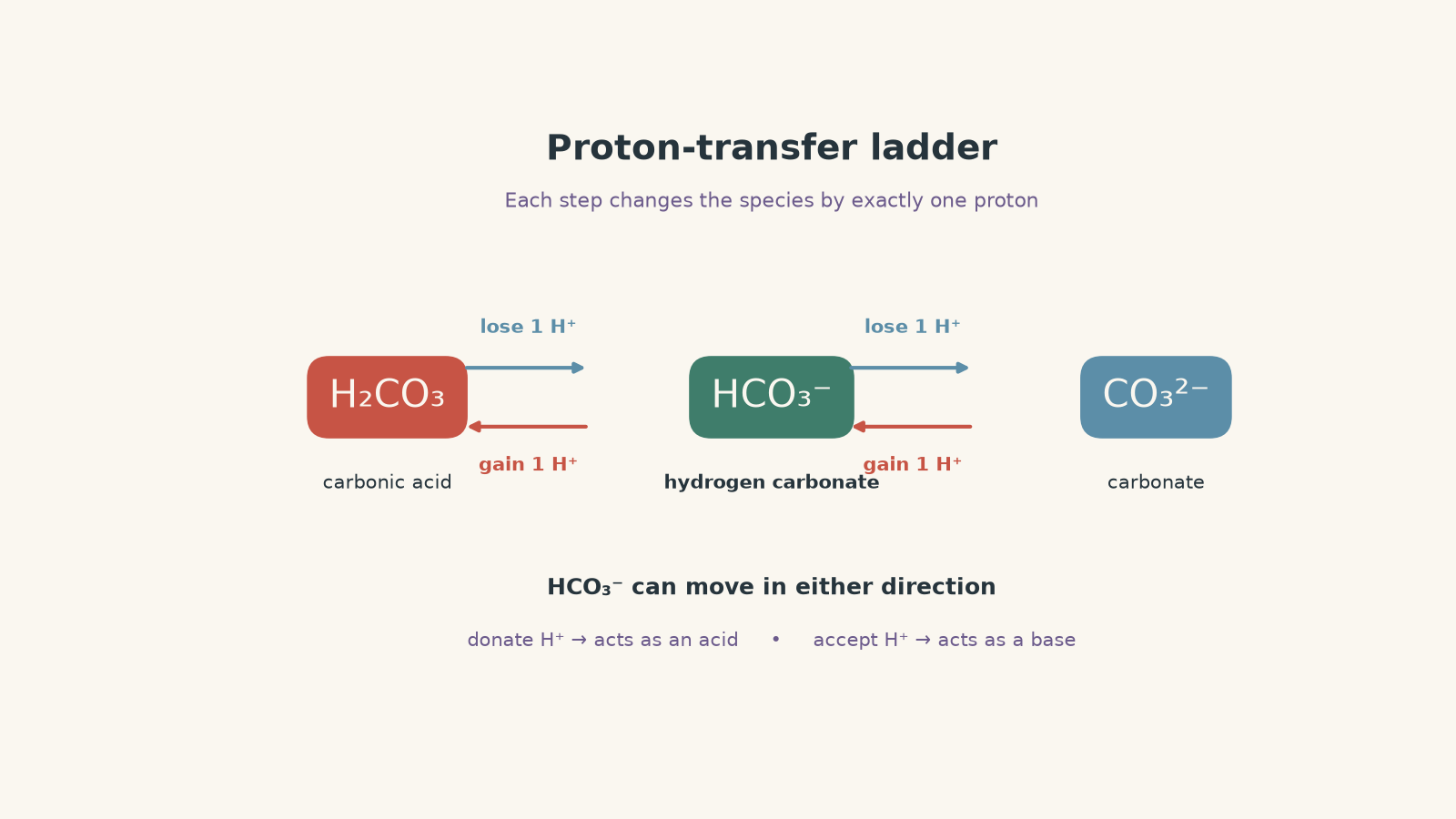
This is closely connected to conjugate acid-base pairs: species next to one another in the chain differ by exactly one proton.
02Amphiprotic does not mean “contains hydrogen”
This is the first trap.
A student might reason:
“If an ion contains hydrogen, it must be able to donate \(\mathrm{H}^{+}\), so it must be amphiprotic.”
Not necessarily.
To be amphiprotic, a species must be able to do both jobs:
- donate a proton, and
- accept a proton.
For example, \(\ce{HSO4-}\) can in principle donate a proton to form \(\ce{SO4^2-}\), and accept one to form \(\ce{H2SO4}\), so it is amphiprotic.
By contrast, \(\ce{NH4+}\) can donate a proton:
\[ \ce{NH4+ -> NH3 + H+} \]
but in ordinary HSC acid-base chemistry we do not treat \(\ce{NH4+}\) as accepting another proton to form a meaningful conjugate acid. It behaves as an acid, not as an amphiprotic species.
Likewise, \(\ce{CO3^2-}\) can accept a proton to become \(\ce{HCO3-}\), but it has no proton available to donate. It behaves as a base.
A quick decision rule is:
| Species | Can lose \(\mathrm{H}^{+}\)? | Can gain \(\mathrm{H}^{+}\)? | Amphiprotic? |
|---|---|---|---|
| \(\ce{HCO3-}\) | Yes, to \(\ce{CO3^2-}\) | Yes, to \(\ce{H2CO3}\) | Yes |
| \(\ce{H2PO4-}\) | Yes, to \(\ce{HPO4^2-}\) | Yes, to \(\ce{H3PO4}\) | Yes |
| \(\ce{CO3^2-}\) | No | Yes | No |
| \(\ce{NH4+}\) | Yes | No, in this course context | No |
There is a useful, slightly silly way to picture this. An amphiprotic ion is like someone standing between two people in a very awkward group chat. It can pass a proton to one side or accept one from the other.
The analogy breaks because chemical proton transfer is not a deliberate choice. Both reactions are governed by equilibrium and the relative strengths of the acids and bases involved.
03Writing the equations with water
In aqueous solution, do not normally write a free \(\mathrm{H}^{+}\) floating by itself. A donated proton is transferred to water, forming \(\ce{H3O+}\). If water donates a proton, it forms \(\ce{OH-}\).
That gives us the two general patterns.
When an amphiprotic species acts as an acid:
\[ \ce{HA- + H2O <=> A^2- + H3O+} \]
Here, \(\ce{HA-}\) donates a proton to water.
When the same species acts as a base:
\[ \ce{HA- + H2O <=> H2A + OH-} \]
Here, \(\ce{HA-}\) accepts a proton from water.
Notice that water changes roles too. In the first reaction water accepts \(\mathrm{H}^{+}\), so water is acting as a base. In the second reaction water donates \(\mathrm{H}^{+}\), so water is acting as an acid.
This is Brønsted-Lowry acid-base chemistry: an acid donates a proton, while a base accepts one.
04Sodium hydrogen carbonate: \(\ce{NaHCO3}\)
Sodium hydrogen carbonate first dissociates:
\[ \ce{NaHCO3(s) -> Na+(aq) + HCO3-(aq)} \]
The sodium ion remains a spectator. You therefore write the acid-base equations using \(\ce{HCO3-}\), not the complete salt.
When \(\ce{HCO3-}\) acts as an acid
Hydrogen carbonate donates one proton to water:
\[ \ce{HCO3-(aq) + H2O(l) <=> CO3^2-(aq) + H3O+(aq)} \]
Check the chemistry by tracking the proton.
- \(\ce{HCO3-}\) loses \(\mathrm{H}^{+}\) and becomes \(\ce{CO3^2-}\).
- \(\ce{H2O}\) gains \(\mathrm{H}^{+}\) and becomes \(\ce{H3O+}\).
The conjugate pairs are therefore:
\[ \ce{HCO3- / CO3^2-} \]
and
\[ \ce{H3O+ / H2O} \]
When \(\ce{HCO3-}\) acts as a base
This time hydrogen carbonate accepts a proton from water:
\[ \ce{HCO3-(aq) + H2O(l) <=> H2CO3(aq) + OH-(aq)} \]
Now:
- \(\ce{HCO3-}\) gains \(\mathrm{H}^{+}\) and becomes \(\ce{H2CO3}\).
- \(\ce{H2O}\) loses \(\mathrm{H}^{+}\) and becomes \(\ce{OH-}\).
The conjugate pairs are:
\[ \ce{H2CO3 / HCO3-} \]
and
\[ \ce{H2O / OH-} \]
These two equations are the evidence that \(\ce{HCO3-}\) is amphiprotic.
Worked example: Write both acid-base equations for sodium hydrogen carbonate
Sodium hydrogen carbonate dissolves in water. Write an ionic equation showing the hydrogen carbonate ion acting as an acid, and another showing it acting as a base.
Step 1
\[ \ce{NaHCO3(s) -> Na+(aq) + HCO3-(aq)} \]
The \(\mathrm{Na}^{+}\) ion is a spectator, so the acid-base equations involve \(\ce{HCO3-}\).
Step 2
Removing \(\mathrm{H}^{+}\) gives \(\ce{CO3^2-}\). Water accepts the proton and becomes \(\ce{H3O+}\):
\[ \ce{HCO3-(aq) + H2O(l) <=> CO3^2-(aq) + H3O+(aq)} \]
Step 3
Adding \(\mathrm{H}^{+}\) gives \(\ce{H2CO3}\). Water supplies that proton and becomes \(\ce{OH-}\):
\[ \ce{HCO3-(aq) + H2O(l) <=> H2CO3(aq) + OH-(aq)} \]
Step 4
For the acidic reaction, the total charge is \(-1\) on both sides:
\[ -1 = -2 + 1 \]
For the basic reaction, the total charge is also \(-1\) on both sides.
The two balanced reactions show that hydrogen carbonate can donate or accept a proton.
05Potassium dihydrogen phosphate: \(\ce{KH2PO4}\)
The same method works for potassium dihydrogen phosphate.
First, dissociation:
\[ \ce{KH2PO4(s) -> K+(aq) + H2PO4-(aq)} \]
Again, \(\mathrm{K}^{+}\) is a spectator ion. The acid-base species is \(\ce{H2PO4-}\).
It lies in the phosphate proton-transfer sequence:
\[ \ce{H3PO4 <=> H2PO4- <=> HPO4^2- <=> PO4^3-} \]
Because \(\ce{H2PO4-}\) has a species on either side of it, it can move in either direction through proton transfer.
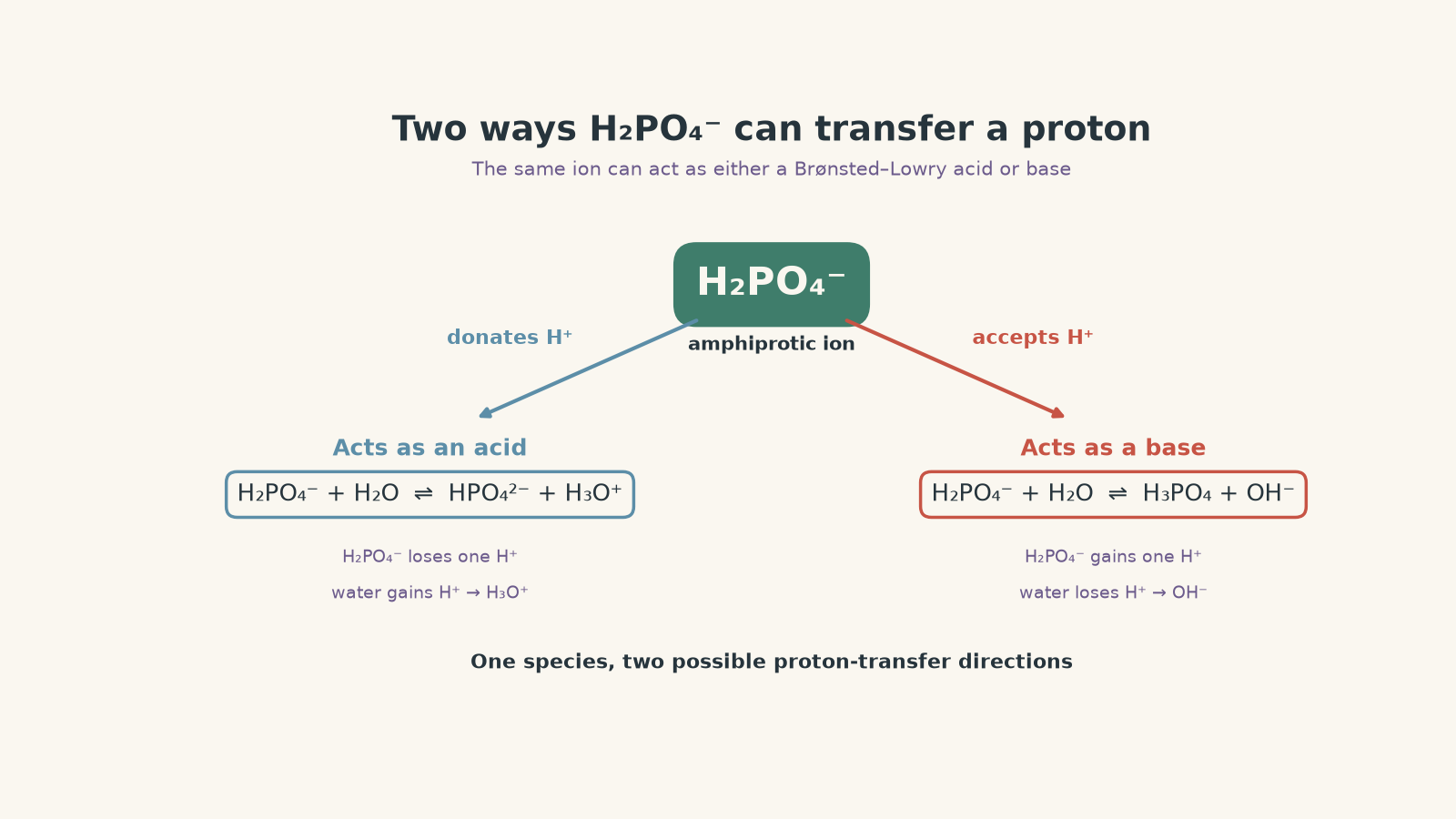
\(\ce{H2PO4-}\) acting as an acid
It donates one proton:
\[ \ce{H2PO4-(aq) + H2O(l) <=> HPO4^2-(aq) + H3O+(aq)} \]
The \(\ce{H2PO4-}\) ion is the acid because it donates \(\mathrm{H}^{+}\).
\(\ce{H2PO4-}\) acting as a base
It accepts one proton:
\[ \ce{H2PO4-(aq) + H2O(l) <=> H3PO4(aq) + OH-(aq)} \]
Here, \(\ce{H2PO4-}\) is the base because it accepts \(\mathrm{H}^{+}\).
So \(\ce{H2PO4-}\), like \(\ce{HCO3-}\), is amphiprotic.
06Amphiprotic does not mean neutral
This is the most important misconception after learning the equations.
You might predict that if an ion can act as both an acid and a base, the two behaviours must cancel and give pH 7.
They do not have to.
“Amphiprotic” tells you what reactions are possible. It does not tell you that the two reactions occur to the same extent.
One direction may be much more favourable than the other.
This is why aqueous sodium hydrogen carbonate is mildly basic, while potassium dihydrogen phosphate produces an acidic solution.
The difference comes from acid and base strength.
If you need a refresher on how strength relates to \(K_a\), \(K_b\), and pH, see pH and Acid-Base Strength.
07Which behaviour dominates?
We can compare the equilibrium constants for the two possible reactions.
Take \(\ce{HCO3-}\).
Its acidic reaction is:
\[ \ce{HCO3- + H2O <=> CO3^2- + H3O+} \]
The equilibrium constant for this reaction is the second acid dissociation constant of carbonic acid, approximately
\[ K_a \approx 4.7 \times 10^{-11} \]
at \(25^\circ\text{C}\).
Its basic reaction is:
\[ \ce{HCO3- + H2O <=> H2CO3 + OH-} \]
For a conjugate acid-base pair,
\[ K_aK_b=K_w \]
where \(K_w = 1.0\times10^{-14}\) at \(25^\circ\text{C}\).
For the pair \(\ce{H2CO3/HCO3-}\), taking \(K_a \approx 4.3\times10^{-7}\):
\[ K_b=\frac{K_w}{K_a} =\frac{1.0\times10^{-14}}{4.3\times10^{-7}} \approx2.3\times10^{-8} \]
Compare the two possibilities:
\[ K_b(\ce{HCO3-})\approx2.3\times10^{-8} \]
\[ K_a(\ce{HCO3-})\approx4.7\times10^{-11} \]
The basic reaction has the larger equilibrium constant. That is why hydrogen carbonate behaves predominantly as a base in water, even though it is amphiprotic.
Do not turn this into the rule “negative amphiprotic ions are basic”. \(\ce{H2PO4-}\) is also negatively charged, yet its acidic behaviour dominates.
Worked example: Decide whether \(\ce{H2PO4-}\) behaves mainly as an acid or a base
At \(25^\circ\text{C}\), suppose the relevant acid dissociation constants of phosphoric acid are
\[ K_{a1}=7.1\times10^{-3} \]
and
\[ K_{a2}=6.3\times10^{-8} \]
Determine whether \(\ce{H2PO4-}\) behaves mainly as an acid or mainly as a base in water. Write both ionic equations.
Step 1
It loses one proton:
\[ \ce{H2PO4-(aq) + H2O(l) <=> HPO4^2-(aq) + H3O+(aq)} \]
For this reaction,
\[ K_a=K_{a2}=6.3\times10^{-8} \]
Step 2
It gains one proton:
\[ \ce{H2PO4-(aq) + H2O(l) <=> H3PO4(aq) + OH-(aq)} \]
Its conjugate acid is \(\ce{H3PO4}\), whose first dissociation has \(K_{a1}=7.1\times10^{-3}\).
Therefore,
\[ K_b=\frac{K_w}{K_{a1}} =\frac{1.0\times10^{-14}}{7.1\times10^{-3}} =1.4\times10^{-12} \]
Step 3
\[ 6.3\times10^{-8} > 1.4\times10^{-12} \]
The proton-donating reaction is therefore much more favourable than the proton-accepting reaction.
Step 4
\(\ce{H2PO4-}\) is amphiprotic because both proton transfers are possible, but it behaves predominantly as an acid in water. A solution of \(\ce{KH2PO4}\) is therefore acidic rather than neutral.
08A reliable method for HSC ionic equations
When you meet a salt containing a possible amphiprotic ion, work through the chemistry in this order.
First, dissociate the soluble salt. For example:
\[ \ce{KH2PO4 -> K+ + H2PO4-} \]
Then ignore any spectator ion such as \(\mathrm{K}^{+}\) or \(\mathrm{Na}^{+}\).
Next, ask two separate questions about the remaining ion:
- What species forms if it loses exactly one \(\mathrm{H}^{+}\)?
- What species forms if it gains exactly one \(\mathrm{H}^{+}\)?
Finally, insert water so the proton has somewhere to go or somewhere to come from.
If the ion donates a proton:
\[ \ce{amphiprotic\ species + H2O <=> conjugate\ base + H3O+} \]
If the ion accepts a proton:
\[ \ce{amphiprotic\ species + H2O <=> conjugate\ acid + OH-} \]
Then check atoms and total charge.
That final charge check catches a lot of mistakes. For example, if you incorrectly wrote
\[ \ce{HCO3- + H2O -> CO3- + H3O+} \]
the carbon and hydrogen counts might look plausible at a glance, but carbonate is \(\ce{CO3^2-}\), not \(\ce{CO3-}\). Charge conservation exposes the error immediately.
09Why the metal ion disappears from the ionic equation
Students sometimes worry that omitting \(\mathrm{Na}^{+}\) or \(\mathrm{K}^{+}\) makes the equation incomplete.
It does not. A net ionic equation deliberately removes ions that do not undergo the chemical change being described.
For sodium hydrogen carbonate, you could imagine \(\mathrm{Na}^{+}\) sitting in the solution before and after proton transfer. It has not gained a proton, lost a proton, precipitated, oxidised, or reduced.
It is present physically, but irrelevant to this particular reaction.
That distinction between “present in the beaker” and “participating in the net reaction” is worth keeping. It appears again in precipitation, redox, and equilibrium equations.
10Questions and solutions
Question 1
A solution is prepared by dissolving sodium hydrogen carbonate, \(\ce{NaHCO3}\), in water.
Write:
a. the dissociation equation for the salt,
b. an ionic equation showing \(\ce{HCO3-}\) acting as a Brønsted-Lowry acid, and
c. an ionic equation showing \(\ce{HCO3-}\) acting as a Brønsted-Lowry base.
Solution 1
\(\ce{HCO3-}\) is amphiprotic: it can donate a proton to form \(\ce{CO3^2-}\), or accept a proton to form \(\ce{H2CO3}\).
For part a, sodium hydrogen carbonate dissociates as:
\[ \ce{NaHCO3(s) -> Na+(aq) + HCO3-(aq)} \]
For part b, \(\ce{HCO3-}\) acts as an acid by donating \(\mathrm{H}^{+}\) to water:
\[ \ce{HCO3-(aq) + H2O(l) <=> CO3^2-(aq) + H3O+(aq)} \]
The hydrogen carbonate ion becomes its conjugate base, \(\ce{CO3^2-}\).
For part c, \(\ce{HCO3-}\) acts as a base by accepting \(\mathrm{H}^{+}\) from water:
\[ \ce{HCO3-(aq) + H2O(l) <=> H2CO3(aq) + OH-(aq)} \]
The tempting mistake is to include \(\mathrm{Na}^{+}\) in both acid-base equations. It is present in solution, but it is a spectator ion, so it does not appear in the net ionic equations.
Question 2
A student writes the following equation to demonstrate the amphiprotic behaviour of \(\ce{H2PO4-}\):
\[ \ce{H2PO4- + H2O <=> PO4^3- + H3O+} \]
Explain why this equation is incorrect, then write the correct equation for \(\ce{H2PO4-}\) acting as an acid and the correct equation for it acting as a base.
Solution 2
The equation is incorrect because one Brønsted-Lowry proton-transfer step must remove only one proton from \(\ce{H2PO4-}\), producing \(\ce{HPO4^2-}\), not \(\ce{PO4^3-}\).
The correct acidic reaction is:
\[ \ce{H2PO4-(aq) + H2O(l) <=> HPO4^2-(aq) + H3O+(aq)} \]
Here, \(\ce{H2PO4-}\) donates one proton.
The correct basic reaction is:
\[ \ce{H2PO4-(aq) + H2O(l) <=> H3PO4(aq) + OH-(aq)} \]
Here, \(\ce{H2PO4-}\) accepts one proton.
The student’s equation is tempting because \(\ce{PO4^3-}\) really is part of the phosphate acid-base system. The problem is that reaching it from \(\ce{H2PO4-}\) requires the loss of two protons:
\[ \ce{H2PO4- -> HPO4^2- -> PO4^3-} \]
Those are two separate proton-transfer steps, with \(\ce{HPO4^2-}\) as the intermediate species.
Question 3
At \(25^\circ\text{C}\), the following values apply approximately to the carbonic acid system:
\[ K_{a1}=4.3\times10^{-7} \]
\[ K_{a2}=4.7\times10^{-11} \]
A student argues:
“Because \(\ce{HCO3-}\) is amphiprotic, a solution of \(\ce{NaHCO3}\) should be neutral.”
Use equilibrium constants to assess this claim. Write the two relevant ionic equations and determine which behaviour of \(\ce{HCO3-}\) is stronger.
Solution 3
The solution is not expected to be neutral; \(\ce{HCO3-}\) is amphiprotic, but its basic behaviour is stronger than its acidic behaviour.
Its acidic reaction is:
\[ \ce{HCO3-(aq) + H2O(l) <=> CO3^2-(aq) + H3O+(aq)} \]
For this reaction,
\[ K_a=K_{a2}=4.7\times10^{-11} \]
Its basic reaction is:
\[ \ce{HCO3-(aq) + H2O(l) <=> H2CO3(aq) + OH-(aq)} \]
The relevant \(K_b\) comes from the conjugate pair \(\ce{H2CO3/HCO3-}\):
\[ K_b=\frac{K_w}{K_{a1}} \]
Using \(K_w=1.0\times10^{-14}\):
\[ K_b = \frac{1.0\times10^{-14}}{4.3\times10^{-7}} = 2.3\times10^{-8} \]
Now compare:
\[ K_b=2.3\times10^{-8} \]
\[ K_a=4.7\times10^{-11} \]
Since \(K_b\) is much larger than \(K_a\), the reaction producing \(\ce{OH-}\) is more favourable than the reaction producing \(\ce{H3O+}\).
Therefore, an aqueous sodium hydrogen carbonate solution is mildly basic.
The tempting argument confuses capability with equal tendency. “Amphiprotic” means both proton-transfer directions are possible; it does not mean their equilibrium constants are equal.
Question 4
Two unlabelled solutions contain equal concentrations of either \(\ce{NaHCO3}\) or \(\ce{KH2PO4}\).
The following equilibrium data are available at \(25^\circ\text{C}\):
For carbonic acid:
\[ K_{a1}=4.3\times10^{-7}, \qquad K_{a2}=4.7\times10^{-11} \]
For phosphoric acid:
\[ K_{a1}=7.1\times10^{-3}, \qquad K_{a2}=6.3\times10^{-8} \]
Without relying on memorised pH values:
a. determine which solution is acidic and which is basic,
b. write the pair of competing ionic equations for each amphiprotic ion, and
c. explain why simply comparing the negative charges on \(\ce{HCO3-}\) and \(\ce{H2PO4-}\) cannot answer the question.
Solution 4
The \(\ce{NaHCO3}\) solution is basic, while the \(\ce{KH2PO4}\) solution is acidic, because the competing acid and base equilibrium constants differ for the two amphiprotic ions.
For \(\ce{HCO3-}\), the acidic reaction is:
\[ \ce{HCO3- + H2O <=> CO3^2- + H3O+} \]
with
\[ K_a=4.7\times10^{-11} \]
Its basic reaction is:
\[ \ce{HCO3- + H2O <=> H2CO3 + OH-} \]
with
\[ K_b = \frac{1.0\times10^{-14}}{4.3\times10^{-7}} = 2.3\times10^{-8} \]
Since
\[ 2.3\times10^{-8}>4.7\times10^{-11} \]
basic behaviour dominates.
For \(\ce{H2PO4-}\), the acidic reaction is:
\[ \ce{H2PO4- + H2O <=> HPO4^2- + H3O+} \]
with
\[ K_a=6.3\times10^{-8} \]
Its basic reaction is:
\[ \ce{H2PO4- + H2O <=> H3PO4 + OH-} \]
with
\[ K_b = \frac{1.0\times10^{-14}}{7.1\times10^{-3}} = 1.4\times10^{-12} \]
Since
\[ 6.3\times10^{-8}>1.4\times10^{-12} \]
acidic behaviour dominates.
Both \(\ce{HCO3-}\) and \(\ce{H2PO4-}\) carry a charge of \(-1\), so charge alone cannot distinguish their behaviour. A negative charge may make proton acceptance seem plausible, but acid-base behaviour depends on the stability of the related conjugate species and therefore on the relevant equilibrium constants.
The red herring is the shared \(-1\) charge. These ions have different structures and different conjugate acids and bases, so they have very different tendencies to transfer a proton.
Question 5
A student makes the following generalisation:
“For any amphiprotic ion \(\ce{HA-}\), if its basic reaction in water is more favourable than its acidic reaction, adding a small amount of strong acid must permanently destroy its amphiprotic behaviour because it converts \(\ce{HA-}\) into \(\ce{H2A}\).”
Consider a solution initially containing \(\ce{HCO3-}\). A small amount of strong acid is added, but not enough to react with all of the \(\ce{HCO3-}\).
Assess the student’s claim. Explain the immediate proton-transfer reaction, identify the important species present afterwards, and determine whether the remaining solution can still exhibit both proton-donating and proton-accepting chemistry.
Solution 5
The student’s claim is incorrect: adding a limited amount of strong acid converts some \(\ce{HCO3-}\) into \(\ce{H2CO3}\), but it does not remove the amphiprotic behaviour of the \(\ce{HCO3-}\) that remains.
The added strong acid supplies \(\ce{H3O+}\). Hydrogen carbonate accepts a proton:
\[ \ce{HCO3-(aq) + H3O+(aq) -> H2CO3(aq) + H2O(l)} \]
Because the question states that the acid is insufficient to consume all the \(\ce{HCO3-}\), the solution afterwards contains both \(\ce{H2CO3}\) and unreacted \(\ce{HCO3-}\), along with spectator ions.
The remaining \(\ce{HCO3-}\) has not changed its chemical identity. It can still donate a proton:
\[ \ce{HCO3-(aq) + H2O(l) <=> CO3^2-(aq) + H3O+(aq)} \]
and it can still accept a proton:
\[ \ce{HCO3-(aq) + H2O(l) <=> H2CO3(aq) + OH-(aq)} \]
So its amphiprotic character remains.
There is an extra interaction here that makes the problem less obvious. Once \(\ce{H2CO3}\) and \(\ce{HCO3-}\) are present together, they form a conjugate acid-base pair. Added acid is opposed by proton acceptance from \(\ce{HCO3-}\), while added base can be opposed by proton donation from \(\ce{H2CO3}\).
The tempting route is to treat “amphiprotic” as a property of the whole original beaker. It is actually a property of the species \(\ce{HCO3-}\). Converting some of that species into its conjugate acid changes the composition and the equilibria of the solution, but any \(\ce{HCO3-}\) that remains is still capable of both proton-transfer roles.
That idea leads directly into buffer chemistry: once appreciable amounts of a weak acid and its conjugate base are present together, the solution can resist changes in pH when small amounts of strong acid or base are added.