
Intermolecular vs Intramolecular Forces in HSC Chemistry
Learn how to distinguish forces within molecules from forces between molecules, compare their strengths, and use them to explain boiling points and physical changes.
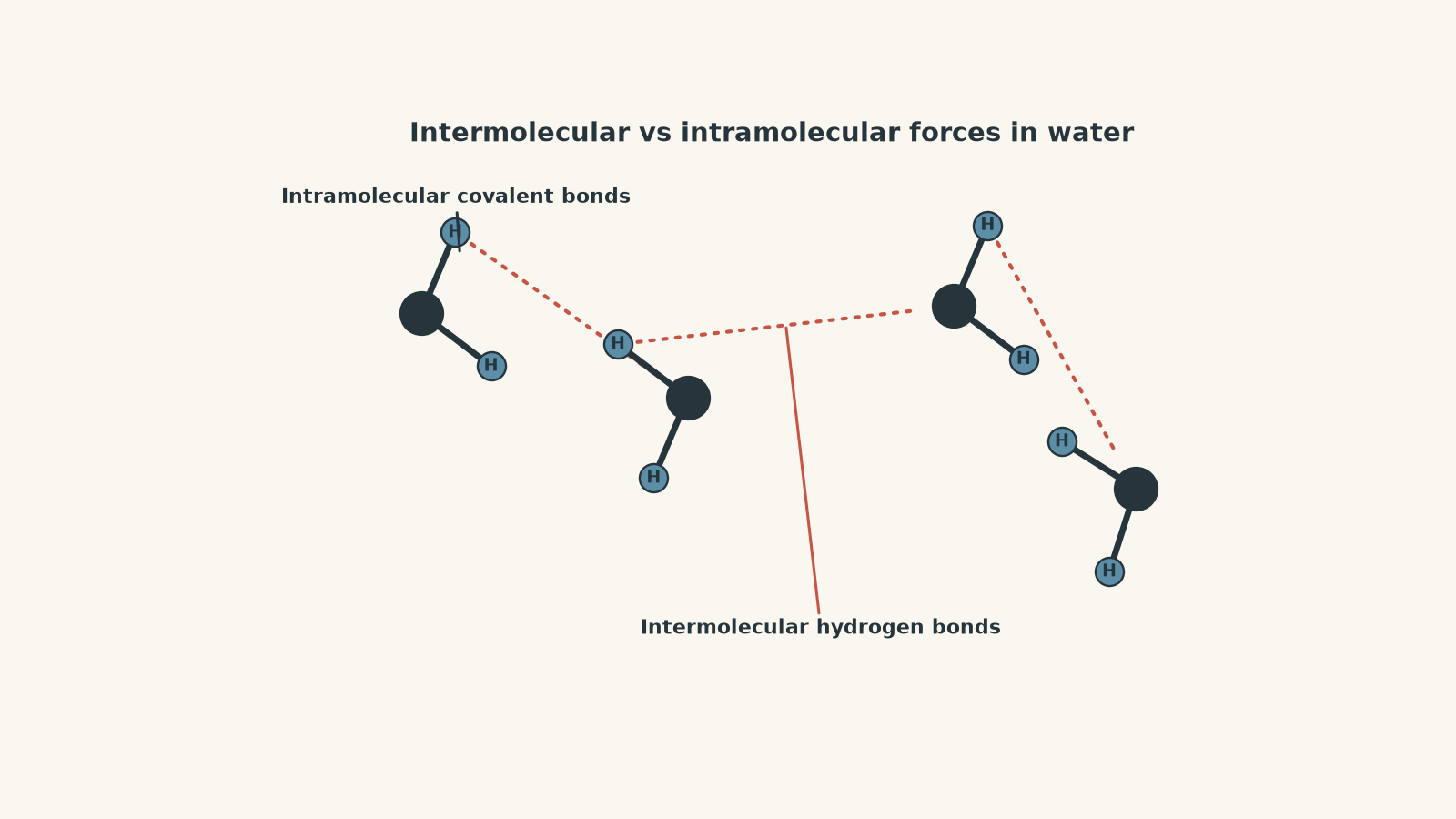
Heat liquid water until it boils. The water molecules fly apart into a gas, but each particle is still \(\ce{H2O}\). The oxygen atom has not suddenly detached from its two hydrogen atoms.
So what actually breaks when water boils?
A tempting prediction is that the O-H bonds break because the molecules are separating. They do not. Boiling overcomes attractions between water molecules. The much stronger covalent bonds within each water molecule remain intact.
That difference is the whole point of intermolecular and intramolecular forces.
01Start with two different jobs
Picture a molecule as a couple holding hands in a crowded concert.
The hand-holding represents the bonds that keep the atoms together as one molecule. The weaker jostling and attraction between different couples represents the forces between neighbouring molecules. If the crowd spreads out, the couples can move away from each other without breaking up.
That is roughly what happens when a molecular liquid boils.
The analogy has limits. Molecules are not choosing partners, and the real attractions are electrical interactions between charged particles. Also, one molecule can attract several neighbours at once. Still, the distinction is useful:
- Intramolecular forces act within a particle and hold its atoms together.
- Intermolecular forces act between separate molecules.
The prefix helps. Intra means within. Inter means between.
For a molecular substance such as water, methane, or ethanol, the main intramolecular forces are covalent bonds.
For example, inside a water molecule:
\[
\ce{H-O-H}
\]
the two O-H covalent bonds are intramolecular.
Between one water molecule and another, there are intermolecular attractions.
This distinction matters because the two types of force do completely different jobs.
| Force type | Where it acts | Main job | Example |
|---|---|---|---|
| Intramolecular | Within a particle | Holds atoms together | O-H covalent bond in \(\ce{H2O}\) |
| Intermolecular | Between molecules | Attracts separate molecules | Hydrogen bonding between water molecules |
02Physical change or chemical change?
This gives you a useful decision rule.
If molecules separate but remain the same molecules, intermolecular forces are being overcome.
If atoms are rearranged into different substances, intramolecular bonds must be broken and new bonds formed.
When water boils:
\[
\ce{H2O(l) -> H2O(g)}
\]
The particles are \(\ce{H2O}\) before and after. This is a physical change.
When water is chemically decomposed:
\[
\ce{2H2O -> 2H2 + O2}
\]
O-H covalent bonds must be broken, and new H-H and O=O bonds form. This is a chemical change.
That is why boiling water does not produce hydrogen and oxygen gas.
03Why intramolecular bonds are usually much stronger
Covalent bonds involve strong electrostatic attraction between positively charged nuclei and shared electrons. Breaking one usually requires hundreds of kilojoules per mole of bonds.
Intermolecular attractions are generally much weaker. An individual intermolecular attraction might involve only a few to a few tens of kilojoules per mole.
For comparison, breaking an O-H covalent bond requires roughly hundreds of kilojoules per mole, while separating water molecules during vaporisation requires far less energy per mole of water.
Do not turn that into the rule:
intramolecular forces are always exactly ten times stronger than intermolecular forces.
There is no fixed ratio.
The useful comparison is:
Intramolecular chemical bonds are generally much stronger than individual intermolecular attractions.
This is why heating a substance can melt or boil it without destroying its molecules.
04The three intermolecular forces you need to recognise
For neutral molecular substances, three intermolecular forces are especially important in HSC Chemistry:
- London dispersion forces
- dipole-dipole forces
- hydrogen bonding
A molecule can experience more than one of these at the same time.
London dispersion forces
Imagine the electrons in a non-polar molecule. They are moving constantly.
At one instant, slightly more electron density might happen to be on one side of the molecule. For that instant, one side becomes slightly negative and the other slightly positive.
This creates a temporary dipole.
That temporary dipole can distort the electron cloud of a nearby molecule, creating another temporary dipole. The opposite partial charges then attract.
These attractions are called London dispersion forces.
The crucial rule is:
All atoms and molecules experience London dispersion forces.
That includes polar molecules.
A common mistake is to write, “Water has hydrogen bonding, so it does not have dispersion forces.” Water has both.
Dispersion forces generally become stronger when a particle has:
- more electrons
- a larger, more easily distorted electron cloud
- greater polarisability
- more surface area available for close contact with neighbouring molecules
This is why large non-polar molecules can have surprisingly strong intermolecular attractions.
Dipole-dipole forces
Some molecules have a permanent uneven distribution of charge.
Take hydrogen chloride, \(\ce{HCl}\). Chlorine attracts the bonding electrons more strongly than hydrogen. The chlorine end is partially negative, written \(\delta-\), while the hydrogen end is partially positive, written \(\delta+\).
Neighbouring molecules can therefore line up so that opposite partial charges attract.
That attraction is a dipole-dipole force.
For dipole-dipole forces to occur, the molecule must have a permanent molecular dipole. Having polar bonds alone is not always enough.
For example, \(\ce{CO2}\) contains polar C=O bonds, but its linear shape causes the bond dipoles to cancel. The molecule is non-polar overall.
So \(\ce{CO2}\) has London dispersion forces but no permanent dipole-dipole attractions.
Hydrogen bonding
Hydrogen bonding is a particularly strong type of dipole-dipole attraction.
For the usual HSC cases, look for hydrogen directly covalently bonded to:
- nitrogen
- oxygen
- fluorine
A hydrogen atom attached to one of these highly electronegative atoms becomes strongly \(\delta+\). It can then attract a lone pair on N, O, or F in a neighbouring molecule.
Water is the classic example.
Inside one water molecule, the O-H bond is covalent and intramolecular.
Between neighbouring water molecules, the attraction involving an H atom on one molecule and the O atom of another is hydrogen bonding and intermolecular.
This wording matters. Saying “the hydrogen bond inside water” usually confuses two different things.
05A fast way to identify the intermolecular forces
When you are given a molecular substance, work through these questions in order.
First: are there separate molecules?
If the substance is an ionic lattice or metallic lattice, describing the solid using intermolecular forces is not appropriate. There are no separate molecules in the lattice.
Second: what intermolecular force is guaranteed?
London dispersion forces. Every molecule has them.
Third: is the molecule polar overall?
If yes, add permanent dipole-dipole attractions.
Fourth: is H directly bonded to N, O, or F?
If yes, molecules can usually form hydrogen bonds with suitable neighbouring N, O, or F atoms.
This gives a compact decision table:
| Molecular feature | Intermolecular forces present |
|---|---|
| Any molecule | London dispersion |
| Polar molecule | London dispersion + dipole-dipole |
| H bonded to N, O, or F | London dispersion + dipole-dipole + hydrogen bonding |
The table is useful, but it hides one important complication: simply naming the force is not enough to predict every boiling point.
Size and shape matter too.
Worked example: What forces act in methanol?
For methanol, \(\ce{CH3OH}\), identify the important intramolecular and intermolecular forces. State what is overcome when methanol boils.
Step 1
The C-H, C-O, and O-H bonds within a methanol molecule are covalent bonds. These are intramolecular.
Step 2
Every methanol molecule experiences London dispersion forces.
Step 3
The C-O and O-H bonds are strongly polar, and their dipoles do not cancel. Methanol is therefore polar.
It experiences dipole-dipole attractions.
Step 4
Methanol contains an O-H bond. The hydrogen attached to oxygen can interact strongly with the oxygen lone pairs of neighbouring methanol molecules.
Methanol therefore forms hydrogen bonds.
Step 5
When methanol boils, the molecules separate from one another. The intermolecular forces are overcome, but the covalent C-H, C-O, and O-H bonds remain.
So methanol has covalent intramolecular bonds and London dispersion, dipole-dipole, and hydrogen-bonding intermolecular forces.
The fact that several intermolecular forces are present does not mean three separate layers have to be “broken” one at a time. They are different contributions to the overall attraction between molecules.
06Comparing the strengths of intermolecular forces
You may see the rough order:
\[
\text{hydrogen bonding} > \text{dipole-dipole} > \text{London dispersion}
\]
This is useful only when comparing similar-sized molecules.
It is not a universal ranking that lets you ignore everything else.
Suppose a student compares a tiny polar molecule with a very large non-polar molecule and says, “The polar one must have the higher boiling point because dipole-dipole forces are stronger than dispersion forces.”
That prediction feels reasonable because we often teach intermolecular forces in a simple hierarchy.
The missing idea is that London dispersion forces do not have one fixed strength. They become much stronger as the electron cloud becomes larger and more polarisable.
A large non-polar molecule can therefore experience stronger total intermolecular attraction than a small polar molecule.
The better decision process is:
- Identify every type of intermolecular force present.
- Compare molecular size and number of electrons.
- Compare shape and surface area.
- Only then decide which substance should have stronger overall intermolecular attraction.
07Why stronger intermolecular forces affect boiling point
A liquid boils when its molecules can escape into the gas phase throughout the liquid.
To do that, molecules must overcome enough of the attractions holding them near their neighbours.
So, under comparable conditions:
stronger intermolecular forces generally produce a higher boiling point.
Notice what does not appear in that statement: stronger covalent bonds inside the molecules.
The C-H bonds in a hydrocarbon are not broken when the hydrocarbon boils. Their strength is therefore not the direct reason for its boiling point.
This is one of the most common intermolecular forces mistakes.
Worked example: Ethanol or dimethyl ether?
Ethanol, \(\ce{CH3CH2OH}\), and dimethyl ether, \(\ce{CH3OCH3}\), have the same molecular formula, \(\ce{C2H6O}\). Predict which has the higher boiling point and explain why.
Step 1
The two molecules have the same molecular formula and therefore the same number and types of atoms. Their molar masses are essentially identical.
That makes this a useful comparison because molecular size is not the main difference.
Step 2
Dimethyl ether has London dispersion forces.
Its C-O bonds are polar, and the molecule has a permanent dipole, so it also has dipole-dipole attractions.
However, none of its hydrogen atoms is directly bonded to oxygen. It cannot form hydrogen bonds with other dimethyl ether molecules in the usual donor-acceptor sense.
Step 3
Ethanol also has London dispersion and dipole-dipole forces.
Its O-H group allows neighbouring ethanol molecules to form hydrogen bonds.
Step 4
Because the molecular sizes are similar, the extra hydrogen bonding in ethanol is an important difference.
Ethanol therefore has stronger intermolecular attraction overall and a higher boiling point.
Step 5
More energy is required to separate ethanol molecules into the gas phase. The difference does not arise because ethanol’s covalent bonds are being broken during boiling.
08Molecular shape can matter too
Two molecules with similar molecular masses can still have different dispersion forces because their shapes affect how closely they can approach each other.
Long, relatively straight molecules can often make more surface contact with neighbouring molecules than compact, highly branched molecules.
More contact can mean stronger dispersion attractions.
This becomes especially important when comparing hydrocarbons. If two hydrocarbons contain similar numbers of electrons, the less branched molecule often has the higher boiling point because its shape allows greater intermolecular contact.
Again, this is an intermolecular effect. The covalent bonds inside the molecules are not being compared.
09The most tempting misconception: “hydrogen bonding is always strongest”
Hydrogen bonding is strong for an intermolecular attraction between small neutral molecules. That does not mean every hydrogen-bonding substance must have a higher boiling point than every substance without hydrogen bonding.
Consider a large hydrocarbon. It may contain many more electrons than a small alcohol, giving it a highly polarisable electron cloud and substantial dispersion forces.
So this reasoning is unsafe:
Substance A hydrogen-bonds. Substance B only has dispersion forces. Therefore A must have the higher boiling point.
You need to ask how large the particles are.
For example, butan-1-ol can hydrogen-bond, while octane is non-polar and cannot. Yet octane has a boiling point of about \(126^\circ\text{C}\), slightly above butan-1-ol at about \(118^\circ\text{C}\).
There is no contradiction.
Octane is considerably larger, has more electrons, and has a more polarisable electron cloud. Its many dispersion interactions add up to strong overall intermolecular attraction.
The simple hierarchy was not wrong. It was incomplete.
10Do not call every strong attraction a hydrogen bond
Another common mistake is to see hydrogen anywhere in a molecule and claim hydrogen bonding.
Methane, \(\ce{CH4}\), contains four C-H bonds but does not form the type of hydrogen bonding considered here.
Why?
The hydrogen must be directly bonded to a highly electronegative N, O, or F atom for the bond to become polar enough.
So:
- \(\ce{H2O}\): yes
- \(\ce{NH3}\): yes
- \(\ce{HF}\): yes
- \(\ce{CH3OH}\): yes
- \(\ce{CH4}\): no
- \(\ce{CH3CH3}\): no
Do not confuse the presence of hydrogen atoms with hydrogen bonding.
11Intramolecular does not always mean “inside a molecule”
The name can create an awkward piece of chemistry.
In molecular substances, intramolecular forces are the bonds inside individual molecules. That is the main comparison on this page.
But ionic and metallic substances do not consist of separate molecules.
Solid sodium chloride, for example, contains a giant lattice of \(\mathrm{Na}^{+}\) and \(\mathrm{Cl}^{-}\) ions. It would be misleading to describe the ionic attractions in the solid as “intermolecular forces”, because there are no \(\ce{NaCl}\) molecules sitting next to one another.
Similarly, a metal consists of a metallic lattice rather than separate metal molecules.
So before talking about intermolecular forces, check that the substance actually contains molecules.
12Questions and solutions
Question 1
A sample of liquid ammonia, \(\ce{NH3}\), is heated until it boils.
Identify the main intramolecular force in each ammonia molecule, identify the intermolecular forces between ammonia molecules, and state which type of force is overcome during boiling.
Solution 1
Boiling overcomes intermolecular forces between ammonia molecules, while the covalent N-H bonds within each \(\ce{NH3}\) molecule remain intact.
The N-H bonds are intramolecular covalent bonds. They hold each nitrogen atom to its three hydrogen atoms.
All ammonia molecules experience London dispersion forces.
Ammonia is also polar, so it experiences dipole-dipole attraction. Its hydrogen atoms are directly bonded to nitrogen, allowing hydrogen bonding between neighbouring ammonia molecules.
Therefore the intermolecular forces are London dispersion, dipole-dipole, and hydrogen bonding.
During boiling, enough of these intermolecular attractions are overcome for ammonia molecules to enter the gas phase:
\[
\ce{NH3(l) -> NH3(g)}
\]
The chemical formula is unchanged, showing that the N-H covalent bonds have not been broken.
Question 2
Two molecular substances contain a similar number of electrons.
Substance A is non-polar. Substance B is polar but has no H atoms bonded to N, O, or F.
Which intermolecular forces act in each substance, and which substance would you generally expect to have the stronger intermolecular attraction if their shapes are also similar?
Solution 2
Substance B would generally be expected to have stronger intermolecular attraction because it experiences both London dispersion and dipole-dipole forces, while substance A experiences London dispersion only.
Every molecule experiences London dispersion forces, so both A and B have them.
Because B is polar, it also has permanent dipole-dipole attractions.
Neither substance has been described as capable of hydrogen bonding.
The comparison is reasonable because the question controls two important variables: the molecules have similar numbers of electrons and similar shapes. Their dispersion forces should therefore be broadly comparable, leaving B’s permanent dipole-dipole attraction as an important extra contribution.
The trap would be to say substance A has “no intermolecular forces” because it is non-polar. Non-polar molecules still experience London dispersion forces.
Question 3
Ethane, \(\ce{C2H6}\), and methanol, \(\ce{CH3OH}\), both contain covalent bonds.
A student says, “Methanol has a higher boiling point because its O-H covalent bond is stronger than the C-H bonds in ethane.”
Explain what is wrong with the student’s reasoning.
Solution 3
The student’s explanation uses the wrong type of force. Boiling point mainly depends on intermolecular attractions, not on the strength of the covalent bonds that remain inside each molecule.
Methanol molecules experience London dispersion forces, permanent dipole-dipole attraction, and hydrogen bonding.
Ethane is non-polar, so its molecules primarily attract through London dispersion forces.
During boiling, neither methanol’s O-H covalent bonds nor ethane’s C-H covalent bonds need to be broken. The molecules separate from neighbouring molecules but stay chemically intact.
Methanol’s higher boiling point is therefore explained by its stronger intermolecular attraction, particularly hydrogen bonding, not by claiming that its intramolecular O-H bond must be broken.
The tempting misconception is understandable because “stronger bonds” sounds like it should mean “harder to boil”. The missing question is: which bonds or forces does boiling actually overcome?
Question 4
Hydrogen chloride, \(\ce{HCl}\), is polar. Chlorine, \(\ce{Cl2}\), is non-polar.
A student therefore predicts that \(\ce{HCl}\) must have the higher boiling point because dipole-dipole attractions are stronger than London dispersion forces.
In fact, chlorine has the higher boiling point. Explain why this observation does not contradict the theory of intermolecular forces.
Solution 4
The observation does not contradict the theory because the strength of London dispersion forces depends strongly on electron-cloud size and polarisability.
\(\ce{HCl}\) is polar. Its molecules therefore experience both London dispersion and permanent dipole-dipole attractions.
\(\ce{Cl2}\) is non-polar, so it does not have permanent dipole-dipole attraction. It does, however, have London dispersion forces.
The student’s hidden assumption is that all London dispersion forces have the same strength. They do not.
A \(\ce{Cl2}\) molecule has a larger, more polarisable electron cloud than an \(\ce{HCl}\) molecule. Temporary fluctuations in its electron distribution can therefore produce stronger instantaneous dipoles.
The resulting dispersion attraction in chlorine is strong enough that its overall intermolecular attraction produces a higher boiling point.
The simplified order
\[
\text{hydrogen bonding} > \text{dipole-dipole} > \text{dispersion}
\]
is most useful when molecules are otherwise reasonably similar. It cannot replace a comparison of molecular size and polarisability.
Question 5
Two liquids have the following properties:
| Liquid | Structure | Boiling point |
|---|---|---|
| P | \(\ce{CH3(CH2)3OH}\) | about \(118^\circ\text{C}\) |
| Q | \(\ce{CH3(CH2)6CH3}\) | about \(126^\circ\text{C}\) |
Liquid P can form hydrogen bonds. Liquid Q is non-polar.
A student argues that the data must be wrong because a hydrogen-bonding liquid cannot have a lower boiling point than a non-polar liquid.
Evaluate the student’s claim.
Solution 5
The student’s claim is incorrect. A larger non-polar molecule can have stronger overall intermolecular attraction than a smaller hydrogen-bonding molecule because London dispersion forces increase with molecular size and polarisability.
Liquid P, butan-1-ol, experiences London dispersion, dipole-dipole, and hydrogen-bonding interactions.
Liquid Q, octane, is non-polar and therefore relies on London dispersion forces.
If the molecules were similar in size, P’s hydrogen bonding would be a strong reason to expect greater intermolecular attraction. They are not similar in size.
Octane contains substantially more electrons and has a larger electron cloud. Its electron distribution is therefore more polarisable, producing stronger temporary dipoles and stronger dispersion attractions.
Its long hydrocarbon structure also allows considerable contact with neighbouring molecules.
The result is that octane’s total intermolecular attraction can exceed that of the smaller butan-1-ol molecules, giving octane the slightly higher boiling point.
The deeper lesson is that naming the “strongest type” of intermolecular force present is not enough. You must compare all important contributors to the attraction.
Question 6
A sealed container contains a molecular substance that is heated.
At temperature \(T_1\), the substance changes from a solid to a liquid. At a higher temperature \(T_2\), it becomes a gas. At an even higher temperature \(T_3\), chemical analysis detects new substances with different molecular formulas.
For each temperature, state whether intramolecular bonds must have been broken, and explain your reasoning.
Solution 6
Intramolecular bonds do not need to be broken at \(T_1\) or \(T_2\), but chemical bond breaking and formation must occur by \(T_3\) because new substances are present.
At \(T_1\), melting changes the arrangement and movement of the existing molecules. The particles remain the same chemical species, so the change can occur by partially overcoming intermolecular attractions.
At \(T_2\), boiling separates the molecules much further. More intermolecular attraction is overcome, but the molecules can still remain chemically intact.
At \(T_3\), the evidence changes. New molecular formulas have been detected.
A change in molecular identity requires atoms to be rearranged. That requires intramolecular chemical bonds to be broken and new bonds to form.
The important distinction is not simply that \(T_3\) is “hotter”. The key evidence is that the particles themselves have changed chemical identity.
Once you can separate intramolecular bonds from intermolecular attractions, boiling points, melting points, volatility, viscosity, and many solubility patterns become much easier to explain. The next useful step is to connect molecular polarity and intermolecular forces to why some substances dissolve in one solvent but not another.