
Brønsted-Lowry Acids and Bases: HSC Chemistry Guide
Learn how to identify Brønsted-Lowry acids, bases, and conjugate pairs by tracking proton transfer through HSC-style reactions.
Ammonia, \(\ce{NH3}\), makes an aqueous solution basic. But there is no \(\ce{OH^-}\) anywhere in its formula. So where does the hydroxide come from?
Before reading on, predict what happens when ammonia meets water. Does ammonia somehow release \(\ce{OH^-}\), or does the water itself change?
The reaction is:
\[
\ce{NH3 + H2O <=> NH4+ + OH^-}
\]
The important event is not the appearance of \(\ce{OH^-}\). It is the movement of one proton, \(\mathrm{H}^{+}\). A water molecule gives a proton to ammonia. Water therefore becomes \(\ce{OH^-}\), while ammonia becomes \(\ce{NH4+}\).
That proton transfer is the central idea of Brønsted-Lowry acid-base theory.
01The one thing to track: the proton
Imagine two people and one borrowed hoodie. One person hands it over; the other puts it on. If you track the hoodie, you can tell who gave and who received.
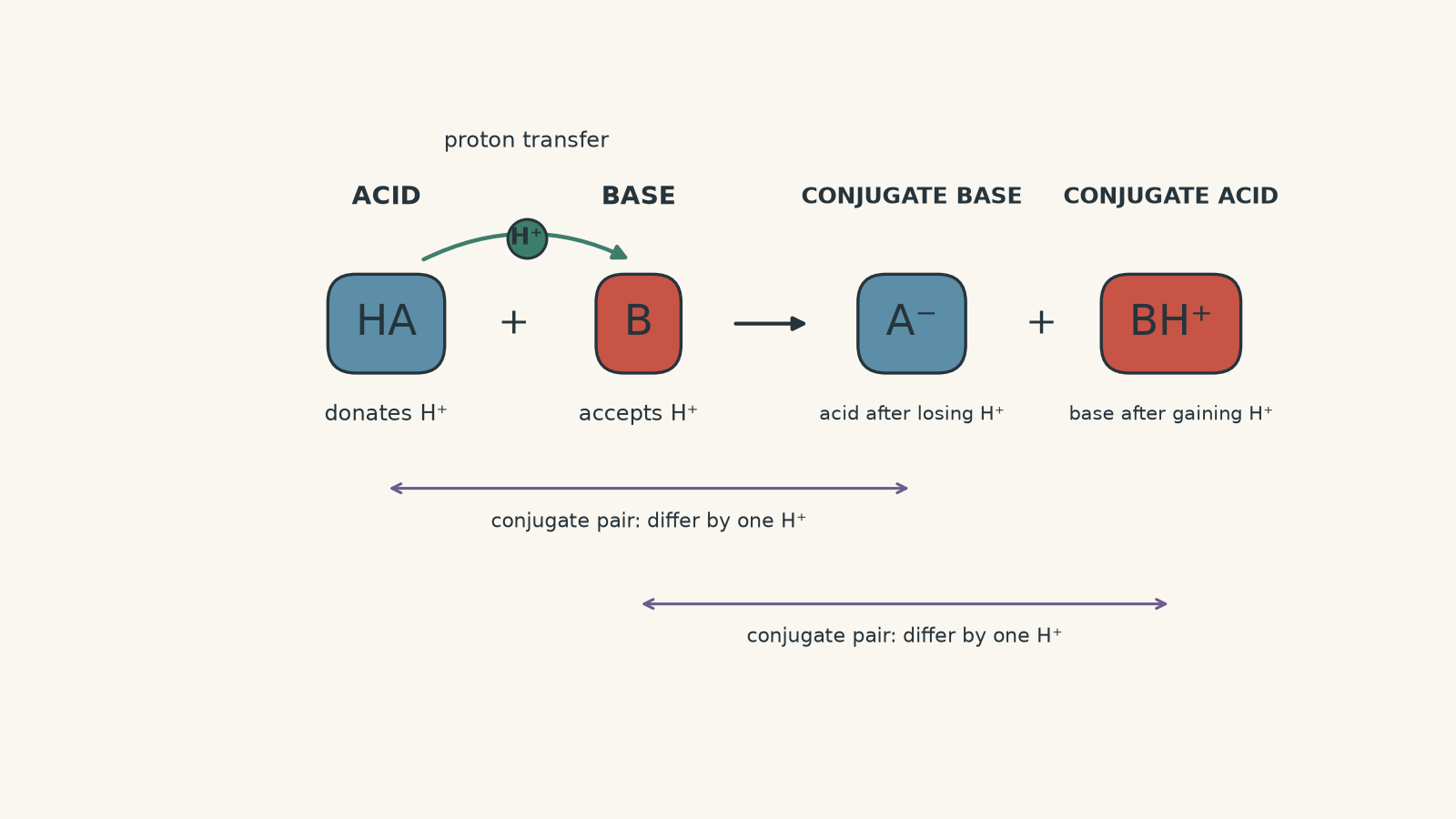
For a Brønsted-Lowry reaction, the “hoodie” is a proton, \(\mathrm{H}^{+}\):
- a Brønsted-Lowry acid donates a proton
- a Brønsted-Lowry base accepts a proton
The analogy stops there. Real proton transfer depends on chemical stability and equilibrium, not on whether one molecule feels cold.
A proton is the nucleus of a hydrogen atom. In acid-base equations, writing \(\mathrm{H}^{+}\) is useful bookkeeping. In aqueous solution, however, a proton is not sitting around by itself. Water accepts it, which we commonly represent by forming hydronium, \(\ce{H3O+}\).
Consider hydrochloric acid in water:
\[
\ce{HCl + H2O -> H3O+ + Cl^-}
\]
Which reactant receives the proton?
Water does. \(\ce{HCl}\) loses \(\mathrm{H}^{+}\) and becomes \(\mathrm{Cl}^{-}\), while \(\ce{H2O}\) gains \(\mathrm{H}^{+}\) and becomes \(\ce{H3O+}\).
So, in this reaction:
- \(\ce{HCl}\) is the acid
- \(\ce{H2O}\) is the base
This gives the general proton-transfer pattern:
\[
\ce{acid + base <=> conjugate\ base + conjugate\ acid}
\]
02How to identify the acid and base from an equation
Don’t begin by asking which substance “looks acidic”. Track what actually happens.
| What happens to a reactant? | Brønsted-Lowry role |
|---|---|
| It loses one \(\mathrm{H}^{+}\) | Acid |
| It gains one \(\mathrm{H}^{+}\) | Base |
| Product has one fewer H and is one charge unit more negative | Conjugate base has formed |
| Product has one more H and is one charge unit more positive | Conjugate acid has formed |
That charge change is a useful check.
If a neutral species loses \(\mathrm{H}^{+}\), for example, its product normally has a \(1-\) charge. If a \(1-\) species accepts \(\mathrm{H}^{+}\), its product becomes neutral.
Worked example: Why is ammonia a base if it contains no hydroxide?
Consider the reaction:
\[
\ce{NH3 + H2O <=> NH4+ + OH^-}
\]
Identify the Brønsted-Lowry acid, base, conjugate acid, and conjugate base.
Step 1
\(\ce{NH3}\) becomes \(\ce{NH4+}\). It has gained one \(\mathrm{H}^{+}\).
Therefore, \(\ce{NH3}\) is the Brønsted-Lowry base.
Step 2
\(\ce{H2O}\) becomes \(\ce{OH^-}\). It has lost one \(\mathrm{H}^{+}\).
Therefore, \(\ce{H2O}\) is the Brønsted-Lowry acid.
Step 3
\(\ce{NH4+}\) is formed when the base \(\ce{NH3}\) gains a proton, so \(\ce{NH4+}\) is the conjugate acid.
\(\ce{OH^-}\) is formed when the acid \(\ce{H2O}\) loses a proton, so \(\ce{OH^-}\) is the conjugate base.
The two conjugate pairs are therefore:
\[
\ce{NH4+ / NH3}
\]
and
\[
\ce{H2O / OH^-}
\]
Step 4
Ammonia does not need to contain \(\ce{OH^-}\) to behave as a base. It accepts a proton from water, and hydroxide is left behind.
That is exactly why defining every base as “a substance containing hydroxide” is too narrow.
03Conjugate acid-base pairs
When an acid donates a proton, it does not disappear. It becomes a new species called its conjugate base.
Similarly, when a base accepts a proton, it becomes its conjugate acid.
A conjugate acid-base pair therefore differs by exactly one proton.
For example:
| Acid | Conjugate base |
|---|---|
| \(\ce{HCl}\) | \(\mathrm{Cl}^{-}\) |
| \(\ce{NH4+}\) | \(\ce{NH3}\) |
| \(\ce{H2CO3}\) | \(\ce{HCO3^-}\) |
| \(\ce{HCO3^-}\) | \(\ce{CO3^2-}\) |
Notice the last two rows. \(\ce{HCO3^-}\) appears once as a conjugate base and once as an acid.
That isn’t a contradiction. Acid and base are roles a species can play during a proton transfer. They are not permanent labels stamped onto the formula.
A useful test for conjugate pairs is:
- Do the two species differ by exactly one H?
- Does their charge differ by exactly one?
For example, \(\ce{NH4+}\) and \(\ce{NH3}\) pass both tests. \(\ce{H2CO3}\) and \(\ce{CO3^2-}\) do not: they differ by two protons, so they are not a single conjugate pair.
04Some species can be acids or bases
Water is a good example.
You have already seen water acting as a base:
\[
\ce{HCl + H2O -> H3O+ + Cl^-}
\]
Here, water accepts a proton.
But in the ammonia reaction:
\[
\ce{NH3 + H2O <=> NH4+ + OH^-}
\]
water donates a proton.
So is water an acid or a base?
The precise answer is: it depends on the reaction.
A species that can either donate or accept a proton is called amphiprotic.
Hydrogen carbonate, \(\ce{HCO3^-}\), is another important example. It can donate a proton:
\[
\ce{HCO3^- + H2O <=> CO3^2- + H3O+}
\]
Here, \(\ce{HCO3^-}\) is the acid because it becomes \(\ce{CO3^2-}\).
It can also accept a proton:
\[
\ce{HCO3^- + H2O <=> H2CO3 + OH^-}
\]
Here, \(\ce{HCO3^-}\) is the base because it becomes \(\ce{H2CO3}\).
This is why trying to memorise a fixed list of “acid substances” and “base substances” eventually causes trouble. Following the proton works more reliably.
Worked example: Two amphiprotic ions react
Consider the reaction:
\[
\ce{H2PO4^- + HCO3^- <=> HPO4^2- + H2CO3}
\]
Identify the Brønsted-Lowry acid, base, and both conjugate pairs.
Step 1
\(\ce{H2PO4^-}\) becomes \(\ce{HPO4^2-}\).
It has lost one \(\mathrm{H}^{+}\), so \(\ce{H2PO4^-}\) is acting as the acid.
Its conjugate base is \(\ce{HPO4^2-}\).
Step 2
\(\ce{HCO3^-}\) becomes \(\ce{H2CO3}\).
It has gained one \(\mathrm{H}^{+}\), so \(\ce{HCO3^-}\) is acting as the base.
Its conjugate acid is \(\ce{H2CO3}\).
Step 3
They are:
\[
\ce{H2PO4^- / HPO4^2-}
\]
and
\[
\ce{H2CO3 / HCO3^-}
\]
Step 4
Both reactants are capable of participating in different acid-base reactions. Their formulas alone don’t tell you their roles here.
The actual change does.
05Reaction role is not the same thing as acid strength
Brønsted-Lowry theory tells you who donates and who accepts a proton. By itself, that does not tell you how completely the reaction occurs.
For example, both hydrochloric acid and ethanoic acid can donate protons to water. That makes both Brønsted-Lowry acids.
They do not, however, donate to the same extent in aqueous solution.
So keep two questions separate:
- What role does the species play? Track the proton.
- How strongly does the reaction favour proton transfer? That is an equilibrium and acid-strength question.
This distinction becomes especially important when an equation uses an equilibrium arrow.
Take:
\[
\ce{NH3 + H2O <=> NH4+ + OH^-}
\]
In the forward direction, \(\ce{H2O}\) donates a proton and \(\ce{NH3}\) accepts it.
In the reverse direction, \(\ce{NH4+}\) donates a proton and \(\ce{OH^-}\) accepts it.
The conjugate relationships have not changed. Only the direction you are analysing has changed.
06The misconceptions that cause most errors
“A base must contain \(\ce{OH^-}\)”
No. A Brønsted-Lowry base needs to accept a proton.
Ammonia contains no oxygen at all:
\[
\ce{NH3 + H2O <=> NH4+ + OH^-}
\]
Yet \(\ce{NH3}\) is clearly the proton acceptor.
Ethanoate is another example:
\[
\ce{CH3COO^- + H2O <=> CH3COOH + OH^-}
\]
The ethanoate ion accepts \(\mathrm{H}^{+}\), so it acts as a base.
“Anything containing hydrogen is an acid”
Also no.
Having hydrogen available somewhere in a formula is not enough. To be the acid in the reaction being analysed, the species must actually donate a proton.
In:
\[
\ce{H2PO4^- + H3O+ <=> H3PO4 + H2O}
\]
\(\ce{H2PO4^-}\) contains hydrogen, but it gains another proton. It is therefore acting as the base.
“Negative ions are bases, positive ions are acids”
Charge can give clues, but it does not decide the role.
For example:
\[
\ce{H2PO4^- + NH3 <=> HPO4^2- + NH4+}
\]
The negatively charged \(\ce{H2PO4^-}\) is the acid because it donates a proton.
“An acid-base reaction must produce water”
Water is produced in many familiar neutralisation reactions, but water formation is not part of the Brønsted-Lowry definition.
The reaction
\[
\ce{H2PO4^- + NH3 <=> HPO4^2- + NH4+}
\]
is still an acid-base reaction. A proton has moved from one species to another.
The same proton-transfer idea sits underneath many familiar neutralisation reactions, even when the equation initially looks quite different.
07A reliable method for analysing any Brønsted-Lowry equation
When an HSC question gives you an unfamiliar reaction, use the equation rather than your memory of the substances.
1. Compare each reactant with a product
Look for species that differ by one H.
2. Work out where the proton went
If a reactant lost \(\mathrm{H}^{+}\), it was the acid.
If a reactant gained \(\mathrm{H}^{+}\), it was the base.
3. Match the conjugate pairs
The acid and its conjugate base differ by one proton.
The base and its conjugate acid also differ by one proton.
4. Check charge
Losing \(\mathrm{H}^{+}\) makes the species one charge unit more negative.
Gaining \(\mathrm{H}^{+}\) makes it one charge unit more positive.
5. Only then think about strength or equilibrium
Don’t use “strong acid”, “weak base”, or equilibrium position to decide who donated the proton. First identify the proton transfer. Strength is the next layer of the problem.
08Questions and solutions
Question 1
Consider the reaction:
\[
\ce{HNO3 + H2O -> H3O+ + NO3^-}
\]
Identify the Brønsted-Lowry acid, base, conjugate acid, and conjugate base. Explain your choices using proton transfer.
Solution 1
\(\ce{HNO3}\) is the acid, \(\ce{H2O}\) is the base, \(\ce{NO3^-}\) is the conjugate base, and \(\ce{H3O+}\) is the conjugate acid.
\(\ce{HNO3}\) loses one proton:
\[
\ce{HNO3 -> NO3^- + H+}
\]
It is therefore the proton donor and hence the Brønsted-Lowry acid.
Water accepts that proton:
\[
\ce{H2O + H+ -> H3O+}
\]
It is therefore the Brønsted-Lowry base.
The conjugate pairs are:
\[
\ce{HNO3 / NO3^-}
\]
and
\[
\ce{H3O+ / H2O}
\]
A tempting approach is simply to recognise \(\ce{HNO3}\) as “an acid”. That gets the correct label here, but it doesn’t demonstrate the Brønsted-Lowry reasoning the question is testing. The stronger explanation tracks the transferred proton.
Question 2
A solution contains \(40.0\ \mathrm{mL}\) of \(0.150\ \mathrm{mol\,L^{-1}}\) \(\ce{HSO4^-}\). It is mixed with \(25.0\ \mathrm{mL}\) of \(0.100\ \mathrm{mol\,L^{-1}}\) \(\ce{OH^-}\).
Assume the following proton-transfer reaction proceeds to completion:
\[
\ce{HSO4^- + OH^- -> SO4^2- + H2O}
\]
- Identify the Brønsted-Lowry acid and base.
- Identify both conjugate pairs.
- Calculate the amount, in moles, of \(\ce{SO4^2-}\) formed and the amount of \(\ce{HSO4^-}\) remaining.
- Assuming volumes are additive, calculate the final concentrations of \(\ce{SO4^2-}\) and unreacted \(\ce{HSO4^-}\).
Solution 2
\(\ce{HSO4^-}\) is the acid, \(\ce{OH^-}\) is the base, \(2.50\times10^{-3}\ \mathrm{mol}\) of \(\ce{SO4^2-}\) forms, and \(3.50\times10^{-3}\ \mathrm{mol}\) of \(\ce{HSO4^-}\) remains.
First identify the proton transfer.
\(\ce{HSO4^-}\) becomes \(\ce{SO4^2-}\), so it loses \(\mathrm{H}^{+}\). It is the acid.
\(\ce{OH^-}\) gains \(\mathrm{H}^{+}\) and becomes \(\ce{H2O}\). It is the base.
The conjugate pairs are:
\[
\ce{HSO4^- / SO4^2-}
\]
and
\[
\ce{H2O / OH^-}
\]
Now calculate the initial amounts.
For \(\ce{HSO4^-}\):
\[
\begin{aligned}
n &= cV \\
&= (0.150\ \mathrm{mol\,L^{-1}})(0.0400\ \mathrm{L}) \\
&= 6.00\times10^{-3}\ \mathrm{mol}
\end{aligned}
\]
For \(\ce{OH^-}\):
\[
\begin{aligned}
n &= cV \\
&= (0.100\ \mathrm{mol\,L^{-1}})(0.0250\ \mathrm{L}) \\
&= 2.50\times10^{-3}\ \mathrm{mol}
\end{aligned}
\]
The equation has a \(1:1\) mole ratio:
\[
\ce{HSO4^- : OH^- = 1 : 1}
\]
Therefore, \(\ce{OH^-}\) is limiting.
The amount of sulfate produced is:
\[
n(\ce{SO4^2-})=2.50\times10^{-3}\ \mathrm{mol}
\]
The amount of hydrogen sulfate remaining is:
\[
\begin{aligned}
n(\ce{HSO4^-})&=6.00\times10^{-3}-2.50\times10^{-3}\\
&=3.50\times10^{-3}\ \mathrm{mol}
\end{aligned}
\]
The final volume is:
\[
V=40.0+25.0=65.0\ \mathrm{mL}=0.0650\ \mathrm{L}
\]
Therefore:
\[
\begin{aligned}
[\ce{SO4^2-}]
&=\frac{2.50\times10^{-3}}{0.0650}\\
&=3.85\times10^{-2}\ \mathrm{mol\,L^{-1}}
\end{aligned}
\]
and
\[
\begin{aligned}
[\ce{HSO4^-}]
&=\frac{3.50\times10^{-3}}{0.0650}\\
&=5.38\times10^{-2}\ \mathrm{mol\,L^{-1}}
\end{aligned}
\]
The tempting mistake is to see \(\ce{OH^-}\) and immediately call this a neutralisation without analysing the proton transfer. The stoichiometry and the Brønsted-Lowry description are describing the same event: \(\ce{OH^-}\) accepts a proton from \(\ce{HSO4^-}\).
Question 3
The dihydrogen phosphate ion, \(\ce{H2PO4^-}\), appears in both reactions below.
Reaction A:
\[
\ce{H2PO4^- + NH3 <=> HPO4^2- + NH4+}
\]
Reaction B:
\[
\ce{H2PO4^- + H3O+ <=> H3PO4 + H2O}
\]
For each reaction:
- identify the acid and base
- identify the conjugate pairs
- explain why describing \(\ce{H2PO4^-}\) simply as “an acid” gives an incomplete picture.
Solution 3
\(\ce{H2PO4^-}\) acts as an acid in Reaction A but as a base in Reaction B, so its role depends on the proton transfer occurring in that particular reaction.
In Reaction A:
\[
\ce{H2PO4^- -> HPO4^2-}
\]
\(\ce{H2PO4^-}\) has lost one proton. It is therefore the acid.
Meanwhile:
\[
\ce{NH3 -> NH4+}
\]
\(\ce{NH3}\) gains the proton and is therefore the base.
The conjugate pairs are:
\[
\ce{H2PO4^- / HPO4^2-}
\]
and
\[
\ce{NH4+ / NH3}
\]
In Reaction B:
\[
\ce{H2PO4^- -> H3PO4}
\]
This time, \(\ce{H2PO4^-}\) gains one proton. It is therefore the base.
\(\ce{H3O+}\) loses a proton to form \(\ce{H2O}\), so \(\ce{H3O+}\) is the acid.
The conjugate pairs are:
\[
\ce{H3PO4 / H2PO4^-}
\]
and
\[
\ce{H3O+ / H2O}
\]
The tempting prediction is that \(\ce{H2PO4^-}\) must always be an acid because it contains hydrogens that can be donated. Reaction B shows exactly what that reasoning misses: the ion can also accept another proton.
\(\ce{H2PO4^-}\) is amphiprotic. Its formula tells you what proton transfers are possible; the reaction tells you which one is actually being considered.
Charge is not enough either. The same negatively charged ion acts as an acid in one equation and a base in another.
Question 4
Consider the following hypothetical two-step proton transfer, where \(\ce{B}\) is a molecular species:
Step 1:
\[
\ce{H2PO4^- + B -> HPO4^2- + BH+}
\]
Step 2:
\[
\ce{BH+ + HCO3^- -> B + H2CO3}
\]
- Identify the Brønsted-Lowry acid and base in each step.
- Identify the conjugate acid-base pairs in each step.
- Add the equations to obtain the overall equation.
- Explain the role of \(\ce{B}\) and \(\ce{BH+}\) in transferring the proton.
- A student argues, “If \(\ce{B}\) is a base in Step 1, it can’t be involved in donating a proton in Step 2.” Explain the error.
Solution 4
\(\ce{B}\) accepts a proton in Step 1, forming its conjugate acid \(\ce{BH+}\), and that newly formed \(\ce{BH+}\) donates the proton in Step 2. Overall, the proton has been transferred from \(\ce{H2PO4^-}\) to \(\ce{HCO3^-}\), while \(\ce{B}\) is regenerated.
In Step 1:
\[
\ce{H2PO4^- -> HPO4^2-}
\]
so \(\ce{H2PO4^-}\) is the acid.
\[
\ce{B -> BH+}
\]
shows that \(\ce{B}\) accepts the proton, so it is the base.
The conjugate pairs are:
\[
\ce{H2PO4^- / HPO4^2-}
\]
and
\[
\ce{BH+ / B}
\]
In Step 2, \(\ce{BH+}\) now loses its proton:
\[
\ce{BH+ -> B}
\]
so \(\ce{BH+}\) is the acid.
Hydrogen carbonate gains that proton:
\[
\ce{HCO3^- -> H2CO3}
\]
so \(\ce{HCO3^-}\) is the base.
The conjugate pairs are:
\[
\ce{BH+ / B}
\]
and
\[
\ce{H2CO3 / HCO3^-}
\]
Adding the two equations gives:
\[
\ce{H2PO4^- + B + BH+ + HCO3^- -> HPO4^2- + BH+ + B + H2CO3}
\]
Species appearing unchanged on both sides cancel:
\[
\ce{H2PO4^- + HCO3^- -> HPO4^2- + H2CO3}
\]
So the net proton transfer is from \(\ce{H2PO4^-}\) to \(\ce{HCO3^-}\).
The important point is that \(\ce{B}\) does not donate a proton in Step 2. \(\ce{BH+}\) does. Accepting a proton in Step 1 has converted the base into its conjugate acid.
The student’s mistake is treating “base” as a permanent property that prevents the corresponding conjugate acid from later donating a proton. In fact, moving between a base and its conjugate acid is the whole structure of Brønsted-Lowry chemistry.
Because \(\ce{B}\) is regenerated, these equations describe it as a proton shuttle in the proposed sequence. You should be careful about going one step further and declaring it a catalyst from these equations alone. Calling something a catalyst requires an actual reaction pathway in which it participates and increases the reaction rate; cancellation from an algebraic sum by itself does not establish that kinetic evidence.
Question 5
A student wants to explain the overall reaction
\[
\ce{H2PO4^- + NH3 -> HPO4^2- + NH4+}
\]
and proposes the following two-step description:
Step 1:
\[
\ce{H2PO4^- + H2O -> HPO4^2- + H3O+}
\]
Step 2:
\[
\ce{H3O+ + NH3 -> H2O + NH4+}
\]
- Identify the Brønsted-Lowry acid and base in each proposed step.
- Add the two equations and show that they reproduce the stated overall reaction.
- Explain the role played by water and hydronium in the proposed sequence.
- Another student claims that because \(\ce{H2O}\) cancels when the equations are added, water “was never really involved”.
- Does the fact that these two equations add to the correct overall equation prove that the reaction actually occurs through these two microscopic steps? Explain.
Solution 5
The two proposed equations give valid Brønsted-Lowry proton bookkeeping and reproduce the overall equation, but their algebraic agreement with the net reaction does not prove that they are the actual microscopic reaction mechanism.
In Step 1:
\[
\ce{H2PO4^- -> HPO4^2-}
\]
so \(\ce{H2PO4^-}\) donates a proton and is the acid.
Water becomes hydronium:
\[
\ce{H2O -> H3O+}
\]
so \(\ce{H2O}\) accepts the proton and is the base.
The conjugate pairs are:
\[
\ce{H2PO4^- / HPO4^2-}
\]
and
\[
\ce{H3O+ / H2O}
\]
In Step 2, hydronium donates a proton:
\[
\ce{H3O+ -> H2O}
\]
so \(\ce{H3O+}\) is the acid.
Ammonia accepts it:
\[
\ce{NH3 -> NH4+}
\]
so \(\ce{NH3}\) is the base.
The conjugate pairs are:
\[
\ce{H3O+ / H2O}
\]
and
\[
\ce{NH4+ / NH3}
\]
Adding the proposed equations gives:
\[
\ce{H2PO4^- + H2O + H3O+ + NH3
-> HPO4^2- + H3O+ + H2O + NH4+}
\]
Cancelling \(\ce{H2O}\) and \(\ce{H3O+}\) from both sides leaves:
\[
\ce{H2PO4^- + NH3 -> HPO4^2- + NH4+}
\]
which is the required overall equation.
Within this proposed sequence, water first accepts a proton and becomes \(\ce{H3O+}\). That hydronium then passes a proton to ammonia, regenerating water. Water therefore participates in the proposed proton relay even though it does not appear in the net equation.
The tempting mistake is to assume that anything cancelled from a net equation must have been chemically irrelevant. Net equations deliberately hide species that are regenerated. Cancellation tells us only that there is no net consumption or production of that species.
There is one final distinction, and it is the important one: these equations do not prove the microscopic mechanism.
Many different sets of intermediate equations can sometimes be constructed so that they add to the same overall equation. Chemical equations provide stoichiometric and proton-transfer bookkeeping, but an actual reaction mechanism is a claim about the sequence of molecular events. Establishing that sequence requires additional evidence.
So Brønsted-Lowry theory lets you say confidently what the proton-transfer roles are in each written step. It does not let you turn a mathematically convenient decomposition into an experimentally established mechanism.
Once proton donation, acceptance, and conjugate pairs become automatic, the next useful question is not merely “where can the proton go?” but “which direction is favoured, and by how much?” That leads directly into acid and base strength, equilibrium constants, pH, and the way conjugate pairs control buffer behaviour.