
Cycad Fruit Detoxification: Solubility and Repeated Extraction
Learn how repeated water extraction can remove soluble toxins from cycad seed material, and why solubility, diffusion, and partitioning all matter.
A cycad seed can contain plenty of useful starch and still be poisonous. That creates a chemistry problem: how can toxic molecules be separated from the plant material without having to chemically destroy every one of them?
Before reading on, make a prediction. Suppose one contact with fresh water removes half of a water-soluble toxin. If the water is replaced and the process happens three times, is half the original toxin left, none of it, or one-eighth?
One-eighth is left. Each new batch of water acts on what remains, so the removal compounds: \(1/2 \times 1/2 \times 1/2 = 1/8\). That simple idea – repeated extraction into fresh solvent – is the chemistry at the centre of this case study.
There is one botanical correction worth making immediately. Cycads do not produce fruit. They are gymnosperms, so the large red, orange, or yellow structures commonly called “cycad fruit” are actually seeds. Botanic Gardens of Sydney
Safety note: Cycad seeds and other parts of the plant can be toxic. This article explains the chemistry of leaching as an HSC case study; it is not a preparation guide. Species, plant parts, and traditional processing methods differ, and improperly processed material can cause serious poisoning.
01The first model: get the toxin out of the solid
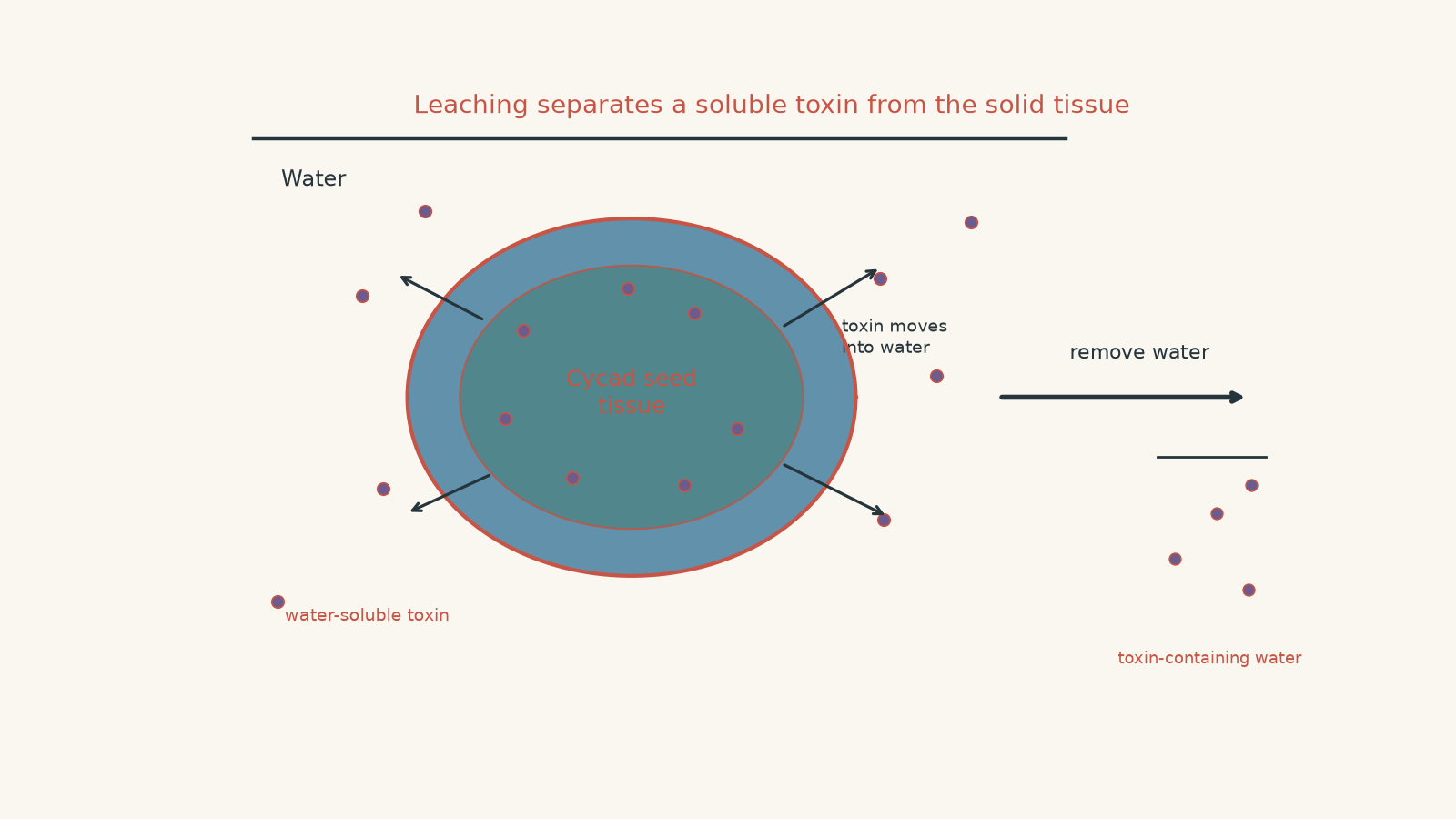
Picture a piece of cycad seed sitting in water. Some toxin molecules are inside the plant tissue. To remove them, three things need to happen:
- the molecules must be able to move through the plant material,
- they must enter the water,
- the toxin-containing water must then be physically removed.
The third step is easy to overlook. Dissolving a toxin is not the same as getting rid of it.
If you put sugar into a cup of tea, the sugar hasn’t vanished. It has moved from a solid phase into a liquid phase. Cycad leaching uses the same basic separation idea: a soluble substance moves from plant material into water, and the water can carry that substance away.
The proper chemistry term is solid-liquid extraction, often called leaching when soluble material is washed out of a solid.
02Why cycasin can move into water
One important cycad toxin is cycasin, an azoxyglycoside. Part of its structure is a glucose unit containing several polar hydroxyl, \(-\mathrm{OH}\), groups.
Water molecules are also polar. The oxygen end of a water molecule carries a partial negative charge, while its hydrogen ends carry partial positive charges. This allows water to form hydrogen-bonding interactions with the polar parts of cycasin.
The useful first rule is therefore:
A molecule with strong favourable interactions with water is more likely to dissolve in water.
PubChem reports that cycasin is readily soluble in water, which helps explain why water-based processing can remove it from plant material. PubChem
“Like dissolves like” is a decent shortcut here, but it is not an exact law. Solubility depends on the whole molecule and the balance between solute-solute, solvent-solvent, and solute-solvent interactions. We should not conclude that every polar toxin will behave identically.
03Why fresh water matters
Suppose cycasin begins moving from the seed material into surrounding water. At first, the water contains almost no cycasin, so there is a strong concentration difference between the plant material and the water.
As cycasin accumulates in the water, that difference becomes smaller. Eventually, the system may approach an equilibrium distribution between toxin remaining in the solid material and toxin dissolved in the liquid.
Now drain away the toxin-containing water and replace it with fresh water.
What happens?
The dissolved cycasin has physically left the system. The new water begins with a much lower cycasin concentration, so more cycasin can transfer out of the plant material.
Think of the fresh water as an empty bus arriving outside a painfully crowded party. The first bus carries some people away. Sending the same full bus back inside won’t help much. Sending a new empty bus gives more people somewhere to go.
The analogy breaks because molecules do not choose buses, and their movement is governed by diffusion and intermolecular interactions. But it captures the useful part: repeatedly removing the receiving phase allows further material to leave the original phase.
This is why one long contact with unchanged water and several contacts with fresh water are not necessarily equivalent.
04A simple mathematical model of repeated washing
Suppose a fraction \(p\) of the toxin present is removed during each identical fresh-water extraction.
The fraction left after one extraction is
\[ r = 1-p \]
where:
- \(p\) is the fraction removed in each extraction,
- \(r\) is the fraction remaining.
If the original toxin mass is \(M_0\), then after \(n\) identical extractions,
\[ M_n=M_0r^n \]
where \(M_n\) is the mass remaining after \(n\) extractions.
This equation is a model. Real plant material will not necessarily lose exactly the same fraction every time, because diffusion, changing tissue structure, multiple compounds, and incomplete equilibration can all matter.
Worked example: How much remains after three extractions?
A hypothetical plant sample contains 150 mg of a water-soluble model toxin. Under fixed laboratory conditions, each fresh-water extraction removes 40% of the toxin present at the start of that extraction. Calculate the toxin remaining after three extractions.
Step 1
If 40% is removed, then 60% remains:
\[ r=1-0.40=0.60 \]
Step 2
\[ M_n=M_0r^n \]
Substituting \(M_0=150\text{ mg}\), \(r=0.60\), and \(n=3\):
\[ M_3=150(0.60)^3 =150(0.216) =32.4\text{ mg} \]
Step 3
\[ m_{\text{removed}}=150-32.4=117.6\text{ mg} \]
The percentage removed is
\[ \frac{117.6}{150}\times100=78.4\% \]
So 32.4 mg remains, meaning 78.4% of the original toxin has been removed in this model.
Notice the trap. Three extractions that each remove 40% do not remove \(3\times40\%=120\%\). Each 40% applies to the smaller amount that is still present.
05A more precise model: partitioning between two phases
The constant-percentage model is useful, but it hides the reason that fraction is removed.
A more precise approach considers the way a substance distributes itself between the solid phase and water.
For an idealised system, define a partition coefficient
\[ K=\frac{C_s}{C_w} \]
where:
- \(K\) is the dimensionless partition coefficient,
- \(C_s\) is the equilibrium concentration of toxin in an effective solid phase,
- \(C_w\) is the equilibrium concentration in water.
A large \(K\) means the substance strongly prefers the solid phase. A small \(K\) means it prefers the water.
If the effective solid-phase volume is \(V_s\) and the water volume is \(V_w\), the fraction remaining in the solid after equilibrium can be written as
\[ f=\frac{KV_s}{KV_s+V_w} \]
This is an idealised extraction model, not a measured equation for preparing cycad seeds. Its job is to show the chemistry of solvent partitioning.
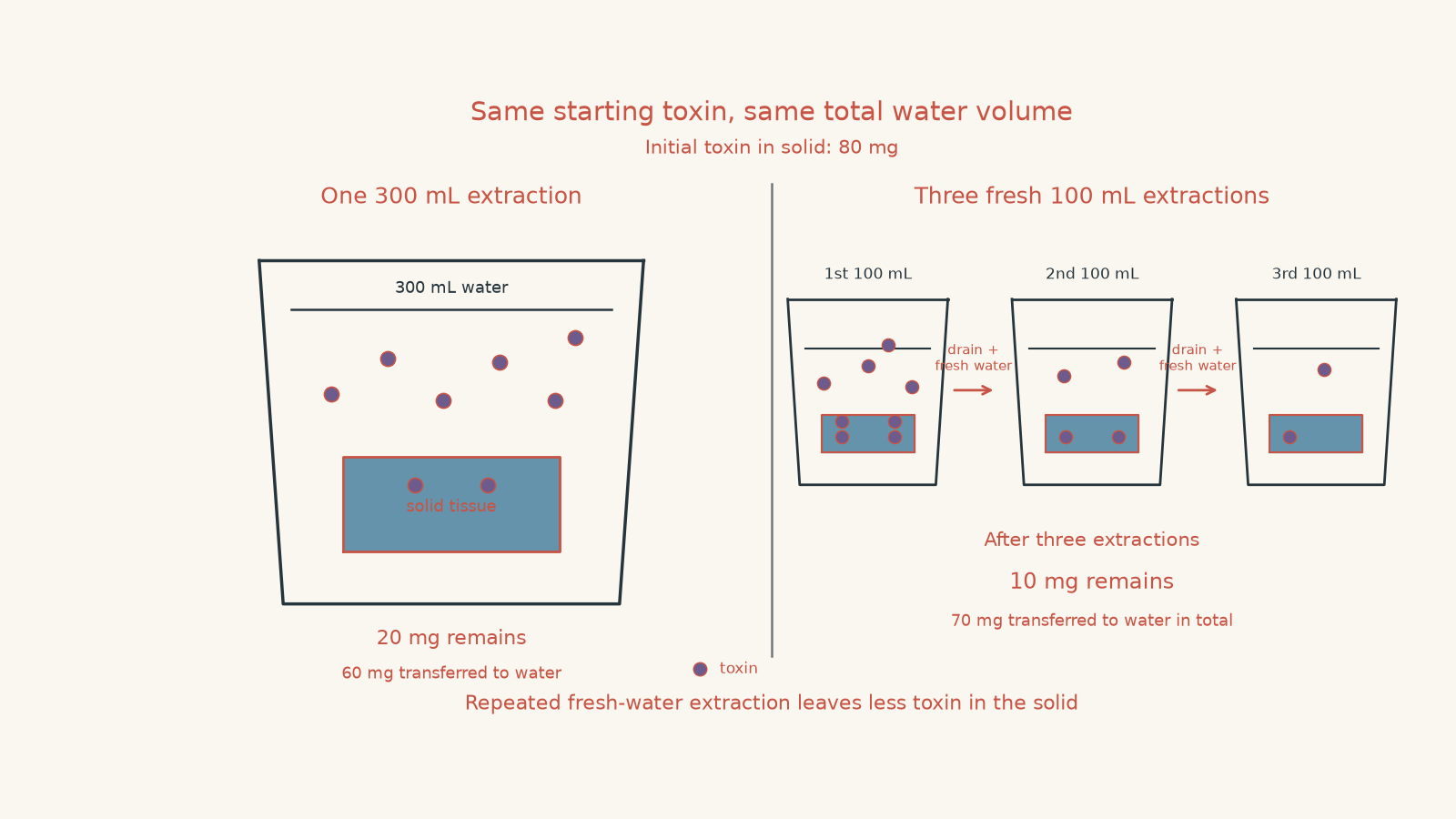
Worked example: One large extraction or several smaller ones?
A model plant sample initially contains 80 mg of a soluble compound. Its partition coefficient is \(K=1.0\), and its effective solid-phase volume is 100 mL.
Compare:
- one extraction using 300 mL of water, and
- three successive extractions using 100 mL of fresh water each.
Both methods use a total of 300 mL of water.
Step 1
\[ f=\frac{KV_s}{KV_s+V_w} \]
Substituting \(K=1.0\), \(V_s=100\text{ mL}\), and \(V_w=300\text{ mL}\):
\[ f=\frac{(1.0)(100)}{(1.0)(100)+300} =\frac{100}{400} =0.25 \]
The mass remaining is
\[ M=80(0.25)=20\text{ mg} \]
So the single large extraction removes
\[ 80-20=60\text{ mg} \]
Step 2
\[ f=\frac{(1.0)(100)}{(1.0)(100)+100} =\frac12 \]
Half remains after each extraction.
Step 3
\[ M_3=80\left(\frac12\right)^3 =10\text{ mg} \]
So the three smaller extractions remove
\[ 80-10=70\text{ mg} \]
Step 4
Both methods used 300 mL of water, but the repeated extractions left 10 mg rather than 20 mg.
Why? Each time the used water was removed, dissolved solute left with it. Fresh water then created a new partitioning step.
06Solubility is only half the story
A student might now predict:
If cycasin is soluble in water, just use enough water and the problem is solved.
That is too simple.
The molecule must first reach the water. If it is trapped deep inside plant tissue, the process can be limited by mass transfer rather than equilibrium solubility.
Imagine dropping a sugar cube into water. Sugar is highly soluble, but an untouched cube does not disappear instantly. Molecules at or near the surface dissolve first. More sugar must then reach the surface.
Plant tissue creates an even more complicated pathway.
This gives us two different questions:
- Equilibrium question: how much toxin can ultimately distribute into the water?
- Kinetics question: how quickly can it get there?
Confusing those questions causes a lot of weak chemistry explanations.
07Why crushing can speed extraction without changing solubility
Breaking plant material into smaller pieces generally increases its exposed surface area and shortens the average distance that molecules must travel before reaching water.
That can make extraction faster.
It does not automatically make the toxin intrinsically more soluble.
Suppose crushed material and large pieces both eventually give the same equilibrium concentration in the water, but the crushed material reaches that concentration much sooner. The sensible conclusion is that crushing changed the rate of mass transfer, not the final equilibrium solubility.
A useful decision table is:
| Change | Main effect in the simple model |
|---|---|
| Replace used water with fresh water | Allows another extraction and removes previously dissolved solute |
| Increase water volume | Gives the solute a larger receiving phase |
| Break material into smaller pieces | Usually increases extraction rate by increasing surface area and shortening diffusion distances |
| Agitate the water | Usually increases mass-transfer rate near the solid surface |
| Increase contact time | Helps while the system is still approaching equilibrium |
| Keep waiting after equilibrium is reached | Gives little extra removal unless another slow process is occurring |
Temperature can affect both diffusion and equilibrium solubility, but there is no safe universal rule that “hotter always removes more”. The effect depends on the substance and the system.
08Cultural knowledge is more complicated than a chemistry diagram
Australian Aboriginal peoples developed different ways of processing toxic cycad seeds in different places and for different species. A major ethnobotanical review found substantial variation in the treatment of Australian genera including Cycas, Macrozamia, Bowenia, and Lepidozamia. The Australian Museum
A 1992 study of Cycas seed processing in northern Australia described several broad approaches, including water leaching and ageing. Analysis of the methods studied found effective removal of cycasin, while also showing that the different processes produced foods with different storage and handling properties. FAO AGRIS
That matters because it would be inaccurate to reduce generations of place-specific knowledge to “people discovered that washing removes poison”. The chemistry of water-soluble compounds helps us explain one part of what is happening. It does not replace the broader knowledge about species identification, harvesting, processing, timing, food properties, and cultural practice.
This guide therefore focuses on the publicly described chemistry of leaching rather than reproducing a preparation procedure.
09The one-toxin model is useful – and incomplete
So far, we have spoken mainly about cycasin because it provides a clear solubility example.
Real cycads contain multiple potentially harmful compounds.
A 2026 study of Cycas angulata analysed several major toxin classes across different seed tissues, including azoxyglycosides such as cycasin, BMAA, and β-sitosterol β-D-glucoside. Their distributions were not identical across the seed. PubMed
That creates an important scientific warning:
Removing one measured toxin is not automatically proof that the whole material has been made safe.
Different substances can have different solubilities, diffusion rates, concentrations, biological effects, and locations within the plant.
This is also why “detoxification” is a stronger claim than “the concentration of cycasin decreased”.
10The most tempting misconception: water destroys the toxin
Water leaching is mainly a separation, not a neutralisation reaction.
If cycasin moves from a seed into surrounding water, the cycasin molecules have not necessarily been chemically destroyed. They are now in a different place.
You could represent the physical idea schematically as
\[ \text{cycasin in plant material} \rightleftharpoons \text{cycasin dissolved in water} \]
This is not a balanced chemical reaction. It represents distribution between phases.
When the water is discarded, some cycasin leaves the system with it.
That distinction is useful far beyond cycads. The same question appears whenever chemists use extraction:
Are we reacting with the unwanted substance, or are we separating it from something else?
11Questions and solutions
Question 1
A model plant sample contains 50 mg of a water-soluble toxin. After the sample has contacted water for long enough to reach equilibrium, analysis shows that 18 mg of toxin is dissolved in the water and 32 mg remains in the plant material.
The water is drained away.
a. What mass of toxin has been removed from the plant material?
b. Explain why adding fresh water can remove additional toxin.
Solution 1
18 mg of toxin has been removed, and fresh water can remove more because it creates a new low-toxin aqueous phase into which additional toxin can transfer.
For part a, the drained water contains 18 mg, so
\[ m_{\text{removed}}=18\text{ mg} \]
and the remaining toxin is
\[ 50-18=32\text{ mg} \]
For part b, the important point is that draining the water physically removes the dissolved toxin from the system. Fresh water initially contains essentially none of the toxin, so the remaining toxin can again distribute from the plant material into the water.
A tempting answer is “fresh water dissolves toxin because water is a solvent”. That is true but incomplete. The crucial extra step is removing the contaminated solvent and replacing it, rather than leaving the same water in contact with the material indefinitely.
Question 2
A laboratory model starts with 200 mg of a water-soluble compound in plant tissue. Each identical extraction with fresh water removes 30% of the compound present at the beginning of that extraction.
Calculate:
a. the mass remaining after four extractions,
b. the percentage of the original compound removed.
Solution 2
After four extractions, 48.0 mg remains and approximately 76.0% of the original compound has been removed.
Each extraction removes 30%, so the fraction remaining is
\[ r=1-0.30=0.70 \]
Using
\[ M_n=M_0r^n \]
gives
\[ M_4=200(0.70)^4 =200(0.2401) =48.02\text{ mg} \]
So approximately
\[ M_4=48.0\text{ mg} \]
remains.
The mass removed is
\[ m_{\text{removed}}=200-48.02=151.98\text{ mg} \]
Therefore,
\[ \%\text{ removed} = \frac{151.98}{200}\times100 = 75.99\% \]
or approximately
\[ 76.0\% \]
The tempting mistake is to calculate \(4\times30\%=120\%\). That treats every extraction as though it acts on the original 200 mg. It does not. Each extraction acts only on what survived the previous one.
Question 3
A plant sample is extracted twice with water.
During the first extraction, 400 mL of water is collected with a measured toxin concentration of \(0.090\text{ g L}^{-1}\).
During the second extraction, 300 mL of water is collected with a measured toxin concentration of \(0.040\text{ g L}^{-1}\).
The plant sample originally contained 65 mg of the measured toxin.
Assuming the measurements are exact and there are no other losses, calculate:
a. the mass removed in each extraction,
b. the total mass removed,
c. the percentage of the original toxin remaining after both extractions.
Solution 3
The first extraction removes 36 mg, the second removes 12 mg, 48 mg is removed in total, and approximately 26.2% of the original toxin remains.
The governing relationship is
\[ c=\frac{m}{V} \]
so
\[ m=cV \]
where \(c\) is concentration in \(\text{g L}^{-1}\), \(m\) is mass in grams, and \(V\) is volume in litres.
For the first extraction,
\[ V_1=400\text{ mL}=0.400\text{ L} \]
so
\[ m_1=(0.090\text{ g L}^{-1})(0.400\text{ L}) =0.0360\text{ g} =36.0\text{ mg} \]
For the second extraction,
\[ V_2=300\text{ mL}=0.300\text{ L} \]
so
\[ m_2=(0.040\text{ g L}^{-1})(0.300\text{ L}) =0.0120\text{ g} =12.0\text{ mg} \]
The total removed is
\[ m_{\text{removed}}=36.0+12.0=48.0\text{ mg} \]
Therefore the mass remaining is
\[ m_{\text{remaining}}=65-48=17\text{ mg} \]
and the percentage remaining is
\[ \frac{17}{65}\times100 =26.2\% \]
The tempting shortcut is to add the concentrations, \(0.090+0.040=0.130\text{ g L}^{-1}\), and treat that as the total amount removed. Concentration is not mass. Because the two solution volumes are different, each concentration must first be converted to a mass.
Question 4
Equal masses of the same plant material are placed into 250 mL portions of water at the same temperature. One sample is finely crushed; the other is left as large pieces.
The measured concentration of a particular water-soluble compound is:
| Time | Finely crushed | Large pieces |
|---|---|---|
| 5 min | \(0.44\text{ g L}^{-1}\) | \(0.18\text{ g L}^{-1}\) |
| 10 min | \(0.68\text{ g L}^{-1}\) | \(0.33\text{ g L}^{-1}\) |
| 20 min | \(0.79\text{ g L}^{-1}\) | \(0.56\text{ g L}^{-1}\) |
| 40 min | \(0.80\text{ g L}^{-1}\) | \(0.79\text{ g L}^{-1}\) |
A student concludes:
Crushing makes the compound much more soluble in water.
Assess this conclusion. As part of your answer, calculate the difference in mass extracted from the two samples after 10 minutes.
Solution 4
The student’s conclusion is not supported: crushing mainly increased the rate of extraction, not the equilibrium solubility. After 10 minutes, the crushed sample has released 87.5 mg more compound into the water.
At 10 minutes, the crushed sample has concentration
\[ c=0.68\text{ g L}^{-1} \]
and the water volume is
\[ V=250\text{ mL}=0.250\text{ L} \]
so
\[ m_{\text{crushed}} = cV = (0.68)(0.250) = 0.170\text{ g} = 170\text{ mg} \]
For the large pieces,
\[ m_{\text{large}} = (0.33\text{ g L}^{-1})(0.250\text{ L}) = 0.0825\text{ g} = 82.5\text{ mg} \]
The difference is
\[ 170-82.5=87.5\text{ mg} \]
So crushing clearly affects how quickly the compound enters the water.
However, look at the 40-minute results. The crushed sample gives \(0.80\text{ g L}^{-1}\), while the large pieces give \(0.79\text{ g L}^{-1}\). Within the precision of these data, they approach essentially the same final concentration.
That is the crucial constraint.
If crushing had greatly increased the compound’s equilibrium solubility, we would expect the crushed sample to settle at a substantially higher final concentration. Instead, the main difference is how fast each sample approaches the same plateau.
The likely explanation is that crushing:
- increases surface area exposed to water, and
- reduces the average diffusion distance from inside the plant material to the surrounding water.
The student’s conclusion feels reasonable because the crushed sample has a higher concentration at every early measurement. The mistake is using a rate measurement to make an equilibrium claim.
Question 5
A researcher measures three compounds in equal-sized samples before and after an experimental water treatment.
| Compound | Before treatment | After treatment |
|---|---|---|
| Cycasin | 100 mg | 2 mg |
| BMAA | 20 mg | 15 mg |
| BSSG | 10 mg | 9 mg |
A student argues:
Cycasin fell by 98%, so the material has been 98% detoxified.
Another student adds the three masses and argues:
The total fell from 130 mg to 26 mg, so the material is 80% less toxic.
Evaluate both claims. State what can legitimately be concluded from the data and what further evidence would be needed before making a claim about overall toxicity.
Solution 5
Neither student can validly convert these chemical measurements directly into a percentage reduction in overall toxicity. The data support a 98% reduction in measured cycasin and an 80% reduction in the combined measured mass of these three compounds, but neither number is automatically a measure of biological hazard.
For cycasin,
\[ \%\text{ reduction} = \frac{100-2}{100}\times100 = 98\% \]
So the first student’s numerical statement about cycasin concentration is correct.
But “98% less cycasin” and “98% detoxified” are different claims. The second would require cycasin to account for all relevant toxicity, which the data do not establish.
For the three measured compounds together,
\[ m_{\text{before}}=100+20+10=130\text{ mg} \]
and
\[ m_{\text{after}}=2+15+9=26\text{ mg} \]
so the combined measured mass has fallen by
\[ \frac{130-26}{130}\times100 = 80\% \]
That arithmetic is valid. The second student’s interpretation is not.
One milligram of cycasin, BMAA, and BSSG cannot simply be treated as one milligram of the same biological effect. Different chemicals can have different toxic mechanisms, potencies, absorption, target organs, and dose-response relationships.
There is another problem. The analysis measures only three compounds. An unmeasured toxic substance could remain unchanged, or processing could change the chemical form or availability of a compound.
This is the hinge in the problem: analytical concentration is evidence, but it is not automatically the same thing as biological risk.
A stronger claim about overall detoxification would require evidence such as reliable measurements of the relevant toxic compounds before and after processing, knowledge of their biological effects and dose-response relationships, appropriate assessment of any important unmeasured compounds, and evidence that the analytical results are representative of the particular species and plant tissue being studied.
The most defensible conclusion from the table is therefore:
- measured cycasin decreased by 98%,
- the combined measured mass of the three listed compounds decreased by 80%,
- BMAA and BSSG were removed much less effectively than cycasin,
- the data alone do not establish a numerical percentage reduction in overall toxicity.
That is a much more careful scientific conclusion than either student’s first answer.
12What this idea lets you understand next
Cycad leaching gives you a useful model for a much broader piece of chemistry: separation depends on where a substance prefers to be, how quickly it can move there, and whether you actually remove the phase containing it.
The same reasoning appears in solvent extraction, chromatography, environmental contaminant removal, and analytical sample preparation.
When you meet one of those problems, ask three questions in order:
Where will the substance distribute at equilibrium? How fast can it get there? What physical step actually separates it from the rest of the system?
Those questions stop “it dissolves” from becoming the end of the explanation when, chemically, it is only the beginning.