
Acid-Base Reactions: Proton Transfer and Neutralisation
Learn how to identify acid-base reactions, track proton transfer, predict products, and write molecular and net ionic equations for HSC Chemistry.
A bottle labelled hydrochloric acid and a bottle labelled sodium hydroxide look equally uninteresting: two clear solutions. Mix the right amounts, though, and the mixture warms up. Something has reacted.
Which particles actually changed? You might predict that every ion in the two solutions must take part. That sounds reasonable, but it isn’t what happens. The sodium and chloride ions mostly watch from the sidelines. The important event is much simpler: an acid gives away a proton, and a base accepts it.
That proton transfer is the key to identifying acid-base reactions, predicting their products, and writing equations that show what is really happening.
01Start by looking for a proton transfer
Suppose hydrochloric acid reacts with sodium hydroxide:
\[
\ce{HCl(aq) + NaOH(aq) -> NaCl(aq) + H2O(l)}
\]
You may already recognise this as neutralisation. But “acid + base gives salt + water” is only one useful pattern. It doesn’t explain why the reaction occurs, and it won’t handle every acid-base reaction.
A better mental model is to imagine a proton, \(\mathrm{H}^{+}\), changing partners.
The acid is the species willing to give the proton away. The base is the species able to take it.
It is a bit like an extremely dramatic dating show where the only contestant is one proton. The acid arrives holding the proton, the base takes it, and the acid leaves as a different species. The analogy breaks because particles aren’t choosing partners, and real proton transfer is governed by chemical energetics and equilibrium. Still, it gives us the right thing to track: where does the proton go?
This leads to the Brønsted-Lowry definitions:
- A Brønsted-Lowry acid is a proton donor.
- A Brønsted-Lowry base is a proton acceptor.
The proton is \(\mathrm{H}^{+}\), which is a hydrogen atom that has lost its electron.
In water, an isolated \(\mathrm{H}^{+}\) does not simply float around by itself. It associates strongly with water molecules. We often represent the protonated water molecule as hydronium, \(\ce{H3O+}\). HSC equations may also use \(\mathrm{H}^{+}\) as convenient shorthand.
02How to identify an acid-base reaction
When you are given a reaction, don’t begin by asking, “Does this formula look like an acid?”
Ask two more useful questions:
- Did one species lose an \(\mathrm{H}^{+}\)?
- Did another species gain that \(\mathrm{H}^{+}\)?
If both happen, you have proton transfer.
Consider:
\[
\ce{HCl + H2O -> H3O+ + Cl-}
\]
Track the proton.
- \(\ce{HCl}\) becomes \(\mathrm{Cl}^{-}\). It has lost \(\mathrm{H}^{+}\), so \(\ce{HCl}\) is acting as the acid.
- \(\ce{H2O}\) becomes \(\ce{H3O+}\). It has gained \(\mathrm{H}^{+}\), so \(\ce{H2O}\) is acting as the base.
Now consider ammonia:
\[
\ce{NH3 + H2O <=> NH4+ + OH-}
\]
Which reactant is the acid this time?
It is tempting to say water must be the base because water accepted a proton in the previous reaction. But a species does not have one permanent role in every reaction.
Here:
- \(\ce{NH3}\) becomes \(\ce{NH4+}\), so ammonia gains \(\mathrm{H}^{+}\) and acts as the base.
- \(\ce{H2O}\) becomes \(\ce{OH-}\), so water loses \(\mathrm{H}^{+}\) and acts as the acid.
Water can therefore act as either an acid or a base, depending on what it reacts with.
03Conjugate acid-base pairs
Whenever an acid donates a proton, it becomes its conjugate base.
Whenever a base accepts a proton, it becomes its conjugate acid.
For the reaction
\[
\ce{HCl + H2O -> H3O+ + Cl-}
\]
the pairs are:
| Species | Role | Becomes |
|---|---|---|
| \(\ce{HCl}\) | acid | \(\mathrm{Cl}^{-}\), its conjugate base |
| \(\ce{H2O}\) | base | \(\ce{H3O+}\), its conjugate acid |
A conjugate acid-base pair differs by exactly one proton.
That gives you a powerful checking rule. If two supposed conjugates differ by an oxygen atom, a carbon atom, or two hydrogens, something has gone wrong.
For example:
\[
\ce{NH4+ <=> NH3 + H+}
\]
\(\ce{NH4+}\) and \(\ce{NH3}\) differ by one \(\mathrm{H}^{+}\), so they are a conjugate acid-base pair.
04Predicting products from proton transfer
For a straightforward Brønsted-Lowry reaction, you can predict the products without memorising a giant list.
Suppose you are asked to predict the products of:
\[
\ce{HNO3 + H2O -> ?}
\]
First, decide which species is likely to donate the proton. Nitric acid, \(\ce{HNO3}\), donates \(\mathrm{H}^{+}\).
Remove one \(\mathrm{H}^{+}\) from \(\ce{HNO3}\):
\[
\ce{HNO3 -> NO3-}
\]
Then add that proton to water:
\[
\ce{H2O -> H3O+}
\]
So:
\[
\ce{HNO3 + H2O -> NO3- + H3O+}
\]
Notice that atoms and overall charge are conserved. This is the same conservation requirement used whenever you track the rearrangement of atoms in chemical reactions.
Worked example: Identify the acid, base, and conjugate pairs
For the reaction below, identify the acid, base, conjugate acid, and conjugate base.
\[
\ce{CH3COOH + H2O <=> CH3COO- + H3O+}
\]
Step 1
\(\ce{CH3COOH}\) becomes \(\ce{CH3COO-}\). It has lost \(\mathrm{H}^{+}\), so \(\ce{CH3COOH}\) is the acid.
Step 2
\(\ce{H2O}\) becomes \(\ce{H3O+}\). It has gained \(\mathrm{H}^{+}\), so \(\ce{H2O}\) is the base.
Step 3
\[
\ce{CH3COOH / CH3COO-}
\]
is one conjugate acid-base pair.
\[
\ce{H2O / H3O+}
\]
is the other.
So:
- acid: \(\ce{CH3COOH}\)
- base: \(\ce{H2O}\)
- conjugate base: \(\ce{CH3COO-}\)
- conjugate acid: \(\ce{H3O+}\)
The important idea is not the labels themselves. It is that the proton has moved from ethanoic acid to water.
05Neutralisation is a particular kind of acid-base reaction
You will often meet reactions between acids and metal hydroxides such as sodium hydroxide.
For example:
\[
\ce{HCl(aq) + NaOH(aq) -> NaCl(aq) + H2O(l)}
\]
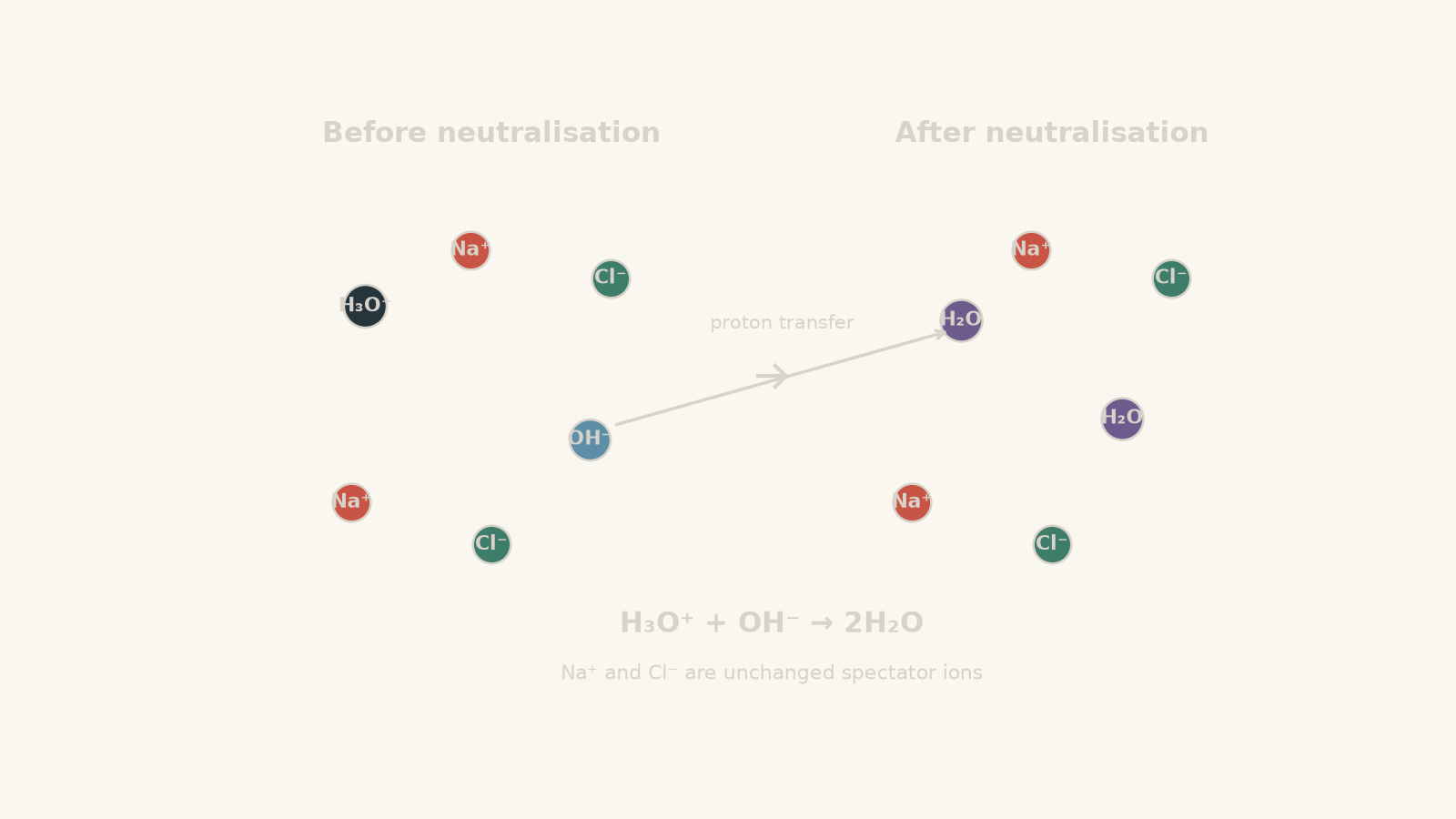
At first glance, four different species seem involved. In aqueous solution, however, the soluble substances separate into ions:
\[
\ce{H+(aq) + Cl-(aq) + Na+(aq) + OH-(aq) -> Na+(aq) + Cl-(aq) + H2O(l)}
\]
The \(\mathrm{Na}^{+}\) and \(\mathrm{Cl}^{-}\) ions appear unchanged on both sides. They are spectator ions.
Remove them:
\[
\ce{H+(aq) + OH-(aq) -> H2O(l)}
\]
Or, using hydronium explicitly:
\[
\ce{H3O+(aq) + OH-(aq) -> 2H2O(l)}
\]
This is the core proton-transfer process in the neutralisation of a strong acid by a soluble hydroxide.
If you need more practice deciding which ions stay unchanged and which belong in a net ionic equation, the same spectator-ion logic also appears in precipitation reactions and net ionic equations.
Worked example: Write the molecular and net ionic equations
Sulfuric acid reacts with aqueous potassium hydroxide. Write a balanced molecular equation and the corresponding net ionic equation.
Step 1
An acid reacting with a metal hydroxide forms a salt and water.
The salt contains potassium ions, \(\mathrm{K}^{+}\), and sulfate ions, \(\ce{SO4^2-}\), so its formula is \(\ce{K2SO4}\).
Start with:
\[
\ce{H2SO4 + KOH -> K2SO4 + H2O}
\]
Step 2
Two potassium ions are required for one sulfate ion, so place a coefficient of 2 before \(\ce{KOH}\).
There are now four hydrogen atoms on the left, so two water molecules are required:
\[
\ce{H2SO4(aq) + 2KOH(aq) -> K2SO4(aq) + 2H2O(l)}
\]
Step 3
In the simplified strong-acid treatment, the reacting species are \(\mathrm{H}^{+}\) and \(\ce{OH-}\). Potassium and sulfate ions do not undergo the proton-transfer step.
The net ionic equation is:
\[
\ce{H+(aq) + OH-(aq) -> H2O(l)}
\]
Step 4
The coefficients in the full equation tell us that one mole of \(\ce{H2SO4}\) can supply enough acidic protons to react with two moles of \(\ce{KOH}\). The net ionic equation is written in its simplest whole-number form because each proton neutralises one hydroxide ion.
06Not every acid-base reaction makes water
This is where the simple rule “acid + base gives salt + water” becomes incomplete.
Consider ammonia reacting with an acid:
\[
\ce{NH3(aq) + H+(aq) -> NH4+(aq)}
\]
Ammonia accepts a proton, so it is clearly acting as a Brønsted-Lowry base. But hydroxide ions are not involved, so there is no requirement for water to appear as a product in this simplified proton-transfer equation.
The more general rule is:
\[
\text{acid + base} \rightarrow \text{conjugate base + conjugate acid}
\]
That description works more widely than “salt + water”.
07Acid reactions with oxides and hydroxides
Many metal oxides and metal hydroxides act as bases.
For example:
\[
\ce{2HCl(aq) + MgO(s) -> MgCl2(aq) + H2O(l)}
\]
The oxide ion in the ionic solid can accept protons. Conceptually:
\[
\ce{O^2- + 2H+ -> H2O}
\]
A hydroxide ion needs one proton:
\[
\ce{OH- + H+ -> H2O}
\]
This helps you predict coefficients instead of guessing them.
For instance, \(\ce{Ca(OH)2}\) contains two hydroxide groups per formula unit, so complete neutralisation requires two acidic protons:
\[
\ce{2HCl(aq) + Ca(OH)2(aq) -> CaCl2(aq) + 2H2O(l)}
\]
08What happens with carbonates?
Acid-carbonate reactions can look like an entirely separate reaction type because you see bubbling.
For example:
\[
\ce{2HCl(aq) + Na2CO3(aq) -> 2NaCl(aq) + H2O(l) + CO2(g)}
\]
The gas is carbon dioxide.
There is still acid-base chemistry underneath the observation. Carbonate ions accept protons. A useful simplified sequence is:
\[
\ce{CO3^2- + H+ -> HCO3-}
\]
followed by:
\[
\ce{HCO3- + H+ -> H2CO3}
\]
Carbonic acid, \(\ce{H2CO3}\), is unstable under ordinary conditions and can form carbon dioxide and water:
\[
\ce{H2CO3 -> CO2 + H2O}
\]
Combining these steps gives:
\[
\ce{CO3^2- + 2H+ -> CO2 + H2O}
\]
This explains two things at once: carbonate behaves as a base by accepting protons, and the final observable product includes a gas.
Worked example: Predict an acid-carbonate reaction
Nitric acid reacts with solid calcium carbonate. Predict the products and write the balanced equation.
Step 1
An acid reacting with a carbonate forms a salt, water, and carbon dioxide.
The ions that form the salt are \(\mathrm{Ca}^{2+}\) and \(\ce{NO3-}\), giving \(\ce{Ca(NO3)2}\).
Step 2
\[
\ce{HNO3 + CaCO3 -> Ca(NO3)2 + H2O + CO2}
\]
Step 3
There are two nitrate ions in \(\ce{Ca(NO3)2}\), so two nitric acid molecules are needed:
\[
\ce{2HNO3 + CaCO3 -> Ca(NO3)2 + H2O + CO2}
\]
The equation is now balanced.
Including states:
\[
\ce{2HNO3(aq) + CaCO3(s) -> Ca(NO3)2(aq) + H2O(l) + CO2(g)}
\]
Step 4
The solid carbonate is consumed, and carbon dioxide gas is produced, so bubbling would be expected. The proton-transfer step is still central, even though the final products are more complicated than simple hydroxide neutralisation.
09The tempting shortcut that causes mistakes
A common shortcut is:
“If a substance contains H, it is an acid. If it contains OH, it is a base.”
That sometimes points you in the right direction, but it is not a definition.
Methane, \(\ce{CH4}\), contains hydrogen but is not treated as a Brønsted-Lowry acid in ordinary HSC acid-base reactions.
Ammonia, \(\ce{NH3}\), contains no \(\ce{OH}\) group but is a base because it can accept a proton:
\[
\ce{NH3 + H+ -> NH4+}
\]
The safer decision rule is always based on proton transfer.
| What to look for | What it tells you |
|---|---|
| Species loses one \(\mathrm{H}^{+}\) | It acted as an acid |
| Species gains one \(\mathrm{H}^{+}\) | It acted as a base |
| Two species differ by one \(\mathrm{H}^{+}\) | They may be a conjugate acid-base pair |
| \(\mathrm{H}^{+}\) reacts with \(\ce{OH-}\) | Neutralisation forms water |
| Acid reacts with carbonate | Expect proton transfer, then \(\ce{CO2}\) and \(\ce{H2O}\) |
| Ions appear unchanged on both sides | They are spectators and can be removed from a net ionic equation |
10Another important trap: acid reactions are not all acid-base reactions
Suppose hydrochloric acid reacts with magnesium:
\[
\ce{Mg(s) + 2HCl(aq) -> MgCl2(aq) + H2(g)}
\]
You might classify this as an acid-base reaction simply because an acid appears on the left.
But look at what changes. Magnesium atoms become \(\mathrm{Mg}^{2+}\), and hydrogen ions become hydrogen gas. Electrons are transferred.
That makes this a redox reaction, not simply a Brønsted-Lowry proton-transfer reaction.
So “contains an acid” is not enough to identify the reaction type. You must look at the actual chemical change.
11A reliable method for HSC questions
When you need to identify or represent an acid-base reaction, use this sequence:
- Identify a possible proton donor. Look for a species that could lose one \(\mathrm{H}^{+}\).
- Identify a possible proton acceptor. Look for a species that could gain that proton.
- Track the proton explicitly. Write what each reactant becomes after losing or gaining \(\mathrm{H}^{+}\).
- Check atoms and charge. Both must be conserved.
- Decide which equation is being requested. A molecular equation, complete ionic equation, and net ionic equation are not the same thing.
- Look for a follow-up process. Carbonic acid forming \(\ce{CO2}\) and water is a common example.
- Do not force the neutralisation template onto every reaction. Proton transfer is the broader idea.
12Questions and solutions
Question 1
In the reaction
\[
\ce{HBr + H2O -> H3O+ + Br-}
\]
identify the acid, base, conjugate acid, and conjugate base.
Solution 1
\(\ce{HBr}\) is the acid, \(\ce{H2O}\) is the base, \(\ce{H3O+}\) is the conjugate acid, and \(\mathrm{Br}^{-}\) is the conjugate base.
\(\ce{HBr}\) loses one proton:
\[
\ce{HBr -> Br- + H+}
\]
so it acts as the proton donor.
Water accepts that proton:
\[
\ce{H2O + H+ -> H3O+}
\]
so water acts as the base.
The conjugate pairs are therefore \(\ce{HBr/Br-}\) and \(\ce{H2O/H3O+}\). Each pair differs by exactly one proton.
Question 2
Ethanoic acid reacts with aqueous sodium hydroxide.
Write:
a. the balanced molecular equation
b. the net ionic equation
c. the Brønsted-Lowry base involved in the net ionic reaction.
Solution 2
The molecular equation is
\[
\ce{CH3COOH(aq) + NaOH(aq) -> CH3COONa(aq) + H2O(l)}
\]
and the net ionic equation is
\[
\ce{CH3COOH(aq) + OH-(aq) -> CH3COO-(aq) + H2O(l)}
\]
The Brønsted-Lowry base is \(\ce{OH-}\).
Ethanoic acid is a weak acid, so it is normally left undissociated in the net ionic equation rather than being written entirely as \(\mathrm{H}^{+}\) and \(\ce{CH3COO-}\).
The hydroxide ion accepts a proton:
\[
\ce{OH- + H+ -> H2O}
\]
while ethanoic acid loses that proton and becomes \(\ce{CH3COO-}\).
The tempting mistake is to write
\[
\ce{H+ + OH- -> H2O}
\]
as though ethanoic acid were already completely separated into ions. That equation describes strong-acid neutralisation well, but it hides the actual weak-acid species taking part here.
Question 3
A student writes the following equation for the reaction between phosphoric acid and potassium hydroxide:
\[
\ce{H3PO4 + KOH -> K3PO4 + H2O}
\]
Explain why the equation is not balanced, then write the balanced equation for complete neutralisation.
Solution 3
Three moles of \(\ce{KOH}\) are required for every mole of \(\ce{H3PO4}\), giving
\[
\ce{H3PO4(aq) + 3KOH(aq) -> K3PO4(aq) + 3H2O(l)}
\]
The original equation contains only one potassium atom on the left but three in \(\ce{K3PO4}\) on the right. It also fails to account correctly for the three acidic hydrogens in \(\ce{H3PO4}\).
For complete neutralisation, all three acidic protons are accounted for. Three hydroxide ions can accept those three protons:
\[
\ce{3H+ + 3OH- -> 3H2O}
\]
The trap is to see “acid + hydroxide” and automatically use a 1:1 ratio. The reacting ratio depends on how many acidic protons are being neutralised and how many hydroxide ions each formula unit supplies.
Question 4
Hydrogen carbonate ions can react both with acids and with bases.
Predict the product containing carbon when \(\ce{HCO3-}\):
a. accepts a proton from an acid
b. donates a proton to a strong base.
Use equations to explain why \(\ce{HCO3-}\) cannot be labelled as “always an acid” or “always a base”.
Solution 4
\(\ce{HCO3-}\) can act as either a base or an acid, depending on the reacting species.
When it accepts a proton, it acts as a base:
\[
\ce{HCO3- + H+ -> H2CO3}
\]
The \(\ce{H2CO3}\) formed can then produce carbon dioxide and water:
\[
\ce{H2CO3 -> CO2 + H2O}
\]
So the overall process may be represented as:
\[
\ce{HCO3- + H+ -> CO2 + H2O}
\]
When hydrogen carbonate donates a proton to hydroxide ions, it acts as an acid:
\[
\ce{HCO3- + OH- -> CO3^2- + H2O}
\]
Here, \(\ce{HCO3-}\) loses \(\mathrm{H}^{+}\) and becomes \(\ce{CO3^2-}\).
The key point is that acid and base labels describe a species’ role in a particular proton-transfer reaction. Hydrogen carbonate is able both to accept and to donate a proton, so its role depends on what it reacts with.
Question 5
Two students are given the reaction
\[
\ce{NH4+ + OH- -> NH3 + H2O}
\]
Student A says, “The hydroxide ion is the base because it contains \(\ce{OH}\).”
Student B says, “The ammonium ion is an acid because it transfers a proton to hydroxide.”
Which reasoning is chemically stronger? Identify both acid-base conjugate pairs and explain what evidence actually establishes each role.
Solution 5
Student B gives the stronger chemical reasoning because the roles are established by tracking proton transfer, not by recognising a particular group in a formula.
The reaction is:
\[
\ce{NH4+ + OH- -> NH3 + H2O}
\]
The ammonium ion changes from \(\ce{NH4+}\) to \(\ce{NH3}\). It has lost one proton:
\[
\ce{NH4+ -> NH3 + H+}
\]
so \(\ce{NH4+}\) acts as the acid, and \(\ce{NH3}\) is its conjugate base.
The hydroxide ion changes from \(\ce{OH-}\) to \(\ce{H2O}\). It has gained one proton:
\[
\ce{OH- + H+ -> H2O}
\]
so \(\ce{OH-}\) acts as the base, and \(\ce{H2O}\) is its conjugate acid.
The conjugate pairs are therefore:
\[
\ce{NH4+ / NH3}
\]
and
\[
\ce{H2O / OH-}
\]
Student A reaches the correct label for hydroxide, but the reasoning is unreliable. A formula containing \(\ce{OH}\) does not, by itself, prove that a species is acting as a Brønsted-Lowry base. The evidence is that \(\ce{OH-}\) actually accepts a proton in this reaction.
Once you can follow the proton rather than just memorise reaction patterns, acid-base chemistry becomes much easier to extend. The next useful step is equilibrium: some proton transfers go almost completely towards products, while others establish a significant mixture of reactants and products. That is where acid strength, base strength, \(K_a\), and pH start to connect back to the same proton-transfer model.