
How Temperature Changes Keq in Endothermic and Exothermic Reactions
Learn how changing temperature affects equilibrium constants for endothermic and exothermic reactions. This guide explains why temperature changes Keq and how to predict equilibrium shifts.
A reaction mixture can sit in a sealed container for hours and still contain both reactants and products. A student might think, “If the reaction is still happening, surely the amount of product must keep increasing.” But that prediction fails once the system reaches equilibrium.
Now imagine you heat the container. What should happen to the balance between reactants and products? Does heating simply make more collisions happen, or can it actually change the final mixture?
The answer depends on whether the reaction absorbs or releases heat. Temperature is special because it can change the value of the equilibrium constant, \(K_\mathrm{eq}\), rather than just changing how quickly equilibrium is reached.

01First idea: equilibrium as a balance
A reversible reaction can move in two directions:
\[ \ce{Reactants <=> Products} \]
At equilibrium, the forward reaction and reverse reaction are still occurring. They have simply reached the same rate.
A useful mental model is two people passing tennis balls between buckets. At first, one bucket might fill quickly because many balls are being thrown in one direction. Later, both people are passing balls at the same rate, so the amounts in each bucket stay constant.
The buckets are not “finished”. They are balanced.
For a chemical reaction, this balance is represented by the equilibrium constant:
\[ K_\mathrm{eq} \]
The value of \(K_\mathrm{eq}\) tells us where the equilibrium position lies.
- A large \(K_\mathrm{eq}\) means equilibrium contains mostly products.
- A small \(K_\mathrm{eq}\) means equilibrium contains mostly reactants.
A key point:
Changing concentration or pressure can shift the position of equilibrium, but changing temperature can change the value of \(K_\mathrm{eq}\) itself.
This distinction is easy to miss.
You can read more about how equilibrium constants describe acid, base, and ionic systems in the tutorgum guide on Keq, Ka and Kb for Acid, Base and Ionic Equilibria.
02The missing piece: heat is part of the reaction
To predict what temperature does, treat heat as either a reactant or a product.
Endothermic reactions
An endothermic reaction absorbs heat:
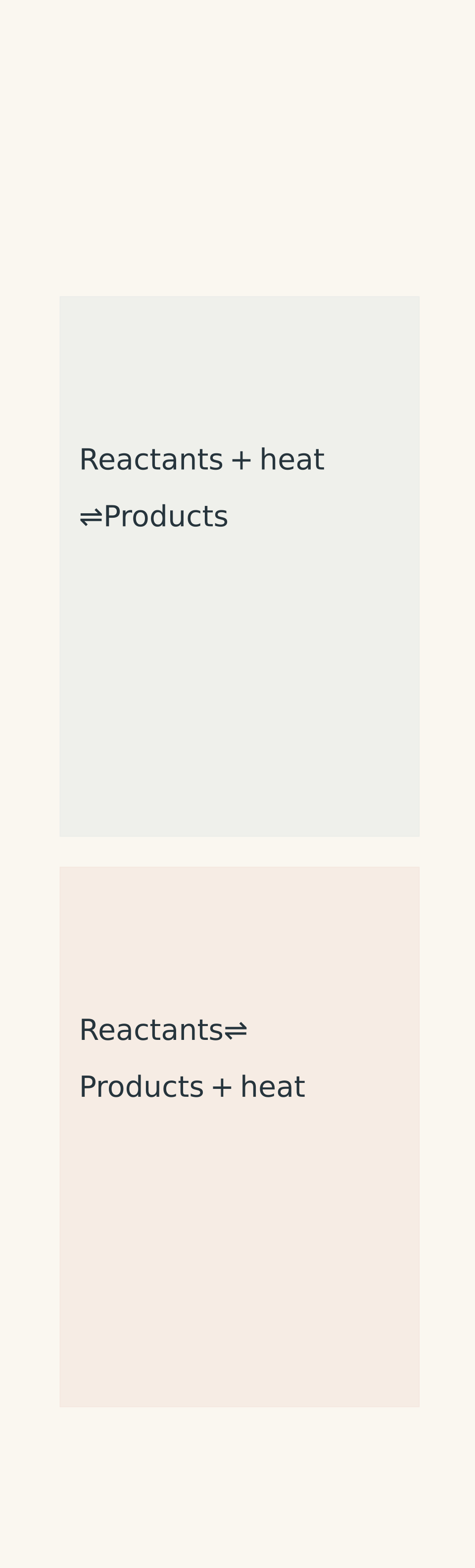
\[ \ce{Reactants + heat <=> Products} \]
Heat behaves like a reactant. If you add heat by increasing temperature, the system has extra “reactant” available, so the equilibrium shifts to use it.
The result:
- more products form,
- \(K_\mathrm{eq}\) increases.
If temperature decreases:
- the system tries to replace lost heat,
- equilibrium shifts left,
- \(K_\mathrm{eq}\) decreases.
Exothermic reactions
An exothermic reaction releases heat:
\[ \ce{Reactants <=> Products + heat} \]
Heat behaves like a product. Increasing temperature adds more product, so the system shifts backwards to remove some of that heat.
The result:
- more reactants form,
- \(K_\mathrm{eq}\) decreases.
If temperature decreases:
- the system shifts right to produce more heat,
- \(K_\mathrm{eq}\) increases.
03A prediction test
Consider this reaction:
\[ \ce{A + B <=> C + heat} \]
Because heat is on the product side, the forward reaction is exothermic.
What would you predict happens when the temperature increases?
A common first guess is: “Everything speeds up, so more products should form.”
That sounds reasonable because higher temperature does increase particle kinetic energy and reaction rates. However, equilibrium is not asking “which reaction is faster?” It is asking “which direction restores balance?”
Adding heat is like adding extra product. The system responds by using up that extra heat, so it shifts left.
The final equilibrium mixture contains more \(A\) and \(B\), and the value of \(K_\mathrm{eq}\) becomes smaller.
The reaction is still faster while hot. It just settles at a different balance.
04A more precise model: what changes and what does not?
Students often mix up three effects:
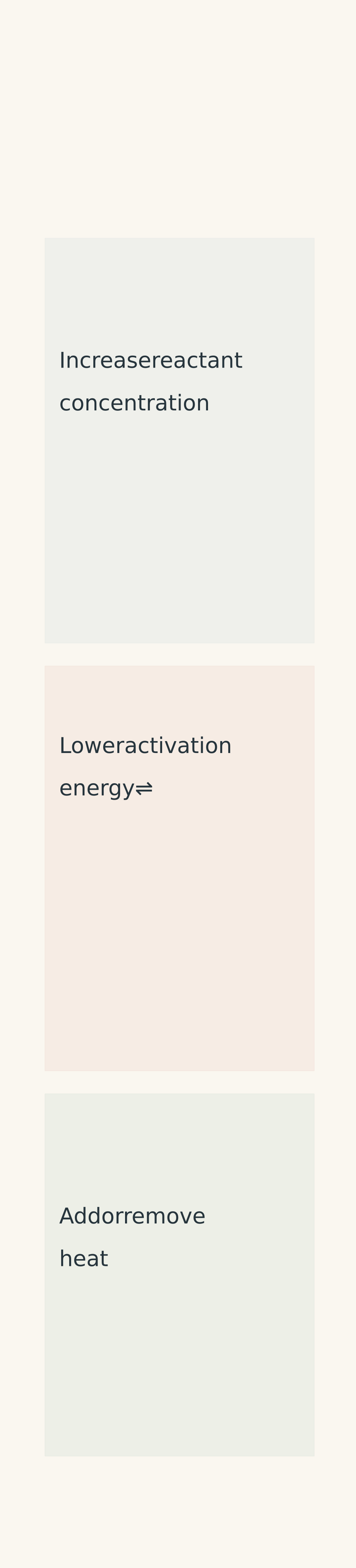
| Change | Does equilibrium position change? | Does \(K_\mathrm{eq}\) change? |
|---|---|---|
| Increase concentration of a reactant | Yes | No |
| Increase pressure for gases | Sometimes | No |
| Add a catalyst | No | No |
| Change temperature | Yes | Yes |
Why does a catalyst not change \(K_\mathrm{eq}\)?
A catalyst lowers the activation energy for both directions. It helps the system reach equilibrium faster, but it does not favour one side.
Temperature is different because it changes the energy balance between forward and reverse reactions.
05Worked example: predicting the effect of heating
Worked example: temperature increase in an exothermic reaction
A reaction is represented by:
\[ \ce{X2(g) + Y2(g) <=> 2XY(g) + heat} \]
The temperature of the system is increased. Predict the change in equilibrium position and \(K_\mathrm{eq}\).
Step 1
Heat appears on the right side, so the forward reaction releases heat. The reaction is exothermic.
Step 2
Increasing temperature adds more heat to the system.
Step 3
The system shifts left to remove the added heat.
Step 4
For an exothermic reaction, increasing temperature decreases \(K_\mathrm{eq}\).
The final result is that the equilibrium mixture contains more reactants, and the value of \(K_\mathrm{eq}\) becomes smaller.
06Worked example: comparing two temperature changes
Worked example: deciding which condition has the larger \(K_\mathrm{eq}\)
The reaction below is endothermic:
\[ \ce{PCl5(g) + heat <=> PCl3(g) + Cl2(g)} \]
A sample is tested at \(300\ \mathrm{K}\) and \(500\ \mathrm{K}\). Which temperature gives the larger \(K_\mathrm{eq}\)?
Step 1
Heat is on the reactant side, so the forward reaction absorbs heat. It is endothermic.
Step 2
The \(500\ \mathrm{K}\) system has more thermal energy available.
Step 3
The system uses the extra heat by shifting right, producing more \(\ce{PCl3}\) and \(\ce{Cl2}\).
Step 4
A larger amount of products at equilibrium means a larger equilibrium constant.
Therefore, the reaction at \(500\ \mathrm{K}\) has the larger \(K_\mathrm{eq}\).
07The misconception to avoid: “higher temperature means bigger Keq”
This is only true for endothermic reactions.
The shortcut “heat pushes equilibrium to products” is incomplete. The correct question is:
Where is heat written in the chemical equation?
- Heat on the left → adding heat increases \(K_\mathrm{eq}\).
- Heat on the right → adding heat decreases \(K_\mathrm{eq}\).
That small habit prevents one of the most common equilibrium mistakes.
08Questions and solutions
Question 1
For the reaction:
\[ \ce{A + B + heat <=> C} \]
the temperature is increased. Describe what happens to the equilibrium position and \(K_\mathrm{eq}\).
Solution 1
The equilibrium shifts right and \(K_\mathrm{eq}\) increases because the reaction is endothermic.
Heat is a reactant in this equation. Increasing temperature adds more reactant-like heat, so the system uses it by forming more product \(C\). Since the equilibrium now contains a greater proportion of products, the value of \(K_\mathrm{eq}\) increases.
The trap is thinking that heating only makes reactions faster. It does increase reaction rates, but it also changes the equilibrium balance when heat is involved.
Question 2
The reaction below is exothermic:
\[ \ce{2SO2(g) + O2(g) <=> 2SO3(g) + heat} \]
A student says, “Increasing temperature should increase the amount of \(\ce{SO3}\) because particles have more energy.”
Explain why this reasoning is incomplete.
Solution 2
Increasing temperature decreases the amount of \(\ce{SO3}\) at equilibrium because the system shifts left to remove added heat.
The student’s reasoning correctly identifies that particles have more kinetic energy, so collisions occur more often and with greater energy. However, this only describes reaction rate.
The equilibrium position depends on which direction reduces the disturbance. Because heat is a product, adding heat causes the reverse reaction to become favoured. Therefore, \(\ce{SO3}\) decreases and \(K_\mathrm{eq}\) becomes smaller.
Question 3
A reaction has a value of \(K_\mathrm{eq}=4.0\) at \(250\ \mathrm{K}\) and \(K_\mathrm{eq}=12.0\) at \(400\ \mathrm{K}\).
What can you conclude about the reaction, and why?
Solution 3
The reaction is endothermic because \(K_\mathrm{eq}\) increases when temperature increases.
Temperature is the only common equilibrium change that alters the value of \(K_\mathrm{eq}\). Since the higher temperature produces a larger equilibrium constant, the forward reaction must be favoured by adding heat.
The conclusion is:
\[ 400\ \mathrm{K} > 250\ \mathrm{K} \]
gives a larger product-favouring equilibrium, so heat must act as a reactant:
\[ \ce{Reactants + heat <=> Products} \]
Question 4
Two gases are at equilibrium:
\[ \ce{N2O4(g) <=> 2NO2(g) - heat} \]
where the forward reaction is endothermic.
A sealed container is heated and the concentration of \(\ce{NO2}\) increases. A student claims that \(K_\mathrm{eq}\) increased because the amount of \(\ce{NO2}\) increased.
Is the student’s claim correct?
Solution 4
The student’s claim is correct because heating an endothermic reaction increases \(K_\mathrm{eq}\).
The tempting mistake is to connect any increase in product concentration directly to \(K_\mathrm{eq}\). A concentration increase by itself does not always mean \(K_\mathrm{eq}\) changed. For example, adding more reactant could temporarily increase product concentration while leaving \(K_\mathrm{eq}\) unchanged.
Here, however, the cause of the change is temperature. The reaction absorbs heat, so increasing temperature shifts equilibrium towards \(\ce{NO2}\) and increases the value of \(K_\mathrm{eq}\).
Question 5
A chemist studies the equilibrium:
\[ \ce{2NO2(g) <=> N2O4(g) + heat} \]
At low temperature, the mixture becomes almost colourless because more \(\ce{N2O4}\) forms. At high temperature, the mixture becomes darker because more brown \(\ce{NO2}\) forms.
The chemist concludes:
“High temperature must increase \(K_\mathrm{eq}\) because the colour change shows more chemical activity.”
Evaluate this conclusion.
Solution 5
The conclusion is incorrect because high temperature decreases \(K_\mathrm{eq}\) for this exothermic reaction.
The first part of the observation is real: the mixture changes colour because the balance between \(\ce{NO2}\) and \(\ce{N2O4}\) changes. However, the conclusion confuses reaction activity with equilibrium position.
The forward reaction is:
\[ \ce{2NO2(g) <=> N2O4(g) + heat} \]
Heat is a product, so increasing temperature adds more product. The equilibrium shifts left to consume heat, producing more brown \(\ce{NO2}\).
A student might argue that “more \(\ce{NO2}\)” means a larger \(K_\mathrm{eq}\) because \(\ce{NO2}\) is visible. The missing constraint is that \(K_\mathrm{eq}\) is defined for a particular reaction direction. For the forward reaction shown, more reactants and fewer products means a smaller value of \(K_\mathrm{eq}\).
The observation supports the opposite conclusion: increasing temperature reduces \(K_\mathrm{eq}\).
Understanding temperature’s effect on \(K_\mathrm{eq}\) gives you the foundation for predicting equilibrium shifts. The next step is using the same ideas quantitatively with equilibrium expressions, reaction quotients, and calculations involving \(K_\mathrm{eq}\).