
Photosynthesis as a Non-Equilibrium System: HSC Chemistry
Understand why photosynthesis is a non-equilibrium process using enthalpy, entropy, Gibbs free energy, and continuous energy input. Includes worked examples and challenging HSC-style questions.
Put carbon dioxide and water in a flask at room temperature. Give the mixture plenty of time. Would you predict that glucose and oxygen eventually appear in useful amounts?
They won’t. Yet a leaf takes those same low-energy starting materials and builds energy-rich carbohydrates while releasing oxygen. The interesting part is not simply that photosynthesis needs light. The deeper question is why it needs a continuous energy supply at all.
The answer comes from two thermodynamic ideas: enthalpy and entropy. For the overall photosynthesis reaction, both push against the forward reaction. A living plant can still make glucose because it is not an equilibrium system sitting on its own. It is a driven, open, non-equilibrium system.
01The chemical reaction is thermodynamically uphill
A useful overall equation for photosynthesis is:
\[ \ce{6CO2(g) + 6H2O(l) -> C6H12O6(s) + 6O2(g)} \]
This equation is chemical bookkeeping. A real leaf does not collide six carbon dioxide molecules with six water molecules and somehow pop out one glucose molecule. Photosynthesis occurs through many coupled biochemical reactions.
Still, the overall equation lets us ask the thermodynamic question: are the products naturally favoured over the reactants?
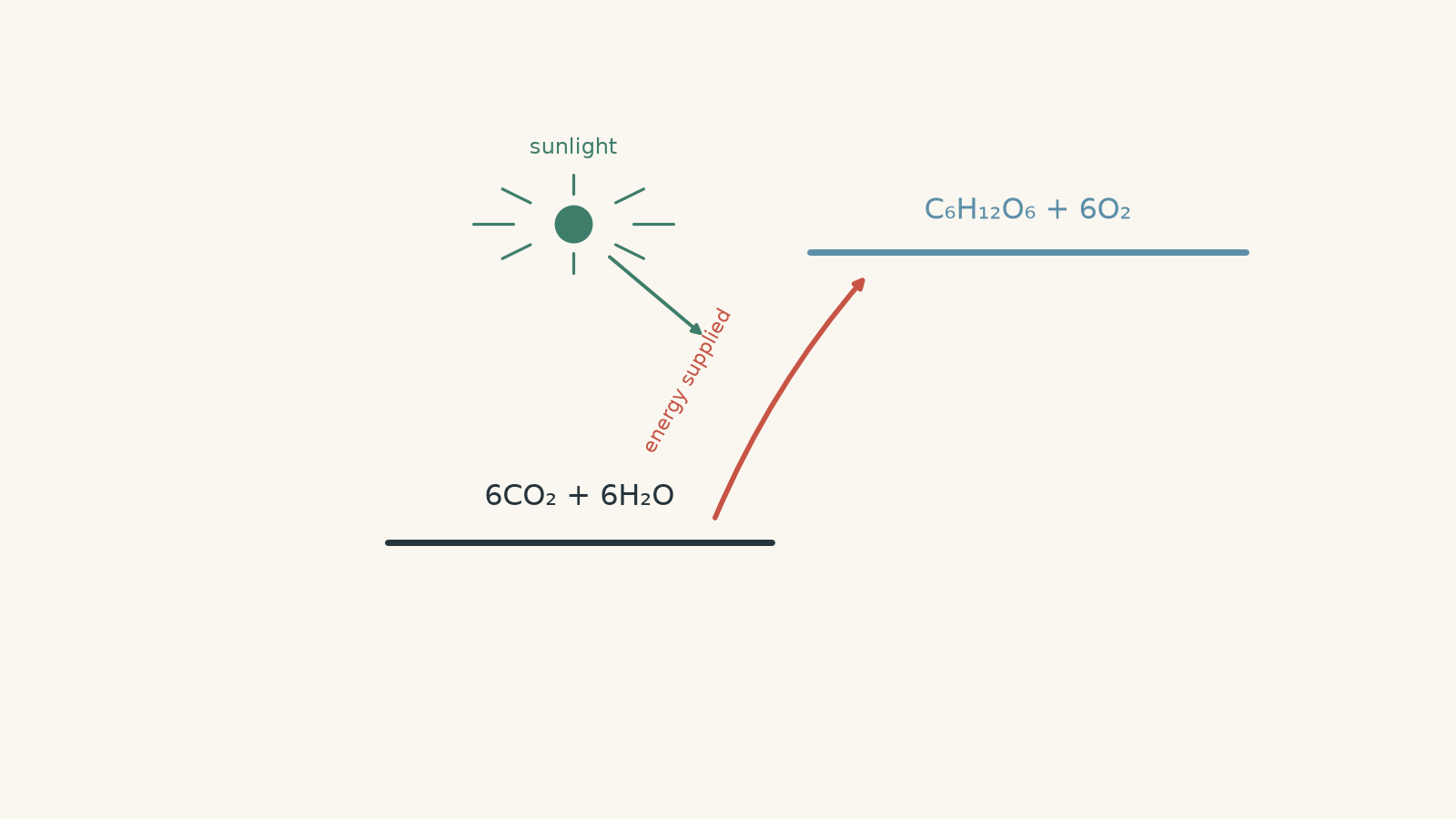
Imagine the reactants and products as two positions on a hill. If the products are lower in energy, the chemical change has an energetic reason to run downhill. If the products are higher, something must supply energy to push the system uphill.
Photosynthesis is the second case.
Enthalpy: glucose stores chemical energy
Enthalpy, \(H\), is an energy quantity associated with a system at constant pressure. For a reaction,
\[ \Delta H = H_{\text{products}} - H_{\text{reactants}} \]
For the overall formation of one mole of glucose by photosynthesis, a representative value is approximately
\[ \Delta H \approx +2800\ \text{kJ mol}^{-1} \]
The positive sign matters.
It means the products have a higher enthalpy than the reactants. Energy must be supplied as the chemical system is converted from carbon dioxide and water into glucose and oxygen.
So photosynthesis is endothermic overall.
Be careful with the next step. It is tempting to say, “The plant needs 2800 kJ of sunlight per mole of glucose.” That is too simple. \(\Delta H\) is a state-function difference between reactants and products. It is not a measurement of the actual light energy that must hit a leaf, and real photosynthesis is not 100% efficient.
What \(\Delta H>0\) tells us is that the chemical products store more energy than the starting materials.
Worked example: How much enthalpy is stored?
A photosynthetic system produces \(0.150\ \text{mol}\) of glucose. The enthalpy change for the overall reaction is \(+2800\ \text{kJ mol}^{-1}\) of glucose. Calculate the enthalpy change associated with forming this amount of glucose.
Step 1
The value \(+2800\ \text{kJ mol}^{-1}\) means \(2800\ \text{kJ}\) is absorbed for every mole of glucose formed under the stated conditions.
Step 2
\[ \Delta H = n\Delta H_m = (0.150\ \text{mol})(+2800\ \text{kJ mol}^{-1}) = +420\ \text{kJ} \]
where \(n\) is the amount of glucose and \(\Delta H_m\) is the molar enthalpy change.
Step 3
The enthalpy change is \(+420\ \text{kJ}\). The positive sign means the chemical system gains enthalpy as the glucose forms.
That stored energy is one reason glucose can later act as a fuel.
02Entropy pushes against photosynthesis too
If enthalpy were the whole story, we could stop there. It isn’t.
A reaction is also affected by entropy, \(S\).
Entropy is often described as “disorder”. That can occasionally help as a first picture, but it is not the exact definition. A better idea is that entropy measures how many microscopic arrangements of matter and energy are available to a system.
More possible arrangements generally means higher entropy.
Think of packing six friends into assigned seats at a tiny dinner table compared with letting them wander around a huge party. The party has many more possible arrangements. That is vaguely entropy-like.
The analogy breaks because molecules do not care about social awkwardness, and thermodynamic entropy is calculated from microscopic energy states rather than visible messiness.
For a reaction,
\[ \Delta S = S_{\text{products}} - S_{\text{reactants}} \]
For photosynthesis under representative standard conditions, \(\Delta S\) is negative.
That may be less obvious than the enthalpy result. There are six moles of gas on both sides of the overall equation, so simply counting gas molecules does not settle the question.
Approximate standard molar entropy values illustrate what happens:
| Substance | Approximate \(S^\circ\) in \(\text{J mol}^{-1}\text{K}^{-1}\) |
|---|---|
| \(\ce{CO2(g)}\) | 214 |
| \(\ce{H2O(l)}\) | 70 |
| \(\ce{C6H12O6(s)}\) | 212 |
| \(\ce{O2(g)}\) | 205 |
The atoms that began in small molecules become partly constrained within a much larger glucose molecule. Using actual entropy data confirms that the total entropy of the chemical system decreases.
This is why “products look more organised” is only an intuition. The sign should ultimately come from entropy data, not from judging which molecular drawing looks tidier.
Worked example: Calculate the entropy change
Using the standard molar entropy values in the table above, calculate \(\Delta S^\circ\) for
\[ \ce{6CO2(g) + 6H2O(l) -> C6H12O6(s) + 6O2(g)} \]
and explain what the result means.
Step 1
\[ S^\circ_{\text{products}} = (1)(212)+(6)(205) =1442\ \text{J mol}^{-1}\text{K}^{-1} \]
Step 2
\[ S^\circ_{\text{reactants}} =(6)(214)+(6)(70) =1704\ \text{J mol}^{-1}\text{K}^{-1} \]
Step 3
\[ \Delta S^\circ =1442-1704 =-262\ \text{J mol}^{-1}\text{K}^{-1} \]
Step 4
The negative value means the chemical system has fewer accessible microscopic arrangements after one mole of glucose is produced, under these standard-state assumptions.
So entropy, like enthalpy, opposes the forward photosynthesis reaction.
03Enthalpy and entropy are working in the same direction
For photosynthesis:
| Thermodynamic factor | Sign | Effect on forward photosynthesis |
|---|---|---|
| Enthalpy change, \(\Delta H\) | Positive | Opposes the reaction |
| Entropy change, \(\Delta S\) | Negative | Opposes the reaction |
This combination is particularly unfavourable.
A useful way to combine enthalpy and entropy is Gibbs free energy:
\[ \Delta G=\Delta H-T\Delta S \]
where:
- \(\Delta G\) is the Gibbs free-energy change,
- \(\Delta H\) is the enthalpy change,
- \(T\) is the absolute temperature in kelvin, and
- \(\Delta S\) is the entropy change.
If \(\Delta H>0\) and \(\Delta S<0\), look carefully at the second term. Because \(T\) is positive,
\[ -T\Delta S \]
is also positive.
Both contributions therefore make \(\Delta G\) positive.
Using \(\Delta H=+2800\ \text{kJ mol}^{-1}\), \(\Delta S=-262\ \text{J mol}^{-1}\text{K}^{-1}\), and \(T=298\ \text{K}\), first convert entropy to kilojoules:
\[ -262\ \text{J mol}^{-1}\text{K}^{-1} =-0.262\ \text{kJ mol}^{-1}\text{K}^{-1} \]
Then:
\[ \begin{aligned} \Delta G &=\Delta H-T\Delta S\\ &=2800-(298)(-0.262)\\ &=+2878\ \text{kJ mol}^{-1} \end{aligned} \]
The large positive value tells us that the net chemical reaction is strongly unfavourable in the forward direction under these conditions.
That is the puzzle we started with. Carbon dioxide and water do not simply sit around and gradually turn into glucose.
04So what is sunlight actually doing?
A common answer is, “Sunlight gives the reaction activation energy.”
That is incomplete.
Activation energy is the barrier a reaction pathway must cross. Lowering that barrier makes a reaction faster, but it does not change the energy difference between the initial and final states.
Imagine pushing a shopping trolley from the bottom of one valley into a higher valley. A catalyst is like finding a lower mountain pass. It can make the journey easier, but the trolley still finishes higher than where it began.
Photosynthesis needs something more than a lower pass. It needs an energy source.
Light absorbed by photosynthetic pigments produces electronically excited states. Through a sequence of coupled reactions, that energy is used to create chemically energetic intermediates, including ATP and reduced electron carriers. Those intermediates then help drive the reactions that fix carbon dioxide into carbohydrate.
The exact biochemistry is more detailed than the thermodynamic argument here. The important point is simple:
Enzymes provide pathways. Sunlight provides the external energy that keeps the overall process moving away from equilibrium.
Heating the leaf is not equivalent to illuminating it. Random thermal energy at the same temperature does not perform the same job as absorbed photons driving specific electronic transitions.
05Why this makes photosynthesis a non-equilibrium system
At thermodynamic equilibrium, a system has no net macroscopic tendency to change. For a reversible reaction, forward and reverse processes may still occur microscopically, but their rates balance.
A living photosynthetic cell is different.
It continually:
- absorbs radiant energy,
- takes in carbon dioxide and water,
- transfers energy through coupled reactions,
- produces and exports substances,
- maintains concentration and electrochemical gradients, and
- releases energy to its surroundings, including as heat.
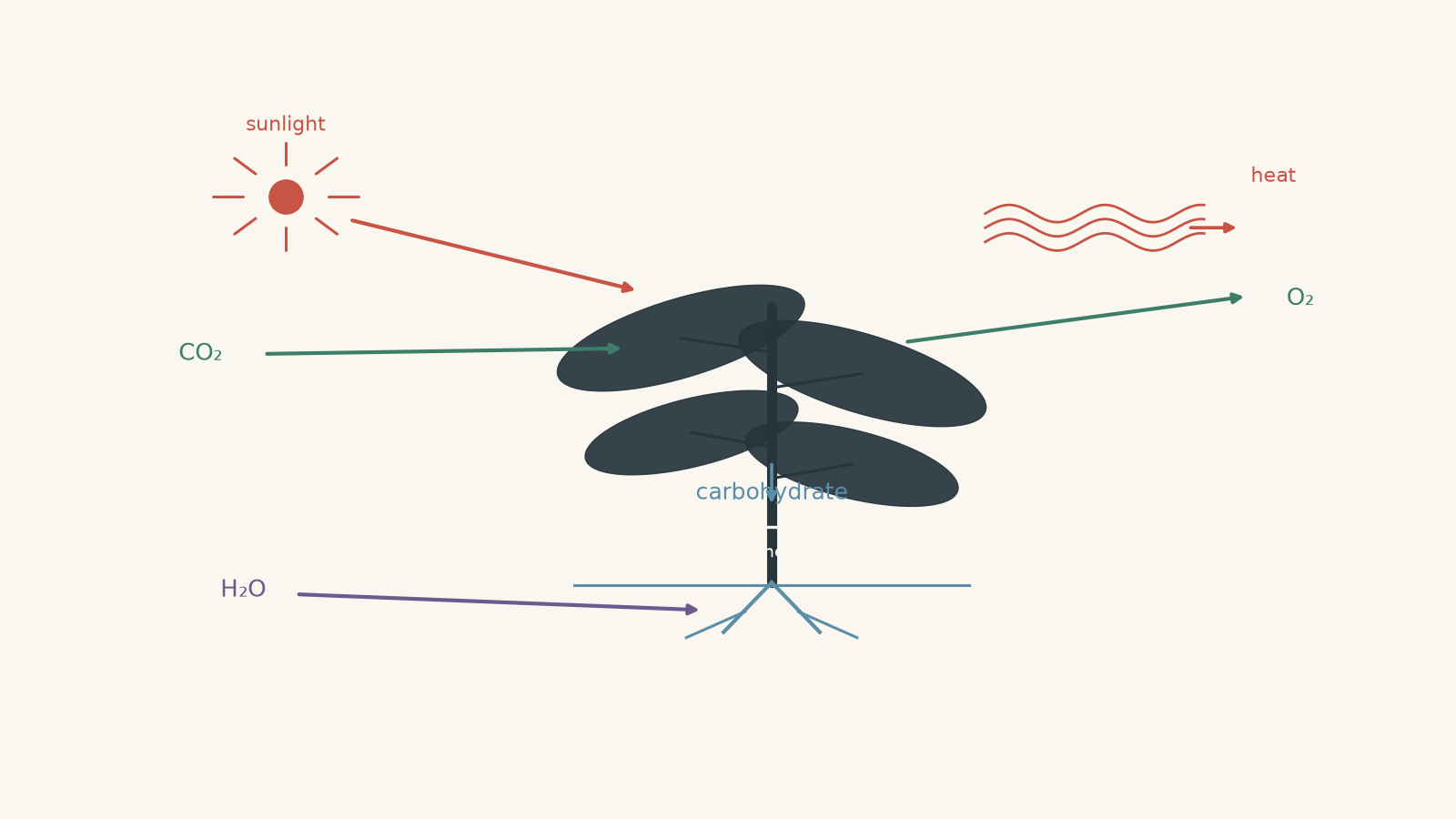
The plant is therefore an open system for both matter and energy.
Its chemical composition is maintained away from thermodynamic equilibrium by continuous flows. Stop those flows, and the state cannot be maintained indefinitely.
This is a useful distinction from static and dynamic equilibrium. Constant concentration does not automatically mean equilibrium. A system can have concentrations that remain approximately steady while matter and energy are still flowing through it.
That condition is called a non-equilibrium steady state.
Imagine a bathtub with the tap running and the drain open. The water level could remain perfectly constant because water enters at the same rate it leaves. Nothing about the constant level proves that water has stopped moving.
A photosynthetic cell can behave similarly. Some concentrations remain within narrow ranges even though reactions are continuously consuming and regenerating substances.
The bathtub analogy eventually fails because chemical reactions involve free-energy differences and microscopic states rather than just water flow. But it gives us the important warning: “unchanging” and “at equilibrium” are not synonyms.
06Photosynthesis does not violate the second law of thermodynamics
Here is the tempting objection.
If entropy tends to increase, and photosynthesis has \(\Delta S_{\text{system}}<0\), how can photosynthesis happen?
Because the second law does not say the entropy of every small system must always increase.
It applies to the total entropy change of the system plus its surroundings:
\[ \Delta S_{\text{universe}} = \Delta S_{\text{system}} + \Delta S_{\text{surroundings}} \]
A leaf can undergo a local entropy decrease because it is not isolated. Energy arrives as radiation, transformations inside the plant generate entropy, and energy eventually leaves in more dispersed forms, including heat.
The entropy decrease associated with building carbohydrate is therefore only one part of the accounting.
A tidier bedroom gives a rough analogy. You can reduce the “mess” in the bedroom by sorting everything into drawers, but you have used chemical energy from food, generated heat, and affected the surroundings. Local organisation has not appeared for free.
Again, actual thermodynamic entropy is not literal mess. The useful part of the analogy is the system boundary: a local decrease does not tell you the total entropy change.
07Three misconceptions worth removing
“Endothermic reactions cannot occur spontaneously”
Not always.
An endothermic reaction has \(\Delta H>0\), but a sufficiently positive entropy change can sometimes compensate for that.
Photosynthesis is especially unfavourable because it has both \(\Delta H>0\) and \(\Delta S<0\). Enthalpy and entropy are not competing here. They both oppose the forward chemical reaction.
“Sunlight shifts the equilibrium to the right”
That wording is risky.
Ordinary Le Chatelier reasoning describes how an equilibrium system responds to changes such as concentration, pressure, or temperature. Photosynthesis is a light-driven network maintained away from equilibrium.
Light is not simply another concentration term being added to the equilibrium expression. It continually supplies energy to excited states and coupled reactions.
“A catalyst could make photosynthesis happen in the dark”
A catalyst could change reaction rates by lowering activation energies. It cannot change \(\Delta H\), \(\Delta S\), or the equilibrium position at a fixed temperature.
If the overall process requires an external free-energy source, lowering the activation barrier does not supply that energy.
08The reverse process makes the contrast clearer
Now reverse the overall equation:
\[ \ce{C6H12O6(s) + 6O2(g) -> 6CO2(g) + 6H2O(l)} \]
The signs also reverse.
For the reverse reaction,
\[ \Delta H<0 \]
and, using the same standard-state comparison,
\[ \Delta S>0 \]
That combination strongly favours the forward direction of glucose oxidation.
This is closely related to why the thermodynamic picture for combustion is the opposite of photosynthesis. Photosynthesis stores externally supplied energy in chemical products; oxidation of the carbohydrate can release that stored chemical energy.
Do not turn that into “photosynthesis is literally combustion backwards inside a leaf”. The overall equations can be reversed, but the actual reaction pathways and mechanisms are completely different.
09Questions and solutions
Question 1
The overall photosynthesis reaction has an enthalpy change of \(+2800\ \text{kJ mol}^{-1}\) of glucose.
A plant produces \(0.0300\ \text{mol}\) of glucose.
Calculate the enthalpy change associated with this production, and state what the sign means.
Solution 1
The enthalpy change is \(+84.0\ \text{kJ}\), meaning the chemical system gains enthalpy as the glucose is formed.
The governing relationship is
\[ \Delta H=n\Delta H_m \]
where \(n\) is the amount of glucose and \(\Delta H_m\) is the molar enthalpy change.
Substituting:
\[ \begin{aligned} \Delta H &=(0.0300\ \text{mol})(+2800\ \text{kJ mol}^{-1})\\ &=+84.0\ \text{kJ} \end{aligned} \]
The positive sign shows that photosynthesis is endothermic overall.
A tempting mistake is to interpret \(84.0\ \text{kJ}\) as the exact amount of sunlight that must strike the plant. It is not. It is the enthalpy difference for the stated chemical change. A real photosynthetic system requires more incident light energy because energy transfer and conversion are not perfectly efficient.
Question 2
For a simplified thermodynamic analysis of photosynthesis, assume
\[ \Delta H=+2800\ \text{kJ mol}^{-1} \]
and
\[ \Delta S=-0.262\ \text{kJ mol}^{-1}\text{K}^{-1}. \]
Calculate \(\Delta G\) at \(298\ \text{K}\) and \(330\ \text{K}\).
A student claims that increasing the temperature must make photosynthesis thermodynamically more favourable because photosynthesis is endothermic. Assess the claim.
Solution 2
The student is incorrect: \(\Delta G\) is about \(+2878\ \text{kJ mol}^{-1}\) at \(298\ \text{K}\) and \(+2886\ \text{kJ mol}^{-1}\) at \(330\ \text{K}\), so the forward chemical reaction becomes slightly less favourable in this simplified model as temperature rises.
Use
\[ \Delta G=\Delta H-T\Delta S. \]
At \(298\ \text{K}\):
\[ \begin{aligned} \Delta G &=2800-(298)(-0.262)\\ &=2800+78.1\\ &=+2878.1\ \text{kJ mol}^{-1} \end{aligned} \]
At \(330\ \text{K}\):
\[ \begin{aligned} \Delta G &=2800-(330)(-0.262)\\ &=2800+86.5\\ &=+2886.5\ \text{kJ mol}^{-1} \end{aligned} \]
The tempting route is to remember that increasing temperature favours the endothermic direction of an equilibrium and stop there.
The missing constraint is entropy. Because \(\Delta S\) is negative, the term \(-T\Delta S\) is positive. Increasing \(T\) makes that positive contribution larger.
This does not mean a real plant’s photosynthetic rate must decrease whenever temperature rises. Reaction rate depends on kinetics, enzyme behaviour, gas exchange, and other biological factors. Thermodynamic favourability and reaction rate are different questions.
Question 3
An illuminated plant is placed in an experimental chamber.
After several hours, measurements show that the concentrations of several metabolites remain approximately constant. Isotope tracing nevertheless shows that carbon atoms are continuously entering carbohydrates and later returning to carbon dioxide through metabolism. The lamp remains on throughout the experiment.
A student concludes that the system has reached dynamic equilibrium because its measured concentrations are constant.
Evaluate the conclusion.
Solution 3
The system is better described as a non-equilibrium steady state, not simply as dynamic equilibrium.
The student’s argument is tempting because constant macroscopic concentrations are a feature of equilibrium. Constant concentration alone, however, is not enough evidence.
The crucial observations are that:
- radiant energy is continuously entering from the lamp,
- carbon is continuously flowing through chemical pathways, and
- the system maintains its composition while those flows continue.
This is similar to a tank whose water level stays constant because the inflow and outflow rates match. The constant level does not mean the water has stopped flowing.
At thermodynamic equilibrium, there is no net driving force maintaining organised chemical fluxes through the system. Here, the lamp supplies external energy that keeps the network away from equilibrium.
The isotope evidence is especially important. It shows that the apparently constant composition hides continuing directional chemical processing.
Turning off the lamp would remove an important energy input. The system would not instantly become an equilibrium system, because stored chemical energy and continuing reactions remain, but it could no longer maintain the same light-driven non-equilibrium state indefinitely.
Question 4
Consider the following idealised cycle.
First, one mole of glucose is produced by photosynthesis:
\[ \ce{6CO2 + 6H2O -> C6H12O6 + 6O2} \]
with
\[ \Delta H=+2800\ \text{kJ mol}^{-1}, \qquad \Delta S=-262\ \text{J mol}^{-1}\text{K}^{-1}. \]
The same mole of glucose is then completely oxidised by the exact reverse overall reaction.
At the end, the quantities of \(\ce{CO2}\), \(\ce{H2O}\), \(\ce{C6H12O6}\), and \(\ce{O2}\) are exactly the same as at the beginning.
A student argues:
“The enthalpy and entropy changes cancel, so the entire cycle has achieved nothing. It could repeat forever without any net energy input.”
Explain what is wrong with this argument.
Solution 4
The chemical state changes cancel, but the complete process does not return every part of the universe to its initial state: external energy has been transferred and degraded, so the cycle cannot run forever for free.
For photosynthesis,
\[ \Delta H_{\text{photo}}=+2800\ \text{kJ mol}^{-1}. \]
For the exact reverse reaction,
\[ \Delta H_{\text{reverse}}=-2800\ \text{kJ mol}^{-1}. \]
Therefore,
\[ \Delta H_{\text{chemical cycle}}=0. \]
Likewise, if the second reaction is exactly the thermodynamic reverse,
\[ \Delta S_{\text{chemical cycle}} =-262+262 =0\ \text{J mol}^{-1}\text{K}^{-1}. \]
The tempting route is to stop here and conclude that absolutely nothing has changed.
The problem is the chosen system boundary.
Photosynthesis required an external energy source. During the complete cycle, high-quality incoming radiant energy can ultimately become more dispersed energy, including heat transferred to the surroundings. The chemical substances may return to their original amounts while the energy reservoirs outside those substances do not.
So the correct accounting must include the surroundings, not just the four substances in the balanced equation.
There is no perpetual cycle producing useful chemical energy for free. The photosynthetic stage requires a source of free energy, and irreversible energy transformations generate entropy elsewhere.
The strange-looking result – zero net chemical \(\Delta H\) and zero net chemical \(\Delta S\) – is therefore perfectly consistent with the second law. It tells us only that the chemical starting and finishing states are identical.
Question 5
Two idealised photosynthetic systems contain the same chemical reaction network. Ignore biological ageing and assume that their matter can be recycled indefinitely.
In System A, no matter crosses the boundary, but light is supplied continuously from an external source. Waste heat can also leave the system, keeping its temperature at \(298\ \text{K}\).
In System B, the lamp and a fully charged but finite battery are both placed inside a perfectly insulated, sealed container. No matter or energy can cross the outer boundary. Initially, the lamp shines with the same intensity as in System A, and the photosynthetic material behaves identically.
A student argues that both systems should be able to maintain photosynthesis indefinitely because “both contain a continuous light source”.
Determine which system could, in principle, maintain a non-equilibrium steady state indefinitely under the stated idealisation. Explain what ultimately happens in the other system, using the system boundary, enthalpy, and entropy in your reasoning.
Solution 5
Only System A could, in principle, maintain the stated non-equilibrium steady state indefinitely; System B cannot because its apparent “energy source” is actually a finite part of the isolated system.
The hinge is the position of the system boundary.
In System A, radiant energy continually crosses the boundary from an external source. The system can also export waste heat. Even though matter is recycled internally, there is a continuing flow of energy through the system.
That energy flow can maintain chemical states that are far from thermodynamic equilibrium. The positive enthalpy change and negative chemical entropy change associated with glucose formation are supported by changes outside the photosynthetic reaction itself.
System B looks similar at first. The lamp shines, excited states form, and glucose may be produced.
The tempting conclusion is therefore that the lamp is an external driver in both cases.
It is not.
For System B, the battery and lamp are inside the boundary. The battery’s stored free energy is part of the initial state of the isolated system. As the battery discharges, that finite store of useful energy decreases.
Energy is conserved, but it becomes progressively less available for maintaining organised gradients and driving the endergonic chemical network. Irreversible processes also increase the total entropy of the isolated system.
Eventually the battery can no longer maintain the light-driven reactions. Concentration gradients decay, useful free-energy differences are exhausted, and the isolated system moves towards thermodynamic equilibrium.
This is why the phrase “energy source” can be misleading unless the boundary is stated. A charged battery inside an isolated box is not a permanent external supply. It is just another store of free energy inside the box.
That distinction is the core of photosynthesis as a non-equilibrium system: the plant’s unusual chemical state is not maintained merely because the right molecules and catalysts are present. It is maintained by a continuing flow of usable energy through the system. Once that idea is clear, equilibrium, combustion, biological energy storage, and other driven chemical systems become much easier to connect.