
Measuring pH of Acids and Bases: HSC Chemistry Guide
Learn how to measure and compare the pH of acidic and basic solutions using indicators and pH probes. Understand the logarithmic pH scale, practical errors, and what pH does and does not tell you.
You test two clear solutions. One gives pH 3.0 and the other pH 5.0.
Which is more acidic? Easy: the pH 3.0 solution.
But now predict this: does pH 3.0 mean it is only a little more acidic than pH 5.0 – perhaps \(5/3\) times as acidic?
No. In terms of hydronium ion concentration, it has about 100 times as much \(\ce{H3O+}\).
That is why measuring pH properly matters. The scale is logarithmic, small numerical differences can represent large chemical differences, and a sloppy measurement method can easily lead you to the wrong comparison.
01What are we actually measuring?
In an acidic aqueous solution, water contains an increased concentration of hydronium ions, \(\ce{H3O+}\). In a basic solution, the concentration of hydroxide ions, \(\ce{OH-}\), is increased.
A useful first model is to think of pH as a compressed way of reporting how much \(\ce{H3O+}\) is present. Instead of writing concentrations such as \(0.0010\ \text{mol L}^{-1}\), we turn powers of ten into small, manageable numbers.
For HSC calculations, we normally use
\[
\text{pH}=-\log_{10}[\ce{H3O+}]
\]
where:
- \(\text{pH}\) is the pH of the solution,
- \([\ce{H3O+}]\) is the hydronium ion concentration in \(\text{mol L}^{-1}\).
The reverse relationship is
\[
[\ce{H3O+}]=10^{-\text{pH}}
\]
So:
| pH | \([\ce{H3O+}]\) |
|---|---|
| 2 | \(1\times10^{-2}\ \text{mol L}^{-1}\) |
| 3 | \(1\times10^{-3}\ \text{mol L}^{-1}\) |
| 4 | \(1\times10^{-4}\ \text{mol L}^{-1}\) |
| 5 | \(1\times10^{-5}\ \text{mol L}^{-1}\) |
Each increase of one pH unit corresponds to a tenfold decrease in \([\ce{H3O+}]\).
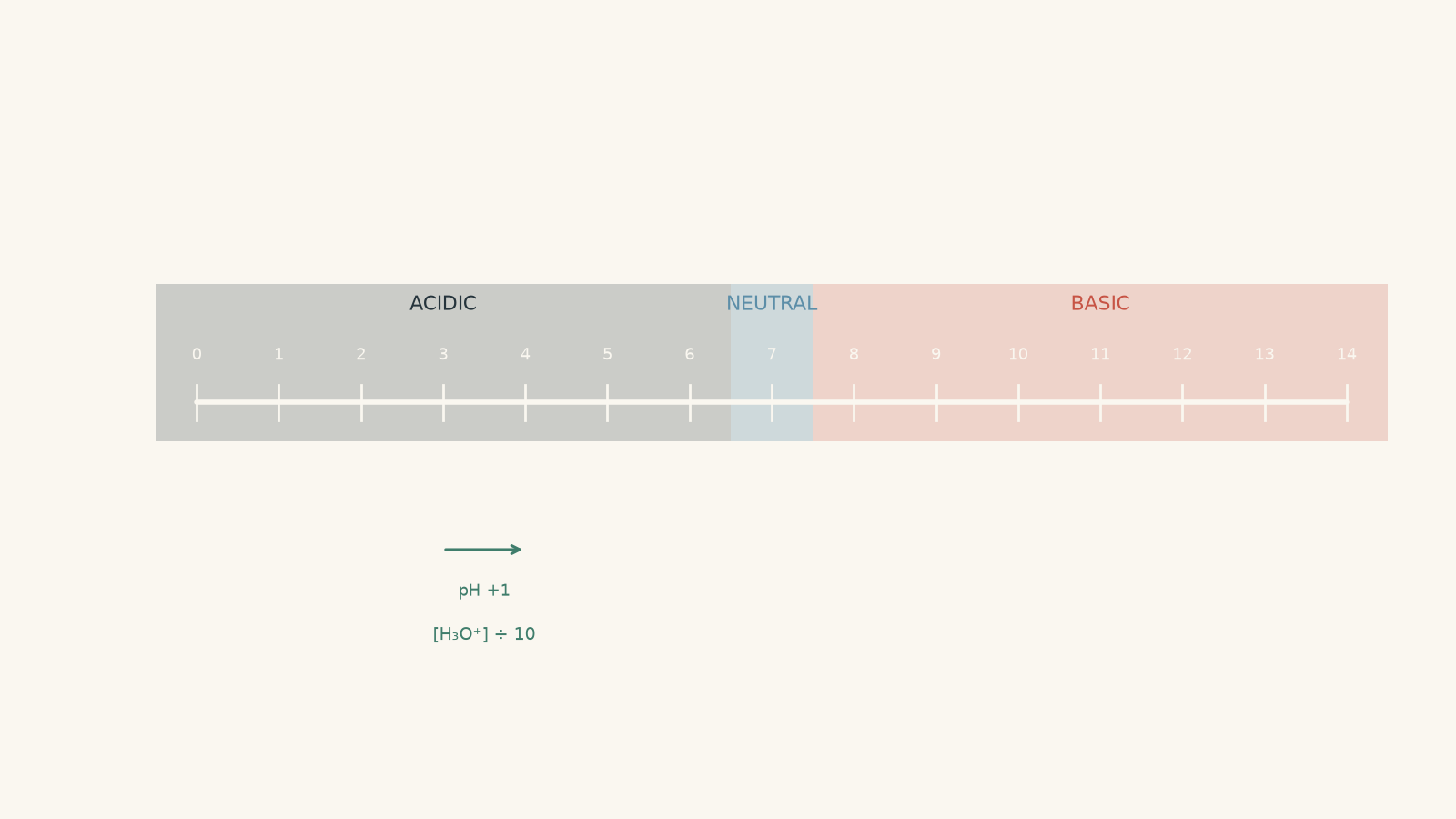
A slightly silly analogy helps here. Imagine pH numbers are apartment floors, but every time you go down one floor, ten times as many people are at the party. Moving from floor 5 to floor 4 does not add one extra person. It multiplies the crowd by ten.
The analogy breaks because ions are not party guests, and actual pH is more precisely related to hydrogen ion activity rather than simply concentration. For dilute HSC-level aqueous solutions, though, treating pH through \([\ce{H3O+}]\) is the useful model.
02Comparing pH values correctly
Suppose solution A has pH 2.5 and solution B has pH 4.5.
It is tempting to say A is \(4.5/2.5=1.8\) times more acidic. That treats pH as an ordinary linear scale, which it is not.
Instead, convert the pH difference into a concentration ratio.
The difference is
\[
4.5-2.5=2.0
\]
A difference of \(2.0\) pH units corresponds to
\[
10^{2.0}=100
\]
So solution A has 100 times the hydronium ion concentration of solution B.
A useful decision rule is:
\[
\frac{[\ce{H3O+}]_{\text{lower pH}}}{[\ce{H3O+}]_{\text{higher pH}}}
=10^{\Delta\text{pH}}
\]
where \(\Delta\text{pH}\) is the positive difference between the two pH values.
Worked example: Comparing two acidic solutions
A student measures the pH of two solutions at the same temperature. Solution P has pH 2.80 and solution Q has pH 4.30. Which solution has the greater hydronium ion concentration, and by what factor?
Step 1
Solution P has the lower pH, so it has the greater \([\ce{H3O+}]\).
Step 2
\[
\Delta\text{pH}=4.30-2.80=1.50
\]
Step 3
\[
\frac{[\ce{H3O+}]_{\mathrm{P}}}{[\ce{H3O+}]_{\mathrm{Q}}}
=10^{1.50}
=31.6
\]
Step 4
Solution P has about \(31.6\) times the hydronium ion concentration of solution Q.
Notice that a pH difference of only \(1.50\) represents a fairly large chemical difference. That is exactly why comparing the pH numbers by subtraction alone is not enough.
03Which practical method should you use?
There is no single perfect pH test. The appropriate method depends on what you need to know.
| Method | What it tells you | Main advantage | Main limitation |
|---|---|---|---|
| Blue or red litmus paper | Whether a solution behaves as an acid or base | Fast and simple | Does not give a useful numerical pH |
| Universal indicator | Approximate pH from colour | Cheap and shows a broad pH range | Colour matching is subjective |
| pH paper | Approximate numerical pH | Quick and portable | Limited precision |
| pH probe or meter | Numerical pH | More precise and useful for close comparisons | Requires calibration and careful handling |
If the aim is simply to separate clearly acidic solutions from clearly basic ones, an indicator may be enough.
If the aim is to compare two solutions with pH values around 4.2 and 4.5, colour matching is a poor choice. A calibrated pH probe is much more appropriate.
This is an important experimental principle: the best instrument is not automatically the fanciest one. It is the instrument whose precision suits the question being asked.
04Measuring pH with an indicator
Universal indicator is a mixture of indicators that changes colour over a wide pH range. The observed colour is compared with a reference chart to estimate pH.
A sensible procedure is:
- Place a small, equal volume of each solution into separate clean test tubes or wells.
- Add the same small quantity of universal indicator to each.
- Mix gently.
- View the colour against a neutral background.
- Compare each colour with the supplied pH chart.
- Record the estimated pH as an approximate value.
Why use the same amount of indicator? Indicators are themselves chemical substances, often weak acids or bases. Dumping a large, inconsistent amount into tiny samples can alter the solution you are trying to measure.
There is another limitation. Suppose one student calls a colour “orange-red” and another calls it “red-orange”. Chemistry has now become suspiciously close to arguing about a paint catalogue.
That is why universal indicator is useful for broad comparisons but not for measurements requiring high precision.
05Measuring pH with a pH probe
A pH probe produces an electrical response related to hydrogen ion activity. The meter converts that response into a pH reading.
You do not need to treat the probe as a magic wand. Its reading is only useful if the probe has been prepared and used correctly.
A strong school practical procedure is:
- Calibrate the pH meter using appropriate standard buffer solutions according to the instrument instructions. A two- or three-point calibration may use buffers such as pH 4, 7, and 10, depending on the range being investigated.
- Pour each test solution into a separate, labelled, clean container.
- Rinse the probe with deionised water before the first measurement.
- Gently blot excess rinse water rather than rubbing the sensing surface.
- Immerse the sensing part of the probe in the sample.
- Swirl or stir gently if required, without striking the probe against the container.
- Allow the reading to stabilise.
- Record the pH, and record temperature if it is relevant to the investigation.
- Rinse the probe with deionised water before moving to the next solution.
- Repeat measurements where useful and compare the repeat values.
Why rinse between samples?
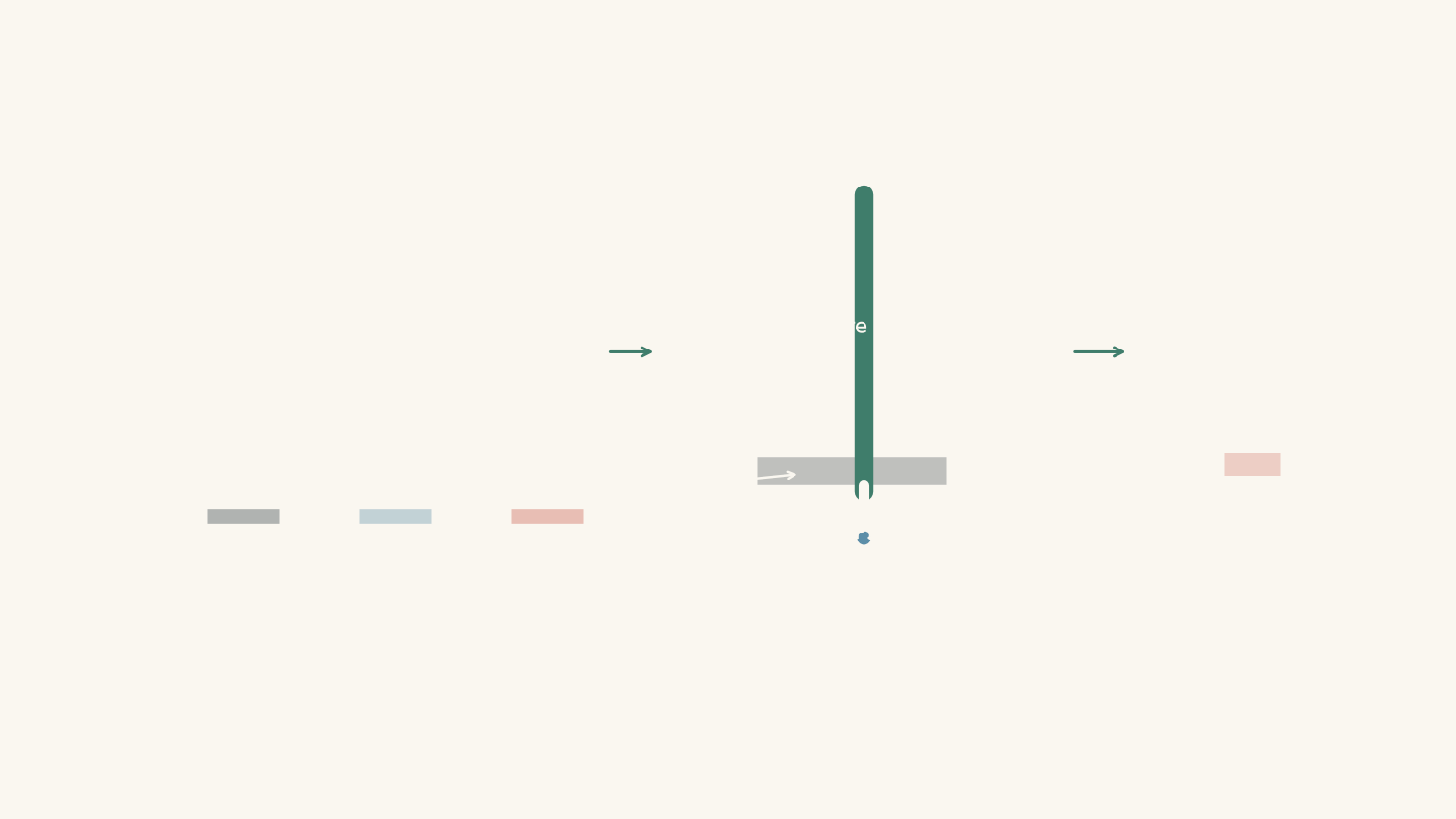
Imagine measuring a basic solution with pH 12, then moving the wet probe directly into a small acidic sample.
A film of the basic solution travels with the probe. You are no longer measuring the original acidic solution. You are measuring an acidic solution that you have partly contaminated with base.
The resulting pH may be too high.
Rinsing reduces this carry-over.
The same logic applies to droppers and stirring rods. Separate equipment, or careful rinsing, prevents one sample from quietly changing another.
06Calibration is part of the measurement
Suppose a balance has not been zeroed and reads every mass \(2.0\ \text{g}\) too high. Recording more decimal places will not rescue the experiment.
A pH meter has the same basic issue. A precise-looking reading such as 4.372 is not automatically accurate.
Calibration compares the meter response with buffer solutions whose pH is known. This allows the instrument to relate its electrical response to meaningful pH values.
For a range containing both acidic and basic samples, calibration points should appropriately cover the region being measured. The exact process depends on the meter, so the instrument instructions matter.
This distinction is useful:
- Repeatability asks whether repeated measurements are close to each other.
- Accuracy asks whether those measurements are close to the true value.
A badly calibrated meter can repeatedly give almost the same wrong answer.
Worked example: Is a small pH difference meaningful?
A student measures two acidic solutions using the same calibrated pH probe.
For solution A, the readings are 3.42, 3.44, and 3.43.
For solution B, the readings are 3.55, 3.57, and 3.56.
Calculate the mean pH of each solution, compare their hydronium ion concentrations, and explain what the repeat measurements tell you.
Step 1
\[
\text{mean pH}_{A}
=\frac{3.42+3.44+3.43}{3}
=3.43
\]
Step 2
\[
\text{mean pH}_{B}
=\frac{3.55+3.57+3.56}{3}
=3.56
\]
Solution A has the lower mean pH, so it has the greater hydronium ion concentration.
Step 3
\[
\Delta\text{pH}=3.56-3.43=0.13
\]
Step 4
\[
\frac{[\ce{H3O+}]_A}{[\ce{H3O+}]_B}
=10^{0.13}
\approx1.35
\]
Solution A therefore has about \(1.35\) times the hydronium ion concentration of solution B.
Step 5
Each set of readings varies by only \(0.02\) pH units from lowest to highest. The measurements are therefore reasonably repeatable.
That does not, by itself, prove the meter is accurate. Confidence in accuracy also depends on correct calibration, suitable buffers, uncontaminated samples, and proper probe use.
07Temperature matters
At \(25^\circ\text{C}\), the familiar relationship is
\[
K_w=[\ce{H3O+}][\ce{OH-}]=1.0\times10^{-14}
\]
where \(K_w\) is the ionic product of water.
At this temperature, a neutral solution has approximately
\[
[\ce{H3O+}]=[\ce{OH-}]=1.0\times10^{-7}\ \text{mol L}^{-1}
\]
and therefore pH 7.
But “neutral means pH 7” is not an exact rule at every temperature. The value of \(K_w\) changes with temperature.
The more fundamental statement is:
A neutral aqueous solution has equal concentrations of \(\ce{H3O+}\) and \(\ce{OH-}\).
For an ordinary HSC practical comparing solutions, this means you should avoid changing temperature unnecessarily between measurements. If samples are at noticeably different temperatures, temperature becomes another variable that can affect the comparison.
08For basic solutions, pOH can help
At \(25^\circ\text{C}\),
\[
\text{pH}+\text{pOH}=14.00
\]
and
\[
\text{pOH}=-\log_{10}[\ce{OH-}]
\]
For example, a solution with pH 11.20 has
\[
\text{pOH}=14.00-11.20=2.80
\]
so
\[
[\ce{OH-}]
=10^{-2.80}
=1.58\times10^{-3}\ \text{mol L}^{-1}
\]
This gives a more chemically useful description than simply saying “the solution is basic”.
Again, the relationship \(\text{pH}+\text{pOH}=14.00\) assumes \(25^\circ\text{C}\).
09The most tempting misconception: pH tells you how much acid is present
It doesn’t.
pH tells you about the hydrogen ion activity of the solution at that moment. In HSC calculations, we usually approximate this using \([\ce{H3O+}]\).
It does not directly tell you:
- the total concentration of an acid,
- whether an acid is strong or weak,
- how many moles of acid are present,
- how much base would be required for complete neutralisation.
This becomes important when comparing strong and weak acids.
A strong acid ionises essentially completely in water. A weak acid ionises only partially and establishes an equilibrium.
So two acid solutions can have the same pH while containing very different total amounts of acid.
You can picture a weak acid as having a large waiting room of acid particles that have not yet donated their protons. pH mainly tells you about the particles currently contributing to the free \(\ce{H3O+}\) population, not everyone sitting in the waiting room.
The analogy breaks because weak-acid ionisation is a reversible chemical equilibrium, not a queue. When conditions change, such as when \(\ce{H3O+}\) is removed, that equilibrium shifts.
This distinction becomes crucial in titrations and buffer chemistry.
10Common practical mistakes
Treating pH paper as highly precise
If a colour chart allows you to distinguish roughly pH 4 from pH 5, reporting pH 4.37 is not justified. The number of decimal places should reflect what the method can actually resolve.
Comparing colours under different conditions
Lighting, coloured glassware, strongly coloured samples, and different amounts of indicator can make colour comparisons unreliable.
Moving a dirty probe between samples
This causes cross-contamination and can shift the next reading towards the previous sample’s pH.
Assuming more repeats fix a systematic problem
Repeating a badly calibrated measurement ten times can give ten impressively consistent wrong values.
Calling the lowest-pH solution the “strongest acid”
A lower measured pH means greater hydrogen ion activity in that particular solution. It does not automatically mean the acid species itself has greater acid strength.
A dilute strong acid can have a higher pH than a sufficiently concentrated weak acid.
11A good way to compare several solutions
If you are asked to measure and compare the pH values of a range of acidic and basic solutions, separate the task into three decisions.
First, choose a method with suitable resolution. Universal indicator may be enough for a broad survey. A pH probe is better if close numerical comparisons matter.
Second, make the measurements comparable. Use clean equipment, prevent contamination, keep temperature reasonably controlled, calibrate the instrument, and use a consistent procedure.
Third, interpret the numbers chemically. Do not merely arrange the pH values from lowest to highest. Explain what lower and higher pH imply about \(\ce{H3O+}\), remembering that the scale is logarithmic.
A results table might therefore look like this:
| Solution | Mean pH | Classification | Interpretation |
|---|---|---|---|
| A | 2.30 | Acidic | Highest \([\ce{H3O+}]\) of these samples |
| B | 4.80 | Acidic | Lower \([\ce{H3O+}]\) than A |
| C | 7.00 | Neutral at \(25^\circ\text{C}\) | \([\ce{H3O+}]\approx[\ce{OH-}]\) |
| D | 9.40 | Basic | \([\ce{OH-}]>[\ce{H3O+}]\) |
| E | 12.10 | Basic | Most basic of these samples by measured pH |
The important word is “samples”. The pH result describes the solutions tested under those conditions. It does not, by itself, rank the intrinsic strength of the substances from which they were prepared.
12Questions and solutions
Question 1
Two solutions are measured at \(25^\circ\text{C}\). Solution X has pH 3.20 and solution Y has pH 5.20.
Identify the more acidic solution and calculate how many times greater its hydronium ion concentration is.
Solution 1
Solution X is more acidic, and its hydronium ion concentration is 100 times that of solution Y.
The lower pH indicates the greater \([\ce{H3O+}]\).
The pH difference is
\[
\Delta\text{pH}=5.20-3.20=2.00
\]
Therefore,
\[
\frac{[\ce{H3O+}]_X}{[\ce{H3O+}]_Y}
=10^{2.00}
=100
\]
The tempting mistake is to compare the pH values using an ordinary ratio such as \(5.20/3.20\). That fails because pH is logarithmic. A difference of two pH units represents a factor of \(10^2\) in hydronium ion concentration.
Question 2
A student needs to compare six colourless solutions expected to have pH values between 2 and 12. Some may differ by less than 0.5 pH units.
The student proposes the following method:
- calibrate a pH meter using only a pH 7 buffer,
- measure each sample once,
- move the probe directly from one sample to the next without rinsing,
- record every result to two decimal places.
Evaluate this method and describe how it should be improved.
Solution 2
The proposed method is not reliable enough for close pH comparisons because its calibration, contamination control, and repeat measurements are inadequate.
A pH probe is an appropriate instrument because differences smaller than 0.5 pH units may be difficult to judge reliably with universal indicator. The problem is how the probe is being used.
First, the meter should be calibrated according to its instructions using suitable buffer solutions that cover the expected measurement range. Because the samples span strongly acidic to strongly basic conditions, calibration only at pH 7 gives a weaker check of the probe response away from neutral pH than an appropriate multi-point calibration.
Second, the probe should be rinsed with deionised water between samples and excess water gently removed. Otherwise, solution carried on the probe contaminates the next sample. This is particularly serious when moving between solutions with very different pH values.
Third, useful measurements should be repeated. Repeats reveal whether the reading is stable and reproducible and reduce the chance that one abnormal value determines the conclusion.
The improved method is therefore to calibrate appropriately, rinse between samples, allow each reading to stabilise, perform repeat measurements, and calculate a representative value such as the mean where appropriate.
Recording two decimal places is only justified if the meter’s resolution, calibration, and experimental procedure support that precision. Extra digits do not repair a poor method.
The tempting route is to think that a digital display automatically makes the measurement accurate. It does not. The instrument can display a precise-looking number while contamination or poor calibration shifts the result systematically.
Question 3
A student measures three solutions in the order A, B, then C using the same pH probe.
The first trial gives:
| Solution | Measured pH |
|---|---|
| A | 2.10 |
| B | 6.85 |
| C | 11.70 |
The student then notices that the probe was not rinsed between samples.
After cleaning and correctly recalibrating the probe, the measurements are repeated independently:
| Solution | Corrected pH |
|---|---|
| A | 2.12 |
| B | 7.35 |
| C | 11.92 |
Explain why contamination from the previous sample could account for the direction of both changes in B and C. Do not simply state that the first results were “wrong”.
Solution 3
Carry-over from A would tend to make B appear too acidic, while carry-over from B would tend to make C appear less basic, so both corrected changes have the expected direction.
Solution A is strongly acidic, with pH about 2.1. If a film of A remains on the probe when it is placed into B, acidic material enters or remains in contact with the B sample near the sensing surface.
That pushes the measured pH of B down. The contaminated result, 6.85, is therefore lower than the corrected value, 7.35.
Next, B is much less basic than C. If material from B is carried into C, it dilutes or partly counteracts the strongly basic environment at the probe. This pushes the measured pH of C down as well.
The first value for C, 11.70, is therefore lower than the corrected value, 11.92.
The important reasoning is directional. Contamination does not produce some mysterious random pH. The previous sample changes the next sample towards its own chemical conditions.
The tempting explanation is to blame every discrepancy on “instrument error”. That is too vague. Here, the sequence of samples predicts the sign of the error: acidic A drags B’s result downward, then the much lower-pH B drags C’s result downward.
Question 4
Two monoprotic acids, X and Y, are investigated.
Before dilution:
- X has pH 2.00.
- Y has pH 2.50.
Each solution is then diluted separately so that its analytical acid concentration becomes one-hundredth of its original value.
After dilution:
- X has pH 4.00.
- Y has pH 3.55.
Each acid is known to be either a strong acid or a weak acid.
Identify which acid is strong and which is weak. Then explain why the order of their measured pH values reverses after dilution.
Assume temperature remains constant and the contribution from water autoionisation is negligible.
Solution 4
X behaves as the strong acid and Y behaves as the weak acid; the ranking reverses because dilution changes weak-acid ionisation as well as concentration.
For X, the initial pH is 2.00, so
\[
[\ce{H3O+}]_{\text{initial}}
=10^{-2.00}
=1.0\times10^{-2}\ \text{mol L}^{-1}
\]
Its final pH is 4.00, giving
\[
[\ce{H3O+}]_{\text{final}}
=10^{-4.00}
=1.0\times10^{-4}\ \text{mol L}^{-1}
\]
The hydronium ion concentration therefore falls by a factor of 100, exactly matching the hundredfold dilution. That is the expected behaviour of a strong monoprotic acid in this concentration range because it is already essentially completely ionised.
For Y, the pH rises from 2.50 to only 3.55. The pH increase is
\[
3.55-2.50=1.05
\]
so its hydronium ion concentration decreases by only
\[
10^{1.05}\approx11.2
\]
rather than by a factor of 100.
Why? Y is a weak acid. We can represent its ionisation as
\[
\ce{HA + H2O <=> H3O+ + A-}
\]
When the solution is diluted, the equilibrium shifts so that a larger fraction of the remaining \(\ce{HA}\) ionises. The analytical concentration has fallen substantially, but increased percentage ionisation partly replaces the \(\ce{H3O+}\) lost through dilution.
Initially, X has the lower pH:
\[
2.00<2.50
\]
so X initially has the greater \([\ce{H3O+}]\).
After dilution,
\[
3.55<4.00
\]
so Y now has the greater \([\ce{H3O+}]\).
The tempting route is to assume that a hundredfold dilution must always raise pH by exactly two units because \(100=10^2\). That works when \([\ce{H3O+}]\) simply scales with the amount of fully ionised acid. For a weak acid, dilution also shifts its ionisation equilibrium, so the relationship is not that simple.
This is also why one pH measurement is not enough to decide whether an unknown acid is intrinsically strong or weak.
Question 5
Two \(25.0\ \text{mL}\) acid samples both have an initial pH of 3.00 at \(25^\circ\text{C}\).
Sample A is \(1.00\times10^{-3}\ \text{mol L}^{-1}\) hydrochloric acid, \(\ce{HCl}\).
Sample B is \(0.100\ \text{mol L}^{-1}\) of a monoprotic weak acid, \(\ce{HA}\), whose equilibrium happens to produce the same initial pH of 3.00.
Each sample is separately titrated to equivalence with \(0.100\ \text{mol L}^{-1}\) \(\ce{NaOH}\).
A student argues:
“Both samples start at pH 3.00, so they contain the same amount of acid and should need the same volume of sodium hydroxide.”
Determine the volume of \(\ce{NaOH}\) required for each sample, and explain how two solutions with the same initial pH can require dramatically different amounts of base.
Solution 5
Sample A requires \(0.250\ \text{mL}\) of \(0.100\ \text{mol L}^{-1}\) \(\ce{NaOH}\), while sample B requires \(25.0\ \text{mL}\). The weak-acid sample therefore requires 100 times as much base even though both samples initially have pH 3.00.
For sample A, \(\ce{HCl}\) is a strong monoprotic acid, so it is essentially completely ionised.
The amount of \(\ce{HCl}\) is
\[
\begin{aligned}
n(\ce{HCl})
&=cV\\
&=(1.00\times10^{-3}\ \text{mol L}^{-1})(0.0250\ \text{L})\\
&=2.50\times10^{-5}\ \text{mol}
\end{aligned}
\]
The neutralisation is
\[
\ce{HCl + NaOH -> NaCl + H2O}
\]
The mole ratio is \(1:1\), so
\[
n(\ce{NaOH})=2.50\times10^{-5}\ \text{mol}
\]
Using \(V=n/c\),
\[
\begin{aligned}
V(\ce{NaOH})
&=\frac{2.50\times10^{-5}\ \text{mol}}
{0.100\ \text{mol L}^{-1}}\\
&=2.50\times10^{-4}\ \text{L}\\
&=0.250\ \text{mL}
\end{aligned}
\]
Now consider sample B.
Its analytical weak-acid concentration is \(0.100\ \text{mol L}^{-1}\), so the total amount of acid species originally added is
\[
\begin{aligned}
n(\ce{HA})
&=cV\\
&=(0.100\ \text{mol L}^{-1})(0.0250\ \text{L})\\
&=2.50\times10^{-3}\ \text{mol}
\end{aligned}
\]
Because the acid is monoprotic, each mole of total acid can supply one mole of acidic proton during complete neutralisation. Overall,
\[
\ce{HA + OH- -> A- + H2O}
\]
so the equivalence requirement is
\[
n(\ce{NaOH})=2.50\times10^{-3}\ \text{mol}
\]
Therefore,
\[
\begin{aligned}
V(\ce{NaOH})
&=\frac{2.50\times10^{-3}\ \text{mol}}
{0.100\ \text{mol L}^{-1}}\\
&=2.50\times10^{-2}\ \text{L}\\
&=25.0\ \text{mL}
\end{aligned}
\]
The surprising part is that the initial pH values are identical.
Both solutions have
\[
[\ce{H3O+}]=10^{-3.00}
=1.00\times10^{-3}\ \text{mol L}^{-1}
\]
at the moment the pH is measured.
But sample B contains a much larger total amount of weak acid. Most of that acid has not ionised initially. As hydroxide ions remove acidic species from the system, the weak-acid equilibrium shifts and more \(\ce{HA}\) can donate protons.
The pH measurement therefore describes the immediate hydrogen ion activity, not the entire reservoir of acid capable of reacting during neutralisation.
The tempting route is particularly convincing here because “same pH” sounds like “same acidity”. The exact constraint that breaks that reasoning is the difference between free \(\ce{H3O+}\) at equilibrium and total acid concentration.
That distinction leads directly into titration curves and buffer systems. Once you understand what pH measures – and what it does not measure – you can explain why a weak acid can resist a pH change, why equivalence points differ from initial pH comparisons, and why titration data can reveal information that a single pH reading cannot.