
Proton NMR Spectroscopy: How to Interpret HSC Chemistry Data
Learn how to use proton environments, chemical shift, integration, and splitting patterns to determine simple organic structures in HSC Chemistry.
A molecular formula can tell you how many atoms are present, but it does not tell you where those atoms sit. Two compounds can have the same formula and completely different structures.
Suppose you know a compound has the formula \(\ce{C3H8O}\). Is it propan-1-ol, propan-2-ol, or an ether? The formula alone cannot decide.
Proton nuclear magnetic resonance spectroscopy, usually called proton NMR or \(^1\text{H}\) NMR, gives you another kind of evidence. Instead of asking, “How many hydrogens are in the molecule?”, it asks:
How many different chemical surroundings do those hydrogens experience?
That turns out to be enough to distinguish many simple organic structures.
Before going further, make a prediction. Propan-2-ol has six hydrogens on two \(\ce{CH3}\) groups. Do those six hydrogens give two separate NMR signals because they sit on two different carbon atoms?
They do not. The two methyl groups are chemically equivalent because the molecule is symmetrical. Their protons experience the same chemical environment, so they produce one signal.
That idea – grouping equivalent hydrogens into chemical environments – is the starting point for interpreting proton NMR.
01What a proton NMR spectrum is actually telling you
A proton NMR spectrum is produced by placing a sample in a strong magnetic field and exposing it to radiofrequency radiation.
Hydrogen nuclei containing one proton behave like tiny magnetic objects. Their interaction with the applied magnetic field depends slightly on the electrons surrounding them. A proton surrounded by one electronic environment responds at a different frequency from a proton surrounded by another.
You do not need a quantum-mechanical model of nuclear spin to interpret HSC-level spectra. What matters is the consequence:
Chemically equivalent protons produce the same NMR signal. Chemically different protons can produce different signals.
Think of the molecule as a house full of people receiving mobile phone reception. Everyone is technically using the same network, but someone beside a window may experience a different signal from someone hiding behind three concrete walls.
In this analogy:
- the people represent hydrogen nuclei,
- the surrounding walls and windows represent the local electronic environment,
- different reception conditions represent different chemical shifts.
The analogy breaks because NMR is not literally measuring electromagnetic reception through barriers. The real effect comes from how electrons respond to the applied magnetic field and alter the effective field experienced by each nucleus.
A proton NMR spectrum gives you four especially useful clues:
| Feature | What it tells you |
|---|---|
| Number of signals | Number of proton environments |
| Chemical shift, \(\delta\) | What electronic environment each proton is in |
| Integration | Relative number of protons producing each signal |
| Splitting pattern | Number of neighbouring equivalent protons |
The trick is not to use these clues separately. Structure determination works best when they constrain one another.
02First clue: count the proton environments
Consider ethanol, \(\ce{CH3CH2OH}\).
Its hydrogens fall into three groups:
- the three hydrogens on \(\ce{CH3}\),
- the two hydrogens on \(\ce{CH2}\),
- the hydrogen on \(\ce{OH}\).
So ethanol normally has three proton environments and therefore three proton NMR signals.
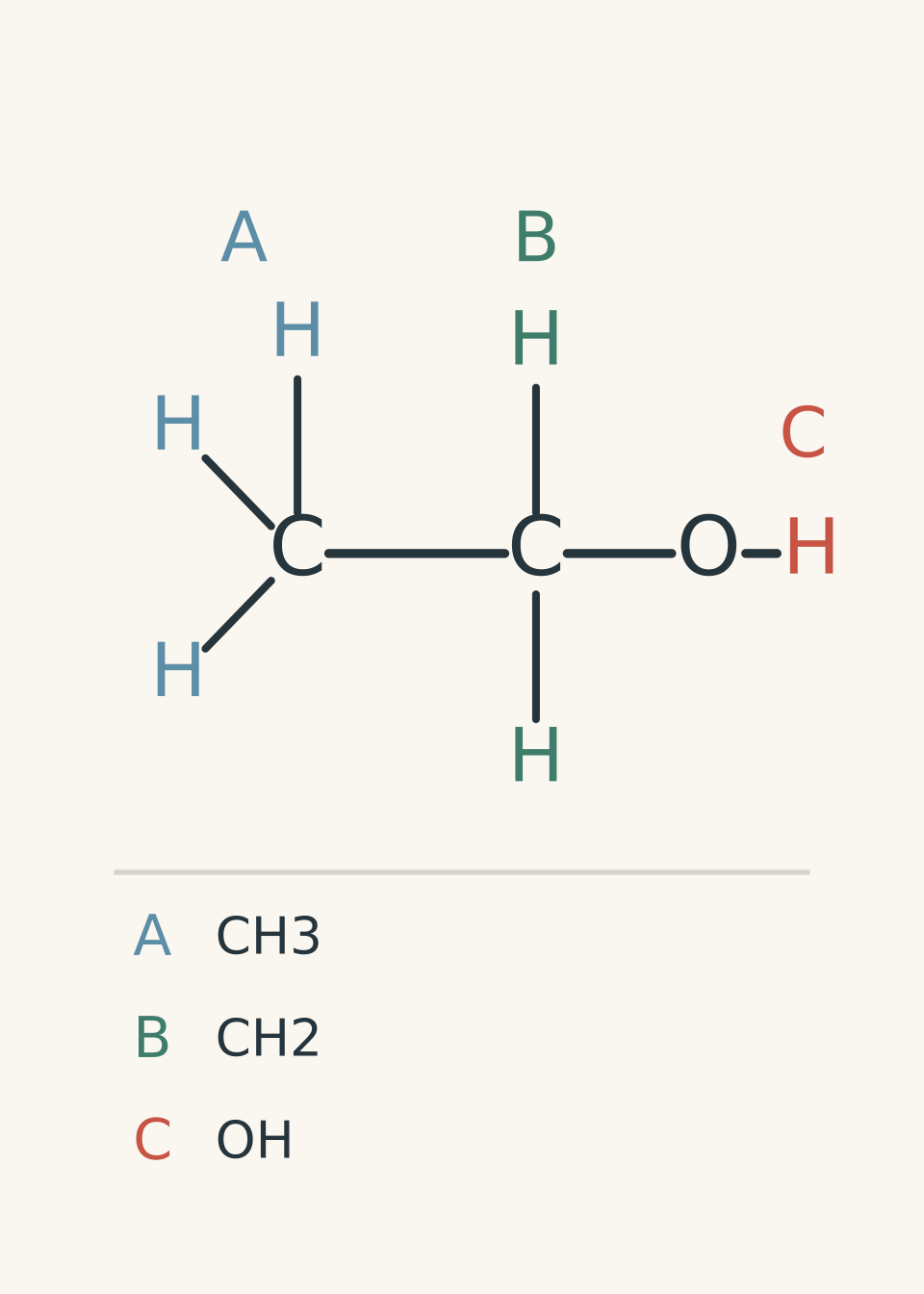
Be careful here. You are not counting carbon atoms, and you are not counting individual hydrogens.
You are counting sets of chemically equivalent hydrogens.
Symmetry can collapse several groups into one signal
Consider propane:
\[ \ce{CH3CH2CH3} \]
At first glance, there are three carbon atoms carrying hydrogens. But the two end \(\ce{CH3}\) groups are equivalent because the molecule is symmetrical.
So there are only two proton environments:
- six equivalent methyl protons,
- two equivalent methylene protons.
The spectrum therefore contains two signals, not three.
A useful decision rule is:
If swapping two groups leaves you with an indistinguishable molecule, their corresponding protons are often chemically equivalent.
That is a useful HSC-level test, although more advanced NMR chemistry contains cases where equivalence becomes subtler.
03Second clue: chemical shift tells you what is nearby
Two proton environments can produce different signals because nearby atoms alter the electron density around the hydrogens.
The horizontal position of an NMR signal is called its chemical shift, represented by \(\delta\), and measured in parts per million, or ppm.
Protons surrounded by relatively high electron density are described as more shielded. Their electrons partly oppose the external magnetic field.
Protons near strongly electronegative atoms or certain electron-withdrawing groups are generally more deshielded, meaning they experience more of the applied field.
Their signals tend to appear at larger chemical shifts.
You do not normally identify a structure from an exact chemical-shift value alone. Treat chemical shift as a range and combine it with the other evidence.
Typical HSC-useful regions include:
| Proton environment | Approximate chemical shift |
|---|---|
| Simple alkyl \(\ce{R-CH3}\), \(\ce{R-CH2-R}\) | about \(0.5\)-\(2\) ppm |
| Near \(\ce{C=O}\) or unsaturation | often about \(2\)-\(3\) ppm |
| Attached to carbon beside O, N, or halogen | often about \(3\)-\(4.5\) ppm |
| Alkene proton | roughly \(4.5\)-\(6.5\) ppm |
| Aromatic proton | roughly \(6\)-\(8.5\) ppm |
| Aldehyde proton | roughly \(9\)-\(10\) ppm |
| Carboxylic acid proton | often roughly \(10\)-\(13\) ppm |
Exact values vary with molecular structure, solvent, concentration, and other conditions.
That means a signal at \(3.7\) ppm should not make you say, “This must be exactly this functional group.” A better conclusion is, “These protons are probably close to an electronegative atom, such as oxygen.”
04Third clue: integration tells you how many protons belong to each signal
The area under each proton NMR signal is proportional to the number of hydrogens in that environment.
Suppose a spectrum has three signals with integration ratio
\[ 3:2:1 \]
That suggests proton environments containing three, two, and one hydrogen respectively.
For ethanol, that matches:
\[ \ce{CH3CH2OH} \]
with:
- \(3\text{ H}\) from \(\ce{CH3}\),
- \(2\text{ H}\) from \(\ce{CH2}\),
- \(1\text{ H}\) from \(\ce{OH}\).
Integration normally gives a ratio rather than magically printing the number of atoms above each peak.
For example, an integration ratio of
\[ 6:4:2 \]
simplifies to
\[ 3:2:1. \]
But do not always reduce the ratio immediately without thinking. If the molecular formula tells you there are 12 hydrogens represented, the actual \(6:4:2\) assignment may matter.
05Fourth clue: splitting reveals neighbouring protons
Now imagine one proton environment sitting beside another.
The neighbouring protons slightly alter the magnetic environment experienced by the proton being observed. Instead of producing one simple peak, the signal may split into several closely spaced peaks.
For simple HSC proton NMR problems, the key relationship is the \(n+1\) rule:
If a proton environment has \(n\) equivalent neighbouring protons on an adjacent carbon, its signal is commonly split into \(n+1\) peaks.
So:
| Equivalent neighbouring H atoms | Common splitting |
|---|---|
| 0 | singlet |
| 1 | doublet |
| 2 | triplet |
| 3 | quartet |
Now predict the splitting of ethanol’s \(\ce{CH3}\) signal.
The methyl group is next to \(\ce{CH2}\), which contains two equivalent neighbouring protons. Using \(n+1\):
\[ 2+1=3 \]
so the \(\ce{CH3}\) signal is a triplet.
What about the \(\ce{CH2}\) group? It sits beside three equivalent methyl hydrogens:
\[ 3+1=4 \]
so its signal is a quartet.
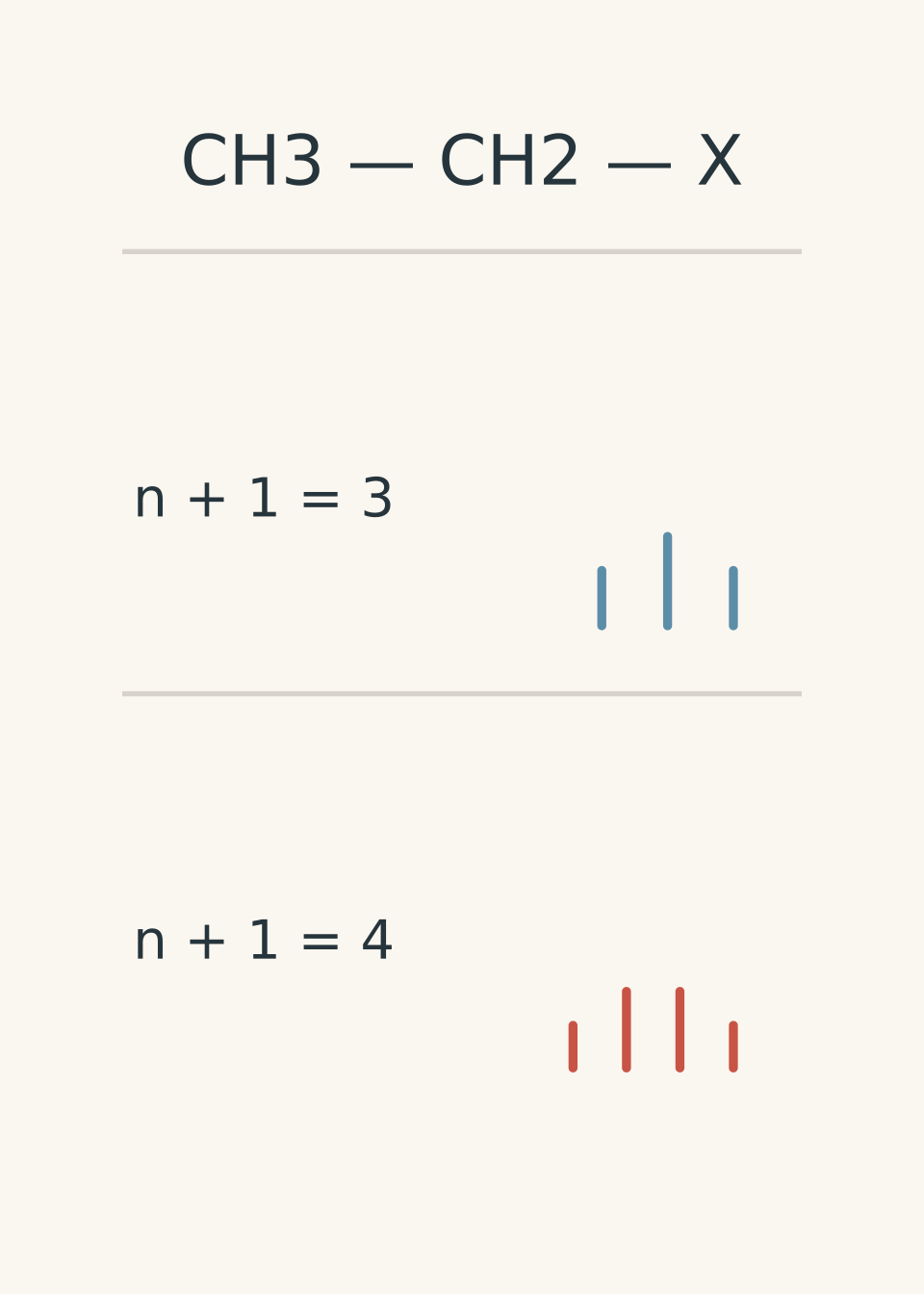
This triplet-quartet combination is a very useful clue for an ethyl fragment, \(\ce{-CH2CH3}\).
But the \(n+1\) rule is a simplified model. It works well for many simple HSC spectra, but real spectra can contain more complicated splitting when protons interact with several non-equivalent neighbours.
What about an OH proton?
Students often try to apply the \(n+1\) rule mechanically to \(\ce{OH}\).
In simple HSC interpretation, \(\ce{OH}\) protons often appear as broad signals and may not show predictable coupling with nearby carbon-bound hydrogens because proton exchange can occur.
So if ethanol has an \(\ce{OH}\), do not automatically insist that its hydrogen must split the neighbouring \(\ce{CH2}\) signal or itself show ordinary splitting.
06Put the clues together, not one at a time
A good proton NMR interpretation usually follows this order:
- Check the molecular formula and any other given structural information.
- Count the signals.
- Use integration to determine how many protons belong to each environment.
- Use chemical shifts to identify likely surroundings.
- Use splitting to determine neighbouring proton groups.
- Build a structure that satisfies all the evidence.
- Check every signal against the proposed structure.
That final check matters. It is easy to invent a structure that explains three pieces of data and quietly ignore the fourth.
Worked example: Identify the structure from three signals
A compound has molecular formula \(\ce{C3H8O}\). Its proton NMR spectrum contains:
- a triplet at \(1.0\) ppm integrating to \(3\text{ H}\),
- a multiplet centred around \(1.6\) ppm integrating to \(2\text{ H}\),
- a triplet at \(3.6\) ppm integrating to \(2\text{ H}\),
- a broad \(\ce{OH}\) signal integrating to \(1\text{ H}\).
Determine the structure.
Step 1
The formula \(\ce{C3H8O}\) could represent an alcohol or an ether. The observed \(\ce{OH}\) signal tells us this compound is an alcohol.
Step 2
The integration is \(2\text{ H}\), so this is probably a \(\ce{CH2}\) group.
Its relatively large chemical shift suggests that this \(\ce{CH2}\) is directly attached to oxygen:
\[ \ce{-CH2OH} \]
It is a triplet, so it has two equivalent neighbouring hydrogens:
\[ n+1=3 \Rightarrow n=2. \]
That suggests another \(\ce{CH2}\) group beside it.
Step 3
A \(3\text{ H}\) signal strongly suggests \(\ce{CH3}\).
Its triplet splitting means it sits next to two equivalent hydrogens, so we have:
\[ \ce{CH3CH2-} \]
Step 4
The pattern is consistent with
\[ \ce{CH3CH2CH2OH}. \]
So the compound is propan-1-ol.
Step 5
The structure gives:
- terminal \(\ce{CH3}\): \(3\text{ H}\), next to \(\ce{CH2}\), so triplet,
- middle \(\ce{CH2}\): \(2\text{ H}\), interacting with protons on both sides, giving a more complicated multiplet,
- \(\ce{CH2OH}\): \(2\text{ H}\), next to \(\ce{CH2}\), so approximately a triplet,
- \(\ce{OH}\): \(1\text{ H}\), often broad.
Everything is consistent.
The important clue was not simply “\(3.6\) ppm means alcohol”. It was the combination of shift, integration, splitting, and formula.
07A common mistake: assuming every carbon creates one signal
Consider propan-2-ol:
\[ \ce{CH3CH(OH)CH3} \]
There are three carbon atoms, so you might predict three carbon-bound proton environments.
But the two \(\ce{CH3}\) groups are equivalent.
The proton environments are:
- six equivalent methyl hydrogens,
- one hydrogen on the central carbon,
- one \(\ce{OH}\) hydrogen.
The integration is therefore approximately
\[ 6:1:1. \]
Now look at the splitting.
Each methyl group sits beside the single proton on the central carbon. So the six equivalent methyl hydrogens produce a doublet:
\[ n+1=1+1=2. \]
The central \(\ce{CH}\) proton sits beside six equivalent methyl hydrogens. In a simple first-order interpretation, its signal is split into seven:
\[ n+1=6+1=7. \]
This is called a septet.
A doublet integrating to \(6\text{ H}\), paired with a septet integrating to \(1\text{ H}\), is a strong clue for a \(\ce{(CH3)2CH-}\) fragment.
08Use splitting from both directions
Splitting is especially powerful when two signals support each other.
Suppose you find:
- a \(3\text{ H}\) triplet,
- a \(2\text{ H}\) quartet.
The triplet says the \(3\text{ H}\) group has two neighbouring hydrogens.
The quartet says the \(2\text{ H}\) group has three neighbouring hydrogens.
Those two statements point at each other:
\[ \ce{CH3CH2-} \]
This is stronger evidence than either splitting pattern alone.
It is a bit like two people separately describing who they went on a date with. One says, “I was with the person wearing a ridiculous frog hat,” and the other says, “I wore a ridiculous frog hat and was with them.” The descriptions reinforce each other.
The analogy breaks because NMR coupling does not identify individual atoms through personal recognition. It reflects magnetic interactions between neighbouring nuclei. But the idea of mutually consistent evidence is useful.
Worked example: Distinguish between possible isomers
A compound has molecular formula \(\ce{C4H8O2}\). Its proton NMR spectrum contains:
- a triplet at \(1.3\) ppm integrating to \(3\text{ H}\),
- a singlet at \(2.0\) ppm integrating to \(3\text{ H}\),
- a quartet at \(4.1\) ppm integrating to \(2\text{ H}\).
Determine a structure consistent with the data.
Step 1
The integrations give:
\[ 3+3+2=8\text{ H}, \]
which accounts for all eight hydrogens in \(\ce{C4H8O2}\).
So there are three proton environments.
Step 2
A \(3\text{ H}\) triplet and \(2\text{ H}\) quartet strongly suggest an ethyl group:
\[ \ce{CH3CH2-}. \]
The \(\ce{CH2}\) signal is at \(4.1\) ppm, considerably further downfield than an ordinary alkyl \(\ce{CH2}\).
That suggests the \(\ce{CH2}\) is directly bonded to oxygen:
\[ \ce{CH3CH2O-}. \]
Step 3
A \(3\text{ H}\) signal suggests another \(\ce{CH3}\).
It is a singlet, which means it has no ordinary neighbouring carbon-bound hydrogens.
Its shift at about \(2.0\) ppm is consistent with a methyl group next to a carbonyl:
\[ \ce{CH3C(=O)-}. \]
Step 4
We need four carbons and two oxygens. The fragments
\[ \ce{CH3C(=O)-} \]
and
\[ \ce{-OCH2CH3} \]
join naturally to give
\[ \ce{CH3COOCH2CH3}. \]
The compound is ethyl ethanoate.
Step 5
For \(\ce{CH3COOCH2CH3}\):
- \(\ce{CH3CO-}\) has \(3\text{ H}\) and no neighbouring hydrogens across the carbonyl carbon, so it is a singlet,
- \(\ce{-OCH2-}\) has \(2\text{ H}\), lies beside oxygen, and has three neighbouring methyl hydrogens, so it is a quartet near \(4\) ppm,
- terminal \(\ce{CH3}\) has \(3\text{ H}\) and two neighbouring \(\ce{CH2}\) hydrogens, so it is a triplet.
The entire spectrum fits one structure.
09Why you should not identify a compound from one spectacular-looking signal
Imagine a spectrum contains a \(3\text{ H}\) singlet around \(2\) ppm.
It is tempting to immediately write:
\[ \ce{CH3CO-} \]
That may be correct, but it is not enough evidence by itself.
A structure must satisfy:
- the molecular formula,
- the total number of environments,
- every integration,
- every relevant chemical shift,
- every relevant splitting pattern.
NMR interpretation is therefore a constraint problem.
Each piece of evidence removes possibilities.
A good exam habit is to ask:
What structures are impossible because of this signal?
That question is often more useful than asking what a single signal “means”.
10When splitting looks simpler than the actual molecule
The basic \(n+1\) rule assumes a relatively simple situation: one set of equivalent neighbouring protons.
Suppose a \(\ce{CH2}\) group has different proton groups on both sides. You cannot always just count all neighbouring protons and apply \(n+1\) once.
For example, the middle \(\ce{CH2}\) group in propan-1-ol,
\[ \ce{CH3CH2CH2OH}, \]
has three methyl hydrogens on one side and two \(\ce{CH2}\) hydrogens on the other.
Because those neighbouring groups are not equivalent, the real splitting can be more complicated than one neat sextet.
At HSC level, such signals may simply be described as multiplets.
So the rule should be remembered as:
For a simple proton environment coupled to \(n\) equivalent neighbouring protons, expect approximately \(n+1\) peaks.
That extra word, “equivalent”, matters.
11Reading a spectrum as a connected story
Suppose an unknown compound gives these clues:
- molecular formula \(\ce{C3H6O}\),
- three proton environments,
- a \(3\text{ H}\) triplet,
- a \(2\text{ H}\) quartet,
- a \(1\text{ H}\) signal near \(9.8\) ppm.
You should not treat these as three unrelated facts.
The \(3\text{ H}\) triplet and \(2\text{ H}\) quartet suggest:
\[ \ce{CH3CH2-}. \]
That already accounts for two carbons and five hydrogens.
The remaining formula requires one carbon, one hydrogen, and one oxygen.
The signal around \(9.8\) ppm strongly indicates an aldehyde proton:
\[ \ce{-CHO}. \]
Putting those clues together gives propanal:
\[ \ce{CH3CH2CHO}. \]
Notice the direction of the reasoning. Chemical shift suggested an aldehyde, but the molecular formula and ethyl splitting pattern made the whole structure possible.
That is much safer than memorising “9.8 ppm = aldehyde” and stopping there.
12Questions and solutions
Question 1
A compound has molecular formula \(\ce{C2H6O}\). Its proton NMR spectrum has three signals:
- a \(3\text{ H}\) triplet at \(1.2\) ppm,
- a \(2\text{ H}\) quartet at \(3.7\) ppm,
- a broad \(1\text{ H}\) signal.
Determine the structure and explain how the spectrum supports your answer.
Solution 1
The compound is ethanol, \(\ce{CH3CH2OH}\).
The molecular formula allows structures including ethanol and dimethyl ether, but the spectrum strongly supports ethanol.
The \(3\text{ H}\) triplet indicates a \(\ce{CH3}\) group next to two equivalent hydrogens:
\[ n+1=2+1=3. \]
The \(2\text{ H}\) quartet indicates a \(\ce{CH2}\) group next to three equivalent hydrogens:
\[ n+1=3+1=4. \]
These signals therefore identify the connected fragment
\[ \ce{CH3CH2-}. \]
The \(\ce{CH2}\) signal occurs at \(3.7\) ppm, which is consistent with that carbon being directly attached to oxygen. The remaining broad \(1\text{ H}\) signal is consistent with \(\ce{OH}\).
The complete structure is therefore
\[ \ce{CH3CH2OH}. \]
A tempting alternative is dimethyl ether, \(\ce{CH3OCH3}\), because it has the same molecular formula. However, its two methyl groups are equivalent by symmetry, so it would give one main proton environment integrating to \(6\text{ H}\), not the triplet-quartet-OH pattern observed here.
Question 2
An unknown compound has molecular formula \(\ce{C4H10O}\). Its proton NMR spectrum has three main signals:
- a doublet integrating to \(6\text{ H}\) at about \(1.1\) ppm,
- a multiplet integrating to \(1\text{ H}\) at about \(3.8\) ppm,
- a broad signal integrating to \(1\text{ H}\).
Determine the structure. Explain why the \(6\text{ H}\) signal is one environment rather than two.
Solution 2
The compound is propan-2-yl alcohol with one additional carbon? That cannot satisfy \(\ce{C4H10O}\), so the listed data are not sufficient for a valid \(\ce{C4H10O}\) structure as written.
The integration totals
\[ 6+1+1=8\text{ H}, \]
but the molecular formula contains \(10\text{ H}\).
Therefore two hydrogens are unaccounted for. A valid structure cannot be accepted unless an additional signal or a different integration is present.
This is exactly the kind of consistency check that prevents a plausible pattern from overriding the full evidence.
The \(6\text{ H}\) doublet is certainly suggestive of two equivalent methyl groups beside one proton:
\[ \ce{(CH3)2CH-}. \]
Each methyl group has one neighbouring \(\ce{CH}\) proton, giving
\[ n+1=1+1=2, \]
so the signal is a doublet.
The two methyl groups can contribute one shared \(6\text{ H}\) signal because they are chemically equivalent in an appropriate symmetrical environment.
The tempting route is to recognise the \(6\text{ H}\) doublet and approximately \(1\text{ H}\) signal near oxygen as an isopropyl alcohol pattern and immediately answer propan-2-ol. But propan-2-ol has molecular formula \(\ce{C3H8O}\), not \(\ce{C4H10O}\).
The exact constraint that blocks that answer is conservation of atoms: any proposed structure must match the stated molecular formula as well as the spectrum.
So the correct conclusion is that the supplied NMR data and molecular formula are inconsistent; no unique valid structure can satisfy all of them.
Question 3
A compound with molecular formula \(\ce{C4H8O2}\) gives three proton NMR signals:
- \(3\text{ H}\), triplet, \(1.2\) ppm,
- \(2\text{ H}\), quartet, \(4.1\) ppm,
- \(3\text{ H}\), singlet, \(2.0\) ppm.
A student proposes butanoic acid, \(\ce{CH3CH2CH2COOH}\).
Evaluate the proposal and determine a structure that better fits the spectrum.
Solution 3
The proposed structure is incorrect; ethyl ethanoate, \(\ce{CH3COOCH2CH3}\), fits the evidence much better.
First, the integrations account for all eight hydrogens:
\[ 3+2+3=8. \]
The \(3\text{ H}\) triplet and \(2\text{ H}\) quartet support an ethyl fragment:
\[ \ce{CH3CH2-}. \]
For the triplet:
\[ n+1=2+1=3, \]
so the methyl group is beside a \(\ce{CH2}\).
For the quartet:
\[ n+1=3+1=4, \]
so the \(\ce{CH2}\) is beside a \(\ce{CH3}\).
The \(\ce{CH2}\) appears at \(4.1\) ppm, which strongly suggests that it is directly attached to oxygen. This gives
\[ \ce{CH3CH2O-}. \]
The remaining \(3\text{ H}\) singlet at about \(2.0\) ppm has no neighbouring carbon-bound hydrogens and is consistent with a methyl group beside a carbonyl:
\[ \ce{CH3C(=O)-}. \]
Combining the fragments gives
\[ \ce{CH3COOCH2CH3}. \]
Butanoic acid would contain several non-equivalent environments along a continuous carbon chain and should also contain an acidic \(\ce{OH}\) proton, commonly much further downfield. Its proton environments would not give the clean \(3:2:3\) singlet-quartet-triplet pattern shown.
The tempting mistake is to use only the molecular formula. Both compounds share \(\ce{C4H8O2}\), but NMR distinguishes how those atoms are connected.
Question 4
Two compounds, A and B, both have molecular formula \(\ce{C3H6O}\).
Compound A gives two proton NMR signals:
- a singlet integrating to \(6\text{ H}\) at about \(2.1\) ppm.
Compound B gives three main proton environments:
- \(3\text{ H}\) near \(1.0\) ppm,
- \(2\text{ H}\) near \(2.4\) ppm,
- \(1\text{ H}\) near \(9.8\) ppm.
Determine A and B.
Then explain why compound A gives only one proton signal even though its six hydrogens are attached to two different carbon atoms.
Solution 4
Compound A is propanone, \(\ce{CH3COCH3}\), and compound B is propanal, \(\ce{CH3CH2CHO}\).
For A, the two methyl groups lie on opposite sides of the same carbonyl group:
\[ \ce{CH3COCH3}. \]
The molecule has a plane of symmetry that makes the two \(\ce{CH3}\) groups chemically equivalent.
All six methyl hydrogens therefore experience the same chemical environment and contribute to one signal integrating to \(6\text{ H}\).
The signal appears around \(2.1\) ppm because the methyl groups lie beside a carbonyl group.
Their signal is a singlet because the adjacent carbonyl carbon carries no hydrogens. There are therefore no neighbouring carbon-bound protons to produce ordinary splitting.
For B, the signal near \(9.8\) ppm is the crucial clue. It is strongly consistent with an aldehyde proton, giving the fragment
\[ \ce{-CHO}. \]
The remaining formula can form
\[ \ce{CH3CH2-}, \]
so the complete structure is
\[ \ce{CH3CH2CHO}. \]
The \(\ce{CH2}\) beside the carbonyl is deshielded relative to an ordinary alkyl \(\ce{CH2}\), explaining its signal near \(2.4\) ppm.
The tempting mistake in A is to say, “Different carbon atoms must mean different signals.” That is false. NMR distinguishes chemical environments, not carbon labels. Two groups on different atoms can still be equivalent if molecular symmetry gives them indistinguishable surroundings.
This comparison also shows why molecular formula alone cannot distinguish functional-group isomers. Both compounds are \(\ce{C3H6O}\), but their proton environments are completely different.
Question 5
An unknown compound has molecular formula \(\ce{C5H10O2}\). Its proton NMR spectrum contains only three signals:
- a singlet integrating to \(6\text{ H}\) at about \(1.3\) ppm,
- a singlet integrating to \(3\text{ H}\) at about \(2.0\) ppm,
- a broad singlet integrating to \(1\text{ H}\).
A student argues:
“The \(6\text{ H}\) signal must come from two equivalent methyl groups beside a \(\ce{CH}\). Therefore it should be a doublet, so the spectrum must be wrong.”
Another student argues:
“If two methyl groups are equivalent, the molecule must contain a \(\ce{(CH3)2CH-}\) group.”
Assess both claims and determine a structure consistent with all the information.
Solution 5
Both claims are incorrect. A structure consistent with the evidence is 2-hydroxy-2-methylbutanone only if the carbon count and proton environments work – but they do not, so we must build the structure from the constraints rather than from the tempting isopropyl pattern.
Start with the \(6\text{ H}\) singlet.
A \(6\text{ H}\) integration strongly suggests two equivalent methyl groups:
\[ \ce{(CH3)2C-} \]
but a singlet tells us those methyl groups have no neighbouring carbon-bound hydrogens.
That means the carbon beside both methyl groups cannot be \(\ce{CH}\). It must carry no hydrogen.
This immediately rules out the first student’s assumed fragment
\[ \ce{(CH3)2CH-}, \]
because a central \(\ce{CH}\) would split the equivalent methyl groups into a doublet.
The key alternative is therefore a carbon bonded to both methyl groups but carrying no hydrogen:
\[ \ce{(CH3)2C(-...)-...} \]
Now consider the molecular formula \(\ce{C5H10O2}\).
Two equivalent methyl groups account for:
\[ \ce{C2H6}. \]
The separate \(3\text{ H}\) singlet suggests a third methyl group. Its chemical shift near \(2.0\) ppm is consistent with a methyl group attached to a carbonyl carbon:
\[ \ce{CH3C(=O)-}. \]
That uses a further two carbons: one methyl carbon and one carbonyl carbon.
We now have four of the five carbons accounted for, so the carbon bonded to the two equivalent methyl groups can be the fifth carbon.
The remaining broad \(1\text{ H}\) signal suggests an \(\ce{OH}\) proton.
Putting those pieces together gives:
\[ \ce{CH3C(=O)C(OH)(CH3)2}. \]
This is 3-hydroxy-3-methylbutan-2-one.
Check the formula:
- carbons: \(5\),
- hydrogens: \(3+6+1=10\),
- oxygens: \(2\).
So the molecular formula is correct.
Now check the NMR evidence.
The two methyl groups attached to \(\ce{C(OH)}\) are equivalent and together contain \(6\text{ H}\). The adjacent carbon has no hydrogen, so these methyl protons have no neighbouring carbon-bound protons:
\[ n=0 \Rightarrow n+1=1. \]
They therefore produce a singlet.
The carbonyl-side methyl group, \(\ce{CH3C(=O)-}\), also has no neighbouring proton on the adjacent carbonyl carbon, so it produces another \(3\text{ H}\) singlet.
The remaining hydrogen is the \(\ce{OH}\) proton, which can appear as a broad signal.
The first student’s mistake was assuming that a \(6\text{ H}\) integration automatically means an isopropyl group. It does not. Integration tells you how many equivalent protons contribute to a signal; splitting tells you what neighbouring protons they interact with.
The second student’s mistake was more subtle. Two equivalent methyl groups do not uniquely imply
\[ \ce{(CH3)2CH-}. \]
They can also occur in an environment such as
\[ \ce{(CH3)2C(-...)-...}, \]
where the central carbon has no hydrogen at all.
The fair hinge in this problem is the singlet. The \(6\text{ H}\) integration invites you to recognise a familiar isopropyl pattern, but the absence of splitting directly contradicts that interpretation. The correct structure has to satisfy both observations at once.
13What proton NMR lets you do next
Once you stop reading proton NMR as a collection of isolated peak rules, it becomes a structural argument.
The number of signals tells you how many environments exist. Integration tells you how many protons belong to each environment. Chemical shift tells you what kinds of groups are nearby. Splitting tells you which proton groups are neighbours.
The next useful step is to combine proton NMR with other structural evidence. Infrared spectroscopy can identify functional groups, mass spectrometry can constrain molecular mass and fragmentation, and carbon-13 NMR can reveal different carbon environments. When several techniques point towards the same arrangement of atoms, an unknown structure becomes much harder to hide.