
Practical Investigations of Reversible Reactions in HSC Chemistry
Learn how cobalt(II) chloride, iron(III) thiocyanate, magnesium, and steel wool investigations provide evidence for reversible and completed reactions.
A student heats a blue solution of cobalt(II) chloride and watches it turn pink. Then they add water, and it turns blue again. Did the reaction “undo itself”? Or did the original reaction never truly stop?
That question is the key to practical investigations of reversibility. In the laboratory, we rarely see molecules moving backwards. Instead, we look for evidence that a system can move in two directions and that changing conditions can shift which direction is favoured.

Before naming the idea, make a prediction.
If a reaction can go forwards and backwards, what would you expect to happen if you remove one of the substances involved? Would the reaction simply stop, or would the system try to replace what was removed?
The system tries to replace the missing substance. This is why colour changes, temperature changes, and mass changes can be useful evidence in reversible reaction investigations.
01From a simple idea to a chemical model
Imagine two groups of people moving between two rooms. At first, more people enter Room A than leave it, so Room A fills up quickly. Later, as Room A becomes crowded, leaving becomes more likely. Eventually, the number entering each second matches the number leaving each second.
The rooms are not frozen. People are still moving. The pattern only looks unchanged from the outside.
A reversible chemical reaction behaves in a similar way.
A reversible reaction is one where products can react to form the original reactants. We represent this using a double arrow:
\[ \ce{A + B <=> C + D} \]
The forward reaction produces \(C\) and \(D\). The reverse reaction uses \(C\) and \(D\) to reform \(A\) and \(B\).
This explanation is useful, but it is still a simplified model. Real reactions do not involve neat groups of particles taking turns. Molecules collide randomly, bonds break, and bonds form. The reaction direction that dominates depends on factors such as concentration, temperature, and the energy changes involved.
You can revise the particle-level explanation of equilibrium in more detail here:
Collision Theory and Chemical Equilibrium: HSC Chemistry
02Investigation 1: Cobalt(II) chloride and water
Cobalt(II) chloride is a classic example because the colour change is easy to observe.
The equilibrium involves hydrated cobalt(II) ions and chloride ions:
\[ \ce{[Co(H2O)6]^2+ + 4Cl^- <=> [CoCl4]^2- + 6H2O} \]
The hydrated cobalt complex, \(\ce{[Co(H2O)6]^2+}\), is pink.
The chloride complex, \(\ce{[CoCl4]^2-}\), is blue.
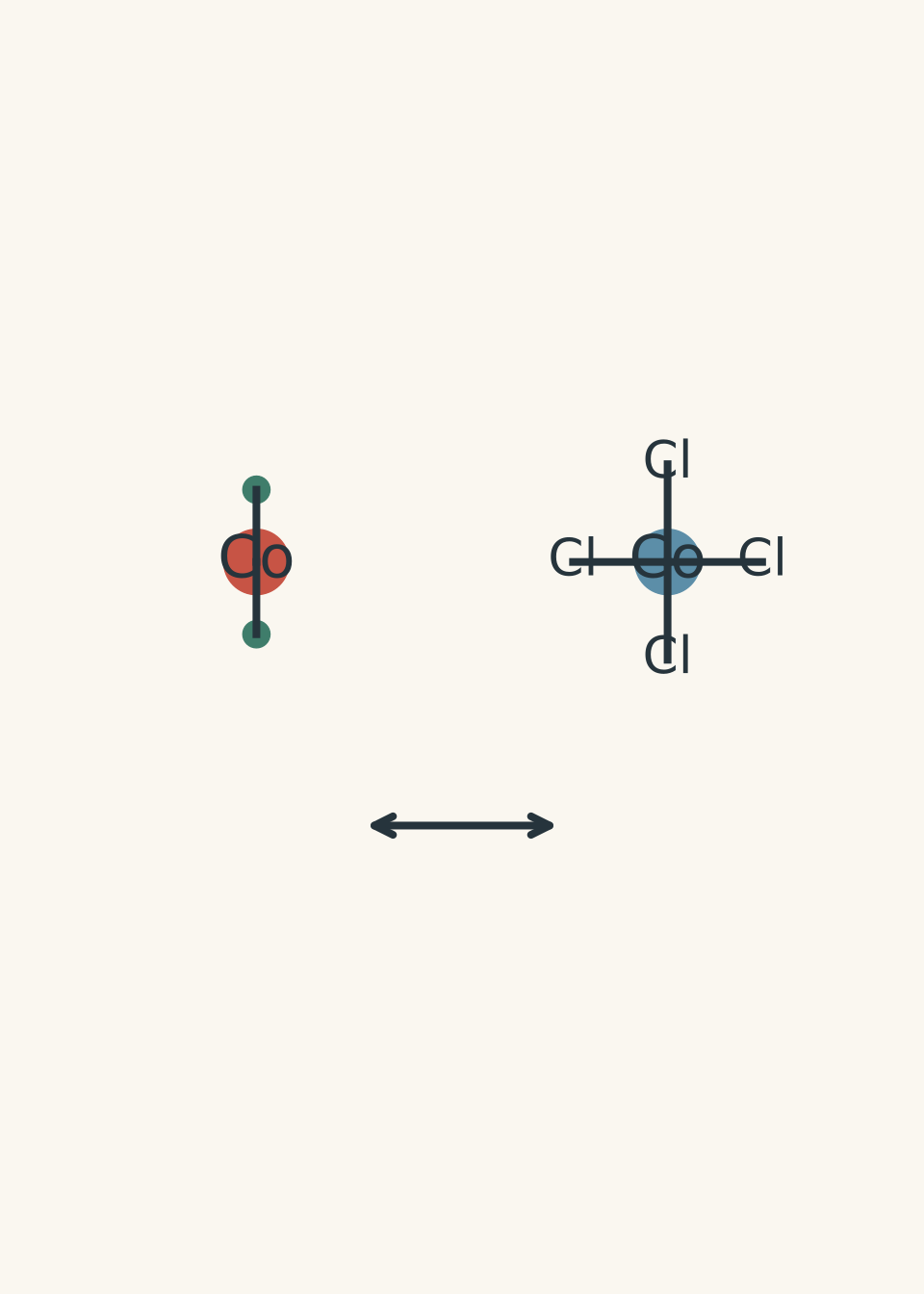
What students observe
A concentrated chloride solution encourages the formation of the blue complex.
Adding water increases the amount of water available and dilutes the chloride ions. The equilibrium shifts towards the pink hydrated ion.
The colour change is evidence that the reaction is reversible.
A common prediction is:
“Adding water should just make the blue solution paler because it is being diluted.”
That sounds reasonable, but it misses the chemical change. Water is not just a background liquid. It is one of the substances involved in the equilibrium.
Limitation of this investigation
Colour is useful evidence, but it is not a direct measurement of particle numbers. A darker colour does not automatically prove a certain concentration unless the relationship has been measured and controlled.
A careful investigation would keep variables such as temperature, volumes, and concentrations controlled.
03Investigation 2: Iron(III) nitrate and thiocyanate ions
Another useful reversible system involves iron(III) ions reacting with thiocyanate ions.
\[ \ce{Fe^3+ + SCN^- <=> FeSCN^2+} \]
The iron(III) thiocyanate complex, \(\ce{FeSCN^2+}\), produces a deep red colour.
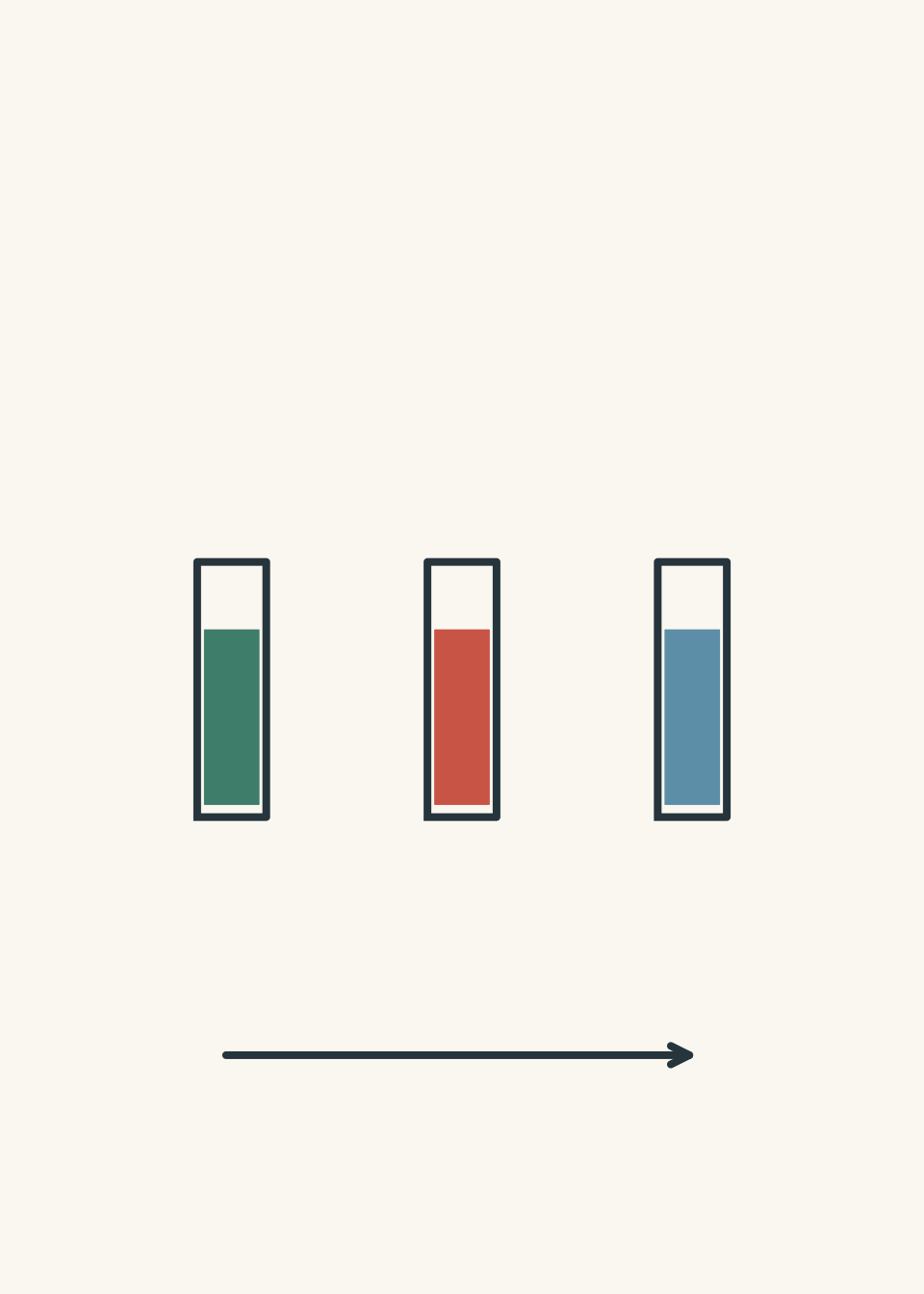
Students can investigate reversibility by adding different reactants:
- adding more thiocyanate ions pushes the equilibrium towards the red complex
- adding more iron(III) ions also pushes the equilibrium towards the red complex
- removing one reactant or adding a competing reaction can shift the system in another direction
The important observation is not just “the solution became red”. The observation is evidence that changing concentrations changes the balance between forward and reverse reactions.
This connects directly to the idea of dynamic equilibrium: a system can appear constant while reactions continue in both directions.
You can compare this with the difference between a static and dynamic equilibrium here:
Static vs Dynamic Equilibrium in HSC Chemistry
04Reversible reactions versus reactions that go to completion
Not every chemical reaction behaves like cobalt chloride or iron thiocyanate.
Some reactions appear to go completely in one direction because the reverse reaction is extremely unlikely under the conditions used.
Burning magnesium is a good example.
\[ \ce{2Mg(s) + O2(g) -> 2MgO(s)} \]
Magnesium burns with a bright white light and forms magnesium oxide.
A student might predict:
“If the reaction is reversible, magnesium oxide should eventually turn back into magnesium and oxygen.”
The prediction makes sense from the definition of reversibility, but it ignores the energy barrier. Breaking the strong ionic structure of magnesium oxide requires a large input of energy.
Under normal classroom conditions, the reverse reaction does not happen at an observable rate.
This is why we often describe combustion as a non-equilibrium system.
Combustion as a Non-Equilibrium System: HSC Chemistry
05Investigation 3: Steel wool and oxygen
Steel wool provides another way to examine reaction completion.
Steel wool is mostly iron. When heated in oxygen, iron reacts to form iron oxides:
\[ \ce{4Fe(s) + 3O2(g) -> 2Fe2O3(s)} \]
The mass may increase because oxygen atoms from the air become part of the solid product.
A key question is:
If the mass increases, does that mean the reaction is reversible?
No. A mass increase only shows that matter has entered the system. It does not prove that the products can reform the reactants.
To investigate completion, chemists look for evidence that one reactant has been used up. For steel wool, this might include:
- no further visible reaction after heating
- no further mass increase after repeated heating and cooling cycles
- analysis showing the original iron has been converted
The investigation must match the claim being made.
06How to design a good reversibility investigation
A strong HSC response does more than describe a colour change. It explains the evidence and the limitations.
| Investigation | Observable evidence | What it suggests | Important limitation |
|---|---|---|---|
| Cobalt(II) chloride and water | Pink/blue colour changes | Equilibrium shifts when conditions change | Colour is indirect evidence |
| Iron(III) nitrate and thiocyanate | Red colour intensity changes | Concentration affects equilibrium position | Other ions may affect the system |
| Burning magnesium | White solid forms | Reaction proceeds strongly forward | Reverse reaction is not observable |
| Steel wool oxidation | Mass increases | Oxygen joins the iron | Mass alone does not prove reversibility |
07Worked example: Cobalt chloride colour change
Question
A student has a blue cobalt(II) chloride solution. They add water and observe that the solution becomes pink.
Explain the chemical reason for this change.
Step 1
The equilibrium is:
\[ \ce{[Co(H2O)6]^2+ + 4Cl^- <=> [CoCl4]^2- + 6H2O} \]
The pink species is \(\ce{[Co(H2O)6]^2+}\), and the blue species is \(\ce{[CoCl4]^2-}\).
Step 2
Adding water increases the concentration of water and decreases the concentration of chloride ions because the solution is diluted.
Step 3
The system shifts to reduce the effect of the change. It forms more hydrated cobalt ions.
Step 4
The solution becomes pink because the equilibrium shifts towards \(\ce{[Co(H2O)6]^2+}\), increasing the amount of the pink complex.
The colour change is evidence that the cobalt chloride system is reversible.
08Worked example: Steel wool mass change
Question
A 2.50 g sample of steel wool is heated in oxygen. After cooling, its mass is 2.86 g. Calculate the mass of oxygen that reacted with the steel wool.
Step 1
The extra mass comes from oxygen atoms from the air becoming part of the iron oxide product.
Step 2
\[ \text{mass of oxygen}=\text{mass of product}-\text{mass of iron} \]
\[ =2.86\text{ g}-2.50\text{ g} \]
Step 3
\[ =0.36\text{ g} \]
Step 4
The steel wool gained 0.36 g of oxygen during the reaction.
This shows oxygen was incorporated into the solid product, but it does not show that the reaction is reversible.
09Common misconception: “If a reaction can reverse, it always will”
This is one of the most important traps.
A reversible reaction does not mean the reverse reaction is equally fast or equally visible.
The reverse reaction may be:
- too slow to observe
- limited by available reactants
- blocked by a large energy requirement
A good investigation asks:
“What evidence shows that both directions occur?”
not:
“Can I imagine the reaction going backwards?”
10Questions and solutions
Question 1
A student adds concentrated hydrochloric acid to a blue cobalt(II) chloride solution. The solution becomes darker blue.
Explain why this occurs.
Solution 1
The solution becomes darker blue because the equilibrium shifts towards the blue \(\ce{[CoCl4]^2-}\) complex.
Hydrochloric acid increases the concentration of chloride ions:
\[ \ce{[Co(H2O)6]^2+ + 4Cl^- <=> [CoCl4]^2- + 6H2O} \]
The system responds by using up some of the added chloride ions, producing more \(\ce{[CoCl4]^2-}\). Since this complex is blue, the colour becomes stronger.
The tempting mistake is to think the acid is simply changing the colour directly. The important idea is that the acid changes the equilibrium position by changing reactant concentration.
Question 2
A student adds more thiocyanate ions to an iron(III) thiocyanate equilibrium. The red colour becomes more intense.
Explain what has happened at the particle level.
Solution 2
The equilibrium shifts towards more \(\ce{FeSCN^2+}\), producing a stronger red colour.
The reaction is:
\[ \ce{Fe^3+ + SCN^- <=> FeSCN^2+} \]
Adding \(\ce{SCN^-}\) increases the number of thiocyanate particles available for collisions with \(\mathrm{Fe}^{3+}\) ions. More forward reactions occur, creating more red complex ions.
A common incorrect explanation is “the reaction rate increases so the colour gets darker”. Rate may increase temporarily, but the colour change comes from a new equilibrium position containing more red complex.
Question 3
A student burns magnesium in oxygen and then leaves the magnesium oxide product for several days. No magnesium metal forms.
Does this prove the magnesium reaction is irreversible?
Solution 3
No, it does not prove the reaction is impossible to reverse; it shows that the reverse reaction is not observable under those conditions.
The reaction:
\[ \ce{2Mg(s) + O2(g) -> 2MgO(s)} \]
forms a very stable ionic compound. Converting magnesium oxide back into magnesium and oxygen requires a large energy input.
The tempting route is to say “no reverse reaction happened, so it cannot be reversible”. The better conclusion is that the reverse reaction is too slow or requires conditions not present in the investigation.
Question 4
A student performs two investigations.
Investigation A: A cobalt chloride solution changes from blue to pink after adding water.
Investigation B: Steel wool increases in mass after heating in oxygen.
The student concludes both investigations prove reversible reactions because both show a chemical change.
Evaluate the conclusion.
Solution 4
The conclusion is incorrect because the two investigations provide different evidence.
The cobalt chloride investigation supports reversibility because the system can shift between different coloured complexes when conditions change:
\[ \ce{[Co(H2O)6]^2+ + 4Cl^- <=> [CoCl4]^2- + 6H2O} \]
The colour can move in both directions depending on the environment.
The steel wool investigation only shows that iron reacts with oxygen:
\[ \ce{4Fe + 3O2 -> 2Fe2O3} \]
The increase in mass shows oxygen has entered the solid product. It does not show that iron oxide reforms iron and oxygen.
The trap is treating “chemical change” and “reversible reaction” as the same idea. A reversible reaction requires evidence of a reverse process, not just evidence that a reaction occurred.
Question 5
A student argues:
“Cobalt chloride is reversible because adding water makes it pink again. Therefore, every chemical reaction should be reversible if we add the correct substance.”
Is this reasoning valid? Explain using magnesium and steel wool as comparisons.
Solution 5
The reasoning is not valid because reversibility depends on the reaction conditions and energy changes, not simply on adding another substance.
Cobalt chloride is useful because the forward and reverse reactions occur at observable rates:
\[ \ce{[Co(H2O)6]^2+ + 4Cl^- <=> [CoCl4]^2- + 6H2O} \]
Changing concentrations shifts the balance between the two directions.
Magnesium combustion is different. The reverse reaction would require converting stable magnesium oxide back into magnesium and oxygen. The energy barrier is so large that the reverse process is not observable in normal conditions.
Steel wool oxidation is also different. Oxygen reacts with iron to form iron oxide, but the increase in mass only shows oxygen has been added. It does not provide evidence that the oxide naturally reforms iron.
The deeper idea is that “reversible” describes a system where both directions can occur under the conditions being studied. It does not mean every product can always be turned back into reactants by making a simple change.
Understanding this distinction prepares you for the next step: predicting how equilibrium systems respond when conditions such as concentration, temperature, and pressure are changed.