
Primary, Secondary and Tertiary Alcohols for HSC Chemistry
Learn how to classify alcohols as primary, secondary, or tertiary, draw structural formulae, and connect the hydroxyl group to bonding and physical properties.
Three molecules can all contain the same \(\ce{-OH}\) group and still behave differently in reactions. The key is not just spotting the hydroxyl group. You need to look at the carbon holding it.
Take butan-1-ol, butan-2-ol, and 2-methylpropan-2-ol. Before reading on, predict which one is primary, secondary, and tertiary. If you are tempted to count how many carbon atoms are in the whole molecule, that is exactly the trap this classification system is designed to avoid.
01The carbon attached to the \(\ce{-OH}\) group is the one that matters
An alcohol contains a hydroxyl functional group, \(\ce{-OH}\), attached to a carbon atom.
To classify the alcohol, first find that carbon. Then count how many other carbon atoms are directly bonded to it.
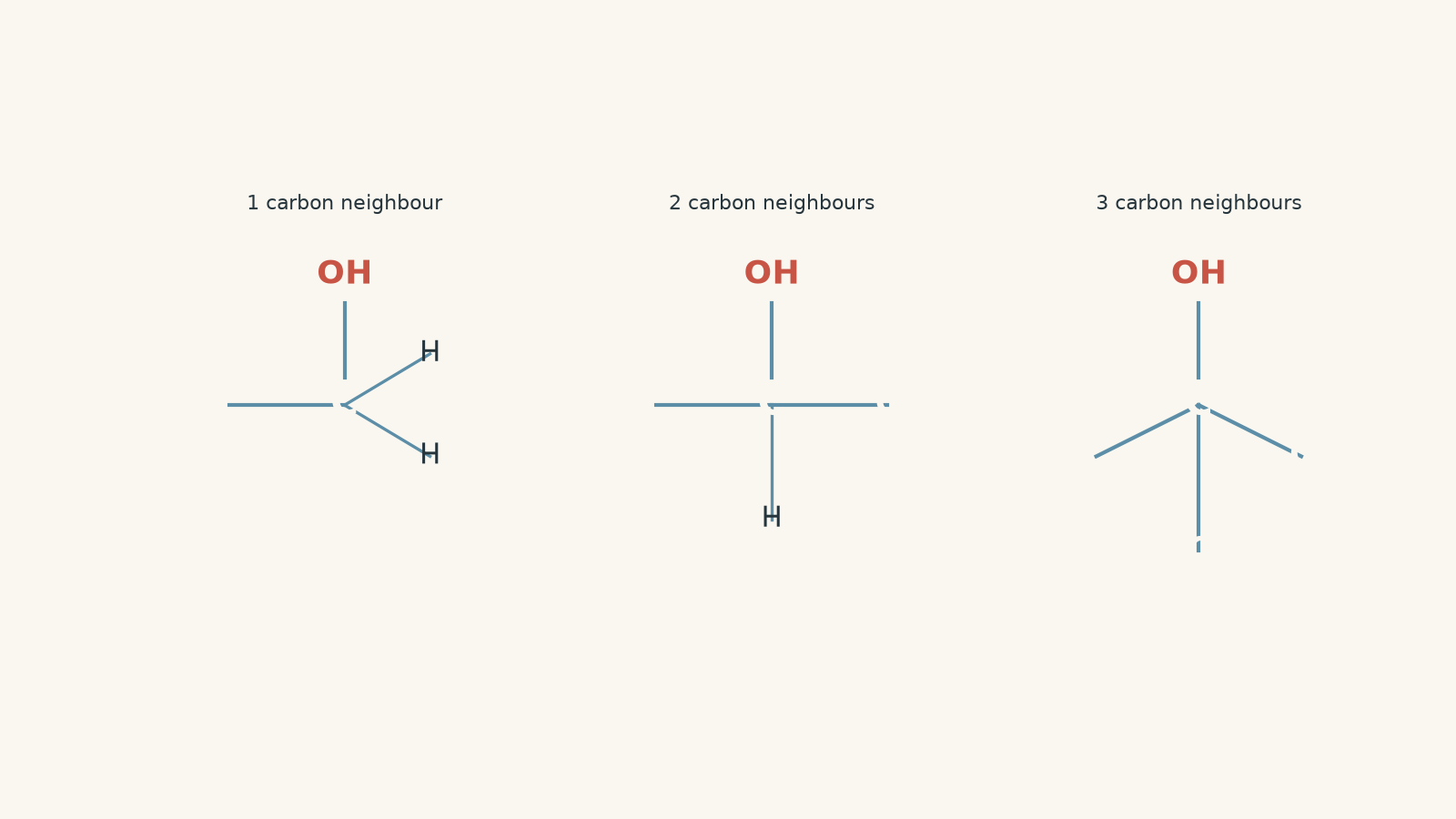
| Type of alcohol | Carbon atoms directly bonded to the \(\ce{C-OH}\) carbon | General local structure |
|---|---|---|
| Primary | 1 | \(\ce{R-CH2-OH}\) |
| Secondary | 2 | \(\ce{R-CH(OH)-R'}\) |
| Tertiary | 3 | \(\ce{R-C(OH)(R')-R''}\) |
Here, \(\ce{R}\), \(\ce{R'}\), and \(\ce{R''}\) represent carbon-containing groups.
Notice that we are counting carbon neighbours of one particular carbon. We are not counting the total number of carbons in the molecule.
Primary alcohols
Consider propan-1-ol:
\[ \ce{CH3-CH2-CH2-OH} \]
The carbon bonded to \(\ce{-OH}\) is the final \(\ce{CH2}\) carbon. It is directly bonded to only one other carbon.
So propan-1-ol is a primary alcohol.
We often shorten this to a \(1^\circ\) alcohol.
Secondary alcohols
Now consider propan-2-ol:
\[ \ce{CH3-CH(OH)-CH3} \]
The carbon carrying the \(\ce{-OH}\) group is bonded to two other carbon atoms.
So propan-2-ol is a secondary, or \(2^\circ\), alcohol.
Tertiary alcohols
Consider 2-methylpropan-2-ol:
\[ \ce{(CH3)3C-OH} \]
The carbon carrying the \(\ce{-OH}\) group is directly bonded to three carbon atoms.
So this is a tertiary, or \(3^\circ\), alcohol.
A useful way to picture the classification is to imagine the \(\ce{C-OH}\) carbon at a party. We only care how many carbon friends it is directly talking to: one means primary, two means secondary, and three means tertiary.
The analogy stops there. Carbon atoms are not choosing whom to talk to, and the actual molecule is held together by covalent bonds with definite geometries.
02A reliable classification method
When the structure gets messy, use the same method every time.
- Find the \(\ce{-OH}\) group.
- Find the carbon directly bonded to its oxygen.
- Ignore every carbon except those directly bonded to that carbon.
- Count those carbon neighbours.
- One gives primary, two gives secondary, and three gives tertiary.
For example:
\[ \ce{CH3-CH2-CH(CH3)-CH2-OH} \]
You might notice several carbon atoms close to the hydroxyl group and guess secondary. Instead, focus on the \(\ce{CH2OH}\) carbon.
That carbon is bonded directly to only one carbon.
The alcohol is therefore primary.
What about methanol?
Methanol is:
\[ \ce{CH3OH} \]
The carbon carrying the \(\ce{-OH}\) group is bonded to zero other carbon atoms, so it does not fit the one-, two-, or three-carbon-neighbour definition neatly.
For classification questions involving primary, secondary, and tertiary alcohols, it is safest to treat methanol as a special case rather than forcing it into the normal counting rule.
03Worked example: classify three alcohols
Classify each alcohol as primary, secondary, or tertiary.
(a) \(\ce{CH3CH2CH2CH2OH}\)
(b) \(\ce{CH3CH(OH)CH2CH3}\)
(c) \(\ce{CH3C(OH)(CH3)CH2CH3}\)
Step 1
In (a), it is the final \(\ce{CH2OH}\) carbon.
In (b), it is the \(\ce{CH(OH)}\) carbon.
In (c), it is the central \(\ce{C(OH)}\) carbon.
Step 2
For (a), the \(\ce{C-OH}\) carbon has one carbon neighbour.
Therefore, (a) is primary.
For (b), the \(\ce{C-OH}\) carbon has two carbon neighbours.
Therefore, (b) is secondary.
For (c), the \(\ce{C-OH}\) carbon is bonded to three carbon atoms: two \(\ce{CH3}\) groups and one \(\ce{CH2CH3}\) group.
Therefore, (c) is tertiary.
The important point is that the length of the molecule does not decide the classification. The local bonding around the \(\ce{C-OH}\) carbon does.
04Drawing structural formulae from the classification
Suppose you are asked to draw a secondary alcohol with four carbon atoms.
Start with four carbons. Then make sure the carbon holding \(\ce{-OH}\) is bonded directly to two other carbons.
One valid structure is butan-2-ol:
\[ \ce{CH3-CH(OH)-CH2-CH3} \]
For a primary four-carbon alcohol, one possibility is butan-1-ol:
\[ \ce{CH3-CH2-CH2-CH2-OH} \]
But there is another primary four-carbon alcohol:
\[ \ce{(CH3)2CH-CH2-OH} \]
This is 2-methylpropan-1-ol.
Its carbon skeleton is branched, but the \(\ce{CH2OH}\) carbon still has only one carbon neighbour. Branching does not automatically make an alcohol tertiary.
For a tertiary four-carbon alcohol, the structure must be:
\[ \ce{(CH3)3C-OH} \]
This is 2-methylpropan-2-ol.
Its \(\ce{C-OH}\) carbon has three carbon neighbours.
Worked example: construct the possible classes from one molecular formula
Alcohols with molecular formula \(\ce{C4H10O}\) can be primary, secondary, or tertiary. Draw one example of each and explain its classification.
Step 1
Use:
\[ \ce{CH3CH2CH2CH2OH} \]
The \(\ce{C-OH}\) carbon has one carbon neighbour, so butan-1-ol is primary.
Step 2
Move the hydroxyl group onto an internal carbon:
\[ \ce{CH3CH(OH)CH2CH3} \]
The \(\ce{C-OH}\) carbon has two carbon neighbours, so butan-2-ol is secondary.
Step 3
The \(\ce{C-OH}\) carbon needs three carbon neighbours. With four carbons available:
\[ \ce{(CH3)3C-OH} \]
The central carbon is bonded to three \(\ce{CH3}\) groups, so 2-methylpropan-2-ol is tertiary.
Step 4
All three structures contain four carbon atoms, ten hydrogen atoms, and one oxygen atom. They are structural isomers.
This is why a molecular formula such as \(\ce{C4H10O}\) cannot tell you whether an alcohol is primary, secondary, or tertiary. You need the structural formula.
05The hydroxyl group changes the physical properties
Primary, secondary, and tertiary describe the environment around the \(\ce{C-OH}\) carbon. They do not mean that the hydroxyl group suddenly has a completely different type of bond.
In every ordinary alcohol, oxygen is more electronegative than both carbon and hydrogen. It attracts the shared bonding electrons more strongly.
The \(\ce{O-H}\) bond is therefore polar. The oxygen has a partial negative charge, while the hydrogen has a partial positive charge.
We can represent this approximately as:
\[ \ce{C-O^{\delta-}-H^{\delta+}} \]
That polarity allows alcohol molecules to form hydrogen bonds with one another.
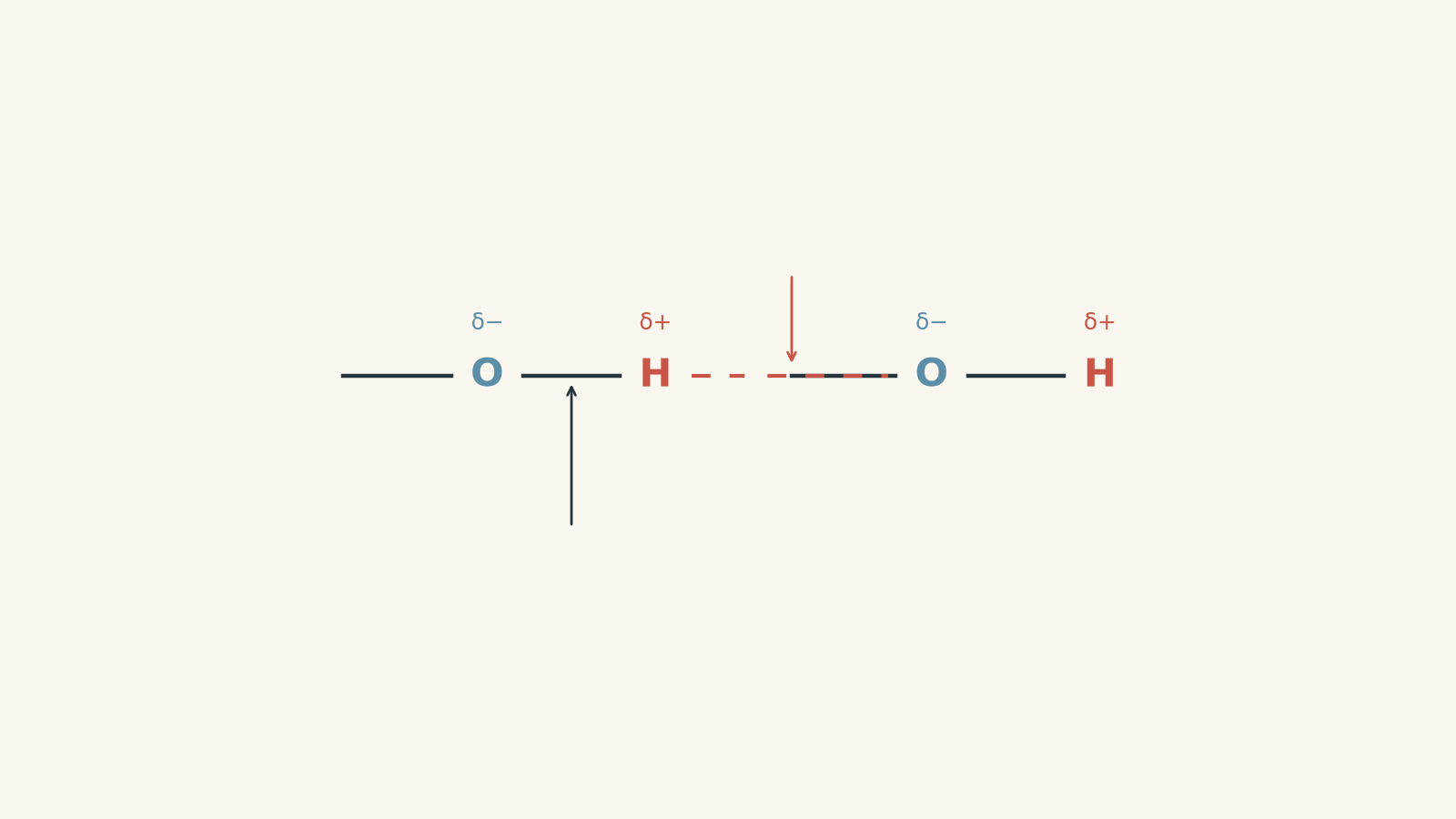
A hydrogen bond is an intermolecular attraction. It is not the same thing as the covalent \(\ce{O-H}\) bond within an alcohol molecule.
That distinction matters when explaining physical properties.
06Why alcohols have relatively high boiling points
Imagine heating an alcohol until its molecules enter the gas phase. Which bonds must actually be overcome: the covalent bonds inside each molecule, or the attractions between molecules?
It is mainly the intermolecular attractions.
The alcohol molecule does not normally break its \(\ce{C-O}\) or \(\ce{O-H}\) covalent bonds when it boils. Instead, enough energy is supplied for molecules to separate from one another.
Hydrogen bonding makes that separation harder.
This is why an alcohol generally has a higher boiling point than a similar-sized hydrocarbon that cannot form hydrogen bonds.
Alcohol molecules also experience dispersion forces. As the carbon chain gets larger, these become increasingly important.
So a useful first model is:
- the hydroxyl group provides hydrogen bonding;
- the hydrocarbon part contributes dispersion forces.
That model is much better than saying simply, “alcohols have high boiling points because they are polar”, because it identifies the actual intermolecular forces involved.
For a deeper treatment of this competition between hydrogen bonding and the carbon skeleton, see Intermolecular Bonding in Alcohols: HSC Chemistry Explained.
07Why small alcohols mix well with water
Water molecules also form hydrogen bonds.
An alcohol oxygen can accept a hydrogen bond from water, and the hydrogen in the alcohol’s \(\ce{-OH}\) group can participate in hydrogen bonding with water.
That makes the hydroxyl end of the molecule strongly compatible with water.
But there is a competing effect. The hydrocarbon part of an alcohol cannot hydrogen bond with water in the same way.
As the non-polar carbon chain becomes larger, it takes up a greater fraction of the molecule. Water solubility therefore tends to decrease as the hydrocarbon chain grows.
Compare:
\[ \ce{CH3CH2OH} \]
with
\[ \ce{CH3(CH2)7OH} \]
Both molecules contain one hydroxyl group. The second, however, has a much larger non-polar hydrocarbon region.
So you should not reason that “one \(\ce{-OH}\) group means the substance must be highly soluble in water”. You need to consider the whole molecule.
08Does tertiary mean weaker hydrogen bonding?
A common mistake is to look at a tertiary alcohol such as:
\[ \ce{(CH3)3C-OH} \]
and say, “The carbon carrying the hydroxyl group has no hydrogen atoms, so this molecule cannot hydrogen bond.”
The first statement is true. The conclusion is not.
Hydrogen bonding depends on the hydrogen bonded to oxygen, not on whether the neighbouring carbon carries hydrogen.
A tertiary alcohol still contains an \(\ce{O-H}\) bond. It can therefore participate in hydrogen bonding.
Primary, secondary, and tertiary classification is about the number of carbon atoms attached to the \(\ce{C-OH}\) carbon. It is not a count of hydrogen bonds.
The carbon skeleton can still affect physical properties. For isomeric alcohols, greater branching often makes the molecule more compact, reducing the contact area available for dispersion forces. Steric effects around the hydroxyl group can also matter.
So if two isomeric alcohols have different boiling points, you should not automatically attribute the difference to one being “more capable of hydrogen bonding”. Several intermolecular effects are operating at once.
09Classification and properties answer different questions
It helps to separate two ideas that students often mix together.
| Question | What you examine |
|---|---|
| Is the alcohol primary, secondary, or tertiary? | Number of carbon neighbours attached to the \(\ce{C-OH}\) carbon |
| Can the alcohol form hydrogen bonds? | Presence of an \(\ce{O-H}\) group |
| Why is its boiling point relatively high? | Intermolecular attractions, especially hydrogen bonding and dispersion forces |
| Why does water solubility change with chain length? | Competition between the polar hydroxyl group and the non-polar hydrocarbon region |
| Does branching automatically make an alcohol tertiary? | No. Classification still depends only on the \(\ce{C-OH}\) carbon |
This distinction becomes especially useful once you start predicting alcohol reactions. For example, the hydroxyl group can be replaced during substitution with hydrogen halides, while the local structure around the \(\ce{C-OH}\) carbon helps determine how different alcohols behave.
10Questions and solutions
Question 1
Classify each alcohol as primary, secondary, or tertiary.
(a) \(\ce{CH3CH2CH2OH}\)
(b) \(\ce{CH3CH(OH)CH3}\)
(c) \(\ce{(CH3)2C(OH)CH2CH3}\)
Explain your classification in each case.
Solution 1
(a) is primary, (b) is secondary, and (c) is tertiary.
For (a),
\[ \ce{CH3CH2CH2OH} \]
the \(\ce{C-OH}\) carbon is the final \(\ce{CH2}\) carbon. It is bonded to one other carbon, so the alcohol is primary.
For (b),
\[ \ce{CH3CH(OH)CH3} \]
the \(\ce{C-OH}\) carbon is bonded to two other carbons, so the alcohol is secondary.
For (c),
\[ \ce{(CH3)2C(OH)CH2CH3} \]
the \(\ce{C-OH}\) carbon is bonded directly to three carbons: two methyl carbons and one \(\ce{CH2}\) carbon. It is therefore tertiary.
The tempting mistake is to count all the carbon atoms in each molecule. Classification depends only on the carbon atoms directly bonded to the carbon carrying \(\ce{-OH}\).
Question 2
Two students draw these structures:
\[ \ce{CH3CH2CH(CH3)CH2OH} \]
and
\[ \ce{CH3CH2C(OH)(CH3)CH3} \]
Student A claims both are tertiary because both contain branches near the hydroxyl group.
Classify both alcohols and explain precisely why Student A’s reasoning fails.
Solution 2
The first alcohol is primary, while the second is tertiary.
For
\[ \ce{CH3CH2CH(CH3)CH2OH} \]
the carbon directly bonded to the hydroxyl group is the \(\ce{CH2OH}\) carbon. That carbon has only one carbon neighbour.
The branching occurs on the next carbon along the chain, so it does not change the classification. This alcohol is primary.
For
\[ \ce{CH3CH2C(OH)(CH3)CH3} \]
the carbon bonded to \(\ce{-OH}\) is also bonded directly to three carbon atoms. This alcohol is therefore tertiary.
Student A’s reasoning fails because branching anywhere in the molecule is not the criterion. The only relevant question is how many carbon atoms are directly bonded to the \(\ce{C-OH}\) carbon.
Question 3
Butan-1-ol and 2-methylpropan-2-ol both have molecular formula \(\ce{C4H10O}\).
(a) Draw their condensed structural formulae.
(b) Classify each alcohol.
(c) Both can form hydrogen bonds, yet butan-1-ol has a substantially higher boiling point. Explain why the statement “tertiary alcohols cannot hydrogen bond” does not explain this difference.
Solution 3
Butan-1-ol is primary, 2-methylpropan-2-ol is tertiary, and both can form intermolecular hydrogen bonds.
For butan-1-ol:
\[ \ce{CH3CH2CH2CH2OH} \]
The \(\ce{C-OH}\) carbon is bonded to one carbon, so it is primary.
For 2-methylpropan-2-ol:
\[ \ce{(CH3)3COH} \]
The \(\ce{C-OH}\) carbon is bonded to three carbons, so it is tertiary.
Both structures contain an \(\ce{O-H}\) bond. The partially positive hydrogen of that bond can participate in hydrogen bonding with oxygen atoms of neighbouring molecules. Tertiary classification does not remove the \(\ce{O-H}\) bond.
The boiling-point difference therefore cannot be explained by saying that the tertiary alcohol has no hydrogen bonding. The carbon skeleton matters too. 2-methylpropan-2-ol is much more compact and branched than butan-1-ol, which changes the dispersion interactions between molecules. The environment around the hydroxyl group can also affect how molecules approach one another.
The tempting route is to make classification itself responsible for the physical property. The stronger reasoning is to identify the intermolecular forces actually present in both substances and then compare their molecular structures.
Question 4
Three oxygen-containing compounds, P, Q, and R, all contain four carbon atoms.
P is \(\ce{CH3CH2CH2CH2OH}\).
Q is \(\ce{(CH3)3COH}\).
R is \(\ce{CH3CH2OCH2CH3}\).
A student argues:
“Q should behave more like R than P because Q is tertiary, so its hydroxyl group cannot hydrogen bond properly.”
Assess the claim. Your answer must compare the types of intermolecular attraction present in all three substances and explain which structural feature is most important.
Solution 4
The claim is incorrect: Q shares the crucial hydrogen-bonding feature with P, not with R.
P, butan-1-ol, contains an \(\ce{O-H}\) bond:
\[ \ce{CH3CH2CH2CH2OH} \]
It can form hydrogen bonds between its own molecules.
Q, 2-methylpropan-2-ol, also contains an \(\ce{O-H}\) bond:
\[ \ce{(CH3)3COH} \]
It is tertiary because its \(\ce{C-OH}\) carbon has three carbon neighbours. However, that classification does not remove the hydrogen attached to oxygen. Q can also form intermolecular hydrogen bonds.
R, ethoxyethane, has the structure:
\[ \ce{CH3CH2OCH2CH3} \]
Its oxygen makes the molecule polar and can act as a hydrogen-bond acceptor when another suitable molecule is present. However, pure ethoxyethane contains no \(\ce{O-H}\) bond, so its molecules cannot donate hydrogen bonds to one another in the way alcohol molecules can.
All three substances also experience dispersion forces.
The decisive mistake is to focus on whether the carbon carrying the hydroxyl group has a hydrogen. Hydrogen bonding in an alcohol depends on the \(\ce{O-H}\) group itself.
P and Q will differ because of factors such as molecular shape, branching, dispersion forces, and how accessible the hydroxyl group is, but Q does not suddenly become ether-like merely because it is tertiary.
Question 5
A chemist has an unknown alcohol X with molecular formula \(\ce{C4H10O}\). X has a lower boiling point than straight-chain butan-1-ol.
A student concludes:
“X must be 2-methylpropan-2-ol. Its lower boiling point proves that it is tertiary, because tertiary alcohols hydrogen bond less.”
Using only the molecular formula, the fact that X is an alcohol, and the boiling-point comparison, determine whether the student’s structural assignment is justified. Give all relevant structural possibilities and explain what extra reasoning would be needed to distinguish them.
Solution 5
The student’s assignment is not justified. A lower boiling point than butan-1-ol does not uniquely prove that X is tertiary.
One possible structure is indeed the tertiary alcohol 2-methylpropan-2-ol:
\[ \ce{(CH3)3COH} \]
However, another \(\ce{C4H10O}\) alcohol is the branched primary alcohol 2-methylpropan-1-ol:
\[ \ce{(CH3)2CHCH2OH} \]
There is also the secondary alcohol butan-2-ol:
\[ \ce{CH3CH(OH)CH2CH3} \]
All three contain an \(\ce{O-H}\) group and can form intermolecular hydrogen bonds.
The student’s tempting argument treats boiling point as though it directly reveals primary, secondary, or tertiary classification. It does not. Boiling point is an overall physical property produced by several intermolecular effects, including hydrogen bonding, dispersion forces, molecular shape, and branching.
Branching can make a molecule more compact and reduce the surface contact involved in dispersion forces. That effect can lower boiling point without changing a primary alcohol into a tertiary one.
The molecular formula also cannot settle the question because all of these alcohols are structural isomers with formula \(\ce{C4H10O}\).
To classify X uniquely, the chemist would need evidence about its actual connectivity or the local environment of the \(\ce{C-OH}\) carbon. A structural formula or suitable structural evidence could show whether that carbon is bonded to one, two, or three other carbons.
The conceptual hinge is that classification predicts something about local bonding, while boiling point reports the combined behaviour of the whole molecule. A physical property can support structural reasoning, but one property should not be treated as a direct label for molecular structure.
Once that separation is clear, the next step is to use primary, secondary, and tertiary structure to predict chemical behaviour rather than just physical properties. Alcohol reactions such as substitution and dehydration depend not only on the presence of the hydroxyl group, but also on the carbon framework surrounding it.