
Why Reflux Favours Further Oxidation of Primary Alcohols
Discover why reflux favours the conversion of primary alcohols into carboxylic acids by retaining aldehyde intermediates in the reaction mixture. Compare reflux with distillation, explore the role of oxidising-agent availability, and practise applying these ideas to HSC Chemistry questions.
Take propan-1-ol and heat it with acidified potassium dichromate(VI). The first organic product is propanal, an aldehyde. But if you keep heating the mixture, why doesn’t the reaction simply stop there?
It can continue. Propanal can undergo further oxidation to form propanoic acid. Reflux favours this second oxidation because it returns volatile substances to the reaction flask instead of allowing them to escape. The aldehyde stays in contact with the oxidising agent, giving it another opportunity to react.
The important conditions are a primary alcohol, a suitable oxidising agent, sufficient oxidant, and enough heating time under reflux. Reflux helps retain the intermediate; it does not supply the oxygen or guarantee complete oxidation by itself.
Before going further, make a prediction. If the vapour rises out of the flask, passes through a condenser, and then flows straight back into the reaction mixture, what happens to the aldehyde?
It gets another chance to be oxidised. That’s the central idea behind reflux.
01The problem: the aldehyde is not necessarily the final product
A primary alcohol can undergo oxidation in two stages.
First, the primary alcohol forms an aldehyde:
\[ \ce{R-CH2OH + [O] -> R-CHO + H2O} \]
The aldehyde can then undergo further oxidation to form a carboxylic acid:
\[ \ce{R-CHO + [O] -> R-COOH} \]
Here, \(\ce{R}\) represents the rest of the carbon chain, and \(\ce{[O]}\) represents the oxidising capacity supplied by the oxidising agent. It does not mean that free oxygen atoms are added directly to the reaction mixture.
For ethanol, the sequence is:
\[ \ce{CH3CH2OH -> CH3CHO -> CH3COOH} \]
The compounds are:
- Ethanol: primary alcohol.
- Ethanal: aldehyde.
- Ethanoic acid: carboxylic acid.
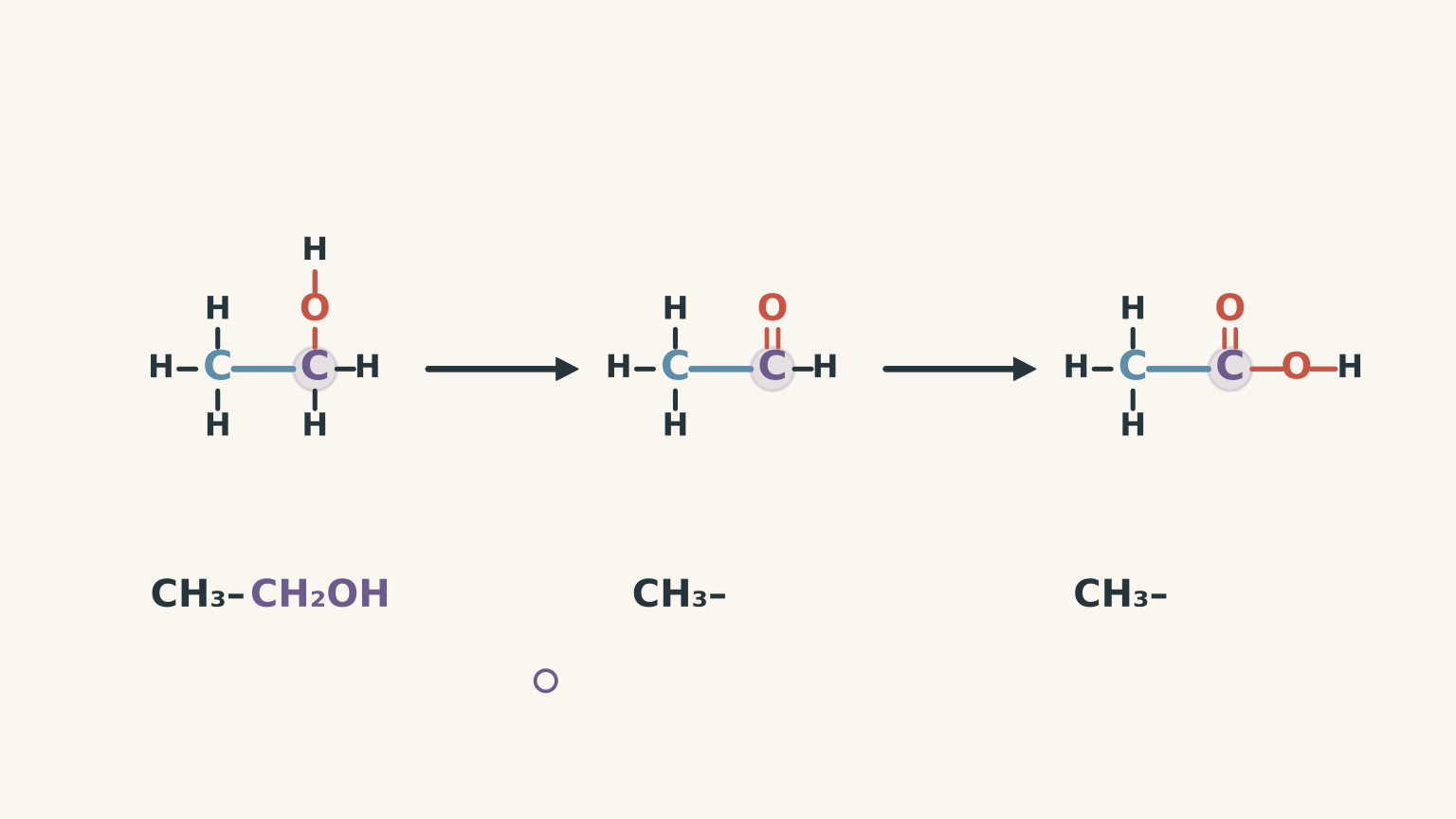
Due to technical limitations, this figure may display incorrectly or contain inaccuracies. Please check key details against your course materials.
Notice something important: the aldehyde is both a product and a reactant.
It is produced when the alcohol undergoes its first oxidation. However, it can react again if it remains in contact with the oxidising agent.
This is why the experimental setup matters.
02What actually happens during reflux?
Imagine heating a mixture of propan-1-ol and acidified potassium dichromate(VI) in a round-bottom flask.
The flask is connected to a vertical, water-cooled condenser. This condenser allows the mixture to be heated for an extended period without losing most of its volatile components.
Follow what happens physically.
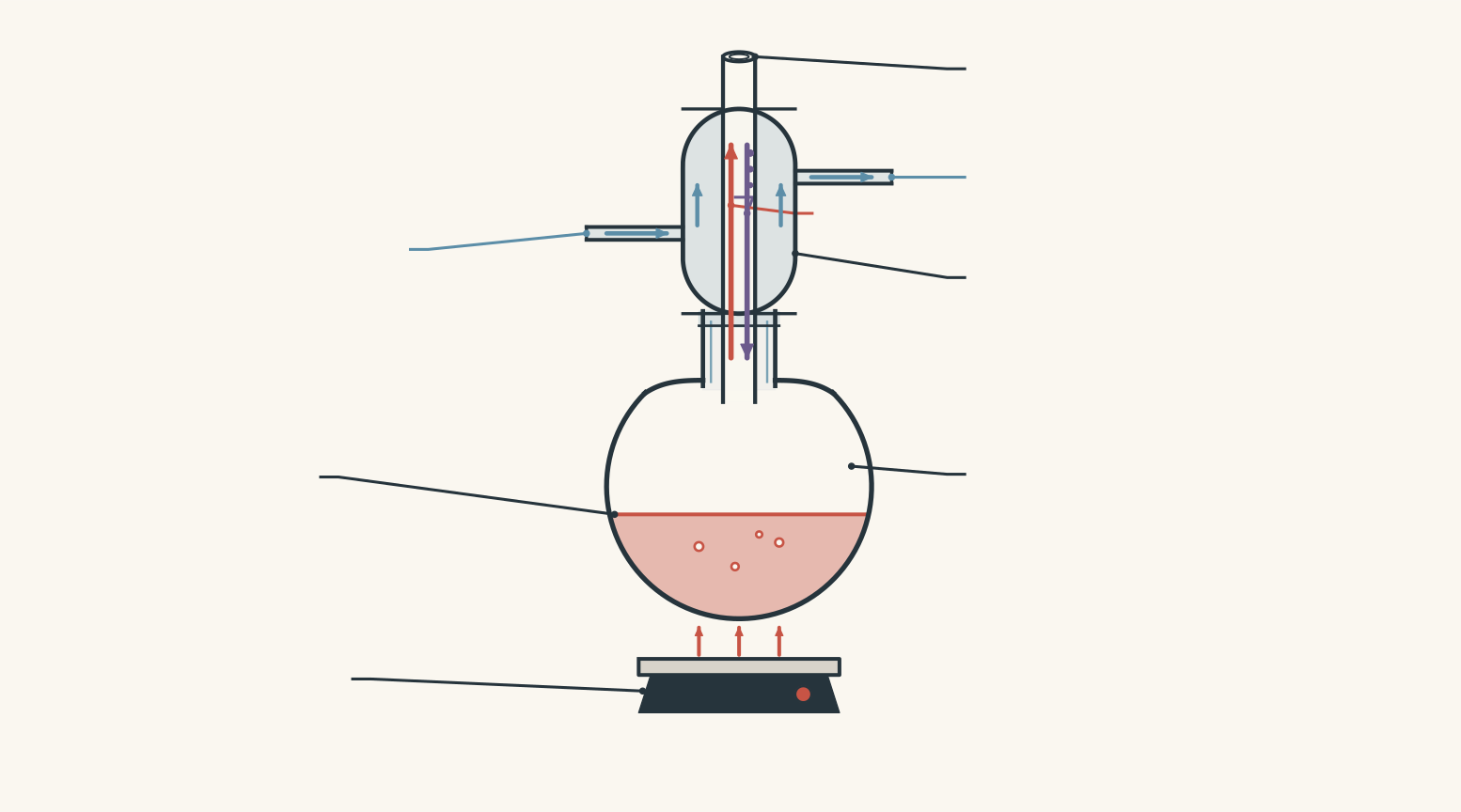
Due to technical limitations, this figure may display incorrectly or contain inaccuracies. Please check key details against your course materials.
Step 1: The reaction mixture is heated
The reaction flask contains:
- A primary alcohol, such as propan-1-ol.
- Acidified potassium dichromate(VI), which acts as the oxidising agent.
As the mixture is heated, the alcohol begins to undergo oxidation.
The first organic product is an aldehyde.
Step 2: Vapour rises into the condenser
Heating causes volatile substances in the mixture to enter the gas phase.
These vapours travel upwards through the central tube of the condenser.
The oxidising agent, which is present as dissolved ions, remains in the reaction flask rather than travelling through the condenser as vapour.
Step 3: The vapour cools and condenses
Cold water flows through the outer jacket of the condenser.
It enters through the lower connection and leaves through the upper connection. This keeps the cooling jacket filled with water.
As the vapour passes through the cooled central tube, it loses thermal energy and condenses into liquid.
Step 4: The liquid returns to the reaction flask
This is the crucial part.
The condenser is positioned vertically above the original flask. The condensed liquid flows back into that same flask.
The aldehyde is therefore not deliberately collected in a separate container.
It remains in the reaction system, where it can continue reacting with the oxidising agent.
Why does returning the aldehyde matter?
Think of a pot in which steam rises, cools, and returns as liquid. You can keep heating the contents without losing as much material through evaporation.
A reflux condenser performs a similar job, except that the vapours can contain alcohol and organic reaction products, not just water.
The analogy has a limit: a reflux apparatus is not a sealed system. Its upper end remains open in a standard setup, and some vapour losses are possible.
The important point is that reflux greatly reduces the loss of volatile substances.
For the oxidation reaction, this means the aldehyde remains available for further oxidation.
03Why reflux favours carboxylic acid formation
Let’s connect the physical apparatus to the chemical reactions.
Consider propan-1-ol.
Its first oxidation produces propanal:
\[ \ce{CH3CH2CH2OH + [O] -> CH3CH2CHO + H2O} \]
If propanal remains in contact with the oxidising agent, it can undergo another oxidation:
\[ \ce{CH3CH2CHO + [O] -> CH3CH2COOH} \]
The final product is propanoic acid.
Adding the two oxidation stages gives the overall equation:
\[ \ce{CH3CH2CH2OH + 2[O] -> CH3CH2COOH + H2O} \]
Notice that two oxidation equivalents are required to take a primary alcohol all the way to a carboxylic acid.
This gives us three connected requirements:
| Requirement | Why it matters |
|---|---|
| Primary alcohol | Provides the oxidation pathway through an aldehyde |
| Sufficient oxidising agent | Allows both oxidation stages to occur |
| Heating under reflux | Retains volatile substances, including the aldehyde intermediate, in the reaction system |
If these conditions are satisfied and the reaction proceeds for sufficient time, carboxylic acid formation is favoured.
Reflux does not guarantee complete oxidation
This is an important qualification.
A student might see the word reflux and immediately predict a carboxylic acid. That is usually the intended prediction when the question also specifies excess oxidising agent and sufficient reaction time.
However, reflux cannot overcome a shortage of oxidising agent.
If there is insufficient oxidant, some aldehyde may remain. If the reaction is stopped too early, the oxidation may also be incomplete.
The distinction is:
- Reflux controls the retention of volatile substances.
- The oxidising agent supplies the chemical capacity for oxidation.
- Reaction time allows the oxidation stages to proceed.
You need all three ideas to explain the result properly.
04Reflux versus distillation: what changes?
Both techniques can use a water-cooled condenser. The difference is where the condensed liquid goes.
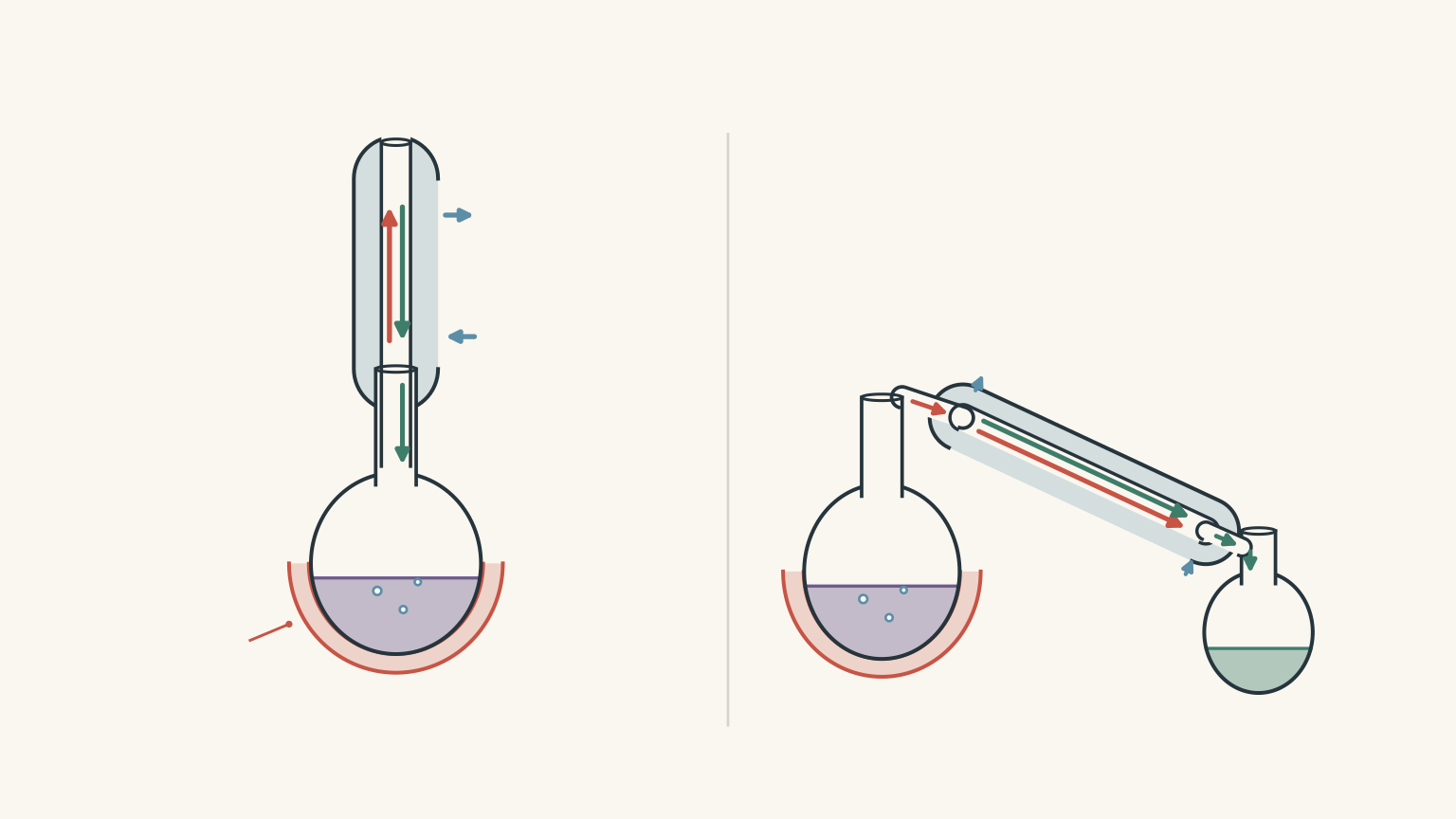
Due to technical limitations, this figure may display incorrectly or contain inaccuracies. Please check key details against your course materials.
| Feature | Reflux | Distillation |
|---|---|---|
| Condenser arrangement | Vertical above reaction flask | Sloping towards a receiver |
| Vapour | Rises into condenser | Travels into condenser |
| Condensed liquid | Returns to original flask | Enters a separate receiver |
| Aldehyde | Remains available for further oxidation | Can be removed as it forms |
| Favoured product from a primary alcohol | Carboxylic acid, with sufficient oxidant and time | Aldehyde |
Suppose you want to obtain propanal from propan-1-ol.
You would generally use distillation to remove propanal from the reaction mixture before it undergoes substantial further oxidation.
If you want propanoic acid, reflux is more suitable because propanal remains available for the second oxidation.
For a more detailed explanation of the opposite approach, see Why Distillation Helps Collect Aldehydes During Alcohol Oxidation.
Remember that neither arrangement guarantees a perfectly pure product. Distillation favours separation, while reflux favours retention. Actual product composition also depends on the reaction conditions.
05Why the type of alcohol still matters
Reflux does not make every alcohol behave like a primary alcohol.
You must identify the type of alcohol before predicting its oxidation products.
The classification depends on the number of carbon atoms directly attached to the carbon carrying the hydroxyl group, \(\ce{-OH}\).
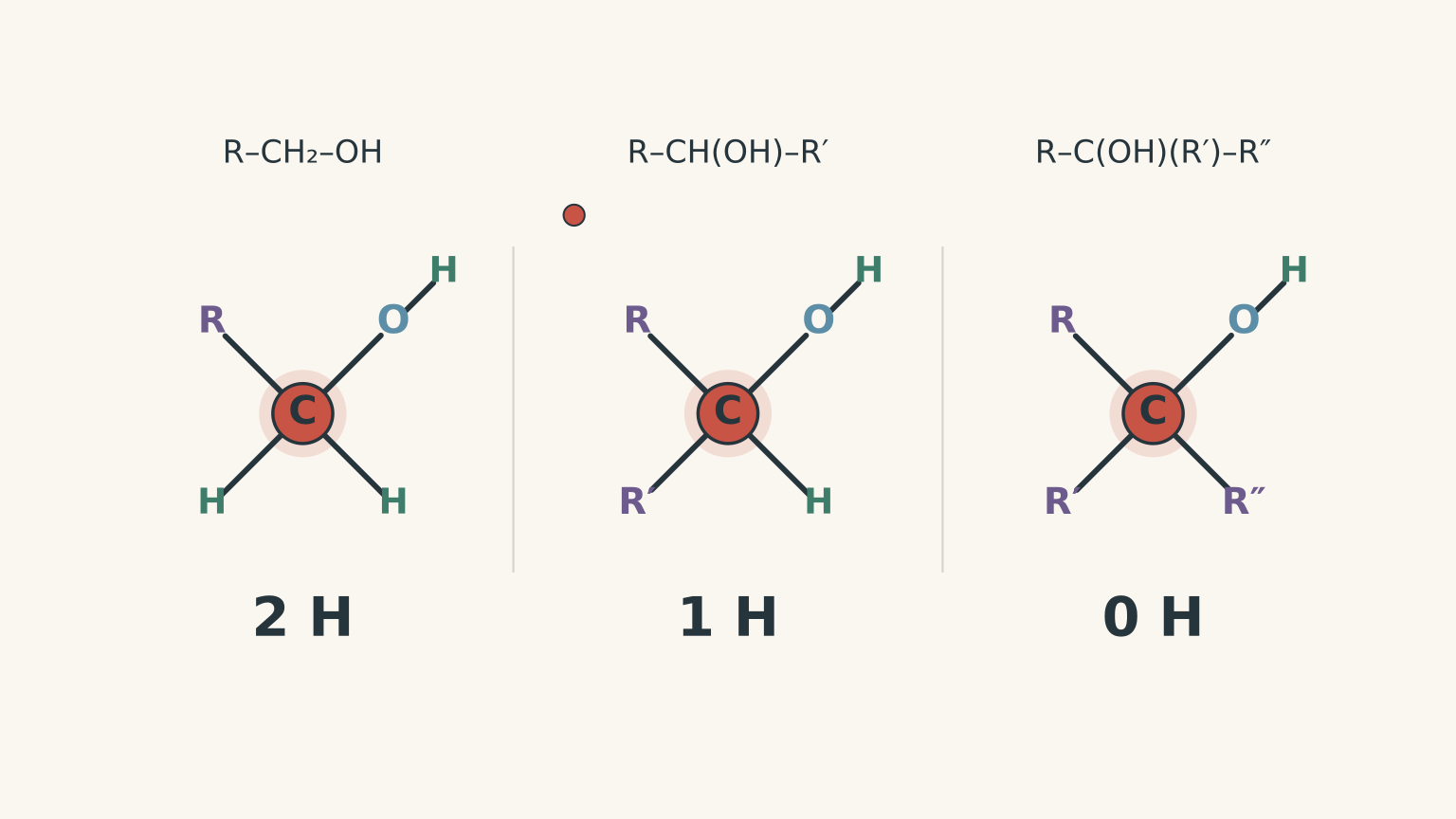
Due to technical limitations, this figure may display incorrectly or contain inaccuracies. Please check key details against your course materials.
| Alcohol type | General structure | Hydrogens on the carbon carrying OH | Usual oxidation product |
|---|---|---|---|
| Primary | \(\ce{R-CH2OH}\) | 2 | Aldehyde, then carboxylic acid |
| Secondary | \(\ce{R-CH(OH)-R'}\) | 1 | Ketone |
| Tertiary | \(\ce{R-C(OH)(R')(R'')}\) | 0 | No normal oxidation under standard alcohol-oxidation conditions |
Why does this happen?
During ordinary alcohol oxidation, the carbon carrying the hydroxyl group loses hydrogen as its bonding to oxygen changes.
A primary alcohol has two hydrogens attached to this carbon. It can therefore form an aldehyde, which can undergo further oxidation to a carboxylic acid.
A secondary alcohol has one hydrogen attached to this carbon. It can be oxidised to a ketone.
A tertiary alcohol has no hydrogen attached to this carbon. It does not undergo the usual oxidation to a carbonyl compound under standard HSC alcohol-oxidation conditions without breaking carbon-carbon bonds.
If you need to revise how these structures are classified, see Primary, Secondary and Tertiary Alcohols for HSC Chemistry.
The important distinction: oxidation is not substitution or elimination
Alcohols can undergo several different types of reactions.
Do not assume that every reaction involving heating an alcohol is an oxidation reaction.
The reagent and conditions determine the reaction family.
Oxidation
A primary alcohol reacts with an oxidising agent, such as acidified potassium dichromate(VI), to form an aldehyde and potentially a carboxylic acid.
For example:
\[ \ce{CH3CH2OH + 2[O] -> CH3COOH + H2O} \]
Heating under reflux favours further oxidation by retaining the aldehyde intermediate.
Substitution
In a substitution reaction, the hydroxyl group is replaced by another atom or group.
For example, ethanol reacts with hydrogen bromide to form bromoethane:
\[ \ce{CH3CH2OH + HBr -> CH3CH2Br + H2O} \]
Here, the \(\ce{-OH}\) group is replaced by bromine.
Heating, often under reflux depending on the reactants, can help the substitution proceed.
Elimination
In an elimination reaction, atoms or groups are removed from adjacent carbon atoms, allowing a carbon-carbon double bond to form.
For example, ethanol can be dehydrated using concentrated sulfuric acid at approximately \(170^\circ\text{C}\):
\[ \ce{CH3CH2OH ->[conc. H2SO4,\ 170^\circ C] CH2=CH2 + H2O} \]
The product is ethene.
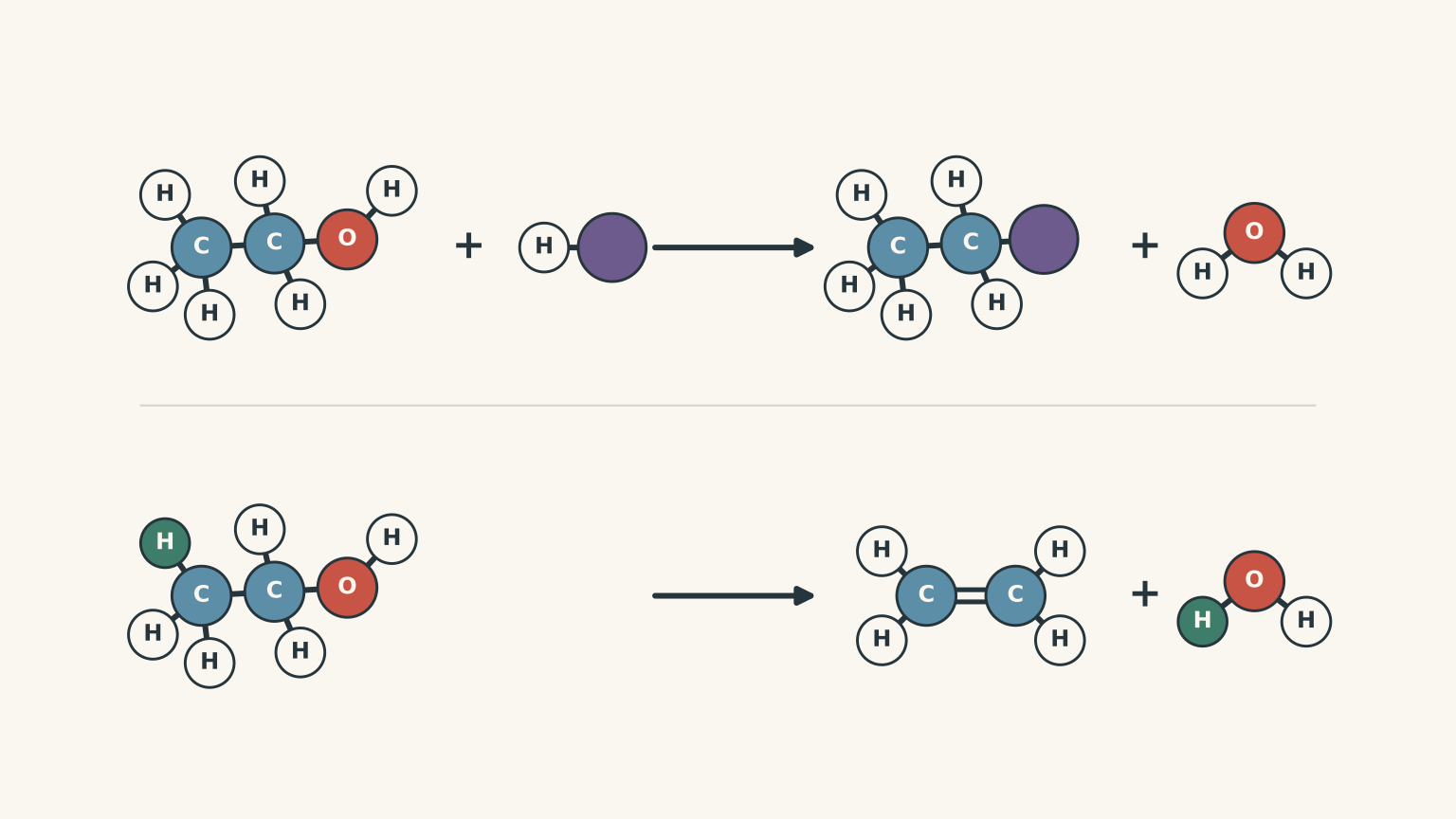
Due to technical limitations, this figure may display incorrectly or contain inaccuracies. Please check key details against your course materials.
These reactions answer different chemical questions:
| Reaction | What happens to the alcohol? | Typical conditions |
|---|---|---|
| Oxidation | Changes the bonding around the carbon carrying OH | Acidified dichromate, heating |
| Substitution | Replaces OH with another group | Hydrogen halide, usually with heating |
| Elimination | Removes OH and an adjacent hydrogen to form an alkene | Concentrated sulfuric acid and strong heating |
A useful diagnostic is to look at the reagent before predicting the product.
Acidified dichromate points towards oxidation. Hydrogen bromide points towards substitution. Concentrated sulfuric acid and strong heating can promote elimination.
Reflux is a heating arrangement, not a chemical reaction. It does not automatically mean oxidation, substitution, or elimination.
06Testing whether further oxidation has occurred
Imagine comparing two experiments using the same primary alcohol and oxidising agent.
The first mixture is heated under reflux. The second uses distillation.
To make the comparison fair, keep the following conditions constant:
- Initial amount of alcohol.
- Concentration and quantity of oxidising agent.
- Heating conditions.
- Reaction time.
- Atmospheric pressure.
The intended difference is the apparatus.
What should happen?
In the reflux experiment, the aldehyde remains in the reaction system. Given sufficient oxidant and time, further oxidation to the carboxylic acid is favoured.
In the distillation experiment, the aldehyde can travel into the condenser and be collected separately. Its contact with the oxidising agent is reduced.
However, how can you tell what actually formed?
The colour change is not enough
Acidified potassium dichromate(VI) is orange.
During oxidation, dichromate ions are reduced to chromium(III) ions, which are green.
The colour change can be represented as:
\[ \ce{Cr2O7^2- -> Cr^3+} \]
This provides evidence that a redox reaction has occurred.
But here is the limitation: both oxidation stages involve reduction of the oxidising agent.
The orange-to-green colour change does not tell you whether the organic product is an aldehyde or a carboxylic acid.
You need additional evidence.
For example:
- A carboxylic acid reacts with sodium hydrogencarbonate to release carbon dioxide gas.
- An aldehyde can give a positive Tollens’ test, producing a silver deposit under suitable conditions.
The reaction of a carboxylic acid with sodium hydrogencarbonate is:
\[ \ce{RCOOH + NaHCO3 -> RCOONa + H2O + CO2} \]
The bubbles of carbon dioxide provide evidence for a carboxylic acid.
There is an experimental complication: the original oxidation mixture contains sulfuric acid. Residual sulfuric acid can also react with sodium hydrogencarbonate.
Therefore, the organic product must be separated appropriately before using this test to identify the carboxylic acid.
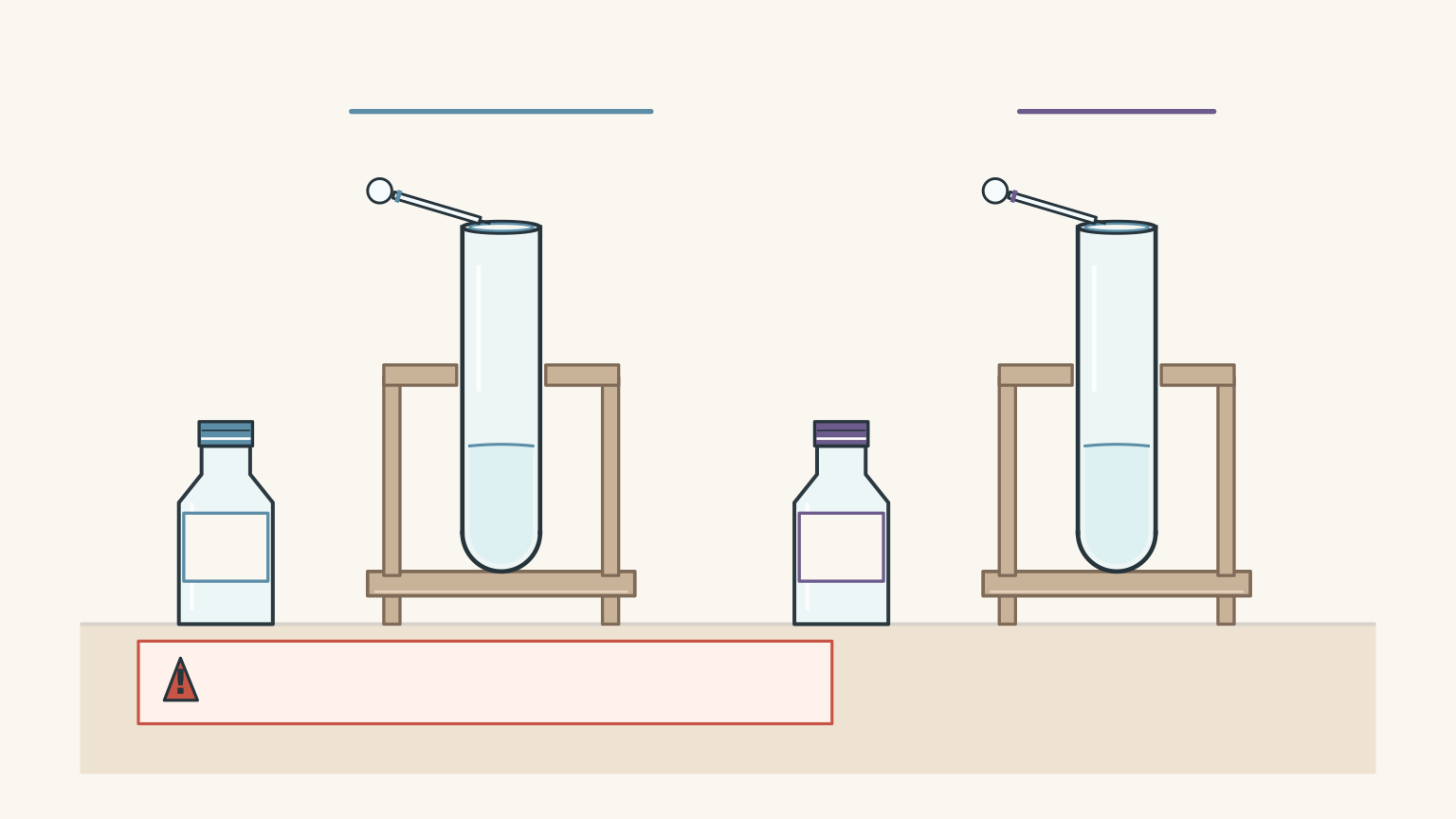
Due to technical limitations, this figure may display incorrectly or contain inaccuracies. Please check key details against your course materials.
The lesson is simple: observing that an oxidising agent has reacted is not the same as identifying the organic product.
07Worked examples
Worked example: Predicting the product of a primary alcohol under reflux
Propan-1-ol is heated under reflux with excess acidified potassium dichromate(VI) for sufficient time. Identify the final organic product, write its condensed structural formula, and explain why reflux favours its formation.
Step 1
Propan-1-ol has the structure:
\[ \ce{CH3CH2CH2OH} \]
The carbon attached to the hydroxyl group is bonded to only one other carbon.
Therefore, propan-1-ol is a primary alcohol.
Step 2
A primary alcohol first forms an aldehyde:
\[ \ce{CH3CH2CH2OH -> CH3CH2CHO} \]
The aldehyde is propanal.
Step 3
The vertical condenser returns volatile vapours to the reaction flask.
Propanal therefore remains available for further oxidation by the excess oxidising agent.
Step 4
Further oxidation converts propanal into propanoic acid:
\[ \ce{CH3CH2CHO + [O] -> CH3CH2COOH} \]
The final organic product is propanoic acid, with condensed structural formula \(\ce{CH3CH2COOH}\).
The overall equation is:
\[ \ce{CH3CH2CH2OH + 2[O] -> CH3CH2COOH + H2O} \]
Reflux favours the acid because it retains the aldehyde intermediate in contact with the oxidising agent.
Worked example: Can a tertiary alcohol be oxidised under reflux?
A student heats 2-methylpropan-2-ol under three different sets of conditions:
- Experiment A: Acidified potassium dichromate(VI) under reflux.
- Experiment B: Hydrogen bromide with heating.
- Experiment C: Concentrated sulfuric acid with strong heating.
Predict the main reaction outcome in each experiment and explain why the products differ.
Step 1
2-methylpropan-2-ol has the structure:
\[ \ce{(CH3)3COH} \]
The carbon carrying the hydroxyl group is bonded to three other carbon atoms.
It is therefore a tertiary alcohol.
Step 2
The carbon carrying the hydroxyl group has no attached hydrogen atoms.
It cannot undergo the usual oxidation to a carbonyl compound without breaking carbon-carbon bonds.
Therefore, under standard alcohol-oxidation conditions, no normal oxidation product is expected.
Reflux cannot change the alcohol’s underlying structure.
Step 3
Hydrogen bromide can replace the hydroxyl group with bromine.
The equation is:
\[ \ce{(CH3)3COH + HBr -> (CH3)3CBr + H2O} \]
The product is 2-bromo-2-methylpropane.
Step 4
Concentrated sulfuric acid and strong heating promote dehydration.
A hydrogen atom is removed from an adjacent carbon while the hydroxyl group is removed from the carbon carrying it.
The resulting product is 2-methylpropene:
\[ \ce{(CH3)3COH ->[conc. H2SO4,\ heat] CH2=C(CH3)2 + H2O} \]
The three experiments produce different outcomes because the reagents and conditions favour different reaction pathways.
This example exposes an important misconception: a tertiary alcohol resists ordinary oxidation, but it can still undergo substitution and elimination.
Worked example: Calculating the theoretical mass of carboxylic acid
A student heats \(0.0250\text{ mol}\) of butan-1-ol under reflux with excess acidified oxidising agent.
Assume complete conversion to butanoic acid and a theoretical yield of \(100\%\).
Calculate the theoretical mass of butanoic acid.
Use:
\[ M(\ce{C4H8O2})=88.11\text{ g mol}^{-1} \]
Step 1
\[ \ce{CH3CH2CH2CH2OH + 2[O] -> CH3CH2CH2COOH + H2O} \]
The mole ratio of butan-1-ol to butanoic acid is \(1:1\).
Therefore:
\[ n(\text{butanoic acid})=0.0250\text{ mol} \]
Step 2
\[ m=nM \]
Substitute:
\[ m=0.0250\times88.11 \]
\[ m=2.20275\text{ g} \]
Step 3
\[ m=2.20\text{ g} \]
The theoretical mass of butanoic acid is \(2.20\text{ g}\).
This calculation assumes that all the starting alcohol is converted into the acid. In an actual experiment, the isolated mass may be lower because of incomplete reaction, product losses, or separation difficulties.
08Questions and solutions
Question 1
A student heats \(0.0500\text{ mol}\) of ethanol under reflux with excess acidified potassium dichromate(VI).
a. Identify the final organic product.
b. Write its condensed structural formula.
c. Write the overall oxidation equation using \(\ce{[O]}\).
d. Explain why reflux favours the formation of this product.
Solution 1
The final organic product is ethanoic acid, \(\ce{CH3COOH}\).
Ethanol is a primary alcohol because the carbon carrying the hydroxyl group is attached to only one other carbon.
Its oxidation occurs in two stages:
\[ \ce{CH3CH2OH -> CH3CHO -> CH3COOH} \]
The overall equation is:
\[ \ce{CH3CH2OH + 2[O] -> CH3COOH + H2O} \]
Reflux returns volatile vapours to the reaction flask. The intermediate ethanal therefore remains available for further oxidation by the excess oxidising agent.
The combination of a primary alcohol, excess oxidant, and sufficient heating under reflux favours complete oxidation to ethanoic acid.
Question 2
Two identical samples of 2-methylpropan-1-ol are heated with excess acidified potassium dichromate(VI).
- Experiment A uses a vertical condenser that returns condensed liquid to the reaction flask.
- Experiment B uses a sloping condenser that directs condensed liquid into a separate receiving flask.
a. Identify the main organic product favoured in each experiment.
b. Explain why the products differ even though both experiments start with the same alcohol and oxidising agent.
c. Explain why the product collected in Experiment B is not necessarily perfectly pure.
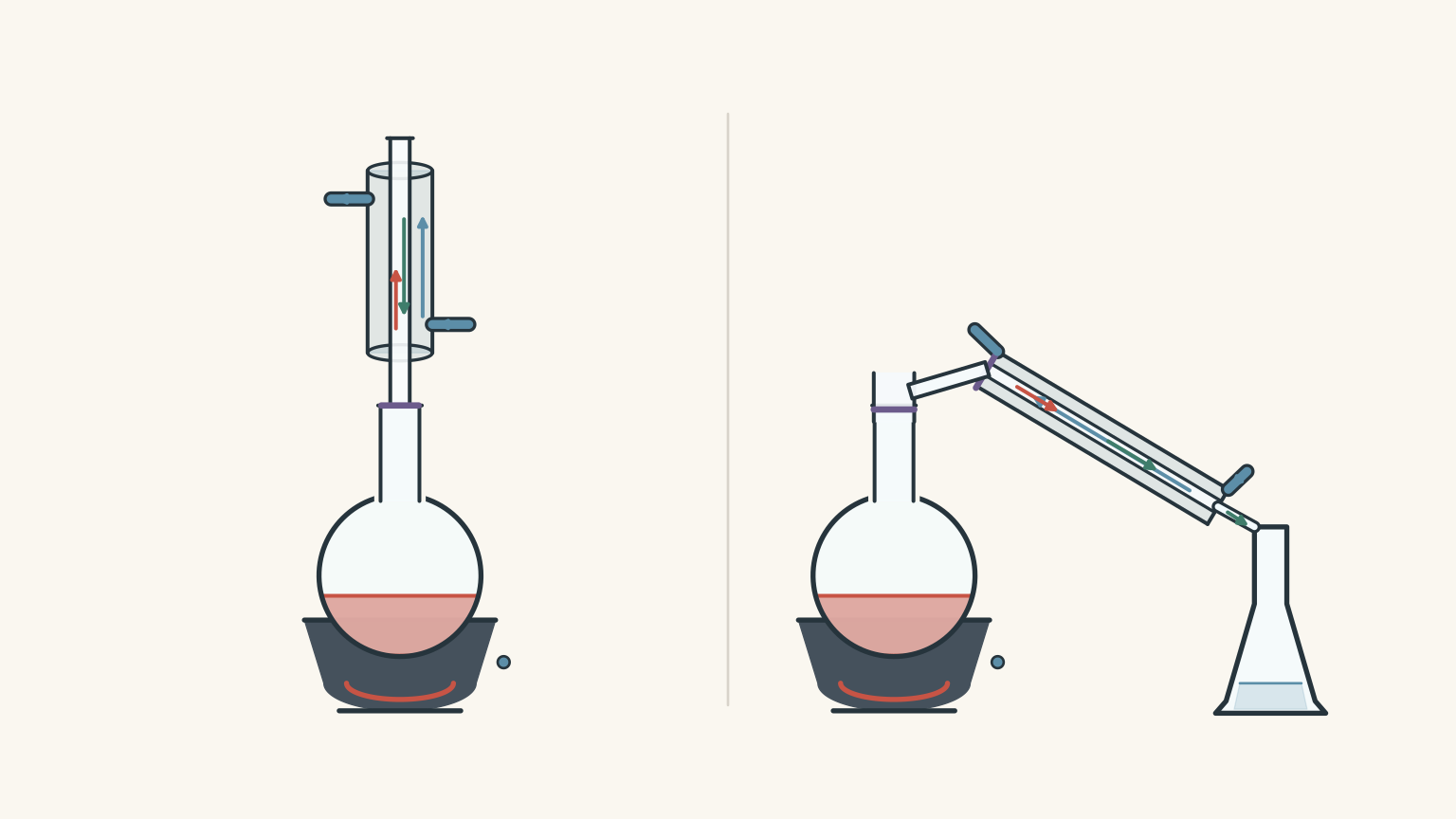
Due to technical limitations, this figure may display incorrectly or contain inaccuracies. Please check key details against your course materials.
Solution 2
Experiment A favours 2-methylpropanoic acid, while Experiment B favours 2-methylpropanal.
The starting alcohol has the structure:
\[ \ce{(CH3)2CHCH2OH} \]
The carbon carrying the hydroxyl group is attached to one other carbon, so this is a primary alcohol.
Its oxidation pathway is:
\[ \ce{(CH3)2CHCH2OH -> (CH3)2CHCHO} \]
The first product is 2-methylpropanal.
Experiment A: Reflux
The vertical condenser returns the volatile aldehyde to the reaction flask.
The aldehyde remains in contact with the excess oxidising agent and can undergo further oxidation:
\[ \ce{(CH3)2CHCHO + [O] -> (CH3)2CHCOOH} \]
The favoured final product is 2-methylpropanoic acid.
Experiment B: Distillation
The sloping condenser directs the condensed liquid into a separate receiving flask.
The aldehyde is removed from the oxidising mixture, reducing the opportunity for further oxidation.
The favoured product is therefore 2-methylpropanal.
However, distillation does not guarantee a perfectly pure aldehyde. Other volatile substances may enter the condenser, and some aldehyde may remain in the reaction mixture or be lost during collection.
The difference between the experiments is the physical treatment of the intermediate, not a change to the starting alcohol’s chemical structure.
Question 3
Three alcohols are represented by the following condensed structural formulae:
- Alcohol X: \(\ce{CH3CH2CH2CH2OH}\)
- Alcohol Y: \(\ce{CH3CH(OH)CH2CH3}\)
- Alcohol Z: \(\ce{(CH3)3COH}\)
Each alcohol is heated under reflux with acidified potassium dichromate(VI) under standard alcohol-oxidation conditions.
a. Classify each alcohol as primary, secondary, or tertiary.
b. Predict the usual organic oxidation product for each alcohol.
c. Identify which alcohol can form a carboxylic acid through further oxidation.
d. Explain why reflux does not make Alcohol Z undergo the same oxidation pathway as Alcohol X.
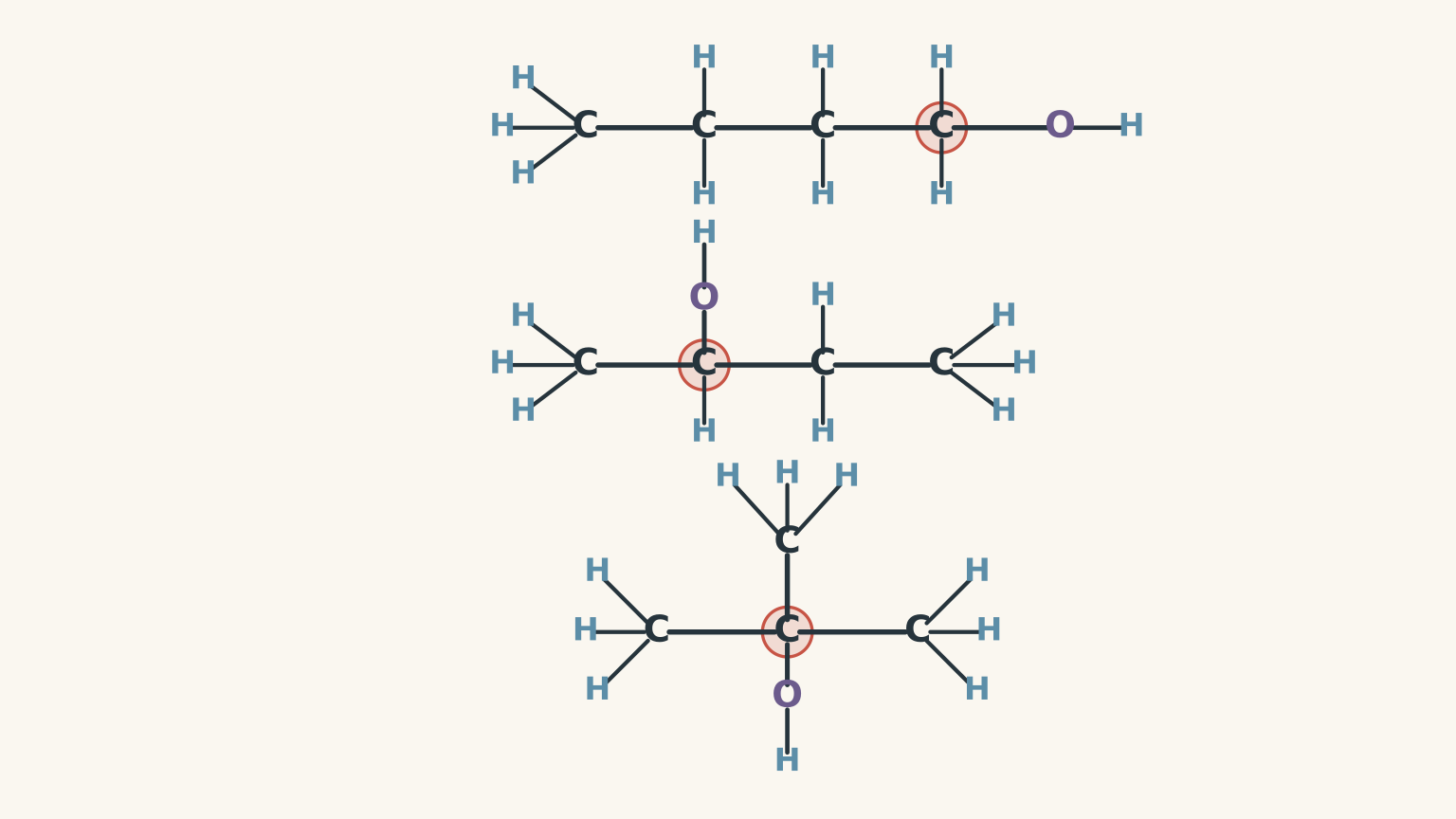
Due to technical limitations, this figure may display incorrectly or contain inaccuracies. Please check key details against your course materials.
Solution 3
Alcohol X is primary, Alcohol Y is secondary, and Alcohol Z is tertiary. Only Alcohol X follows the usual primary-alcohol pathway to a carboxylic acid.
Alcohol X
\[ \ce{CH3CH2CH2CH2OH} \]
The carbon carrying OH is attached to one other carbon.
Therefore, X is primary.
Its oxidation proceeds through butanal to butanoic acid:
\[ \ce{CH3CH2CH2CH2OH -> CH3CH2CH2CHO -> CH3CH2CH2COOH} \]
With sufficient oxidant and reaction time, butanoic acid is favoured.
Alcohol Y
\[ \ce{CH3CH(OH)CH2CH3} \]
The carbon carrying OH is attached to two other carbons.
Therefore, Y is secondary.
Its oxidation produces butanone:
\[ \ce{CH3CH(OH)CH2CH3 + [O] -> CH3COCH2CH3 + H2O} \]
Alcohol Z
\[ \ce{(CH3)3COH} \]
The carbon carrying OH is attached to three other carbons.
Therefore, Z is tertiary.
It does not undergo the usual oxidation to an aldehyde, ketone, or carboxylic acid under these conditions.
The reason is structural: the carbon carrying OH has no attached hydrogen that can be removed during the ordinary alcohol-oxidation pathway.
Reflux cannot change this bonding arrangement. It helps retain volatile substances, but it does not make a tertiary alcohol behave like a primary alcohol.
Question 4
A student heats propan-1-ol under reflux with acidified potassium dichromate(VI).
The reaction mixture changes from orange to green.
The student concludes:
“The green colour proves that propanoic acid has formed.”
Evaluate this conclusion.
In your response:
a. Explain what the colour change indicates.
b. Explain why the colour change does not identify the organic product.
c. Propose a chemical test that could distinguish propanoic acid from propanal, including one experimental limitation that must be considered.
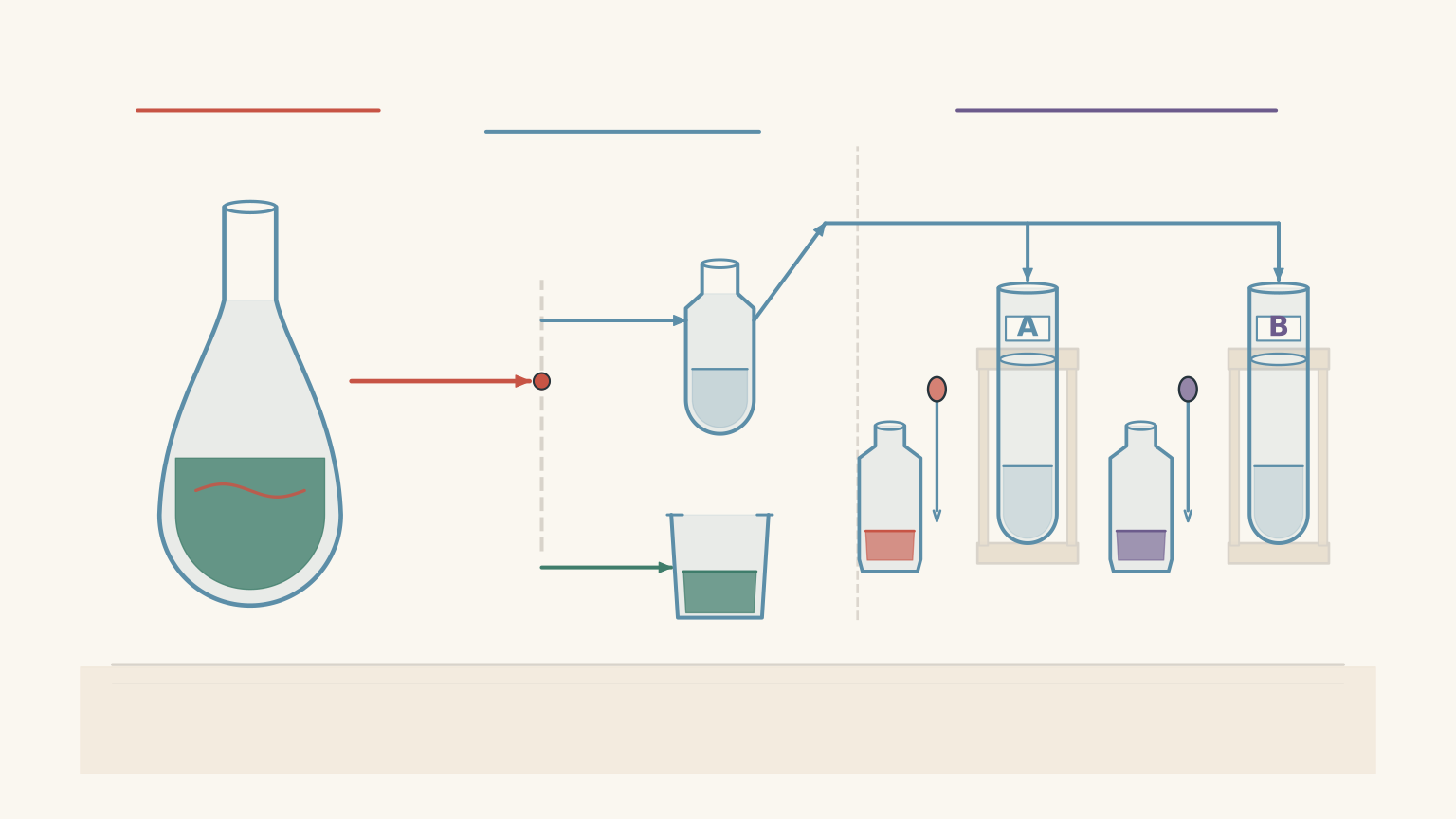
Due to technical limitations, this figure may display incorrectly or contain inaccuracies. Please check key details against your course materials.
Solution 4
The student’s conclusion is not justified. The colour change confirms that the oxidising agent has been reduced, but it does not prove that propanoic acid is the organic product.
Acidified potassium dichromate(VI) contains orange dichromate ions.
During oxidation, these ions are reduced to green chromium(III) ions.
Therefore, the colour change is evidence that a redox reaction has occurred.
However, both oxidation stages can produce this colour change:
\[ \ce{CH3CH2CH2OH -> CH3CH2CHO} \]
and
\[ \ce{CH3CH2CHO -> CH3CH2COOH} \]
The colour change alone cannot distinguish propanal from propanoic acid.
A suitable test is to react an appropriately separated product sample with sodium hydrogencarbonate.
If propanoic acid is present, it reacts to release carbon dioxide:
\[ \ce{CH3CH2COOH + NaHCO3 -> CH3CH2COONa + H2O + CO2} \]
Effervescence provides evidence of a carboxylic acid.
Propanal does not undergo this acid-carbonate reaction.
An alternative is to use Tollens’ reagent to test for an aldehyde. A positive result produces a silver deposit under suitable conditions.
The experimental limitation is that the original reaction mixture contains sulfuric acid. Residual mineral acid can also react with sodium hydrogencarbonate and produce bubbles.
Therefore, the organic product must be appropriately separated before carrying out the acid-carbonate test.
The key distinction is between evidence that oxidation occurred and evidence identifying the particular oxidation product.
Question 5
A chemist heats \(1.00\text{ mol}\) of butan-1-ol under reflux with acidified potassium dichromate(VI).
The total oxidising capacity available is equivalent to exactly \(1.50\text{ mol}\) of \(\ce{[O]}\).
Assume the following:
- Every starting alcohol molecule reacts.
- No carbon-carbon bonds are broken.
- The only organic products remaining are butanal and butanoic acid.
- All available oxidising equivalents are consumed in the two oxidation stages.
- Each conversion of a primary alcohol to an aldehyde requires one equivalent of \(\ce{[O]}\), and each further conversion of an aldehyde to a carboxylic acid requires one additional equivalent.
A student argues:
“Because the alcohol is heated under reflux, all \(1.00\text{ mol}\) must eventually become butanoic acid.”
a. Calculate the number of moles of butanal and butanoic acid in the final mixture.
b. Explain why the student’s prediction is incorrect.
c. Calculate the additional amount of \(\ce{[O]}\) required to convert all the remaining butanal into butanoic acid.
d. Explain what this scenario demonstrates about the relationship between reflux and oxidising-agent availability.
Solution 5
The final mixture contains \(0.50\text{ mol}\) of butanal and \(0.50\text{ mol}\) of butanoic acid. Reflux favours further oxidation, but the available oxidising capacity is insufficient to convert every alcohol molecule into the carboxylic acid.
This question requires us to combine the reaction pathway with a material balance.
Step 1: Establish the oxidising-agent requirements.
The first oxidation stage is:
\[ \ce{CH3CH2CH2CH2OH + [O] -> CH3CH2CH2CHO + H2O} \]
Each mole of butan-1-ol requires one mole-equivalent of \(\ce{[O]}\) to form butanal.
The second stage is:
\[ \ce{CH3CH2CH2CHO + [O] -> CH3CH2CH2COOH} \]
Each mole of butanal requires one additional mole-equivalent of \(\ce{[O]}\) to form butanoic acid.
Therefore:
- Butanal requires \(1\) equivalent of \(\ce{[O]}\) per mole of starting alcohol.
- Butanoic acid requires \(2\) equivalents of \(\ce{[O]}\) per mole of starting alcohol.
Step 2: Define the unknown amounts.
Let \(x\) represent the moles of butanoic acid formed.
Since all \(1.00\text{ mol}\) of starting alcohol reacts, the remaining organic product must be butanal:
\[ n(\text{butanal})=1.00-x \]
Step 3: Calculate the total oxidising-agent consumption.
The butanoic acid requires two equivalents per mole.
The butanal requires one equivalent per mole.
Therefore:
\[ n([O])=2x+(1.00-x) \]
Simplifying:
\[ n([O])=1.00+x \]
We are told that the available oxidising capacity is \(1.50\text{ mol}\) of \(\ce{[O]}\).
Substitute:
\[ 1.50=1.00+x \]
\[ x=0.50\text{ mol} \]
Step 4: Calculate the amount of butanal.
\[ n(\text{butanal})=1.00-0.50 \]
\[ n(\text{butanal})=0.50\text{ mol} \]
The final composition is therefore:
| Organic product | Amount |
|---|---|
| Butanal | \(0.50\text{ mol}\) |
| Butanoic acid | \(0.50\text{ mol}\) |
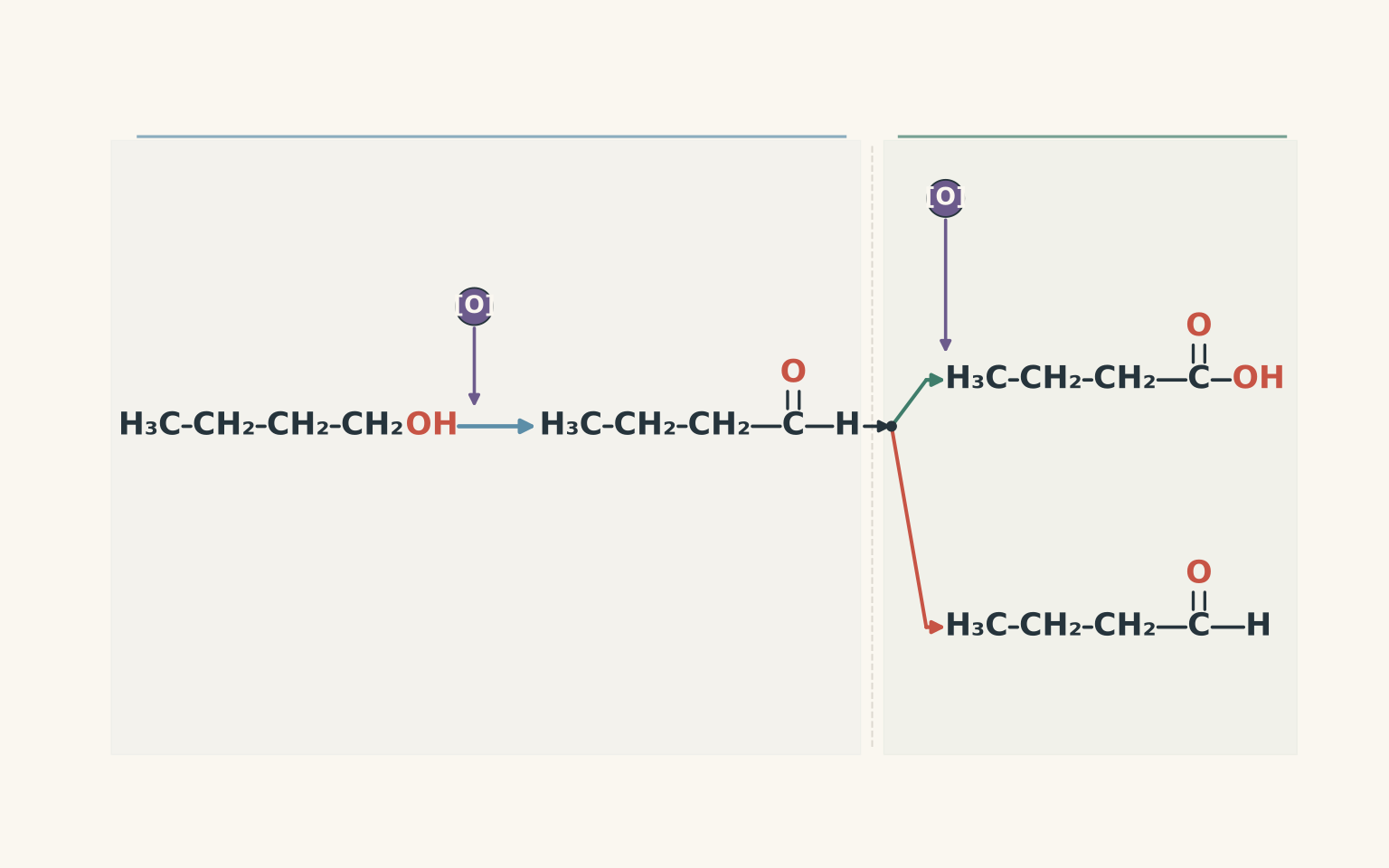
Due to technical limitations, this figure may display incorrectly or contain inaccuracies. Please check key details against your course materials.
Step 5: Calculate the additional oxidising capacity required.
There are \(0.50\text{ mol}\) of butanal remaining.
Each mole requires one additional mole-equivalent of \(\ce{[O]}\).
Therefore:
\[ n([O])=0.50\times1 \]
\[ n([O])=0.50\text{ mol} \]
An additional \(0.50\text{ mol}\) of \(\ce{[O]}\) is required.
If this oxidising capacity is supplied and the mixture remains under suitable reflux conditions for sufficient time, the remaining butanal can be converted into butanoic acid.
Step 6: Explain the misconception.
The student’s mistake is treating reflux as if it guarantees complete oxidation.
It does not.
Reflux keeps volatile reactants and intermediates in the reaction system. It does not create additional oxidising agent.
There is also an important molecular-level detail: oxidation does not have to occur in perfectly separated stages across the entire flask. Some molecules can undergo their second oxidation while other molecules are still undergoing their first.
The available oxidising equivalents therefore impose a limit on the possible product composition.
This is why the word favours is more accurate than guarantees when describing the effect of reflux.
09The decision to make in an HSC question
When you see a primary alcohol being heated with an oxidising agent, identify three things before predicting the product:
- Alcohol classification: Is the alcohol primary, secondary, or tertiary?
- Reaction conditions: Is the mixture being heated under reflux or is the product being removed by distillation?
- Oxidant availability: Is there enough oxidising agent, and is the reaction allowed to proceed for sufficient time?
For a primary alcohol, the usual pathway is:
\[ \ce{R-CH2OH -> R-CHO -> R-COOH} \]
Reflux favours the second oxidation because it retains the aldehyde intermediate in the reaction system.
Distillation favours collection of the aldehyde by removing it from the reaction mixture.
Once you understand this physical difference, the product predictions become much easier. The next useful step is to practise writing balanced equations for each oxidation stage and checking whether the stated amount of oxidising agent can support the product you have predicted.