
Fermentation vs Ethene Hydration: Comparing Ethanol Production
Learn how fermentation and ethene hydration produce ethanol, and compare their reactants, catalysts, conditions, reaction types, and industrial processes. Includes worked yield calculations, experimental comparisons, and applications of ethanol oxidation, substitution, and elimination reactions.
A chemical plant can produce ethanol in two very different ways. One uses sugar and living yeast in a warm fermentation vessel. The other reacts ethene with steam in a hot, pressurised reactor. Both processes produce exactly the same molecule, \(\ce{C2H5OH}\), but the chemistry, conditions, and industrial equipment are quite different.

**Fermentation** produces ethanol by breaking down glucose using yeast under oxygen-limited conditions. **Ethene hydration** produces ethanol by adding water across the carbon-carbon double bond in ethene, using a phosphoric acid catalyst at approximately \(300^\circ\text{C}\) and \(60\text{-}70\) atm.

The key to comparing them is to examine the starting materials, reaction types, conditions, and products. Once you understand those differences, you can also predict how the ethanol produced will behave in oxidation, substitution, and elimination reactions.

## 1. The two methods of producing ethanol

Start by looking at the reactants. Fermentation starts with a carbohydrate, while hydration starts with an alkene.

### Method 1: Fermentation of glucose

Yeast contains enzymes that catalyse the conversion of glucose into ethanol and carbon dioxide.

The overall balanced equation is:

\[
\ce{C6H12O6(aq) -> 2C2H5OH(aq) + 2CO2(g)}
\]

One mole of glucose produces two moles of ethanol and two moles of carbon dioxide.

The important conditions are:

- **Reactant:** Glucose, usually dissolved in water.
- **Biological catalyst:** Yeast, which supplies the enzymes needed for fermentation.
- **Oxygen:** Restricted or excluded. This favours anaerobic fermentation rather than aerobic respiration.
- **Temperature:** A moderate temperature, commonly around \(30\text{-}40^\circ\text{C}\), allows the enzymes to function.
- **Pressure:** Relatively mild conditions compared with industrial ethene hydration.

The ethanol remains dissolved in the fermentation mixture. It must subsequently be separated and concentrated, usually by distillation.

[IMAGE: An annotated fermentation apparatus showing a warm vessel containing aqueous glucose and yeast, a controlled low-oxygen environment, carbon dioxide escaping through a gas outlet, and the ethanol-containing liquid being transferred towards a distillation column. Show the physical connections and distinguish the gas outlet from the liquid product stream.]

Fermentation uses a biological pathway. It is not an addition reaction, and yeast is not consumed according to the balanced equation.

For a more detailed explanation of the fermentation equation, enzyme conditions, and theoretical yields, see [Fermentation Production of Ethanol: HSC Chemistry Guide](https://tutorgum.com/learn/resources/hsc-chemistry-fermentation-production-of-alcohols/).

### Method 2: Hydration of ethene

Ethene is an alkene with the molecular formula \(\ce{C2H4}\). It contains a carbon-carbon double bond.

During hydration, steam reacts with ethene. The water molecule supplies hydrogen and hydroxyl groups, which add across the double bond to produce ethanol.

The balanced reversible equation is:

\[
\ce{CH2=CH2(g) + H2O(g) <=> CH3CH2OH(g)}
\]

The industrial conditions are:

- **Reactants:** Ethene gas and steam.
- **Catalyst:** Phosphoric acid, commonly supported on silica.
- **Temperature:** Approximately \(300^\circ\text{C}\).
- **Pressure:** Approximately \(60\text{-}70\) atm.
- **Reaction type:** Addition (hydration).

[IMAGE: Molecular structural diagram of ethene reacting with steam to form ethanol. Show the carbon-carbon double bond opening, one hydrogen attaching to one carbon, and the hydroxyl group attaching to the other. Label the reaction as addition and show the phosphoric acid catalyst above the reaction arrow.]

Unlike fermentation, ethene hydration is a chemical reaction carried out using an industrial catalyst. It does not require living organisms.

The ethanol initially leaves the reactor as a gas. The product mixture is cooled so that ethanol and water condense, while unreacted ethene remains gaseous and can be recycled.

### Direct comparison

| Feature | Fermentation | Ethene hydration |
|---|---|---|
| Starting material | Glucose | Ethene and steam |
| Main product | Ethanol | Ethanol |
| Other product | Carbon dioxide | No additional stoichiometric product |
| Reaction type | Biochemical fermentation | Addition |
| Catalyst | Yeast enzymes | Phosphoric acid |
| Temperature | Commonly \(30\text{-}40^\circ\text{C}\) | Approximately \(300^\circ\text{C}\) |
| Pressure | Relatively low | Approximately \(60\text{-}70\) atm |
| Oxygen | Restricted | Not a reactant |
| Product separation | Distillation of fermentation mixture | Cooling, separation, and distillation |
| Typical operation | Batch fermentation | Continuous industrial processing |

The biggest distinction is the reaction itself. Fermentation converts a six-carbon sugar into ethanol and carbon dioxide. Hydration adds the elements of water to a two-carbon alkene.

Both routes produce ethanol, but they do not have the same starting materials or reaction mechanism.

## 2. Understanding why ethene hydration needs high pressure

The conditions for ethene hydration are not arbitrary. They reflect a compromise between reaction rate and equilibrium yield.

Consider the reversible reaction again:

\[
\ce{C2H4(g) + H2O(g) <=> C2H5OH(g)}
\]

Two moles of gaseous reactants produce one mole of gaseous product.

The forward reaction is exothermic, meaning it releases heat.

This gives us two important predictions.

**Prediction 1: What happens if pressure increases?**

The equilibrium shifts towards the side with fewer gas molecules. The product side contains one mole of gas, compared with two moles on the reactant side.

Therefore, increasing pressure favours ethanol formation.

**Prediction 2: What happens if temperature increases?**

Because the forward reaction is exothermic, decreasing temperature favours the forward reaction at equilibrium.

However, a lower temperature also slows the reaction. Industry therefore uses a relatively high temperature of approximately \(300^\circ\text{C}\) as a compromise between a useful reaction rate and a reasonable equilibrium yield.

The phosphoric acid catalyst increases the rate at which equilibrium is reached. It does not change the equilibrium position or increase the equilibrium yield by itself.

[IMAGE: An explanatory equilibrium diagram for ethene hydration showing two gaseous reactant particles forming one gaseous ethanol particle. Include a separate pressure comparison illustrating that higher pressure favours the side with fewer gas particles, and a temperature comparison showing that lower temperature favours the exothermic forward reaction.]

### Why is unreacted ethene recycled?

A common mistake is to assume that all ethene reacts during one pass through the reactor.

In reality, the hydration reaction is reversible, so some ethene remains unreacted when equilibrium is reached.

The industrial process deals with this by separating the products and recycling the unreacted ethene.

The process follows this sequence:

1. Ethene and steam enter the heated reactor.
2. The mixture passes over the phosphoric acid catalyst.
3. Ethanol, unreacted ethene, and unreacted steam leave the reactor.
4. The mixture is cooled, allowing ethanol and water to condense.
5. The remaining ethene gas is separated and returned to the reactor.
6. The ethanol-containing liquid is further purified.

[IMAGE: Industrial ethene hydration process-flow diagram. Show ethene and steam entering a high-pressure reactor containing a phosphoric-acid-on-silica catalyst, the gaseous outlet passing to a cooler and separator, liquid ethanol and water leaving for distillation, and unreacted ethene returning through a clearly labelled recycle pipe to the reactor.]

Recycling improves the overall conversion of ethene supplied to the plant. It does not mean that the equilibrium conversion in each individual pass has increased.

That distinction becomes important when interpreting industrial process data.

## 3. Both processes produce the same type of alcohol

Now consider the ethanol molecule itself:

\[
\ce{CH3CH2OH}
\]

It does not matter whether the ethanol came from fermentation or ethene hydration. Its molecular structure is identical, so its classification and chemical properties are identical.

Ethanol is a **primary alcohol**.

Alcohols are classified according to the number of carbon atoms directly attached to the carbon atom bonded to the hydroxyl group, \(\ce{-OH}\).

| Alcohol classification | Carbon atoms attached to the carbon bearing \(\ce{-OH}\) | Example |
|---|---:|---|
| Primary | 1 | Ethanol |
| Secondary | 2 | Propan-2-ol |
| Tertiary | 3 | 2-methylpropan-2-ol |

[IMAGE: Three accurate displayed structural formulae side by side for ethanol, propan-2-ol, and 2-methylpropan-2-ol. Highlight the carbon directly bonded to the hydroxyl group in each molecule and show its one, two, or three carbon neighbours respectively.]

Be careful with the classification rule. You count the carbon atoms attached directly to the carbon bearing the hydroxyl group. You do not count the total number of carbon atoms in the molecule.

This classification becomes particularly important when predicting oxidation products.

### Oxidation of alcohols

Oxidation involves an increase in oxidation state. In organic chemistry, this commonly involves the loss of hydrogen or an increase in bonding to oxygen.

The products depend on whether the alcohol is primary, secondary, or tertiary.

**Primary alcohols**

A primary alcohol can be oxidised first to an aldehyde and then further to a carboxylic acid.

For ethanol:

\[
\ce{CH3CH2OH + [O] -> CH3CHO + H2O}
\]

Ethanol produces ethanal.

With further oxidation:

\[
\ce{CH3CHO + [O] -> CH3COOH}
\]

Ethanal produces ethanoic acid.

The conditions matter:

- To obtain ethanal, use an oxidising agent such as acidified potassium dichromate(VI), heat gently, and distil the aldehyde as it forms.
- To obtain ethanoic acid, heat under reflux with excess oxidising agent so the aldehyde can undergo further oxidation.

**Secondary alcohols**

Secondary alcohols oxidise to ketones.

For example, propan-2-ol produces propanone:

\[
\ce{CH3CH(OH)CH3 + [O] -> CH3COCH3 + H2O}
\]

**Tertiary alcohols**

Tertiary alcohols do not readily oxidise under the usual HSC alcohol-oxidation conditions.

The carbon bearing the hydroxyl group has no hydrogen atom attached to it. Oxidation would generally require breaking carbon-carbon bonds, rather than simply removing hydrogen to form a carbonyl compound.

[IMAGE: Reaction pathway diagram showing a primary alcohol oxidising to an aldehyde and then a carboxylic acid, a secondary alcohol oxidising to a ketone, and a tertiary alcohol showing no reaction under ordinary oxidation conditions. Label the oxidising conditions and distinguish distillation from reflux.]

The important connection is that ethanol is always a primary alcohol, regardless of its production method. Both fermentation ethanol and hydration ethanol can therefore be oxidised to ethanal and, with further oxidation, ethanoic acid.

### Substitution of ethanol

Ethanol can also undergo substitution reactions.

In a substitution reaction, one atom or group is replaced by another.

For example, ethanol reacts with hydrogen bromide to form bromoethane and water:

\[
\ce{CH3CH2OH + HBr -> CH3CH2Br + H2O}
\]

The hydroxyl group is replaced by a bromine atom.

Concentrated hydrogen halide and heating provide suitable conditions for this reaction.

Notice that the carbon chain remains intact. The reaction changes the functional group attached to the carbon chain rather than forming a carbon-carbon double bond.

### Elimination of ethanol

Ethanol can also undergo dehydration, which is an elimination reaction.

In elimination, atoms or groups are removed from a molecule, producing a multiple bond.

When ethanol is heated with concentrated sulfuric acid at approximately \(170^\circ\text{C}\), water is removed and ethene forms:

\[
\ce{CH3CH2OH -> CH2=CH2 + H2O}
\]

This is the reverse of ethene hydration.

Compare the two reactions:

| Reaction | Starting material | Main change | Product |
|---|---|---|---|
| Hydration | Ethene | Water adds across a double bond | Ethanol |
| Dehydration | Ethanol | Water is eliminated | Ethene |
| Substitution | Ethanol | \(\ce{-OH}\) is replaced by a halogen | Haloalkane |

[IMAGE: Three connected reaction pathways starting from ethanol: oxidation to ethanal and then ethanoic acid, substitution with concentrated HBr and heat to form bromoethane, and dehydration with concentrated sulfuric acid at approximately 170 degrees Celsius to form ethene. Label each pathway with its reaction type and conditions.]

A useful way to avoid confusion is to focus on what happens to the atoms:

- Addition puts atoms or groups into a molecule.
- Substitution replaces one group with another.
- Elimination removes atoms or groups and commonly forms a double bond.
- Oxidation changes the oxidation state of the organic molecule.

These are different reaction types, even when they involve the same starting alcohol.
04How would you compare the processes experimentally?
Imagine you are asked to investigate which process is producing ethanol and how effectively it is operating.
You cannot simply look at the gas being released and declare that fermentation has occurred. You need measurements that identify the products, not just evidence that a reaction is happening.
Investigating fermentation
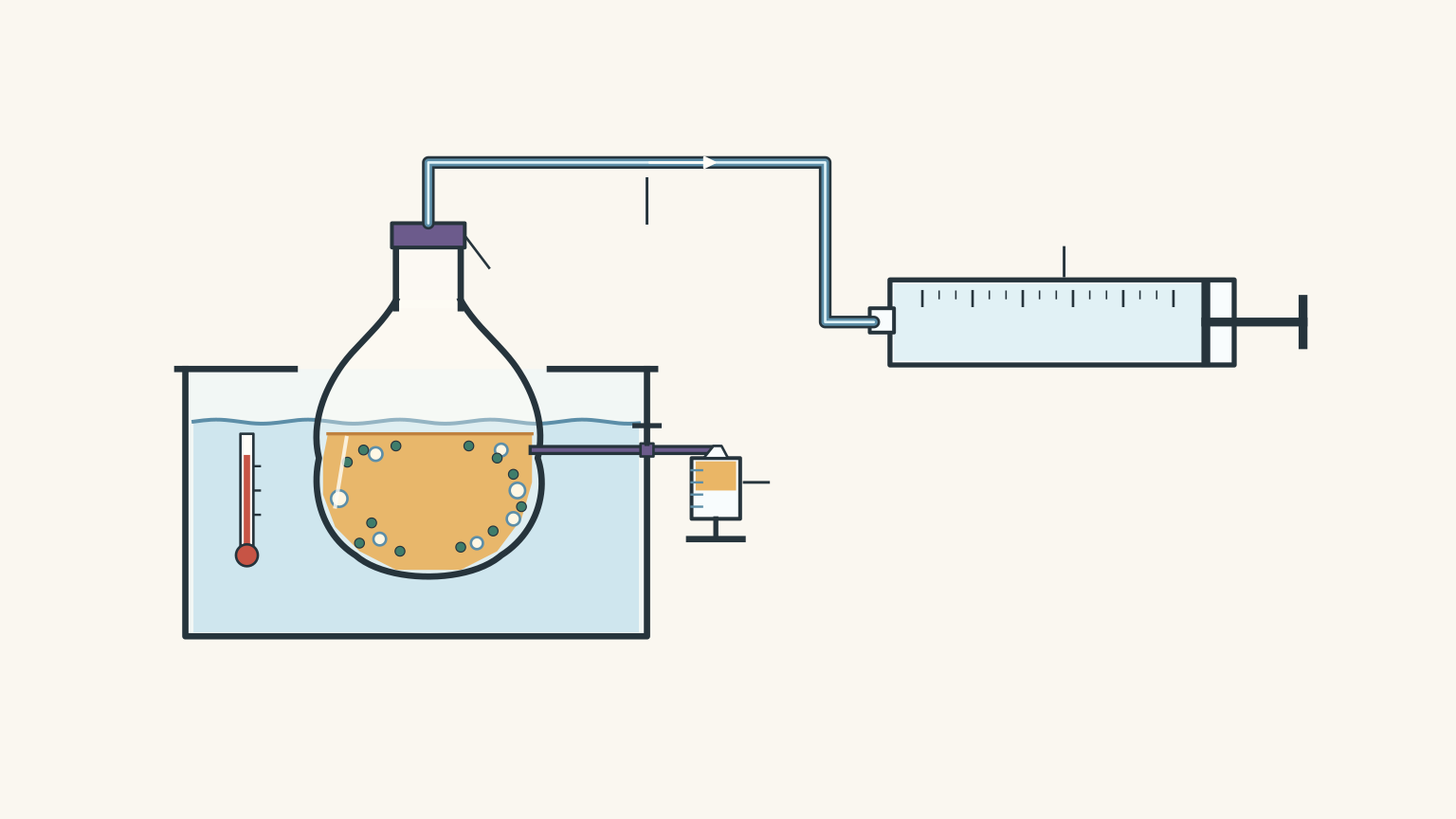
A suitable investigation uses a fermentation vessel containing glucose solution and yeast.
The vessel is kept warm, and oxygen is restricted. A gas outlet connects the vessel to a gas syringe or gas-measuring apparatus, allowing the carbon dioxide produced to be monitored.
You could collect three important measurements:
- The initial amount of glucose.
- The volume or amount of carbon dioxide produced.
- The amount of ethanol present in the liquid mixture.
Due to technical limitations, this figure may display incorrectly or contain inaccuracies. Please check key details against your course materials.
What should you observe?
If fermentation occurs, carbon dioxide is released and ethanol accumulates in the liquid.
However, there is a limitation. Aerobic respiration also produces carbon dioxide. Measuring carbon dioxide alone does not establish that ethanol has formed.
A better investigation therefore combines oxygen restriction with an independent measurement of ethanol.
Investigating ethene hydration
The hydration process requires a different apparatus.
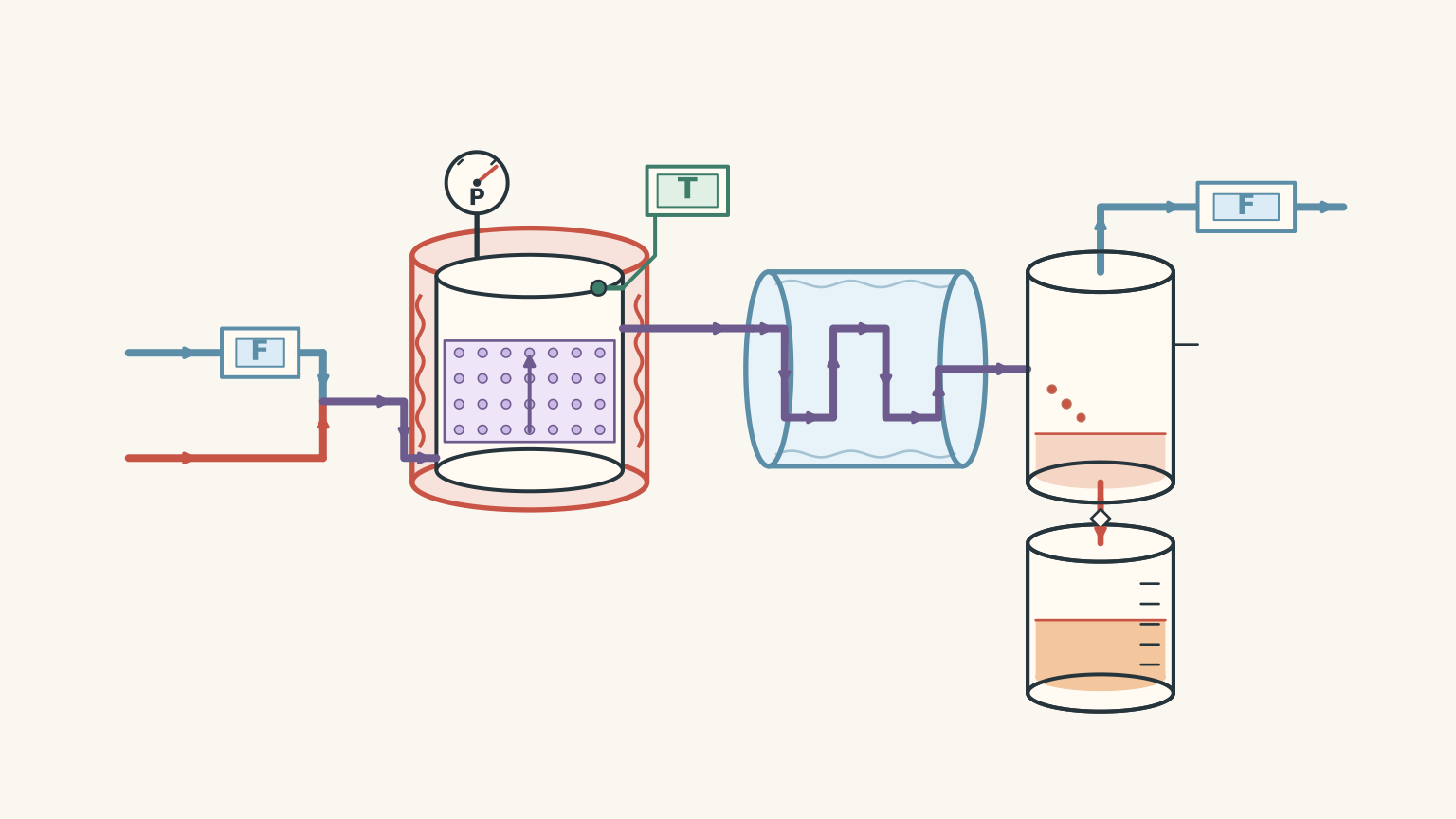
Ethene and steam enter a heated, pressurised reactor containing the phosphoric acid catalyst. The gas mixture leaves the reactor and passes through a cooling system.
After cooling, ethanol and water form a liquid mixture. Unreacted ethene remains gaseous and can be separated for recycling.
Due to technical limitations, this figure may display incorrectly or contain inaccuracies. Please check key details against your course materials.
The important measurements are the amount of ethene entering the reactor, the amount remaining after reaction, and the amount of ethanol collected.
This allows the operator to calculate conversion and product yield.
Conversion versus percentage yield
These terms are related, but they do not mean the same thing.
Percentage conversion measures how much of a reactant has been consumed:
\[ \text{Conversion} = \frac{\text{moles of reactant consumed}} {\text{initial moles of reactant}} \times 100 \]
Percentage yield measures how much product was actually obtained compared with the theoretical maximum:
\[ \text{Percentage yield} = \frac{\text{actual product yield}} {\text{theoretical product yield}} \times 100 \]
For example, a hydration reactor could have a \(40\%\) conversion of ethene. This does not automatically mean it has a \(40\%\) ethanol yield.
That conclusion requires another assumption: all the ethene that reacts must form ethanol.
If side reactions occur, some consumed ethene may form other products. Conversion alone cannot tell you how much ethanol was produced.
The same distinction applies when comparing fermentation and hydration. Do not compare a fermentation percentage yield directly with an ethene conversion percentage and assume they measure the same thing.
What happens when the original process design is insufficient?
There are two important limitations to recognise.
- A fermentation gas-measuring apparatus cannot independently establish the ethanol yield. The investigation needs a separate measurement of ethanol.
- A single-pass hydration reactor may leave substantial ethene unreacted. Adding a separation and recycling stage allows that ethene to be used again.
The second change improves overall feedstock conversion without changing the equilibrium conversion of an individual pass.
This is why a complete comparison needs to consider the whole process, rather than just the reaction occurring inside the vessel.
05Worked examples
Worked example: Calculating ethanol from ethene hydration
An industrial hydration reactor receives \(2.00\text{ mol}\) of ethene and excess steam. During one pass through the reactor, \(35.0\%\) of the ethene reacts.
Calculate the amount, in moles, and the mass of ethanol produced. Assume all reacted ethene forms ethanol.
Step 1: Write the balanced reaction.
\[ \ce{C2H4 + H2O <=> C2H5OH} \]
The mole ratio of ethene to ethanol is \(1:1\).
Step 2: Calculate the amount of ethene that reacts.
\[ \begin{aligned} n(\ce{C2H4, reacted}) &= 2.00 \times \frac{35.0}{100}\\\ &= 0.700\text{ mol} \end{aligned} \]
Step 3: Use the mole ratio to calculate ethanol production.
\[ n(\ce{C2H5OH})=0.700\text{ mol} \]
Step 4: Convert moles of ethanol into mass.
Using \(M(\ce{C2H5OH})=46.07\text{ g mol}^{-1}\):
\[ \begin{aligned} m &= nM\\\ &=0.700\times46.07\\\ &=32.249\text{ g} \end{aligned} \]
The mass of ethanol produced is:
\[ \boxed{32.2\text{ g}} \]
The reactor produces \(0.700\text{ mol}\) of ethanol in one pass. The remaining \(65.0\%\) of the ethene has not reacted and could be recycled.
Notice that the conversion percentage was applied to the initial ethene, not to the steam or ethanol.
Worked example: Comparing both routes on an equal carbon basis
An engineer compares two hypothetical production trials.
All data below are illustrative, not measurements from actual industrial plants.
- Trial A: \(0.200\text{ mol}\) of glucose undergoes fermentation with an \(80.0\%\) theoretical ethanol yield.
- Trial B: \(0.600\text{ mol}\) of ethene undergoes hydration with a \(40.0\%\) single-pass conversion.
Assume all reacted ethene produces ethanol.
Calculate the mass of ethanol from each trial and determine which process sends a greater fraction of its feedstock carbon into ethanol.
Step 1: Check that both trials start with the same amount of carbon.
Glucose contains six carbon atoms per molecule:
\[ 0.200\times6=1.20\text{ mol C} \]
Ethene contains two carbon atoms per molecule:
\[ 0.600\times2=1.20\text{ mol C} \]
Both trials therefore start with \(1.20\text{ mol}\) of carbon atoms.
This gives us a fairer basis for comparing how much feedstock carbon ends up in ethanol.
Step 2: Calculate the theoretical ethanol production from fermentation.
The balanced equation is:
\[ \ce{C6H12O6 -> 2C2H5OH + 2CO2} \]
One mole of glucose produces two moles of ethanol.
\[ n_{\text{theoretical}}(\ce{C2H5OH}) =0.200\times2 =0.400\text{ mol} \]
Step 3: Apply the fermentation percentage yield.
\[ \begin{aligned} n_{\text{actual}}(\ce{C2H5OH}) &=0.400\times0.800\\\ &=0.320\text{ mol} \end{aligned} \]
Convert this to mass:
\[ \begin{aligned} m &=0.320\times46.07\\\ &=14.7424\text{ g} \end{aligned} \]
Trial A produces \(14.7\text{ g}\) of ethanol.
Step 4: Calculate the ethanol production from hydration.
The conversion is \(40.0\%\), so:
\[ \begin{aligned} n(\ce{C2H4, reacted}) &=0.600\times0.400\\\ &=0.240\text{ mol} \end{aligned} \]
The mole ratio of ethene to ethanol is \(1:1\):
\[ n(\ce{C2H5OH})=0.240\text{ mol} \]
Convert to mass:
\[ \begin{aligned} m &=0.240\times46.07\\\ &=11.0568\text{ g} \end{aligned} \]
Trial B produces \(11.1\text{ g}\) of ethanol.
Step 5: Compare the fraction of feedstock carbon retained in ethanol.
Each ethanol molecule contains two carbon atoms.
For fermentation:
\[ \begin{aligned} \text{Carbon in ethanol} &=0.320\times2\\\ &=0.640\text{ mol C} \end{aligned} \]
Therefore:
\[ \frac{0.640}{1.20}\times100 =53.3\% \]
For hydration:
\[ \begin{aligned} \text{Carbon in ethanol} &=0.240\times2\\\ &=0.480\text{ mol C} \end{aligned} \]
Therefore:
\[ \frac{0.480}{1.20}\times100 =40.0\% \]
The comparison is:
| Measurement | Fermentation | Hydration |
|---|---|---|
| Initial carbon | 1.20 mol | 1.20 mol |
| Ethanol produced | 0.320 mol | 0.240 mol |
| Ethanol mass | 14.7 g | 11.1 g |
| Feedstock carbon in ethanol | 53.3% | 40.0% |
For these particular illustrative trials, fermentation produces more ethanol and retains a greater fraction of the feedstock carbon in the product.
However, this does not establish that fermentation is always the better industrial process. Feedstock availability, actual operating conditions, separation requirements, energy consumption, and the possibility of recycling unreacted materials also matter.
The key mathematical lesson is that percentage yield and percentage conversion have different denominators. Convert both results to a common basis before making a meaningful comparison.
Source and syllabus note: The industrial hydration conditions and reactor arrangement described here are consistent with ChemKey’s explanation of ethene hydration and Elucidate’s industrial production explanation. For students sitting the 2026-27 HSC, the Chemistry Stage 6 Syllabus (2017) remains in effect. The new Chemistry 11-12 Syllabus (2025) begins implementation in 2028, according to NESA’s syllabus transition information.
03Questions and solutions
Question 1
Two industrial processes are used to produce ethanol.
Process A uses glucose and yeast under oxygen-limited conditions.
Process B reacts ethene with steam over a phosphoric acid catalyst at approximately \(300^\circ\text{C}\) and \(60\text{-}70\) atm.
a. Write a balanced chemical equation for each process.
b. Identify the reaction type involved in each process.
c. Explain why carbon dioxide is produced in Process A but not in the overall equation for Process B.
Solution 1
Process A is fermentation, while Process B is ethene hydration.
Process A: Fermentation
\[ \ce{C6H12O6 -> 2C2H5OH + 2CO2} \]
Fermentation is a biochemical process catalysed by enzymes supplied by yeast. It occurs under anaerobic or oxygen-limited conditions at a moderate temperature, commonly around \(30\text{-}40^\circ\text{C}\).
Process B: Ethene hydration
\[ \ce{CH2=CH2 + H2O <=> CH3CH2OH} \]
Hydration is an addition reaction. Hydrogen and hydroxyl groups from water add across the carbon-carbon double bond in ethene.
The reaction uses phosphoric acid as a catalyst, with industrial conditions of approximately \(300^\circ\text{C}\) and \(60\text{-}70\) atm.
Why are the products different?
In fermentation, glucose contains six carbon atoms. Only four of these carbon atoms end up in the two ethanol molecules. The remaining two form two carbon dioxide molecules.
In hydration, the two carbon atoms in ethene both remain in the ethanol molecule. The hydrogen and oxygen atoms are supplied by water.
Therefore, carbon dioxide is a product of fermentation but is not a stoichiometric product of ethene hydration.
Question 2
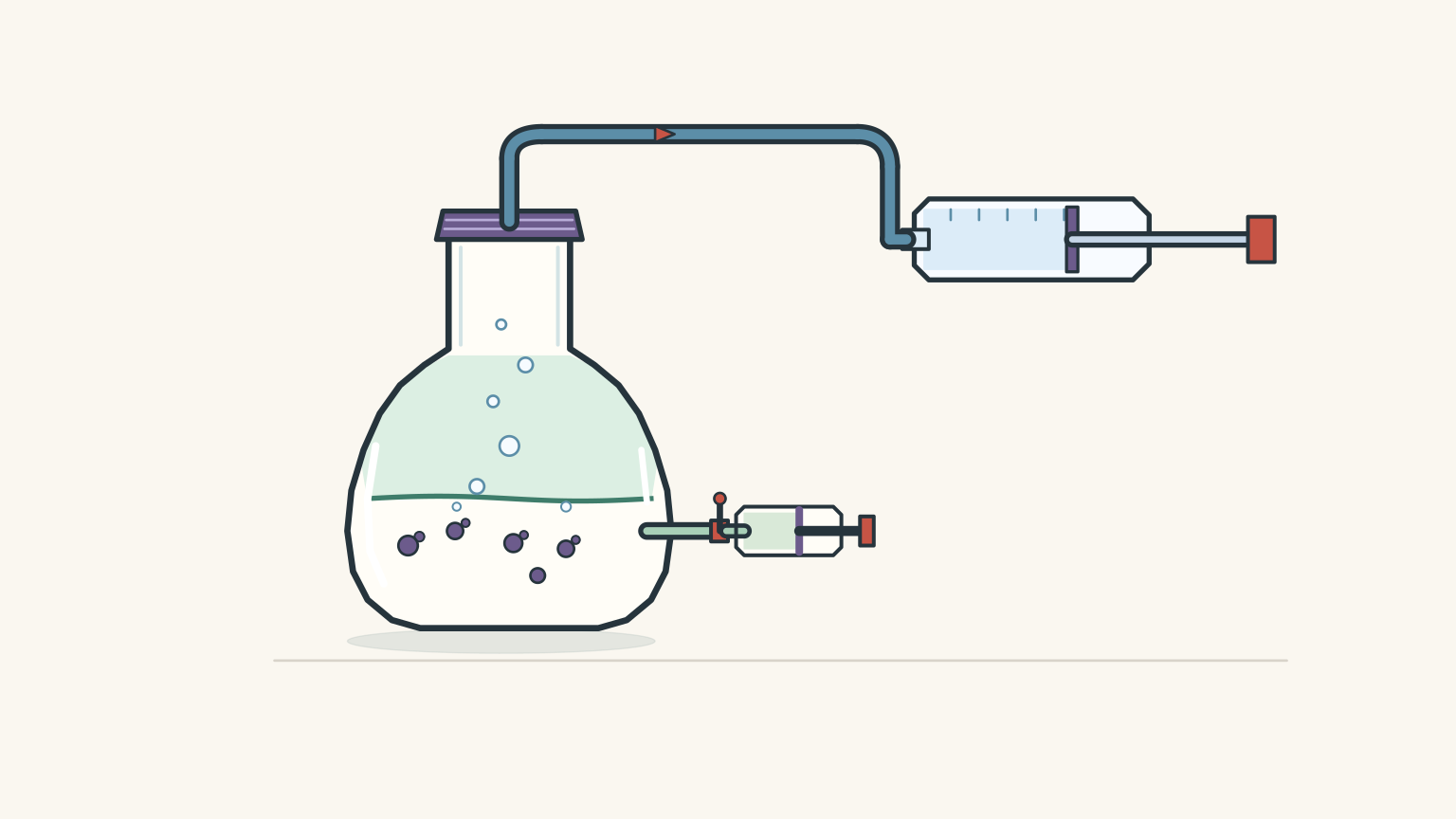
A fermentation vessel initially contains \(18.0\text{ g}\) of glucose. After fermentation, \(7.36\text{ g}\) of ethanol has been collected.
A gas-measuring apparatus records \(0.150\text{ mol}\) of carbon dioxide.
Calculate:
a. The theoretical mass of ethanol.
b. The percentage yield of ethanol.
c. Whether the measured carbon dioxide is consistent with the amount of ethanol produced, assuming ideal fermentation stoichiometry and no gas loss.
Use:
- \(M(\ce{C6H12O6})=180.16\text{ g mol}^{-1}\)
- \(M(\ce{C2H5OH})=46.07\text{ g mol}^{-1}\)
Due to technical limitations, this figure may display incorrectly or contain inaccuracies. Please check key details against your course materials.
Solution 2
The theoretical ethanol mass is approximately \(9.21\text{ g}\), and the percentage yield is \(80.0\%\). The carbon dioxide measurement is slightly lower than expected from the measured ethanol, so the results are not exactly consistent with ideal fermentation stoichiometry.
Step 1: Calculate the initial amount of glucose.
\[ \begin{aligned} n &= \frac{m}{M}\\\ &= \frac{18.0}{180.16}\\\ &=0.09991\text{ mol} \end{aligned} \]
Step 2: Calculate the theoretical amount of ethanol.
The balanced equation gives a glucose-to-ethanol mole ratio of \(1:2\).
\[ n(\ce{C2H5OH}) =2\times0.09991 =0.1998\text{ mol} \]
Step 3: Calculate the theoretical ethanol mass.
\[ \begin{aligned} m &= nM\\\ &=0.1998\times46.07\\\ &=9.21\text{ g} \end{aligned} \]
Step 4: Calculate percentage yield.
\[ \begin{aligned} \text{Yield} &=\frac{7.36}{9.21}\times100\\\ &=80.0\% \end{aligned} \]
Step 5: Check the carbon dioxide measurement.
First, calculate the actual amount of ethanol:
\[ n(\ce{C2H5OH}) =\frac{7.36}{46.07} =0.1598\text{ mol} \]
The balanced equation shows that ethanol and carbon dioxide are produced in a \(1:1\) mole ratio.
Therefore, if ideal fermentation is the only process occurring and no gas is lost:
\[ n(\ce{CO2})=0.1598\text{ mol} \]
However, the measured amount is only \(0.150\text{ mol}\).
The difference is:
\[ 0.1598-0.150=0.0098\text{ mol} \]
The results do not match exactly.
Possible explanations include incomplete gas collection, measurement uncertainty, or other processes occurring in the vessel.
The important experimental lesson is that carbon dioxide measurements alone cannot establish the ethanol yield. Independent product measurements are needed.
Question 3
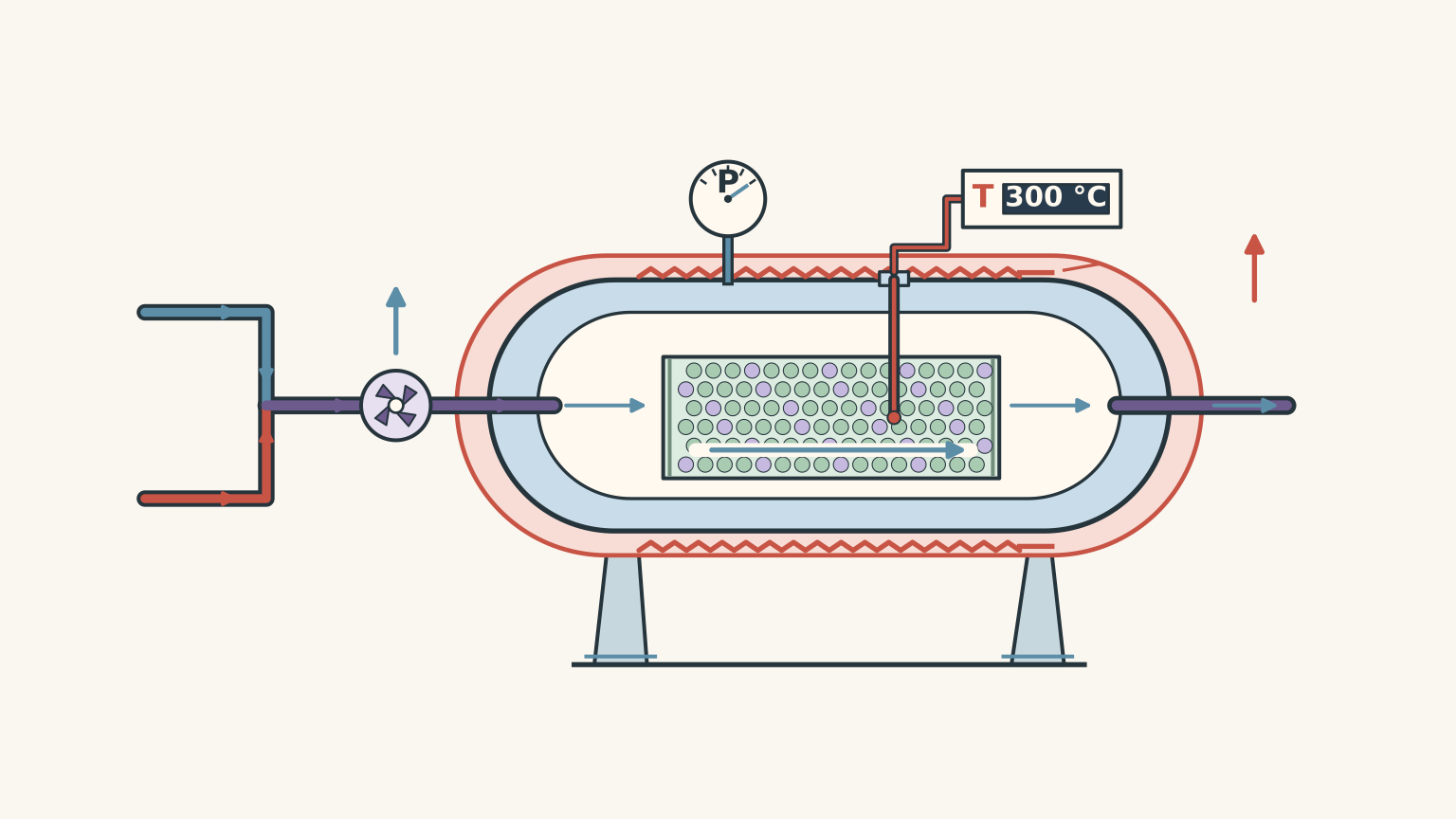
An industrial ethene hydration reactor initially operates at \(300^\circ\text{C}\) and \(60\) atm using a phosphoric acid catalyst.
A plant operator suggests increasing the temperature to \(350^\circ\text{C}\) because higher temperatures increase reaction rates.
Another operator suggests increasing the pressure while keeping the temperature constant.
The forward hydration reaction is exothermic.
a. Explain what increasing the temperature does to the equilibrium position and reaction rate.
b. Explain what increasing the pressure does to the equilibrium position.
c. Explain why adding more catalyst cannot independently increase the equilibrium yield of ethanol.
Due to technical limitations, this figure may display incorrectly or contain inaccuracies. Please check key details against your course materials.
Solution 3
Increasing temperature increases the reaction rate but shifts equilibrium towards the reactants. Increasing pressure favours ethanol formation, while adding more catalyst does not change the equilibrium position.
Part a: Increasing temperature
The forward reaction is exothermic, so heat can be treated as a product.
\[ \ce{C2H4(g) + H2O(g) <=> C2H5OH(g) + heat} \]
Increasing temperature adds heat to the system.
According to Le Chatelier’s principle, equilibrium shifts in the direction that absorbs the added heat. This is the reverse, endothermic reaction.
Therefore:
- The equilibrium position shifts towards ethene and water.
- The equilibrium amount of ethanol decreases.
- The reaction rate generally increases because particles have greater kinetic energy and a greater proportion can overcome the activation energy.
This creates an industrial compromise. A higher temperature may improve reaction speed but reduce equilibrium yield.
Part b: Increasing pressure
Count the gaseous particles on each side of the equation.
| Side | Number of gaseous moles |
|---|---|
| Reactants | 2 |
| Products | 1 |
Increasing pressure favours the side with fewer gaseous particles.
Therefore, equilibrium shifts towards ethanol formation.
This is one reason industrial ethene hydration uses high pressure.
Part c: Increasing catalyst concentration
A catalyst provides an alternative reaction pathway with lower activation energy.
It increases the rate of both the forward and reverse reactions. Equilibrium is reached more quickly, but its position remains unchanged.
Consequently, adding more phosphoric acid catalyst cannot independently increase the equilibrium yield.
It may improve production rates if a reactor is not reaching equilibrium within its available reaction time. However, it cannot change the equilibrium composition at fixed temperature and pressure.
Question 4
Three alcohols are represented by the following condensed structural formulae:
- Alcohol A: \(\ce{CH3CH2OH}\)
- Alcohol B: \(\ce{CH3CH(OH)CH3}\)
- Alcohol C: \(\ce{(CH3)3COH}\)
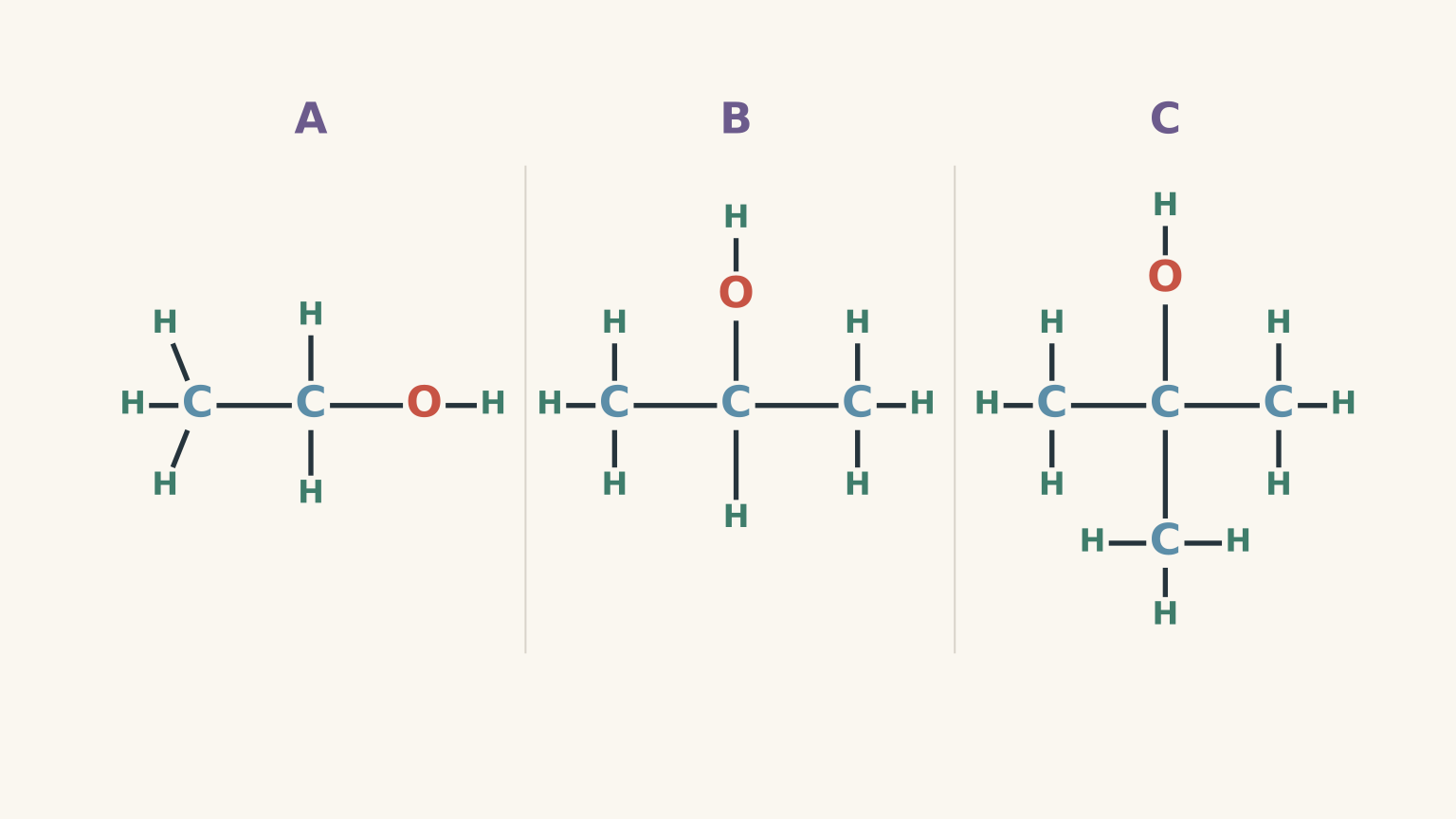
Due to technical limitations, this figure may display incorrectly or contain inaccuracies. Please check key details against your course materials.
a. Classify each alcohol as primary, secondary, or tertiary.
b. Predict the oxidation product of each alcohol under ordinary HSC alcohol-oxidation conditions.
c. State the conditions required to oxidise ethanol to ethanoic acid rather than stopping at ethanal.
d. Ethanol is reacted separately with concentrated hydrogen bromide and concentrated sulfuric acid at approximately \(170^\circ\text{C}\). Identify the major organic product and reaction type in each case.
Solution 4
Alcohol A is primary, Alcohol B is secondary, and Alcohol C is tertiary. Their oxidation behaviour depends on their structures, while the reactions of ethanol with hydrogen bromide and concentrated sulfuric acid produce different products through substitution and elimination respectively.
Part a: Classification
- Alcohol A, \(\ce{CH3CH2OH}\), is primary. Its hydroxyl-bearing carbon is attached to one other carbon atom.
- Alcohol B, \(\ce{CH3CH(OH)CH3}\), is secondary. Its hydroxyl-bearing carbon is attached to two other carbon atoms.
- Alcohol C, \(\ce{(CH3)3COH}\), is tertiary. Its hydroxyl-bearing carbon is attached to three other carbon atoms.
Part b: Oxidation products
Alcohol A is ethanol, a primary alcohol.
It oxidises first to ethanal:
\[ \ce{CH3CH2OH + [O] -> CH3CHO + H2O} \]
With further oxidation, ethanal forms ethanoic acid:
\[ \ce{CH3CHO + [O] -> CH3COOH} \]
Alcohol B is propan-2-ol, a secondary alcohol.
It oxidises to propanone:
\[ \ce{CH3CH(OH)CH3 + [O] -> CH3COCH3 + H2O} \]
Alcohol C is 2-methylpropan-2-ol, a tertiary alcohol.
It does not readily undergo oxidation under ordinary HSC alcohol-oxidation conditions because the carbon bearing the hydroxyl group has no hydrogen atom attached to it.
Part c: Producing ethanoic acid
To obtain ethanoic acid, ethanol must undergo further oxidation beyond ethanal.
Use excess acidified potassium dichromate(VI) and heat under reflux.
Reflux allows volatile substances to condense and return to the reaction vessel, giving the ethanal time to undergo further oxidation.
If ethanal is the desired product instead, it should be distilled away as it forms to minimise further oxidation.
Part d: Substitution and elimination
With concentrated hydrogen bromide and heat:
\[ \ce{CH3CH2OH + HBr -> CH3CH2Br + H2O} \]
The product is bromoethane.
This is a substitution reaction because the hydroxyl group is replaced by a bromine atom.
With concentrated sulfuric acid at approximately \(170^\circ\text{C}\):
\[ \ce{CH3CH2OH -> CH2=CH2 + H2O} \]
The product is ethene.
This is an elimination reaction because water is removed from ethanol, forming a carbon-carbon double bond.
Notice that the starting alcohol is identical in both reactions. The different products result from the different reaction conditions and reagents.
Question 5
An industrial plant uses ethene hydration to manufacture ethanol.
The plant initially feeds \(1.00\text{ mol}\) of ethene into a reactor with excess steam. Under its operating conditions, \(40.0\%\) of the ethene entering the reactor reacts during each pass.
After each pass:
- Ethanol is separated from the product mixture.
- Unreacted ethene is recycled into the reactor.
- Sufficient steam is available for every pass.
Assume that each pass achieves the same \(40.0\%\) conversion, all reacted ethene forms ethanol, and there are no material losses.
The plant operates for three passes.
a. Calculate the amount of ethanol produced during each pass.
b. Calculate the total amount and mass of ethanol produced after three passes.
c. Calculate the overall percentage conversion of the original ethene feed.
d. A manager proposes doubling the phosphoric acid catalyst to double the overall ethanol yield. Evaluate this proposal.
e. A second manager claims that ethanol produced by hydration will oxidise differently from ethanol produced by fermentation. Explain whether this is correct.
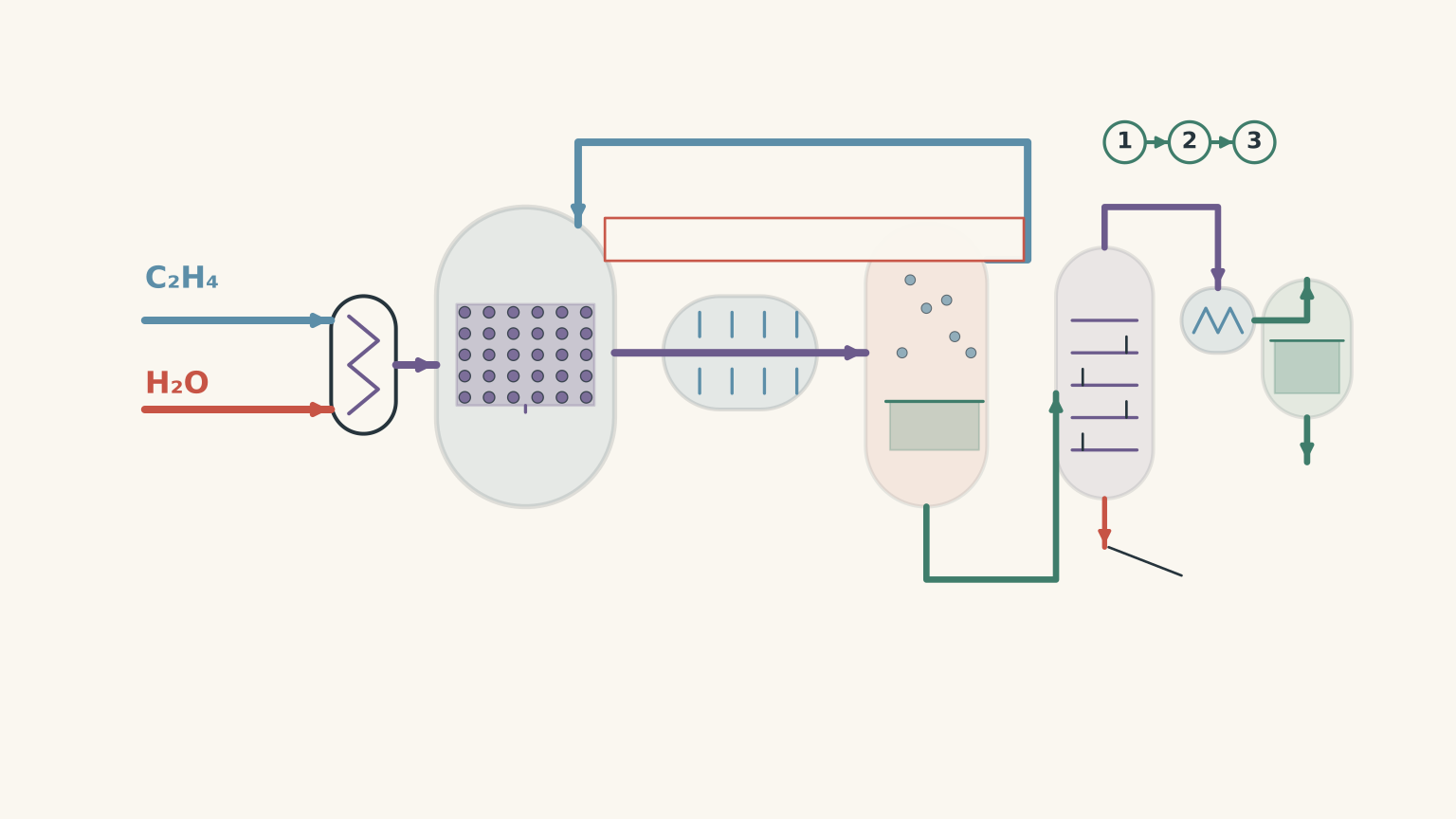
Due to technical limitations, this figure may display incorrectly or contain inaccuracies. Please check key details against your course materials.
Solution 5
The plant produces \(0.784\text{ mol}\) of ethanol after three passes, corresponding to an overall ethene conversion of \(78.4\%\). Doubling the catalyst cannot change the equilibrium conversion under the stated assumptions, and ethanol from either production route has identical oxidation behaviour.
Part a: Ethanol produced during each pass
The initial ethene feed is \(1.00\text{ mol}\).
During the first pass, \(40.0\%\) reacts:
\[ n_1=1.00\times0.400=0.400\text{ mol} \]
The remaining ethene is:
\[ 1.00-0.400=0.600\text{ mol} \]
During the second pass, \(40.0\%\) of the remaining ethene reacts:
\[ n_2=0.600\times0.400=0.240\text{ mol} \]
The remaining ethene is:
\[ 0.600-0.240=0.360\text{ mol} \]
During the third pass:
\[ n_3=0.360\times0.400=0.144\text{ mol} \]
The results are:
| Pass | Ethene entering (mol) | Ethanol produced (mol) | Ethene remaining (mol) |
|---|---|---|---|
| 1 | 1.000 | 0.400 | 0.600 |
| 2 | 0.600 | 0.240 | 0.360 |
| 3 | 0.360 | 0.144 | 0.216 |
Part b: Total ethanol produced
Add the ethanol from all three passes:
\[ \begin{aligned} n_{\text{total}} &=0.400+0.240+0.144\\\ &=0.784\text{ mol} \end{aligned} \]
Convert this amount into mass:
\[ \begin{aligned} m &= nM\\\ &=0.784\times46.07\\\ &=36.1189\text{ g} \end{aligned} \]
Therefore, the plant produces:
\[ \boxed{36.1\text{ g ethanol}} \]
Part c: Overall conversion
The original feed contained \(1.00\text{ mol}\) of ethene.
The total amount converted into ethanol is \(0.784\text{ mol}\).
\[ \begin{aligned} \text{Overall conversion} &=\frac{0.784}{1.00}\times100\\\ &=78.4\% \end{aligned} \]
The overall conversion is \(78.4\%\), even though the conversion during each individual pass is only \(40.0\%\).
This is the important effect of recycling.
The percentage conversion is not simply \(40.0\%\times3=120\%\). Each pass acts on the smaller amount of ethene remaining from the previous pass.
Part d: Would doubling the catalyst double the yield?
No. Doubling the phosphoric acid catalyst does not double the equilibrium yield.
A catalyst increases reaction rate by lowering activation energy. It does not change the equilibrium position.
Under the assumptions in this question, each pass already reaches the same equilibrium-limited conversion of \(40.0\%\). Adding more catalyst therefore cannot increase that conversion.
The recycle system is what increases the overall conversion of the original ethene feed.
There is an important qualification: if a real reactor does not have enough time to approach equilibrium, increasing catalyst loading could improve the amount reacting during a fixed residence time. However, that is a rate limitation, not a change in equilibrium yield.
Part e: Would the two ethanol samples oxidise differently?
No. Pure ethanol produced by fermentation and pure ethanol produced by hydration have the same molecular structure:
\[ \ce{CH3CH2OH} \]
Both are primary alcohols.
Both can oxidise to ethanal and then ethanoic acid, depending on the oxidising conditions.
The route used to produce a molecule does not change its chemical identity.
There is one practical qualification. Crude fermentation mixtures and crude hydration product mixtures may contain different impurities and amounts of water. Those mixtures may behave differently in an experiment, but the pure ethanol molecules themselves have identical chemical properties.
The distinction between production route and molecular structure is the central idea behind this question.
06What to remember when comparing the two methods
When an HSC question asks you to compare fermentation and ethene hydration, organise your response around the following features.
| What to identify | Fermentation | Ethene hydration |
|---|---|---|
| Reactants | Glucose | Ethene and steam |
| Catalyst | Yeast enzymes | Phosphoric acid |
| Reaction type | Fermentation | Addition |
| Main conditions | Oxygen-limited, moderate temperature | \(300^\circ\text{C}\), \(60\text{-}70\) atm |
| Additional product | Carbon dioxide | None in the overall equation |
| Equilibrium considerations | Not usually treated as the same industrial equilibrium system as hydration | Reversible reaction; pressure and temperature affect equilibrium |
| Separation | Distillation | Cooling, separation, and distillation |
| Ethanol classification | Primary | Primary |
Three common mistakes are worth avoiding:
- Calling ethene hydration substitution. It is addition because water adds across the carbon-carbon double bond.
- Assuming a catalyst increases equilibrium yield. It increases reaction rate, not the equilibrium position.
- Assuming ethanol produced by different methods has different chemical properties. Pure ethanol has the same structure regardless of its source.
The next useful step is to connect these reactions into a broader organic synthesis pathway. In particular, practise moving between ethanol, ethene, haloalkanes, aldehydes, and carboxylic acids by identifying the reaction type and choosing the correct conditions. That is where understanding the comparison becomes useful for unfamiliar HSC reaction-prediction questions.