
How to Calculate Ethanol Yield from Fermentation Stoichiometry
Learn how to calculate theoretical ethanol yield from glucose fermentation using balanced equations, mole ratios, and experimental data. Includes worked calculations, carbon dioxide measurements, percentage yield, and how ethanol undergoes oxidation, substitution, and elimination.
A fermentation vessel starts with \(90.0\text{ g}\) of glucose. After fermentation and separation, \(31.0\text{ g}\) of pure ethanol is recovered. Is that a good yield? More importantly, how much ethanol should the glucose have produced in the first place?
The answer comes from the balanced fermentation equation. One mole of glucose produces two moles of ethanol:
\[ \ce{C6H12O6(aq) -> 2C2H5OH(aq) + 2CO2(g)} \]
Using the molar masses of glucose (\(180.16\text{ g mol}^{-1}\)) and ethanol (\(46.07\text{ g mol}^{-1}\)):
\[ \begin{aligned} n(\text{glucose}) &= \frac{90.0}{180.16}\\ &=0.4996\text{ mol} \end{aligned} \]
The equation gives a glucose-to-ethanol mole ratio of \(1:2\):
\[ n(\text{ethanol})=2(0.4996)=0.9991\text{ mol} \]
Convert this amount into mass:
\[ \begin{aligned} m(\text{ethanol})&=nM\\ &=0.9991\times46.07\\ &=46.0\text{ g} \end{aligned} \]
The theoretical yield is therefore \(46.0\text{ g}\) of ethanol.
Since only \(31.0\text{ g}\) was recovered, the overall isolated percentage yield is:
\[ \begin{aligned} \%\text{ yield} &=\frac{31.0}{46.0}\times100\\ &=67.4\% \end{aligned} \]
That’s the essential method: use the balanced equation to calculate the theoretical ethanol yield, then compare it with the amount actually recovered.
The interesting part is understanding why the calculation works, when it can be used, and what happens when the experimental conditions change.
All numerical data in the worked examples and practice questions below are illustrative.
01Understand the fermentation equation first
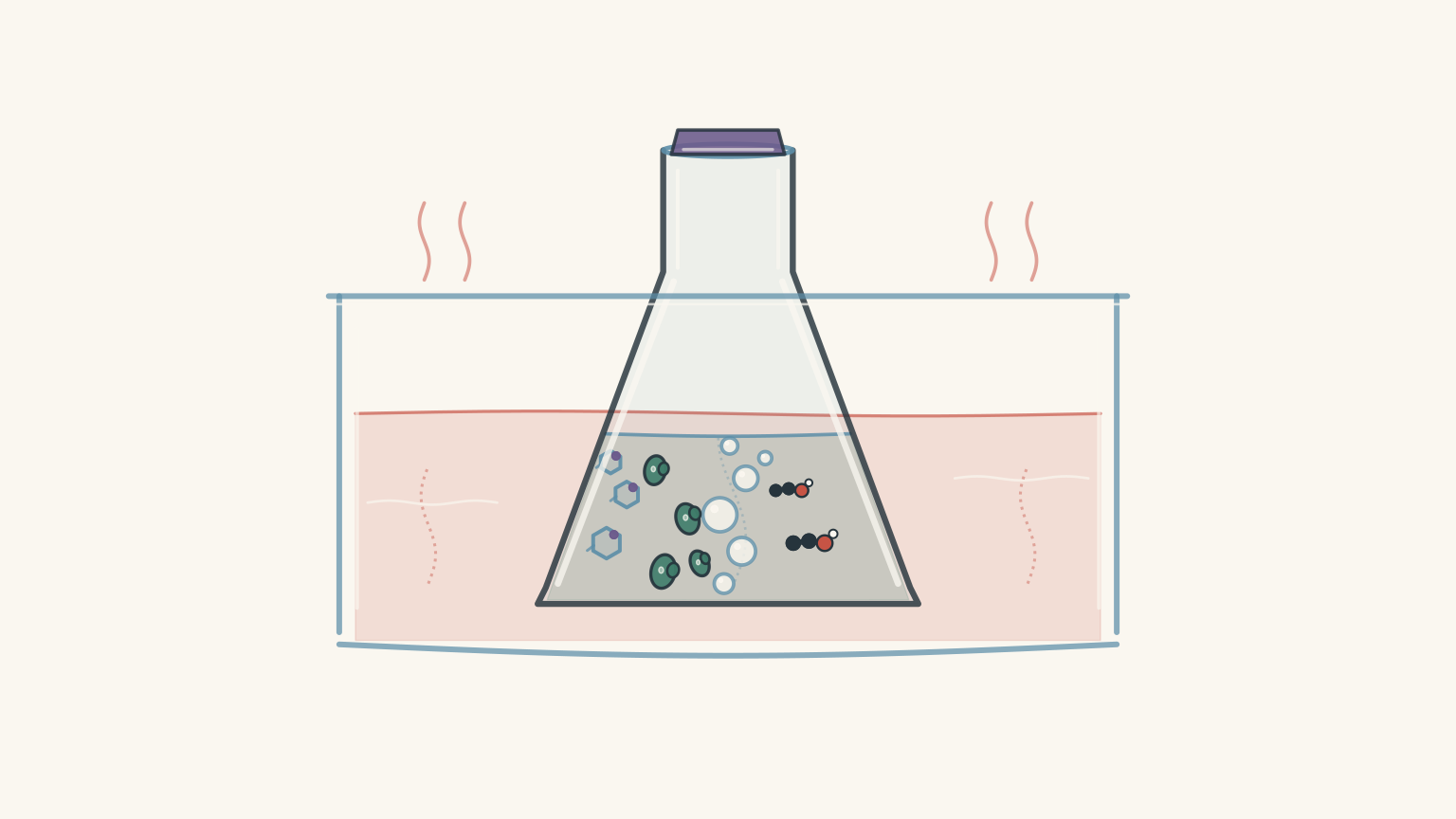
Fermentation is a biological process in which yeast uses enzymes to convert glucose into ethanol and carbon dioxide under anaerobic conditions (with little or no oxygen).
The overall reaction is:
\[ \ce{C6H12O6(aq) -> 2C2H5OH(aq) + 2CO2(g)} \]
There are three important substances here:
- Glucose, \(\ce{C6H12O6}\), is the reactant.
- Ethanol, \(\ce{C2H5OH}\), is the desired alcohol product.
- Carbon dioxide, \(\ce{CO2}\), is the gaseous by-product.
Yeast supplies the enzymes that catalyse the reaction. It is not a stoichiometric reactant, so it does not appear in the balanced equation.
Due to technical limitations, this figure may display incorrectly or contain inaccuracies. Please check key details against your course materials.
What do the coefficients actually tell us?
The coefficients in a balanced chemical equation represent mole ratios.
For fermentation:
\[ 1:2:2 \]
This means:
| Substance | Mole ratio | Molar mass |
|---|---|---|
| Glucose | 1 | \(180.16\text{ g mol}^{-1}\) |
| Ethanol | 2 | \(46.07\text{ g mol}^{-1}\) |
| Carbon dioxide | 2 | \(44.01\text{ g mol}^{-1}\) |
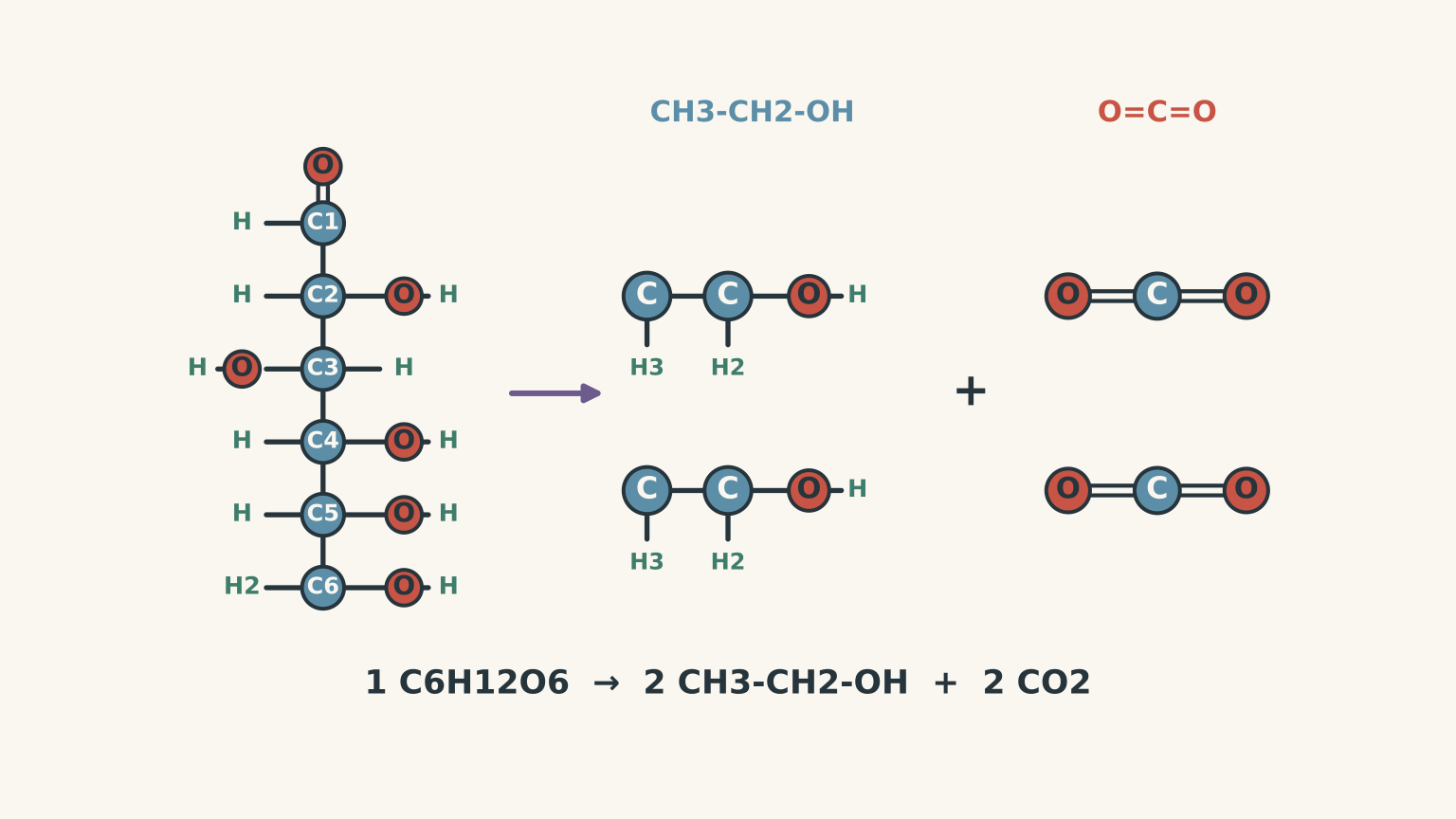
For every mole of glucose that ferments completely, two moles of ethanol and two moles of carbon dioxide form.
Notice that the equation gives a \(1:2\) ratio between glucose and ethanol. It does not say that the mass of ethanol will be twice the mass of glucose.
That is a common calculation mistake.
Two moles of ethanol have a combined mass of:
\[ 2\times46.07=92.14\text{ g} \]
One mole of glucose has a mass of \(180.16\text{ g}\).
The difference is accounted for by the carbon dioxide:
\[ 2\times44.01=88.02\text{ g} \]
| Substance | Total mass |
|---|---|
| Glucose consumed | \(180.16\text{ g}\) |
| Ethanol produced | \(92.14\text{ g}\) |
| Carbon dioxide produced | \(88.02\text{ g}\) |
| Total products | \(180.16\text{ g}\) |
Mass is conserved. Some of the original glucose atoms end up in ethanol, while the rest end up in carbon dioxide.
Due to technical limitations, this figure may display incorrectly or contain inaccuracies. Please check key details against your course materials.
A useful shortcut for theoretical ethanol yield
The mass relationship gives us a convenient shortcut.
For every \(180.16\text{ g}\) of glucose, the theoretical ethanol production is \(92.14\text{ g}\).
Therefore:
\[ \begin{aligned} m(\text{ethanol}) &=m(\text{glucose})\times \frac{92.14}{180.16}\\ &=m(\text{glucose})\times0.5114 \end{aligned} \]
So, approximately \(0.511\text{ g}\) of ethanol can theoretically form from every gram of glucose.
This shortcut assumes that glucose is the only fermentable substrate and that it undergoes complete fermentation.
It is useful for checking your working, but understanding the mole ratio is more important. HSC questions may change the information supplied, and you need to know how to work backwards from different quantities.
02How an experiment can measure ethanol production
Imagine that you want to determine how much ethanol forms inside a fermentation vessel.
You cannot simply look at the liquid and measure the ethanol by eye. Instead, you can monitor the carbon dioxide released during fermentation and use the balanced equation to make an indirect calculation.
The experimental setup
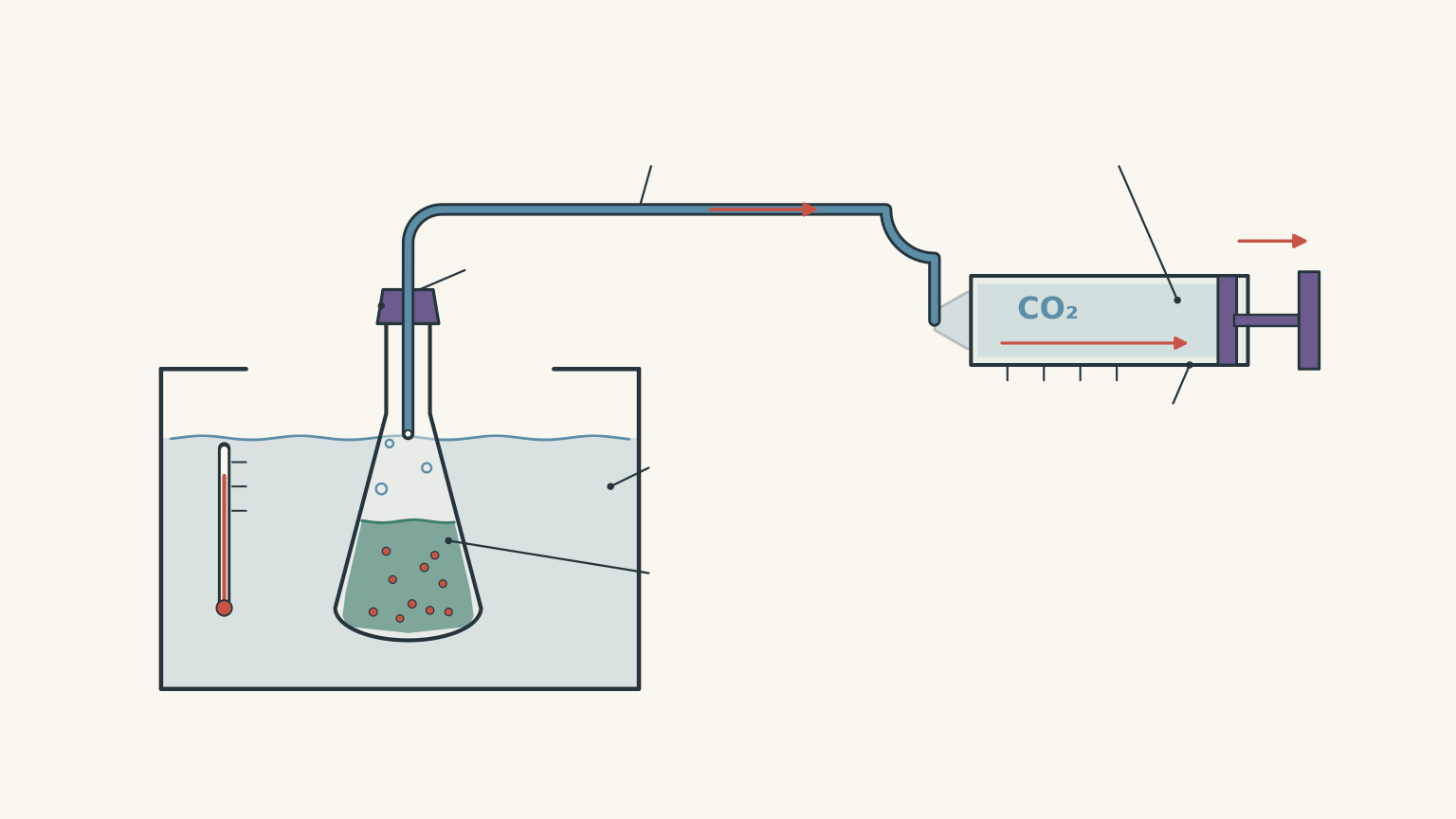
A suitable school-scale investigation uses the following arrangement:
- Place a glucose solution and yeast into a conical flask.
- Position the flask in a temperature-controlled water bath to maintain suitable conditions.
- Seal the flask with an airtight bung.
- Connect a delivery tube from the bung to a gas syringe.
- Allow the carbon dioxide produced to enter the syringe, moving its plunger outwards.
- Record the volume of gas collected over a known period.
Due to technical limitations, this figure may display incorrectly or contain inaccuracies. Please check key details against your course materials.
What should the experiment show?
If glucose undergoes fermentation, carbon dioxide should be released.
The balanced equation predicts:
\[ 1\text{ mol glucose} \longrightarrow 2\text{ mol ethanol} + 2\text{ mol CO}_2 \]
Notice that ethanol and carbon dioxide have equal mole amounts.
\[ n(\ce{C2H5OH})=n(\ce{CO2}) \]
This is particularly useful. If you know the number of moles of carbon dioxide produced, you can calculate the number of moles of ethanol formed.
For example, if \(0.200\text{ mol}\) of carbon dioxide is produced exclusively through fermentation, then \(0.200\text{ mol}\) of ethanol must also have formed.
What could go wrong with the original design?
A gas collection system is only useful if it measures the gas accurately.
Consider an experiment that collects carbon dioxide over water using an inverted measuring cylinder.
Some carbon dioxide dissolves in water. As a result, the measured gas volume can be lower than the amount actually produced.
A better design uses a gas syringe connected through airtight tubing. This reduces the problem of carbon dioxide dissolving in the collection liquid and helps prevent gas escaping.
However, there is another limitation.
Carbon dioxide production does not automatically prove that ethanol fermentation has occurred. Yeast can also carry out aerobic respiration, which produces carbon dioxide and water rather than ethanol as the main products.
The revised experiment therefore needs to control oxygen availability as well as gas collection.
For a reliable inference, we assume:
- Oxygen is excluded so that ethanol fermentation is favoured.
- Fermentation is the only source of carbon dioxide.
- All produced carbon dioxide is collected.
- The gas temperature and pressure are known when calculating its mole amount.
The gas measurement is still indirect evidence of ethanol production. Measuring the ethanol in the liquid separately provides an independent check.
This distinction becomes particularly important in more challenging HSC questions.
03The calculation method: from glucose to ethanol
Most ethanol yield questions follow the same underlying sequence.
Step 1: Write the balanced equation
Start with:
\[ \ce{C6H12O6 -> 2C2H5OH + 2CO2} \]
The coefficients give you the mole ratio:
\[ 1\text{ mol glucose}:2\text{ mol ethanol} \]
Step 2: Convert the glucose quantity into moles
If the question provides a glucose mass, use:
\[ n=\frac{m}{M} \]
Where:
- \(n\) is the amount of substance in moles (\(\text{mol}\)).
- \(m\) is the mass in grams (\(\text{g}\)).
- \(M\) is the molar mass in \(\text{g mol}^{-1}\).
If the question gives a glucose solution concentration and volume, use:
\[ n=cV \]
Here, \(c\) is concentration in \(\text{mol L}^{-1}\), and \(V\) is solution volume in litres.
Remember to convert millilitres into litres before substituting.
Step 3: Apply the mole ratio
Multiply the glucose mole amount by two:
\[ n(\text{ethanol})=2n(\text{glucose}) \]
This gives the theoretical amount of ethanol in moles.
Step 4: Convert ethanol moles into mass
Use:
\[ m=nM \]
The molar mass of ethanol is:
\[ M(\ce{C2H5OH})=46.07\text{ g mol}^{-1} \]
This gives the theoretical mass of ethanol.
Step 5: Calculate percentage yield if actual ethanol is provided
The percentage yield compares the amount of pure ethanol actually recovered with the theoretical amount.
\[ \%\text{ yield}= \frac{\text{actual yield}}{\text{theoretical yield}} \times100 \]
Both quantities must use the same units.
If the question gives the volume of pure ethanol rather than its mass, use:
\[ m=\rho V \]
where \(\rho\) is density and \(V\) is volume.
For pure ethanol at \(20^\circ\text{C}\), a useful approximate density is \(0.789\text{ g mL}^{-1}\).
Be careful: the volume of the entire fermentation liquid is not the volume of ethanol. Ethanol is mixed with water and other substances before separation.
For a more detailed explanation of theoretical yield, actual yield, and percentage yield, see Theoretical vs Actual Yield: Calculate Yield and Explain Losses.
04Worked examples
Worked example: Calculate the theoretical mass and volume of ethanol
A fermentation vessel contains \(54.0\text{ g}\) of glucose. Assume complete fermentation occurs.
Calculate the theoretical mass and volume of ethanol produced. The density of pure ethanol at \(20^\circ\text{C}\) is \(0.789\text{ g mL}^{-1}\).
Step 1
\[ \ce{C6H12O6 -> 2C2H5OH + 2CO2} \]
One mole of glucose produces two moles of ethanol.
Step 2
Using \(n=m/M\):
\[ \begin{aligned} n(\text{glucose}) &=\frac{54.0}{180.16}\\ &=0.2997\text{ mol} \end{aligned} \]
Step 3
\[ \begin{aligned} n(\text{ethanol}) &=2\times0.2997\\ &=0.5995\text{ mol} \end{aligned} \]
Step 4
\[ \begin{aligned} m(\text{ethanol}) &=nM\\ &=0.5995\times46.07\\ &=27.6\text{ g} \end{aligned} \]
Step 5
Rearrange the density equation:
\[ V=\frac{m}{\rho} \]
Substitute:
\[ \begin{aligned} V&=\frac{27.6}{0.789}\\ &=35.0\text{ mL} \end{aligned} \]
The theoretical yield is \(27.6\text{ g}\), or approximately \(35.0\text{ mL}\), of pure ethanol.
Notice that the mole ratio was applied before converting into mass. Multiplying \(54.0\text{ g}\) directly by two would give an incorrect result.
Worked example: Calculate ethanol yield using collected carbon dioxide
A fermentation vessel initially contains \(36.0\text{ g}\) of glucose.
After fermentation, a gas syringe collects \(4.96\text{ L}\) of carbon dioxide at \(25^\circ\text{C}\) and \(100\text{ kPa}\). Assume oxygen is excluded and all carbon dioxide produced is collected.
After separation, \(6.40\text{ g}\) of pure ethanol is recovered.
Given a molar gas volume of \(24.8\text{ L mol}^{-1}\), calculate:
a) The theoretical mass of ethanol.
b) The mass of ethanol inferred to have formed from the carbon dioxide measurement.
c) The overall isolated percentage yield and the fraction of formed ethanol recovered.
Step 1
First, convert glucose into moles:
\[ \begin{aligned} n(\text{glucose}) &=\frac{36.0}{180.16}\\ &=0.1998\text{ mol} \end{aligned} \]
The equation gives a \(1:2\) glucose-to-ethanol ratio:
\[ n(\text{ethanol})=2(0.1998) \]
\[ =0.3996\text{ mol} \]
Convert to mass:
\[ \begin{aligned} m(\text{ethanol}) &=0.3996\times46.07\\ &=18.4\text{ g} \end{aligned} \]
The theoretical yield is \(18.4\text{ g}\).
Step 2
Use:
\[ n=\frac{V}{V_m} \]
where \(V_m\) is the molar gas volume.
\[ \begin{aligned} n(\ce{CO2}) &=\frac{4.96}{24.8}\\ &=0.200\text{ mol} \end{aligned} \]
Step 3
Under the stated anaerobic conditions, the mole ratio of ethanol to carbon dioxide is \(1:1\).
Therefore:
\[ n(\text{ethanol formed})=0.200\text{ mol} \]
Convert into mass:
\[ \begin{aligned} m(\text{ethanol formed}) &=0.200\times46.07\\ &=9.21\text{ g} \end{aligned} \]
The gas measurement indicates that approximately \(9.21\text{ g}\) of ethanol formed during fermentation.
Step 4
\[ \begin{aligned} \text{Fraction formed} &=\frac{9.21}{18.4}\times100\\ &=50.0\% \end{aligned} \]
Approximately half of the theoretical ethanol amount had formed.
Step 5
The actual recovered mass is \(6.40\text{ g}\).
\[ \begin{aligned} \%\text{ yield} &=\frac{6.40}{18.4}\times100\\ &=34.8\% \end{aligned} \]
The overall isolated percentage yield is \(34.8\%\).
We can also calculate the fraction of ethanol formed that was recovered:
\[ \begin{aligned} \text{Recovery} &=\frac{6.40}{9.21}\times100\\ &=69.5\% \end{aligned} \]
This example reveals an important distinction.
- \(50.0\%\) of the theoretical ethanol amount had formed.
- \(69.5\%\) of the formed ethanol was recovered.
- The overall isolated percentage yield was \(34.8\%\).
The gas measurement estimates how much ethanol formed. The recovered mass tells us how much ethanol survived the separation process.
These are different measurements, and confusing them can lead to incorrect yield calculations.
05Ethanol is a primary alcohol: what happens next?
Once you’ve calculated the ethanol yield, it helps to understand exactly what chemical has been produced.
Ethanol has the structural formula:
\[ \ce{CH3CH2OH} \]
It belongs to the alcohol homologous series because it contains a hydroxyl group (\(-\mathrm{OH}\)) bonded to a carbon atom.
More specifically, ethanol is a primary alcohol.
How are alcohols classified?
Alcohols are classified according to the number of carbon-containing groups attached to the carbon atom that carries the hydroxyl group.
| Alcohol classification | Carbon groups attached to the OH-bearing carbon | Example |
|---|---|---|
| Primary | 1 | Ethanol |
| Secondary | 2 | Propan-2-ol |
| Tertiary | 3 | 2-methylpropan-2-ol |
In ethanol, the carbon carrying the hydroxyl group is attached to just one other carbon.
That makes it a primary alcohol.
This classification is important because it helps predict the products of oxidation reactions.
Oxidation of ethanol
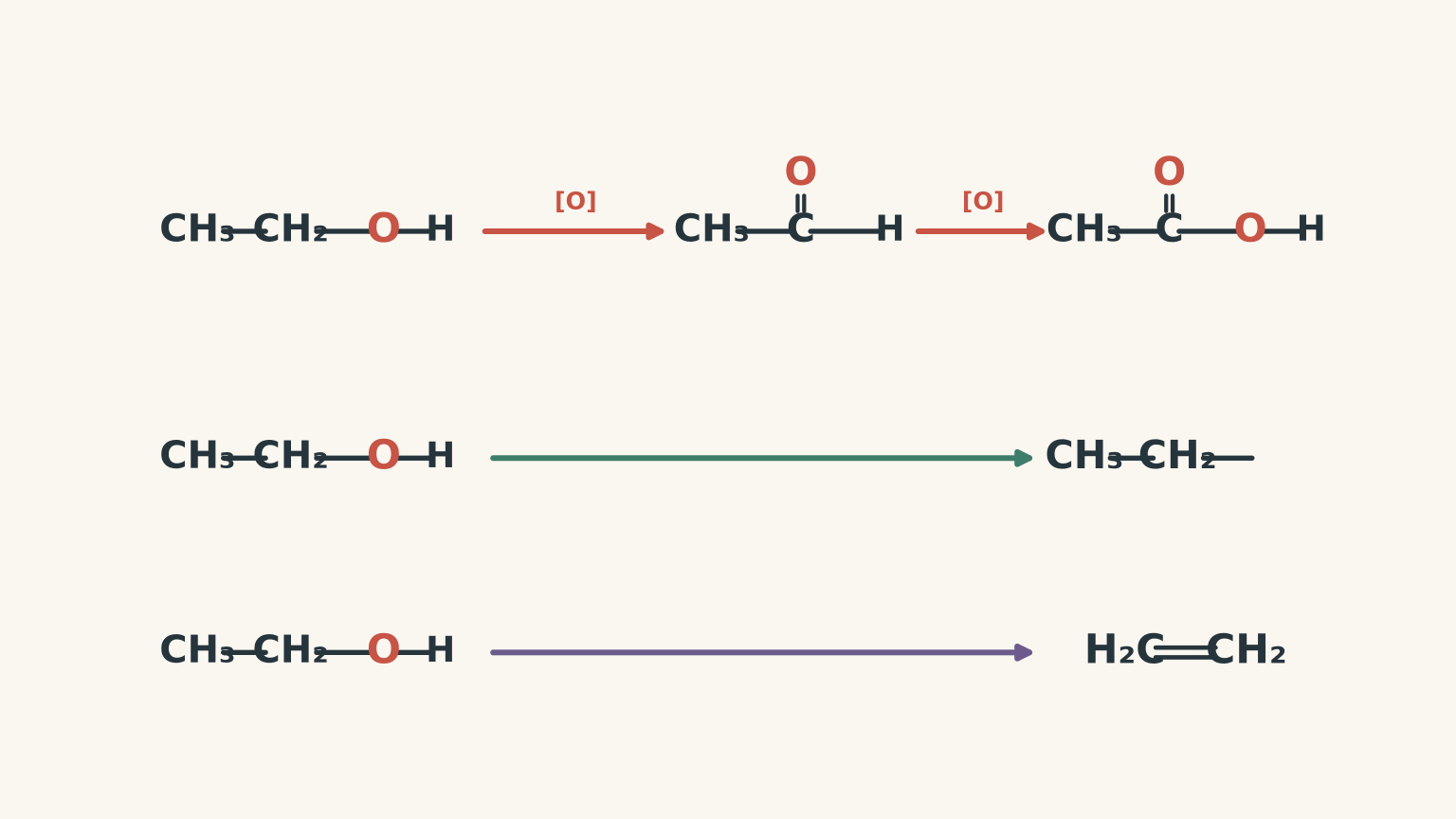
Primary alcohols can undergo oxidation to form aldehydes and then carboxylic acids.
Ethanol follows this sequence:
\[ \ce{CH3CH2OH -> CH3CHO -> CH3COOH} \]
The products are:
- Ethanal, an aldehyde.
- Ethanoic acid, a carboxylic acid.
The oxidising conditions determine which product is obtained.
Controlled oxidation: formation of ethanal
When ethanol is heated with acidified potassium dichromate and the ethanal is distilled off as it forms, further oxidation can be limited.
\[ \ce{CH3CH2OH + [O] -> CH3CHO + H2O} \]
Further oxidation: formation of ethanoic acid
If excess acidified oxidising agent is used and the mixture is heated under reflux, ethanal can undergo further oxidation.
\[ \ce{CH3CHO + [O] -> CH3COOH} \]
The symbol \([O]\) represents oxygen supplied by the oxidising agent. It is a shorthand, not a separate reactant molecule.
Secondary alcohols generally oxidise to ketones, while tertiary alcohols resist oxidation under the usual HSC oxidation conditions because oxidation would require breaking a carbon-carbon bond.
Due to technical limitations, this figure may display incorrectly or contain inaccuracies. Please check key details against your course materials.
Substitution of ethanol
Ethanol can also undergo a substitution reaction.
In substitution, one atom or group is replaced by another.
For example, ethanol can react with concentrated hydrogen bromide when heated to produce bromoethane.
\[ \ce{CH3CH2OH + HBr -> CH3CH2Br + H2O} \]
The hydroxyl group is replaced by a bromine atom.
The organic product is bromoethane, a haloalkane.
Elimination of ethanol
Under different conditions, ethanol can undergo an elimination reaction.
When ethanol is heated with concentrated sulfuric acid at approximately \(170^\circ\text{C}\), it can undergo dehydration to form ethene.
\[ \ce{CH3CH2OH -> CH2=CH2 + H2O} \]
The reaction removes water from the ethanol molecule and produces a carbon-carbon double bond.
The product is ethene, an alkene.
Why do these conditions matter?
Ethanol does not produce the same product under every reaction condition.
| Reaction | Conditions | Organic product |
|---|---|---|
| Oxidation | Acidified dichromate, controlled distillation | Ethanal |
| Further oxidation | Excess acidified dichromate, reflux | Ethanoic acid |
| Substitution | Concentrated HBr, heating | Bromoethane |
| Elimination | Concentrated sulfuric acid, approximately \(170^\circ\text{C}\) | Ethene |
The important distinction is that oxidation, substitution, and elimination are different chemical transformations.
They are not stages of fermentation. They are reactions that ethanol can undergo after it has been produced.
06Questions and solutions
Question 1
A student ferments \(27.0\text{ g}\) of glucose under anaerobic conditions. Assume complete fermentation occurs.
Calculate the theoretical mass of ethanol produced.
Use:
- \(M(\ce{C6H12O6})=180.16\text{ g mol}^{-1}\)
- \(M(\ce{C2H5OH})=46.07\text{ g mol}^{-1}\)
Solution 1
The theoretical mass of ethanol is \(13.8\text{ g}\).
The balanced equation is:
\[ \ce{C6H12O6 -> 2C2H5OH + 2CO2} \]
First, calculate the moles of glucose:
\[ \begin{aligned} n(\text{glucose}) &=\frac{27.0}{180.16}\\ &=0.1499\text{ mol} \end{aligned} \]
The mole ratio of glucose to ethanol is \(1:2\).
\[ \begin{aligned} n(\text{ethanol}) &=2(0.1499)\\ &=0.2997\text{ mol} \end{aligned} \]
Convert this amount into mass:
\[ \begin{aligned} m(\text{ethanol}) &=0.2997\times46.07\\ &=13.8\text{ g} \end{aligned} \]
The theoretical yield is \(13.8\text{ g}\).
The key is to apply the mole ratio before converting into mass. The coefficient of two does not mean the ethanol mass is twice the glucose mass.
Question 2
A fermentation vessel contains \(250.0\text{ mL}\) of glucose solution with a concentration of \(0.800\text{ mol L}^{-1}\).
After fermentation and separation, \(14.0\text{ g}\) of pure ethanol is recovered.
Assuming glucose is the only fermentable substrate, calculate:
a) The theoretical mass of ethanol.
b) The overall isolated percentage yield.
c) One possible reason why the percentage yield is below \(100\%\).
Solution 2
The theoretical yield is \(18.4\text{ g}\), and the overall isolated percentage yield is \(76.0\%\).
Part a: Theoretical yield
First, convert the volume into litres:
\[ 250.0\text{ mL}=0.2500\text{ L} \]
Calculate the moles of glucose using \(n=cV\):
\[ \begin{aligned} n(\text{glucose}) &=0.800\times0.2500\\ &=0.200\text{ mol} \end{aligned} \]
Use the balanced equation to calculate the ethanol amount:
\[ \begin{aligned} n(\text{ethanol}) &=2(0.200)\\ &=0.400\text{ mol} \end{aligned} \]
Convert into mass:
\[ \begin{aligned} m(\text{ethanol}) &=0.400\times46.07\\ &=18.4\text{ g} \end{aligned} \]
Part b: Percentage yield
The actual recovered mass is \(14.0\text{ g}\).
\[ \begin{aligned} \%\text{ yield} &=\frac{14.0}{18.4}\times100\\ &=76.0\% \end{aligned} \]
Part c: Explaining the lower yield
One possible explanation is that some ethanol was lost during distillation or transfer between containers.
Other possibilities include incomplete fermentation or competing metabolic pathways.
The percentage yield tells us how much product was recovered relative to the theoretical maximum. It does not identify the exact cause of the missing product.
Question 3
A fermentation plant collects \(15.0\text{ mL}\) of pure ethanol at \(20^\circ\text{C}\).
The overall isolated percentage yield is \(68.0\%\).
Assuming glucose was the only fermentable substrate, calculate the original mass of glucose required.
Use:
- Ethanol density: \(0.789\text{ g mL}^{-1}\)
- Ethanol molar mass: \(46.07\text{ g mol}^{-1}\)
- Glucose molar mass: \(180.16\text{ g mol}^{-1}\)
Solution 3
The original glucose mass was approximately \(34.0\text{ g}\).
This question works backwards from the recovered ethanol to the original glucose quantity.
Step 1: Convert the ethanol volume into mass.
\[ \begin{aligned} m&=\rho V\\ &=0.789\times15.0\\ &=11.835\text{ g} \end{aligned} \]
The actual ethanol mass is \(11.835\text{ g}\).
Step 2: Calculate the theoretical ethanol mass.
Rearrange the percentage yield equation:
\[ \text{Theoretical yield} =\frac{\text{Actual yield}}{\text{Percentage yield}/100} \]
Substitute:
\[ \begin{aligned} m_{\text{theoretical}} &=\frac{11.835}{0.680}\\ &=17.40\text{ g} \end{aligned} \]
Step 3: Convert theoretical ethanol mass into moles.
\[ \begin{aligned} n(\text{ethanol}) &=\frac{17.40}{46.07}\\ &=0.3778\text{ mol} \end{aligned} \]
Step 4: Work backwards using the mole ratio.
The fermentation equation gives two moles of ethanol for every mole of glucose.
Therefore:
\[ \begin{aligned} n(\text{glucose}) &=\frac{0.3778}{2}\\ &=0.1889\text{ mol} \end{aligned} \]
Step 5: Convert the glucose amount into mass.
\[ \begin{aligned} m(\text{glucose}) &=0.1889\times180.16\\ &=34.0\text{ g} \end{aligned} \]
The original glucose mass was approximately \(34.0\text{ g}\).
The important skill here is reversing the stoichiometric calculation. You must reverse the mole ratio as well as the yield calculation.
Question 4
A chemist divides a sample of ethanol into three portions.
Each portion undergoes a different reaction:
- Sample A is heated with acidified potassium dichromate. The product is distilled off as it forms.
- Sample B is heated under reflux with concentrated hydrogen bromide.
- Sample C is heated with concentrated sulfuric acid at approximately \(170^\circ\text{C}\).
For each sample:
a) Identify the organic product.
b) Classify the reaction as oxidation, substitution, or elimination.
c) Explain why ethanol is classified as a primary alcohol and describe how this classification helps predict its oxidation products.
Solution 4
Sample A produces ethanal by oxidation, Sample B produces bromoethane by substitution, and Sample C produces ethene by elimination.
Ethanol is a primary alcohol because the carbon atom bonded to the hydroxyl group is attached to one other carbon atom.
Part a and b: Identify the products and reactions
Sample A: Oxidation
The product is ethanal.
\[ \ce{CH3CH2OH + [O] -> CH3CHO + H2O} \]
The acidified potassium dichromate oxidises ethanol. Distilling the ethanal as it forms helps prevent further oxidation to ethanoic acid.
Sample B: Substitution
The product is bromoethane.
\[ \ce{CH3CH2OH + HBr -> CH3CH2Br + H2O} \]
The hydroxyl group is replaced by bromine. This is a substitution reaction.
Sample C: Elimination
The product is ethene.
\[ \ce{CH3CH2OH -> CH2=CH2 + H2O} \]
Concentrated sulfuric acid and heating promote dehydration. Water is eliminated, producing a carbon-carbon double bond.
Part c: Alcohol classification
Ethanol has the structure:
\[ \ce{CH3CH2OH} \]
The carbon bonded to the hydroxyl group is attached to only one other carbon.
Therefore, ethanol is a primary alcohol.
This classification predicts its oxidation behaviour:
\[ \text{Primary alcohol} \longrightarrow \text{Aldehyde} \longrightarrow \text{Carboxylic acid} \]
Under controlled oxidation, ethanol produces ethanal. Under further oxidation with excess oxidising agent and reflux, ethanoic acid forms.
The key is to consider both the structure of the alcohol and the reaction conditions. Knowing that ethanol is a primary alcohol does not, by itself, tell you whether the reaction will stop at ethanal or continue to ethanoic acid.
Question 5
A student investigates fermentation using a sealed vessel containing \(18.0\text{ g}\) of glucose and excess yeast at \(30^\circ\text{C}\).
During the experiment, \(0.100\text{ mol}\) of oxygen is accidentally admitted into the vessel and is completely consumed.
The following simplified model applies:
- Each glucose molecule is either completely fermented or completely respired.
- All oxygen is consumed through complete aerobic respiration.
- All glucose is consumed.
- There are no other reaction pathways or losses of glucose to biomass.
- All carbon dioxide produced is collected.
The relevant equations are:
Fermentation:
\[ \ce{C6H12O6 -> 2C2H5OH + 2CO2} \]
Aerobic respiration:
\[ \ce{C6H12O6 + 6O2 -> 6CO2 + 6H2O} \]
The gas syringe records \(6.61\text{ L}\) of carbon dioxide at \(25^\circ\text{C}\) and \(100\text{ kPa}\).
After separation, \(6.90\text{ g}\) of pure ethanol is recovered.
Use a molar gas volume of \(24.8\text{ L mol}^{-1}\).
A student argues:
“Since fermentation produces equal mole amounts of ethanol and carbon dioxide, the \(6.61\text{ L}\) of carbon dioxide proves that approximately \(12.3\text{ g}\) of ethanol formed.”
Evaluate this claim.
Calculate:
a) The amount of glucose that underwent aerobic respiration.
b) The amount and mass of ethanol actually formed.
c) The fraction of the theoretical ethanol amount that formed.
d) The fraction of formed ethanol that was recovered.
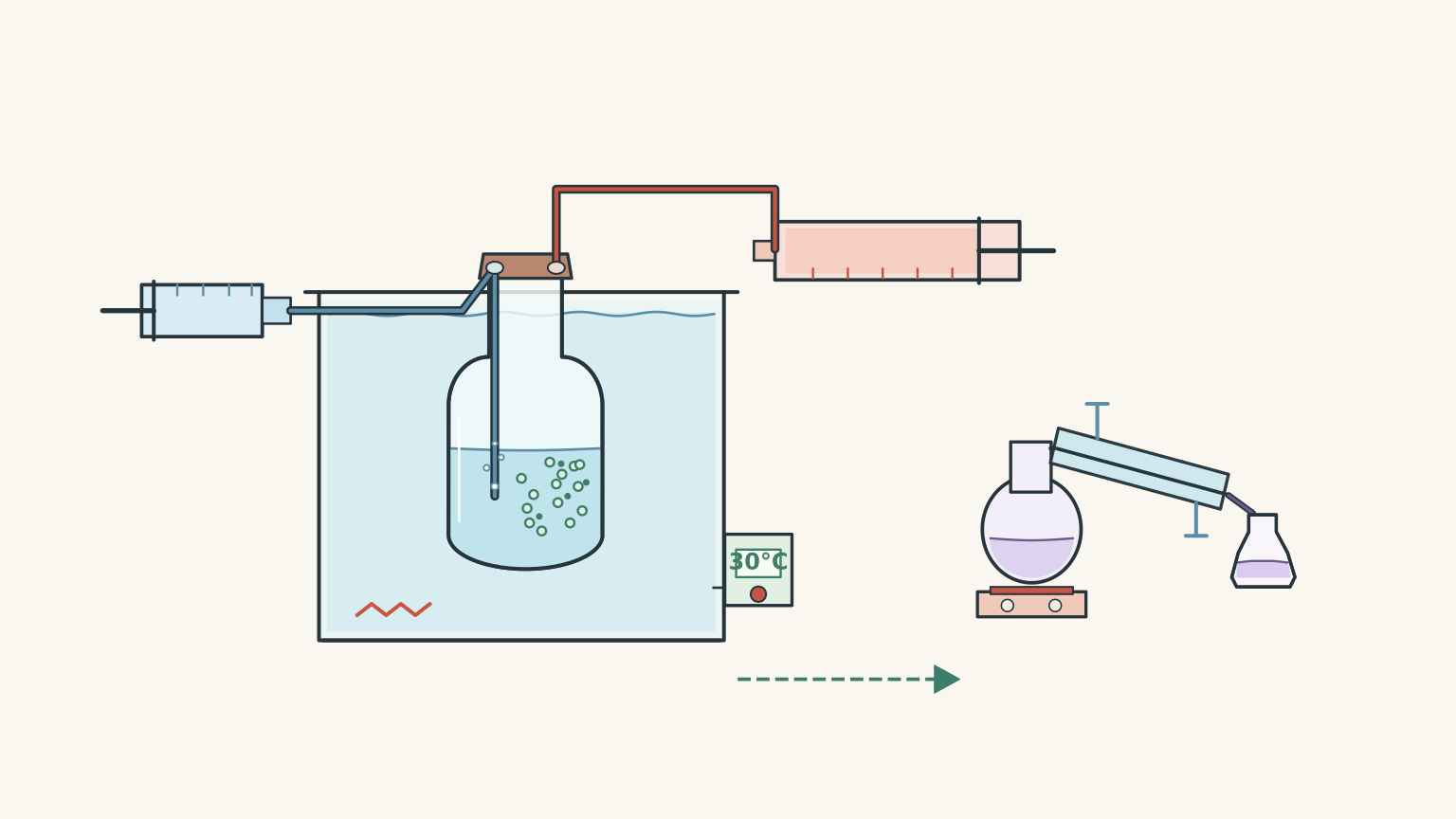
Due to technical limitations, this figure may display incorrectly or contain inaccuracies. Please check key details against your course materials.
Solution 5
The student’s claim is incorrect. The actual ethanol formed is approximately \(7.67\text{ g}\), not \(12.3\text{ g}\).
The problem is that carbon dioxide is being produced by two different reactions.
Fermentation produces both ethanol and carbon dioxide, but aerobic respiration produces carbon dioxide without producing ethanol.
We need to track the glucose through both pathways before calculating the ethanol amount.
Part a: Calculate the glucose consumed by aerobic respiration
Start by calculating the initial glucose amount:
\[ \begin{aligned} n(\text{glucose}) &=\frac{18.0}{180.16}\\ &=0.09991\text{ mol} \end{aligned} \]
The aerobic respiration equation requires six moles of oxygen for every mole of glucose.
Therefore:
\[ \begin{aligned} n(\text{glucose respired}) &=\frac{0.100}{6}\\ &=0.01667\text{ mol} \end{aligned} \]
So, \(0.01667\text{ mol}\) of glucose underwent aerobic respiration.
Part b: Calculate the ethanol actually formed
All glucose is consumed, so the glucose available for fermentation is:
\[ \begin{aligned} n(\text{glucose fermented}) &=0.09991-0.01667\\ &=0.08324\text{ mol} \end{aligned} \]
Now apply the fermentation mole ratio.
\[ \begin{aligned} n(\text{ethanol}) &=2(0.08324)\\ &=0.1665\text{ mol} \end{aligned} \]
Convert into mass:
\[ \begin{aligned} m(\text{ethanol}) &=0.1665\times46.07\\ &=7.67\text{ g} \end{aligned} \]
The actual amount of ethanol formed is approximately \(7.67\text{ g}\).
Why doesn’t the carbon dioxide give the same result?
Let’s calculate the carbon dioxide produced by each pathway.
From fermentation:
\[ n(\ce{CO2})=2(0.08324)=0.1665\text{ mol} \]
From aerobic respiration:
\[ n(\ce{CO2})=6(0.01667)=0.1000\text{ mol} \]
Total carbon dioxide:
\[ \begin{aligned} n(\ce{CO2})_{\text{total}} &=0.1665+0.1000\\ &=0.2665\text{ mol} \end{aligned} \]
Check this against the measured gas volume:
\[ \begin{aligned} V&=nV_m\\ &=0.2665\times24.8\\ &=6.61\text{ L} \end{aligned} \]
This agrees with the experimental measurement.
The gas measurement is correct. The student’s interpretation is not.
The \(0.1000\text{ mol}\) of carbon dioxide from aerobic respiration has no corresponding ethanol.
Part c: Calculate the fraction of theoretical ethanol formed
First, calculate the theoretical ethanol yield if all the original glucose had fermented.
\[ \begin{aligned} n(\text{ethanol})_{\text{theoretical}} &=2(0.09991)\\ &=0.1998\text{ mol} \end{aligned} \]
Convert into mass:
\[ \begin{aligned} m_{\text{theoretical}} &=0.1998\times46.07\\ &=9.21\text{ g} \end{aligned} \]
Now compare the ethanol formed with this theoretical amount:
\[ \begin{aligned} \text{Fraction formed} &=\frac{7.67}{9.21}\times100\\ &=83.3\% \end{aligned} \]
Approximately \(83.3\%\) of the theoretical ethanol amount formed.
Part d: Calculate the fraction of ethanol recovered
The experiment recovered \(6.90\text{ g}\) from the \(7.67\text{ g}\) that formed.
\[ \begin{aligned} \text{Recovery} &=\frac{6.90}{7.67}\times100\\ &=89.9\% \end{aligned} \]
Approximately \(89.9\%\) of the ethanol formed was recovered.
The overall isolated yield, relative to the original theoretical maximum, is:
\[ \begin{aligned} \%\text{ overall yield} &=\frac{6.90}{9.21}\times100\\ &=74.9\% \end{aligned} \]
The three percentages describe different stages of the process:
| Measurement | Result |
|---|---|
| Fraction of theoretical ethanol formed | \(83.3\%\) |
| Fraction of formed ethanol recovered | \(89.9\%\) |
| Overall isolated percentage yield | \(74.9\%\) |
The central lesson is that the \(1:1\) mole ratio between ethanol and carbon dioxide only applies when the carbon dioxide comes exclusively from fermentation.
Once another reaction produces carbon dioxide, that shortcut no longer works.
This is why you must always check the reaction conditions before applying a stoichiometric ratio. A balanced equation describes a particular reaction, not every reaction that might occur in the same vessel.
07What to learn next
Calculating ethanol yield connects three important areas of HSC Chemistry:
- Stoichiometry: using balanced equations and mole ratios to predict product quantities.
- Experimental chemistry: distinguishing theoretical production from the amount actually recovered.
- Organic chemistry: identifying ethanol as a primary alcohol and predicting its oxidation, substitution, and elimination reactions.
If you want to build on the fermentation chemistry, read Fermentation Production of Ethanol: HSC Chemistry Guide.
The next useful step is learning to distinguish incomplete reaction from product loss during separation. That is where stoichiometric calculations become much more than simply substituting numbers into a formula.